
Emotions and Institutions: Complete Chapter-by-Chapter Summary
Welcome to today's session on *Emotion and Institution: Mother-Son Relationships in the Wei-Jin Period* by Zheng Yaru.
This book explores a profound clash: how the organic, deep bonds of maternal love collided with, and ultimately reshaped, the rigid patriarchal laws of early medieval China.
As the title suggests, we are looking at the tension between emotion and institution. The cover art beautifully captures this—against the backdrop of traditional architectural lines representing strict social order, a bold red ribbon flows freely, symbolizing the fluid, powerful force of maternal emotion breaking through those structures.
The story begins with a heartbreaking real-life case from the Eastern Jin Dynasty. A mother named Yu Shi, unable to bear her own children, spent twenty years raising her husband's brother's son, He Lv, treating him as her own. Yet, when the husband had a biological son, the law demanded He Lv be returned to his birth mother. Yu Shi protested, arguing that her years of raising him made him her son, but the patriarchal system prioritized bloodline over nurture, and she lost her son.
This book uses such stories to examine how the natural mother-son bond was woven into a complex network of family rules. It asks a question that still resonates today: how much of our modern view of motherhood is still shaped by these ancient patriarchal shadows? Join me as we dive into how women navigated these constraints.
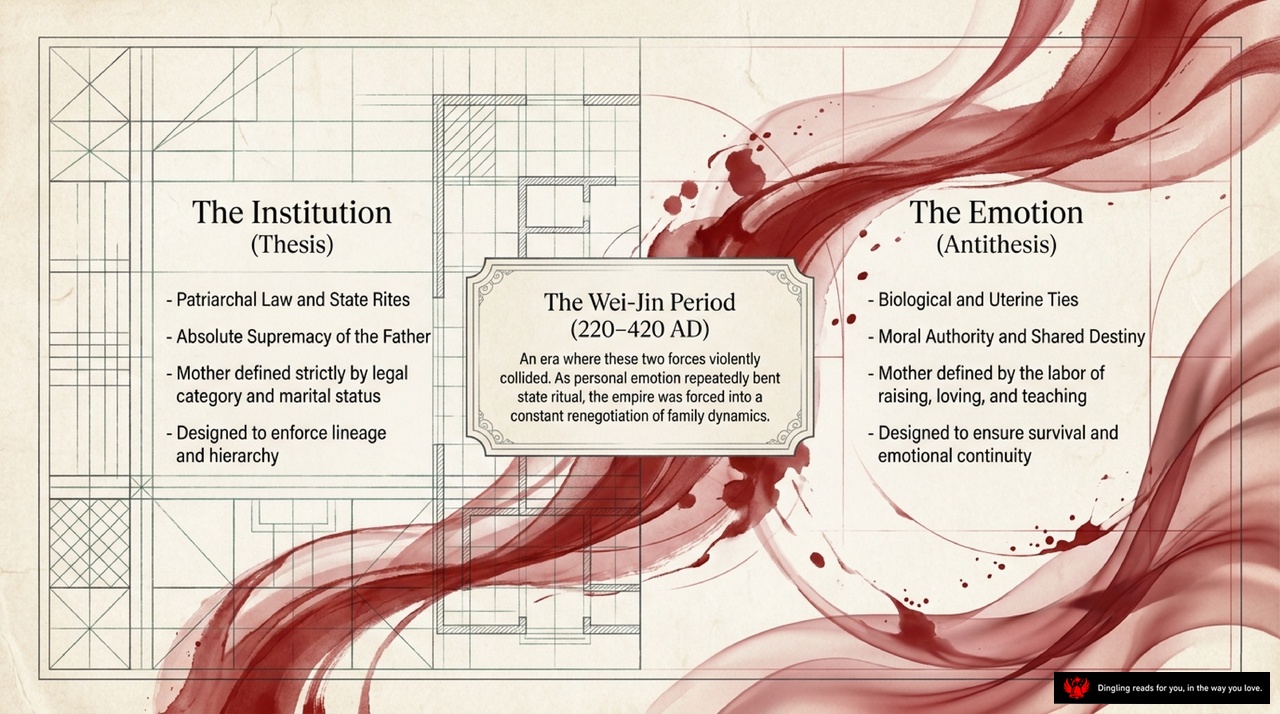
The slide visually contrasts two powerful forces shaping the Wei-Jin period: rigid institutions on the left and raw human emotion on the right. In the center, we see the era itself, from 220 to 420 AD, defined as a violent collision between these two.
On the left, we have "The Institution." This represents the patriarchal law and state rites designed to enforce strict hierarchy. It prioritizes the absolute supremacy of the father and defines a mother strictly by her legal category and marital status. The goal here is lineage and order, suppressing individual feelings to maintain the family structure.
On the right, we have "The Emotion." This is the antithesis. It's rooted in biological and uterine ties, driven by moral authority and a shared destiny. Here, a mother is defined by the labor of raising, loving, and teaching her children, aiming to ensure survival and emotional continuity.
The central text explains that during this era, personal emotion repeatedly bent state ritual, forcing the empire into a constant renegotiation of family dynamics. We see this tension clearly in historical records like the story of Yu Shi. She raised a boy for over twenty years, treating him as her own, only to be told by the patriarchal system that he belonged to his biological mother once a male heir was born. Her personal bond was legally erased by the institution.
This slide captures the core conflict of the Wei-Jin period: the struggle between the cold, unyielding rules of the father's house and the warm, enduring bond of the mother's heart. As we move forward, we will explore how mothers navigated this impossible space, trying to assert their emotional reality against an institution that demanded they disappear.

Look at this pyramid. It's not just a diagram; it's a blueprint of a very specific kind of hierarchy, one that systematically dismantles the mother's power in favor of the father's. This slide illustrates "The Architecture of Grief," specifically how the ancient Chinese *Yili*—the Book of Etiquette and Ceremonial—used the duration and fabric of mourning clothes to politically enforce patriarchal order.
Notice the three tiers. At the top, Tier 1 is the Father or Patriarch. His mourning garment is *Zhan Cui*, made of unhemmed, extremely rough hemp, worn for three years. This signifies absolute supremacy. He is the unchallengeable authority.
Directly below him is Tier 2, the Main Wife or Mother. Her garment is *Qi Cui*, hemmed hemp, worn for only one year. The significance here is clear: she is deliberately downgraded. Her mourning period is cut in half, and her fabric is softer, explicitly out of respect for the father's ultimate authority. The system tells us that a mother's grief is secondary to a father's status.
Finally, at the bottom is Tier 3, the Concubine Mother. She wears *Si Ma*, fine linen, for just three months. Her significance is minimized. Even if a son named after the father as his heir, the law required him to mourn his biological concubine mother as if she were a distant relative.
This visual hierarchy reveals a harsh reality: in this system, the mother's biological significance is systematically erased. Whether she is the primary wife or a concubine, her role is defined entirely by her relationship to the father, not by her own bond with her children. The architecture of grief here isn't about honoring loss; it's about cementing control.
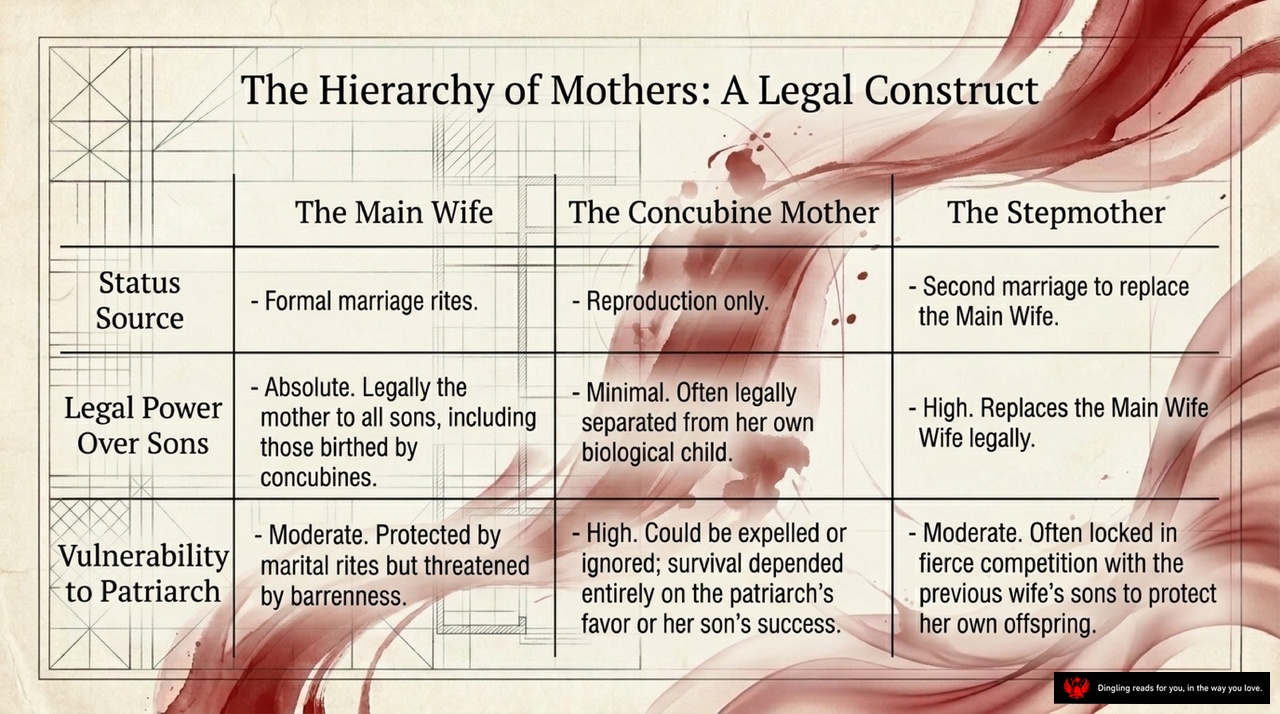
The Hierarchy of Mothers: A Legal Construct. This chart reveals a stark reality of ancient China: a mother's power didn't come from her love, but from her legal title. Let's look at the three roles. The Main Wife held absolute power over all sons, protected by formal marriage rites, though she remained vulnerable if she couldn't bear children. The Concubine Mother, however, had minimal legal power. Even if she gave birth, she was often legally separated from her own son, surviving only on the patriarch's favor. In contrast, the Stepmother had high legal power; by replacing the Main Wife, she could legally claim the sons as her own. Yet, she lived in constant fear of fierce competition with the previous wife's lineage to protect her offspring. This system shows that in a patriarchal family, a woman's status was a fragile construct, defined not by her bond with her children, but by her position within a rigid hierarchy of wives and concubines.
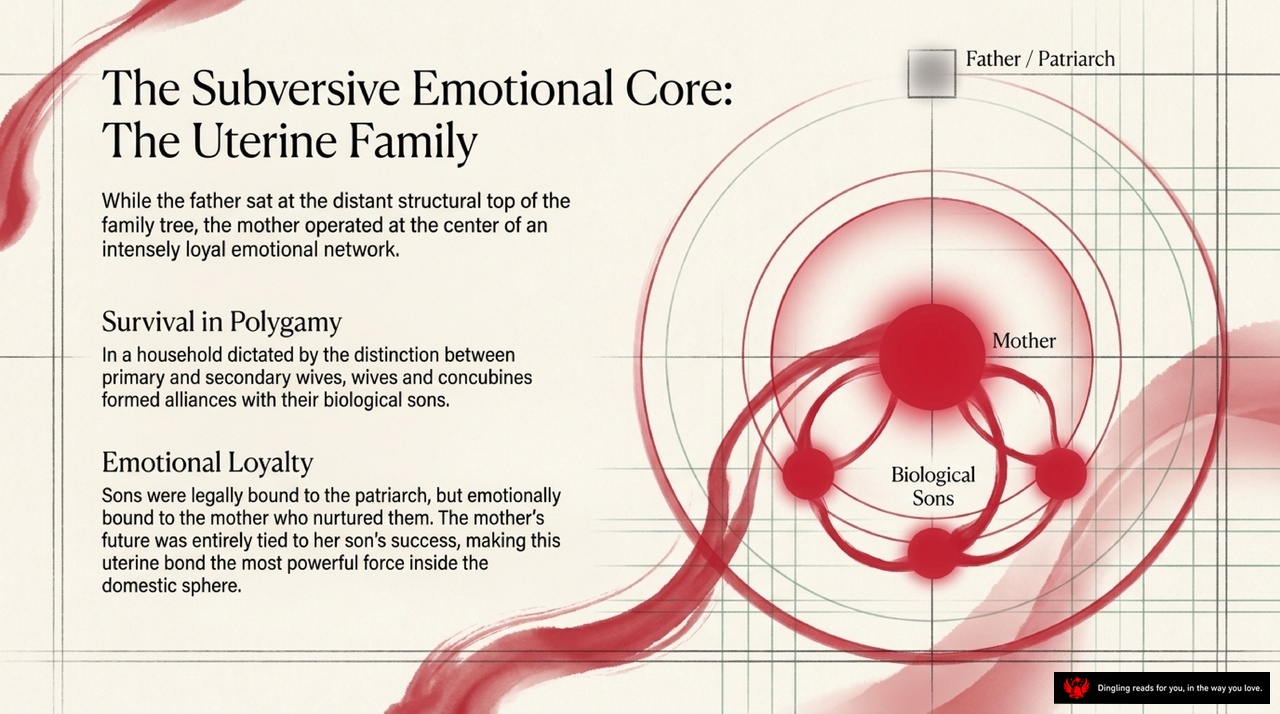
While the father sat at the distant structural top of the family tree, the real emotional power often pulsed right in the center, driven by the mother. This is what we call the "Uterine Family." In a household dictated by the distinction between primary and secondary wives, wives and concubines formed tight alliances with their biological sons to survive. While the patriarch held the legal title, the mother operated within an intensely loyal emotional network, where her future was entirely tied to her son's success.
Sons were legally bound to the patriarch, but emotionally bound to the mother who nurtured them. This uterine bond became the most powerful force inside the domestic sphere, creating a subversive emotional core that constantly challenged the rigid rules of the father's authority. Even when fathers tried to impose their will, the deep connection between mother and child often found a way to protect itself, proving that while the law belonged to the father, the heart often belonged to the mother.
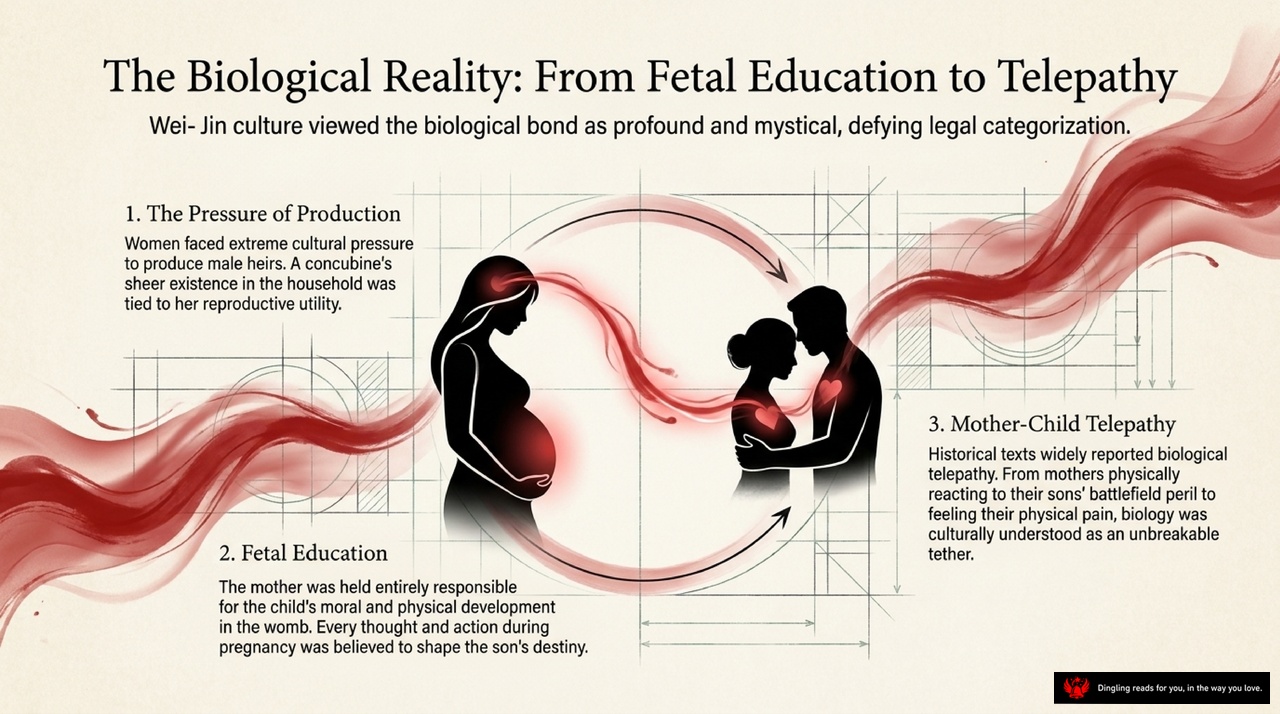
The Biological Reality: From Fetal Education to Telepathy
In ancient China, the bond between mother and child wasn't just emotional—it was seen as a profound, mystical force that defied the rigid rules of law. The Wei and Jin dynasties believed in a biological connection so deep it felt like telepathy. Imagine a mother physically reacting to her son's pain on a distant battlefield, or feeling his fear instantly. History records countless stories of mothers and sons sharing a single nervous system, an unbreakable tether woven into their very DNA.
But this biological reality came with a heavy price. Women lived under immense pressure to produce male heirs. A concubine's entire worth was tied to her reproductive utility; if she failed, her existence in the household was threatened. Even if she succeeded, she wasn't safe. Consider the story of Yu Shi, a wife who couldn't bear children. She was sent back to her parents, only to be asked to raise her husband's brother's son, He Shuai, for twenty years. She breastfed him, raised him, and loved him as her own. Yet, when the husband finally had a biological son, the family demanded He Shuai be returned to his biological mother. Yu Shi's decades of sacrifice were erased by a simple rule of bloodline.
This wasn't just about biology; it was about control. The culture believed the mother held the entire responsibility for the child's destiny while in the womb. Every thought, every action during pregnancy was believed to shape the son's future. This "fetal education" placed an unbearable burden on women, turning their bodies into vessels for shaping the next generation's fate. While men dictated the laws of inheritance and family name, women were the architects of the soul, yet they were never allowed to claim the title of mother in the eyes of the law.
The tragedy of Yu Shi highlights a harsh truth: in a patriarchal system, biology is powerful, but it is not enough. No matter how deeply a mother loves her child, or how strong that biological telepathy feels, the system prioritizes the father's lineage above all else. The mother's love, her sacrifice, and her biological connection were constantly overshadowed by the need to preserve the father's family name. This tension between the deep, intuitive bond of mother and child and the cold, rigid structure of patriarchal law defined the lives of countless women in that era.

The Power of Maternal Teaching reveals a fascinating truth about ancient China: while women were legally confined to the domestic sphere, their sons became their primary vehicle for wielding political and social power. Look at the image here; the red arrow symbolizes this upward trajectory, showing how a mother's influence inside the home could shape the empire from within. This concept of the "Moral Absolute" was unique—historical texts praised mothers who strictly guided their sons' studies and political allegiances, granting them an unquestionable moral authority that transcended their legal limitations. A perfect example is the case of Zhong Hui, the famous statesman of the Wei dynasty. His mother meticulously directed his education from childhood, teaching him classics and instilling deep moral principles. Her strict instruction directly engineered his rise to political dominance, proving that a mother could indeed shape the empire from inside the home. In a patriarchal society where men held all official power, these "powerful mothers" used their sons not just as children, but as extensions of their own will, ensuring that their values and strategies would rule the land long after they were gone.
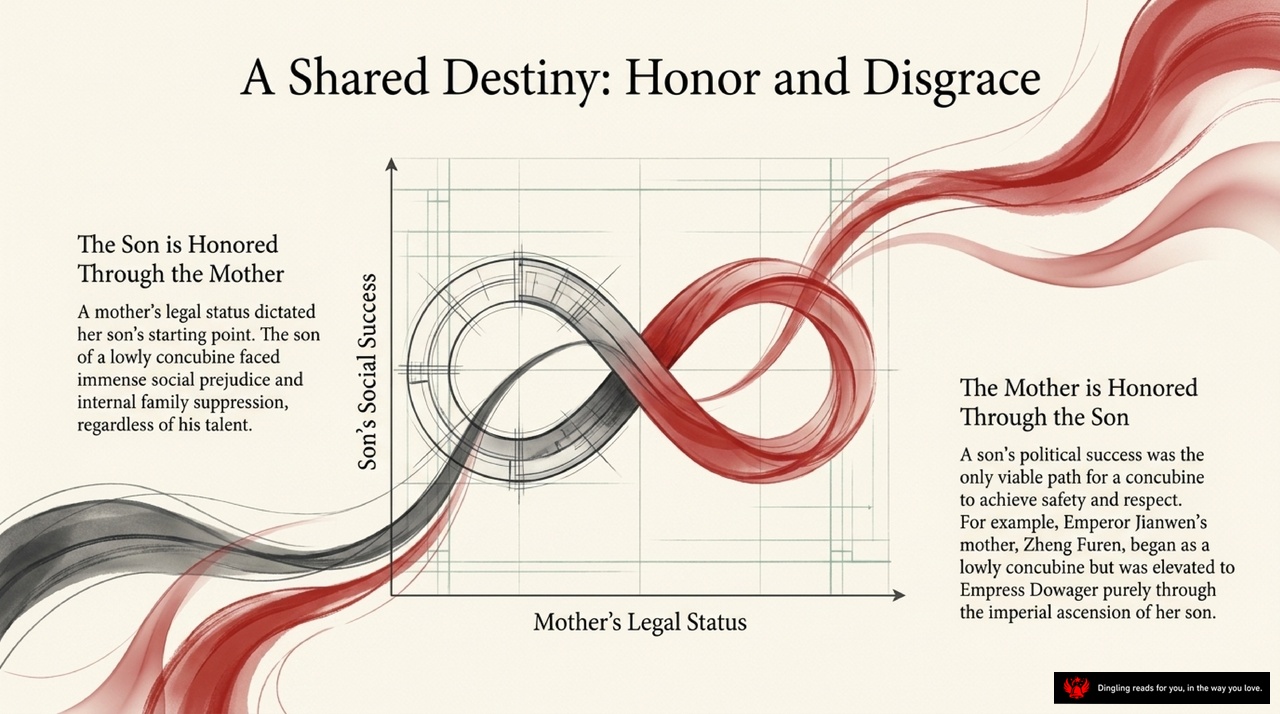
Look at this infinity loop in the center. It perfectly captures the tangled reality of motherhood in ancient China: a cycle where honor and disgrace are inextricably linked.
On the left, we see the harsh truth: "The Son is Honored Through the Mother." A mother's legal status dictated her son's starting point. If she was a lowly concubine, her son faced immense social prejudice and internal family suppression, regardless of his own talent. He was born into a shadow.
But flip to the right, and you see the other side of the coin: "The Mother is Honored Through the Son." In a patriarchal system, a concubine's only path to safety and respect was her son's political success. Take Empress Dowager Zheng Furen, for example. She began as a lowly concubine but was elevated to Empress Dowager purely through the imperial ascension of her son.
This graph illustrates a shared destiny. The mother's rise and fall were directly tied to the son's status. Without a powerful son, a mother remained invisible and vulnerable. With a successful son, she could transcend her lowly origins. This wasn't just about love; it was a survival strategy in a rigid social hierarchy where a mother's value was entirely dependent on her son's achievements.

The Clash Part I: Mourning the Concubine Mother. By the Eastern Jin dynasty, the rigid mourning system began to break under the weight of human emotion.
On the left, we see "The Patriarchal Law." This was the rulebook of the time: if a son was appointed as the patriarch's heir, he was legally forced to downgrade his mourning for his biological concubine mother to a mere three months. The logic was simple but cruel—this rule denied her maternal significance entirely, all to protect the Main Wife's supremacy. It was a system designed to suppress biology in favor of hierarchy.
But look at the red ink flowing across the page to the right. That represents "The Emotional Rebellion." Sons, including imperial heirs like Sima Yu, began outright defying the court. Driven by filial piety and deep biological loyalty, they demanded the right to mourn their concubine mothers with full, heavy three-year periods. They refused to let the law erase their grief.
The image captures a critical turning point. On the left is "Strict Adherence to Law," a cold, rigid structure. On the right is "Emotional Rebellion," a force that cracked the foundation of that structure. The red stream shows how human feeling overwhelmed the grey grid of tradition.
Finally, the Insight at the bottom explains the outcome: The state was forced to repeatedly debate and eventually adapt its rituals to accommodate this undeniable emotional reality. The law didn't win. The sons' feelings did. The state had to bend, proving that even in the most rigid patriarchal systems, the bond between a mother and her son could not be entirely ignored.
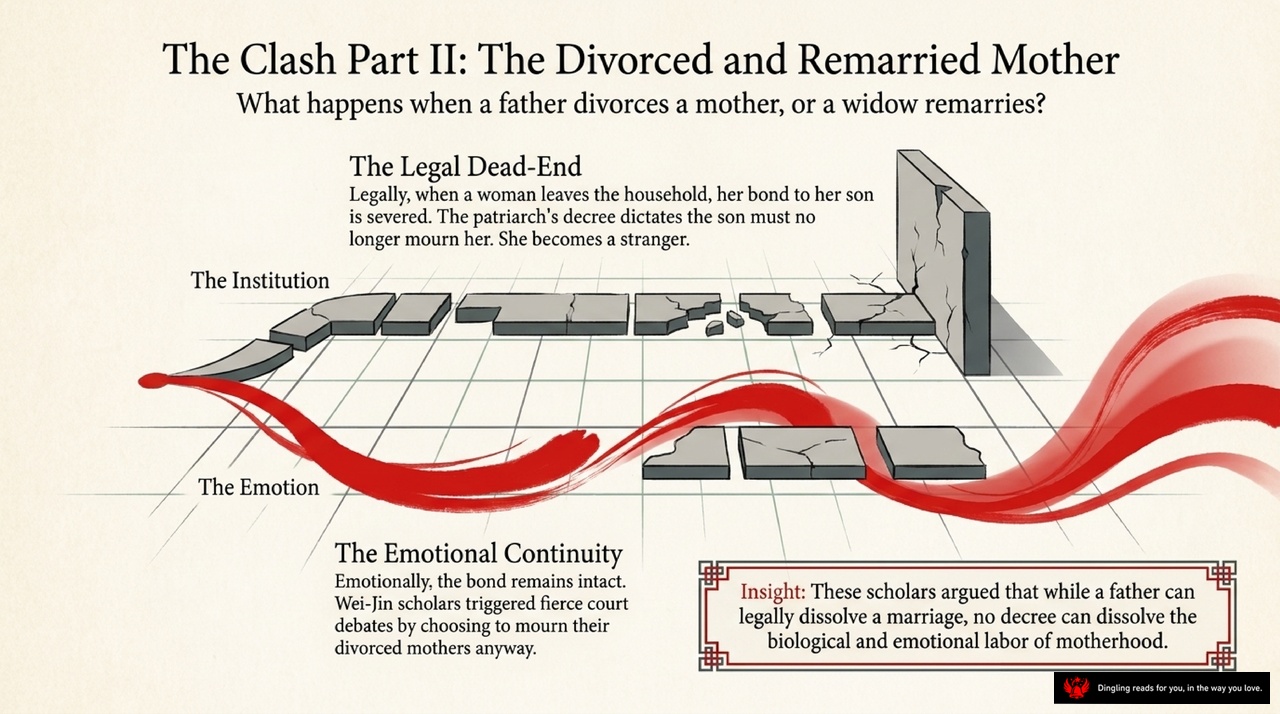
Look at this striking visual: a broken stone path labeled "The Institution" versus a flowing red ribbon representing "The Emotion." This slide captures the central tension of our story: what happens when a father divorces a mother, or a widow remarries?
Legally, the system offers a "Legal Dead-End." The moment a woman leaves the household, the patriarch's decree severs her bond to her son. In the eyes of the law, she becomes a stranger, and the son is told he no longer needs to mourn her. The institution demands that the mother be erased to preserve the father's authority.
But look at that red ribbon. It flows uninterrupted, cutting through the broken stones. This represents "The Emotional Continuity." While the father can legally dissolve a marriage, no decree can dissolve the biological and emotional labor of motherhood. As the scholars noted, Wei-Jin scholars fiercely argued that even if a mother is divorced, the bond remains intact.
We see this in history. Take Yu Shi, a divorced mother who raised a stepson for twenty years. When her son was later sent back to his biological mother, Yu Shi didn't accept it. She stood up to the entire patriarchal system, arguing that her years of nursing and raising her son created a bond far stronger than mere blood. She proved that while the father defines the family name, the mother defines the heart.
This clash between the rigid institution and the enduring emotion is the core of our discussion. It shows that while laws tried to suppress maternal bonds, the reality of love and care often broke through those walls, forcing society to acknowledge that a mother's role is something no decree can truly destroy.
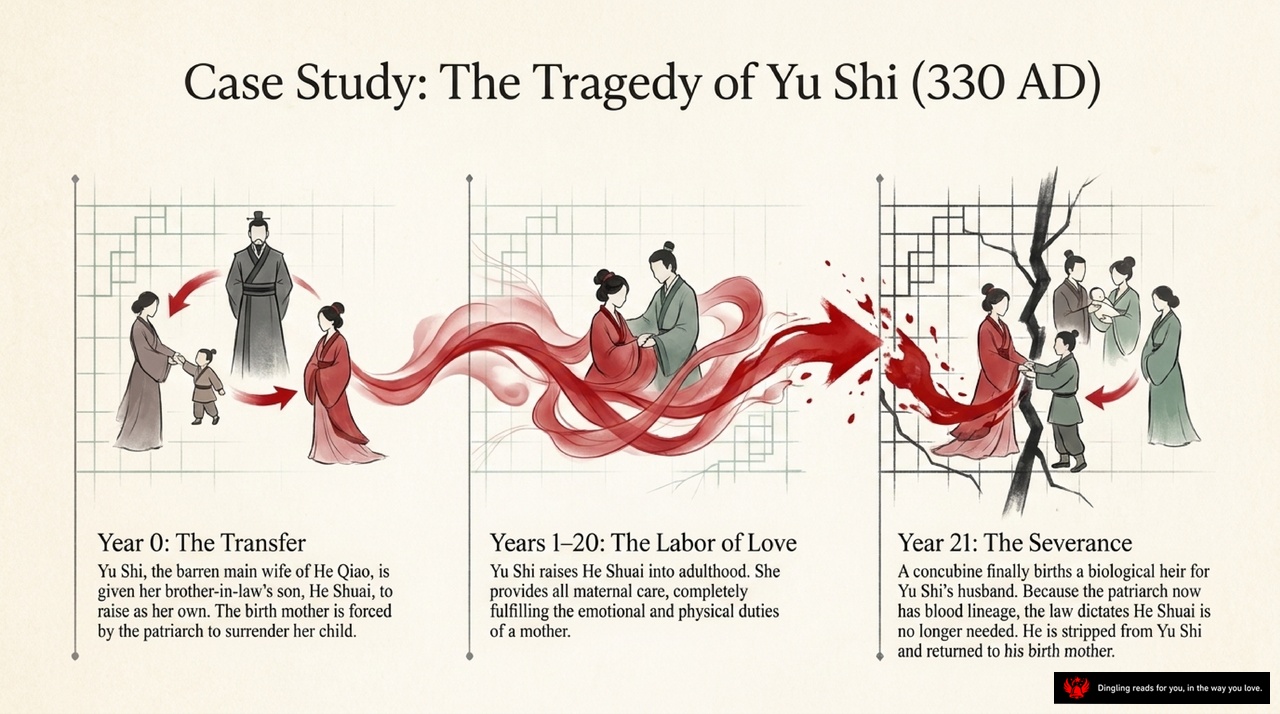
Look at this timeline of Yu Shi's life. It tells a heartbreaking story about how a mother's love was ultimately erased by the rules of the time.
It all begins with "The Transfer." Yu Shi, the barren wife of He Qiao, was forced to give up her own son and raise her husband's brother's child, He Shuai, as her own. She didn't just take him in; she poured her entire soul into him. Over the next twenty years, she was the one who clothed him, fed him, and raised him from infancy to adulthood. She fulfilled every duty of a mother, so completely that when he grew up, he didn't even know she wasn't his biological parent.
But then came "The Severance." When a concubine finally bore a biological son, the patriarchal system demanded that He Shuai be stripped away from Yu Shi and returned to his birth mother. The law dictated that bloodline mattered more than the twenty years of love and care Yu Shi had given.
This case study exposes the brutal reality of the era: no matter how deep a mother's emotional labor was, it could be instantly nullified the moment a biological heir appeared. Yu Shi's tragedy wasn't just personal; it was a systemic failure where the "institution" of motherhood was constantly crushed by the "logic" of the father's family.
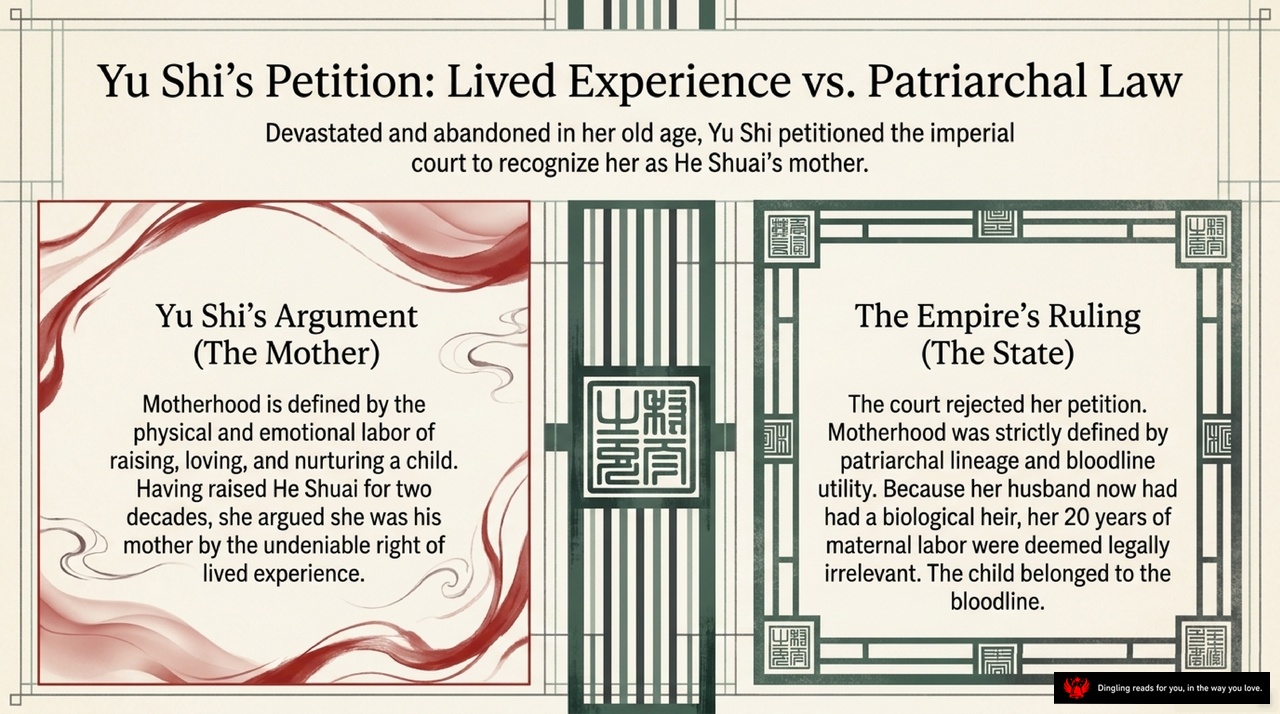
Yu Shi's Petition: Lived Experience vs. Patriarchal Law
In her old age, utterly devastated and abandoned, Yu Shi made a desperate move: she petitioned the imperial court to officially recognize herself as the mother of He Shuai. This wasn't just a legal battle; it was a clash between a woman's lived reality and the rigid laws of the empire.
On one side stood Yu Shi's argument, rooted in the undeniable truth of her life. She defined motherhood not by blood, but by the physical and emotional labor of raising, loving, and nurturing a child. Having cared for He Shuai for two decades—preparing his clothes, breastfeeding him, and guiding his growth—she insisted she was his mother by the sheer right of her lived experience. To her, twenty years of devotion was the only thing that mattered.
On the other side stood the Empire's ruling, representing the cold logic of the state. The court rejected her petition entirely. In their eyes, motherhood was strictly defined by patriarchal lineage and bloodline utility. Because He Shuai now had a biological heir from his father's concubine, Yu Shi's twenty years of maternal labor were deemed legally irrelevant. The law cared only about the bloodline; the child belonged to the father's line, not the mother's.
The tragedy here is that Yu Shi's immense sacrifice was erased by a system that prioritized blood over bond, and the state's definition over a mother's heart.
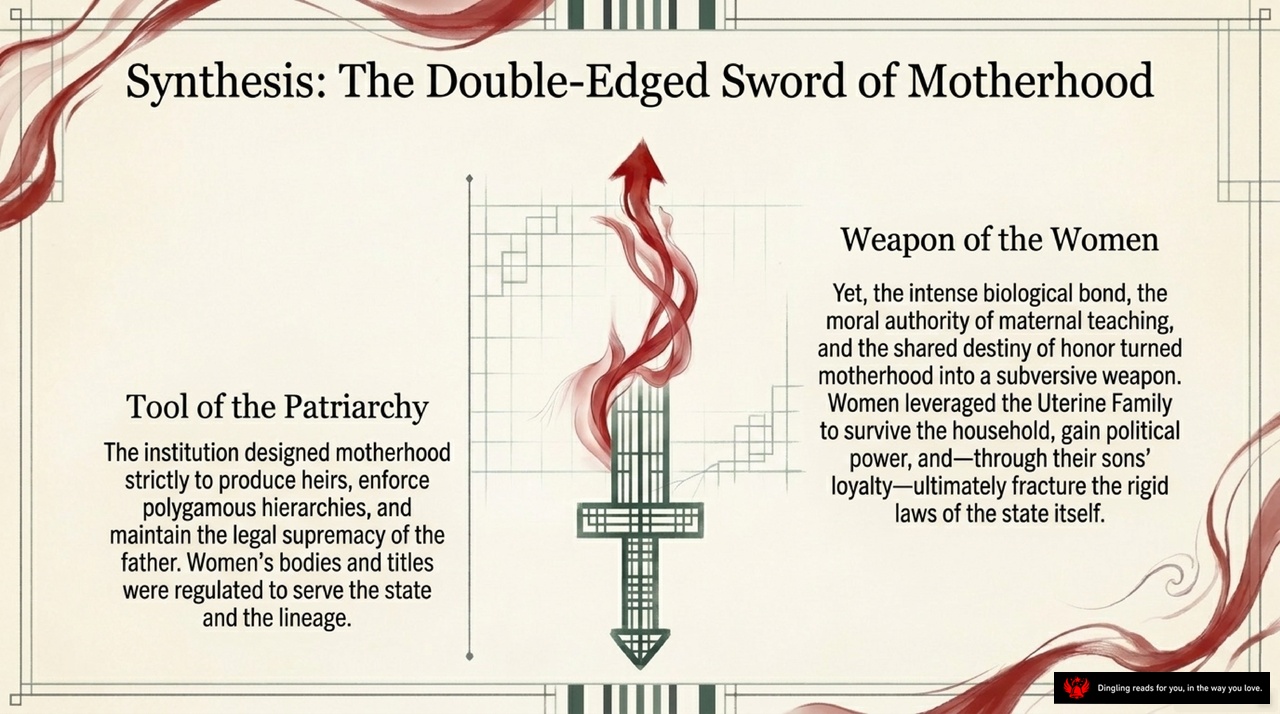
Motherhood in the Wei and Jin Dynasties was never just a biological role; it was a battlefield where rigid patriarchal rules clashed with the raw, unbreakable power of maternal love. On one side, the state designed motherhood as a tool for the patriarchy—a mechanism to produce heirs, enforce polygamous hierarchies, and keep the father's legal supremacy absolute. Women's bodies and titles were strictly regulated to serve the state and the lineage, often reducing mothers to mere vessels for continuing the family line.
Yet, as the image suggests, this same institution became a double-edged sword. While the system tried to suppress them, women leveraged the intense biological bond and the moral authority of maternal teaching to turn motherhood into a subversive weapon. They built what scholars call the "Uterine Family," a hidden sphere where mothers and sons formed an unbreakable alliance. Through this bond, women gained political power and, most importantly, the loyalty of their sons. It was this very loyalty that allowed them to fracture the rigid laws of the state itself. As we saw in the case of Yu Shi, a mother who fought tirelessly to claim her adopted son against the law, the emotional reality of motherhood could sometimes challenge the cold logic of the father's authority. This tension between the tool of the patriarchy and the weapon of the women defines the complex, often painful, yet profoundly resilient story of motherhood in that era.

The image in front of us captures a profound tension that defined the Wei-Jin era: the struggle between rigid patriarchal laws and the undeniable reality of human emotion. As the slide illustrates, while institutions could write the laws and categorize bodies, they simply could not legislate the human heart. We see this visualized by that breaking grid—the rigid structure of the patriarchal family constantly fractured by the deep emotional bond between mother and son. This forced the state to continuously negotiate between strict legal mandates and the undeniable power of love.
The core question posed here is one that still resonates today: if an institution must constantly bend to accommodate the basic reality of human emotion, who truly holds the power? Are we the architects of the law, or are we the mothers who raise them? History shows us that in the Wei-Jin period, the emotional reality of the mother-son bond was so powerful that it often outweighed legal definitions of lineage. Whether it was a wet nurse raising a child or a stepmother showing unexpected kindness, these personal connections challenged the cold logic of the father-centered system. Ultimately, the slide reminds us that while laws try to control us, the heart's capacity for love often finds a way to reshape the very structures meant to contain it.