
Emotions Revealed: Complete Chapter-by-Chapter Summary
Welcome to the world of *Emotions Revealed* by Paul Ekman. Imagine your face not just as a mask, but as a universal language that speaks across every culture and borders. In this book, we unlock the hidden code of human feelings, proving that the expressions on our faces are biologically wired and shared by all of us. From the deep lines of sadness to the subtle twitch of disgust, Ekman guides us through the science behind why we look the way we feel, turning the invisible complexity of the human heart into something we can finally see and understand.
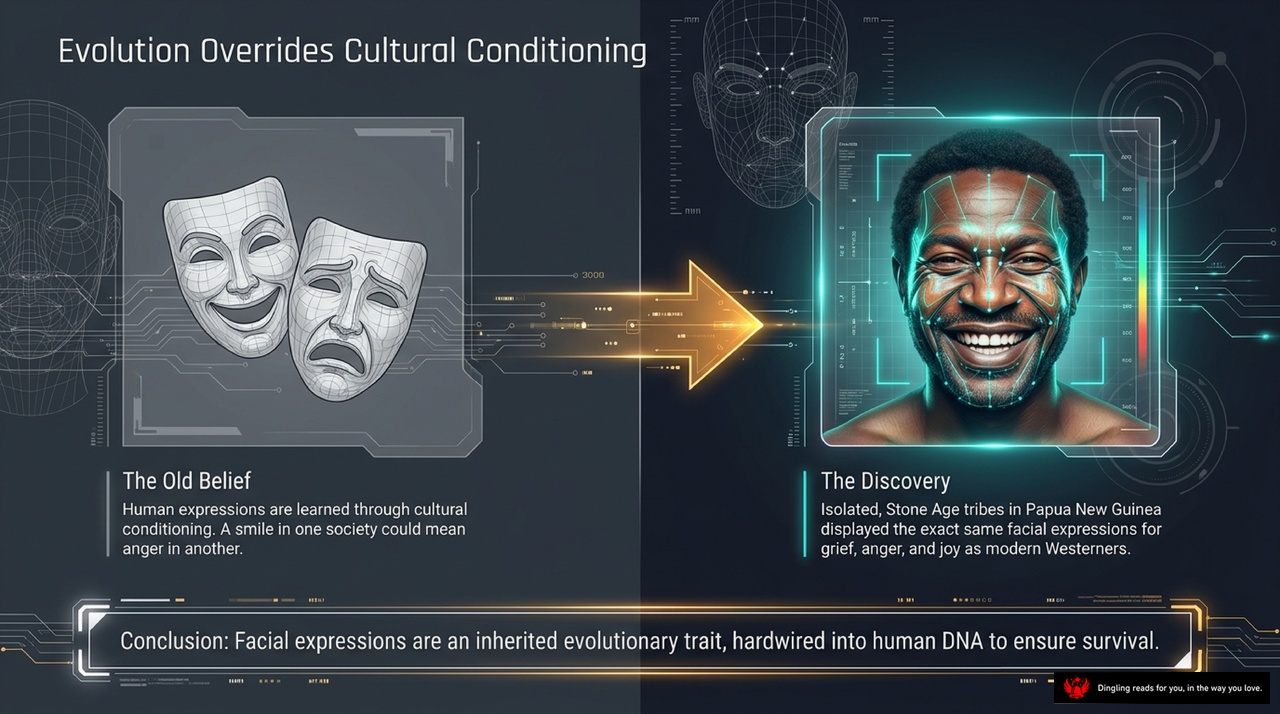
Have you ever wondered if our emotions are written in our DNA or if they're just something we learn from the people around us? For decades, the prevailing belief was that facial expressions are purely cultural. Think of it like a mask: we thought that a smile in one society might mean anger in another, and that our emotions were entirely conditioned by our environment.
But the story takes a dramatic turn with a groundbreaking discovery. Scientists traveled to isolated Stone Age tribes in Papua New Guinea—communities that had never seen a Western movie, heard a foreign language, or been influenced by modern culture. When they observed these people, something astonishing happened: their faces told the exact same stories as ours. Whether they were expressing grief, rage, or joy, their facial expressions were identical to those of modern Westerners.
This wasn't a coincidence; it was proof that evolution overrides cultural conditioning. Our ability to read and show emotions isn't a learned skill; it's a hardwired evolutionary trait embedded in our DNA. It's a survival mechanism that has allowed humans to communicate and understand one another across the vast expanse of history and geography. While we do learn rules about *when* and *where* to show our feelings, the core signals of our emotions are universal, ancient, and biological.

Look at this flow: Scan, Match, Ignite. This is how your brain's auto-appraisal engine operates in mere milliseconds. It's a high-speed biological system that never sleeps.
First, we have the **Scan** phase. Your brain unconsciously and continuously monitors your environment for threats or rewards, all without you even thinking about it. It's like a background process running 24/7.
Next comes the **Match**. In a split second, your system compares that sensory input against an internal Emotion Alert Database. It's checking if what you see aligns with past experiences or evolutionary triggers.
Finally, we reach **Ignite**. Here, the brain bypasses conscious thought entirely. It triggers an immediate physiological and facial response. You might feel a spike in heart rate or see your face change before you've even realized what you're feeling.
This entire cycle happens in milliseconds, proving that our emotional reactions are often automatic, hardwired, and far faster than our ability to reason.

When we look at the face of someone in deep grief, like Betty Shirley mourning her son, we often feel our own hearts tighten. That physical reaction—heavy eyelids, aching throat, rising cheeks—is the body's direct signal of sadness. But what if you can't feel it yet? You can try mimicking the expression: dropping your jaw, raising your cheeks, and furrowing your brows. Studies show that forcing this face actually triggers the real emotion inside your brain, proving that the expression and the feeling are deeply linked.
However, reading sadness isn't just about feeling it; it's about spotting the subtle clues. Look closely at the eyes: the eyebrows often raise and draw together, creating a distinct triangle shape near the upper eyelids that is nearly impossible to fake. Notice the mouth too; lips may spread horizontally, tremble, or open wide. Even if someone tries to hold back tears, a young woman standing behind Betty might show this by keeping her lips tightly shut. In other cases, raised cheeks combined with a downturned mouth might look like a smile, but the context tells the truth. These micro-signals—like the "horse-shoe" lines on a forehead in New Guinea—are universal. When you see them, remember that the person is signaling, "I need support." Your response should be gentle and respectful, offering understanding without forcing them to talk if they aren't ready.

When we feel sadness, our bodies betray us before we even realize it. Think about the last time you lost something precious. Suddenly, your eyelids feel heavy, your jaw tightens, and a lump forms in your throat. That physical sensation is the true signal of grief.
But what if you're watching someone else cry? You don't have to wait for them to break down. Look closely at their face. True sadness creates a distinct pattern: the eyebrows pull together and lift toward the forehead, creating a triangle shape above the eyes. At the same time, the cheeks rise, and the lips may tremble or flatten out. Even if someone tries to hide it, this combination of a raised brow and lifting cheeks is almost impossible to fake.
This isn't just about looking sad; it's about reading the raw, biological truth of pain. Whether it's a friend grieving a loss or a colleague dealing with bad news, these subtle cues tell you exactly what they are feeling. Recognizing them allows you to respond with empathy rather than misunderstanding. So next time you see someone's face, look past the words and check the eyebrows and cheeks—that's where the real story is written.

When we look at someone grieving, our own hearts often tighten in sympathy. But how do we actually know when someone is sad? Is it just the tears? Not quite. True sadness has a very specific, biological signature that is incredibly difficult to fake.
Look closely at the eyebrows. When someone is truly sad, the inner corners of their eyebrows rise and draw together. This creates a distinct V-shape in the forehead. This muscle movement is the most reliable sign of genuine sadness and is nearly impossible to fake voluntarily. Even if someone tries to hide their pain, this specific brow movement will usually slip through.
Now, look at the lower face. In sadness, the cheeks tend to lift upward. At the same time, the corners of the lips are pulled downward. In moments of extreme anguish, those lips might even stretch tightly horizontally, creating a look of deep distress.
So, the next time you see someone who looks upset, don't just guess. Check the brow and the mouth. If the inner eyebrows are raised and drawn together while the cheeks lift and the lips drop, you are likely looking at authentic sadness. These are the universal signals of human pain, written in our faces since the beginning of time.
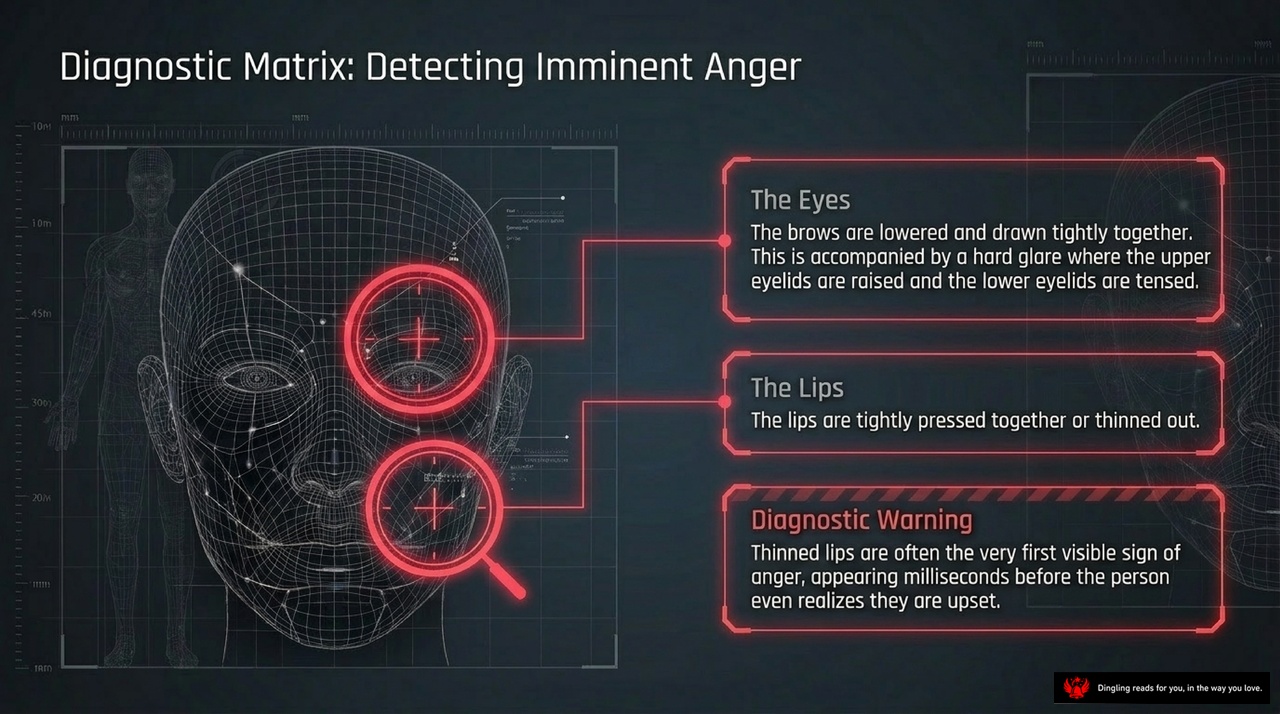
Imagine a high-tech diagnostic screen scanning a human face, locking onto specific zones with red targeting circles. This isn't science fiction; it's the real-world "Diagnostic Matrix" for spotting imminent anger. Look closely at the eyes: when brows lower and draw tight together, accompanied by a hard glare where the upper lids rise and lower ones tense, you're seeing the early warning system kick in. Now, shift your focus to the lips. If they press tightly together or thin out, that's a critical signal. Here is the crucial insight from our research: those thinned lips are often the very first visible sign of anger, appearing in mere milliseconds before the person even realizes they are upset. While we might try to control our expressions, these subtle shifts in the eyes and mouth reveal the truth, giving us a split second to pause, understand, and choose a better response before the full storm of anger breaks loose.
Here is the spoken script for Slide 7, tailored for an American audience with a natural, engaging tone.
**Slide 7 Script:**
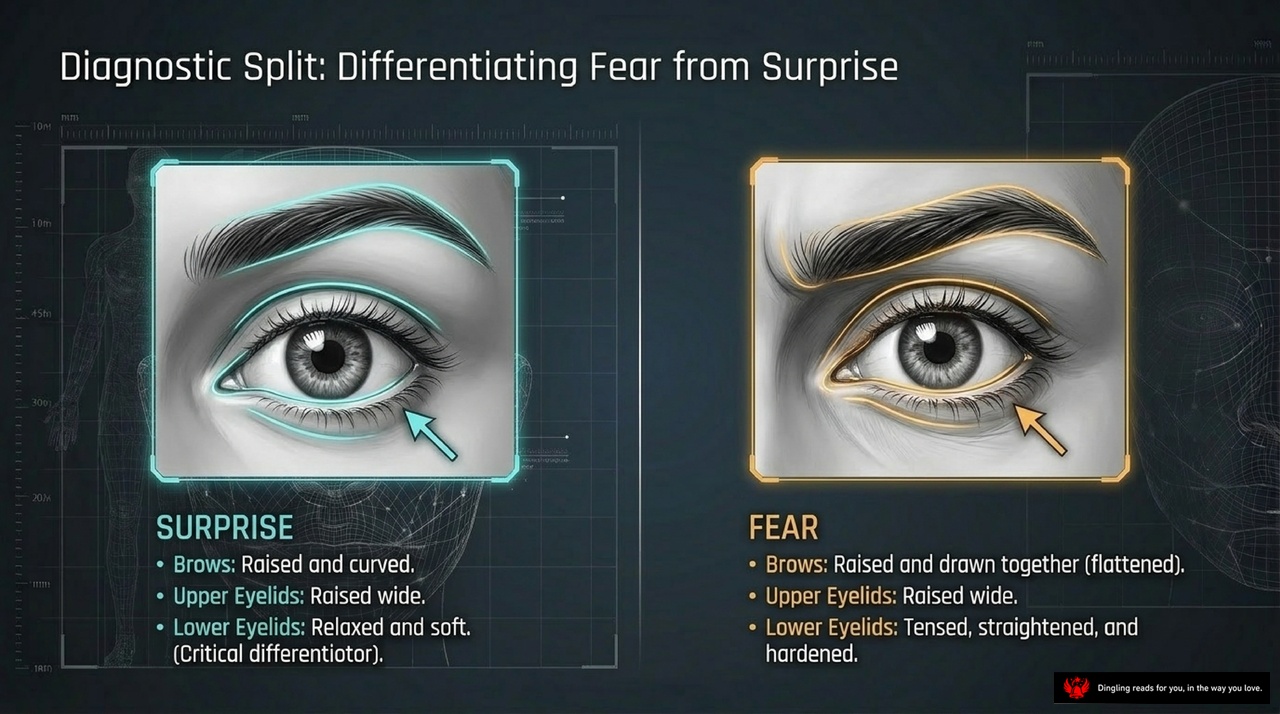
"Let's look closely at the difference between surprise and fear. While both involve wide eyes and raised eyebrows, the subtle mechanics tell a completely different story. In the left panel, labeled 'Surprise,' notice how the eyebrows are raised and curved upward, creating an open, welcoming look. The lower eyelids are relaxed and soft. This is the body's automatic reaction to something unexpected—a sudden noise or a dropped object. It's pure, unfiltered shock.
Now, look at the right panel, labeled 'Fear.' Here, the eyebrows are still raised, but they are drawn together and flattened, creating a distinct furrow between them. The critical difference lies in the lower eyelids. Instead of being relaxed, they are tensed, straightened, and hardened. This creates a protective barrier around the eye.
Why does this matter? Because these micro-movements are the biological signature of your brain's response. A curved eyebrow signals, 'What is this new thing?' while a flattened, furrowed brow signals, 'Danger is here, I need to defend myself.' Understanding this split allows you to instantly distinguish between harmless surprise and genuine threat, giving you a crucial edge in reading people accurately.
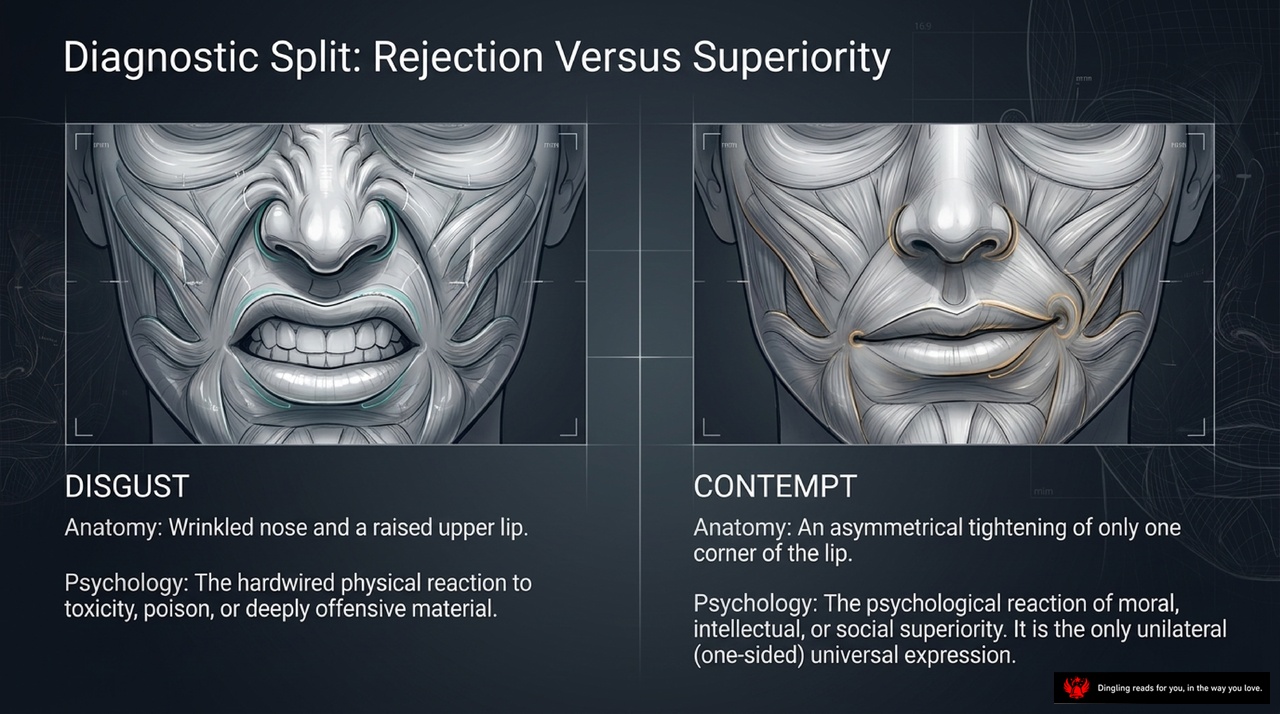
Look at this split screen. On the left, we see a face contorted with disgust: the nose is wrinkled, and the upper lip is raised. This isn't just a random grimace; it's our brain's hardwired alarm system. Evolution gave us this reaction to instantly spot toxicity, poison, or anything deeply offensive. It's a survival mechanism that screams, "Stay away from this."
Now, shift your gaze to the right. Notice how different this expression is. Here, only one corner of the lip tightens, creating an asymmetrical smirk. This is contempt. While disgust pushes us away from things, contempt is about looking down on people. It signals a sense of moral, intellectual, or social superiority. In fact, psychologists note that this is the only truly one-sided expression in the human face. You can't fake it equally on both sides.
So, what's the diagnostic split here? It's the difference between fearing something is bad for us versus believing someone is worse than us. Understanding these subtle muscle movements allows us to decode the true intent behind a smile or a frown, revealing whether someone is reacting to a threat or simply judging our worth.

The Anatomy of Joy: Spotting the Duchenne Smile. Have you ever wondered how to tell if someone is truly happy or just being polite? The answer lies not just in the corners of their mouth, but in the muscles around their eyes.
On the left, you see the Polite Smile. This relies solely on the Zygomatic major muscle, which pulls the lip corners up. Because this muscle is under conscious control, it's easily faked for social politeness. It's the smile you give a cashier or a stranger you don't really know.
Now, look at the right side under the magnifying glass. This is the Duchenne Smile, a genuine smile. A true smile involuntarily engages the Orbicularis oculi, the muscle surrounding the eye. It pulls the brows down slightly, raises the cheeks, and creates those familiar crow's feet. This muscle is involuntary; you can't just turn it on when you want.
Here is the critical data point: Only roughly 10% of humanity can consciously fake the movement of the Orbicularis oculi muscle. So, if you see a smile that lifts the cheeks but leaves the eyes perfectly still, be cautious. If you see that genuine crinkling around the eyes, you are witnessing real joy.
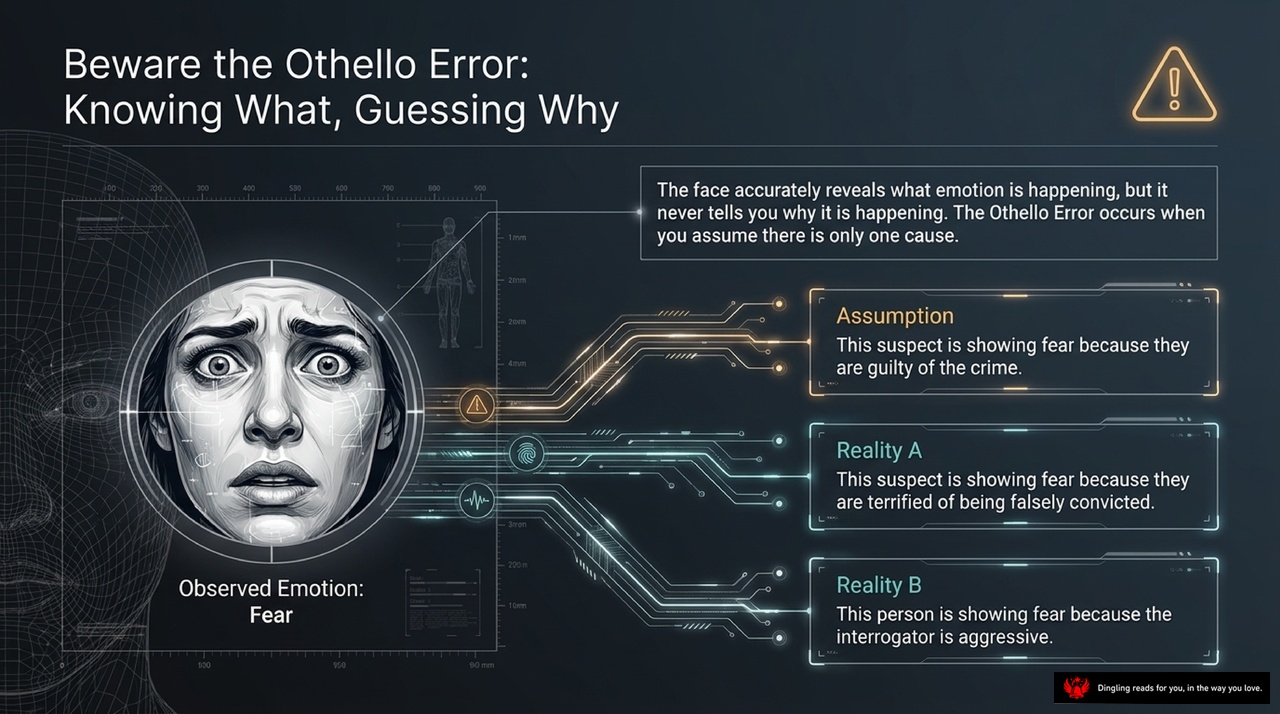
Now, let's talk about the Othello Error. It happens when we see an emotion but guess the wrong reason behind it. Look at the image: we clearly see fear in the suspect's face, but assuming that fear means guilt is a trap. Fear doesn't always mean you're guilty; it could mean you're terrified of being falsely accused, or maybe you're just reacting to an aggressive interrogator. The face tells us *what* emotion is happening, but it never reveals *why*. To avoid this mistake, always consider multiple possibilities instead of jumping to a single conclusion. Don't let a quick assumption blind you to the real story.
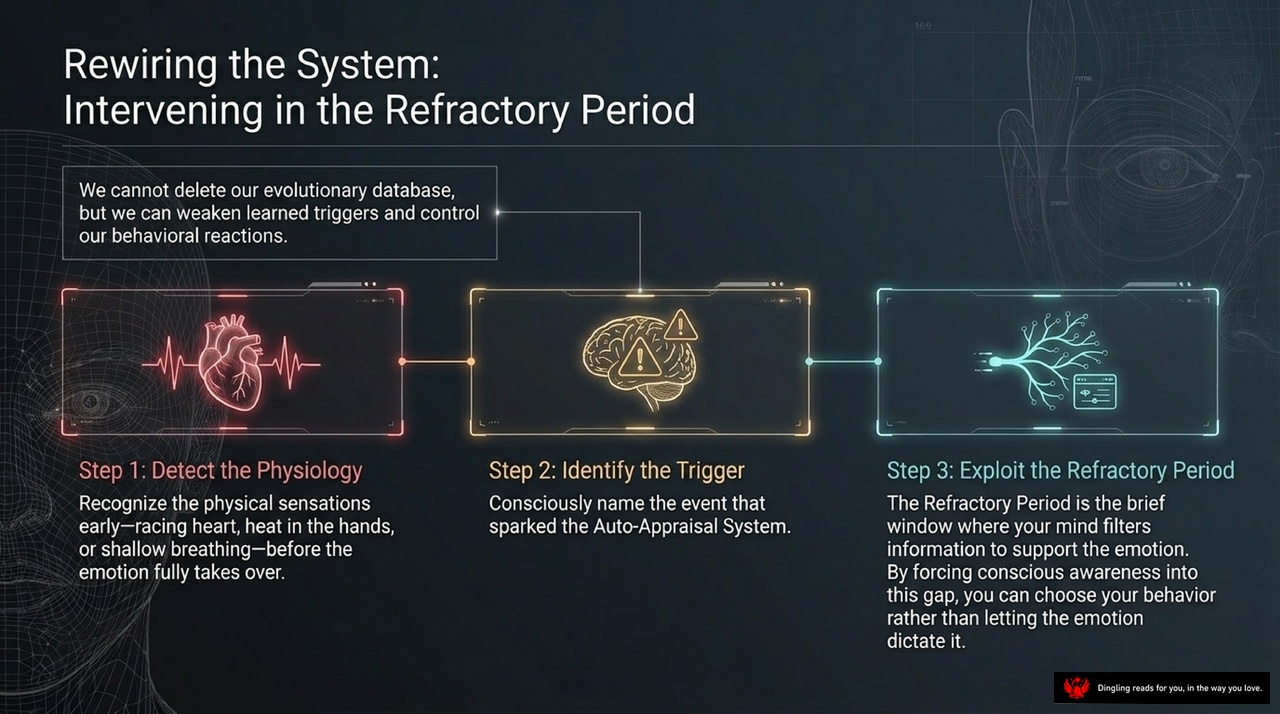
We cannot delete our evolutionary database, but we can weaken learned triggers and control our behavioral reactions. Think of your brain as a high-speed processor with a built-in lag time—the refractory period. This brief window is where your mind filters information to support your emotions, but it's also the golden opportunity to take the wheel.
When you feel that surge of adrenaline, notice the physical sensations first: a racing heart, heat in your hands, or shallow breathing. Recognize these early signals before the emotion fully takes over. Next, consciously name the specific event that sparked your Auto-Appraisal System. Don't just feel the anger; identify the trigger. By forcing conscious awareness into this gap, you stop letting the emotion dictate your behavior and start choosing your response. This is how you rewire the system and regain control.
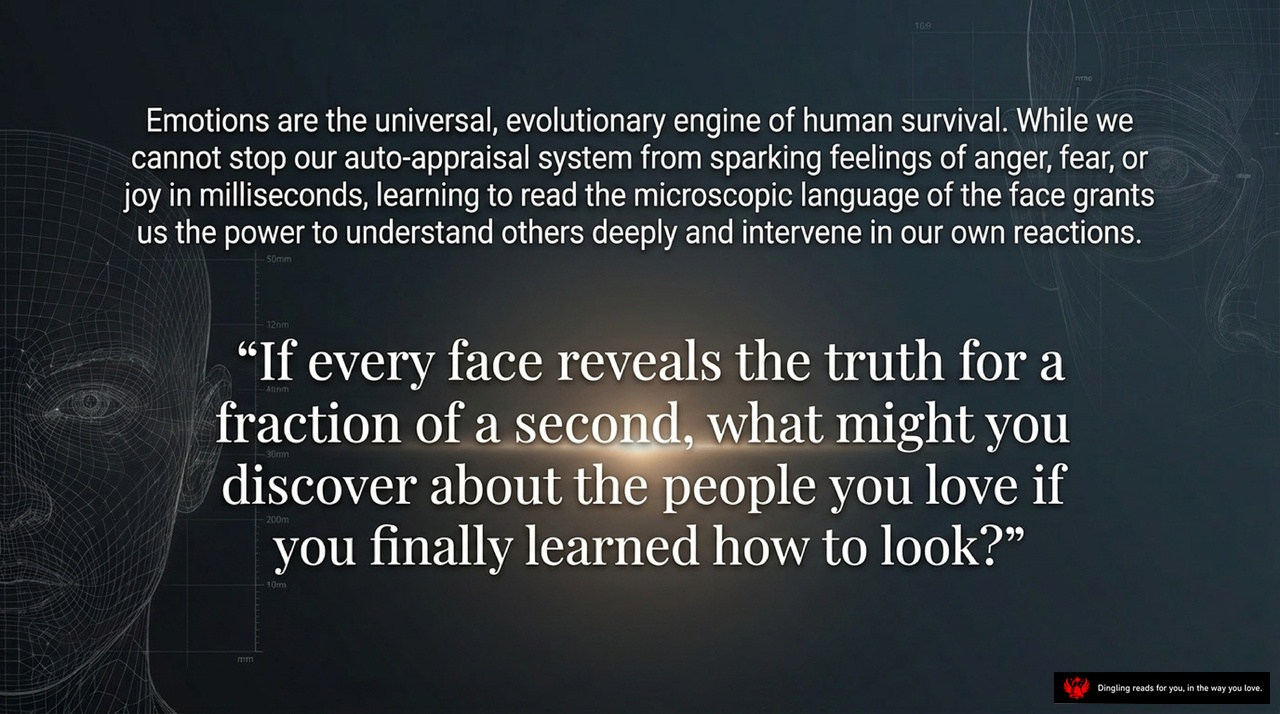
Emotions are the universal, evolutionary engine of human survival. While we cannot stop our auto-appraisal system from sparking feelings of anger, fear, or joy in milliseconds, learning to read the microscopic language of the face grants us the power to understand others deeply and intervene in our own reactions.
"If every face reveals the truth for a fraction of a second, what might you discover about the people you love if you finally learned how to look?"
Think about it: those fleeting micro-expressions, lasting less than a fifth of a second, are often the only honest signals we give. They bypass our conscious filters and reveal what we are truly feeling, even when we think we are hiding it. Whether it's a subtle downturn of the eyelids signaling sadness, a tightened lip indicating suppressed anger, or a specific muscle movement around the eyes that confirms a genuine smile, these tiny cues are everywhere.
The question isn't whether these signals exist—they absolutely do. The question is whether you are paying attention. In a world full of noise and distractions, the ability to decode these rapid, often invisible flashes of emotion is the ultimate superpower. It transforms how you connect with your partner, your colleagues, and even yourself. So, the next time you look at someone, don't just see their face. See the story it's telling in that split second. What are you missing right now?