
Empire of Cotton: Complete Chapter-by-Chapter Summary

Welcome to the Empire of Cotton. Today, we dive into the epic story of how a single plant wove the fabric of modern global capitalism. This isn't just about a white flower; it's about the forces that shaped our world.
Look at the map behind us. Five hundred years ago, cotton was already a global powerhouse. From the villages of Mexico to the ancient markets of India and Peru, this plant thrived independently across three continents long before Europe arrived. For centuries, it was a family affair—women spinning thread while weaving cloth at home, creating a world where cotton was as valuable as money itself.
But then, the game changed forever. The image of that fluffy cotton boll represents a shift from a peaceful, multi-centered world to one driven by violence and profit. As the text tells us, Europe had no place in this early empire. It was Asia that ruled. But through a system we call "war capitalism," Europe used military power, slavery, and colonial expansion to rewrite the rules. They built a global network where the motherland held the law, while colonies were ruled by force.
This brutal transformation turned cotton into the engine of the modern world. What started as a humble crop became the foundation for the Industrial Revolution, reshaping economies and societies across the globe. We are about to explore how one plant pulled the strings of history, connecting the fate of millions to the rise of a new global order.
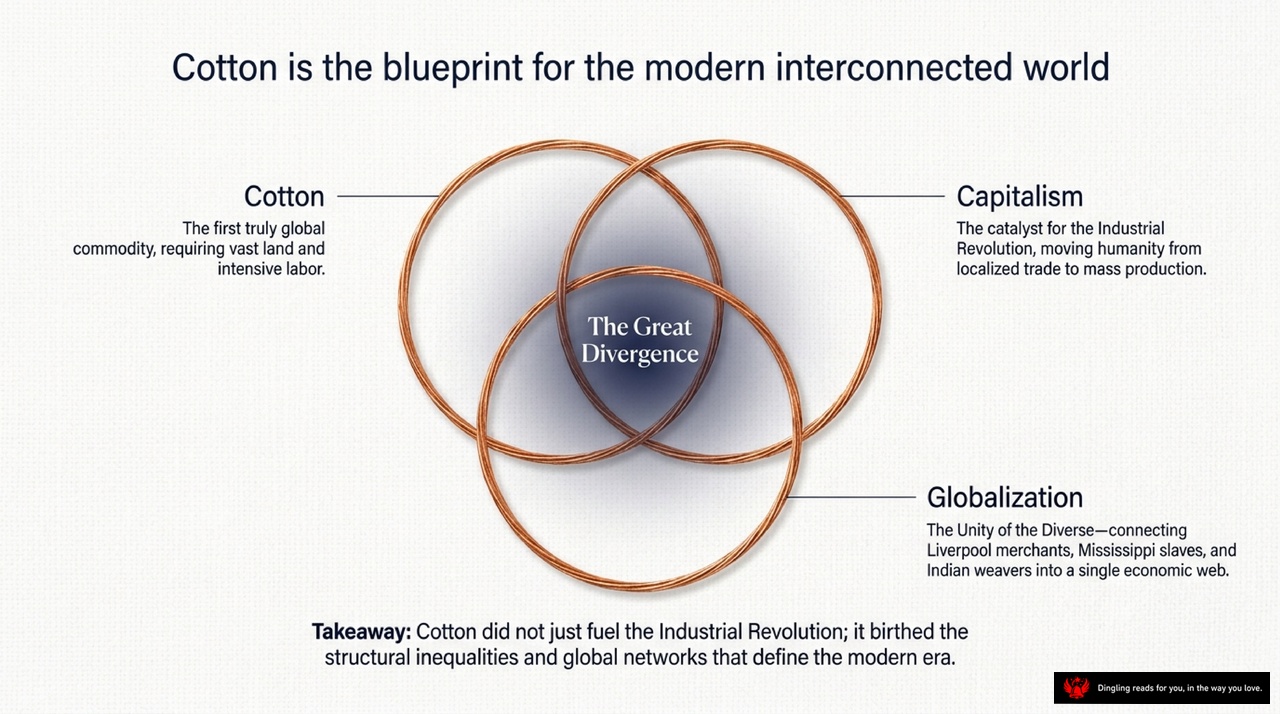
Cotton is the blueprint for the modern interconnected world. This single crop didn't just feed our clothes; it built the very engine of our global economy. Look at the center of this diagram: "The Great Divergence." This is where the story of cotton splits the world into winners and losers.
On the left, we have **Cotton** itself. It was the first truly global commodity, demanding vast land and intensive labor to grow. On the top right, we see **Capitalism**. Cotton was the catalyst for the Industrial Revolution, forcing humanity to move from small, localized trade to mass production. And on the bottom right, **Globalization**. This represents the "Unity of the Diverse"—connecting Liverpool merchants, Mississippi slaves, and Indian weavers into one single, inescapable economic web.
When these three forces collided, they created a structural shift that defines our era. Cotton didn't just fuel the Industrial Revolution; it birthed the deep inequalities and complex global networks we live in today. As the takeaway states, this was the moment the world was fundamentally remade.
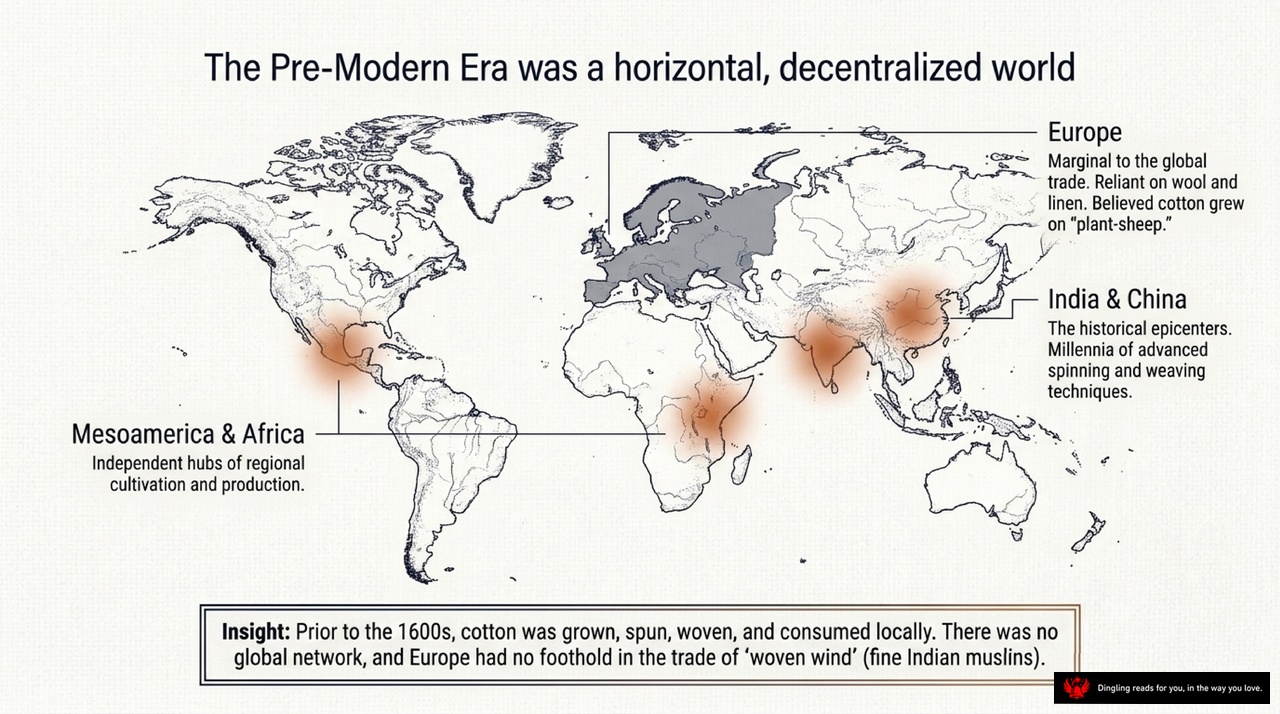
Look at this map. Before the 1600s, the world wasn't a single connected system; it was a collection of independent hubs. India and China were the epicenters of cotton, boasting millennia of advanced spinning and weaving techniques. Meanwhile, Mesoamerica and Africa were thriving as their own centers of regional cultivation. Europe, in contrast, was on the margins, relying on wool and linen, and honestly, they had no idea what cotton was—some even thought it grew on "plant-sheep." There was no global network. Cotton was grown, spun, woven, and consumed locally. Europe had no foothold in the trade of "woven wind," those fine Indian muslins.
But everything changed with the rise of "war capitalism." Europe used military force to build a trade network across Asia, Africa, and the Americas. They bought cotton textiles from India, traded them for enslaved people in Africa, and shipped those people to the Americas to work on sugar and tobacco plantations. This brutal system, driven by violence and slavery, transformed the world from a decentralized, multi-polar cotton world into a single hierarchy centered on Europe. By 1780, Britain had become the heart of this global cotton network, setting the stage for the Industrial Revolution.
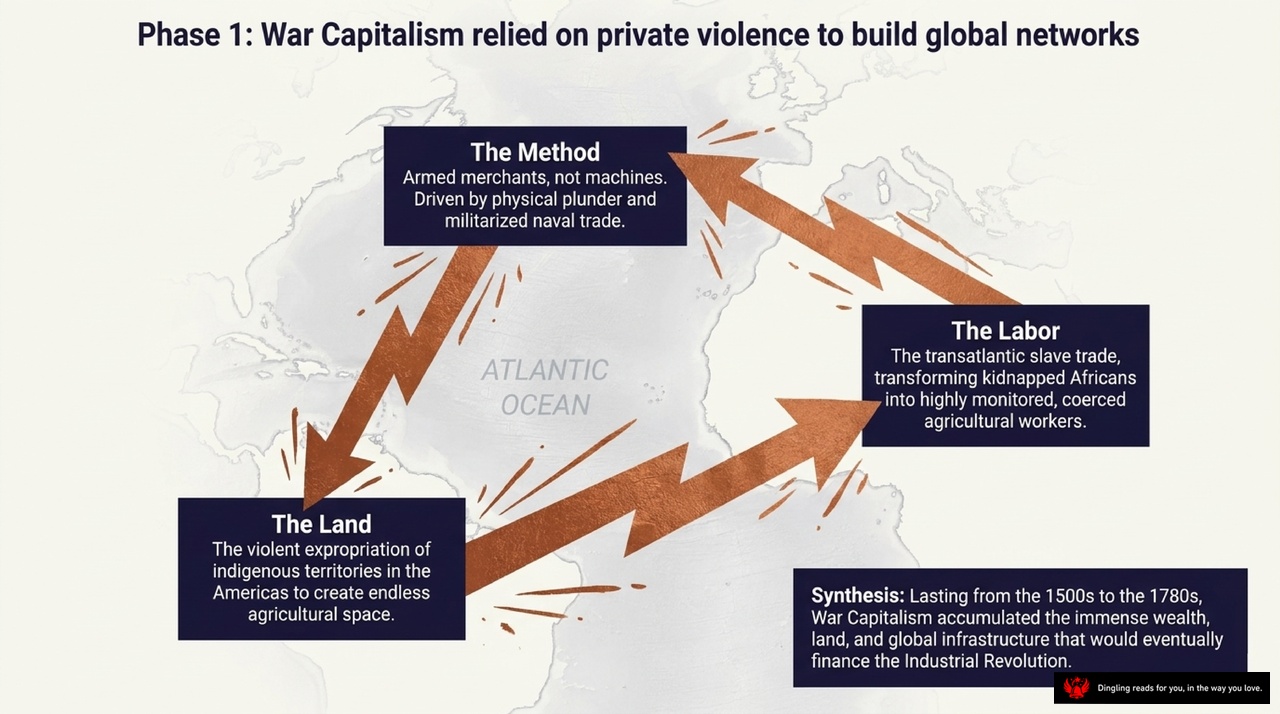
Look at this map of the Atlantic Ocean. This image captures a brutal truth about how the modern world was built: the first phase of global capitalism wasn't about machines or innovation. It was about private violence.
As the slide outlines, this era, known as "War Capitalism," relied on three key pillars. First, look at "The Method." It wasn't about technology; it was about armed merchants and militarized naval trade. They used physical plunder to build networks. Second, consider "The Labor." This is the transatlantic slave trade, where kidnapped Africans were transformed into highly monitored, coerced agricultural workers. Third, examine "The Land." This involved the violent expropriation of indigenous territories in the Americas to create endless space for agriculture.
By synthesizing these elements between the 1500s and the 1780s, War Capitalism accumulated immense wealth, land, and global infrastructure. This violent foundation provided the exact capital and resources needed to eventually finance the Industrial Revolution. It's a stark reminder that before we celebrated the age of industry, there was an age of conquest.

Phase 2: Industrial Capitalism married slave labor to the factory system.
Look at this split screen. On the left, we see **The Fields** in the American South. Here, the driver wasn't just technology, but **Whitney's Cotton Gin in 1793** combined with **systematic physical coercion**. This created an unprecedented, elastic supply of raw cotton at plummeting prices.
On the right, we see **The Mills** in Manchester and Lancashire. The driver here was **Samuel Greg's Quarry Bank Mill in 1784**, powered by water and steam. This was the invention of the factory system, mobilizing a new class of wage workers—women and children.
These two sides were inextricably linked. By 1860, the UK consumed 800 million pounds of cotton—77% of it grown by enslaved people in the United States. This is the moment the global economy shifted: the brutal reality of the plantation became the fuel for the machine age.
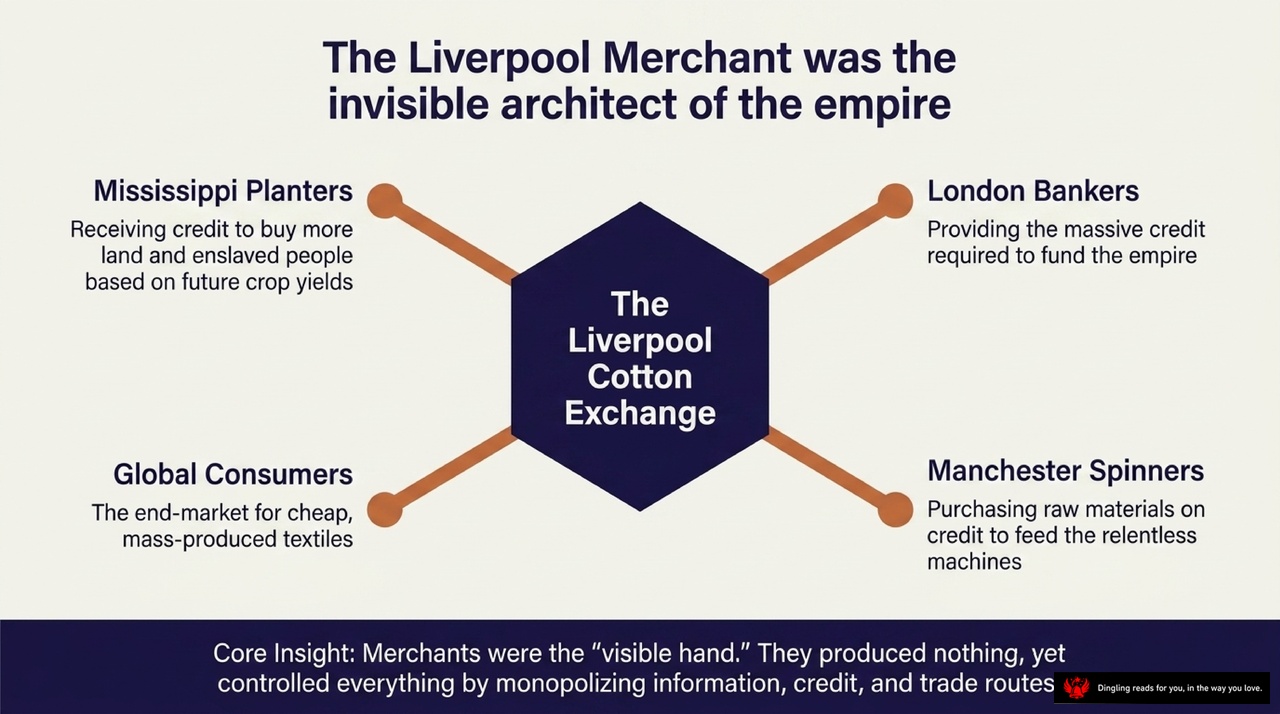
Look at this diagram. At its heart lies the Liverpool Cotton Exchange, the invisible architect of an entire empire. This wasn't just a trading floor; it was the brain connecting four powerful forces. On one side, you have the Mississippi Planters, who used credit to buy land and enslaved people, betting their future on crop yields. Opposite them stand the London Bankers, providing the massive capital required to fund this global machine. On the other side, the Manchester Spinners bought raw materials on credit to feed their relentless machines, while the Global Consumers on the final side bought cheap, mass-produced textiles, unknowingly driving the whole system.
The core insight here is profound: merchants were the "visible hand." They produced nothing themselves, yet they controlled everything by monopolizing information, credit, and trade routes. By connecting these four nodes—the planters, the bankers, the spinners, and the consumers—the Liverpool merchants orchestrated a system where every link depended on the others, creating a self-sustaining engine of industrial capitalism that reshaped the world.

Imagine the cotton empire as a living organism that never stopped evolving. In the 19th century, the center of gravity shifted dramatically from the Atlantic Ocean to the factory floor itself. While the old model relied on enslaved people and physical plunder, the new era of Industrial Capitalism fused mechanization with structured credit systems. Look at the shift in the "Primary Labor Force": we moved from relying solely on enslaved and indigenous populations to a hybrid model where enslaved people provided raw materials, while wage workers drove the manufacturing process. This was a fundamental change in how power was generated. Instead of armed merchants and privateers, the new engine was the factory owner backed by banks and machines. The state's role also transformed completely. It went from a weak entity that outsourced violence to a strong power that actively backed contracts, protected private property, and built the infrastructure necessary for mass production. Finally, notice where the "Center of Gravity" moved. It left the chaotic trade routes of the Atlantic Ocean and settled firmly in the factory—specifically Manchester—and the plantation in the US South. This wasn't just a change in location; it was an evolutionary leap where violence and capital merged into a single, unstoppable system.
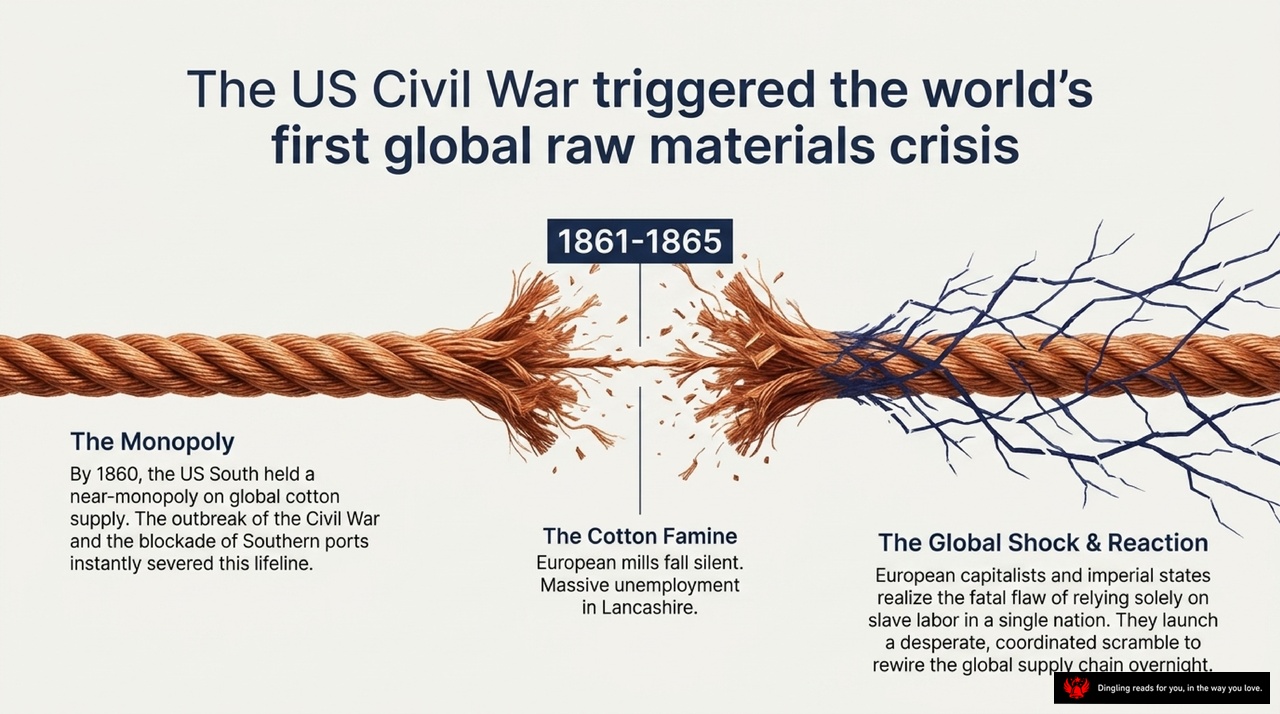
The American Civil War didn't just reshape a nation; it triggered the world's first global raw materials crisis. As the slide illustrates, between 1861 and 1865, a near-monopoly on global cotton supply held by the US South was instantly severed by the war and the blockade of Southern ports. This rupture created the "Cotton Famine," causing European mills to fall silent and leaving massive unemployment in industrial hubs like Lancashire. The global shock was immediate: European capitalists and imperial states realized the fatal flaw of relying solely on slave labor in a single nation. Forced by this desperation, they launched a coordinated scramble to rewire the global supply chain overnight. This crisis marked a pivotal shift, ending the era of the "Cotton Kingdom" and forcing the world into a new industrial reality where no single nation could control the fabric of global trade.
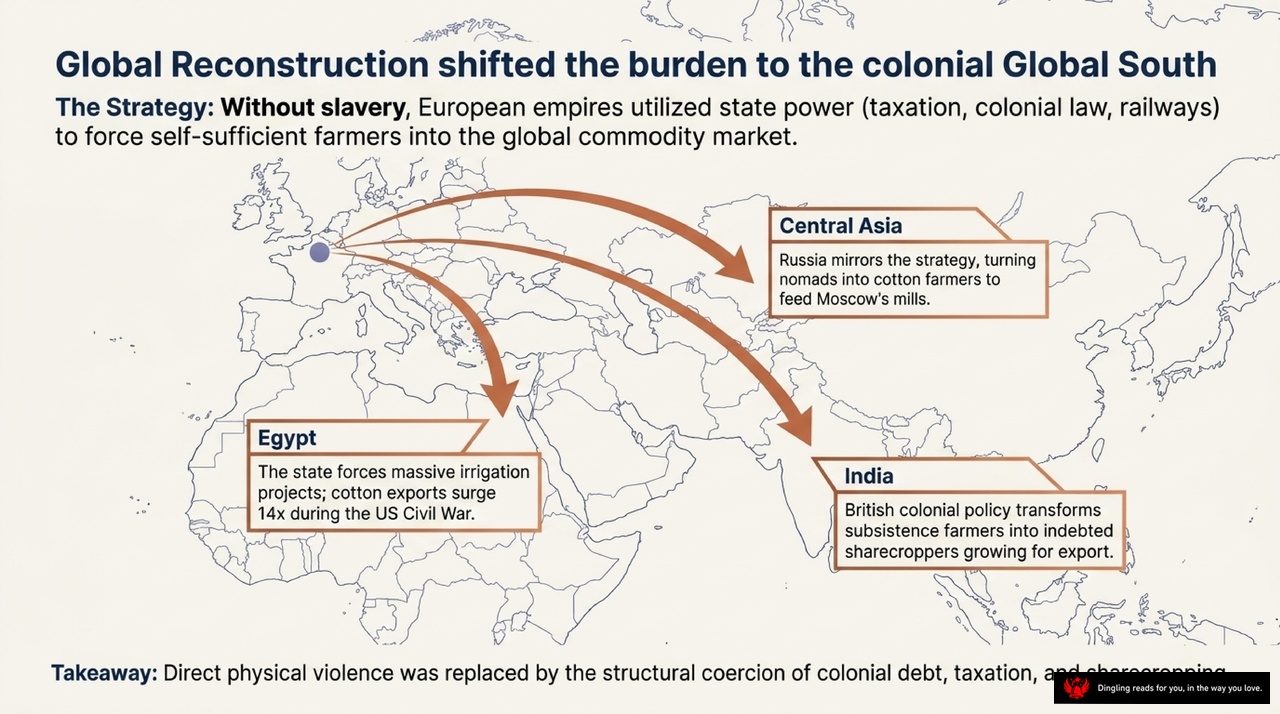
Global Reconstruction shifted the burden to the colonial Global South. Look at this map. It tells a stark story about how European empires, after abolishing slavery, didn't stop exploiting the world—they just changed the playbook. The strategy was clear: without physical chains, they used state power—taxation, colonial laws, and railways—to force self-sufficient farmers into the global commodity market.
Notice the arrows pointing from Europe to the rest of the world. In Central Asia, Russia mirrored this strategy, turning nomads into cotton farmers just to feed Moscow's mills. In India, British colonial policy transformed subsistence farmers into indebted sharecroppers who grew crops solely for export. And in Egypt, the state forced massive irrigation projects, causing cotton exports to surge 14 times during the US Civil War.
The takeaway is simple but profound: direct physical violence was replaced by the structural coercion of colonial debt, taxation, and sharecropping. The burden of production was shifted entirely to the Global South, creating a system where local communities were forced to serve the global economy against their own interests.

Look at this striking chart. We see two opposing forces colliding between 1830 and 1860. The blue line, representing Asian domestic hand-loom manufacturing, is crashing down. Meanwhile, the brown line for European mechanical manufacturing is soaring into the sky. This isn't just a story about better technology; it's a deliberate trap set by colonial powers.
Imagine a region like India, forced to export raw cotton cheaply, only to have finished British textiles sold back to them at exorbitant prices. The impact was devastating. Millions of skilled spinners and weavers lost their livelihoods overnight. This wasn't an accident of market forces. As our key insight highlights, it was the result of deliberate imperial policy and unequal tariffs. These strategies transformed independent artisans into a captive market, effectively dismantling centuries of local industry and accelerating the de-industrialization of the East.
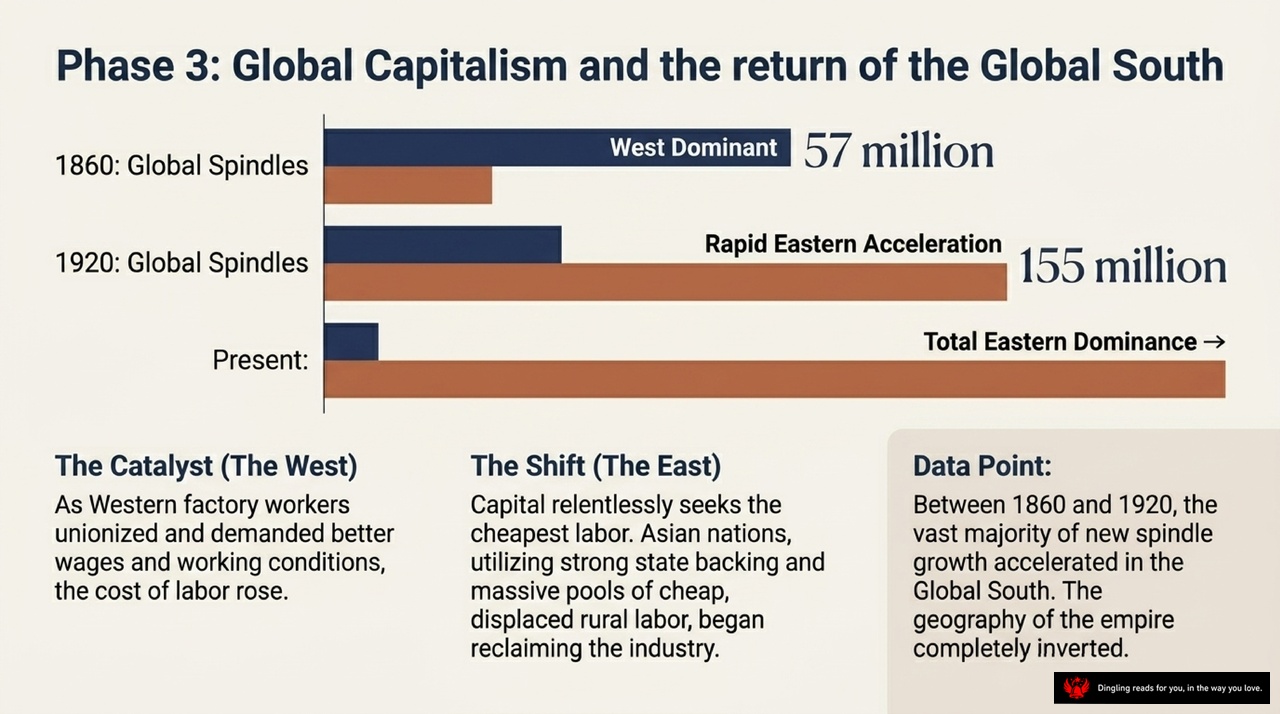
Phase 3: Global Capitalism and the return of the Global South. Look at this chart. In 1860, the West dominated global spindles with 57 million, while the East trailed far behind. But by 1920, everything changed. A rapid eastern acceleration pushed total spindles to 155 million, with the East taking the lead. Today, we see total eastern dominance. Why did this shift happen? It all comes down to the catalyst and the shift. On one side, the West. As Western factory workers unionized and demanded better wages and working conditions, the cost of labor rose, squeezing out their competitive edge. On the other side, the East. Capital relentlessly seeks the cheapest labor. Asian nations, utilizing strong state backing and massive pools of cheap, displaced rural labor, began reclaiming the industry. The data point confirms it: between 1860 and 1920, the vast majority of new spindle growth accelerated in the Global South. The geography of the empire completely inverted. This isn't just a numbers game; it's the story of how the center of gravity moved from the Global North to the Global South, driven by rising costs in the West and the industrial mobilization of the East.

The modern era is defined by the absolute dominance of the retailer. As this inverted pyramid illustrates, the power structure has completely flipped from what we saw in the age of industrial capitalism. At the very top, sitting on the shoulders of the entire system, are the Retailers and Brands. Companies like Walmart, Zara, and Carrefour don't own factories. They own nothing but the power to dictate terms. They pull products across oceans to meet precise, low-cost demands, leveraging immense purchasing power to force suppliers into a demand-driven system where the suppliers bear all the risks and cost pressures.
Below them sits Mobile Capital and Manufacturers. In a relentless race to the bottom for labor costs, manufacturers constantly shift production across borders—from China to Bangladesh to Vietnam—seeking regions with the least regulation and worker protection. They are merely intermediaries, moving capital where it is cheapest.
At the very bottom, trapped and exposed, are The Workers. With weakened labor unions and minimal government intervention, workers in the global South face precarious employment and low wages. Capital is now untethered from the nation-state, leaving these workers completely exposed to global competition with almost no safety net. This is the new reality: a system where the retailer holds all the cards, while the labor that actually makes the products remains invisible and vulnerable.
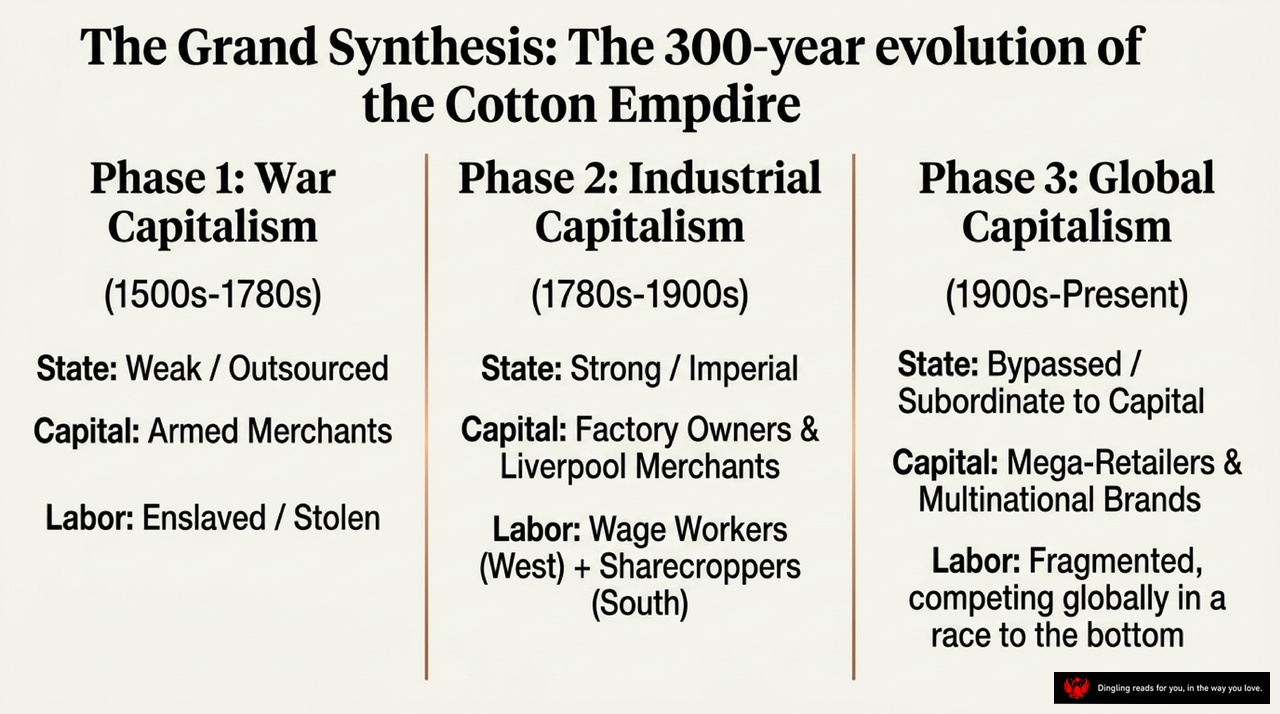
Today's slide lays out the "Grand Synthesis": the 300-year evolution of the Cotton Empire. Think of this not just as a history of fabric, but as a history of how the world's economy was built on three distinct phases of capitalism.
First, we have **Phase 1: War Capitalism** from the 1500s to the 1780s. Here, the State was weak or outsourced, while capital belonged to armed merchants. The labor force? Enslaved and stolen people. This era was about brute force and building the initial global trade networks.
Then comes **Phase 2: Industrial Capitalism**, spanning the 1780s to the 1900s. The dynamic shifts. Now, the State is strong and imperial. Capital moves into the hands of factory owners and merchants like those in Liverpool. The labor force evolves into wage workers in the West and sharecroppers in the South. This is the era of steam engines and massive factories.
Finally, we arrive at **Phase 3: Global Capitalism**, from the 1900s to the present. In this phase, the State is often bypassed or becomes subordinate to capital itself. The new players are mega-retailers and multinational brands. The labor force becomes fragmented, with workers competing globally in a relentless race to the bottom.
This timeline shows a clear trajectory: from violent conquest to industrial machinery, and finally to a complex, globalized market where a few giant corporations dictate the rules for everyone else.

The image before us captures the profound duality of the empire's legacy—a paradox woven into the very fabric of our global history. On one side, we see the golden threads of **Innovation & Connectivity**, representing the catalyst for unprecedented technological miracles that generated immense global wealth and raised living standards in the West. It was here that the first truly integrated global communication and trade networks were created, weaving the world together in ways never before imagined.
Yet, this brilliance was inextricably bound to the dark reality of **Extraction & Exploitation**. This side of the loom reveals the brutal foundation upon which the empire was built: systemic human slavery and stolen land. It drove ruthless colonial exploitation and the deliberate de-industrialization of the East, stripping vibrant economies of their potential. Furthermore, it established a blueprint for perpetual global inequality and ecological extraction that continues to shape our world today.
This split image reminds us that the technological miracles and global connectivity we celebrate were not born in a vacuum. They were the direct result of a violent transfer of resources and labor from the periphery to the core. The prosperity of the West was literally woven from the suffering of the East, a complex tapestry where every thread of progress was tied to a thread of pain. Understanding this paradox is essential to understanding how the modern world was constructed, not just through innovation, but through the relentless machinery of extraction.
Cotton forged the modern world by violently weaving together disparate lands, labor, and capital into a single, unyielding capitalist system. This slide captures the core truth of the Empire of Cotton: it wasn't just a crop, but the engine that built the global economy we know today.
Look at that cotton icon. It represents a brutal reality. As the text states, cotton connected distant continents through force. It took enslaved labor from the Americas, land from Indigenous peoples, and capital from European investors, fusing them into one powerful machine. The system was designed to be relentless, constantly seeking the cheapest labor and the most fertile land to maximize profit.
But here is the question that lingers at the bottom of this slide: As capital continues to roam the globe untethered from nations in a relentless search for the cheapest labor, who truly holds the power in the empire today?
In the 19th century, that power clearly belonged to the industrial nations of the North, fueled by the raw materials of the South. However, the story has shifted. Today, the center of gravity has moved. While the West still controls the brands and the finance, the actual production and consumption of cotton now dominate the Global South. Countries like China and India are no longer just suppliers; they are the heart of the industry. Yet, the underlying logic remains the same. The system still demands cheap labor, often pushing workers in places like Uzbekistan or West Africa into poverty, while massive retailers and corporations reap the rewards.
So, while the map of power has changed, the question remains urgent. Who really controls the flow of value in our global cotton empire? Is it the farmers who plant the seeds, or the distant consumers who wear the clothes? The answer reveals that the empire of cotton is far from over; it has simply evolved into a new, equally complex form of global domination.