
Everything I Never Told You: Complete Chapter-by-Chapter Summary

Welcome to a profound exploration of a family's silent burdens and the tragic weight of unfulfilled expectations. We are diving into Celeste Ng's masterpiece, *Everything I Never Told You*.
Imagine a family where every member feels invisible, yet they are all desperately trying to be seen. This story is about a Chinese-American family in 1977, where the parents are constantly searching for their daughter, Lydia, who has mysteriously disappeared. It's a tale of secrets, of a mother who sacrificed her own dreams for her children, and a father who spent his life trying to prove he belonged in a world that never truly accepted him.
Lydia, the daughter, is the center of this storm. She is the perfect child on the outside, but inside, she is suffocating under the weight of her parents' expectations. Her mother wants her to be a brilliant doctor, fulfilling the mother's own unfulfilled career. Her father wants her to be popular and "American," a direct reflection of his own painful journey of trying to fit in. Lydia is just a girl caught in the middle, forced to say "yes" to everything so her family doesn't fall apart.
But behind the smiles and the perfect grades, there is a deep, aching loneliness. Lydia has no real friends, no hobbies she loves, and no voice of her own. She is a vessel for her parents' dreams, not a person with her own desires. As the story unfolds, we see how these unspoken pressures build up until they become too heavy to carry. The question isn't just where Lydia went, but why she felt she had to disappear to make her parents happy.
This book challenges us to look at our own families. Are we loving our children, or are we loving the versions of ourselves we want them to be? It's a heartbreaking reminder that sometimes, the things we say we want for our kids are actually the things we want for ourselves. Join us as we turn the pages and uncover the truth behind the silence.

Before May 3, 1977, the Lee household was a house built on silence. On the surface, everything looked normal. Marylin was a brilliant physicist who had sacrificed her career to raise children, and James was a history professor who had spent his life trying to erase his Chinese heritage. Lydia, their favorite daughter, was the perfect bridge between them—the one with Marylin's blue eyes and James's dark hair, the one who could say "yes" to everything to keep the peace. But underneath that polished exterior, there were deep psychological fractures, invisible cracks in the foundation that everyone was too afraid to address.
Then came May 3rd. The fracture became a chasm. Lydia vanished, and the family's world split into two distinct realities. On the left side, before the disappearance, lived "The Unsaid"—a life where normalcy masked deep psychological wounds, where Lydia's identity was entirely constructed by her parents' unspoken expectations. On the right side, after the tragedy, lies "The Autopsy." The search for Lydia on the lake quickly shifted into a forensic search of the family's past. It wasn't just about finding a missing body; it was about diagnosing the psychological architecture that pulled her under. Lydia is dead, but the truth is that she never really lived as herself. She was a diagnostic tool for her parents' failures, a vessel for their regrets, and ultimately, a victim of a love that demanded she disappear so they could feel whole.
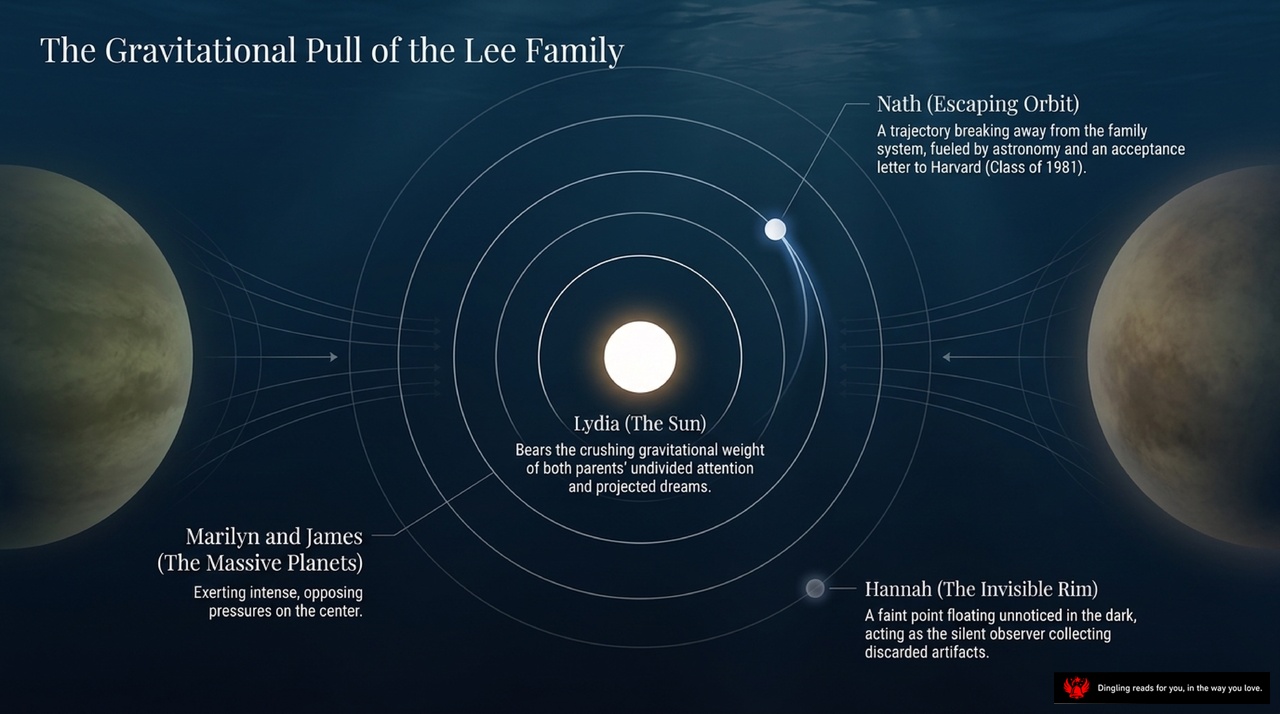
The Lee family isn't just a household; it's a chaotic solar system under constant gravitational stress. At the center sits Lydia, our protagonist, depicted here as the Sun. She bears the crushing weight of her parents' undivided attention and their projected dreams, radiating light but burning herself in the process. Flanking her are Marilyn and James, the massive planets exerting intense, opposing pressures that keep the system spinning but never letting anyone rest.
Then there's Nath, orbiting on an escaping trajectory. Fueled by astronomy and that acceptance letter to Harvard, he's breaking away from the family system, leaving behind the gravity that binds everyone else. In the shadows, barely visible on the rim, floats Hannah. She's the silent observer, collecting the discarded artifacts of their lives—the things they drop when they're too overwhelmed to notice them. This diagram perfectly captures the tragedy: a system so heavy with expectation that the one person meant to hold it together, Lydia, is the first to be pulled apart by the very forces meant to keep her safe.

The Architecture of Parental Expectation isn't just a title; it's the blueprint of a life built on someone else's dreams. Look at the two sides of this slide. On the left, we have Marilyn, the mother. Her silhouette is paired with a stethoscope and a medical textbook. Why? Because her own ambition to become a doctor was crushed. Her core desire? To shatter glass ceilings and stand out. So, she projects academic perfection onto Lydia, pushing her toward advanced sciences and demanding she never settle for anything ordinary. It's a classic case of a parent trying to live out their unfinished story through their child.
On the right stands James, the father. His image is accompanied by a heart-shaped necklace and a copy of *How to Win Friends and Influence People*. His trauma was lifelong racial isolation as a Chinese-American in 1970s Ohio. His core desire? To blend in and be universally liked. He projects social popularity onto Lydia, desperately monitoring her social life and urging her to conform, smile, and assimilate. He wants her to have a life he never got to have—a life of easy acceptance.
So, Lydia is caught in the middle. She is being pulled by two opposite forces: her mother's demand for brilliance and her father's demand for popularity. She becomes a puppet, with her mother's unfulfilled medical dreams and her father's unfulfilled social needs tied to her very soul. This pressure cooker of expectations is what slowly suffocates her, turning a vibrant young girl into a vessel for her parents' anxieties and regrets.
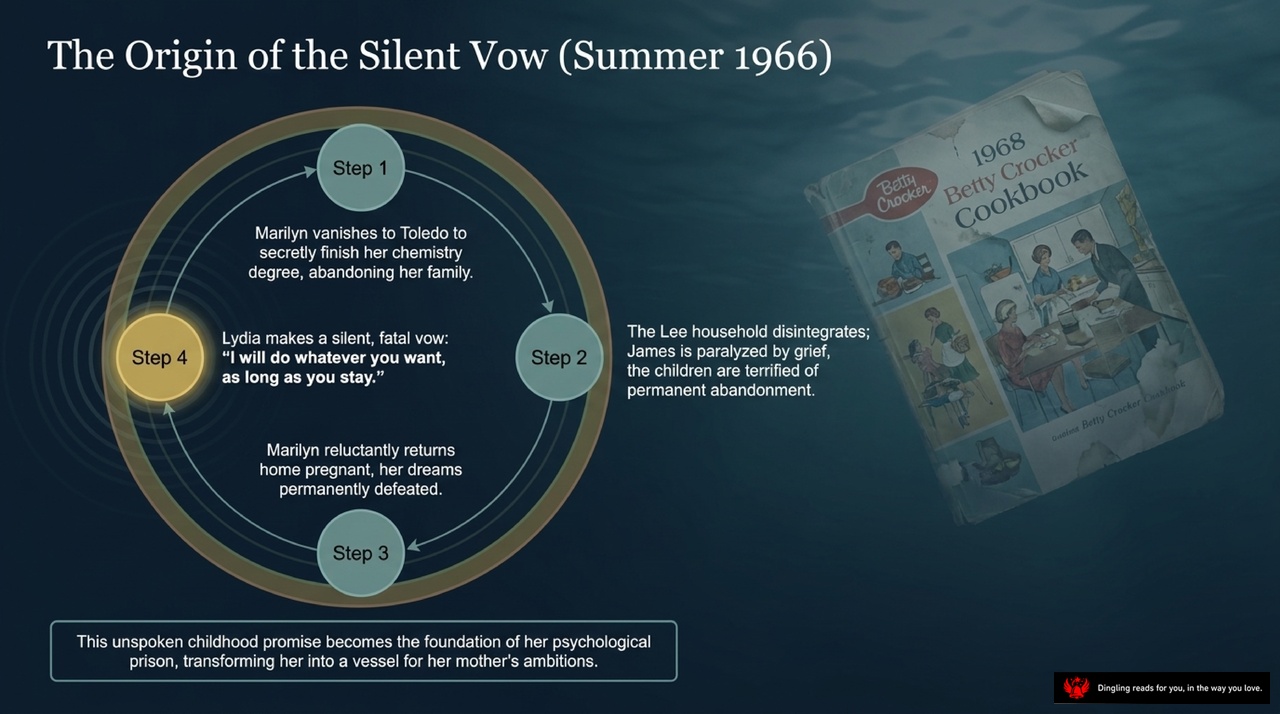
Step 1 is complete. Marilyn vanishes to Toledo to secretly finish her chemistry degree, abandoning her family. This unspoken childhood promise becomes the foundation of her psychological prison, transforming her into a vessel for her mother's ambitions. The Lee household disintegrates; James is paralyzed by grief, the children are terrified of permanent abandonment. Marilyn reluctantly returns home pregnant, her dreams permanently defeated. Lydia makes a silent, fatal vow: "I will do whatever you want, as long as you stay."
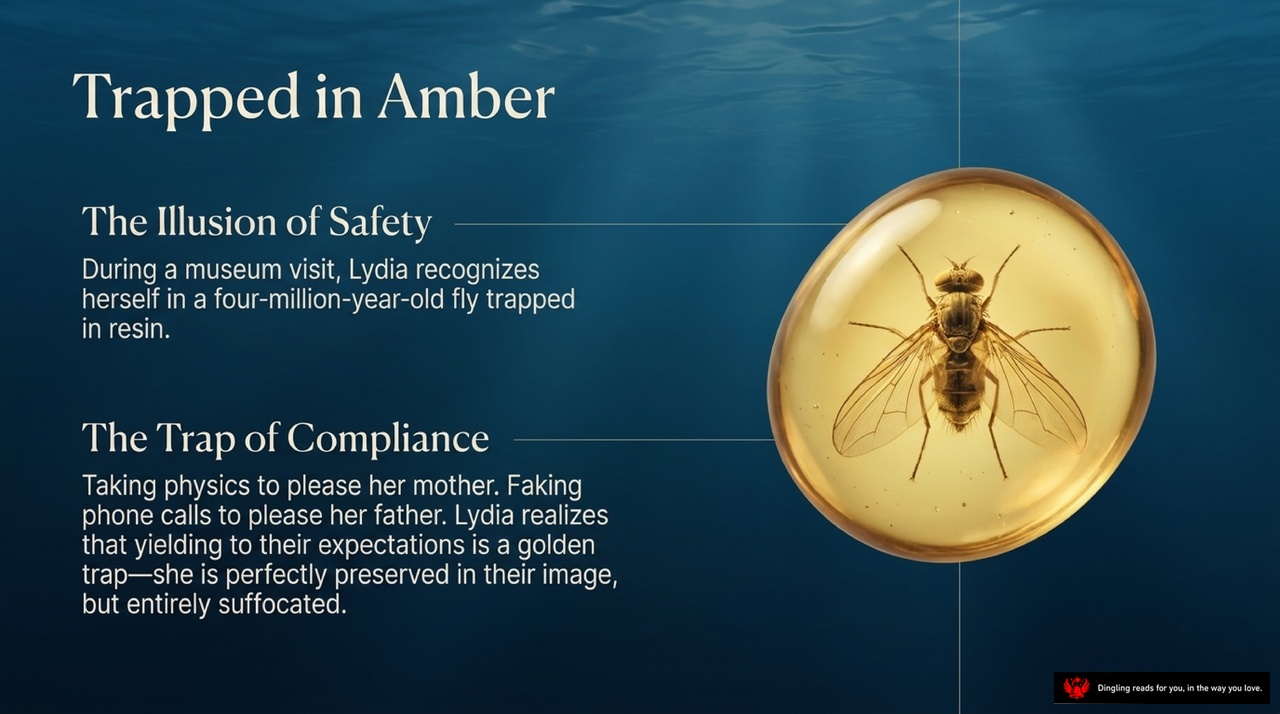
Trapped in Amber: The Illusion of Safety and the Trap of Compliance.
During a museum visit, Lydia recognizes herself in a four-million-year-old fly trapped in resin. It's a haunting image that perfectly captures her life. She feels like that fly—perfectly preserved, yet entirely suffocated.
This is the trap of compliance. Lydia takes physics not because she loves it, but to please her mother. She fakes phone calls to please her father. She realizes that yielding to their expectations is a golden cage. She is perfectly preserved in their image, but she has no breath left.
She tries to escape by jumping into the lake, but the water is just another form of the amber she's already in. Her death isn't just an act of rebellion; it's the final, desperate scream of a girl who realized too late that she was never allowed to be herself. She was trapped in amber, preserved by love, but killed by it.
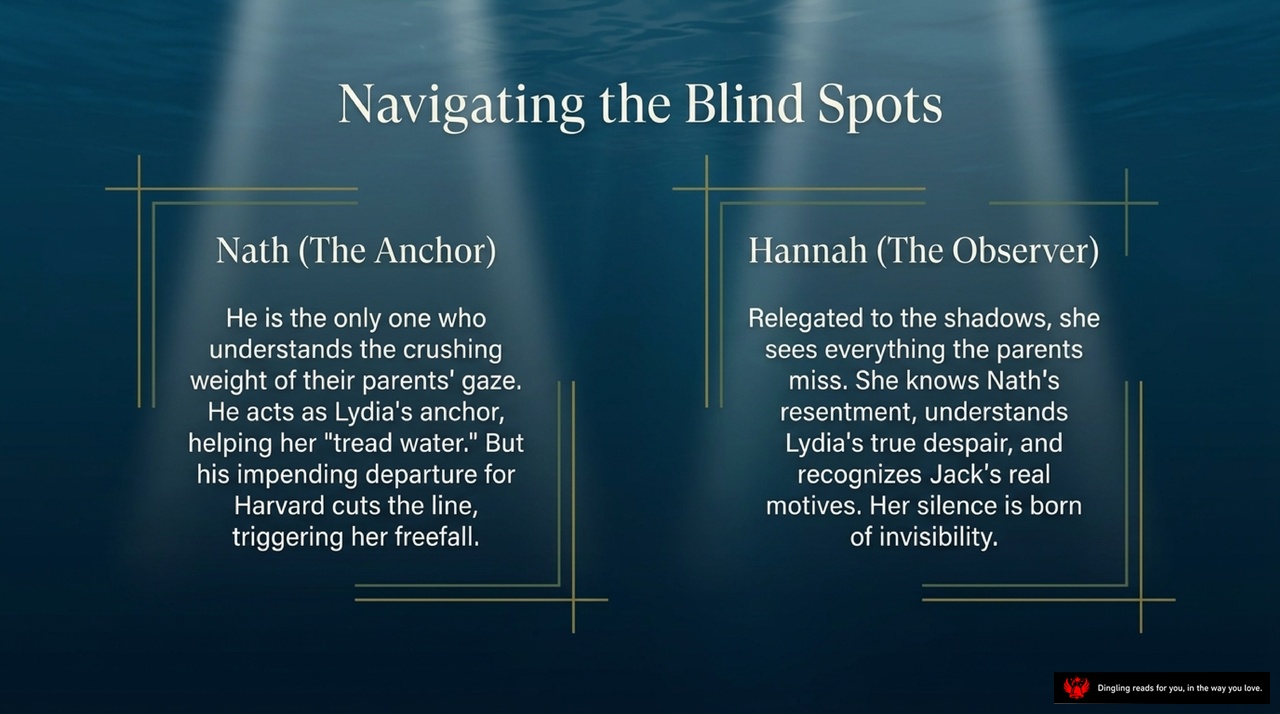
Navigating the Blind Spots isn't just about seeing clearly; it's about understanding who holds the family together when the lights go out. On this slide, we see two pivotal figures: Nath, our Anchor, and Hannah, our Observer.
Nath is the glue. He feels the crushing weight of his parents' gaze just as deeply as Lydia does, acting as her lifeline to help her "tread water" when the current gets too strong. But here lies the tragedy: his impending departure for Harvard cuts that lifeline. When he leaves, the support structure collapses, triggering Lydia's inevitable freefall. He tries to hold the family together, but his own desire to escape becomes the very thing that pulls Lydia under.
Then there is Hannah, relegated to the shadows. While the parents are busy projecting their expectations onto Lydia, Hannah sees everything they miss. She knows Nath's resentment, understands Lydia's true despair, and recognizes Jack's real motives. Her silence isn't indifference; it's born of invisibility. She is the only one truly seeing the storm, yet she has no power to stop it. Together, they represent the invisible forces that both sustain and destroy the family, proving that sometimes the people who see the most are the ones left to watch the tragedy unfold.

The misunderstood outsider is a tragic figure, but in Lydia's story, the truth was far more heartbreaking than anyone assumed. While the world saw Jack as a delinquent and a corrupting influence, the reality was that he was the only person who demanded nothing from Lydia. In his car, she was finally allowed to be flawed, angry, and unexceptional. However, the most tragic irony lies beneath the surface: Jack was not in love with Lydia. He was secretly, agonizingly in love with Nath—a truth Lydia discovers in the car, which permanently shifts her understanding of identity and courage. This revelation exposes the deep misunderstandings that defined their lives, turning the "misunderstood outsider" into a symbol of lost connections and unspoken truths.
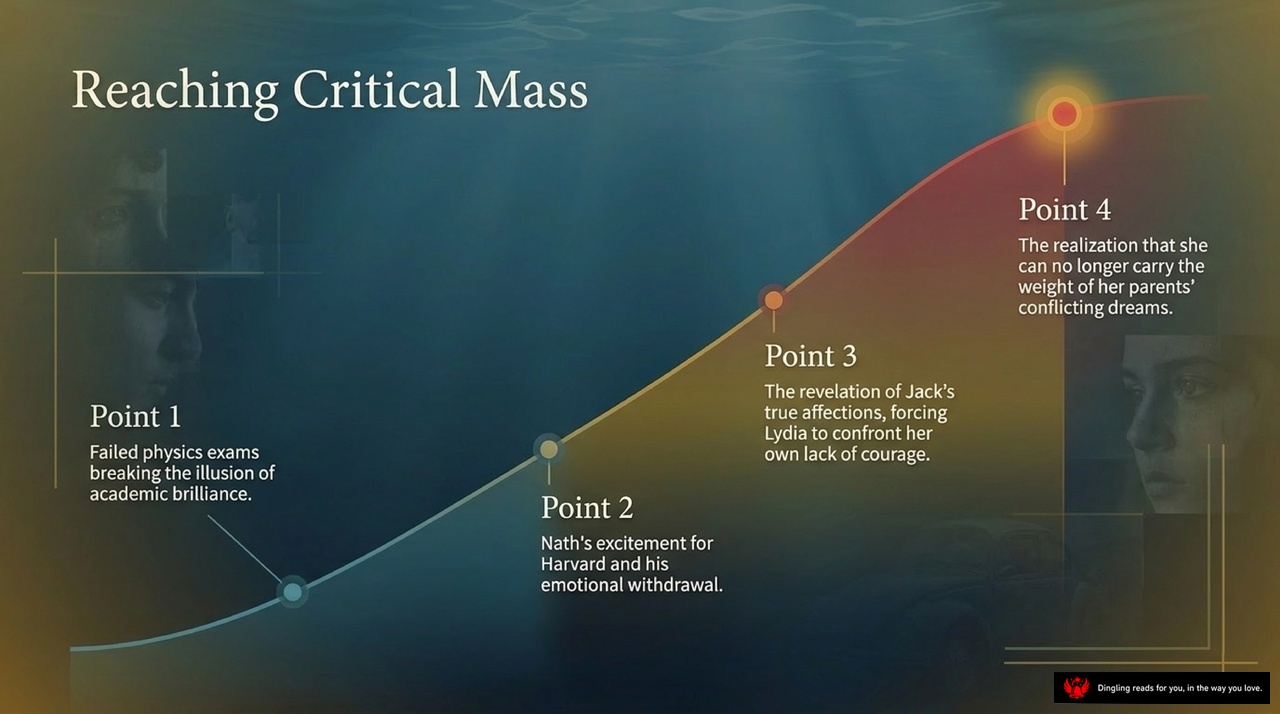
Look at this curve labeled "Reaching Critical Mass." It maps Lydia's journey from a fragile illusion of perfection to a breaking point where she can no longer hold on. It starts at Point 1, where failing physics exams shatters the family's belief in her academic brilliance. She isn't just a student anymore; she's a disappointment, and that cracks the foundation of her identity.
As the line climbs to Point 2, we see the pressure shift. Nath's excitement about Harvard is supposed to be a victory, but instead, it creates an emotional vacuum. Lydia feels abandoned as her brother moves toward the freedom she desperately craves, leaving her to face the weight of the family alone.
Then, at Point 3, the truth comes out. Jack's feelings are revealed, forcing Lydia to confront her own lack of courage and the lies she's built around her relationships. She realizes she's been performing a role for everyone else. Finally, at Point 4, the curve peaks tragically. Lydia reaches the realization that she can no longer carry the heavy, conflicting dreams of her parents. She understands that being their perfect doctor or their perfect socialite means losing herself entirely. That final realization is the tipping point, pushing her over the edge into the water, where she finally stops trying to be who they want her to be and becomes who she truly is, even if it means disappearing.
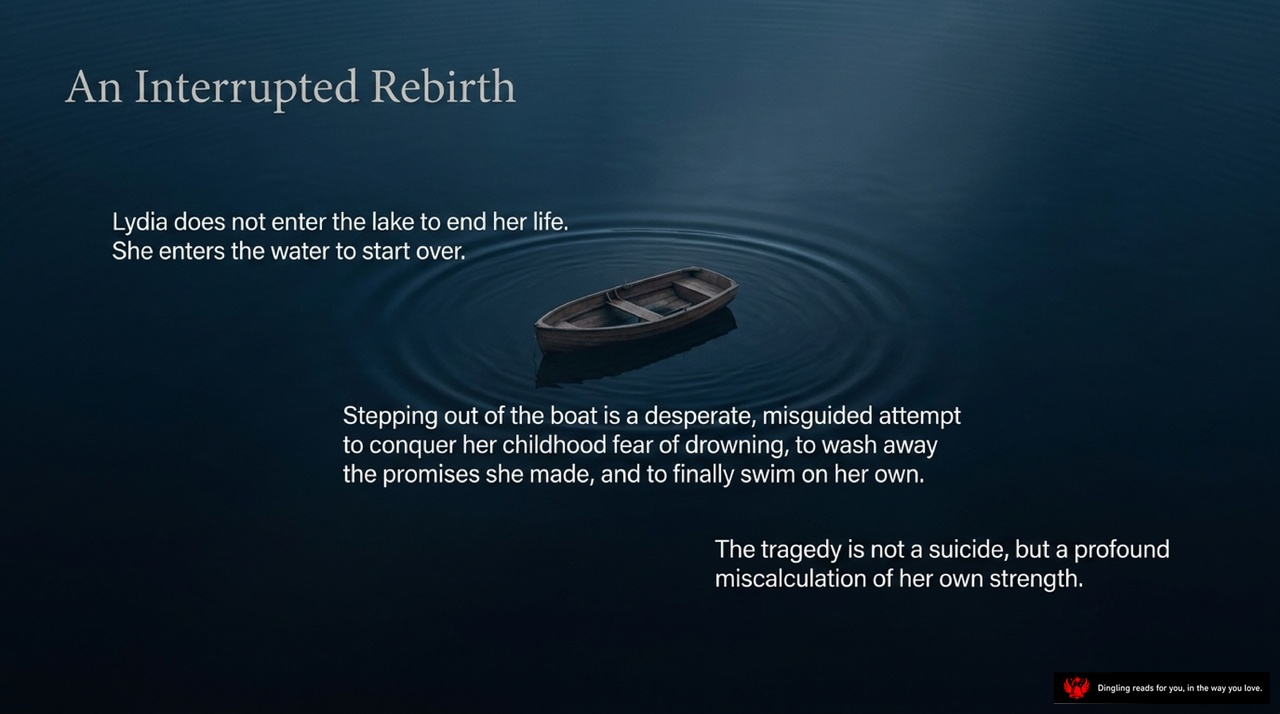
Look at this image: a small boat gently rocking on dark, rippling water. The text calls this "An Interrupted Rebirth." It tells us that Lydia didn't go into the lake to end her life; she went in to start over.
Stepping out of that boat was a desperate, misguided attempt for her. She wanted to conquer her childhood fear of drowning—the very fear that once threatened her life. She wanted to wash away the promises she made to her parents, the promises that had trapped her for so long. She wanted to finally swim on her own, without anyone holding her down.
But here lies the tragedy. It wasn't a suicide in the traditional sense. It was a profound miscalculation of her own strength. Lydia had spent her whole life believing she was drowning, waiting for someone to save her. She never realized that she had the power to swim. By jumping in, she didn't break free; she simply gave up before she could learn how to float. The water took her not because she was weak, but because she had never been taught how to trust herself.
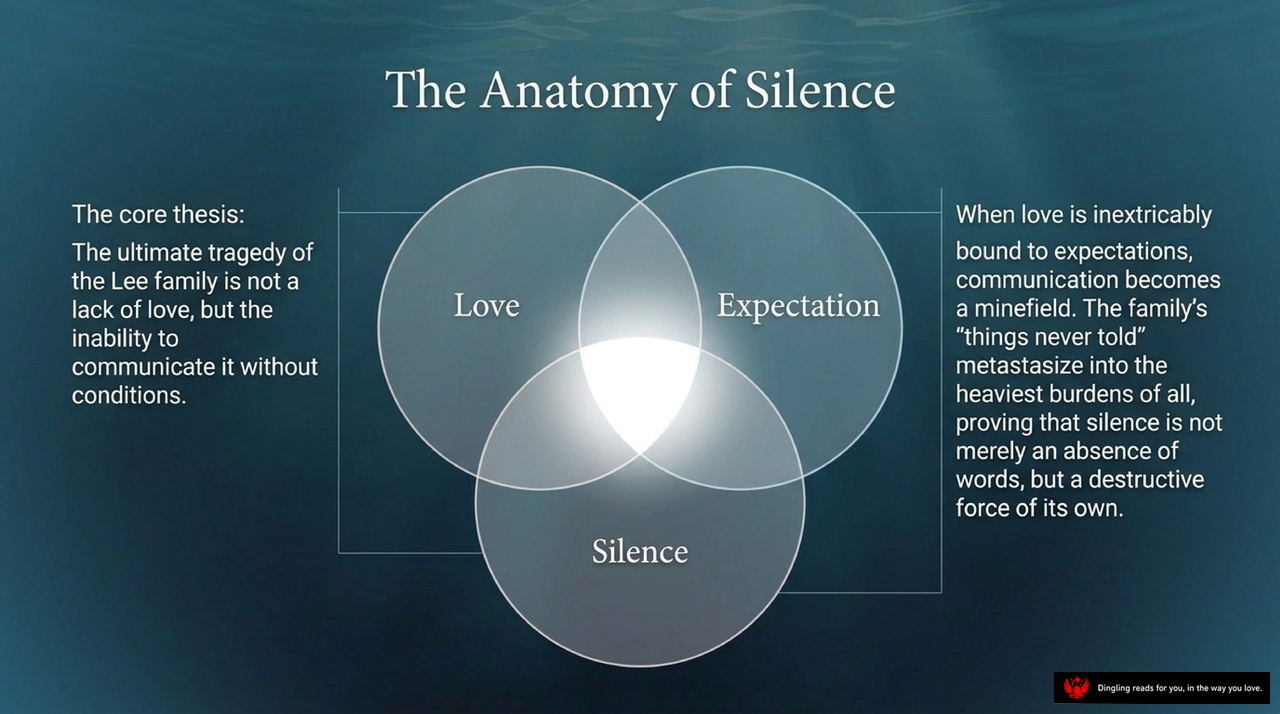
The Anatomy of Silence. Look at this Venn diagram. It captures the tragic heart of the Lee family: Love, Expectation, and Silence. When love gets inextricably bound to expectations, communication turns into a minefield. The family's "things never told" metastasize into the heaviest burdens of all, proving that silence is not merely an absence of words, but a destructive force of its own.
The core thesis here is devastatingly clear: The ultimate tragedy of the Lee family is not a lack of love, but the inability to communicate it without conditions. We see this play out in Lydia's life. Her mother, Marilyn, poured her unfulfilled dreams into Lydia, expecting a brilliant doctor. Her father, James, projected his lifelong fear of being an outsider onto her, demanding she be popular and "one of them." Lydia tried to bridge these two worlds, but she was crushed between them. She learned that to keep the peace, she had to say "yes" to everything, even when her heart was screaming "no."
This dynamic created a suffocating atmosphere where no one could speak their truth. James hid his affair with Louise, Marilyn hid her disappointment, and Lydia hid her exhaustion. They all waited for the other person to make the first move, terrified that breaking the silence would shatter the family. But as we saw with Lydia's final act, that silence didn't protect them; it isolated them. It pushed them into a corner where the only way out was through. True connection requires the courage to speak, to admit when we are struggling, and to love without the heavy chains of expectation. That is the lesson Lydia's story leaves us with.
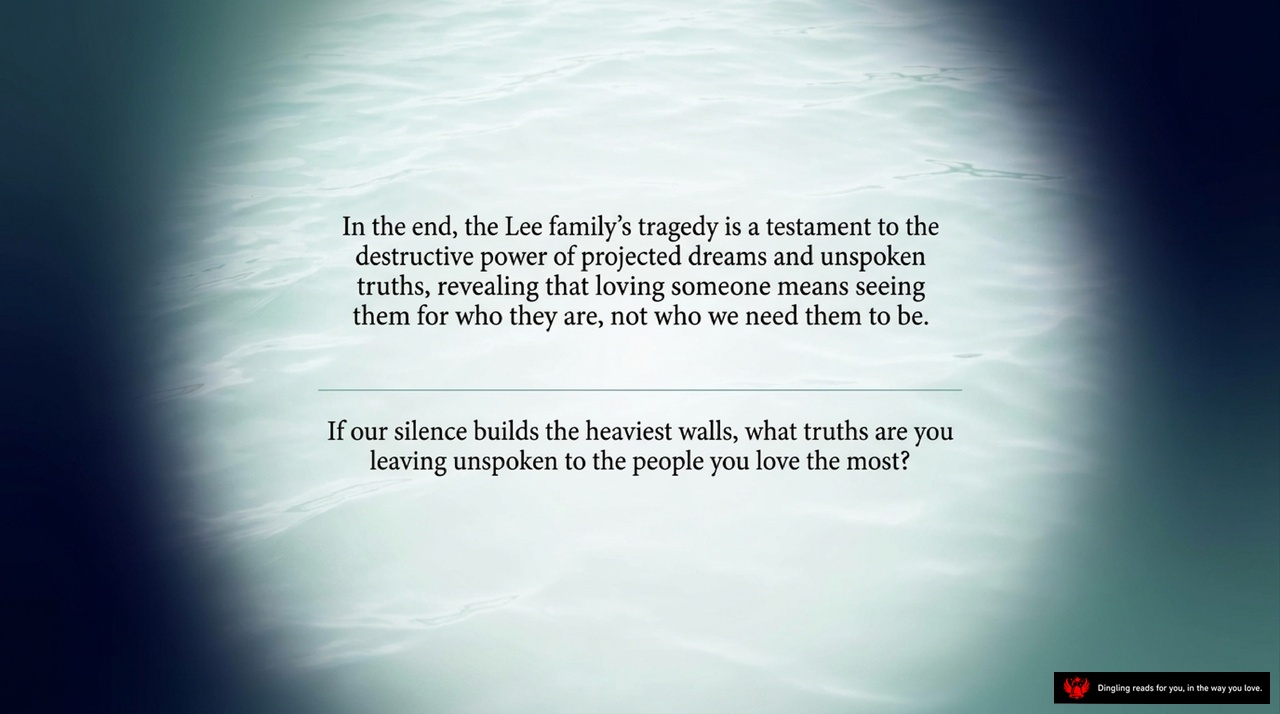
In the end, the Lee family's tragedy stands as a haunting testament to the destructive power of projected dreams and the weight of unspoken truths. It reveals a heartbreaking reality: loving someone truly means seeing them for who they are, not for who we desperately need them to be. Throughout their lives, James and Marilyn projected their own insecurities and unfinished ambitions onto Lydia, molding her into a perfect doctor and a socially flawless girl, while completely erasing her own identity. Their silence built the heaviest walls, creating a suffocating atmosphere where Lydia's authentic voice was never heard.
Now, the question lingers in the air, heavy and urgent: If our silence has built these walls, what truths are you leaving unsaid to the people you love the most? Are you protecting them, or are you simply hiding from the pain of seeing them clearly? It is time to ask ourselves what we are willing to say out loud, before it is too late.