
Everything is a Contract: Complete Chapter-by-Chapter Summary

Welcome to the world of Nie Huihua, where we explore a radical idea that reshapes how we see reality: Everything is a contract. From the moment you wake up to the moment you sleep, every interaction, every relationship, and every decision is governed by an agreement, whether written or unwritten.
Think about the intricate web of connections that holds society together. Just like the complex network you see on this slide, our lives are a series of interconnected contracts. A handshake is a promise; a marriage is a lifelong commitment; even the laws of our country are a social contract between citizens and the state. This isn't just about business deals; it's the fundamental operating system of human life.
At its core, this perspective comes from Game Theory and Decision-Making in the real world. We live in a world of scarcity where resources are limited but desires are infinite. Every choice we make is a negotiation of costs and benefits. But it gets deeper. When we interact with others, our choices aren't made in a vacuum; they are influenced by what others do. This is where the concept of the "Contract" becomes powerful. It provides a framework to understand everything from why we cooperate, to why we sometimes betray each other, and how we can design systems that encourage trust and fairness.
Whether it's the price of a mask during a crisis, the fairness of a workplace promotion, or the stability of a marriage, the logic remains the same: we are constantly defining, fulfilling, and optimizing these invisible agreements. By viewing the world through the lens of contracts, we gain a clearer, more rational way to navigate the complexities of life, turning chaotic interactions into structured, predictable outcomes. This is the essence of understanding the game we all play every single day.
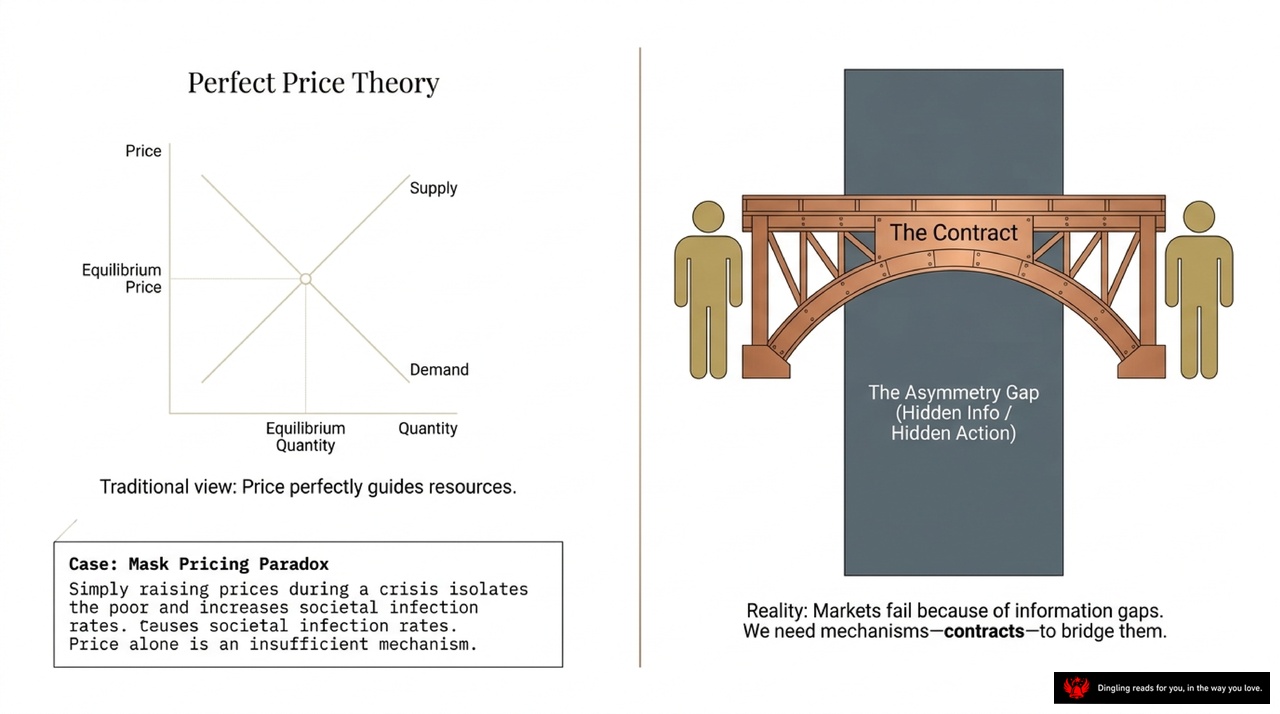
Let's dive into why the traditional idea of "perfect prices" often fails us in the real world. On the left, you see the classic supply and demand curve, showing how economists traditionally believe price acts as a perfect compass, guiding resources to where they are needed most. But look at the right side—that bridge labeled "The Contract" spanning a dark gap called "The Asymmetry Gap." This visual perfectly captures the reality we face: markets crash not because of bad intentions, but because of hidden information and hidden actions.
Take the mask pricing paradox from the text. When prices skyrocketed during the crisis, the market didn't save everyone; it simply isolated the poor who couldn't afford protection. This created a chain reaction where infection rates soared across the entire society, hurting everyone, including the wealthy who could afford the masks. The lesson is clear: price alone is an insufficient mechanism.
The root problem lies in information asymmetry—when one side knows something the other doesn't, like a seller hiding a car's accident history or a company masking quality issues. In these scenarios, relying solely on price signals leads to failure. This is where the concept of "The Contract" becomes vital. It's not just a piece of paper; it's a mechanism designed to bridge that gap. By creating incentives that align interests—whether through transparency laws, reputation systems, or smart corporate governance—we can turn a broken market into a functioning one. The real power of economics isn't just in letting prices float; it's in designing the right contracts to ensure fairness and efficiency when information is incomplete.

The 3 Pillars of Contract Theory aren't just abstract academic concepts; they are the invisible architecture holding up our modern economy. Think of it this way: modern economics isn't really about "choice"—it's about the science of contracts. Every interaction, from hiring an employee to buying a house, is a contract waiting to happen.
Let's break down these three pillars. First, the **Pre-Contract** phase. Before we even shake hands, there's **Hidden Information**. The core question is: "Who are you really?" In the job market, you know your true skills, but the employer doesn't. This gap creates **Adverse Selection**, where the best candidates get squeezed out. That's why we rely on **Signaling and Screening**—like your degree or a bold career move—to prove your worth before the deal is even signed.
Once the deal is done, we move to the **Post-Contract** stage. Here, the problem shifts to **Hidden Action**. The question becomes: "Are you actually working?" You've been paid, but are you slacking off or taking risks that hurt the company? This is **Moral Hazard**. To fix this, we use **Incentives and Moral Hazard** mechanisms, like tying your bonus to performance or giving you stock options, so your personal gain aligns with the company's success.
Finally, we face **The Unforeseeable Future**. Contracts can never be perfect because the future is messy. We face **Incomplete Contracts** where things change in ways we couldn't predict. The question is: "What if things change?" If a project fails or the market shifts, who decides? This is where **Ownership and Firm Boundaries** matter most. Who holds the power to make the final call when the original plan falls apart?
Understanding these three pillars—Pre-Contract information, Post-Contract behavior, and Future uncertainty—gives you the toolkit to navigate any complex negotiation or organizational challenge with clarity and confidence.

When we look at the Qing Dynasty mechanism depicted here, we see a fascinating example of how trust is engineered when information is scarce. The diagram highlights a critical "Information Gap" between lenders in Beijing and appointed officials. The lenders don't know if the officials are honest, lack collateral, or even have a steady income, creating a massive risk of default.
In this high-stakes environment, a simple contract isn't enough. That's where "The Servant" becomes the pivotal link. This figure acts as an embedded employee who bridges the divide. By providing local expertise and supervision, the servant effectively closes the information gap. He transforms an opaque, high-risk loan into a manageable transaction. The capital flows from Beijing to the officials, and in return, the officials offer embedded employment to the servant, creating a self-reinforcing cycle.
The core takeaway from this case study is profound: where there is a genuine demand for trust, a specific mechanism will emerge to fill the void. The embedded servant didn't just manage the money; he solved the information asymmetry that would have otherwise collapsed the entire system. This illustrates that in economics, the right institutional design can turn an impossible transaction into a thriving reality.

When you scale a company, the biggest governance challenge isn't just about hiring more people; it's about choosing between centralization and decentralization. You might assume that giving power to the front line is always better, but the reality is far more nuanced. As we see in the diagram, this choice is fundamentally about managing "Pre-Contract Asymmetry" and the threat of "Adverse Selection."
Think of your organization as a funnel. On one side, you have your "A-Players"—the high-value actors who truly drive growth. On the other, you have the "Fakers"—those who might be good at talking but not at delivering. In a decentralized model, you trust the A-Players to make decisions, which boosts their motivation. However, this creates a risk: if the system lacks clear boundaries, those Fakers might exploit their information advantage to push their own agenda, perhaps recommending a factory in their hometown just to help a relative, rather than for the company's best interest. This is the "Adverse Selection" problem.
Conversely, a centralized model gives you total control. You ensure every decision aligns perfectly with your vision, effectively filtering out the Fakers. But the cost is that your A-Players lose their autonomy. Without the power to act, their motivation plummets, and they might miss critical details on the ground that you simply can't see from the top.
So, which path do you choose? The answer lies in the nature of your contracts. In a world of "incomplete contracts"—where you can't write a rule for every possible future scenario—you need authority to fill the gaps. If your team's interests are perfectly aligned with yours, like in a family business, decentralization works beautifully because there's no risk of control loss. But if there are conflicting interests, you must weigh the trade-off carefully.
When information is highly asymmetric or technology is changing rapidly, you might need to lean toward decentralization to capture market insights quickly. However, you must make your commitment credible. If you promise to delegate power but then micromanage every penny, your A-Players will disengage immediately. Effective leaders set clear boundaries, like defining a spending limit below which a manager can decide autonomously, or strictly prohibiting "over-reporting" to protect the team's initiative.
Ultimately, there is no standard answer for every company. The key is to match your governance structure to your specific interest landscape and development stage. Whether you are building a startup or running a global giant, the goal is always the same: find the sweet spot where you maximize your team's drive without losing control to the wrong people.

Today's slide introduces the "Information Reveal Matrix," a powerful framework for separating top-tier talent from impostors. At its heart lies a fundamental truth: your choices betray your true type. When we design effective mechanisms, it becomes economically irrational to lie.
On the left, we look at **Signaling**, where the agent takes action. Think of education or a degree. For high-ability individuals, the cost of acquiring this signal is low. For low-ability individuals, faking it is prohibitively expensive. This cost difference prevents a "pooling equilibrium" where everyone looks the same, allowing smart candidates to stand out naturally.
On the right, we see **Screening**, where the principal—the employer or principal—takes action. Instead of just asking for degrees, they design a menu of choices, like Contract A versus Contract B. These contracts offer different trade-offs between base salary and bonus. High-risk or high-ability candidates self-select the contract that matches their true risk profile, while others choose the safer option.
Whether you are designing a career path or hiring a team, remember this: the goal is to make honesty the most profitable strategy. By aligning incentives, you ensure that the best people reveal themselves, not through deception, but through rational choice.

In the complex machinery of governance, we often face a unique trap known as "Common Agency." Imagine a single agent—like a farmer, a factory, or even a public servant—serving multiple principals at once. In our food safety system, one producer must simultaneously answer to eleven different regulators: agriculture, finance, customs, health, and more. Each has a different goal. The agriculture department wants safe feed; the finance bureau wants to boost production capacity; the market bureau wants stable prices.
Here lies the problem. When an agent serves many masters with conflicting interests, they don't just work harder; they learn to play them against each other. Since the regulator can't watch every second of the agent's work, the agent exploits this information gap. They prioritize the task with the highest reward or the easiest execution, ignoring the others. If the finance bureau offers a generous subsidy for expanding herds, the farmer focuses entirely on breeding more pigs, neglecting the health checks required by the health department. This creates a perfect loophole for moral hazards like feeding substandard feed or hiding disease outbreaks.
Worse still, the agent can actively manipulate the system. Think of the "Three Monks" story: when two bosses give contradictory orders, the servant simply does nothing, letting the bosses fight over who should do the work. In reality, companies and officials use this dynamic to their advantage, slipping through the cracks between departments. The solution isn't to add more rules or more inspectors; it's to do the opposite—subtract. We need to reduce the number of principals by merging overlapping agencies or, if we must keep them separate, establish a unified coordination body to set clear priorities. As seen in China's State-owned Assets Supervision and Administration Commission, consolidating power under one authority eliminates the chaos of "nine dragons taming water," restoring efficiency and accountability.

So, here's the reality check: you've learned that contracts are rarely perfect. We can't write down every possible future event, and enforcing them is often impossible. This "incompleteness" creates a massive loophole for opportunism. But here's the good news: we don't need perfect contracts to get by. We need *incentive-compatible* ones.
Think about the "Incentive Spectrum" on your slide. It's all about allocating risk to solve moral hazard. On the far left, we have the **Fixed Wage**. Here, the agent takes zero risk. The employer bears everything—weather, market crashes, everything. The downside? Low incentive and high moral hazard. If the boss pays you a flat salary, you have little reason to try your hardest when things get tough.
Move to the middle: **Revenue Sharing**. This is the sweet spot. It balances the risk. By aligning interests through incentive compatibility, you create a system where the agent and principal both win, even in unpredictable environments. It's the ideal compromise.
Then, on the far right, we have **Fixed Price or Franchise**. Here, the agent takes 100% of the risk. They become the "residual claimant," meaning they get all the upside but also bear all the downside. This creates high incentives, but it's risky for the employee.
The golden rule at the bottom of this spectrum is simple yet profound: Optimal contracts balance the agent's need for insurance against the principal's need for motivation. There is no one-size-fits-all solution. You have to choose where on this spectrum your specific situation falls.

Imagine a workplace where hard work is actually a career-killer. This is the "Dynamic Moral Hazard," often called the Ratchet Effect. It's a vicious cycle where your success becomes the trap that sets you up for failure next time.
Here's how it works. First, you over-perform. You crush your targets, maybe doubling your sales or delivering a project weeks early. Your boss sees this and thinks, "Wow, this employee is incredible." But instead of celebrating and giving you a break, the boss uses your peak performance as the new baseline. The target for next year is permanently raised to match what you just achieved.
This creates a slippery slope. If you keep hitting these ever-higher targets, your workload becomes impossible. Eventually, you reach a point where the only rational choice is to intentionally slack off. You stop trying to exceed expectations because doing so just guarantees an even higher bar next year. You settle into a cycle of mediocrity, not because you lack ability, but because the system has trapped you.
The solution lies in changing how we measure success. We need to disconnect targets from your personal past performance. Instead of beating your own record, benchmark yourself against the industry average or peer competitors. Or, use internal rotation to move you to new roles where old expectations don't follow you. By breaking the link between yesterday's glory and tomorrow's quota, you can actually encourage employees to keep striving for greatness without fear of the ratchet tightening around their necks.

Imagine a scale balancing two very different worlds: on one side, the tangible, measurable tasks like sales and table turnover; on the other, the invisible but equally critical work of service quality and cleanliness. This image perfectly captures the "Multi-Tasking Trap," where an agent juggling conflicting duties ends up failing at the very things that matter most for long-term success.
The graphic illustrates a harsh reality: when an agent faces multiple conflicting tasks, heavy incentives on the measurable side will inevitably cannibalize the unmeasurable one. Think about it—when a waiter is rewarded solely for turning tables fast, what happens to the time they spend ensuring the table is spotless or checking on guests? They cut those corners to hit the numbers. This isn't just about laziness; it's a structural flaw in how we design incentives.
This is exactly what happened at Haidilao. When they tried to boost revenue by tying bonuses to table-turnover rates, waitstaff started giving away free food just to get customers to leave quickly. The result? Revenue didn't grow, but profitability plummeted because the cost of free food skyrocketed. The system forced employees to sacrifice the company's overall health to satisfy a single, easily measured metric.
The lesson here is clear: you cannot simply pick the numbers you can measure and ignore the rest. If you over-incentivize the wrong tasks, you don't just miss the unmeasurable ones; you actively destroy them. True performance management requires balancing the scale, ensuring that the drive for short-term metrics doesn't crush the foundation of long-term value.

So, we've seen how contracts work in theory, but the reality is messier. We're now entering "Pillar 3: The Unforeseeable Future." The core idea here is that no contract is ever truly complete. Because we have bounded rationality, we simply cannot predict every future event—like a market boom, a crisis, or a sudden shift in technology. This creates an "Incomplete Contract."
When you combine this incomplete contract with "Asset Specificity," something dangerous happens. Let's look at the classic example: Fisher Body. They built a dedicated plant solely to supply GM. That investment became a sunk cost. Because their asset is so specific to one partner, they are now locked in.
This is where "The Hold-Up Vulnerability" kicks in. Since the contract couldn't cover every future scenario, one party can exploit those loopholes to extract extra profits. They know the other party cannot easily walk away because their specialized investment is now worthless elsewhere.
The takeaway is clear: due to our limited ability to foresee the future, every contract has loopholes. And when you make highly specific investments, you are essentially inviting extortion. It's a trap that happens whenever we try to lock in a future that we simply cannot fully define today.

The Power of Ownership isn't just about legal title; it's the ultimate solution to the chaos of incomplete contracts. As the slide illustrates, before we had firms, we only had "Market Haggling." Imagine a General Manager and a Fisher separated by a fragile market boundary. Every time they need to coordinate, they must negotiate, pay transaction costs, and risk a breakdown in communication. It's inefficient, slow, and prone to conflict.
But what happens when we merge them into "The Firm"? Suddenly, that noisy market boundary disappears. The GM and the Fisher are now under a single roof of "Command & Authority." Ownership replaces the endless negotiation of the market with the clear, decisive voice of a boss. This is the core insight of Hart's Property Rights Theory: when contracts are incomplete—which they always are in the real world—the party making the most crucial investments should own the asset.
Think about it: who invests more? The GM or the Fisher? Ownership gives the right to decide. If the GM owns the firm, they can direct the Fisher without needing a new contract for every small change. This internal authority solves the coordination problems that plague the open market. That's why vertical integration happens. It's not just about efficiency; it's about solving the puzzle of incomplete contracts by putting the right to decide in the hands of those who care most about the outcome.

The boundaries of the firm come down to a fundamental choice between two types of contracts: relational or hierarchical. Look at this comparison between McDonald's and Haidilao. McDonald's operates on a franchise model, relying on market mechanisms. The headquarters doesn't directly manage every store; instead, it sets the rules and lets franchisees run the show. This creates high incentives for owners to succeed and allows for rapid expansion, but it comes with a trade-off: weaker coordination and quality control. When you have dozens of independent owners, ensuring every burger tastes the same becomes a challenge.
In contrast, Haidilao uses a direct-operated model, which is essentially an internal hierarchy. Here, the headquarters retains full control over everything, from regional managers down to individual staff. This structure allows for strict service standardization and total authority over tasks that are hard to measure, like the warmth of a greeting or the speed of a refill. However, this tight control slows down expansion because every decision requires internal approval.
So, which path should your business take? The answer depends on your specific needs. If your priority is rapid local market adaptation and you trust your partners to self-manage, the franchise model is the way to go. But if your product is non-standardized and quality control is your lifeblood, like in high-end service, then a strict hierarchy is necessary. It's not about which model is better, but which contract fits your business's unique requirements.

When we zoom out from individual firms to the global stage, a powerful new framework emerges: New-New Trade Theory. As the slide illustrates, a nation's comparative advantage is no longer defined simply by cheap labor or abundant resources. Instead, the true engine of global dominance lies in the equation: Institutional Quality plus Contract Enforcement equals High-Tech Export Dominance.
Look at the map connecting Silicon Valley, New York, London, Tokyo, and Shenzhen. These aren't just economic hubs; they are nodes of trust. In the modern economy, we deal with incredibly complex supply chains. These networks are rife with incomplete contracts—agreements that simply cannot cover every future possibility. When a contract is incomplete, there is always a risk of a "hold-up," where one party exploits the other after investments have been made.
Only nations with superior legal frameworks and robust property rights can minimize these hold-up risks. Think of it this way: if you are building a high-tech product, you need to invest heavily in R&D and specialized equipment. If you operate in a country where contracts are weak and enforcement is unreliable, you fear that your partners might renege on the deal once you've invested your capital. That fear paralyzes innovation.
Conversely, in countries with strong institutions, you can trust that the rules of the game will be honored. This trust allows companies to take the risks necessary to lead in advanced industries. That is why, despite having a massive workforce, some nations remain stuck in low-value manufacturing, while others with smaller populations dominate the global tech landscape. The slide captures this perfectly: it is not about how many workers you have, but how well you can enforce the promises that bind your economy together. To move up the value chain, you don't just need factories; you need a legal system that makes doing business safe and predictable.

The image presents a striking blueprint of a bridge constructed entirely from interlocking gears, symbolizing the intricate machinery of trust that underpins our economy. The text above reminds us that economics is not merely about prices; it is the architecture of trust. By designing optimal mechanisms for hidden information and unpredictable futures, we can mitigate reality's imperfections.
This leads to a critical question posed at the bottom: If every human interaction is an incomplete contract, how will you rewrite your rules of engagement?
In our previous discussions, we learned that the real world is defined by incomplete contracts. We cannot foresee every future event, negotiate every detail, or prove every promise to a third party. This inherent uncertainty creates a vacuum of trust.
The solution lies in what we call "Incentive Compatibility." Instead of trying to write a perfect contract that covers every scenario—which is impossible—we must design systems where it is in every participant's self-interest to act honestly and fulfill their obligations. When the rules of engagement are structured correctly, individuals don't need to be forced to cooperate; they want to.
Think of it like the gears in our image. If one gear is designed poorly, the entire mechanism jams. Similarly, if our social or business contracts lack the right incentives, trust collapses, and efficiency plummets. Whether it's a CEO aligning with shareholders through stock options, a supplier maintaining quality to avoid losing future contracts, or a citizen adhering to laws because the social cost of cheating is too high, the principle remains the same.
We are not just waiting for people to be good; we are engineering environments where being good is the most rational choice. So, as you look at your own professional or personal life, ask yourself: Are the rules I've set up encouraging the right behaviors, or are they creating loopholes for opportunism? How can you redesign the gears of your world to ensure the system runs smoothly, even when no one is watching?