
Evicted: Complete Chapter-by-Chapter Summary
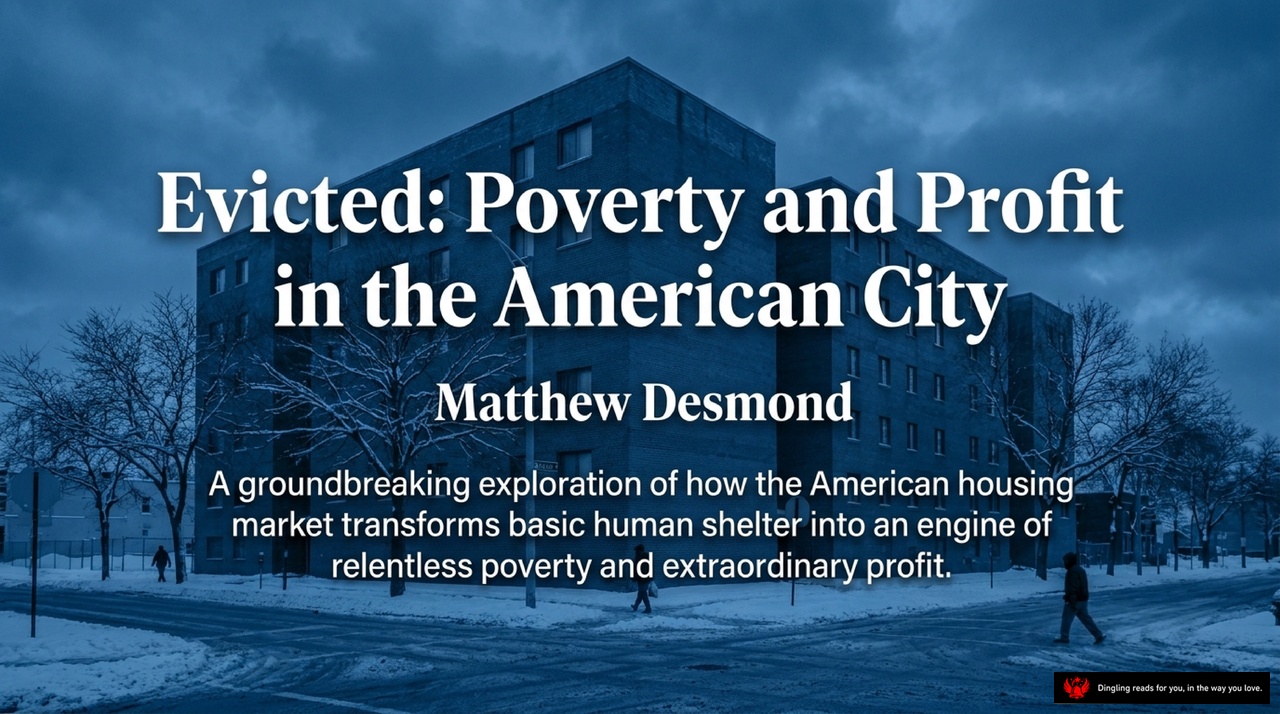
Welcome to today's deep dive into one of the most urgent issues facing America today: the housing crisis. We're looking at a book called *Evicted: Poverty and Profit in the American City* by Matthew Desmond.
This isn't just a story about rent or mortgages; it's a groundbreaking exploration of how our housing market has transformed a basic human need—shelter—into an engine for relentless poverty and extraordinary profit. The cover image sets a somber tone, showing a stark, snow-covered apartment building that represents the cold reality many families face.
Desmond argues that for many landlords, especially in struggling neighborhoods, poverty isn't a problem to be solved; it's a market opportunity. By focusing on the survival struggles of tenants, they turn risk into steady cash flow. But for the families on the other side, eviction isn't just about losing a home. It's a catastrophic event that destroys savings, severs community ties, and traps people in a cycle of destitution from which it is nearly impossible to escape. This book forces us to ask a difficult question: Is our current system protecting the vulnerable, or is it systematically exploiting them for profit? Let's turn the page and see how this plays out in real lives.
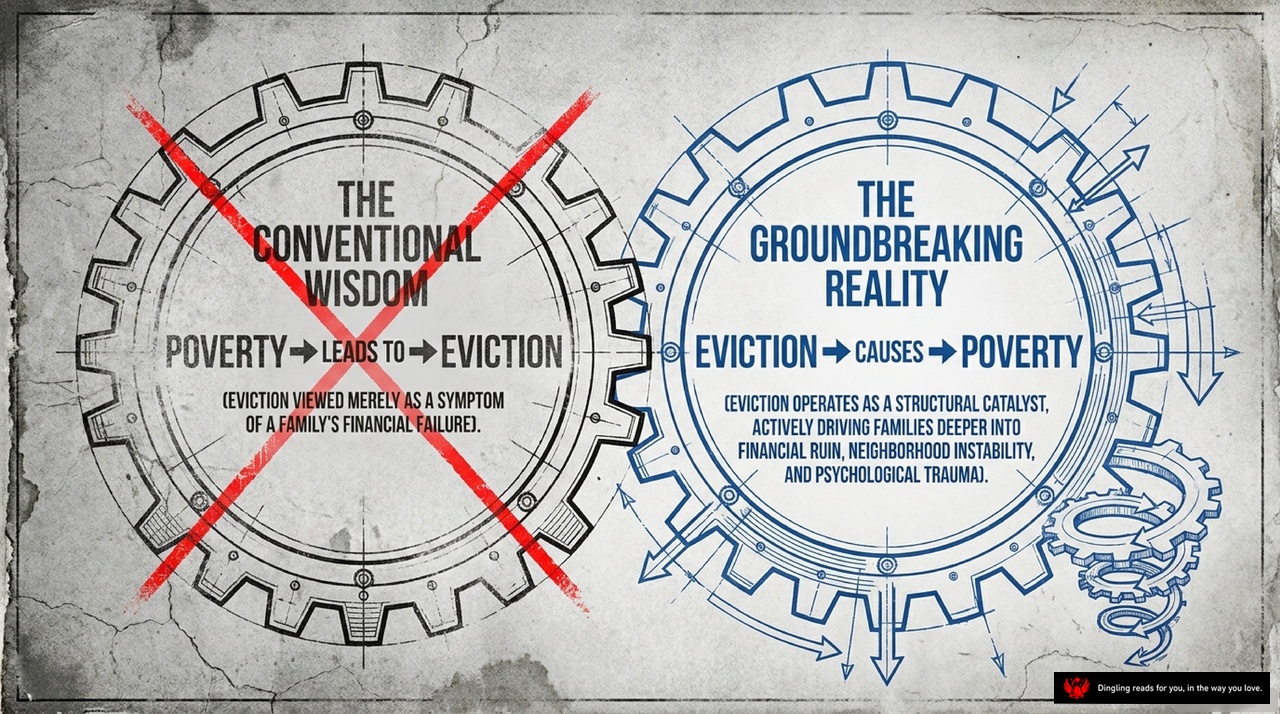
Imagine two gears, spinning in opposite directions. On the left, we see the "Conventional Wisdom"—a simple, crossed-out idea that poverty leads to eviction. It treats eviction merely as a symptom of a family's financial failure, a tragic but passive outcome. But look at the right: the "Groundbreaking Reality." This is the engine that actually drives our crisis. Here, the logic flips completely. Eviction doesn't just happen to the poor; it actively causes poverty.
Think of eviction not as a final sentence, but as a structural catalyst. It's a machine that actively drives families deeper into financial ruin, neighborhood instability, and psychological trauma. When a family gets kicked out, they lose their furniture, their community, and their stability. Suddenly, finding a new home becomes exponentially harder because that eviction record acts as a permanent barrier. The data shows that families who are evicted are 25% more likely to face housing instability afterward.
This cycle creates what urbanist Jane Jacobs called "permanent slums." When you remove a stable family from a neighborhood, you don't just move them; you destabilize the entire block. The next person who moves in might not have the same roots or commitment to maintain the property. This high turnover erodes the trust and social control that make a community safe and vibrant.
The result is a vicious loop. Poverty leads to eviction, but that eviction then manufactures deeper poverty, making it even harder to escape the cycle. It's not just about missing a rent check; it's about a system designed to push people down, ensuring they stay there. This isn't just a housing issue; it's a fundamental failure of our social contract.

Look at this split screen. On the left, we have "The Landlord's Ledger," and on the right, "The Tenant's Ledger." This isn't just a comparison; it's a stark illustration of two completely different realities existing side by side in the same city.
On the landlord's side, the strategy is coldly calculated. It starts with asset acquisition: buying foreclosed properties in struggling neighborhoods at rock-bottom prices, sometimes as low as $10,000 a unit. Then comes revenue maximization. They charge high rents to a captive market of low-income renters who have no other options because of bad credit or past evictions. To keep costs down, they minimize expenses by ignoring structural maintenance, skipping building codes, and simply passing repair costs onto the tenants. Finally, they mitigate risk by using aggressive eviction filings to maintain leverage and collect extra fees.
Now, look at the tenant's side. The burden is crushing. Rent consumes 70% to 80% of their total income, leaving almost nothing for food, utilities, or emergencies. They live under a state of artificial scarcity, accepting broken plumbing, code violations, and even pest infestations simply because they have no choice. Their financial fragility is extreme; for some, the entire welfare check is less than $100 a month, which barely covers the basics. And the most terrifying entry is the constant threat: living under the perpetual shadow of a pink notice, where a single unexpected expense can mean sudden homelessness.
This ledger reveals the brutal math of housing insecurity. One side sees poverty as an investment opportunity; the other sees survival as a daily gamble with no safety net.
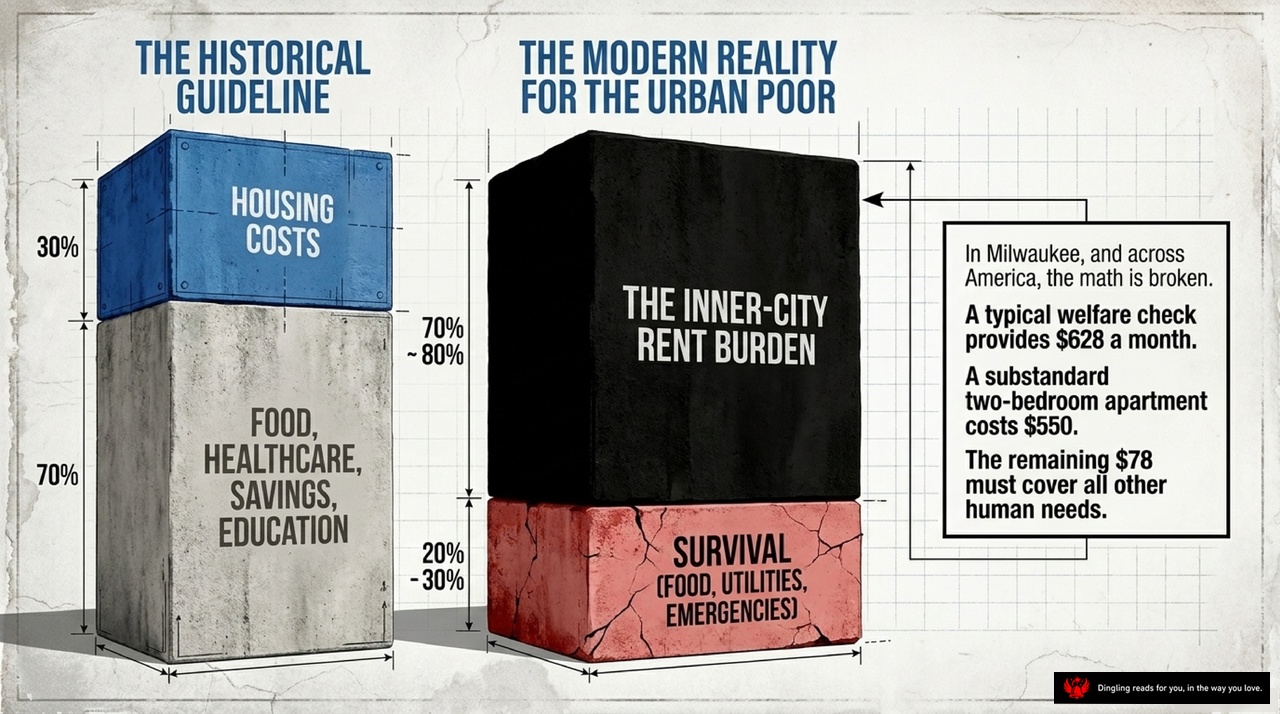
Look at this stark comparison. On the left, we see the "Historical Guideline": a balanced life where housing costs stay at a manageable 30%, leaving the other 70% for food, healthcare, savings, and education. That was the promise. But on the right, we see the brutal reality for the urban poor today. The entire 70% to 80% of their budget is swallowed by what the graphic calls "The Inner-City Rent Burden." There is almost nothing left for survival—just 20% to 30% for food, utilities, and emergencies.
The text on the right makes this math impossible to ignore. In cities like Milwaukee, the system is literally broken. A typical welfare check provides only $628 a month. Yet, a substandard two-bedroom apartment costs $550 just to survive. That leaves a meager $78 to cover everything else. It's a setup for failure from day one.
This isn't just about high prices; it's about a rigged game. The graphic shows how the poor are forced to choose between shelter and life itself, while the historical model of a stable, middle-class life becomes a distant memory. The "inner-city rent burden" isn't a choice; it's a wall that traps families in poverty, leaving them with no safety net and no future.

Look at this slide. It lays out a stark, brutal reality for Black women in Milwaukee. The first box hits us hard with a quote: "Eviction is to Black women what incarceration is to Black men." It's not just about losing a home; it's about a systemic failure where Black women, making up only 9% of the city's population, account for a staggering 30% of all evictions. In the poorest neighborhoods, the odds are terrifying—one in 17 Black women faces eviction every single year.
Then we move to the middle section, "The Penalty of Motherhood." This is where the personal cost becomes clear. Having children triples a tenant's likelihood of receiving an eviction judgment. Why? Because landlords consistently exploit loopholes, file noise complaints, or charge fees for child damage specifically to filter out mothers. The Fair Housing Act is supposed to protect families, but in practice, it's often ignored to make room for profit.
Finally, on the right, we see "The Scale of the Crisis." Between 2009 and 2011 alone, one in eight Milwaukee renters experienced a forced move. This isn't an anomaly; it's a epidemic. These statistics aren't just numbers on a page; they represent shattered lives, broken communities, and a system that has systematically pushed the most vulnerable—especially mothers of color—out of the places they call home.
Home is more than just walls and a roof; it is the very source of our identity, the sanctuary where we finally take off our masks and become ourselves. As Alexis de Tocqueville noted, our concern for what happens right outside our front doors is the bedrock of our democracy. But for millions of American families, that foundation is crumbling under the weight of mass evictions. When you lose your home, you don't just lose a place to sleep; you lose your stability, your dignity, and your future.
The consequences are devastating and far-reaching. Families are forced to leave behind their furniture and belongings, often ending up with nothing but the clothes on their backs. The financial shock is immediate and severe, pushing unemployment rates up by nearly 15% for those who have been evicted. Perhaps most tragically, a single eviction record can lock a family out of public housing for years, trapping them in a cycle of poverty where they are denied the very safety net they need most.
This crisis doesn't just hurt individuals; it tears apart entire communities. High turnover destroys the trust and cooperation that make neighborhoods safe and vibrant. For children, the cost is a broken education and a shattered sense of self-worth, as they are forced to constantly change schools and friends. For mothers, the emotional toll is immense, with depression rates doubling in the wake of eviction.
But there is a path forward. True housing justice is not just a slogan; it is a fundamental right. We need to expand rental assistance programs so that every low-income family can afford safe, stable housing without being priced out. We must ensure that legal aid is available to tenants facing eviction, leveling the playing field against powerful landlords. And most importantly, we must reform the system that treats eviction records as permanent stains on a person's life. By protecting the right to housing, we protect the right to be an American—to live with security, to raise our children, and to build a future.

Home is never just bricks and mortar; it is the source of our identity, the only place where we can finally take off our masks and be ourselves. It is where children dream and grow, where adults build lives and raise families. As Tocqueville noted, our care for our homes is the very foundation of American democracy. A stable home is the concrete expression of liberty and the starting point for a better life. Without it, privacy, safety, and even the ability to work or speak freely vanish into thin air.
But eviction is ruthlessly destroying this foundation. Millions of families are forced out every year, losing not just their furniture and clothes, but their future. The data is stark: families facing eviction are nearly 15% more likely to lose their jobs, and within two years, their risk of falling into deep poverty jumps by 20%. The scars go far deeper than just the loss of a roof; mothers are twice as likely to develop clinical depression, and children suffer from the trauma of constantly changing schools, their self-worth eroded by the instability. This isn't just an individual tragedy; it tears communities apart, turning neighbors into strangers and driving up crime.
The solution lies in recognizing housing as a fundamental right, not a luxury. We need to fix the broken safety net that leaves most low-income renters struggling. Imagine a system where every family, regardless of income, has a rental voucher allowing them to choose a home that keeps their rent under 30% of their income. This model has worked in other nations, preventing the creation of segregated ghettos while giving families dignity and choice. We also need to bring public defenders into housing courts. Right now, landlords have legal teams, while tenants face complex legal battles alone. Providing free legal aid could stop the vast majority of unjust evictions, saving lives and taxpayer money at the same time.
Finally, we must challenge the profit-driven logic that treats low-income tenants as disposable. Just as we have minimum wage and workplace safety laws, we need protections against predatory rent hikes and abusive eviction practices. The current system labels families as "bad tenants" for no fault of their own, trapping them in a cycle of homelessness. True justice means ensuring that everyone, no matter their background, has the right to a stable, decent home. It is time to stop treating housing as a commodity and start treating it as the essential right it truly is.
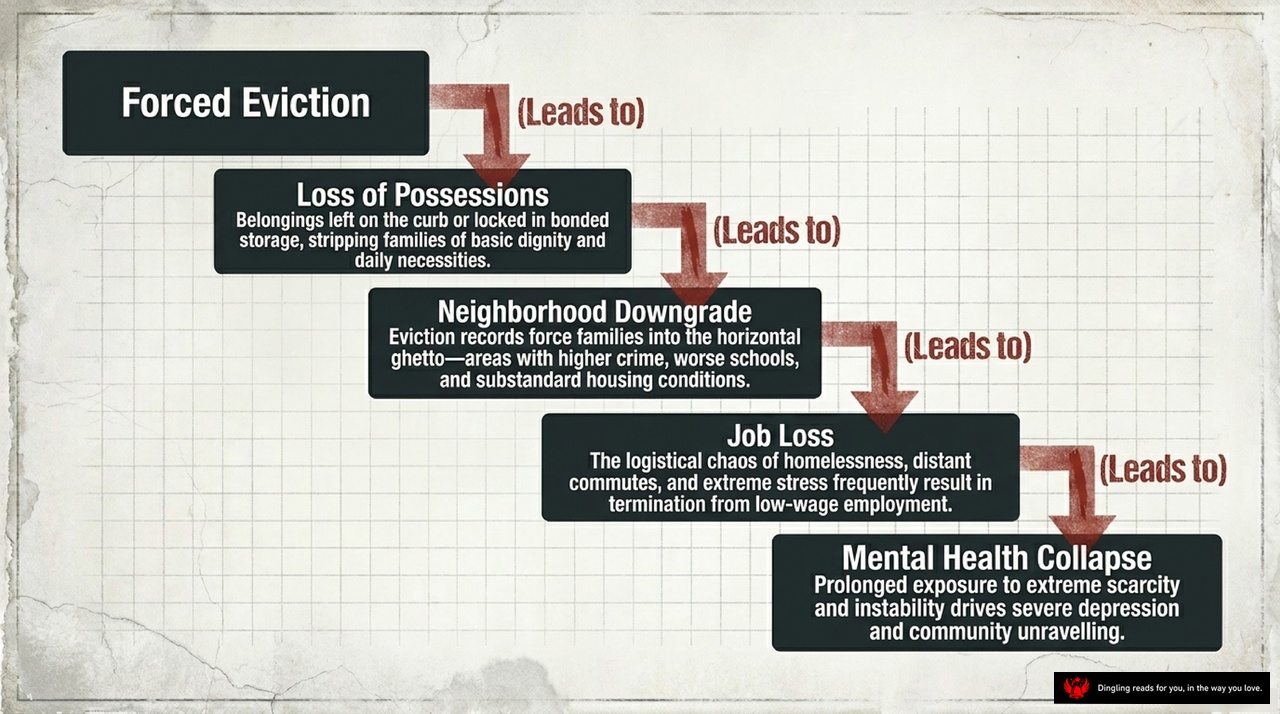
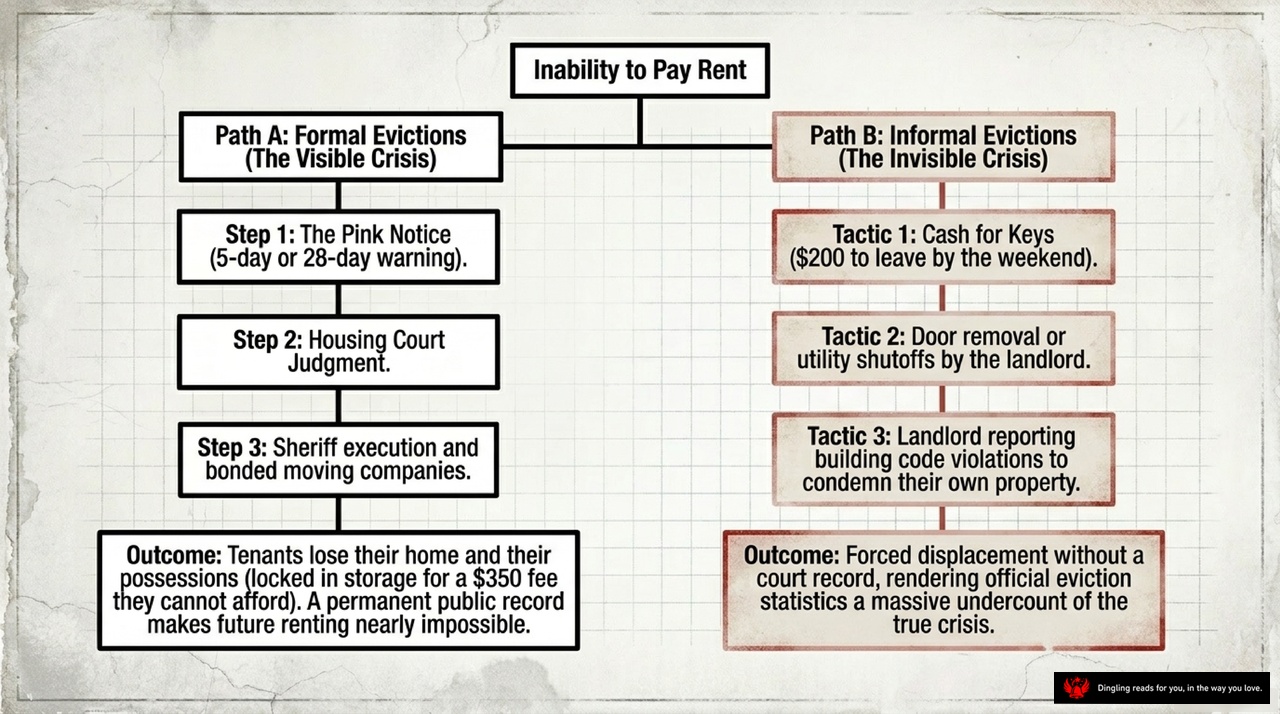
Forced eviction isn't just about losing a key; it's a domino effect that dismantles an entire life. As we see here, it starts with the **Loss of Possessions**. Families are stripped of their dignity, left with belongings piled on the curb or locked away in bonded storage, losing everything they've built.
This loss forces them into **Neighborhood Downgrade**. Once evicted, families are often pushed into "horizontal ghettos"—areas plagued by higher crime, worse schools, and substandard housing. The map shows this isn't a random shift; it's a forced migration into environments with fewer resources and more danger.
That unstable environment leads directly to **Job Loss**. The logistical chaos of homelessness, combined with the stress of distant commutes and a lack of stability, frequently results in termination from low-wage employment. When you can't show up reliably, you can't keep your job.
Finally, this cycle culminates in a **Mental Health Collapse**. Prolonged exposure to extreme scarcity and instability drives severe depression and community unraveling. The stress of rebuilding from nothing breaks the mind as surely as it breaks the home. This isn't just a personal tragedy; it's a systemic failure that traps families in a cycle of poverty with no clear path out.

Home as a Commodity versus Home as a Sanctuary: This slide lays bare the brutal divide between how we treat shelter. On the left, we see the hyper-capitalist engine where housing is just another asset for wealth accumulation. For landlords like Sharona, it's a cold calculation—protecting ROI, excluding anyone who might lower property values, and treating basic human needs as vehicles for extraordinary profit. It's a system where the urban poor are systematically alienated, facing the constant threat of displacement because they aren't seen as people, but as obstacles to profit.
But look at the right side: Home as a Sanctuary. This is the ideology we should be fighting for. It views the home as the wellspring of our personhood and identity, a place for civic engagement and psychological safety. It's about the human desire to nest, to build community ties, and to have a reliable refuge from the chaos of the world. Yet, as the text reveals, this fundamental human right is being denied. When we treat homes purely as commodities, we destroy the very fabric of community. We create "permanent ghettos" where families like the Sincesters lose their stability, and where neighbors stop trusting each other. The result isn't just financial loss for tenants; it's a shattered sense of self and a broken society. True housing justice isn't just about finding a roof; it's about restoring the right to belong, to grow, and to be safe.
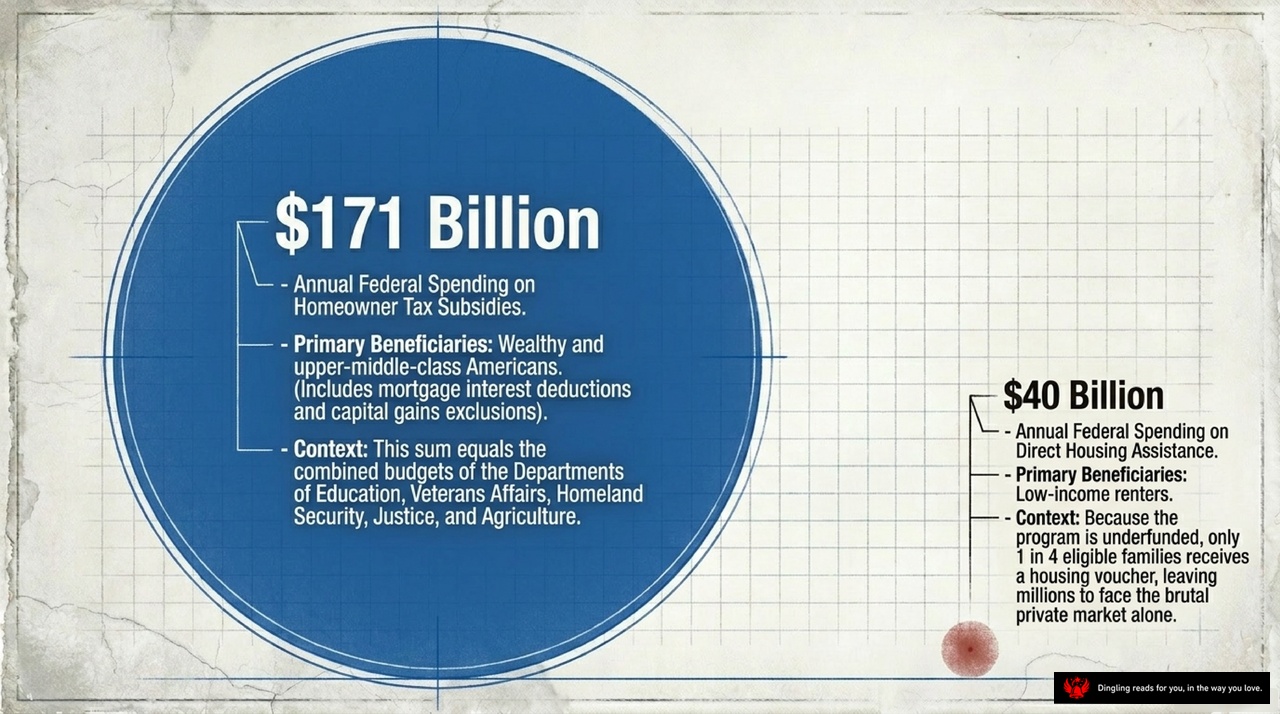
Look at this stark comparison. On the left, we see $171 billion—the annual federal spending on homeowner tax subsidies. The primary beneficiaries here are wealthy and upper-middle-class Americans, enjoying benefits like mortgage interest deductions and capital gains exclusions. This massive sum is actually equal to the combined budgets of the Departments of Education, Veterans Affairs, Homeland Security, Justice, and Agriculture.
On the right, the figure is $40 billion for direct housing assistance, primarily for low-income renters. But here's the catch: because the program is severely underfunded, only 1 in 4 eligible families receives a housing voucher. This leaves millions of vulnerable families facing the brutal private market alone.
This slide highlights a profound imbalance in our housing policy. We are pouring hundreds of billions into subsidizing homeownership for those who can already afford it, while the safety net for renters is so thin that it fails to catch the vast majority of those who need it most. It's a system where the financial safety net is built for the top, while the rest are left to navigate a housing crisis with almost no support.
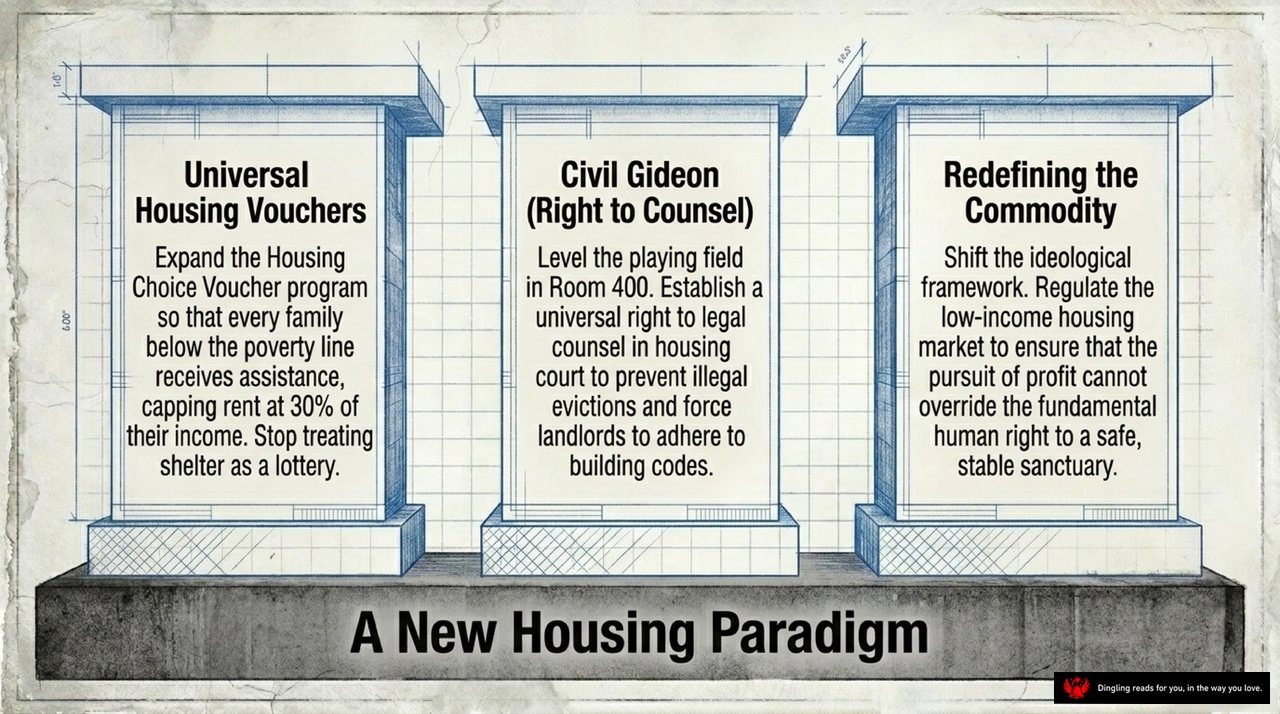
Imagine a building where justice, not profit, is the foundation. Today, we are proposing a new housing paradigm built on three essential pillars: Universal Housing Vouchers, Civil Gideon, and redefining the very nature of housing as a commodity.
First, let's talk about **Universal Housing Vouchers**. Currently, shelter often feels like a lottery for low-income families. We need to expand the Housing Choice Voucher program so that every family below the poverty line receives assistance. By capping rent at just 30% of their income, we stop treating survival as a gamble and ensure that no family is priced out of the market simply because they are poor.
Second, we must establish **Civil Gideon**, or the Right to Counsel. Right now, the legal playing field is uneven. Landlords have attorneys, while tenants face eviction alone. We need to establish a universal right to legal counsel in housing court. This isn't just about fairness; it's about preventing illegal evictions and forcing landlords to adhere to building codes. Imagine a system where a tenant's rights are defended as vigorously as a landlord's profit margins.
Finally, we need to **Redefine the Commodity**. We must shift the ideological framework that treats housing purely as an asset for speculation. We need to regulate the low-income housing market to ensure that the pursuit of profit cannot override the fundamental human right to a safe, stable sanctuary. Housing is not a product to be exploited; it is a human right.
Together, these three pillars form a new housing paradigm—one that protects the vulnerable, levels the legal playing field, and prioritizes human dignity over financial gain.

Home is not just a place; it is the foundation of our dignity. When we accept that a safe home is essential for human survival, how can we continue to tolerate a system that treats shelter as a luxury only the privileged can afford?
In Milwaukee, the reality is stark. The American housing market has transformed our basic need for shelter into an engine of exploitation. Landlords like Sheralyn turn poverty into profit, viewing tenants' struggles as business opportunities rather than human crises. They calculate every decision down to the cent, balancing mortgage payments against the risk of eviction, often prioritizing profit over people.
For families like the Sincesters, eviction is not a one-time event but a trap. After being forced out of their stable home, they land in overcrowded, dilapidated conditions where mold, pests, and broken pipes become daily realities. This displacement doesn't just move them physically; it tears apart their community. As Jane Jacobs noted, when stable residents are pushed out, neighborhoods lose their guardians, leading to what sociologists call "permanent ghettos."
The cycle is brutal and self-perpetuating. Evicted families face a 25% higher risk of finding substandard housing next time. They lose furniture, jobs, and social connections, often falling into a deep cycle of poverty from which there is no easy escape. Statistics show that evicted families are 20% more likely to face severe material hardship in the following two years.
But the cost extends beyond the individual. It rips apart the entire community, increasing crime rates and destroying the trust that holds neighborhoods together. For children, frequent moves mean disrupted education and shattered self-worth. For mothers, the trauma of eviction can lead to clinical depression, leaving a shadow that lasts for years.
We cannot accept this as inevitable. The path forward requires bold policy changes. We need to expand housing vouchers so every low-income family can choose a safe home without fear of discrimination. We must provide legal defense in housing courts to level the playing field between landlords and tenants. And most importantly, we must challenge the logic that treats low-income housing as a commodity to be exploited rather than a right to be protected.
True justice means ensuring that a safe home is not a privilege, but a guarantee for every person, regardless of their background or income. Only then can we build a society where everyone has the foundation they need to thrive.