
Factfulness: Complete Chapter-by-Chapter Summary

Welcome to *Factfulness*. This isn't just another book about the world; it's a manual for fixing your brain. Written by Hans Rosling and his team, this book tackles a simple but powerful idea: we are wrong about the world, and things are actually much better than you think.
The cover itself sets the stage. Those colorful, glowing bubbles represent the complexity of reality, contrasting with our tendency to see the world in black and white. The subtitle promises ten reasons why our intuition fails us. We are wired with instincts that helped our ancestors survive in the savannah, but they are terrible tools for navigating the modern, interconnected world. Instead of reacting with fear or bias, we need to adopt a "factful" mindset. This means replacing our gut feelings with data, seeing the world not as a series of extremes, but as a spectrum of gradual improvement. By understanding how our brains trick us, we can stop panicking about problems that are getting solved and start focusing our energy on the real challenges that matter. Let's dive into the ten instincts that keep us wrong, and learn how to see the world as it truly is.

Imagine you are a human expert, the kind who holds a briefcase, stands on a podium, or works in a government building. You might assume your knowledge is superior, right? But look at this chart. It reveals a shocking truth: when tested on basic global facts, your average score is only between 10% and 20%.
Now, look at the other side. This is a chimpanzee choosing between three bunches of bananas. If you pick randomly, your success rate is 33%. And guess what? That chimpanzee outperforms the average human expert.
This isn't just about ignorance. The insight here is profound: our knowledge is actually actively outdated, and we are systematically biased. We aren't just lacking information; we are holding onto old data and letting our instincts distort reality.
In a world that changes rapidly, relying on the "expert" label is dangerous. The real experts are the data, not the title. So, how do we stop being the monkey with the bananas? We need to move beyond our gut feelings and start looking at the actual trends. Instead of fearing the unknown or assuming things will stay the same, we must learn to read the curves of reality. Whether it's the rise of global life expectancy or the stabilization of population growth, the facts tell a different story than our fears do.
Let's stop guessing and start seeing the world as it truly is. The next step is to identify the specific cognitive traps—like binary thinking or linear assumptions—that are keeping us stuck in the past. Once we see those traps, we can finally upgrade our mental operating system.

Mode 1, Evolutionary Survival, represents that over-dramatic worldview where our brains evolved to jump to quick conclusions, fear threats, and crave drama to survive in ancient times. But Mode 2, Factfulness, offers a fact-based worldview that overrides dread and rigid filters by choosing data instead. Modern reality requires overriding our instincts with critical thinking, paused reactions, and data.
Think about the lion icon on the left—it symbolizes that ancient survival instinct. It triggers a red, reactive path in our brain, pushing us toward panic and oversimplified binaries. In contrast, the blue path on the right represents the calm, analytical approach of Mode 2. It connects to icons for analysis, growth, and pausing, reminding us that true progress isn't about reacting to every scare, but about understanding the underlying trends.
We often mistake a dramatic, single event for the whole story. For instance, we might focus on a rare plane crash and believe air travel is dangerous, ignoring the fact that billions of flights land safely every year. Or we might fixate on a single starving child and conclude that poverty is everywhere, missing the reality that extreme poverty has been halved globally. These are the traps of Mode 1.
To move forward, we must embrace the blue path. We need to pause before reacting, look at the full dataset rather than just the headline, and recognize that the world is constantly improving, even when it feels chaotic. By switching from the red, reactive mode to the blue, fact-based mode, we can see the world clearly, make better decisions, and stop letting our ancient instincts dictate our modern reality.

Have you ever felt that the world is split into two opposing camps: "us," the wealthy and developed, versus "them," the poor and struggling? It feels like a natural divide, doesn't it? But what if I told you that this "gap" is actually a myth?
Look at the reality below the myth. Instead of two separate peaks, the truth looks like a massive, overlapping mountain of colorful dots. This visual represents the most important statistic you need to know: seventy-five percent of humanity lives right here in the middle. The "gap" simply does not exist anymore.
We have moved from a world of extremes to a world of the "Overlapping Middle." In this vast middle ground, people aren't starving or living in extreme luxury; they are living lives of steady improvement. They might be saving for a bicycle, buying a plastic bucket, or ensuring their children can study under an electric light. They represent the true face of our planet.
When we stop seeing the world as a binary choice between rich and poor, we finally start to see the complexity of human life. We realize that the majority of us share similar struggles and aspirations. This shift in perspective is the first step toward understanding the real world, because it breaks the illusion that there are only two types of people. The truth is far more diverse, and far more connected, than we ever imagined.

The image in front of us illustrates a powerful truth that counters our most instinctive biases: the world isn't a binary choice between the "rich" and the "poor." Instead, it's a spectrum of four distinct levels. As we climb these steps, we see the real structure of human life.
At the bottom, Level 1 represents extreme poverty, where about one billion people struggle to survive. Life here is defined by scarcity—hours spent fetching water, reliance on basic food, and a constant fear of falling ill without access to medicine. Moving up to Level 2, we find the "Basic Needs Met" group, comprising three billion people. Here, life stabilizes. Families can afford enough food, simple clothes, and even a bicycle. Water is closer, and children can study under a lightbulb, though power remains unreliable.
Level 3 is the "Rising Middle," home to two billion people. This is where life truly transforms. With access to running water, electricity, and refrigeration, diets improve, and education becomes a reality. A motorcycle expands their world, allowing them to reach better jobs and save for their children's future. Finally, at the top, Level 4 represents the high-income group—one billion people who are mature consumers with cars, planes, and stable careers.
The most striking fact on this slide is right here: five billion people—the majority of humanity—now live in Levels 2 and 3. This means that the vast majority of the world is not in extreme poverty, nor is it ultra-wealthy. They are in the middle, steadily improving their lives. This visual reminds us that the "developing vs. developed" divide is a myth. By understanding these four levels, we stop seeing the world in black and white and start seeing the complex, diverse reality where most of us actually live.

Let's talk about the gap between what we see and what is actually happening. On the left, look at that magnifying glass. It's zoomed in on a jagged red line, representing the constant noise of bad news we see every day. We are told the world is getting worse, that disasters are everywhere. But the text reminds us: we hear about bad events simply because our global surveillance and media reporting have improved, not because the world is actually deteriorating.
Now, look to the right at the concept of "The Unseen Miracle." While the noise on the left suggests chaos, the green curve on the right tells a different story. It shows that in the past 20 years, the proportion of people living in extreme poverty has actually halved. Billions of incremental improvements happen daily—people getting vaccinated, children surviving diseases, families finding stable work—but these changes rarely make the headlines. They are the quiet, steady progress that gets lost in the media storm.
The core lesson here is to stop letting the loudest noise dictate your reality. Just because you constantly hear about crises doesn't mean the world is failing. In fact, the data proves we are in the middle of a massive, unseen recovery. True progress isn't always dramatic; often, it's just the slow, steady climb out of poverty that happens right under our noses, unnoticed by the world but life-changing for billions.

Today's slide breaks down four distinct patterns that often hide in plain sight, shaping how we misunderstand the world. First, look at "The False Assumption," marked by that big red X. This represents our dangerous habit of assuming current trends will continue in a straight line forever. We see growth now, so we assume it never stops. But as we've discussed, the world rarely moves in straight lines.
Next is "The S-Curve," illustrated here by basic education and literacy rates. You'll notice it starts slow, accelerates rapidly in the middle, and then plateaus. This isn't linear; it's a natural progression where progress takes time to gather momentum before hitting a ceiling.
Then we have "The Slide," shown by the green line dropping and flattening out. This captures the reality of extreme poverty and child mortality. For centuries, these numbers were high, but they have been steadily sliding down, eventually stabilizing at a much lower, sustainable level. It's a story of decline that we often fail to see because we're focused on the past.
Finally, there is "The Hump," depicted by the yellow curve peaking and falling. The example given is the "Peak Child" phenomenon. We have about 2 billion children today, but the United Nations projects that by 2100, that number will remain stable. Why? Because population growth isn't infinite; it follows a hump shape where the current generation of children grows up to fill the gaps left by aging parents, eventually balancing out. Understanding these curves—the S-shape, the slide, and the hump—is the key to stopping the "False Assumption" of endless linear growth and seeing the true, complex rhythm of our world.
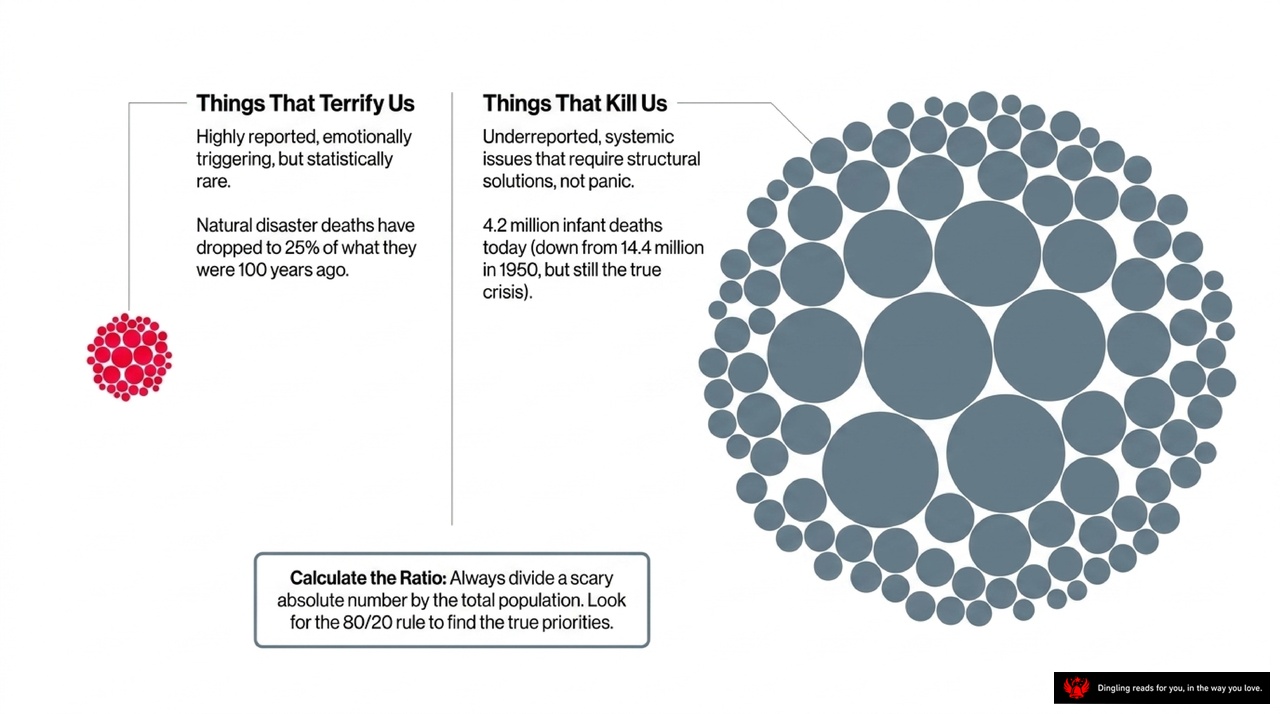
When we look at the terrifying headlines, our brains often trick us into thinking the world is falling apart. But the data tells a completely different story. This slide highlights a critical distinction: the difference between "Things That Terrify Us" and "Things That Kill Us."
On the left, we see natural disasters. These are highly reported and emotionally triggering, yet statistically rare. Natural disaster deaths have dropped to just 25% of what they were 100 years ago. However, on the right, we see the silent crisis: "Things That Kill Us." These are underreported, systemic issues that require structural solutions, not panic. The most striking example is infant mortality. Today, 4.2 million infants die annually. While this is down from 14.4 million in 1950, it remains the true crisis of our time.
We need to change how we calculate risk. As the bottom box suggests, always calculate the ratio by dividing a scary absolute number by the total population. This is where the 80/20 rule helps us find true priorities. We often fear the rare event—the plane crash, the earthquake—while ignoring the common killers like diarrhea or malnutrition, which claim far more lives. By shifting our focus from the dramatic to the systemic, we stop panicking about the unlikely and start solving the problems that actually kill us.
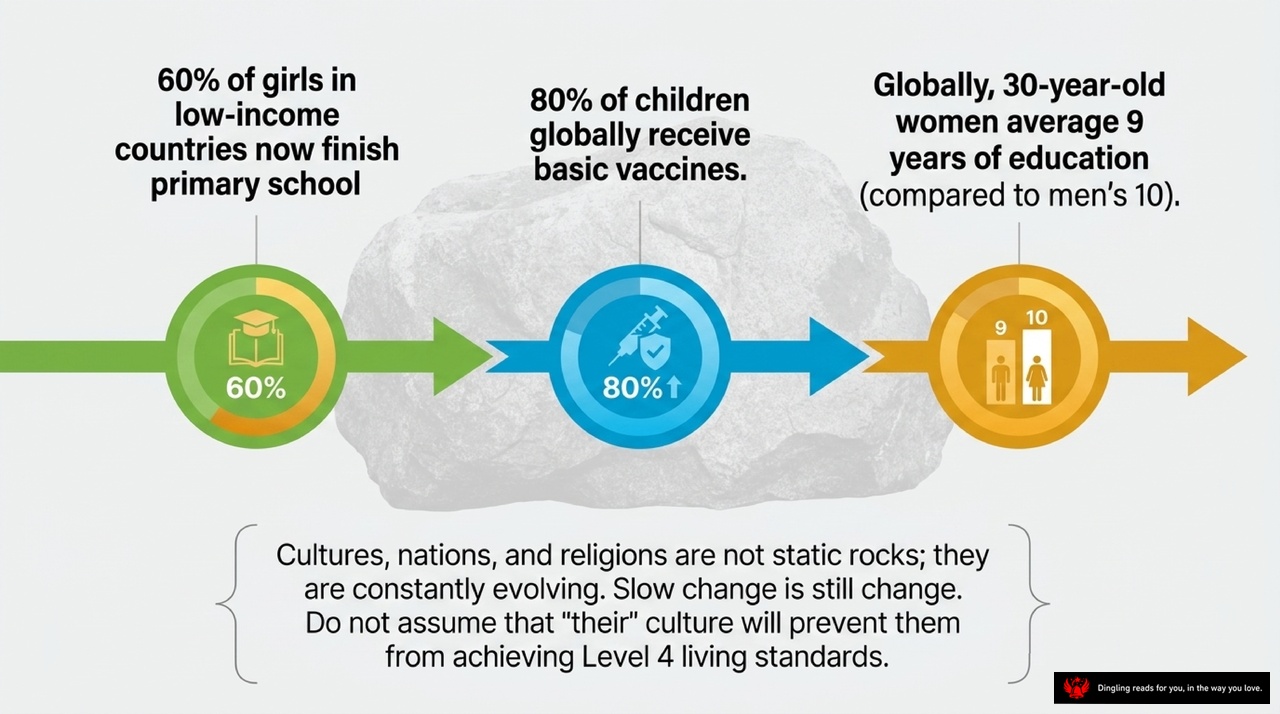
We are living in a world that is constantly evolving, not a static collection of unchangeable cultures or nations. A powerful message on this slide reminds us: "Cultures, nations, and religions are not static rocks; they are constantly evolving. Slow change is still change." This is a crucial mindset shift. Too often, we assume that someone else's culture will act as an insurmountable barrier, preventing them from achieving a high standard of living. But the data tells a different story.
Look at the first milestone: 60% of girls in low-income countries now finish primary school. This isn't a distant dream; it's a reality happening right now. Next, we see that 80% of children globally receive basic vaccines. This massive progress in health is a direct result of slow, persistent improvements in infrastructure and education, proving that poverty is not a permanent state.
Finally, consider the education gap between genders. Globally, 30-year-old women average 9 years of education, which is only one year behind men. This is a dramatic improvement from decades past. These statistics dismantle the myth of "development traps." They show that even in the poorest regions, life is getting better, and the gap is narrowing. By recognizing that change is always happening, we stop underestimating the potential of others and start seeing the real, dynamic world we live in.
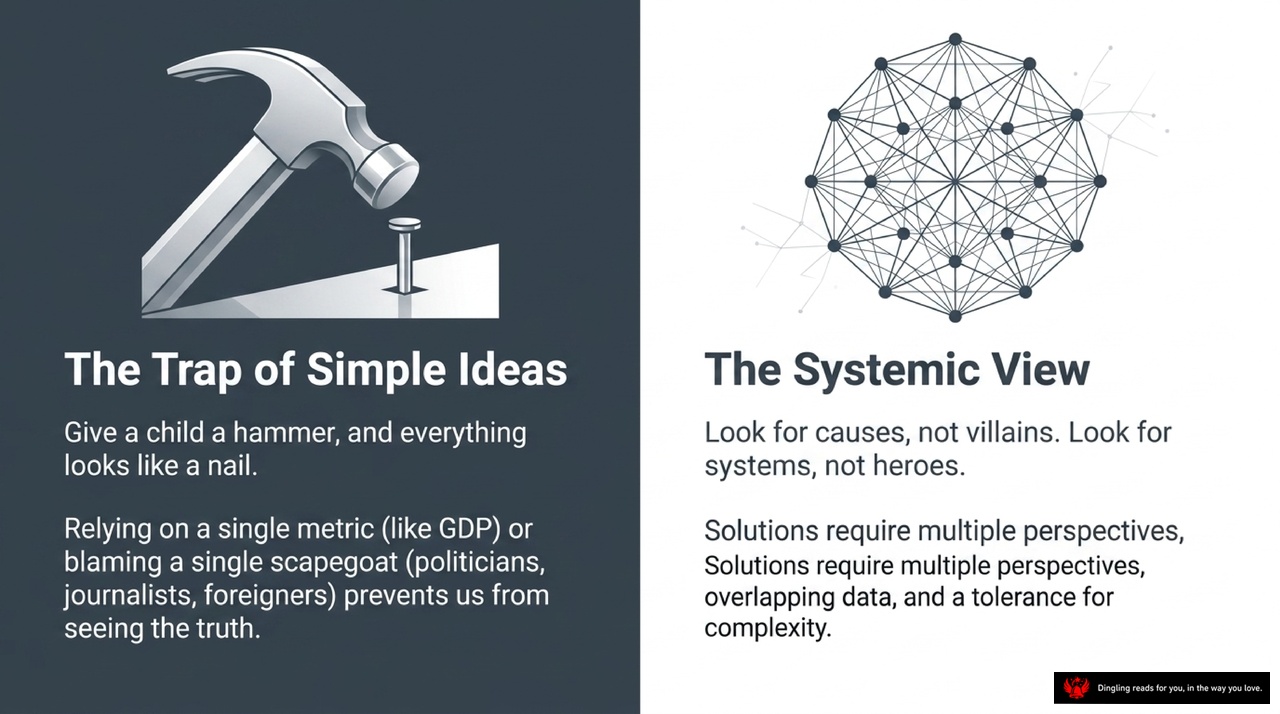
So, here is the reality check we need to make today. Look at these two images. On the left, we have a hammer and a nail. This represents "The Trap of Simple Ideas." It's that classic saying: give a child a hammer, and everything looks like a nail. We are so addicted to simple explanations that we start blaming a single scapegoat for every problem. We point fingers at politicians, journalists, or foreign countries, thinking that if we just punish one villain, everything will be fixed. But this narrow view prevents us from seeing the truth.
On the right, we see a complex web. This is "The Systemic View." Instead of looking for villains, we need to look for causes. Instead of searching for heroes who will save us, we need to look at systems. Real solutions don't come from a single perspective or a magic bullet. They require overlapping data, multiple viewpoints, and a healthy tolerance for complexity.
The text on your screen says it clearly: relying on a single metric or blaming a single scapegoat blinds us. But when we shift to a systemic view, we stop fighting imaginary enemies and start solving actual problems. We stop asking "Who is to blame?" and start asking "What is the system doing?" That shift is the difference between making things worse and finally making them better.

On the left, we see the silent backbone of our world: Institutions. Think of the plumbers, nurses, and teachers—the invisible networks that quietly save millions of lives every single day. Without them, our schools, hospitals, and homes would simply fall apart.
On the right, we have Technology. It's like the magic washing machine. Sure, it does more than just clean clothes; it liberates billions of hours. That extra time allows mothers to read and daughters to go to school, sparking a ripple effect of progress.
Here is the crucial distinction: Institutions are the people and the systems we rely on to function, while Technology is the tool that frees us up to build better lives. We often talk about "developed" versus "developing" countries as if there is a massive gap, but the reality is far more nuanced. The true divide isn't between nations; it's between income levels. Most of the world lives in the middle, relying on a mix of institutions and technology to improve their daily reality. Recognizing this helps us stop looking at the world in black and white and start seeing the complex, interconnected reality that actually exists.
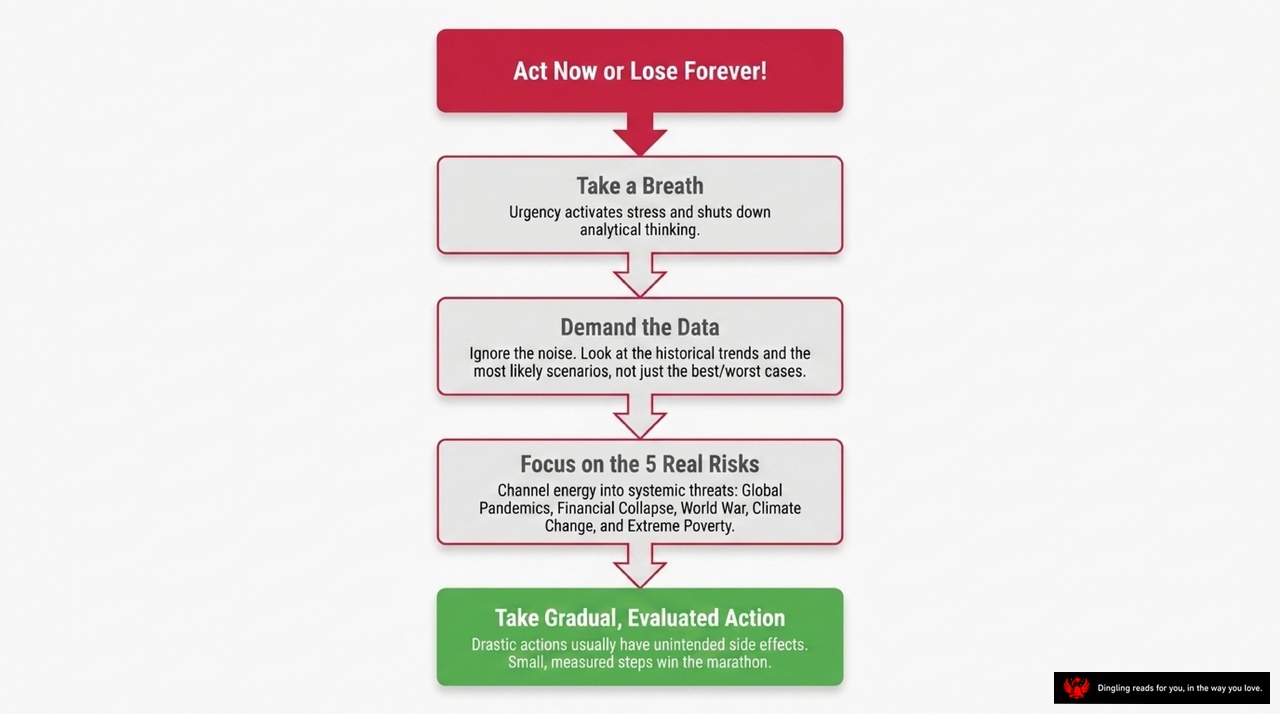
Act Now or Lose Forever! This isn't just a slogan; it's the reality we face when we let fear and bad habits dictate our choices. But before we panic, let's pause. Urgency activates stress, and stress shuts down our analytical thinking. When we feel the pressure, our brains go into survival mode, ignoring the data we actually need.
So, take a breath. Once you're calm, demand the data. Ignore the noise and the sensational headlines. Instead, look at historical trends and focus on the most likely scenarios, not just the best-case or worst-case extremes. We need to channel our energy into the five real risks that threaten us all: global pandemics, financial collapse, world war, climate change, and extreme poverty. These are the systemic threats that matter.
But here's the key: don't rush to drastic measures. Drastic actions often have unintended side effects. Instead, take gradual, evaluated action. Small, measured steps win the marathon. By combining a clear understanding of the risks with calm, data-driven decisions, we can navigate the future without losing it forever.
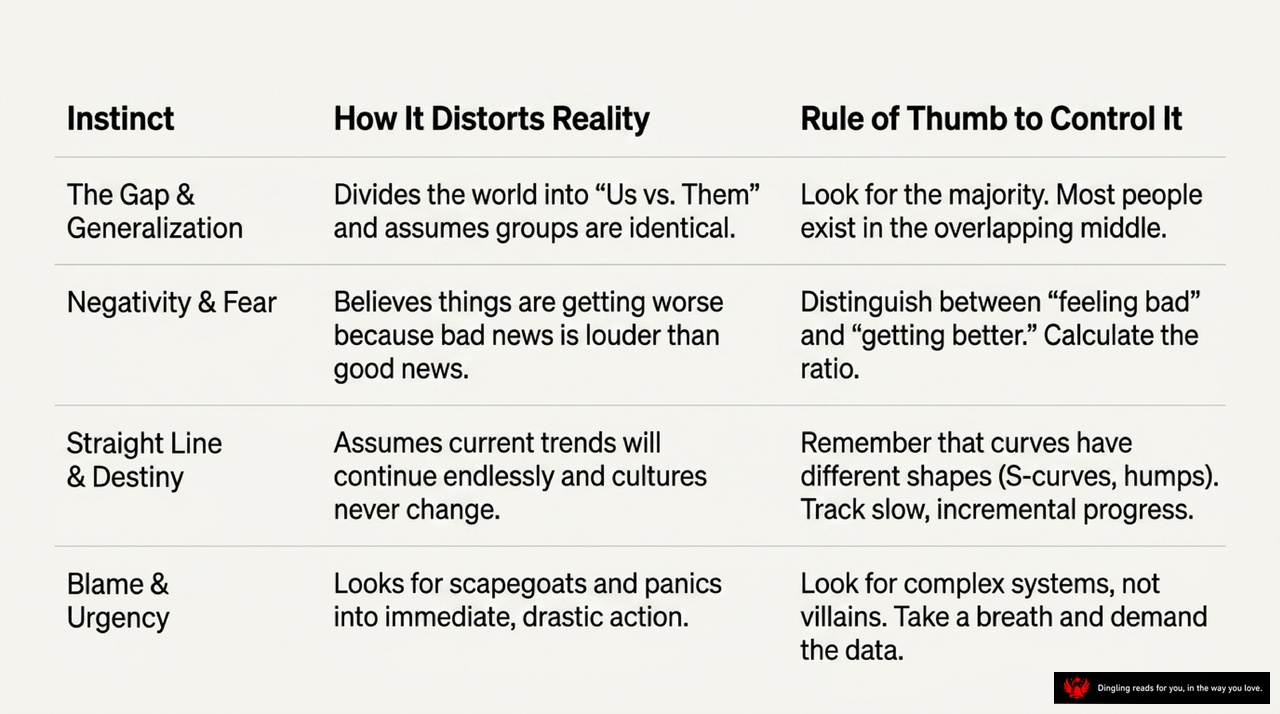
Here is the spoken script for slide 12, tailored for an American audience with a natural, engaging tone.
***
**Slide 12 Script:**
"Let's talk about the four mental traps that are quietly distorting how we see reality, and the simple rules to fix them.
First, our brain loves to create a 'Us vs. Them' gap. It forces us to see the world in black and white, ignoring the messy middle where most people actually live. The fix? Stop looking for extremes and start looking for the majority. Remember, most people exist in an overlapping middle, not on opposite poles.
Second, we are wired for negativity. Bad news travels faster and feels louder than good news, tricking us into thinking the world is getting worse. But just because things feel bad doesn't mean they are. You need to distinguish between your feelings and the actual trend. Calculate the ratio and trust the data, not the drama.
Third, we fall into the 'Straight Line' trap. We assume current trends will continue forever in a straight line, ignoring that life follows curves—S-curves, humps, and plateaus. Whether it's population growth or disease rates, trends bend. So, remember that progress is often slow and incremental, not a straight rocket to the moon.
Finally, when things go wrong, our instinct is to find a villain and panic for a quick fix. We look for scapegoats instead of understanding complex systems. The antidote is to take a breath, demand the full data, and look for the underlying system rather than just blaming a person.
By mastering these four rules, you can stop reacting to illusions and start navigating the real world with clarity."

Look at this slide. It breaks down how we can actually change the world by fixing our own thinking in three key areas: Education, Business, and Daily Life.
First, in Education, we need to stop teaching the outdated "Developed vs. Developing" binary. That simple two-part split is a major cognitive trap that blinds us to reality. Instead, we must teach the Four Income Levels framework. This gives students the tools to accurately track global progress, seeing that the vast majority of humanity lives in the middle, rather than assuming the world is just rich and poor.
Second, in Business, the goal is to avoid missing the greatest economic opportunity in history. We often ignore the future 4 billion consumers who are currently rising through Levels 2 and 3 in Asia and Africa. If we stick to our old stereotypes, we fail to see this massive, growing market right in front of us.
Finally, in Daily Life, we need to cultivate humility and curiosity. We must accept that our worldview needs constant updating. When we make mistakes or encounter new information, let those moments inspire curiosity rather than embarrassment. Only by staying open to change can we truly understand the complex, evolving world we live in.

The world isn't as broken as our brains try to convince us it is. We have a hardwired instinct to split reality into black and white, to see the world as either "developed" or "poor," or to believe that things will just keep getting worse in a straight line. But the data tells a completely different story.
Look at the reality of global progress. While we often focus on the dramatic tragedies that make the headlines—plane crashes, wars, or natural disasters—these are statistical outliers. The true story is one of slow, steady improvement. Think about air travel: in 2016, 40 million commercial flights landed safely, with only 10 crashes. Yet, our fear of flying remains high because we only remember the crashes. Or consider extreme poverty: in 1800, over 85% of humanity lived in extreme poverty. Today, that number has nearly halved, with billions lifted out of destitution, yet our gut feeling often tells us the opposite.
This isn't about blind optimism. It's about swapping our dramatic instincts for a fact-based worldview. When we stop looking for a single villain to blame and start looking at the system, or when we stop assuming a straight line and look for the actual curve, we see the truth. The world is not deteriorating; it is evolving. There are new possibilities everywhere if we just have the courage to look past our biases and trust the evidence. The challenge isn't that the world is hopeless; it's that we need the dedicated effort to see clearly and act accordingly.