
Factory Girls: Complete Chapter-by-Chapter Summary

Welcome to "Factory Girls," a profound journey into the lives of the young women who built modern China. Set against the backdrop of a vast, humming factory floor, this book by Leslie T. Chang captures a defining era. It tells the story of the greatest human migration in history, as millions of rural girls left their villages to manufacture their own destinies in the industrial boomtowns of the Pearl River Delta. These weren't just workers; they were pioneers, navigating a world of uncertainty, ambition, and transformation. Through their intimate portraits, we see how these women traded traditional rural life for the chaotic, electric energy of the city, turning factories into both their workplace and their stage for reinvention.
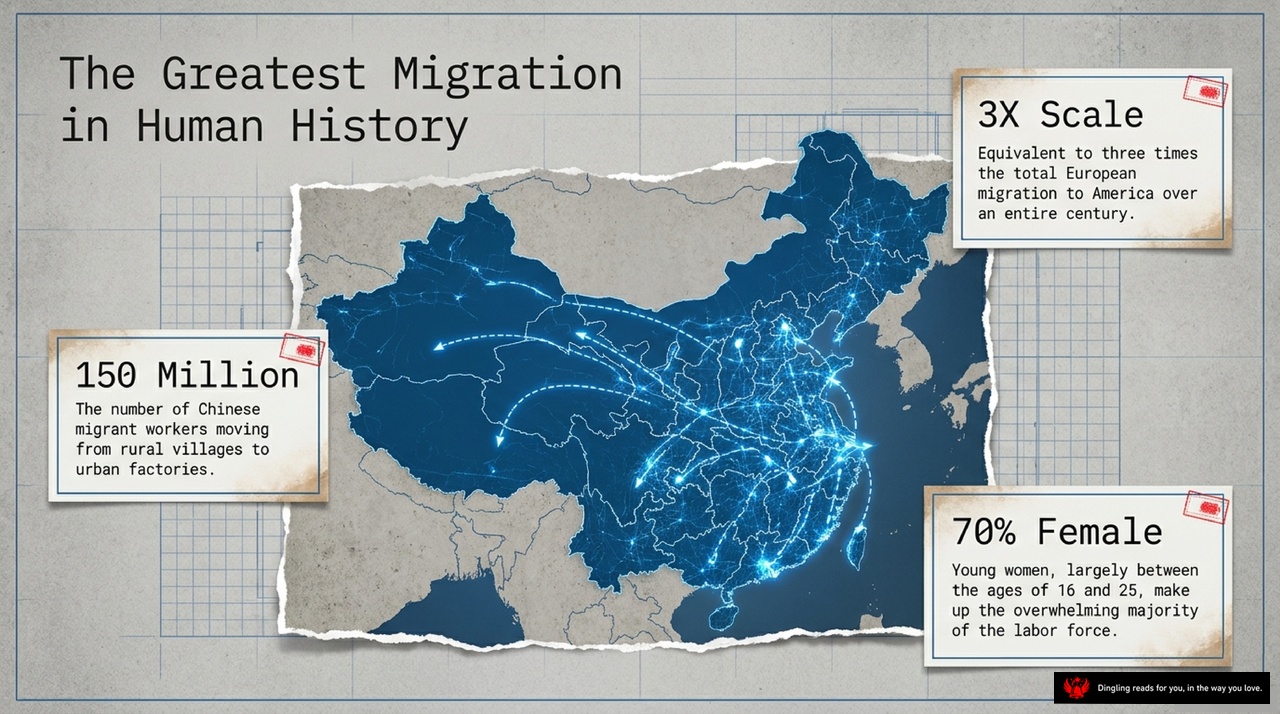
Picture this: A map of China, but not as you know it. It's a glowing blue network of light, tracing the most massive movement of people in human history. We're talking about 150 million Chinese migrant workers leaving rural villages to flood into urban factories. To put that in perspective, this migration is three times the scale of the entire European migration to America over a whole century.
But here's the most striking detail on this slide: 70% of this workforce is female. And specifically, young women between the ages of 16 and 25. These aren't just workers; they are the overwhelming majority of the labor force. They are the engines driving this industrial boom.
For these girls, leaving home wasn't just a change of address; it was a desperate, active break from their fate. Back in the countryside, there was little hope for them. Staying meant failure. Going to the city, even with its low wages and grueling hours, was the only way to escape. They weren't just running away; they were going on an adventure to rewrite their lives.
So, what does this look like on the ground? It looks like a chaotic, vibrant, and often contradictory city like Dongguan. Imagine a landscape where 17th-century agriculture clashes with a high-speed industrial future. You have massive factories humming day and night, sitting right next to muddy swamps and even some remaining rice paddies. It's a place where fake diplomas are sold openly on the street, and where a girl can go from a dusty rural village to a bustling city center in a single lifetime.
This is the reality for these 150 million people. They are the "invisible group" in the official eyes, yet they are the ones building the city. They navigate a system that doesn't always welcome them, facing strict rules, crowded buses, and a constant pressure to succeed or be left behind. But despite the challenges, they are the most educated and ambitious group of rural youth in China. They are proving that "going out" is the only path to changing their destiny.

Welcome to Dongguan: Built for Machines, Not Men. Look at this blueprint of the city. It's a sprawling industrial machine where 1.7 million locals share space with an estimated 7 to 10 million migrant workers. Note that stamp: official census data is void. The real story isn't in the numbers, but in the grid. Ten-lane highways crisscross the city with zero crosswalks. You navigate this concrete jungle by dodging trucks and hopping fences. There are no sidewalks for people, only for the machines that drive this economy.
Now, look at the ecosystems. This city is built on 32 specialized towns. Each town has a specific job: Changan manufactures electronics, Dalang knits sweaters, and Houjie produces shoes. Factories are the only landmarks here. There are no parks, no historic centers, just endless rows of white tiled factories housing the world's supply chain. This is a city designed purely for efficiency and production, not for human life. It's a place where you trade your freedom for a paycheck, and the city runs on the relentless rhythm of the assembly line.

Welcome back. Today, we're stepping inside the Yue Yuan factory, the massive engine behind the world's most popular sneakers. Imagine this: manufacturing a single pair of shoes isn't just about one person working hard; it's a synchronized dance of 200 pairs of hands. Every cut, every stitch, every sole attachment is a link in a precise human chain that spans the entire factory floor.
But what does this look like for the workers? The rhythm is relentless. During peak seasons like Christmas or summer, the pace is so intense that workers are running two shifts a day, their biological clocks completely shattered by the constant roar of machines. It's a high-pressure environment where stress is the norm. Yet, amidst the grueling 12-to-14 hour days, there are small glimmers of life. When the orders slow down in the summer, the pace eases, and workers get a rare chance to breathe, even to go home for a few days.
For these young women, the factory is more than just a place of labor; it's a classroom for a new kind of city life. They are learning to navigate a world that values ambition and adaptability. They trade traditional rural values for modern urban dreams, spending their meager earnings on things like glittery high heels or studio photos that look nothing like their gritty work environment. They are building a new identity, one where they are no longer just daughters or sisters, but professionals in a global industry.
This shift is driven by a powerful belief: the need to upgrade. Many of these workers realize that staying on the assembly line limits their potential. So, they seek out opportunities to transform themselves. They enroll in night classes, learning office skills, English, and computer literacy. They attend seminars on etiquette and career strategy, studying how to dress like a professional, how to smile with confidence, and how to navigate the complex social rules of the city. It's a desperate but determined effort to break free from the label of "factory worker" and step into the world of the "white-collar" professional. They are rewriting their own stories, one shift and one lesson at a time.

The Catalyst: Why They Go Out. This slide breaks down the powerful forces driving the Great Migration, moving us from the myth of poverty to the reality of ambition.
Look at this image: on the left, we see the harsh, dusty reality of the rural fields. On the right, we see the bustling, complex machinery of the industrial city. The arrow between them represents the escape route chosen by millions.
First, let's bust the biggest myth. Many believe people leave just to escape grinding poverty. But the text reveals the truth: it's not just about survival. The primary drivers are ambition, the desperate pursuit of new skills, and a refusal to accept crippling rural boredom. It's a choice to grow, not just to survive.
Second, consider the demographic. These migrants aren't the average; they are the village elite. They are the younger, the more ambitious, and often the best-educated in their hometowns. They leave because staying behind means accepting a life of limited potential. Going out is the only way to change their destiny.
Finally, look at the escape itself. It's a profound rejection of the patriarchal village structure. In those traditional settings, daughters are often seen as temporary residents, expected to stay until they marry and then move into their husband's home. Leaving is a bold statement of independence. It's a refusal to be defined by tradition.
So, when you see that arrow pointing from the field to the factory, remember: it's not just a journey across miles. It's a journey from a life of expectation to a life of possibility. It's the moment they decide to build their own future, no matter how tough the road gets.

Welcome back to the journey of these resilient young women. Today, we are diving deep into the final chapter of their transformation: the art of the "jump."
Look at this circular diagram on the screen. It maps out the anatomy of a career leap in Dongguan, a cycle that defines their survival and ambition. Let's walk through these steps together.
It all begins with **Step 1: The Grievance**. This is the spark. For these women, it's not just about low wages; it's the crushing realization that their current factory offers no path forward. They see themselves trapped in a loop of repetitive labor, with no new skills to gain. As the text describes, they feel the weight of a future that looks exactly like the past.
Next, they enter **Step 2: The Talent Market**. Imagine a crowded, ruthless bazaar. The rules here are unforgiving: youth and height are strict prerequisites. It's a place where everyone is competing, and the barrier to entry feels impossibly high.
To overcome this, they adopt **Step 3: The Fake Identity**. This is a bold, sometimes desperate move. They borrow ID cards to meet age requirements or fabricate resumes to land white-collar roles. They are essentially reinventing themselves, stripping away their rural origins to present a new, more competitive persona.
But the transition isn't always smooth. Many face **Step 4: The Crazy Leave**. This is the moment of rupture. They quit abruptly, often forfeiting two months of withheld pay just to secure immediate freedom. They choose the pain of losing money over the pain of staying in a dead-end job. It is a declaration that they would rather starve with freedom than feast in captivity.
Then comes **Step 5: The Severance**. This is the hardest part emotionally. It means abandoning old friends and leaving behind the safety net of their past. As the quote in the center reminds us, "The easiest thing in the world is to lose touch with someone." Yet, they do it. They cut ties to move upward.
This entire cycle is what the author calls "The Art of the Jump." It's not a linear path; it's a continuous loop of leaving, reinventing, and pushing forward. These women understand that in this city, the only way to survive is to constantly disrupt your own life. They leave their comfort zones, they risk their savings, and they sever their roots, all because they believe that staying still means failing. This relentless drive to "jump" is what transforms them from factory workers into the architects of their own destinies.

Case Study: Min's Pragmatic Ascent. Look at this staircase. It's not just a path; it's a strategy of survival. Min didn't climb by luck. She climbed by cutting ties with her past and boldly demanding opportunities.
She started at age 16 as an Assembly Line Worker, enduring strict rules like the infamous 10-minute bathroom limit. But she didn't stay there. By age 17, she leveraged her neat handwriting to land a job as an Equipment Clerk, even faking her computer skills to get ahead. Then, at 18, she became a Purchasing Agent, earning a base of 1,200 RMB plus up to 10,000 RMB in secret kickbacks.
This is the power of her tactic: refusing to let age or a lack of experience halt her momentum. She realized that in this city, the only rule is to be more ruthless and more adaptable than the competition. She stopped waiting for permission and started taking it. That's how she transformed from a factory girl into a key player in the supply chain.

Look at this split-screen. On the left, we have "The Physical Reality." Chunming arrives in the city at just 17. It's brutal. She narrowly escapes being tricked into prostitution by hiding in a chicken coop, sleeps under bridges, and even steals a lost ID to become "Tang Congyun" just to get a job. Her physical survival is a daily battle against a harsh, unforgiving world.
But look at the right side: "The Internal World." While her body is freezing and exhausted, her mind is fiercely disciplined. She keeps a meticulous diary, studies Benjamin Franklin's 13 Virtues, and practices Cantonese aggressively just to sound like the bosses. This is the core of her hustle. She operates on a simple, powerful belief: "I have nothing, my only capital is that I am still young."
This contrast defines her entrepreneurial journey. The external chaos forces her to build an internal fortress of self-improvement and strategy. She doesn't just survive; she transforms her vulnerability into her greatest weapon, turning every struggle into a lesson for her future success.

The Anatomy of Reinvention: White-Collar Schools. This blueprint illustrates how modern women were engineered for success. Look at the core philosophy: "We are all in sales. We are selling ourselves." That was the golden rule.
On the left, we see "The Institution"—commercial night schools with no grades, no exams, just one metric: getting a better job. These schools taught Aesthetics, like how purple eyeshadow signifies mystery, and Audacity, eliminating rural shyness to develop relentless self-promotion. Every gesture was calculated.
On the right, Etiquette ruled everything. From dining rules to the strict hierarchy of taking up only one-third of a chair. It wasn't just about manners; it was about performance. Every piece of this blueprint—from the makeup to the seating arrangement—was designed to transform a factory worker into a confident, marketable professional. It was a rigorous training ground for selling oneself in a city that demanded nothing less.
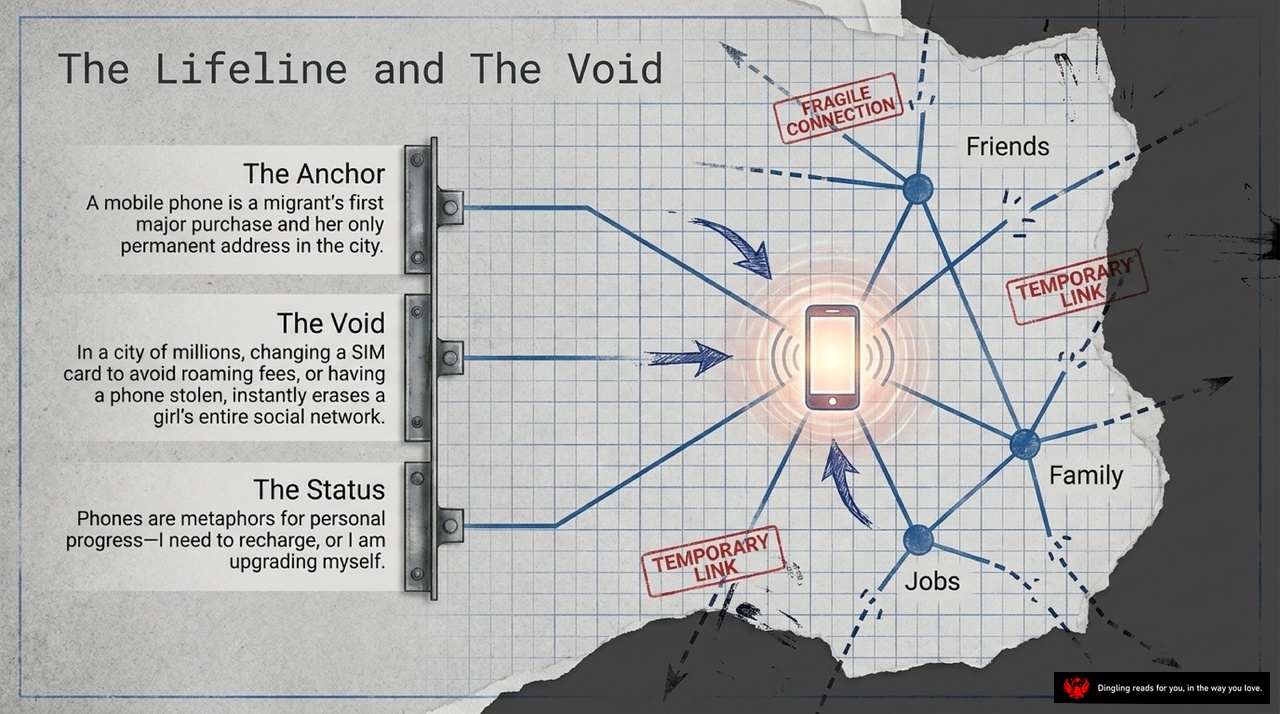
The Lifeline and The Void isn't just a diagram; it's the daily reality for millions of young women who left their villages to build a life in Dongguan. Look at the center of this map: the mobile phone. For a migrant, this isn't just a tool; it's her first major purchase and her only permanent address in a city of millions. It's her lifeline.
But notice the red stamps around her: "Fragile Connection" and "Temporary Link." In a city this size, a phone isn't a guarantee of stability. Change a SIM card to avoid roaming fees, or worse, have your phone stolen, and instantly, an entire social network—friends, family, jobs—vanishes. Her connections are fragile, easily severed by a single mistake or misfortune.
Then there's the status. This phone is a metaphor for personal progress. To recharge is to say, "I am upgrading myself." To buy a new model is to signal success. Yet, this status symbol also highlights the void. When the phone breaks or the signal drops, the girl feels erased. She realizes that in this hyper-connected world, she is terrifyingly vulnerable. Her entire identity rests on a device that can disappear in a heartbeat.
This tension between the anchor of the phone and the void of its fragility defines the migrant experience. They cling to this lifeline to survive, yet they know that at any moment, the connection could snap, leaving them alone in the urban void.

Love, Marriage, and the Shadow Economy. This slide exposes a harsh reality in Dongguan: romance has become a transaction, and human connection is weighed against material value.
Look at the scale in the center. On one side, you have love, symbolized by the rose and heart. On the other, you have a house, cash, and a tape measure—pure commodities. This visual perfectly captures the "Shadow Economy" described in the text.
First, we see "Calculated Romance." It's no longer about sparks; it's about specs. The text describes "8-Minute Dating clubs" where requirements are strictly quantified. Men must be over 1.7 meters tall and own a five-room brick house. If you don't meet the criteria, you aren't just rejected; you're disqualified. The stamp says "Approved" only for those who check every box.
Then, there's the "Shadow Economy" itself. Consider the KTV hostesses. These are often rural high school graduates who bypass the factory assembly line to earn 20,000 RMB a month. In this world, companionship is turned into a direct commodity. It's not about building a relationship; it's about selling a service to survive in a city that offers little else.
Finally, we face "The Dilemma." It's a cruel catch-22. Upwardly mobile factory girls look down on rural men because they want status, yet urban men look down on them because they lack money or education. Romance is fundamentally transactional. You are either valued for what you can give, or you are invisible.
In this city of opportunity, love isn't a feeling; it's a balance sheet. And for many, the numbers simply don't add up.
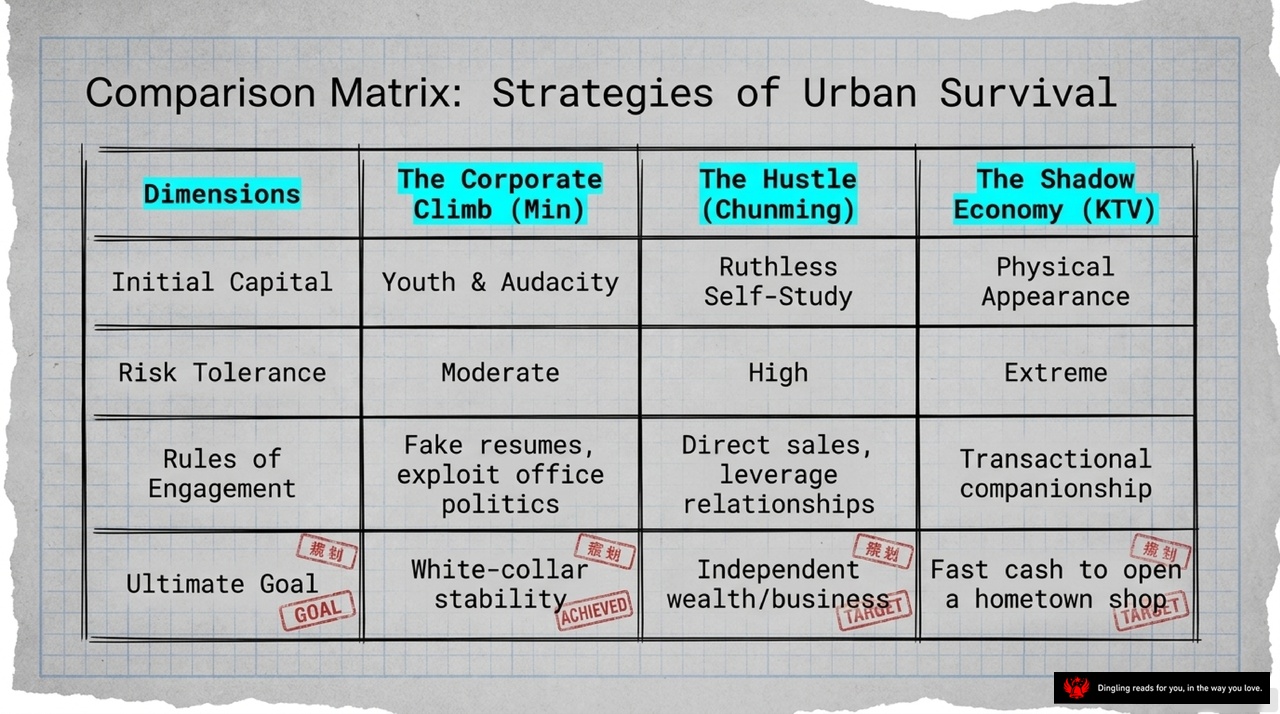
Welcome back. Today, we're diving into the raw, unfiltered reality of survival in China's industrial heartland. Look at this matrix: "Strategies of Urban Survival." It breaks down three distinct paths for workers trying to make it.
First, we have "The Corporate Climb," or the "Min" path. This is the route of the educated few. It requires youth and audacity as your initial capital. The risk tolerance is moderate. The rules? It's about navigating office politics, sometimes even using fake resumes or exploiting connections. The goal? Stable white-collar security. It's a path of calculated moves within the system.
Then, there's "The Hustle," the path of Chunming. This demands ruthless self-study and a high tolerance for risk. The engagement here is direct sales and leveraging personal relationships. It's about building an independent business or wealth from scratch. It's not about playing by the rules; it's about rewriting them.
Finally, we have "The Shadow Economy," labeled here as "KTV." This is the high-stakes game. Your initial capital is purely physical appearance. The risk tolerance is extreme. The rules of engagement are transactional companionship—selling yourself in ways that blur the line between business and intimacy. The goal? Fast cash, often just enough to open a small hometown shop later.
These aren't just categories; they are the survival strategies of millions. Whether you're climbing the corporate ladder, hustling in the shadows, or navigating the gray areas, the city demands you choose your weapon. And once you step onto that floor, there is no going back.

Welcome back to the story of Dongguan. Today, we're diving deep into the emotional core of the migrant experience: "The Illusion of the Return."
Look at this split screen. On the left, we see "The Disconnect"—a sepia-toned image of a quiet, slow village. This represents the reality for the women who left. They are fundamentally changed. They find their hometown unbearably slow, patriarchal, and boring. The village they remember is gone; the life they left behind feels like a trap they can't escape.
On the right, we see "The Trophies"—a vibrant, neon-lit industrial cityscape. Returning home isn't about nostalgia; it's about transaction. It means bringing back DVD players, counterfeit designer bags, and cash to command respect. These items are their armor, proof that they've survived the city and succeeded where their village couldn't.
But the reality, as written at the bottom, is heartbreaking. Despite the nostalgia, they can never truly go back to the fields. Home is good, but you can only stay for a few days. The city, with all its harshness, offers a chance to become someone new. The village only offers a place to hide. For these young women, the return is just a temporary visit, a brief pause before they must go back out to fight for their future again.

Now, let's talk about the price of absolute independence.
Look at the slide. It tells a powerful story about the millions of young women who migrated to Dongguan. They didn't just manufacture the shoes and electronics that built the modern global economy. Through fake IDs, relentless job-hopping, and fierce ambition, they manufactured entirely new identities for themselves.
But here is the hard truth we must ask ourselves: When the price of absolute independence is the permanent loss of your past, what does it truly mean to build yourself?
These women left their villages, their families, and their old selves behind. They traded their roots for a chance at a different life. They became the very products of the city they built, creating new identities from scratch. Yet, the slide challenges us to consider the cost. Did they lose too much of who they were to become who they wanted to be?
In the American dream, we often talk about reinvention. But for these young women, it wasn't just a career change; it was a total erasure of their origins. They built their futures on the foundation of their pasts being destroyed.
So, as we reflect on their journey, we must ask: Is building yourself worth it if it means you can never go back? Or is the true cost not the past we leave behind, but the freedom we find in the new person we become?