
Fatelessness: Complete Chapter-by-Chapter Summary
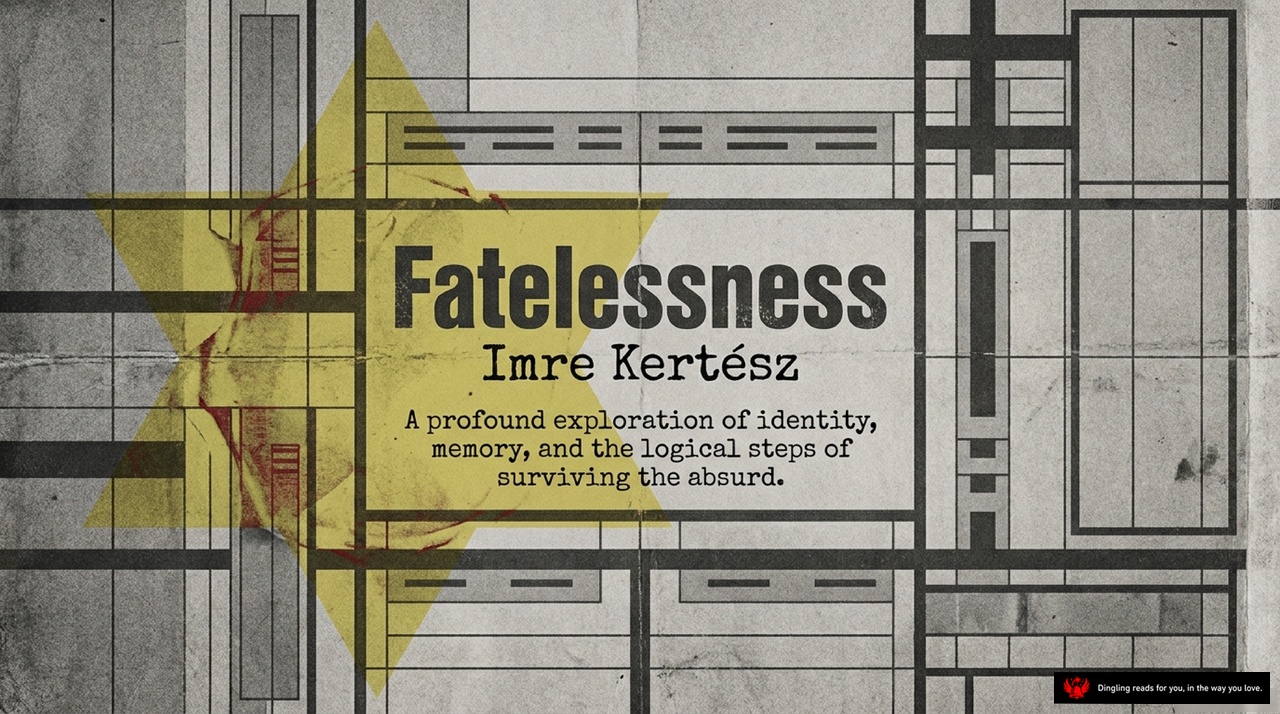
Fatelessness by Imre Kertész isn't just a story; it's a profound exploration of identity, memory, and the logical steps of surviving the absurd. Set against the backdrop of 1944 Hungary, this narrative begins with a stark reality: the yellow star of David, a symbol that instantly isolates a family from the world they once knew. As the protagonist's father is conscripted for forced labor, the household fractures, leaving a young boy to navigate a world where normalcy has been stripped away. From the secret agreements to hide their assets to the final, heartbreaking goodbyes, the book captures the quiet desperation of a life upended by war. It asks us to confront how we find our footing when the ground beneath us vanishes, making it an essential read for anyone who has ever felt lost in the face of overwhelming chaos.

On the left, we see a striking portrait of Imre Kertész, the man who would become the architect of a new way to remember the Holocaust. On the right, the slide breaks down his life into four critical pillars: his identity as a survivor, the difficult process of writing his memoir, his controversial philosophy, and his bold thesis about the nature of Auschwitz.
Kertész wasn't just a victim; he was a survivor of Auschwitz and Buchenwald, deported at the age of 14. This childhood trauma shaped his entire worldview. In 2002, he was awarded the Nobel Prize in Literature for his novel, *Fatelessness*. But writing it was no easy feat. It took him 13 years to complete, finishing in 1973. Why the delay? Because he was defying the era's ideological demands. At the time, there was a pressure to create heroic antifascist narratives, to turn victims into martyrs. Kertész refused to play that role.
His philosophy was radical and often misunderstood. He rejected what he called "Holocaust sentimentalism." He openly criticized famous films like *Schindler's List* and *Life is Beautiful*. Why? Because he felt they created a mass myth or a fairy tale. He argued that these stories bypassed the true, systematic absurdity of the camps by focusing too much on individual heroism or tragic romance. For Kertész, the horror of Auschwitz wasn't about a singular, unimaginable hell. His thesis, clearly stated at the bottom of this slide, is that Auschwitz was not an unimaginable Hell. It was a rationalized, step-by-step bureaucratic process. He wanted to strip away the myth and show the cold, logical machinery of evil.

Look at this diagram: "The Imposed Identity Matrix." It shows György Köves at the center, completely surrounded by arrows pointing inward from every direction. This visual perfectly captures his tragic reality. He wasn't a person with agency; he was a collection of labels forced upon him by the systems around him.
The slide breaks this down into four crushing forces. First, the State Bureaucracy. The yellow star he was forced to wear wasn't just a symbol; it was a physical label of difference, a permanent mark that isolated him from the rest of society. Then, the Religious Community. Even within the Orthodox prison, he was rejected because he didn't speak Yiddish or know the prayers. He was an outsider even among fellow victims.
Next, Nationalism. His fellow Hungarian prisoner found strength in their shared heritage, while György felt alienated and stripped of that identity. Finally, the absurd result: a fateless identity. György was stripped of personal agency. His fate wasn't his own; it was merely a sequence of external conditions he was forced to walk through. He didn't feel a deep internal connection to Judaism; his identity was entirely constructed and imposed by the systems around him. In the Holocaust, he wasn't a man; he was just a point in a matrix, defined entirely by what others said he was.

The journey into the abyss often doesn't begin with a scream, but with a quiet, bureaucratic hum. As we see here, the descent starts in Budapest with administrative compliance. The slide captures the "Banal Beginnings" of a nightmare. Look at that train ticket; it's not a getaway pass, but a death warrant. And that yellow star? For György, it wasn't initially about existential dread. It was about style. His primary worry was ensuring the wind didn't blow his coat up and expose the mandatory star, violating the new regulations.
But the real tragedy lies in the "Illusion of Order." The family treats their father's deportation to a labor camp as merely a temporary inconvenience. They gather, pray, and discuss international politics, hoping for a quick resolution, while the business is legally transferred to a non-Jewish employee to "safeguard" it. This false sense of security shatters when the "Business Handover" becomes permanent. The father is gone, and the family is left to navigate a world where rules are designed to erase them. The banal details—the ticket, the star, the polite transfer of property—mask the horrific reality that the abyss has already opened, and they are just stepping in.

The slide before you, titled "The Descent into the Absurd," maps out a terrifyingly logical trap. It shows how a simple commute to a job at the Csepel Shell Oil plant morphs, step by step, into total captivity.
Let's follow this path. It starts with **The Commute**. György boards the bus, just another worker heading to his shift. But then comes **The Polite Delay**. A policeman stops the bus, asking Jewish boys to step off. To them, it feels like a routine document check—a harmless administrative hiccup. They don't see the danger yet; they just see a delay.
Next, they are herded into **The Customs House**. Here, the boys wait in the shade, bored and hungry. But because they are young, they treat it like a school trip, playing games and singing songs, completely unaware that their freedom has already been revoked. This innocence is what makes the trap so effective.
Then, they are transferred to **The Brickyard**. Now, they are waiting for orders, surrounded by rumors of being sent to Germany. The atmosphere shifts from a workplace to a holding cell. Finally, the journey ends at **The Train**. Boarding crowded cattle cars, adults rationalize the situation, packing their bags methodically as if they are going on a normal vacation, not a one-way ticket to a death camp.
This slide illustrates a brutal truth: evil often doesn't announce itself with sirens. Instead, it wears a polite smile, uses bureaucratic language, and waits for victims to lower their guard, transforming a daily routine into a final destination from which there is no return.
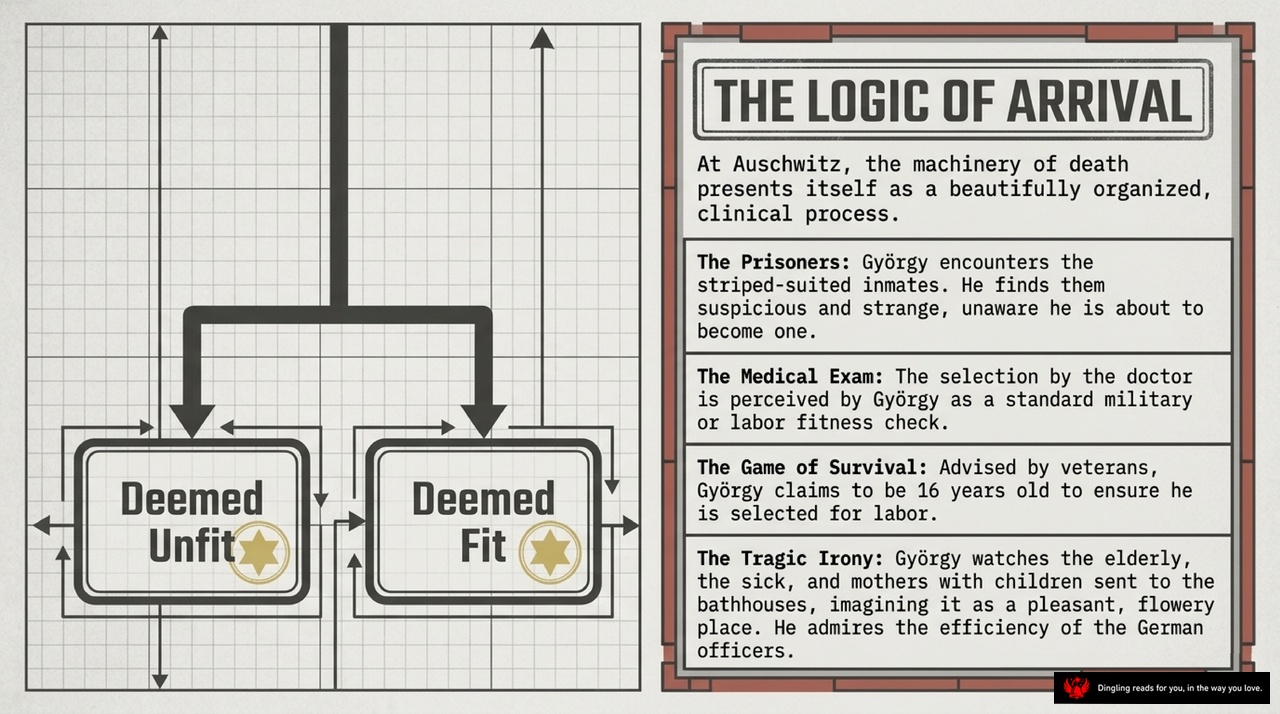
At Auschwitz, the machinery of death presents itself not as a chaotic slaughter, but as a beautifully organized, clinical process. It's a system built on efficiency, where every action has a purpose and every life is categorized with terrifying precision. As György arrives, he is immediately thrust into this rigid hierarchy. He encounters the inmates in their striped suits, appearing suspicious and strange, completely unaware that he is about to become one of them.
The selection by the doctor is perceived by György initially as a standard military or labor fitness check—a bureaucratic hurdle rather than a death sentence. He even plays a game of survival, advised by veterans, by claiming to be 16 years old to ensure he is selected for labor rather than immediate elimination. This moment defines the "Logic of Arrival": the distinction between those deemed "Fit" and those deemed "Unfit." The "Fit" are sent to the labor camps, while the "Unfit"—the elderly, the sick, and mothers with children—are sent directly to the bathhouses.
Here lies the tragic irony that György fails to see in his shock. While he watches the elderly and mothers being sent to the bathhouses, he imagines it as a pleasant, flowery place. He admires the efficiency of the German officers, completely blind to the reality that this "efficiency" is the mechanism of mass murder. The logic of arrival is a lie wrapped in order, separating the living from the dead based on a cold, calculated assessment of utility.

In the Zetzsche camp, life entered what survivors called a "Golden Age"—a deceptive period where horror was temporarily replaced by a mechanical, predictable routine. As the slide illustrates, this adaptation loop forced the mind to shrink its horizon to the immediate present, surviving solely on the gap between morning roll call and evening sleep.
For György, this meant becoming "The Good Prisoner." He initially found pride in efficiency, carrying cement sacks quickly just to avoid beatings. But soon, life reduced to an obsession with rations—the fraction of bread or the viscosity of the evening soup—turning hunger into a bottomless, all-consuming void. Time itself began to erase; it no longer flowed toward a future but looped endlessly. The ultimate goal became simply enduring the cycle.
This rigid order eventually cracked. During a work shift, György's cement bag slipped, spilling gray dust everywhere. A German overseer didn't just punish him; he shoved György's face into the wet cement, forcing him to lick it clean. That day, the cycle of survival took a brutal physical toll. György's knee swelled into a painful lump, a stark reminder that in this bureaucracy of survival, the body was merely a vessel to be used and discarded.

Look at this graph. It's not just a chart; it's a map of György's soul as his body collapses. On the left, we see the brutal reality: his physical health is plummeting. Starvation, scabies, and infection turn his body into a heavy, failing machine he can barely drag around. He observes his wasting limbs and festering skin as if they belong to a stranger—a total alienation.
But look at the yellow line on the right. While his body dies, his mind is escaping. This is the "Flight of the Imagination." As he drags gravel or cement, his consciousness flies back to Budapest, reliving childhood memories to survive the present. He is mentally detached, creating a parallel world where he isn't suffering.
Eventually, the two lines cross at that red target in the middle. This is the point of "Total Alienation." Even the will to survive fades into annoyance. He resents his friend Bandi Citrom for forcing him to stay alive. His body is breaking down, but his mind has already left him behind, trapped in a ghost story while his flesh rots away.

A Pause in the Void. Imagine being transferred to Buchenwald as a near-corpse, only to find yourself in the ultimate bureaucratic paradox: a fully functional hospital operating inside an extermination camp. For György, this wasn't just a medical facility; it was a surreal sanctuary where clinical routine met the absurdity of care.
He is placed in a real bed with sheets, receiving daily rounds where doctors meticulously treat his infected hip and knee. For the first time, he experiences a semblance of humanity. Fellow prisoners feed him, and a Polish orderly named Pjetyka protects him, shielding him from the chaos outside. Yet, this care operates with the same cold, rationalized efficiency as the gas chambers. The hospital treats the body with precision, highlighting the arbitrary, systemic nature of who lives and who dies. It is a pause in the void—a moment of fragile order in a world designed for destruction, where the line between healing and survival blurs into something terrifyingly complex.
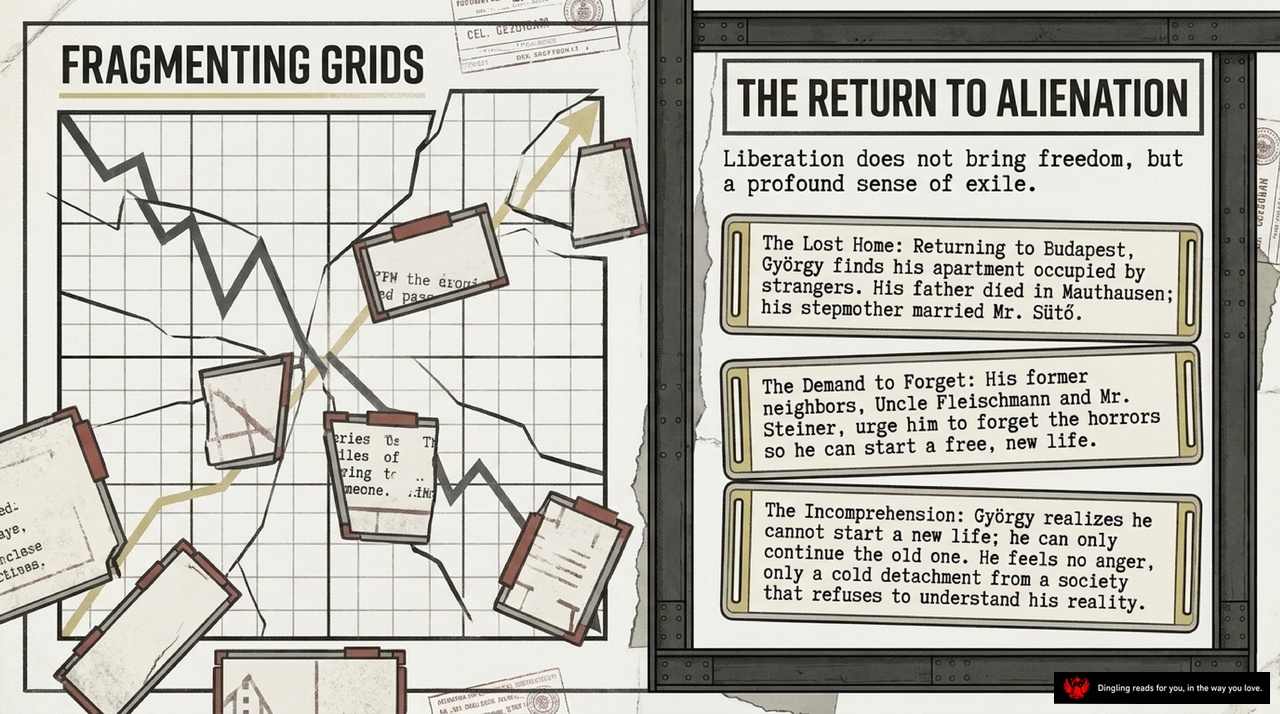
The slide title "The Return to Alienation" captures a profound truth that many survivors struggle to articulate: liberation does not automatically bring freedom. Instead, it often brings a deep, haunting sense of exile. Look at the first box on the right, "The Lost Home." György returns to Budapest expecting a reunion, only to find his apartment occupied by strangers. His father is dead in Mauthausen, and his stepmother has married Mr. Sütő. The very space that should feel like home now feels like a foreign land.
This leads to the second point: "The Demand to Forget." His former neighbors, Uncle Fleischmann and Mr. Steiner, urge him to forget the horrors he witnessed so he can start a free, new life. They believe that to move forward, he must erase the past. But this creates the third reality shown on the slide: "The Incomprehension." György realizes he cannot simply start anew. He can only continue the old, broken life. He feels no anger, only a cold detachment from a society that refuses to understand his reality.
On the left, the graphic titled "Fragmenting Grids" visually represents this shattered existence. The broken grid lines and scattered documents symbolize how his orderly world has been dismantled. He is no longer part of the grid; he is the debris left behind. This isn't just about losing a home; it is about losing the very framework of who he is, leaving him trapped in a permanent state of alienation despite being physically free.

Expectation versus reality: the language of the Holocaust. This slide captures a painful truth György discovers when he meets a journalist. The journalist wants a story of a "Nazi Hell"—chaotic, sudden, and unimaginable evil that demands tears and moral outrage. But for György, the survivor's reality was nothing like that. It wasn't chaos; it was a highly organized, banal bureaucratic process. The primary experience wasn't horror, but boredom, waiting, hunger, and routine. The free world wanted to forget and start over, treating the trauma as an anomaly to be erased. But György simply walked the path. It was his actual life, and he cannot pretend it didn't happen. The language of the Holocaust doesn't fit into our comfortable stories of sudden evil; it is the quiet, logical steps of a machine designed to destroy.
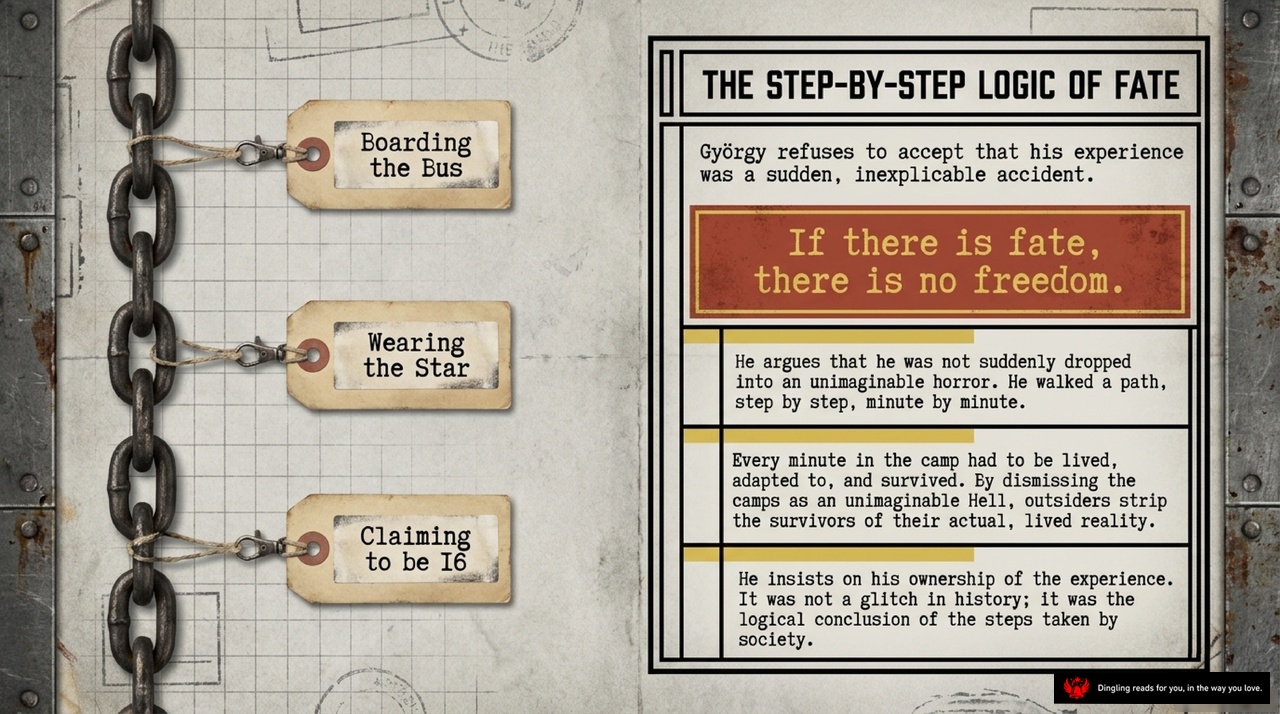
Look at this slide, titled "The Step-by-Step Logic of Fate." It breaks down György's terrifying conclusion: if there is fate, there is no freedom. He refused to believe his experience was a sudden, inexplicable accident. Instead, he argued that he walked a path, step by step, minute by minute.
The slide highlights three critical moments that led here. First, "Boarding the Bus." This wasn't a random event; it was the logical result of the rules he followed. Then, "Wearing the Star." By obeying the law and keeping his star visible, he was following the only logical path available to him. Finally, "Claiming to be 16." When he lied about his age to avoid work, he was making a rational choice based on the information he had.
György insists on his ownership of this experience. He wasn't suddenly dropped into an unimaginable horror; he took the steps that society dictated. By dismissing the camps as an impossible hell, outsiders strip survivors of their actual, lived reality. For György, the Holocaust wasn't a glitch in history; it was the logical conclusion of the steps taken by society. He survived not by chance, but by navigating the only logic the world presented to him.

Look at this tangled mess on the left. It represents the ultimate paradox: finding happiness in the abyss. Standing in the ruined streets of Budapest, György experiences something shocking and painful: nostalgia for the camp. It sounds impossible, doesn't it? How could anyone miss the place that tried to destroy them?
The slide breaks this down into three key points. First, the clarity of the camp. In Buchenwald and Zeitz, the rules were brutal, yes, but they were perfectly clear. Survival was the only metric, and that clarity offered a strange kind of safety. Second, the hypocrisy of freedom. Back in Budapest, he is surrounded by people who deny reality, demand sentimental lies, and fail to take responsibility for the steps they took. It was far more confusing and exhausting than the camp ever was.
Finally, the final confession. He realizes that even in the shadow of the chimneys, in the quiet moments between torments, there was a pure, undeniable sense of existence. As the slide emphasizes, there was something resembling happiness even there. It wasn't the happiness we think of, but it was real. It was the only happiness he knew.
Györgyi Köves survived the physical reality of the concentration camps, only to find his true exile in the sentimental historical memory of the free world. This slide asks us to confront a painful truth: if we demand that survivors reshape their lived trauma into our comforting narratives of Hell and Heroes, are we not simply imposing another form of fatelessness upon them?
In America, we often crave a clear story—a villain defeated, a hero saved, a moral lesson learned. But for survivors like Györgyi, the reality was far messier. It wasn't a simple arc of suffering and redemption. It was a chaotic, unscripted existence where the line between victim and survivor was constantly blurred. When we force their experiences into a neat box of "Hell and Hero," we inadvertently erase the complexity of their humanity. We turn their profound loss into a prop for our own moral education.
True healing doesn't come from rewriting the past to fit our expectations. It comes from honoring the raw, unfiltered truth of what they endured. It means listening to their stories without trying to fix them, without trying to make them palatable, and without demanding that they perform heroism. Their survival was not a victory lap; it was a quiet, often invisible act of endurance. By resisting the urge to romanticize their pain or simplify their journey, we finally allow them to be fully human, rather than just symbols of their tragedy.