
Fight the Fear: Complete Chapter-by-Chapter Summary
Welcome. We explore Mandie Holgate’s book, Fight the Fear. It transforms hidden mental blocks into strategic confidence. This session helps you identify fears and reclaim what matters. Let's begin.
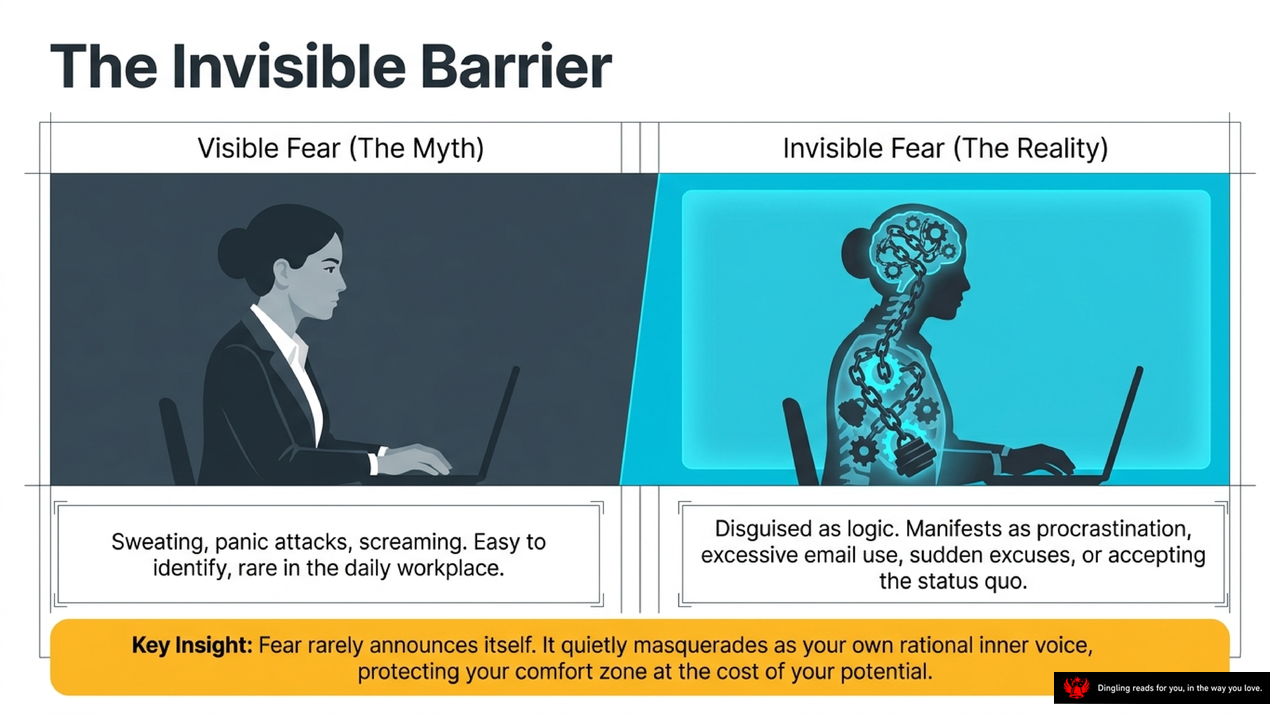
Have you ever noticed how fear isn't always dramatic? On this slide, we see "The Invisible Barrier." It splits into two sides. On the left, "Visible Fear (The Myth)." We see a person looking stressed. The text says this involves sweating, panic attacks, screaming. It's easy to identify, but it's rare in the daily workplace.
But on the right? That's where the real struggle lies. "Invisible Fear (The Reality)." Here, we see a person with chains on their brain. This fear is disguised as logic. It doesn't scream; it whispers. It manifests as procrastination, excessive email use, sudden excuses, or just accepting the status quo.
Why do we do this? The book explains that we often hide our true needs to avoid judgment. We tell ourselves we are being productive when we are actually just protecting ourselves. We convince ourselves that "I'm not ready" or "I need more data" is a rational strategy, but it's actually fear in disguise.
The book notes that hidden fears are often scarier because you don't even know they exist. You might think you're being productive, but you're actually avoiding the very thing that would make you successful. This invisible fear keeps us chasing goals set by others, not our own. It keeps us in the comfort zone where we feel safe but unfulfilled. Accepting the status quo is the easiest way to stay safe, but it's the hardest way to live.
The Key Insight at the bottom is crucial: "Fear rarely announces itself. It quietly masquerades as your own rational inner voice, protecting your comfort zone at the cost of your potential."
This means your brain is tricking you. It tells you that staying in your comfort zone is smart, that taking a risk is dangerous. But this invisible barrier is costing you your success. You might feel busy, but you aren't growing. You are just surviving.
To move forward, you have to recognize these hidden chains. You need to ask yourself: Is this decision coming from my values, or from my fear? When you realize that your "logic" is actually fear protecting your comfort zone, you can start to break free. That is the first step to unlocking your true potential.
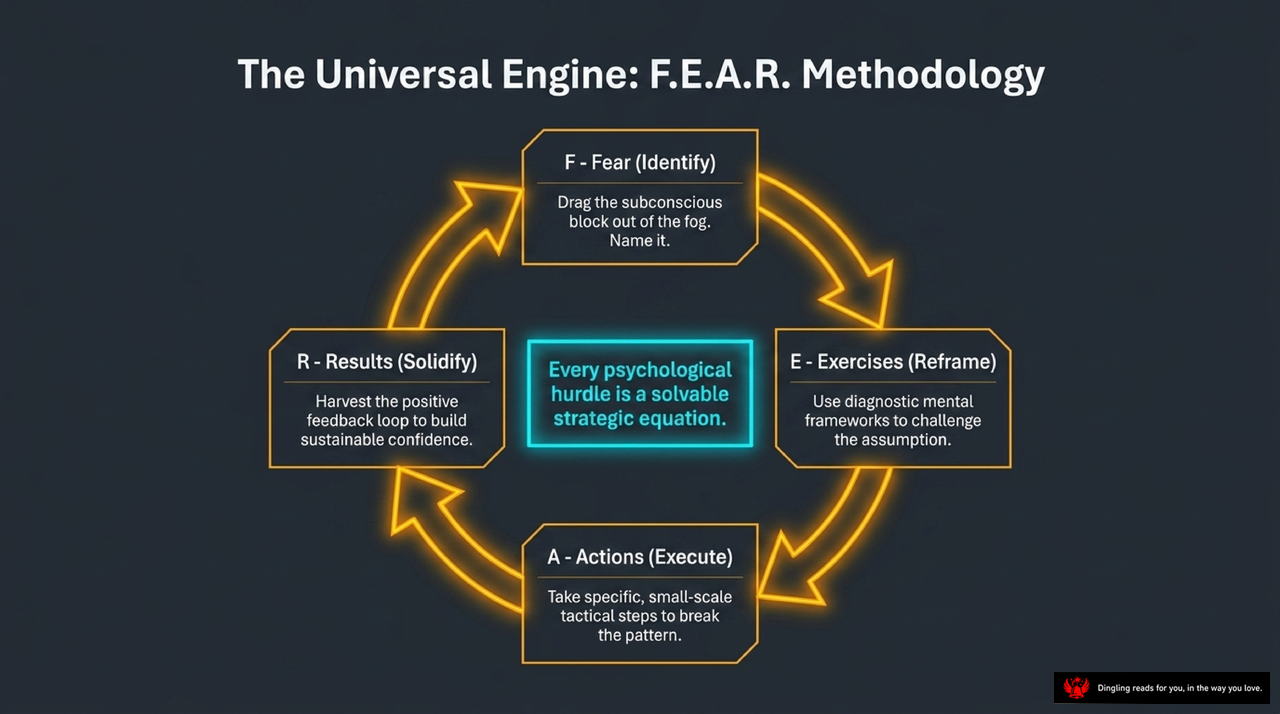
Let's talk about the Universal Engine that drives real change: the F.E.A.R. Methodology. You see, every psychological hurdle is actually a solvable strategic equation. It's about a deliberate cycle you can control.
First, we start with F, which stands for Fear, specifically Identify. We all have hidden fears—maybe it's the fear of looking stupid in a meeting, the fear of losing a client, or the fear of asking for help because we don't want to seem weak. But here's the thing: you can't fix what you can't see. You need to drag that subconscious block out of the fog. Name it. Acknowledge it. When you admit you're afraid, you strip the fear of its power.
Next is E for Exercises, which means Reframe. This is where you use diagnostic mental frameworks to challenge your assumptions. Think about how often we tell ourselves lies. Remember, fear loves a loose brain. So, you have to actively replace those negative thoughts with positive ones. Instead of worrying about failure, ask yourself, 'Why not me?' or challenge the idea that a rejection means you're not good enough. It's about shifting your mindset.
Then comes A for Actions, Execute. You can't just think your way to success; you have to move. Take specific, small-scale tactical steps to break the pattern. Don't wait for the perfect moment or the perfect plan. Whether it's making that one phone call, asking for help, or setting a clear goal, action creates momentum. Small wins build the bridge to big results.
Finally, R stands for Results, Solidify. Once you take action, you harvest the positive feedback loop to build sustainable confidence. This isn't just about feeling good; it's about proving to yourself that you can handle the challenge. Every time you overcome a fear, you reinforce your belief in your own capability.
So, remember this: your psychological hurdles aren't roadblocks; they're just equations waiting to be solved. Identify the fear, reframe the narrative, execute the action, and solidify your confidence. Now, let's see how you can apply this to your own life.
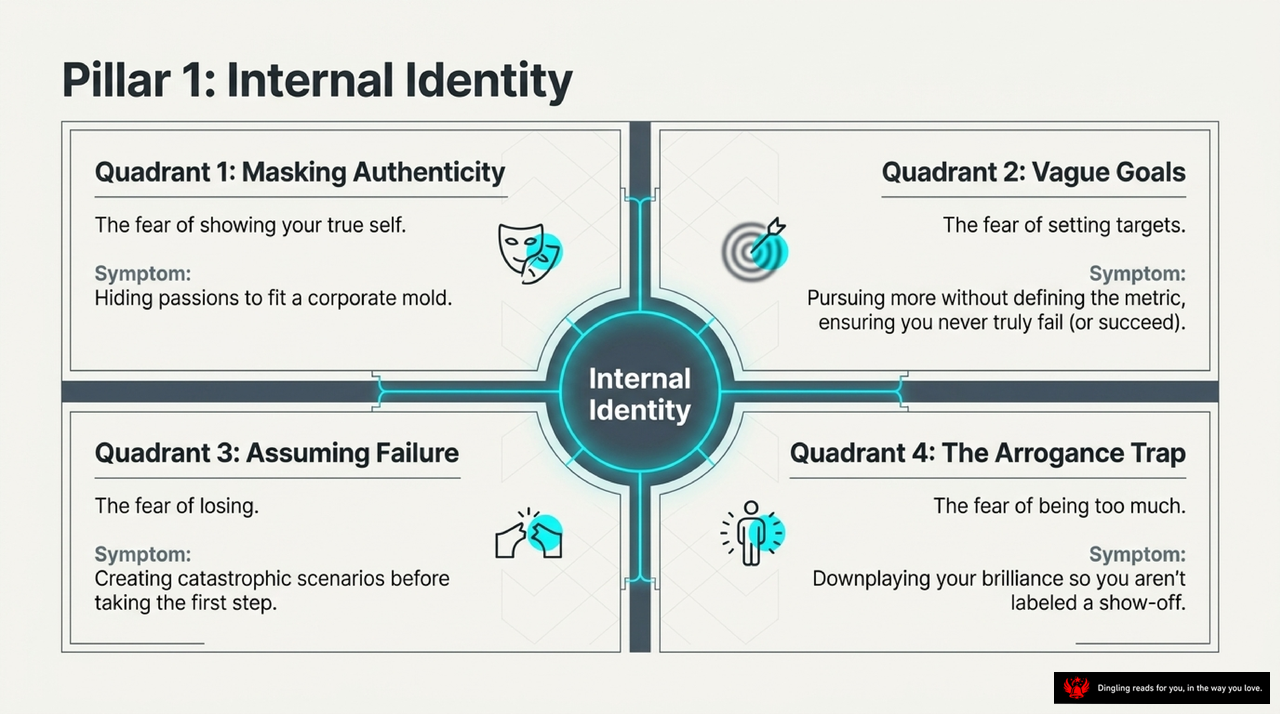
Welcome back to our session. Today we're diving deep into Pillar 1: Internal Identity. This is the foundation of everything we do. It's about understanding the invisible barriers that keep us from living our best lives. Let's break down the four quadrants that shape how we approach success.
First, look at Quadrant 1: Masking Authenticity. This is the fear of showing your true self. How often do you hide your passions to fit a corporate mold? We suppress our genuine interests, like loving travel or creativity, just to blend in. But when you hide who you are, you can't truly define your career goals. You end up chasing what others want instead of what you need. This is why so many people feel unfulfilled. When you mask who you are, you lose the drive to succeed because you're not working on what you love.
Next, Quadrant 2: Vague Goals. This stems from the fear of setting targets. Many of us are stuck pursuing more without defining the metric, ensuring we never truly fail or succeed. We want the outcome but avoid the clarity that comes with a real goal. It's easier to aimlessly drift than to commit to a specific path. Without clear targets, you can't measure your progress. It's like running on a treadmill without knowing where it leads. You work hard but don't know if you're actually getting closer.
Then, we have Quadrant 3: Assuming Failure. This is the fear of losing. We create catastrophic scenarios in our minds before taking the first step. We convince ourselves that the worst-case scenario is inevitable, so we never even try. We imagine the disaster before we've even started, which is a self-fulfilling prophecy. This stops us from taking action. You play defense instead of offense. You protect yourself from pain rather than moving toward growth.
Finally, Quadrant 4: The Arrogance Trap. This is the fear of being too much. We downplay our brilliance so we aren't labeled a show-off. We hold back our talents because we're afraid of standing out, not realizing that confidence isn't arrogance. You can be great without being loud. True confidence is quiet. It's about knowing your worth without needing to prove it to everyone else.
The truth is, these fears are keeping you from your potential. You don't need to be perfect; you just need to be real. By addressing these internal identities, you unlock the ability to live on your own terms. So, ask yourself: which quadrant is holding you back today?
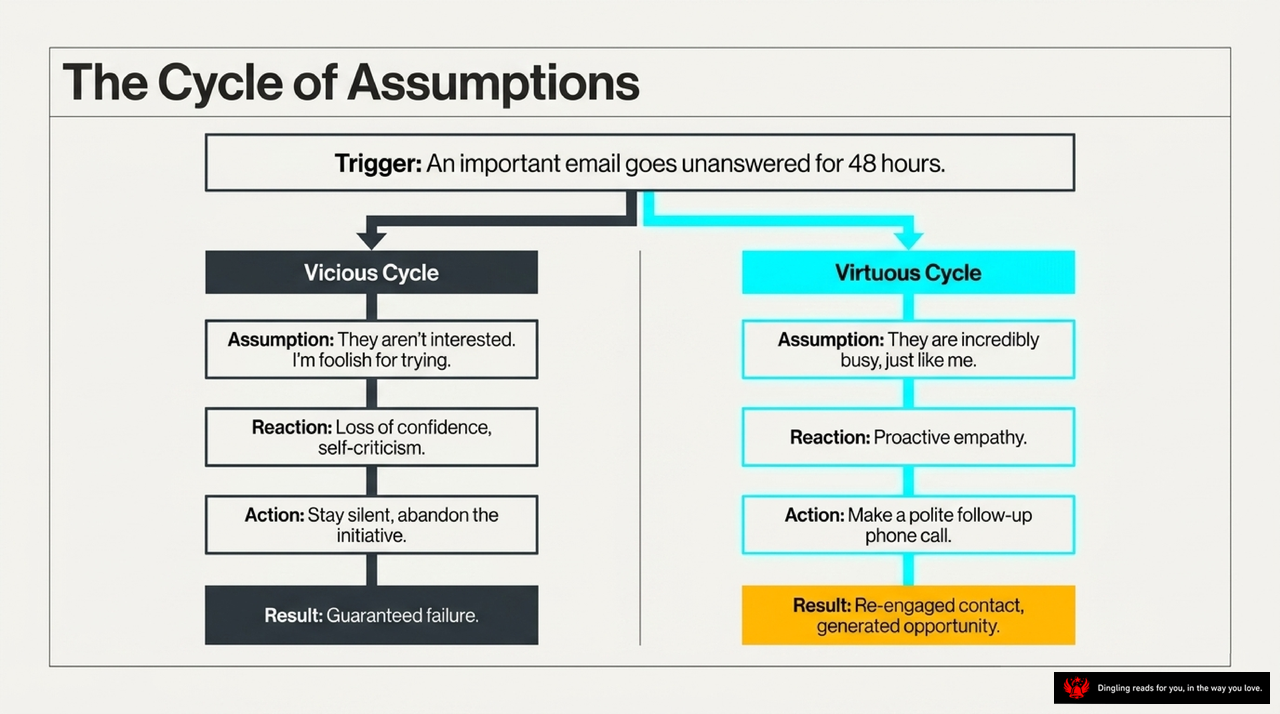
Have you ever sent an important email, waited 48 hours, and heard nothing back? That silence is the trigger. Now, your brain has to make a choice, and usually, it chooses the path of least resistance.
On the left, we have the vicious cycle. The first thing that happens is your assumption. You think, "They aren't interested. I'm foolish for trying." That thought instantly triggers a reaction: loss of confidence and self-criticism. So, what is the action? You stay silent. You abandon the initiative. And the result? Guaranteed failure. It destroys your momentum. You stop trying before you even try again. It keeps us stuck in negativity, letting a single silence define your worth.
But look at the other side. The virtuous cycle. Instead of assuming rejection, you assume they are incredibly busy, just like you are. That small shift in perspective changes your reaction entirely. You move from self-criticism to proactive empathy. You don't hide; you reach out. The action becomes making a polite follow-up phone call. You acknowledge their reality rather than your own fears. You understand that their silence might just be their schedule, not a rejection of you. The result? A re-engaged contact and a generated opportunity.
The difference isn't about the email itself. It's about the story you tell yourself before you act. When you assume the worst, you get the worst. When you assume the best and act with empathy, you open doors. Don't let a lack of response become a lack of courage. Break the vicious cycle by choosing the virtuous one. Your assumption dictates your outcome. This is about rewriting the narrative of your workday. Instead of waiting for permission, you create it. So next time you hit send, ask yourself: am I building a bridge or building a wall? Choosing the virtuous path builds your reputation as someone who is resilient and easy to work with.
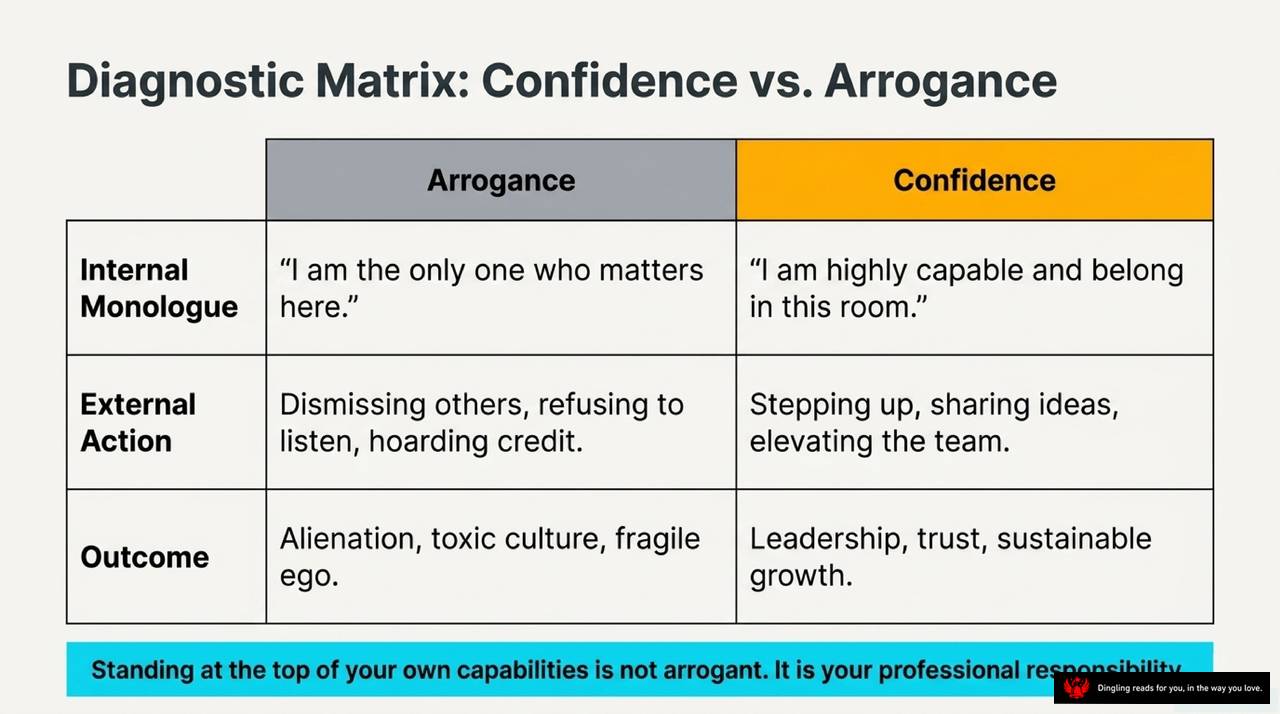
Okay, let's dive into this diagnostic matrix. We often struggle to tell confidence apart from arrogance, but this slide breaks it down perfectly. Think about your internal monologue first. When you're operating from arrogance, your inner voice is actually quite limiting. It whispers, 'I am the only one who matters here.' It's all about exclusion. But true confidence? It sounds like, 'I am highly capable and I belong in this room.' It's about inclusion and ownership.
Now, watch how that plays out in your actions. Arrogance tends to dismiss others, refuse to listen, and hoard credit. It creates a barrier. In contrast, confidence is about stepping up, sharing ideas, and elevating the team. You aren't trying to be the only smart person in the room; you're trying to make the room smarter.
And look at the outcome. Arrogance leads to alienation, a toxic culture, and a fragile ego that breaks under pressure. Confidence, however, builds leadership, trust, and sustainable growth. It's the foundation of long-term success.
Here's the thing that trips a lot of people up. We often hide our skills because we're terrified of being labeled arrogant. We think that if we own our capabilities, we're being a show-off. We've all been conditioned to believe that no one likes a show-off, so we stay quiet. We tell ourselves we're being humble, but often we're just being afraid of being seen as arrogant. But the text reminds us of a crucial distinction: Standing at the top of your own capabilities is not arrogant. It is your professional responsibility.
So, ask yourself: Am I making people feel small to feel big myself? Or am I stepping up to share the load? If you're not making everyone uncomfortable, you're not arrogant. You're just confident. Don't let the fear of being perceived as arrogant stop you from owning your value. It's not about being better than everyone else; it's about being responsible for your own excellence. That's the real difference. Own your skills without the fear. If you aren't making everyone uncomfortable, you're not arrogant. You're just confident.
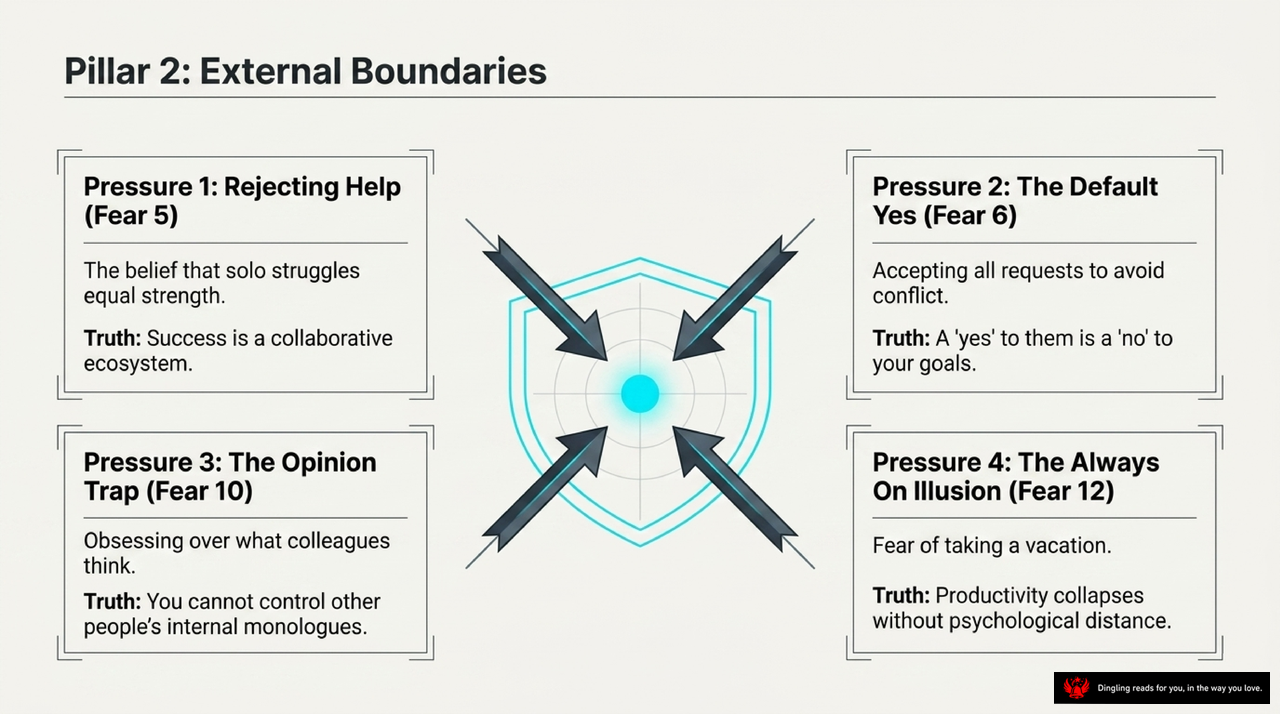
Welcome to Pillar 2: External Boundaries. We've spent time on internal fears, but today we need to tackle the invisible pressures pushing against us from the outside. These are the forces that try to pull you away from your goals.
Let's start with Pressure 1: Rejecting Help. Think about how often you say no to assistance. Deep down, we believe that solo struggles equal strength. We think asking for help makes us look weak or incompetent. But the Truth is: Success is a collaborative ecosystem. You cannot build an empire alone. Even the biggest leaders rely on a team. Stop hiding your needs and start leveraging the support around you. Remember, a strong leader knows when to ask for help.
Moving to Pressure 2: The Default Yes. How many times have you said yes to a request just to avoid conflict or seem like a team player? The reality is, we often accept all requests to avoid conflict, but the Truth is: A 'yes' to them is a 'no' to your goals. Every time you say yes to a distraction, you are saying no to your own vision. Protect your time fiercely. Your time is your most valuable asset.
Then we have Pressure 3: The Opinion Trap. We constantly obsess over what colleagues think. We worry about judgment, about being seen as the 'wrong' person. We check our phones constantly for notifications. But the Truth is: You cannot control other people's internal monologues. Their thoughts are their business, not yours. Stop wasting energy trying to manage their perception. Focus on your own values and actions instead.
Finally, Pressure 4: The Always On Illusion. Many of us are terrified of taking a vacation. We feel guilty when we log off. We fear that if we stop, the world will stop. But the Truth is: Productivity collapses without psychological distance. Your brain needs downtime to process information and innovate. Constant connection leads to burnout, not success. You need rest to recharge.
So, how do we shift this? By setting boundaries. By asking for help, by saying no to distractions, by ignoring the noise of others, and by prioritizing rest. Don't let external pressures dictate your life. You are the architect of your time. Take control of these boundaries and watch your success grow.
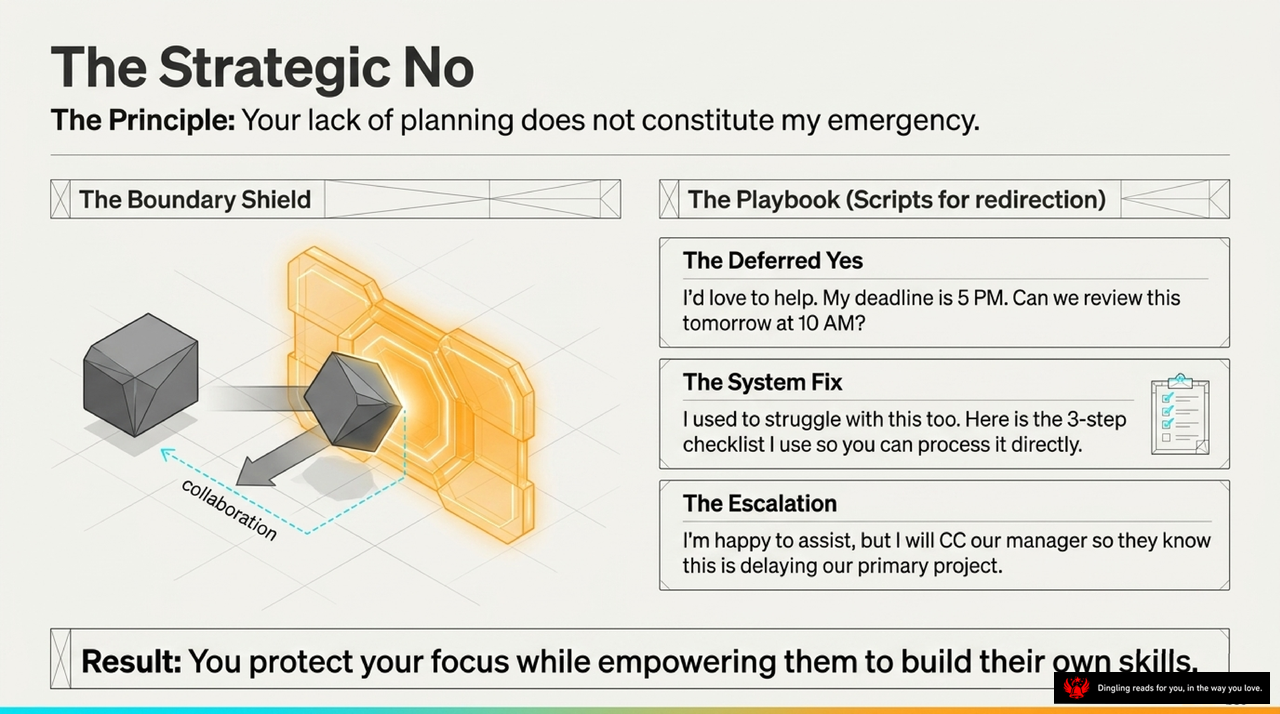
Let's dive into a concept that can completely transform how you handle your workload: The Strategic No.
Look at that principle at the top: Your lack of planning does not constitute my emergency. It sounds harsh, but it is actually a liberating truth. We often feel guilty when someone asks for help, but the reality is that if they aren't ready, they aren't ready. And if you jump in to save them, you are not being a hero; you are enabling a cycle of dependency.
On the left, you see the Boundary Shield. This visual represents how you intercept requests that do not align with your priorities. The arrow labeled collaboration is being redirected, not blocked. You are not stopping the connection; you are changing the direction.
Now, look at the Playbook on the right. These are your scripts for redirection. First, try The Deferred Yes. You say, I'd love to help. My deadline is 5 PM. Can we review this tomorrow at 10 AM? This buys you time to prioritize. Second, use The System Fix. Say, I used to struggle with this too. Here is the 3-step checklist I use so you can process it directly. You are teaching them how to fish instead of giving them the fish. Third, apply The Escalation. Say, I'm happy to assist, but I will CC our manager so they know this is delaying our primary project. This gently reminds them of the real stakes.
Notice the result at the bottom: You protect your focus while empowering them to build their own skills. By refusing to be the safety net for their disorganization, you actually make yourself more valuable and them more capable. It is about shifting from a savior mindset to a coach mindset.
Think about how often you say yes just to keep the peace. That is where the burnout starts. This is not about being difficult. It is about being intentional. When you stop rescuing others from their own lack of planning, you free up your own mental space to do the work that actually matters. We often think that helping someone is the ultimate act of kindness, but sometimes, the kindest thing is to let them face the consequences of their own schedule. This creates a healthier dynamic where everyone knows their boundaries. So, the next time someone asks for a favor, pause. Check your plan. And remember, a strategic No is often the most generous thing you can give.
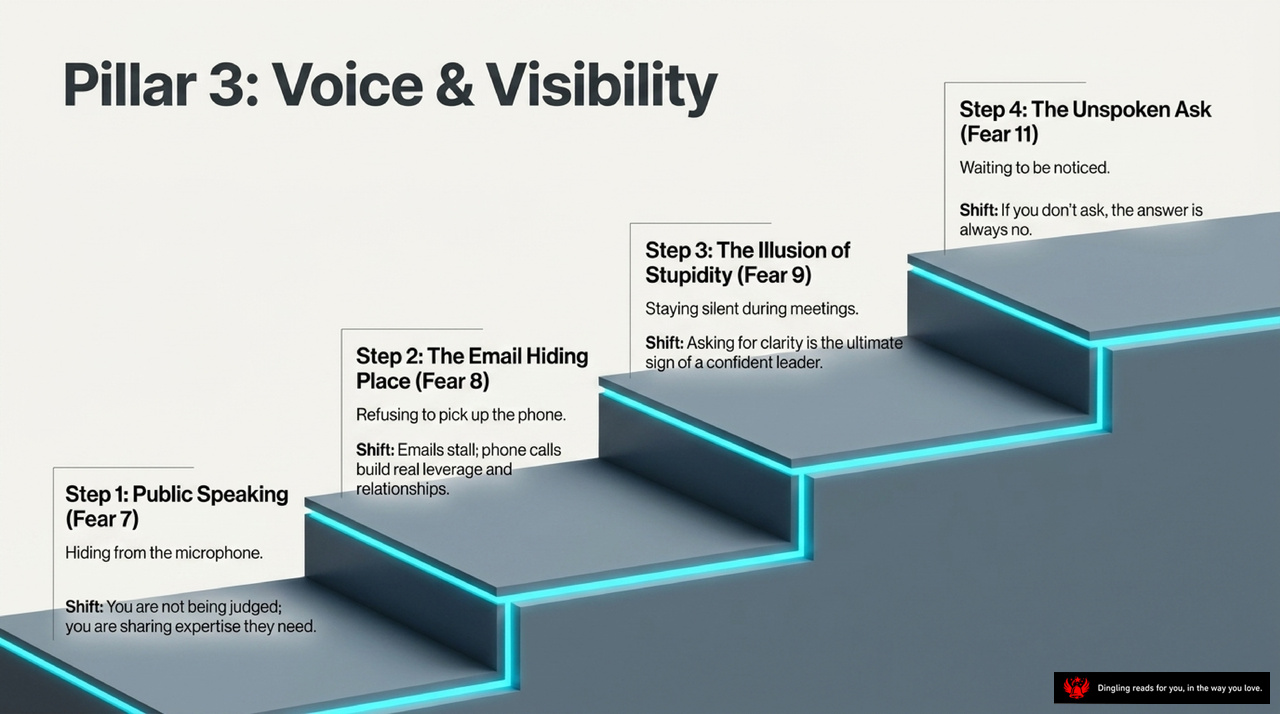
Welcome to Pillar Three: Voice and Visibility. Think of this as a staircase. To truly get seen, you have to climb four specific steps, each representing a fear you need to overcome.
Let's start at the bottom with Step One: Public Speaking. That's Fear Number Seven. We all know the feeling of hiding from the microphone. You might be shaking or wishing you could just leave. But here's the shift in perspective: You aren't being judged; you're actually sharing expertise they need.
Next, we hit Step Two: The Email Hiding Place. That's Fear Number Eight. How many of you refuse to pick up the phone? You think emails are safer, but they're actually a trap. Emails stall. Phone calls build real leverage and relationships. You need to get off that digital island and speak directly.
Moving up the stairs, Step Three is The Illusion of Stupidity. That's Fear Number Nine. You stay silent during meetings because you're scared of looking dumb. But here's the game-changer: Asking for clarity is the ultimate sign of a confident leader. Don't suffer in silence; speak up.
And finally, Step Four: The Unspoken Ask. That's Fear Number Eleven. You're just waiting to be noticed. But let me tell you, if you don't ask, the answer is always no. You have to be the one to request the opportunity.
So, don't hide. Speak up. Make the call. Ask questions. And ask for what you want. This is how you build your voice.
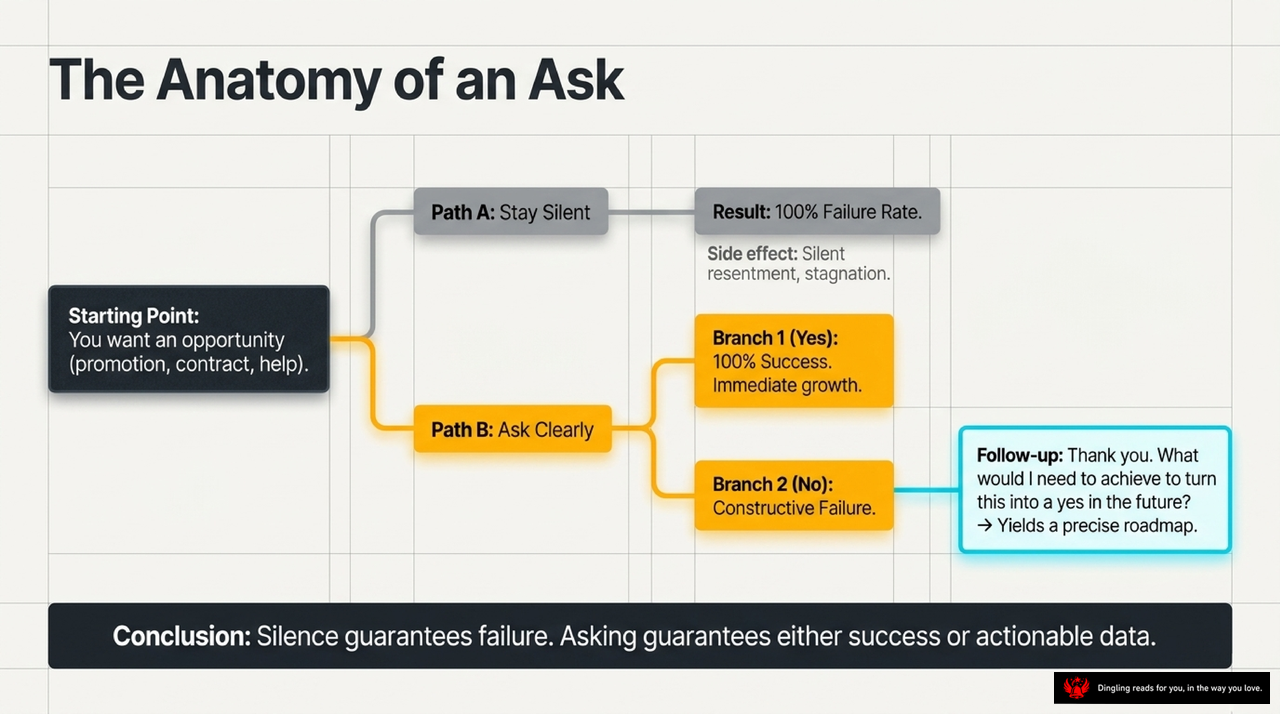
Let's talk about the anatomy of an ask. You have a starting point. You want an opportunity. Maybe it's a promotion, a new contract, or help with a project. Now, you have two paths. Path A is to stay silent. It feels safer, right? We think if we don't ask, we won't look desperate. But here is the hard truth: staying silent guarantees a 100% failure rate. The side effect is silent resentment and stagnation. You end up watching others succeed while you stay stuck, wondering why.
Path B is to ask clearly. This is the brave choice. When you ask, you open up two branches. Branch one is a yes. That means 100% success and immediate growth. You get the opportunity you wanted. But what about Branch two? A no. Many people see a no as a dead end, but it is actually constructive failure. It is not a rejection of you; it is a rejection of the current request. And that is valuable. It gives you actionable data.
Instead of taking it personally, use that no to build a roadmap. Follow up with, "Thank you. What would I need to achieve to turn this into a yes in the future?" This question turns a rejection into a precise plan for success. You learn exactly what is missing. You learn the gap between where you are and where they want you to be.
The conclusion is simple but powerful. Silence guarantees failure. Asking guarantees either success or actionable data. We are often taught to hide our needs to avoid looking weak or annoying. But the truth is, hiding your needs is the real risk. When you stay silent, you lose. When you ask, you gain. Even if you don't get the job today, you gain clarity for tomorrow. So, don't let fear dictate your silence. Ask clearly. Own the outcome. Whether it is a yes or a no, you are moving forward. That is how you build a career. That is how you turn fear into fuel.
Welcome back to our session. Today we're diving into a concept that holds us back more than anything else: Reframing the Comfort Zone.
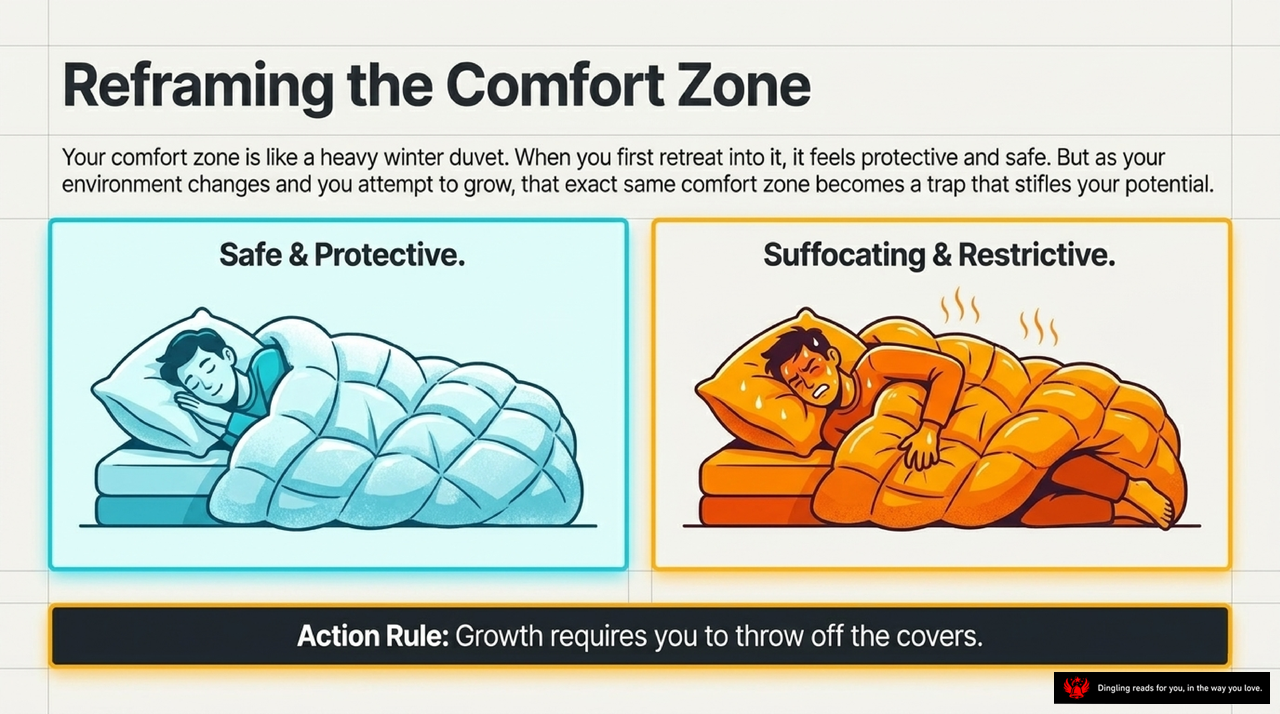
Think of your comfort zone like a heavy winter duvet. When you first retreat into it, it feels incredibly protective and safe. It wraps you up, keeping you warm while the world outside feels cold and uncertain. We stay in it because it feels secure. But here's the real catch. As your environment changes and you attempt to grow, that exact same comfort zone becomes a trap that stifles your potential.
Look at the slide. On the left, we have Safe and Protective. You're sleeping soundly, wrapped in blue. You feel cozy. But on the right, things change. You become Suffocating and Restrictive. You're sweating, trapped under orange covers. You can't move your arms or legs. That's what happens when you stay in your comfort zone too long. You stop breathing fresh air, and you stop growing.
So, what is the solution? The Action Rule is clear: Growth requires you to throw off the covers.
We often confuse safety with success. We think hiding our true potential is safe, but actually, it's just holding us back. Imagine you're afraid to ask a question in a meeting because you don't want to look foolish. That fear keeps you in that warm, safe duvet. But staying there means you never learn. You never grow.
You have to make the conscious choice to get uncomfortable. Ask yourself: Is this blanket helping me, or is it suffocating me? If you feel like you're struggling just to stay in your current role, it's time to take it off. You might feel cold at first, and that's okay. That's the feeling of growth. That's the feeling of becoming your best self.
Don't let the fear of being exposed stop you from stepping into the light. Throw off the covers and take the first step. Your potential is waiting for you on the other side, and it's worth the effort to get there.
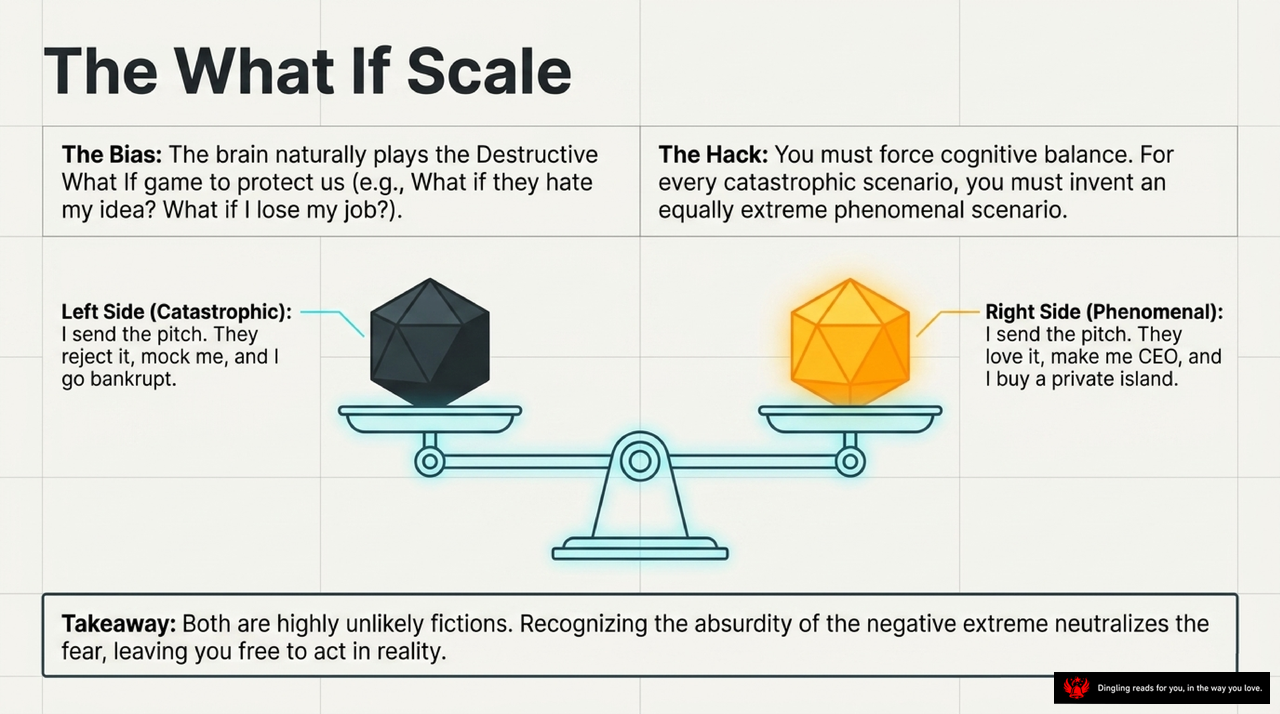
Let's talk about the What If Scale. Have you ever stopped to think about how your brain naturally plays a game? It loves to run the Destructive What If scenario to keep us safe. It asks questions like, What if they hate my idea? What if I lose my job? This is the Bias. It pushes us into the catastrophic side, like imagining a pitch rejection leading to bankruptcy and mockery. It feels real, but it's just a protective mechanism that often paralyzes us.
But here is the Hack. You must force cognitive balance. For every catastrophic scenario, you must invent an equally extreme phenomenal scenario. Look at the other side of the scale. Instead of the dark diamond of failure, imagine the bright one. What if they love the pitch? What if they make you CEO and you buy a private island? It sounds absurd, right? But that's the point.
This isn't about predicting the future; it's about balancing the fear. We often get stuck in a vicious cycle where a small failure, like an unanswered email, snowballs into a belief that we're incapable. We stop trying because the negative feels so certain. But the truth is, both sides of this scale are highly unlikely fictions. Recognizing the absurdity of the negative extreme neutralizes the fear. When you realize the catastrophic outcome is just as fiction as the phenomenal one, you stop fearing the unknown.
This is why we use assumption games. We challenge the destructive thoughts with crazy, positive possibilities. We play the Ordinary, the Crazy, and the Destructive games to see the full picture. It might seem ridiculous, but it works. It pulls you out of the comfort zone of fear and back into reality. Once you see that the fear is just a story you're telling yourself, you leave the scale balanced. You're free to act in reality without being paralyzed by the imaginary worst-case scenario. So, next time you hesitate, ask yourself: What is the most extreme good that could happen? Balance the fear with the possibility, and take the step forward. Remember, your success depends on your ability to trust your own path, not on the stories your brain tells you about potential disasters. Don't let the fear of the impossible stop you from creating the real. It is about shifting your mindset from avoidance to action, realizing that the only thing you truly need to control is your response to these stories.
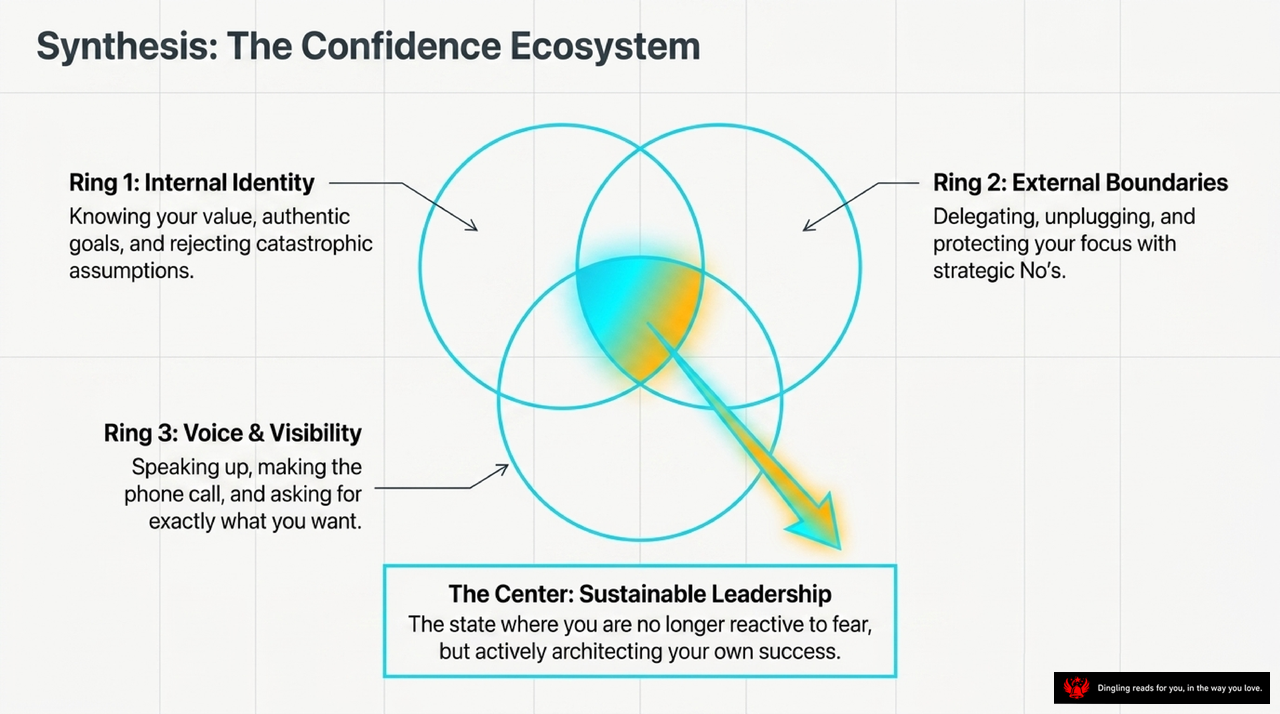
Let's bring it all together. This is the Confidence Ecosystem. Think of it as the blueprint for sustainable success. It's not just about one skill; it's about how three key areas work together to create a powerful whole.
First, look at Ring 1: Internal Identity. This is the foundation. It's about knowing your value, setting authentic goals, and rejecting catastrophic assumptions. You need to be clear on who you are, not who you think you should be to please others. As we discussed, you have to stop hiding behind fear and start defining yourself on your own terms. You must recognize that your worth isn't tied to your productivity or what others think.
Next, Ring 2: External Boundaries. This is about protecting your focus. In the modern world, your attention is your most valuable asset. This ring is about delegating, unplugging, and protecting your focus with strategic No's. You have to learn to say no to things that don't align with your vision. Remember, if you can't stop working, you can't lead sustainably. You must guard against that 'politician tone' that tricks you into thinking you can't take a break. Use skills like outsourcing, delegating, and automation to reclaim your time.
Then, Ring 3: Voice & Visibility. This is where you take action. It's about speaking up, making the phone call, and asking for exactly what you want. Too often, we stay silent, but true confidence requires you to be visible and vocal about your needs. Don't wait for permission; ask for it. Learn to challenge subjective assumptions that hold you back. Overcome the fear of looking stupid by realizing that asking questions is a sign of curiosity, not weakness.
When these three rings overlap, you reach The Center: Sustainable Leadership. This is the state where you are no longer reactive to fear, but actively architecting your own success. You stop worrying about what others think and start building a life that works for you.
So, confidence isn't just a feeling. It's a structure. It's the balance between knowing your worth, protecting your time, and having the courage to ask for what you need. When you master this ecosystem, you stop worrying about what others think and start building a life that works for you. Remember, sustainable leadership is the result of integrating your identity, your boundaries, and your voice.
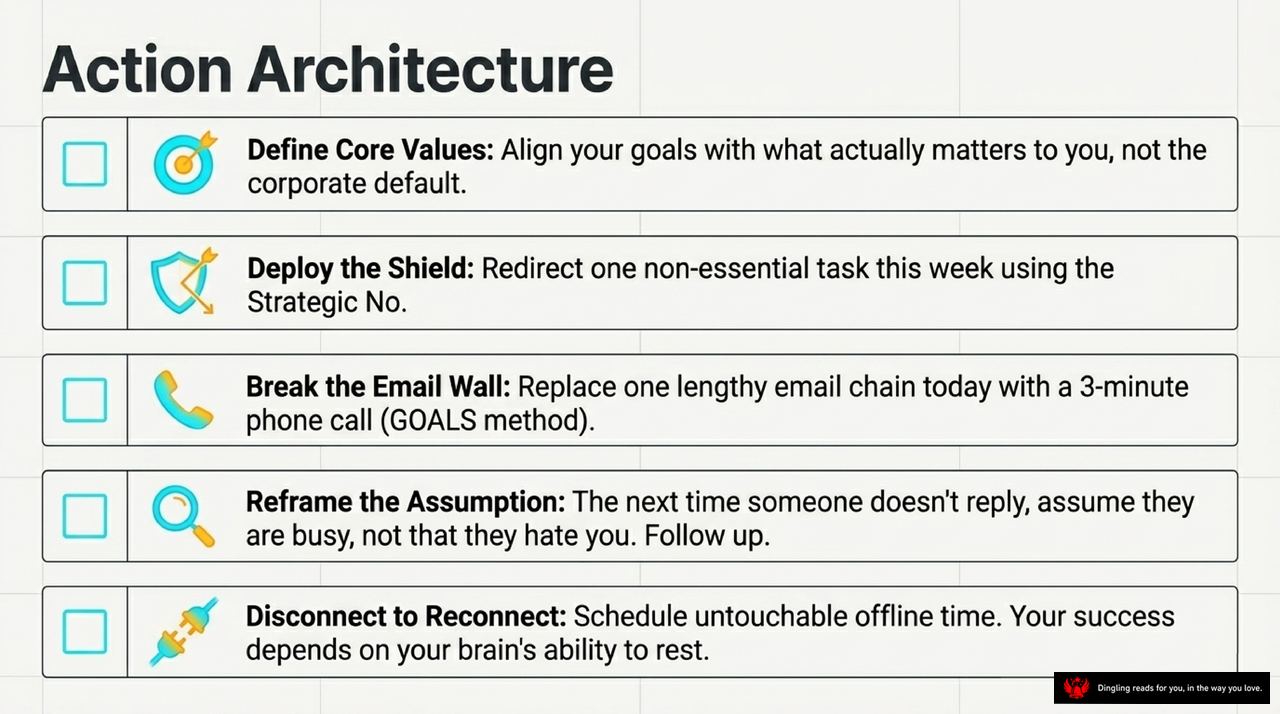
Welcome to the Action Architecture. This is where we move from passive thinking to active building. Let's walk through the five critical steps that form your success system.
First, **Define Core Values**. Most of us chase goals set by society, not ourselves. You need to align your goals with what actually matters to you, not the corporate default. Think about it: if you hide your true needs, you can't protect your success. Many people fail because they pursue what the world wants, not what they want. So, take the time to rank what's important. Is it family, freedom, or impact? When your goals match your values, you stop pretending and start thriving.
Second, **Deploy the Shield**. You have to protect your time aggressively. Redirect one non-essential task this week using the Strategic No. If you're available 24/7, you're actually available to nothing. Set boundaries. Say no to the urgent but unimportant so you can focus on the important. Remember, your time is your most valuable asset.
Third, **Break the Email Wall**. Email chains kill momentum. Replace one lengthy email chain today with a 3-minute phone call. Use the GOALS method: Guard your time, Open with clarity, Ask for the result, Listen actively, and Study the outcome. Direct communication is often more efficient than typing and builds trust.
Fourth, **Reframe the Assumption**. When someone doesn't reply, your instinct is to think they hate you. Don't do that. Assume they are busy. Follow up. This simple mental shift stops the negative spiral of rejection and keeps you moving forward. It turns a potential failure into a simple scheduling conflict.
Finally, **Disconnect to Reconnect**. Your success depends on your brain's ability to rest. Schedule untouchable offline time. My father once said, 'I don't want to be the richest man in the world lying in a grave.' Rest isn't a luxury; it's a requirement for high performance.
Start with these five actions. Define your values, deploy your shield, break the email wall, reframe your assumptions, and disconnect to reconnect. This is the blueprint for sustainable success.
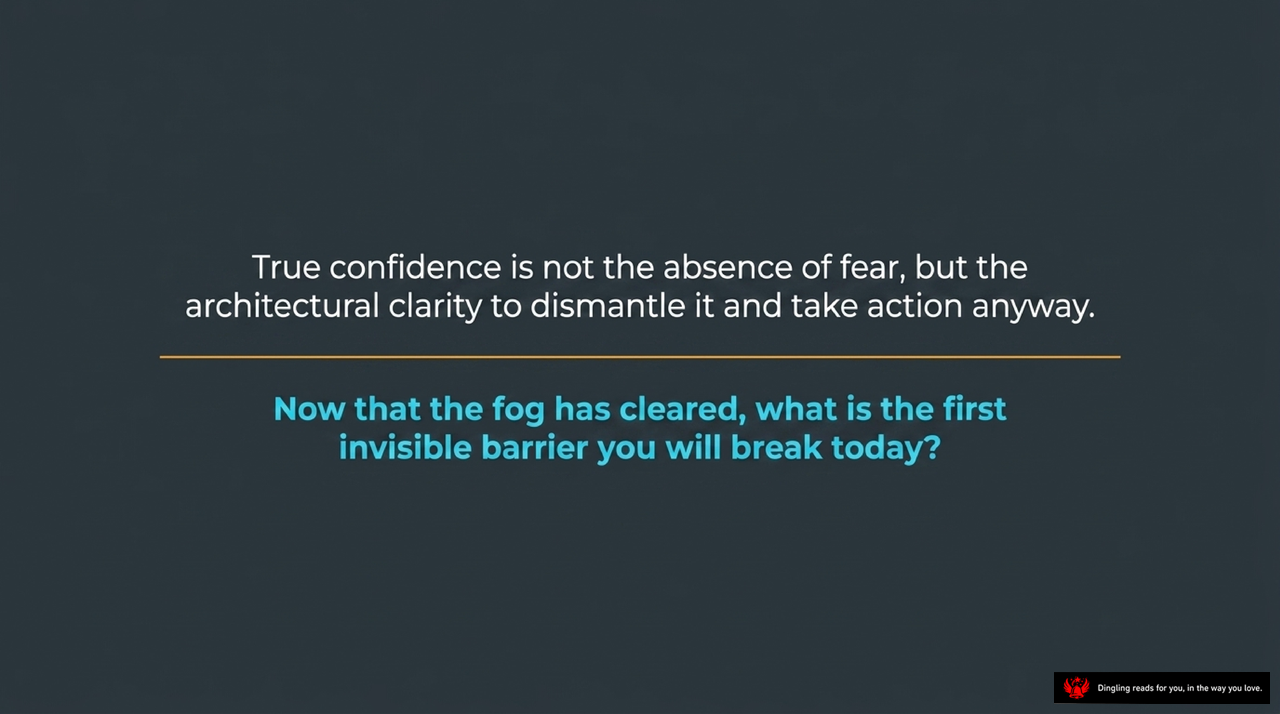
Take a look at this slide. It says clearly that "True confidence is not the absence of fear, but the architectural clarity to dismantle it and take action anyway." That is a profound insight. We often mistake confidence for a feeling of safety or the lack of nervousness, but the book teaches us that it is actually a mindset. It is about building a clear framework in your mind—what I call architectural clarity—that allows you to take apart fear when it arises and keep moving forward regardless. It is like having a blueprint for your life.
We have spent time discussing the "fog" that clouds our judgment. This fog comes from many places: the fear of looking stupid in a meeting, the fear of asking for help because we think we should be superheroes, or the fear of setting boundaries because we worry about disappointing others. We also discussed the fear of failure and the fear of being seen as arrogant. These invisible barriers keep us stuck in a cycle of anxiety and inaction. But remember, the text reminds us that fear loves a loose brain. If you do not actively challenge these negative thoughts, they will grow into walls that block your success.
However, once you engage in the exercises we discussed—clarifying your values, breaking down your goals, and challenging your assumptions—that fog begins to lift. You realize that no one has the right to define you but you. You see that your values are the compass, not other people's expectations. For example, we talked about how even successful people struggle with the fear of failure or the fear of being seen as arrogant. But when you focus on your core values, those fears become manageable obstacles rather than roadblocks. You learn that true confidence comes from knowing your worth and taking action aligned with it.
Now, the slide asks a critical question: "Now that the fog has cleared, what is the first invisible barrier you will break today?"
Do not just read this and move on. Think deeply. Is it the hesitation to make that cold call? Is it the reluctance to say no to a request that drains your energy? Is it the fear of admitting you do not know something? These barriers are invisible, which makes them dangerous because they can fester. But you have the tools now. You know how to dismantle them.
So, commit to one action. True confidence is not about waiting until you feel brave. It is about taking action despite the fear. What is your first step? Make it count.