
Finding Your Element: Complete Chapter-by-Chapter Summary

Welcome to the journey of "Finding Your Element." Imagine a river winding through a vast, ancient forest, carving its own unique path without a map. That is exactly what discovering your true potential feels like.
In this book by Ken Robinson, we learn that your life is not a straight line to be planned, but an organic river to be explored. The core idea is simple yet transformative: true fulfillment happens when your natural aptitude aligns with your personal passion. It's not about forcing yourself into a pre-defined career, but about uncovering the unique combination of what you are good at and what you love doing.
Think of your life as a river that shapes its own course. Sometimes, the path isn't clear at the start, just like that river in the image. You might feel stuck or unsure, but the key is to stop trying to control the flow and instead start exploring. By shielding yourself from the noise of modern life and using tools like mind maps or vision boards, you can begin to see your own unique direction.
Remember, you are a miracle of biology and culture. Your starting point does not dictate your destination. Whether you find your element early or later in life, the act of following your curiosity and connecting with like-minded people is what sets you free. So, take a deep breath, look at the river before you, and trust that you have the power to create a life that is entirely your own.
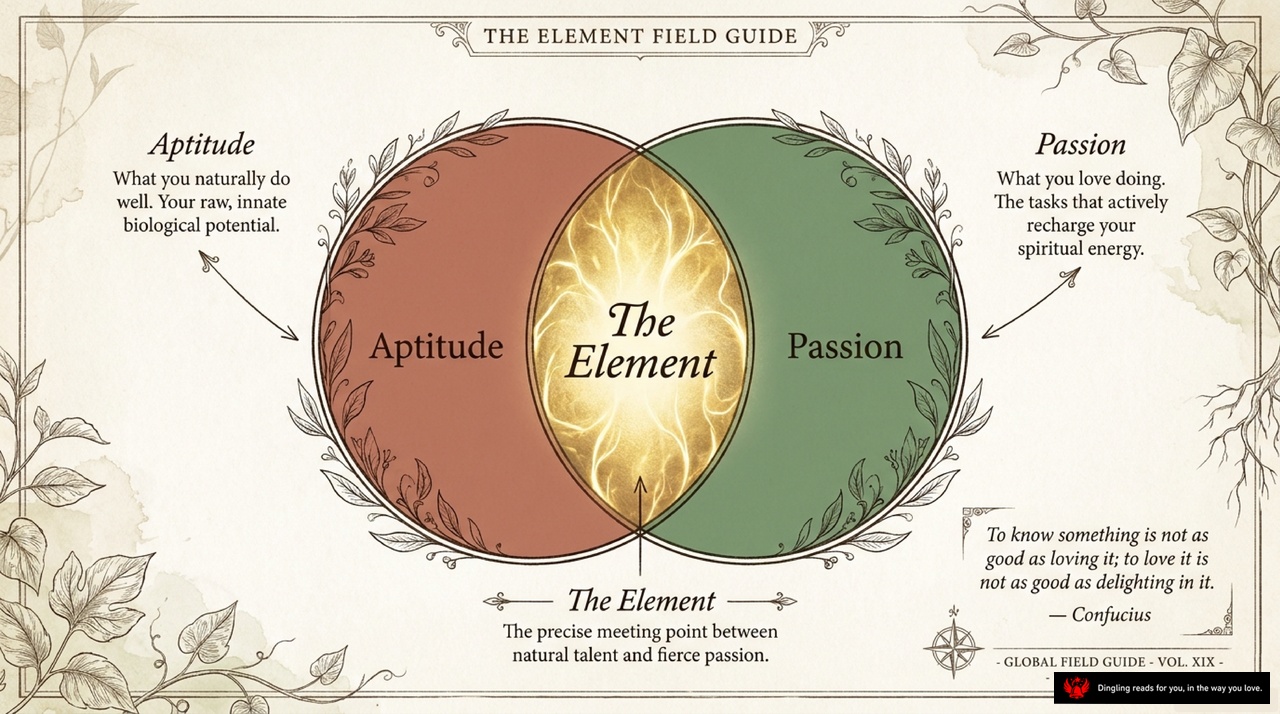
Look at this Venn diagram. It perfectly captures the heart of what we've been talking about: finding your Element. Notice how "The Element" sits right in the center, formed by the overlap of two distinct circles. On the left, we have Aptitude. As the guide defines it, this is what you naturally do well—your raw, innate biological potential. Think of it as your hardware; it's the unique combination of talents you were born with, like the author's brother who could hear an engine's "voice" and diagnose mechanical issues instantly.
On the right, we have Passion. This is what you love doing—the tasks that actively recharge your spiritual energy. It's not just about hobbies; it's about that deep, internal drive that makes you feel alive. The quote from Confucius at the bottom reminds us that loving something is powerful, but delighting in it is even better.
The magic happens in the middle. True fulfillment doesn't come from just being good at something, nor from just loving something. It happens when you combine your natural strengths with what you deeply care about. That intersection is where you find your Element. It is the precise meeting point between your unique talents and your fierce passion. When you align these two, you stop guessing and start living your authentic life.

Welcome to Pillar 3 of our Element Field Guide: Life is Organic, Not Linear. Think about this for a moment. Most of us were raised with the idea that life is a straight highway—a planned route where you pick the right major, pass the exams, and suddenly, everything clicks into place. But the truth is, life isn't a manufactured road; it's more like a meandering river. It shapes itself through organic growth, reacting to the terrain, the weather, and the unexpected turns along the way.
This isn't just a metaphor; it's the reality of human experience. Take David Ogilvy, the legendary advertising pioneer. His path was anything but straight. He started working in a hotel kitchen in France, sold kitchenware in Scotland, served as an intelligence officer during the war, and even farmed with the Amish. Yet, he ended up building Ogilvy & Mather into a global powerhouse. His journey had no straight line, yet his talent and creativity allowed him to create a legendary path.
The lesson here is profound: you cannot predict another person's life, and you certainly cannot predict your own. We often edit our pasts to look planned, like a polished resume, but that's just a story we tell to fit external expectations. Real success comes from embracing new experiences, staying open to the unknown, and accepting that your life is an improvisation. You don't need a map to the finish line; you just need the courage to keep moving forward, even when the path bends in a direction you didn't expect. So, stop trying to force life into a straight line. Embrace the meander.

Imagine your life as a map of two distinct territories. On the left, you have **The Inner World**—your private consciousness, governed by your feelings, thoughts, and emotional energy. It's the vibrant, swirling landscape of your own mind. On the right lies **The Outer World**, consisting of circumstances, people, and opportunities that exist independently of you. You can't change the external terrain directly; you can only perceive it through the lens of your inner world.
Connecting these two realms is **The Bridge: The Element**. Finding your element requires a dual journey: looking inward to discover your raw aptitudes and looking outward to find the right environment to manifest them. To navigate this complex terrain, you need specific **Navigation Tools**. First, practice **Mindfulness** to silence the constant noise of the modern world and reconnect with your true self. Second, engage in **Exploration** by actively testing new external environments. By bridging your internal potential with external opportunities, you unlock the path to your unique element.

Most people assume that finding your passion is about finding a specific talent you were born with, but the truth is much more dynamic. It's actually about connecting your innate potential with the energy that drives you.
Think of your talent as raw material, but passion is the fuel that makes it move. As we explored earlier, passion comes from the Greek word *philia*, which means a deep, sustaining love for something. It's not just a fleeting hobby; it's a source of vital energy. The book reminds us of a crucial truth: "No energy, no life." Without that spark of passion, even the greatest talent remains dormant.
Consider the story of Emily Kammings. Her grandfather gave her a hammer when she was just four years old. Instead of seeing it as a dangerous tool, she saw it as an invitation to create. That moment ignited a lifelong fire. She went on to design solar-powered refrigerators for Africa, not because she was forced to, but because she was deeply energized by the act of solving problems. Her passion wasn't just about the invention; it was about the creative process itself.
But here is the most important distinction to make: you must separate your physical energy from your spiritual energy. Physical energy relates to your health and stamina, while spiritual energy is about your mindset and your connection to something bigger. Take the story of Randy Parsons. He was a talented guitarist who felt he could never be a rock star, so he sold his guitar and joined the military. For years, he felt empty. But one day, while showering, the idea struck him to build guitars. He didn't just do it; he poured his soul into it. He eventually founded a company that makes instruments for legends like Jimmy Page.
Why did he succeed where he thought he'd fail? Because he tapped into his spiritual energy. He found a way to be authentic. The book asks us a powerful question to help you find your own path: "What do you love? And what do you love about it?"
It's okay if you feel like you have no passion right now. Often, we aren't lacking passion; we are just blocked by past trauma or the wrong environment. Remember, passion is a skill. It's like a muscle that grows when you use it. When you find something that truly resonates with your spirit, you unlock a state of flow where work feels less like a burden and more like an adventure.
So, don't wait for the perfect moment or the perfect skill. Look for what excites your inner world. When you align your actions with that deep, spiritual energy, you stop just surviving and start truly living. That is the bridge between discovering your talent and building a life you love.

Imagine your life not as a battery that slowly drains until you hit zero, but as a dynamic system where two types of energy collide. On one side, you have the trap of "Mere Competence." Picture this: you're incredibly good at your job, maybe even the best in the room. But every day feels like dragging a heavy anchor through water. Time slows down, your physical stamina vanishes, and by the end of the day, you feel aged, depleted, and spiritually empty. You've traded your vitality for efficiency, and it's costing you everything.
Now, look at the other side: The Flow State. This is the true litmus test for passion. When you are doing what you love, something magical happens. Your perception of time distorts; an hour feels like five minutes. Yes, your physical body might be tired, but your spiritual energy isn't just replenished—it's deeply recharged. You feel alive, not exhausted.
So, here is your diagnostic prompt for today: Look at your week. What activities leave you physically exhausted but spiritually radiant? That is the sweet spot where your competence meets your passion. That is where your real life happens. Don't settle for just being good at things; strive to be in the flow.

True happiness isn't a fleeting high; it's a sustained internal state built on balance. Think of your life not as a single track, but as an ecosystem. Research from Gallup tells us that thriving in your career is just the tip of the iceberg—only about 20% of people actually flourish professionally. But here's the game-changer: when you align your career with your true element, your chances of overall success more than double.
This slide outlines the five pillars of that happiness ecosystem. It's all about finding the right balance across Career, Social connections, Financial stability, Physical energy, and Community engagement. If you're missing one, the whole structure weakens. But when these dimensions support each other, you unlock what we call the "Multiplier Effect." You stop just surviving and start thriving. So, instead of chasing a linear path, focus on nurturing this entire ecosystem. It's about creating a life where every part fuels the others, leading to a deeper, more resilient kind of happiness.

Have you ever felt like your life was stuck on a single track, convinced that your starting point dictates your entire future? The reality is far more exciting: life is not a linear path, but a living, breathing organism that constantly evolves. Think about Dr. Jeffrey Meyers, a pathology expert who once dreamed of being in a rock band. After years in medicine, he didn't choose between his career and his music; he did both, leading innovation in his field while playing guitar with colleagues. Similarly, photographer Chris Jordan spent nearly 40 years as a corporate lawyer, feeling trapped and depressed. Only when he finally had the courage to quit did he discover his true calling, turning his debt into a thriving career and finding the joy he had been missing.
These stories prove that you don't have to pick just one talent. Your starting point is never your destination. Many of us fall into the trap of "fixed mindset," believing our traits are static and that failure is a permanent indictment of our identity. But the alternative is a "growth mindset"—seeing potential as something that can be endlessly expanded through effort and experience. Just like the tree breaking through the rocks in our visual, your roots can grow stronger through challenges. Embrace them as necessary stretch assignments. Whether you're 22 and free to choose, or 65 and looking for a new chapter like Mimi Weddle, who became an acclaimed actress after retiring, your life is an organic process of improvisation. Don't worry about the whole map; just focus on the next step. If you feel heavy, it might be because you're suppressing your talents. Remember, the cost of ignoring your inner call is often far greater than the risk of trying. So, take that first real step today.

Imagine your life not as a rigid track, but as a vast, uncharted ocean. Just as a sailor must constantly check their map to navigate changing winds and currents, you too need to understand your current coordinates to find your true north. Today, we are going to use a powerful tool called a "Global Field Guide" to map your exact position.
At the center of this map lies your compass, pointing toward two distinct worlds. On one side, we look inward at your **Internal Attributes**. Here, you must honestly assess your **Strengths**: What raw aptitudes have you buried? What tasks place you in a state of energetic flow? Conversely, you must confront your **Weaknesses**: Where does your mindset default to a fixed state? What tasks drain your spiritual energy?
On the other side, we look outward at your **External Environments**. You need to scan the horizon for **Opportunities**: What unmapped territories—new communities, hobbies, or courses—exist in your immediate environment that you haven't explored yet? And you must remain vigilant for **Threats**: What cultural expectations, financial constraints, or unsupportive relationships are anchoring you in place, preventing you from moving forward?
By honestly answering these questions, you transform confusion into clarity. You stop guessing where you are and start seeing the landscape clearly. Once you have mapped your current coordinates, you can finally plot a course that honors who you are and where you are going.

Imagine your life not as a solitary tree, but as a vibrant ecosystem centered around "You," where your roots reach deep into a community known as "The Tribe." This slide beautifully illustrates that finding your Element is rarely a lonely pursuit. Just as you cannot grow a tropical plant in arctic soil, you cannot flourish without the right environment. The Tribe offers four critical supports: Validation, which proves your passion is legitimate and you are not alone; Inspiration, pushing your boundaries by showing you what true mastery looks like; Guidance, offering mentorship to help you navigate inevitable obstacles; and Synergy, the alchemy of collaboration where 1+1 equals 3. These connections remind us that while your unique gifts matter, they are amplified when you are part of a supportive group. As the text emphasizes, if you feel wilting, it might not be a lack of talent, but simply being in the wrong tribe. So, don't hesitate to seek out the people who fuel your growth, because together, you can create a life that is far greater than the sum of its parts.

Imagine your life not as a rigid machine, but as a living, breathing ecosystem. Today, we're looking at "The Element Engine," a visual guide that explains how your unique potential actually works. Think of it as a globe where different elements combine to create your true self.
At the very core, buried deep like roots in the soil, lies your **Aptitude**. This is your innate talent, your natural wiring. But roots alone don't make a tree; they need the right environment. That's where **The Tribe** comes in—your climate and ecosystem. You can't grow in isolation; you need a community that supports your specific kind of person.
Inside this globe, you'll see **Passion** flowing like water and sunlight. This is the fuel that keeps things alive. But passion isn't enough on its own. It starts with a **Spark**, which happens when your innate aptitude meets fierce passion. That initial connection is what ignites everything.
However, a spark is fragile. To survive early failures and self-doubt, you need **Fuel**. This is your Growth Attitude—the soil quality that allows you to keep growing even when things get tough. Without the right mindset, even the best talent will wither.
Finally, for long-term flourishing, you need **Sustainment**. This is where the right Tribe steps in again. Just as an ecosystem needs balance, your career and life need a supportive community to sustain the fire of your passion.
The book teaches us that finding your element isn't about following a straight line. It's about nurturing your roots, finding your tribe, and tending to your passion until it becomes a thriving, sustainable part of your life.

Imagine life not as a rigid, manufactured highway, but as a living, breathing river that naturally finds its own course. Today, we are exploring the concept of "The Organic Bends"—a global field guide for navigating your unique journey. The core message here is profound: you do not need a perfect 10-year plan. In fact, the most profound lives are often organic improvisations born from paying attention to your inner energy and outer opportunities.
Think about the meandering river in our image. Just as a river creates beautiful curves instead of a straight line, your life is designed to be flexible. This brings us to the first crucial step: taking the first step in faith. As Martin Luther King Jr. famously said, "You don't have to see the whole staircase, just take the first step." You don't need to know the entire destination to start moving forward.
But what is the biggest regret people face at the end of their lives? Research in palliative care reveals a heartbreaking truth: the number one regret is, "I wish I'd had the courage to live a life true to myself, not the life others expected of me." This is why embracing the meander is so vital. When we stop trying to force our lives into a linear box and instead allow for the twists and turns of exploration, we unlock our true potential. So, stop waiting for a perfect map. Trust the process, embrace the unexpected bends, and let your life unfold naturally.

Have you ever felt stuck in a harbor of expectation, waiting for a sign that never comes? The image before us captures that very moment—a solitary figure standing on the edge of the world, gazing out at the vast, uncertain ocean. This isn't just a photo; it's a mirror reflecting the ultimate question we all face: Will you remain safely anchored, or will you risk the open ocean to discover who you are truly meant to be?
The text on the screen reminds us of a profound truth: Your Element is not a destination you reach, but a continuous alignment of your deepest passions, your innate aptitudes, and the courage to seek out your tribe. Think about it. We often treat life like a linear map, believing that if we just pick the right major or follow the right career path, we'll arrive at a place of happiness. But the reality is far more dynamic. Life is an organic process, a bit like improvising a jazz solo. You start with a melody, but the rhythm changes, new instruments join in, and sometimes you have to detour to find a better path.
The figure in the image represents that brave step into the unknown. Many of us fear the "open ocean" because it's unpredictable. We worry about what if we fail? What if we're not good enough? But consider the stories of people who have dared to sail. Whether it's a lawyer who quits to become a photographer, or a scientist who returns to music, their journeys weren't about finding a pre-written script. They were about listening to their inner compass and taking the first step, even when the map was blank.
So, the choice is yours. You can stay safe in the harbor, comfortable but perhaps unfulfilled, or you can embrace the risk. The ocean might be rough, but it's also where the greatest discoveries happen. It's where you meet your tribe, where your unique talents finally click into place, and where you find the kind of joy that comes from living authentically. Don't let the fear of the unknown keep you from seeing the beauty that lies just beyond the horizon. Your Element is waiting, but only if you're brave enough to set sail.