
Fire in the Valley: Complete Chapter-by-Chapter Summary

Welcome to today's session on *Fire in the Valley: The Birth and Death of the Personal Computer*. Imagine a glass tube containing a miniature circuit board, a visual metaphor for how computing evolved from bulky, mysterious machinery into something we carry in our pockets. This book tells the story of how a band of hobbyists, hackers, and visionaries stole computing power from the corporate priesthood and put it right in our hands.
In the 19th century, inventors like Babbage dreamed of mechanizing thought, but it took decades and the invention of the transistor, followed by the integrated circuit, to make that possible. The real revolution began when engineers realized they could build a universal computer on a single chip. Intel's 4004 microprocessor, the world's first general-purpose chip, changed everything. But the story doesn't end with hardware; it's about the people who believed computers should belong to everyone, not just big corporations. From the garage-based homebrew computer clubs to the rise of companies like Apple and Microsoft, this narrative captures the explosive journey from a niche hobby to the dominant force in our daily lives. Join us as we explore how these rebels dismantled the old guard and built the digital world we live in today.

Look at this diagram. It visualizes the early era of computing as a fortress guarded by a "white-robed priesthood." For decades, computing power was centralized behind institutional glass walls, accessible only to the elite. The outer ring represents mainframes—massive, centralized power controlled by institutions, treating computing as a rare privilege. Moving inward, we see minicomputers from companies like DEC; these were still large, fridge-sized machines confined strictly to enterprise walls. But then, everything changed. At the very center lies the microprocessor, the "Intel Spark." This is the revolution. Chips like the 4004 and 8080 concentrated immense computing power onto a single piece of silicon. This tiny ignition source broke the glass walls, ending the priesthood's monopoly and sparking the personal computer revolution that would eventually empower everyone.

The Altair 8800 was barely functional, but it belonged to the people. This slide captures a pivotal moment in history: the birth of the personal computer, driven not by corporate giants, but by a desperate gamble and a community of believers.
On the left, we see "Ed Roberts' Gamble." In 1974, MITS, the company Ed Roberts founded, was facing ruin. The calculator market was collapsing, and they were drowning in debt. With no other option, Roberts pivoted to a new idea: a kit-based computer. He didn't build a finished product; he sold a promise. As the slide notes, buyers didn't receive a polished tool. They received a blank canvas—just a box with flashing lights, no keyboard, no monitor. It was a hardware kit that required assembly, yet it ignited a fire.
This led to "The Catalyst." The Altair proved that people desperately wanted a computer of their own, regardless of how hard it was to build. It wasn't about convenience; it was about ownership. This raw, do-it-yourself spirit attracted a new generation of hackers and enthusiasts. It was the moment the computer stopped being a room-sized machine owned by big corporations and became something accessible to the individual.
Finally, look at the center: the "S-100 Bus." This wasn't just a circuit board; it was an open standard. By designing an expandable bus, Roberts and his team allowed others to create peripherals and software. This openness is what turned a niche hobby into a global industry. The Altair might have been rough around the edges, but its legacy is clear: it democratized computing, laying the foundation for everything we use today.

The Homebrew Computer Club wasn't just a meetup; it was the explosive catalyst for the entire tech revolution we know today. Think of it as the ultimate incubator where a true technological rebellion was born.
At the heart of this movement was a radical, almost dangerous idea: that technology shouldn't be locked away by corporate "priests," but instead should be shared, playful, and decentralized. This was the antidote to the exclusive, high-priced mainframes of the past. The club institutionalized this belief, creating the primordial soup of Silicon Valley.
What fueled this fire? It was a perfect storm of ingredients. You had cheap Intel silicon making hardware accessible, a fierce radical anti-establishment ethos that refused to accept the status quo, and the open, collaborative spirit of the BBS sharing culture. These forces converged in one central hub: the Homebrew Computer Club itself.
From this single club, an incredible ecosystem erupted. It birthed The Apple I, the direct ancestor of every computer we use today. It laid the retail foundations for companies like IMSAI, proving that personal computing could be a business. It cemented the hacker DIY philosophy, empowering anyone with a soldering iron and a dream to build their own machine.
The mechanism behind this success was legendary. Led by toastmaster Lee Felsenstein, the club thrived on schematic sharing and fierce, spirited debates. It was a place where ideas were torn down and rebuilt instantly, creating a culture of innovation that was impossible to replicate anywhere else. It didn't just build computers; it built the mindset that changed the world.
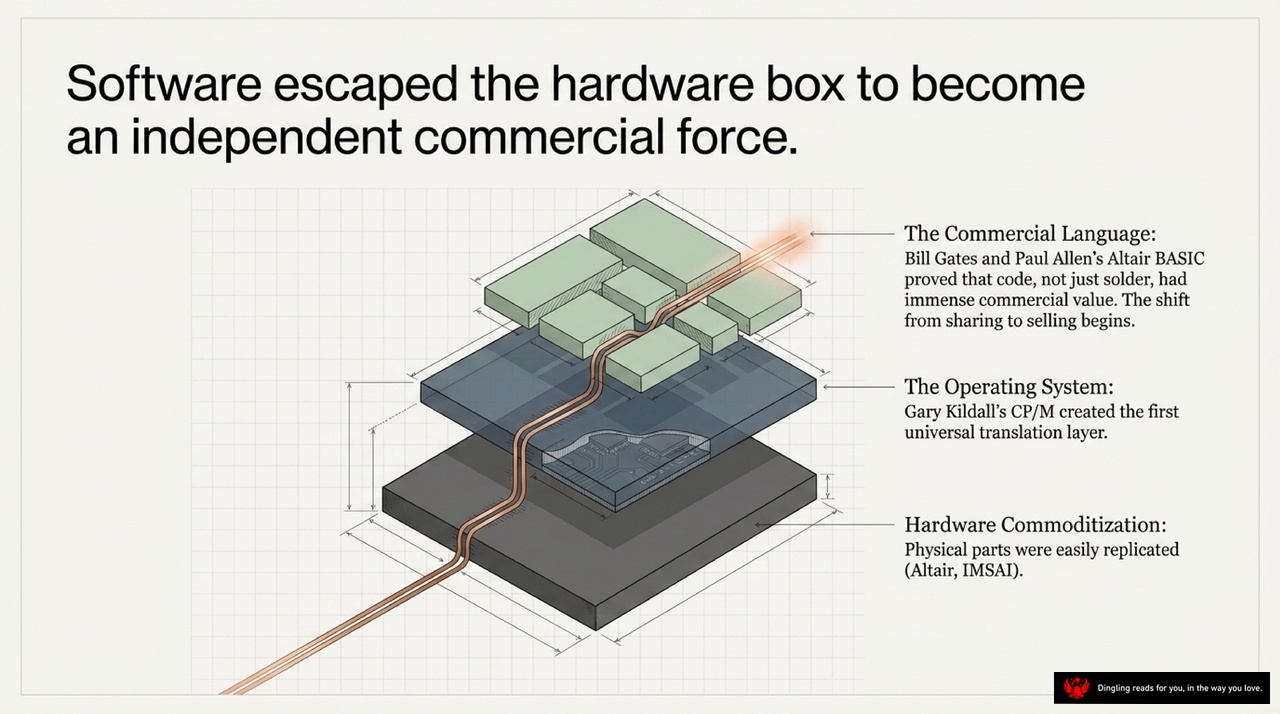
Imagine the early days of personal computing not as a sterile corporate battle, but as a vibrant, chaotic movement fueled by passion. In 1975, the Altair 8800 arrived, but here's the catch: it was essentially a bare metal box with no keyboard. Users had to toggle switches to input binary code. It wasn't user-friendly; it was a toy for the dedicated.
But then, something magical happened. Steve Eastpy brought his Altair to a homebrew club meeting and demonstrated how a simple program could control the machine's electrical interference to make a radio play Beatles songs. Suddenly, the computer wasn't just a tool for engineers; it was a fun, creative device anyone could tap into. This moment proved that software wasn't just a utility; it was a commercial force in its own right.
However, hardware alone wasn't enough. The real revolution came when software became a standalone business. Gary Kildall's CP/M created the first universal translation layer, letting different machines speak the same language. Then came Bill Gates and Paul Allen. They realized that code, not just solder, had immense value. They rushed to write a BASIC interpreter for the Altair, proving that sharing code could evolve into selling it.
This shift was explosive. Early software companies like Personal Software and VisiCalc turned the computer from a gaming toy into a business tool with spreadsheets. But as the market grew, so did the problem of piracy. Gates famously wrote an open letter to fans, arguing that software should be protected, even if the community initially resisted.
Companies like IMSAI tried to capitalize on this by bundling software with hardware, but they often failed because they ignored the culture of sharing that fueled the industry. Instead, the future belonged to those who understood that software could be an independent commercial entity. Whether it was selling licenses for CP/M, developing commercial BASIC, or creating killer apps like VisiCalc, these pioneers laid the groundwork for the modern software economy. They transformed the computer from a piece of hardware you owned into a platform you could sell your ideas on.
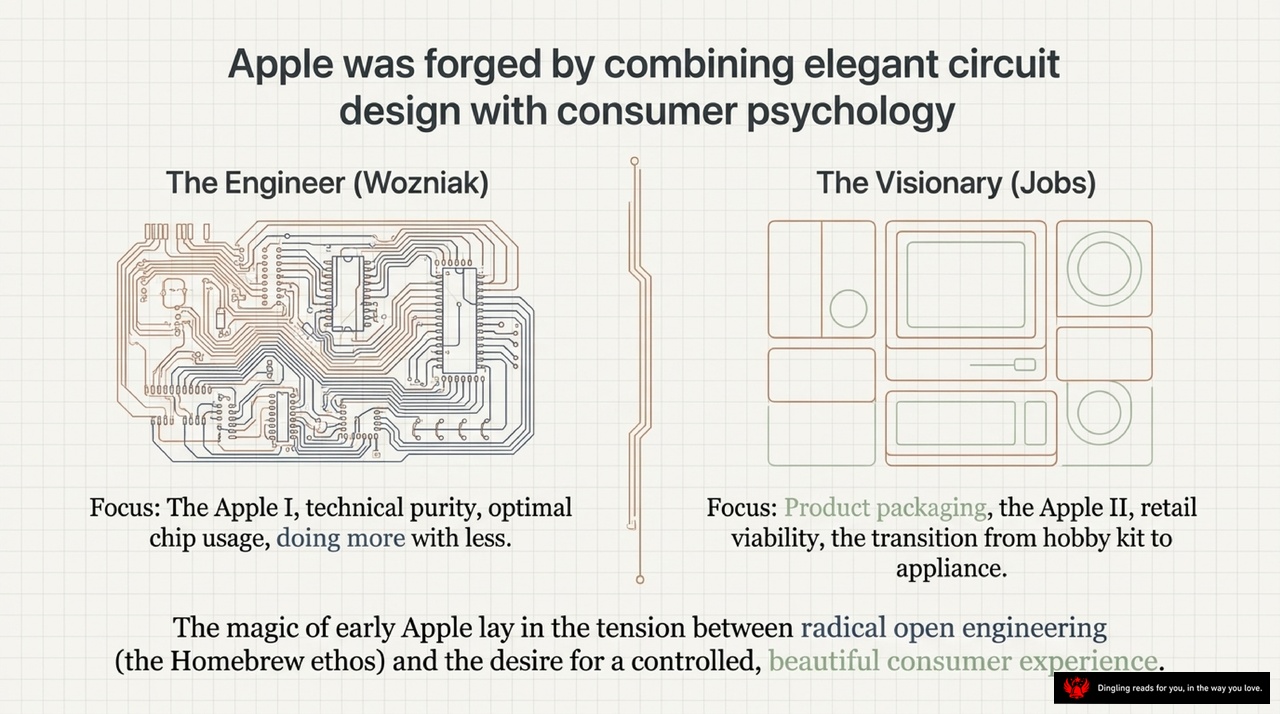
Look at this slide. It captures the exact moment Apple was forged: by marrying elegant circuit design with consumer psychology. On the left, we see the Engineer, Steve Wozniak. His focus was pure technical purity—think Apple I, optimal chip usage, and doing more with less. He was the master of radical open engineering, embodying that "Homebrew ethos" where the joy was in the build. On the right stands the Visionary, Steve Jobs. His focus shifted entirely to the outside world: product packaging, retail viability, and the critical transition from a hobbyist kit to a reliable home appliance.
The magic of early Apple lay in the tension between these two forces. Wozniak wanted to build a beautiful machine for engineers, while Jobs insisted it had to be a beautiful experience for everyone. This balance between the raw power of open engineering and the desire for a controlled, consumer-friendly interface is what made the Apple II a true success. It wasn't just a computer; it was an appliance that anyone could use, proving that technology only works when it speaks the language of people, not just machines.

Back in the late 80s, the personal computer landscape shifted dramatically. The "hobbyist" era was over, and the industry had matured into a serious business. While Apple's Macintosh was trying to lead with its advanced graphical interface, it was struggling with serious hardware limitations like a lack of hard drives and insufficient memory. More critically, the software world was overwhelmingly built for Windows. Developers prioritized Windows applications, and businesses viewed Macs as cool toys rather than essential tools for commerce. Apple was effectively surrounded.
Faced with this crisis, Apple had only two real options: either open up their technology and let other companies clone their system to survive on licensing fees, or find a powerful partner to help them compete. In 1985, Bill Gates had actually suggested this alliance, but Apple's leadership hesitated, fearing the loss of intellectual property. This mistake proved costly. While Apple dithered, their competitor Sun Microsystems thrived by embracing an open-architecture model, capturing the high-end workstation market.
The tide turned completely in 1989. The battle for chip dominance intensified between Intel and Motorola. Intel's chips became the standard for the booming IBM-compatible market, while Motorola's chips were almost exclusively used by Apple. Meanwhile, Compaq redefined the portable computer with a "clean room" approach that allowed them to build 100% compatible machines without infringing on IBM's BIOS. Compaq and Dell quickly surpassed IBM in profitability. The retail landscape also changed; massive electronics stores like Best Buy and CompUSA, driven by low prices and variety, crushed the traditional specialized computer chains.
While the industry raced forward, the stakes for Apple grew higher. The internet was about to explode. Tim Berners-Lee invented the World Wide Web on a NeXT computer, and the Mosaic browser made the internet accessible to everyone. This created a massive data and connectivity boom that threatened Microsoft's dominance. Microsoft responded aggressively, launching Internet Explorer to crush Netscape. As the 90s progressed, Apple's internal struggles continued. After Steve Jobs left, the company made a series of missteps, culminating in a disastrous partnership with IBM that failed to produce a viable operating system. By 1996, Apple was on the brink of collapse, with its stock price plummeting and its future in question. It was then that they made a life-changing decision to acquire NeXT, bringing Steve Jobs back into the fold to save the company.
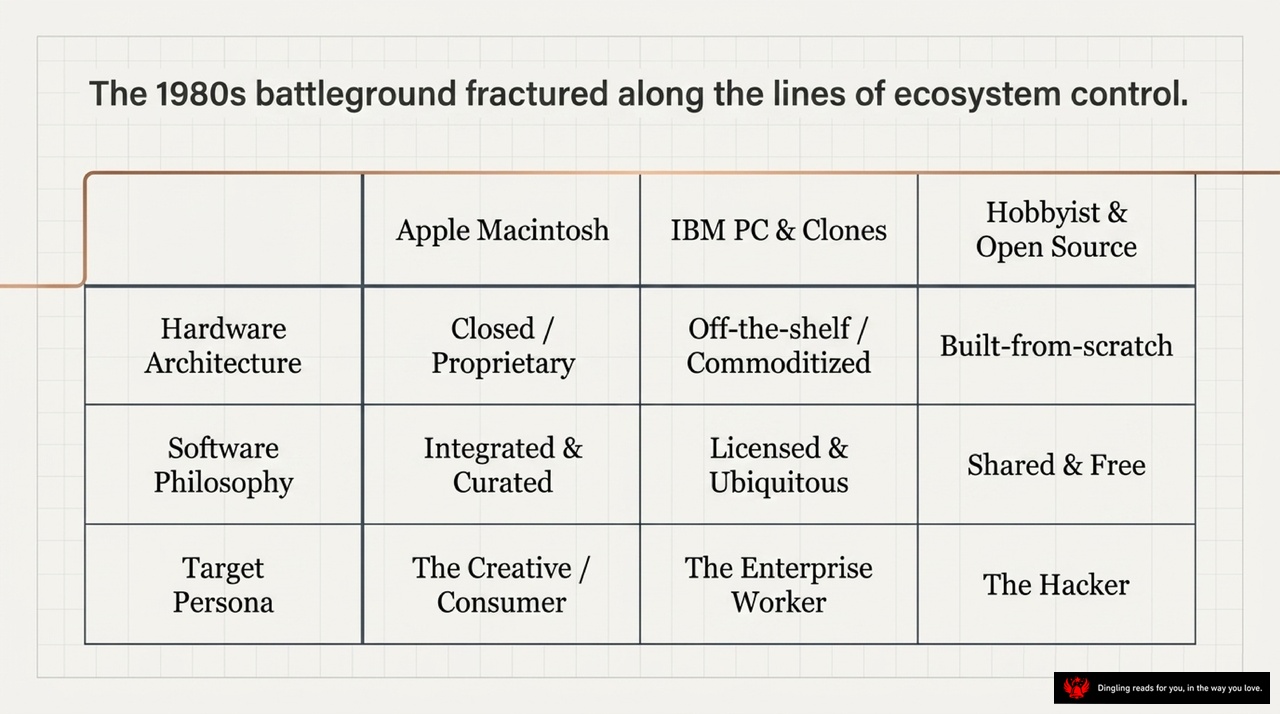
The 1980s battleground fractured along the lines of ecosystem control, and this slide perfectly maps out the three distinct worlds that defined the decade. On the left, you have the Apple Macintosh. Think of this as the walled garden. It features a closed, proprietary hardware architecture where everything is integrated and curated by Apple. The software philosophy was all about control and curation, targeting the creative consumer who wanted a polished, out-of-the-box experience without the hassle of tinkering.
Moving to the center, we see the IBM PC and its clones. This was the realm of the enterprise worker. Here, the hardware was off-the-shelf and commoditized, meaning you could buy parts separately. The software was licensed and ubiquitous; it wasn't about a curated experience, but about compatibility and availability. This was the world of business, where standardization mattered more than innovation.
Finally, on the far right, sits the world of the hobbyist and open source. This was the domain of the hacker. Their hardware was built from scratch, often in garages or labs. Their software philosophy was radical: shared and free. They didn't want to buy or license; they wanted to build and distribute code openly. This ecosystem wasn't driven by profit or enterprise needs, but by pure technical passion and the belief that knowledge should be free.
These three pillars—Apple's curated control, IBM's open standardization, and the hacker's open-source freedom—created the complex, fractured landscape that would drive the entire computing revolution forward.
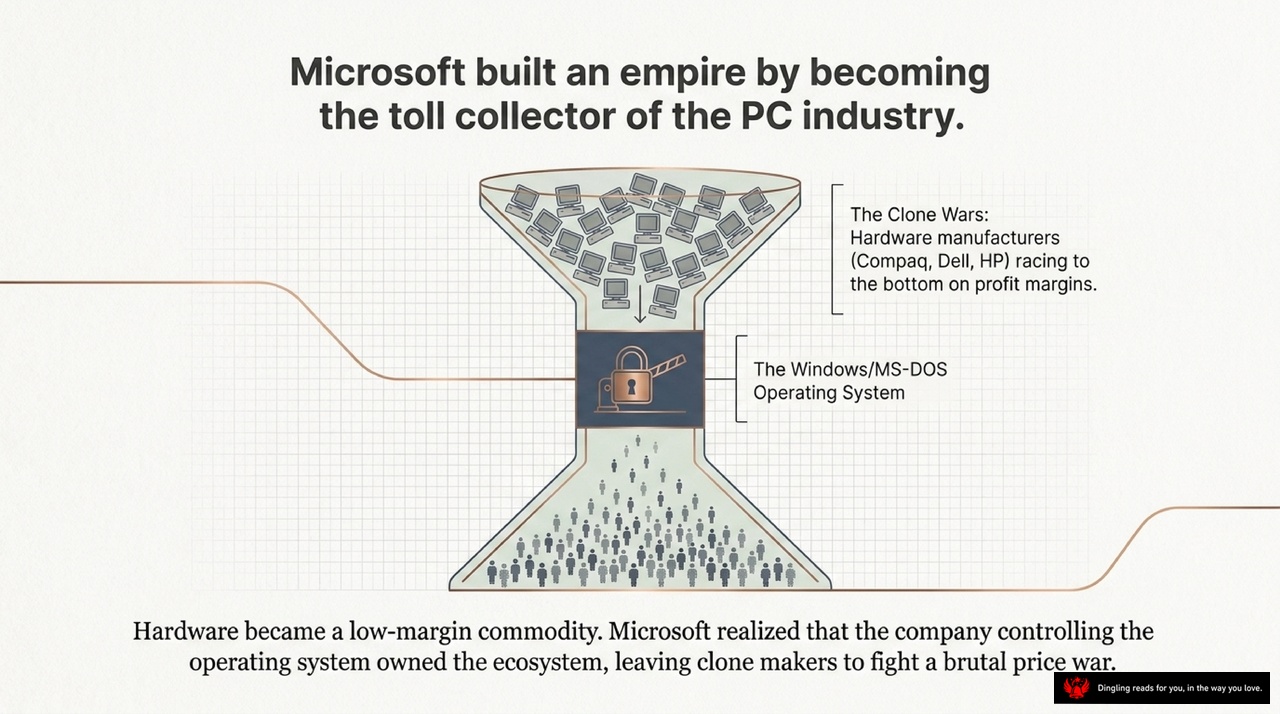
Microsoft built an empire by becoming the toll collector of the PC industry. Imagine a massive hourglass: at the top, countless hardware manufacturers like Compaq, Dell, and HP are racing to the bottom, slashing profit margins in a brutal "Clone Wars." They compete on price, turning computers into cheap commodities. But right in the middle sits the choke point—the Windows and MS-DOS operating system. This is where Microsoft locked the gate.
The logic was simple yet devastatingly effective. Once hardware became a low-margin commodity, the real power shifted to whoever controlled the operating system. Microsoft realized that by owning the ecosystem, they could leave the clone makers fighting over scraps while collecting the toll on every single PC that passed through. This strategy didn't just make Microsoft rich; it cemented their dominance for decades, turning the open hardware market into a walled garden where they held the keys to the kingdom.

The slide highlights a pivotal shift in computing history: the move from the machine's strict syntax to human intuition. On the left, you see "The Command Line," representing an era where users had to learn the machine's rigid mathematical language, typing commands like "RUN" into a black box. It was a barrier that only experts could cross.
But look at the right side. This is "The GUI," or Graphical User Interface, pioneered by Macintosh and PARC. Here, the machine speaks the human language of spatial recognition. Instead of typing code, users interact with icons, folders, and windows—things they can actually see and understand in the real world.
The bottom of the slide points to the catalyst for this revolution: Steve Jobs' visit to Xerox PARC. That experience triggered a crucial realization that computing had to hide its complexity behind a visual metaphor to achieve true mass adoption. This wasn't just about making computers prettier; it was about making them usable for everyone, not just engineers. By shifting power from the machine's syntax to human intuition, the technology finally became a tool for the masses, setting the stage for the personal computer revolution we know today.

The internet and open-source movements threatened to dismantle the closed PC empires. Look at this graphic: a massive, cracked block of stone represents the old, walled-off world of proprietary computing, while golden circuit lines surge outward, symbolizing the new, decentralized reality.
On the left, we see "The Browser Wars," led by Netscape. This was the moment the web hijacked the operating system. Suddenly, the value wasn't in the software you installed on your hard drive, but in the content you accessed through a browser. It made the underlying OS irrelevant. You didn't need to buy a specific version of Windows or Mac to be productive; you just needed a browser.
On the right, we have "Open Source," specifically Linux. This wasn't just a technical fix; it was a cultural revolution. It was a return to the radical sharing ethos of the Homebrew Computer Club, proving that decentralized, global communities could build enterprise-grade software without a single corporation controlling the code.
Together, these two forces—the democratization of access via the web and the democratization of creation via open-source code—cracked the foundation of the closed PC empires. They shifted power from a few tech giants to everyone holding a connected device, forever changing how we think about technology and ownership.
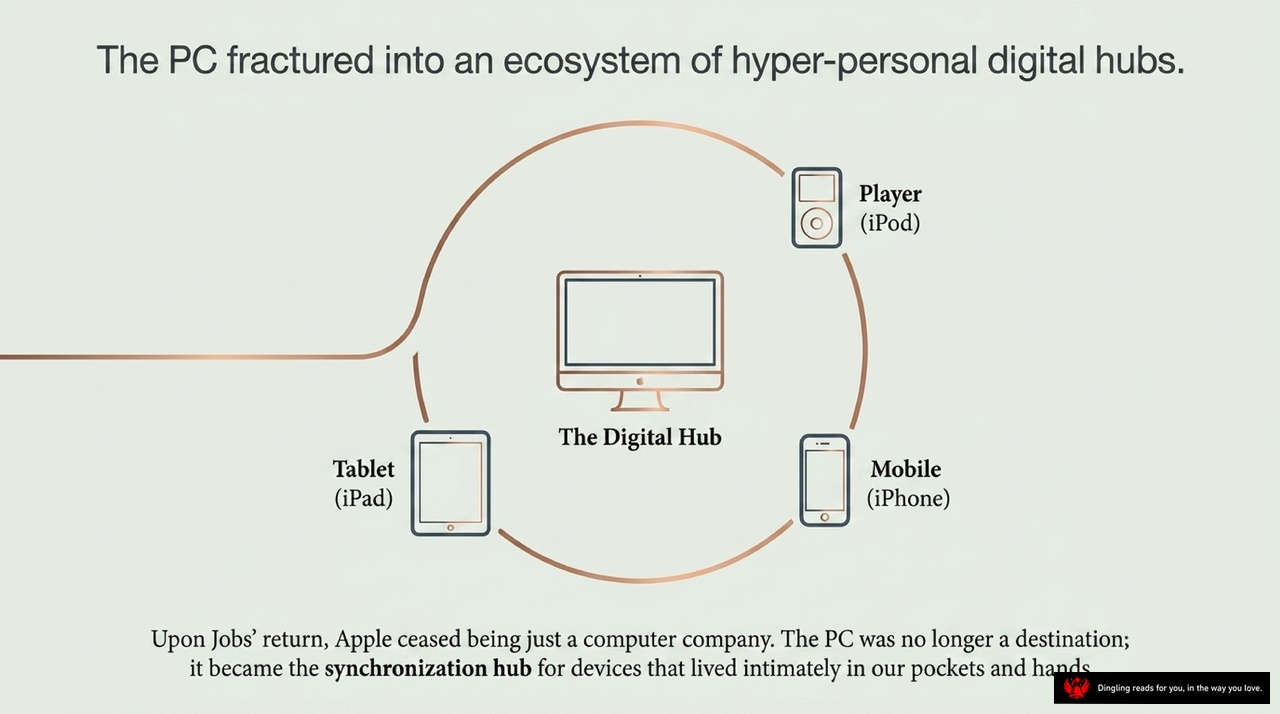
The PC didn't just evolve; it fractured into a completely new ecosystem of hyper-personal digital hubs. Look at this diagram: what was once a single, monolithic destination—the desktop computer—has splintered into a synchronized network of devices that live intimately in our pockets and hands. At the center, we still have the digital hub, but now it's merely the synchronization point for a player like the iPod, a mobile phone like the iPhone, and a tablet like the iPad.
This shift happened because, upon Jobs' return, Apple ceased being just a computer company. The PC was no longer the ultimate destination for everyone; instead, it became the central hub that kept these intimate devices in sync. We moved from an era where you had to sit at a desk to access your life, to one where your life is distributed across a personal ecosystem. This fragmentation didn't weaken computing; it made it more personal, putting the power of the computer directly into the flow of our daily lives, ready whenever we need it, without the constraints of a desk or a monitor.

The traditional Personal Computer didn't die; it dissolved into our environment. Think about it: in the PC Era from 1980 to 2005, computing was defined by the "Local Desk." You needed a specific physical machine, a keyboard and mouse for syntax, and modular hardware you could upgrade. It was all about creation and processing. But then, the landscape shifted dramatically into the Post-PC Era starting in 2007. Suddenly, the machine faded into the background. We moved from the local desk to "The Cloud & The Pocket." The interaction changed from rigid syntax to intuitive Touch and Voice. Instead of building and processing, the focus shifted to consumption and continuous connection. The hardware became sealed black boxes that you just used, stripping away the visible complexities of computing. The network and the interface took the forefront, making technology invisible and always with us.

The Great Value Migration: From physical iron to invisible clouds. This chart maps the last fifty years of computing, showing how the source of value has shifted from one layer of abstraction to the next. In the 1970s, Wave 1 was all about Hardware. It was the era of physical iron—vacuum tubes, then transistors, and finally the integrated circuits that built the silicon chips we know today. Whoever controlled the silicon back then controlled the industry's wealth.
Then came Wave 2 in the 80s and 90s: Local Software and Operating Systems. The value moved from the metal underneath to the code running on top. Think of the early days of Altair and the rise of BASIC and CP/M. Control of the operating system became the key to power.
Now we are in Wave 3, the Mobile & Cloud era, stretching from the 2000s to the present. The value has migrated again, this time to invisible clouds. We no longer care about owning the hardware or even the local software; the real wealth lies in the data and services floating in the cloud. As the timeline illustrates, whoever controls the current layer of abstraction controls the entire industry's wealth. We have moved from controlling the machine, to controlling the system, and now to controlling the network itself.

The Woz Principle isn't just a catchy slogan; it's the invisible engine that drove the entire history of computing. As the slide beautifully illustrates, technology doesn't force us to adapt; instead, it bends to meet human intuition. Steve Wozniak understood this deeply when he built the Apple I. His goal wasn't to create a complex machine for experts, but to strip away the barriers between human thought and digital execution, empowering the individual.
Look at the trajectory of the industry shown here. We've moved from clunky toggle switches to intuitive touchscreens, from local hard drives that required maintenance to the ubiquitous cloud that works silently in the background. Every step in this multi-decade journey was a quest to fulfill this singular principle: making technology feel natural, almost instinctive, so that anyone can create and connect without needing a degree in engineering.
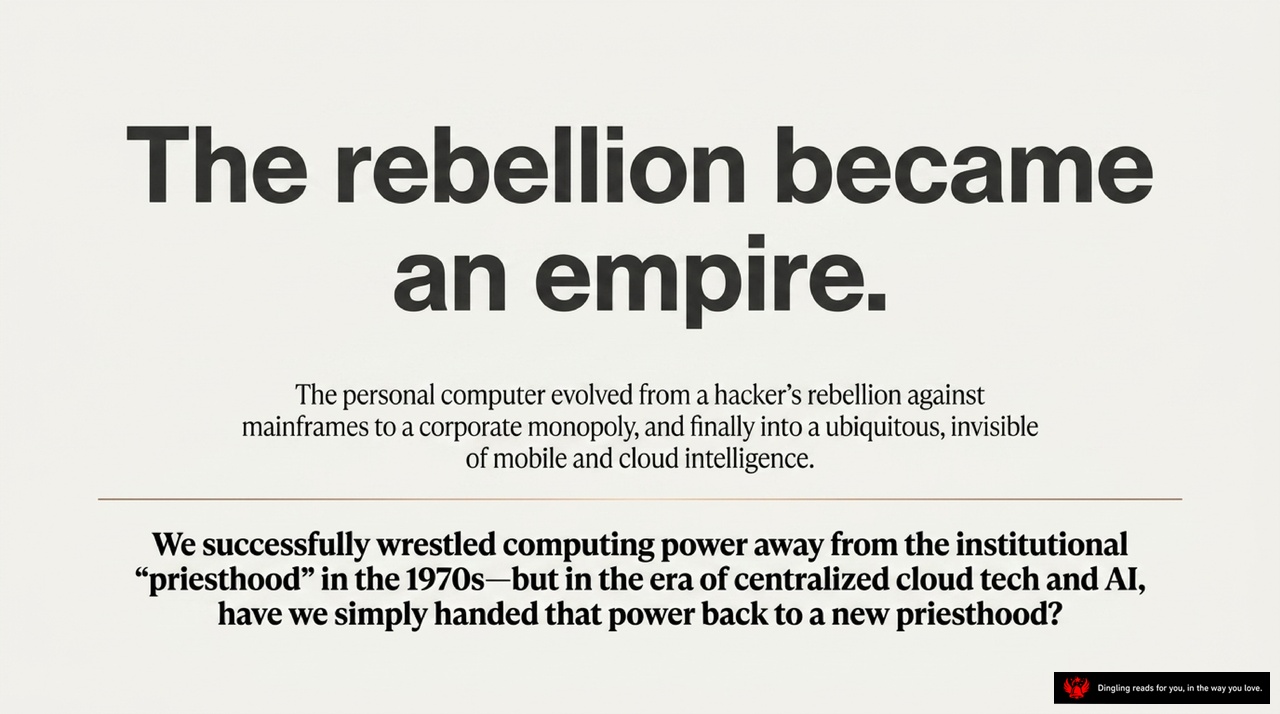
The rebellion became an empire. It all started as a hacker's rebellion against the massive, exclusive mainframes of the past. Those early machines were guarded by a kind of institutional "priesthood"—a group of elite experts who believed computing power was too complex for the average person. But thanks to the rise of the personal computer, we successfully wrestled that power away. We took control from those gatekeepers and democratized technology, turning it into something ubiquitous and accessible for everyone.
Today, that personal computer has evolved. It's no longer just a box on a desk; it has transformed into a corporate monopoly, and finally, into an invisible, ubiquitous mobile and cloud intelligence that surrounds us everywhere. We moved from the garage to the cloud. But here is the critical question we must face: In the era of centralized cloud tech and artificial intelligence, have we simply handed that power back to a new priesthood? Just because the tools are now in the cloud doesn't mean the control is truly free. We need to ask ourselves who really holds the keys now.