
Five Kinds of Time: Complete Chapter-by-Chapter Summary
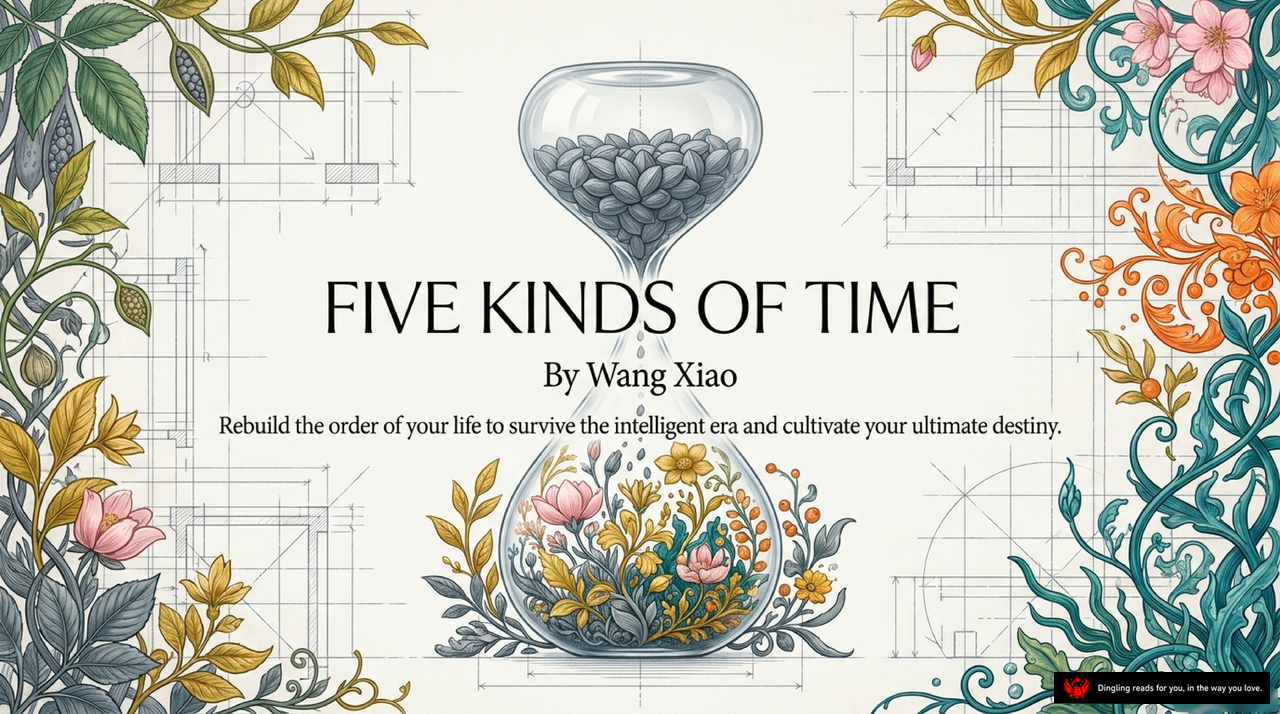
Hey everyone, welcome to the session. Today, we're unlocking the secrets of "Five Kinds of Time" by Wang Xiao.
Think about it: we're living in an intelligent era where everything moves faster than ever. But are we actually in control of our lives? This book challenges us to rebuild the order of our existence and cultivate our ultimate destiny.
Instead of treating time as a scarce resource that just ticks away, we learn to see it as a garden we can design. The core idea is simple yet powerful: we divide our daily actions into five distinct categories. From the survival time that keeps us grounded, to the money-making time that builds value, and the flow time that brings true fulfillment.
The visual on this slide—an hourglass filled with life—symbolizes this transformation. It's about shifting from a passive state of survival to an active design of your own future.
So, whether you're looking to survive the chaos of modern life or find that ultimate sense of purpose, these five kinds of time offer the blueprint. Let's dive in and see how you can reclaim your time and shape your destiny.
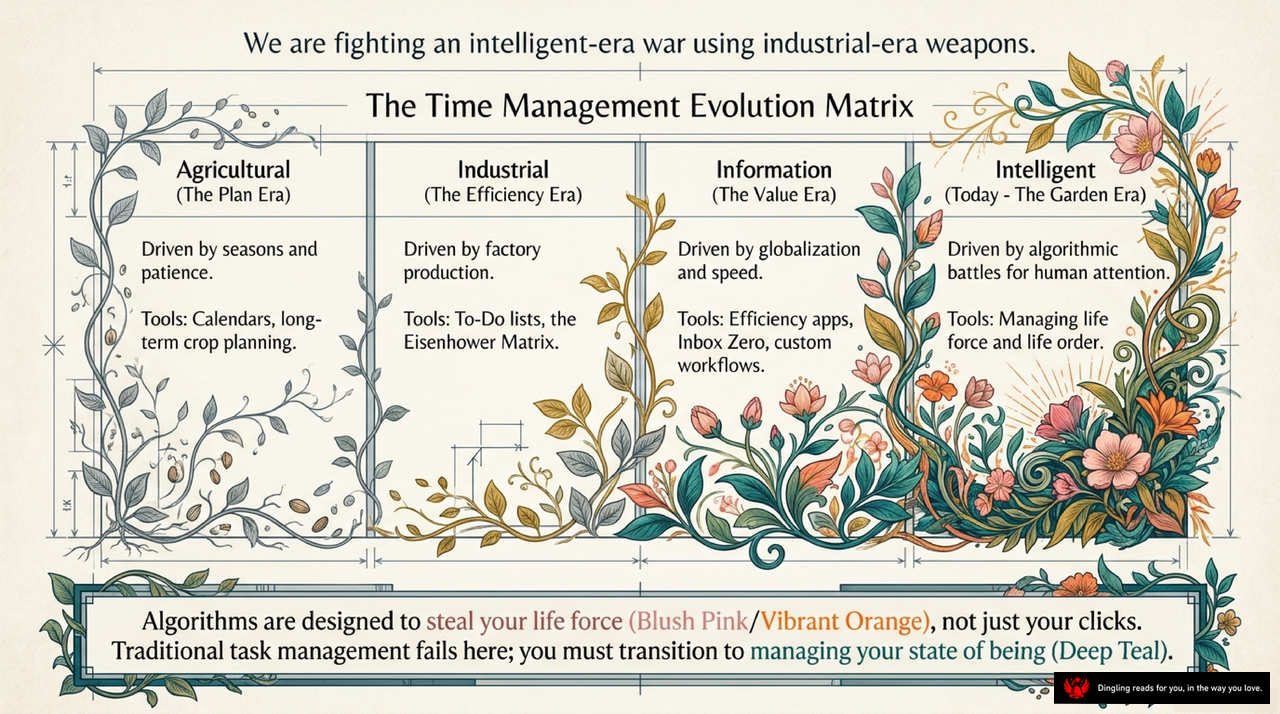
Look at this Time Management Evolution Matrix. It maps out how we've tried to control our lives over the last century. We started with the Agricultural Era, relying on seasons and patience. Then came the Industrial Era, obsessed with factory-style efficiency and tools like the Eisenhower Matrix. Next, the Information Era, where speed and apps like Inbox Zero ruled the day. But look at the final column: the Intelligent Era. This is where we are now.
Here's the hard truth at the top: "We are fighting an intelligent-era war using industrial-era weapons." It's a massive problem. We're using 20th-century tools—calendars, checklists, matrices—to battle 21st-century algorithms.
The bottom banner hits home: "Algorithms are designed to steal your life force, not just your clicks." Traditional task management fails here. If you just check off boxes, you're still playing the old game. You need to transition to managing your state of being.
In the book, we call this the "Garden Era." Instead of viewing time as a linear list of tasks, think of your 24 hours as a garden you cultivate. You have five types of "plants" to grow: Survival, Money-Making, Good-Looking, Fun, and Flow. The key isn't just efficiency; it's about energy and life force.
Think about it. When you use a To-Do list, you are managing tasks. When you manage your state of being, you are managing your energy and your identity. The book explains that we need to shift from "managing time" to "managing life." The Garden Model helps you decide which plants to prioritize. Do you want to spend your life just surviving? Or do you want to fold your time—combining survival with flow, for example?
Notice the color shift on the slide. Algorithms steal your "life force"—represented by that Blush Pink and Vibrant Orange energy. But to win, you must protect your "state of being," represented by that Deep Teal stability.
So, stop trying to hack your time with better apps. Start by managing your state of being. That's how you move from the Industrial Era to the Intelligent Era. That's how you stop being a battery for the algorithm and start owning your life. It's not about doing more; it's about being who you want to be.
Ultimately, your future is built on the choices you make today. Are you planting seeds for a garden, or just checking boxes for a factory? The choice is yours.
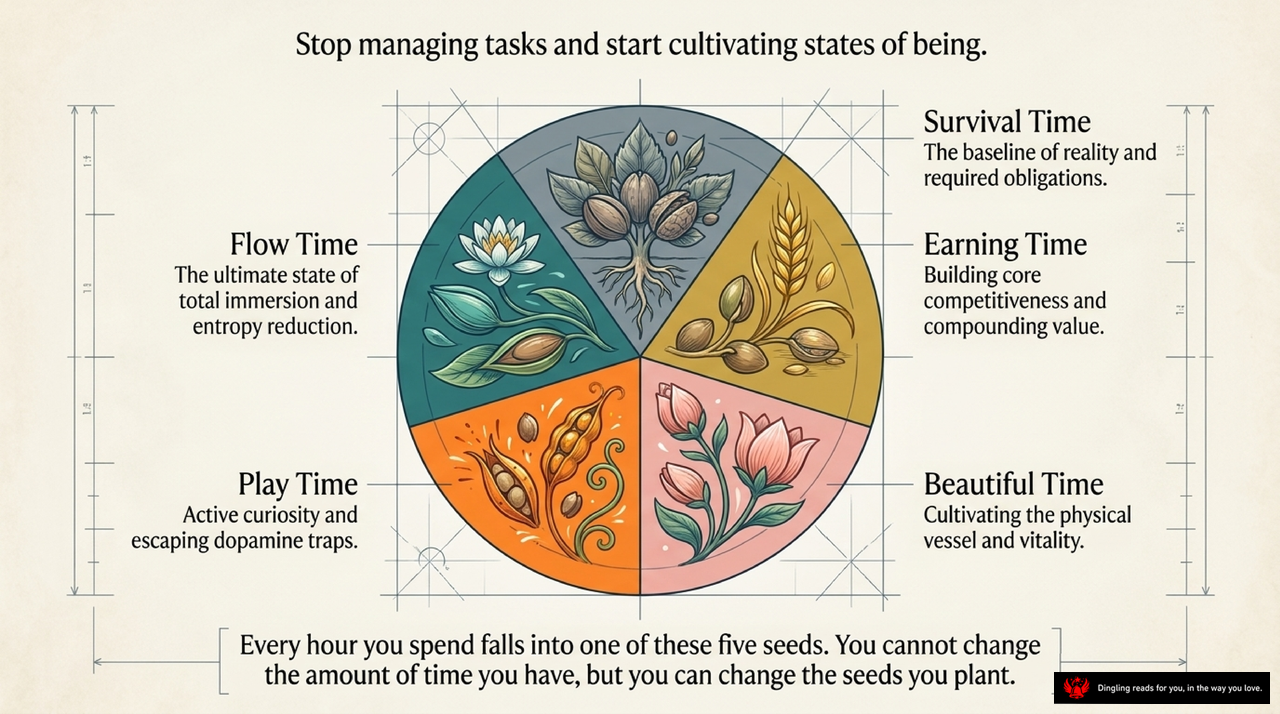
Look at this diagram. The title says, "Stop managing tasks and start cultivating states of being." This is a fundamental shift in how we view our days. We often get caught up in checking off boxes, but the real work is about the state we are in.
Every hour you spend falls into one of these five seeds. You cannot change the amount of time you have, but you can change the seeds you plant. This simple idea changes everything.
Let's take a closer look at these five seeds.
First, we have Survival Time. This is the baseline of reality and required obligations. It's the stuff we simply have to do to keep functioning—sleep, eating, basic work. It's the foundation, but if we spend too much time here, we never grow.
Next, we have Earning Time. This is about building core competitiveness and compounding value. It's not just working; it's working to create skills that make you more valuable over time. It's where you invest in yourself.
Then, Beautiful Time. This is about cultivating the physical vessel and vitality. It's taking care of your body, not just for looks, but for long-term health and energy. A healthy body supports a healthy mind.
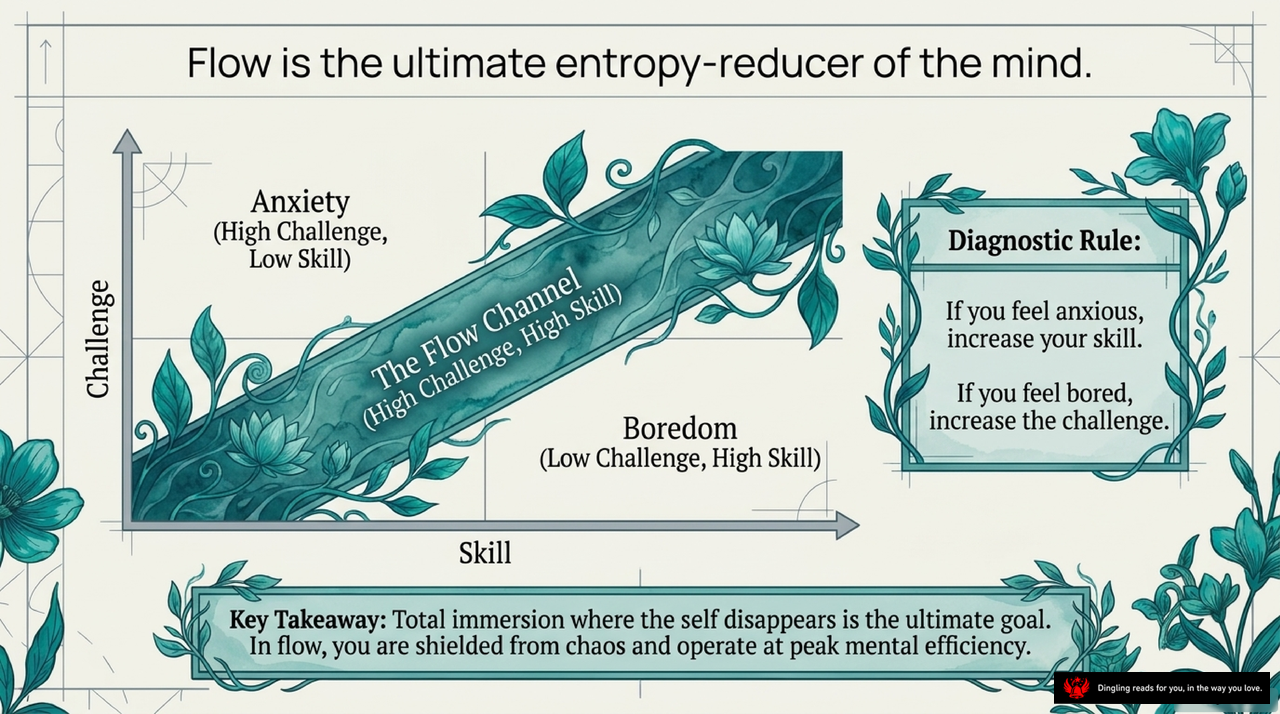
After that, Play Time. This is about active curiosity and escaping dopamine traps. It's important to distinguish this from mindless scrolling. True play is exploring with intention, finding joy that isn't just a chemical reaction from your phone. It keeps your curiosity alive.
And finally, Flow Time. This is the ultimate state of total immersion and entropy reduction. It's when you are so focused on a challenging task that you lose track of time. It's where your mental chaos turns into order, and you feel completely alive.
So, the circle represents your day. You have a fixed number of hours. The question is, how do you distribute them? If you plant too many survival seeds, you get a garden of survival. If you plant more flow seeds, you get a garden of growth.
The bottom text reminds us: "Every hour you spend falls into one of these five seeds. You cannot change the amount of time you have, but you can change the seeds you plant."
This means your future isn't determined by how much time you have, but by what you choose to grow in that time. It's about planting the right seeds for the life you want to harvest. You can't change the weather, but you can choose what to plant in your garden.

Survival time is inescapable, but the goal is to overcome it, not just manage it. Let's be honest: we all spend a massive chunk of our lives just trying to survive. But there are two distinct ways we live in that time.
First, look at Step 1: Passive Survival. This is where your capability is a deficit. Your time is arranged by others. You feel like a puppet, enduring endless waiting, and utilizing the List Method just to survive the day. It's reactive. You're just checking boxes to get through the moment, hoping it doesn't get worse. It's the comfort of the cage. You are just reacting to the environment, not shaping it. In this state, the List Method is a band-aid, helping you cope but not helping you grow.
But we need to move to Step 2: Active Survival. This is where the Athlete's Mindset kicks in. You recognize the baseline, but you actively choose the suffering to reach the next tier. It's not about avoiding pain; it's about using it as fuel. This is characterized by analyzing opponents, seeking the next match point, and deliberate training.
The key takeaway here is simple but powerful: You must transition from passive endurance to active training. You choose the suffering to reach the next level of the game.
Why does this matter? Because survival time occupies the majority of our lives. Our choice is always to either progress or stay stuck. When you feel trapped, don't just manage the time. Overcome it.
Think about the difference. Passive survival keeps you chained, like the steps in our image. Active survival is about climbing. You analyze your competition, not to be mean, but to understand where you need to grow. You prepare for the next match point. You train deliberately.
Remember, the problem cannot be solved by the same thinking that created it. If you want to break out of survival time, you need a new mindset. You need to stop waiting for permission and start taking action.
But how do you actually do this? In passive survival, you rely on external validation. In active survival, you rely on internal standards. You become your own coach. You know your strengths and weaknesses. You know exactly what you need to do to level up.
So, when you feel the weight of survival pressing down, ask yourself: Am I just enduring, or am I training? Choose the suffering. Choose the growth. That is how you transform your life from a series of days you survive into a story you create.
Welcome everyone to Play Time. This is the section many of us have been waiting for, but it's often misunderstood. Let's redefine what this actually means. Play Time isn't about slacking off or wasting time. It's actually the opposite of boredom. Boredom is inevitable in life, but play is not. Everyone feels bored, which is why we need this time. It's about active choice. You decide how long it lasts and how often.
Think about it like a cat chasing its tail. It's natural, not a sign of failure. You don't need to feel guilty for not being productive. But here is a crucial warning. Just because you spend time on something doesn't mean you're happy. It's like spending money without buying anything valuable.
We live in an age where information traps are everywhere. Many people spend their evenings doom-scrolling, thinking they are in charge, but actually, they are being manipulated by dopamine loops. You are basically an unpaid employee for algorithms. So, how do we reclaim this time?
Play Time teaches us how to handle disappointment. Life isn't always perfect. Sometimes you plan to read a book, but you end up at a party you didn't want to attend. Instead of regretting it, tell yourself this is part of the game. Disappointment is data for future choices. If we stop trying new things because we're afraid of disappointment, we lose our vitality.
Also, remember that boredom is actually a precursor to deep thought. It's the curtain raiser for creativity. So, don't fear the quiet moments. Keep your curiosity alive. Whether it's trying a new hobby or just exploring a new path, the goal is to keep your spirit young.
So, welcome to Play Time. It's the game of life. It's about freedom and curiosity. Don't let the world tell you what to do with your free time. You decide. Keep playing, keep exploring, and keep your soul fresh.

Let's be honest for a second. We often treat our bodies like rental properties. We decorate the inside with clothes, filters, and makeup, but we neglect the actual structure. But this slide reminds us of a powerful truth: Your body is the only true house your soul will ever live in. You can't just renovate the exterior and expect the interior to stay warm.
Look at the left side: 'Inner Alchemy.' This is the core. In the book, we call this 'Neidan' or inner cultivation. It focuses on the basics—sleep, diet, and exercise. It's not glamorous, but it's compounding. It builds foundational biological vitality. It's long-term work. It's like pouring a strong concrete foundation for a skyscraper. If you skip this, the whole structure eventually crumbles.
Now, look at the right side: 'Outer Magic.' This is the surface. Makeup, clothing, cosmetic fixes. It's tempting because it gives instant gratification. It makes you look good today. But the book warns us that this is depleting and short-term. It merely mimics vitality without creating it. It's like painting over a cracked wall. It looks nice from a distance, but it doesn't stop the decay underneath.
So, how do we balance this? The slide gives us a strict rule at the bottom: The ultimate physicalism requires a 1:1 ratio. For every hour you spend on outer presentation, you must dedicate an hour to inner biological cultivation.
Think about your 'Good Looking Time.' It's not just about being pretty; it's about having life force. If you spend three hours on your outfit and only five minutes on your sleep, you're running on empty. You might look good for the photo, but you'll feel terrible by the end of the day.
Don't get me wrong, looking good is part of life. But you can't have the surface without the core. You need to invest in your biology just as much as you invest in your image. Build the house, and then decorate the rooms. That's the only way to achieve real, lasting vitality. Remember, the best investment you can make is in the one house you can never sell.
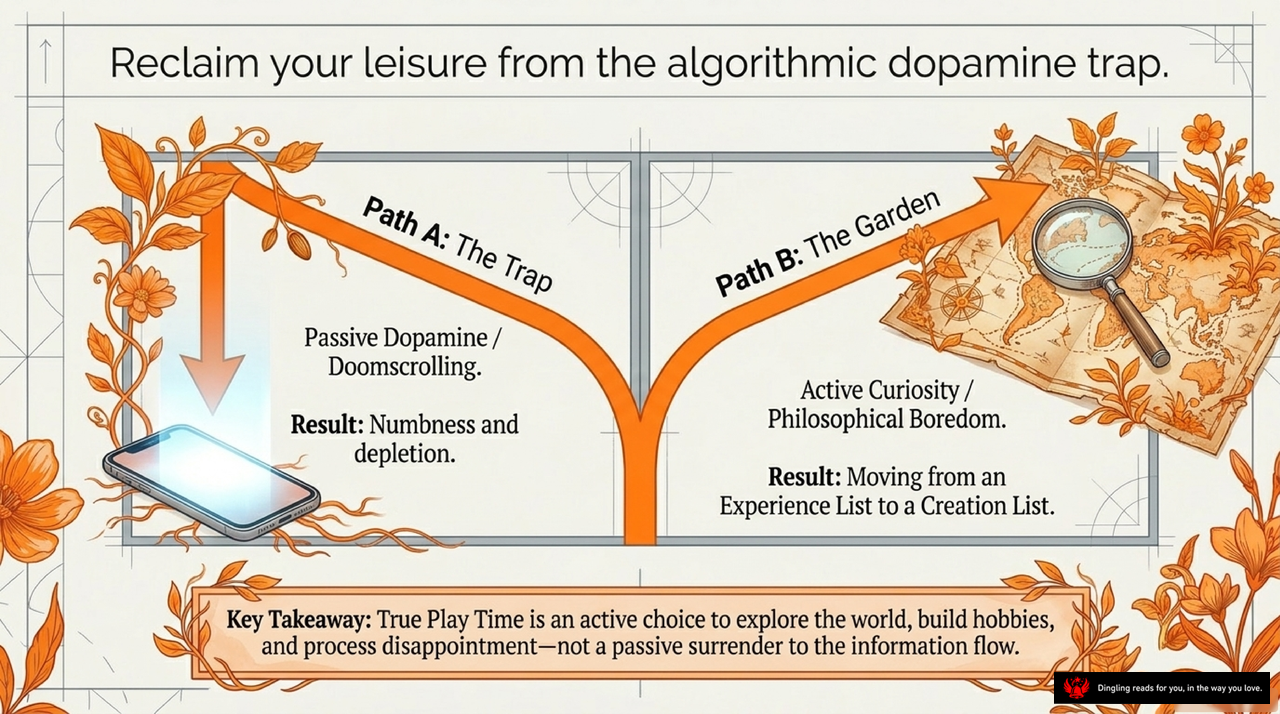
Have you ever felt like you're just scrolling through your phone, thinking you're relaxing, but actually you're just trapped? This slide asks us to reclaim our leisure from that algorithmic dopamine trap. It's a choice between two very different paths for how we spend our free time.
On the left, we have Path A: The Trap. This is what we call doomscrolling. It's passive dopamine. You're like that lab rat in the experiment, pressing the button over and over just waiting for a little bit of food. But the result? Numbness and depletion. You feel empty, and you've lost your agency. You're just consuming information without any real value, letting the algorithm dictate your mood.
On the right, we have Path B: The Garden. This is the alternative. It starts with active curiosity. It even embraces what we call philosophical boredom. Instead of running away from boredom, you let it sit there. That discomfort actually sparks thinking. It pushes you to explore and change. The result here is powerful: you move from an Experience List to a Creation List. An Experience List is just checking things off, like traveling or watching a show. But a Creation List is about building things, building hobbies, and building your own life. You are creating value, not just consuming it.
The key takeaway at the bottom is crucial. True Play Time isn't about passively surrendering to the information flow. It's an active choice. It's about exploring the world, building hobbies, and yes, even processing disappointment. We can't just avoid the bad stuff; we have to learn from it. If we say 'that was boring' or 'that didn't work' and stop, we lose our vitality. Real play includes the struggle. Processing disappointment means accepting that not every attempt will work. That friction creates growth.
So, how do we choose the Garden? It's not about buying the most expensive tickets or having the most time. It's about keeping your curiosity alive. It's about playing with a purpose. When you choose the Garden, you aren't just killing time; you're planting seeds for your future. You are reclaiming your freedom from the algorithm. True play is about the journey, not just the destination. Choose the path that builds you, not the one that just drains you.
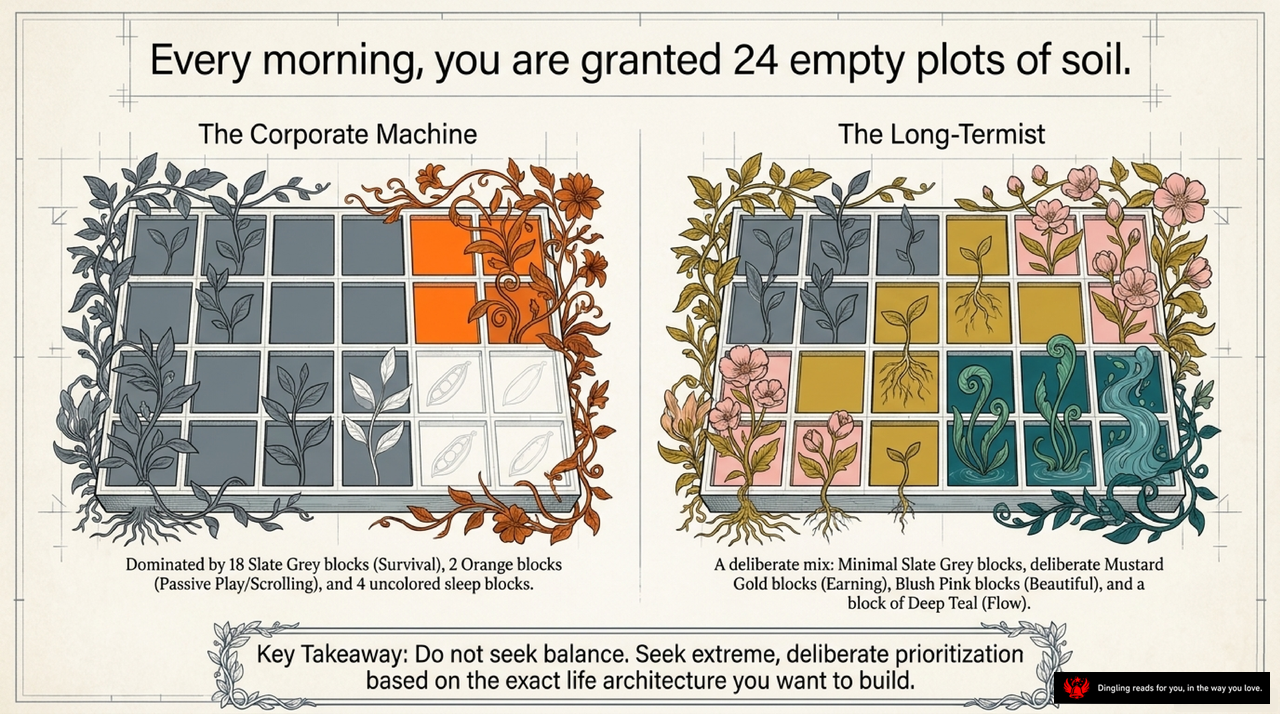
Every morning, you wake up with 24 empty plots of soil. That is the only land you get to work with. But how you plant that land determines everything about your life.
Look at the two gardens on the screen. On the left, you have the "Corporate Machine." It's dominated by survival time—just getting through the day. You see a lot of gray blocks, representing survival, a chunk of orange for passive scrolling, and a few uncolored blocks for sleep. It's a life on autopilot, where you're just reacting to demands rather than designing your days.
On the right, you have the "Long-Termist." Notice the difference. Survival time is minimized. Instead, you see a deliberate mix of mustard gold for Earning, blush pink for Beautiful, and deep teal for Flow. This isn't just about working harder; it's about planting the specific things that give your life meaning.
Here is the hard truth: Do not seek balance. Balance is a trap that keeps you mediocre. We often think we need equal parts of everything—work, rest, play, health. But that's not how growth works. You don't need balance; you need extreme, deliberate prioritization based on the exact life architecture you want to build.
Think of your time as a garden. If your goal is to build a legacy, you plant more Earning and Flow time. If your priority is well-being and creativity, you prioritize Beautiful and Flow time. The "Corporate Machine" forces you into survival mode, but you have the power to redesign the garden.
The book tells us that the five types of time—Survival, Earning, Beautiful, Fun, and Flow—are not fixed. You can fold them. You can make one hour serve multiple purposes. But the key is knowing which plants matter most to *you*.
So, stop trying to balance your time. Start designing your garden. If you want a future filled with purpose, you have to plant the seeds of Flow and Earning today. Your future isn't random; it's the result of what you choose to plant every single morning. Choose your priorities, and watch your life grow.
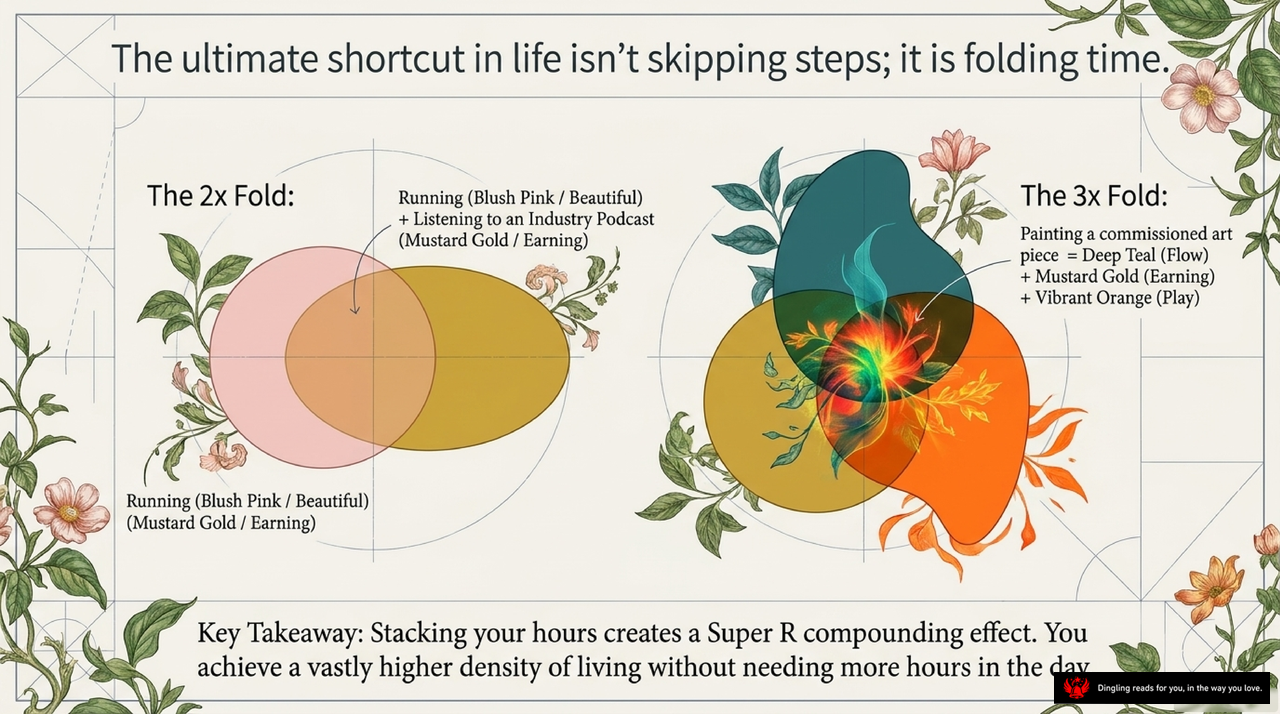
The ultimate shortcut in life isn't skipping steps; it's folding time. Look at these visuals. On the left, we have the 2x Fold. Imagine you're running—let's call that beautiful time—but while you run, you're also listening to an industry podcast. That's earning time. You're doing two things at once. You're stacking your hours. On the right, we see the 3x Fold. Here, you're painting a commissioned piece. That's flow time. But you're also getting paid, so that's earning time, and you're playing, so that's play time. You're combining flow, earning, and play simultaneously.
This is what the book calls folding time. It's the difference between serializing your life and parallelizing it. Instead of doing one thing after another, you layer them. The text describes this as the Super R compounding effect. When you stack your hours, you don't need more time in the day to get more done. You achieve a vastly higher density of living.
Think about it this way: In the information age, we can easily achieve this two-time folding. It's like watching a movie while wearing a mask—simultaneously beautiful time and fun time. Or standing at your desk—survival time and beautiful time. But the 2x fold is just the entry-level game. The real power is in multi-dimensional folding. Like the top athletes or writers who are constantly folding multiple types of time. The more you fold, the more possibilities you unlock.
We can view your daily 24 hours as a garden. Survival time is the foundation you must plant, like sleep and food. But the rest is up to you. You can choose to plant beautiful time, fun time, earning time, or flow time. Different ratios create different life states. Some people get stuck in survival time, while others burn out chasing earning time. The key is to fold your time. For example, a chef in a cooking class might be practicing a skill earning, enjoying the process fun, and entering a state of flow all at once. By folding your time, you create a life that is richer, denser, and more fulfilling without needing to work longer. It's about how you use the time you already have.
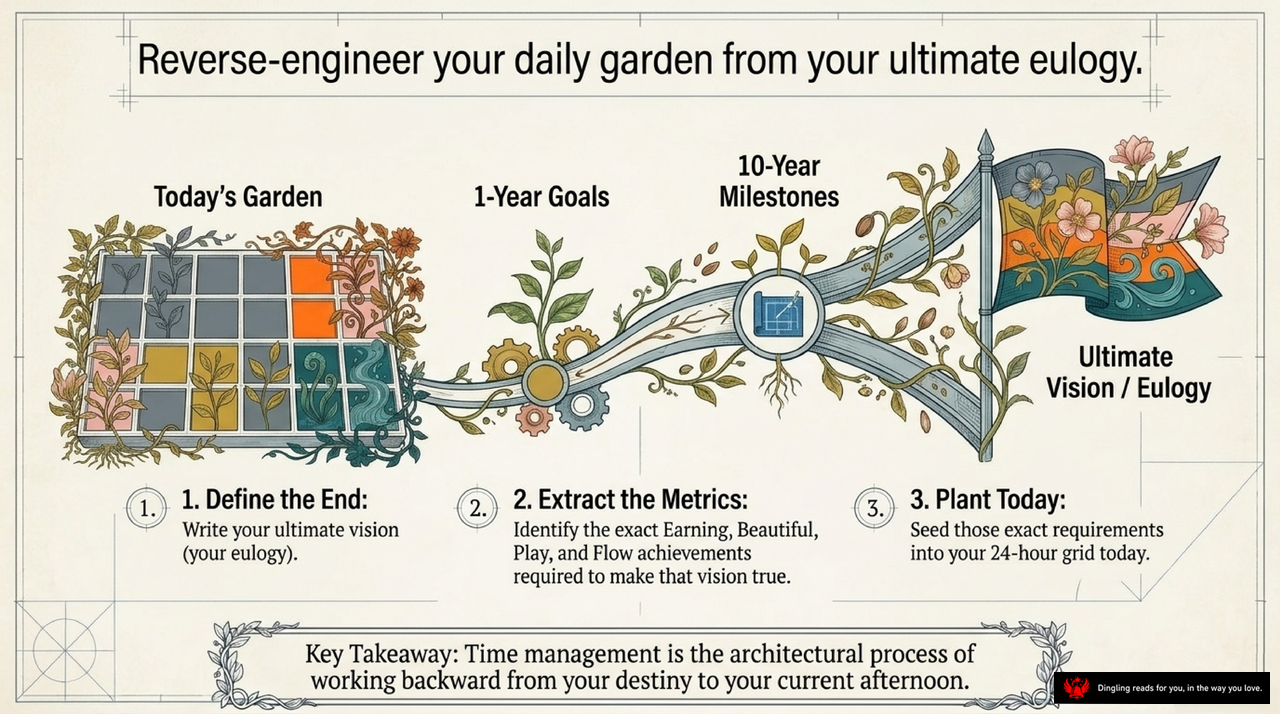
Look at this image. It visualizes a powerful concept: Reverse-engineer your daily garden from your ultimate eulogy. It's about designing your life backwards, starting from where you want to end up.
First, define the end. Think about your ultimate vision or eulogy. What does your life look like when it's over? This isn't morbid; it's the anchor for everything else. When you know the destination, you can finally see the path clearly.
Next, extract the metrics. Once you know the destination, what does the journey look like? You need to identify the specific achievements required. In our system, we look at Earning, Beautiful, Play, and Flow. You need to make sure your daily actions support these goals, balancing your time across these five types so you don't just survive, but truly live.
Finally, plant today. This is where the magic happens. Take those requirements and seed them into your 24-hour grid right now. Don't wait for next week. If you want a life of flow, you need to protect that time today.
The key takeaway here is powerful: Time management is the architectural process of working backward from your destiny to your current afternoon. Most people get lost in the weeds of today, reacting to the day. But if you build from the vision, every small choice plants a seed for your future.
Your future is built by the choices you make in this very moment. So, look at your own garden. What are you planting today that will grow into the life you want to leave behind?
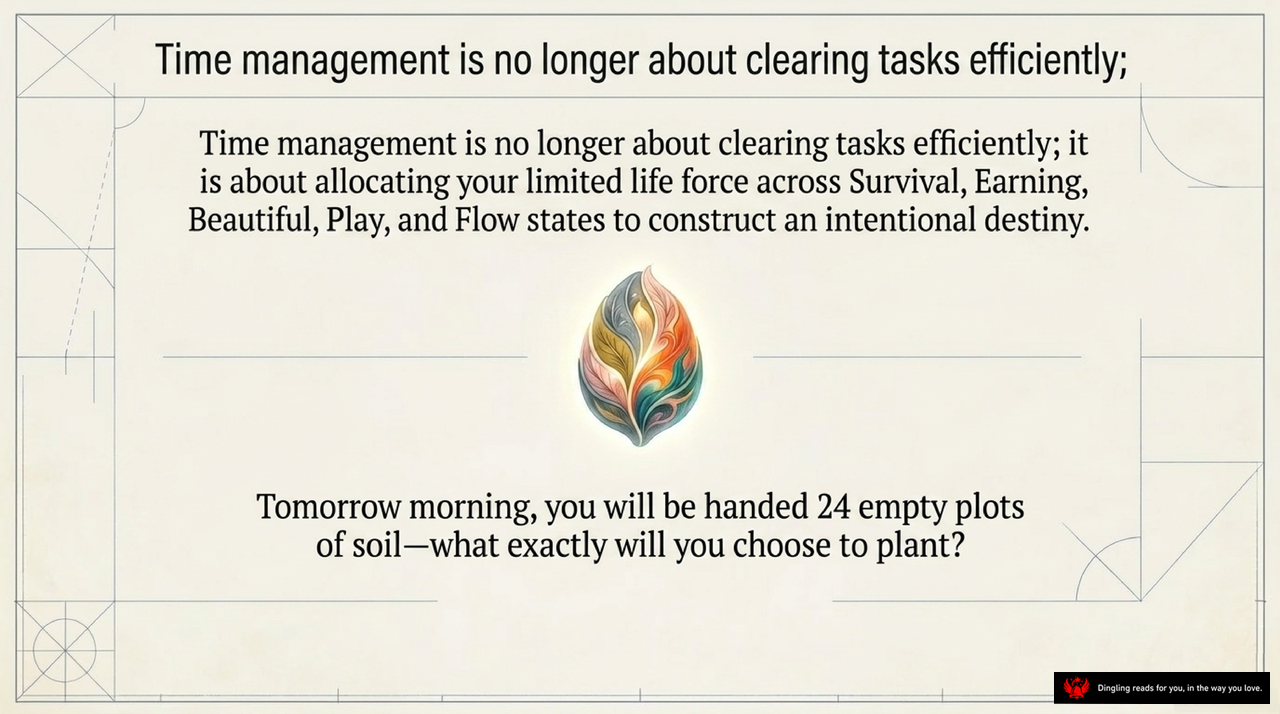
Let's be honest. For a long time, we've been obsessed with "time management." We think it's about clearing our to-do lists faster, checking off boxes, and working harder. But that's outdated. Real time management is no longer about clearing tasks efficiently. It is about allocating your limited life force across Survival, Earning, Beautiful, Play, and Flow states to construct an intentional destiny.
Think of it this way: your day isn't just a list of tasks. It's a series of states. First, there's Survival Time. That's the baseline—eating, sleeping, and the work you need to do just to exist. It's necessary, but it shouldn't consume you. Then, there's Earning Time. This is where you create value, build your skills, and generate wealth. It's about being a "hardcore" creator who focuses on core competitiveness. It's the engine that drives your freedom.
But it's not just about survival and money. There's Beautiful Time. This is about your body, your health, your vitality. It's about looking good not just for others, but because you feel alive and energetic. It's an investment in your longevity. Then, Play Time. This is your freedom. It's about curiosity, doing things just for fun, and exploring new paths without pressure. It's where you keep your spark alive and prevent burnout.
And finally, Flow Time. This is the sweet spot. It's when you're so immersed in a challenge that you lose track of time. It's where you find deep happiness and true growth. It's the most valuable state you can achieve because it renews your energy.
The author uses a beautiful metaphor here. Imagine tomorrow morning, you wake up and you're handed 24 empty plots of soil. You have 24 hours. That's it. No more, no less. You have to decide: what exactly will you choose to plant?
Do you fill your garden with just survival weeds? Or do you plant seeds for your dreams? Do you plant a mix of earning and flow? Your choices today determine the harvest of your life. If you want a rich harvest, you have to plant the right seeds. You have to intentionally design your destiny.
So, look at your calendar. Where are you planting right now? And what are you choosing to grow tomorrow? Because your future is just a garden you're currently building. Every time you choose to allocate your time, you are writing the story of who you become. Don't just clear tasks. Start planting your destiny. The 24 plots are waiting for you.