
Flowers for Algernon: Complete Chapter-by-Chapter Summary

Welcome to our deep dive into *Flowers for Algernon* by Daniel Keyes. Today's opening slide sets the stage for a story that isn't just about intelligence, but about the very fragility of the human mind. The image captures the essence of this journey: a tragic exploration of how quickly brilliance can rise and how painfully it can fall.
This is the story of Charlie Gordon, a man who starts at the bottom of society, working in a bakery and attending an adult education class for the intellectually disabled. His dream is simple yet profound: to become smart enough to understand the world, to find his lost family, and to finally have a place among his peers. He takes a bold risk, becoming the first human to undergo a groundbreaking experimental surgery designed to boost his IQ.
But as the title suggests, this is a story about flowers for Algernon—a clever mouse that shares Charlie's fate. The narrative warns us that while intelligence can be unlocked, the cost of that knowledge often comes with emotional isolation. As Charlie climbs the ladder of intellect, he realizes that true wisdom isn't just about knowing more; it's about understanding the pain of being alone when you no longer belong to the past, but haven't yet found your place in the future. It's a haunting reminder that the human mind is delicate, and the gap between a genius and a child can be just as wide as the gap between the smartest and the least understood.

The Beekman College Experiment was a bold, almost reckless attempt to surgically multiply human intelligence, aiming to lift a mind from the shadows into blinding light. To understand the stakes, we have to look at the two subjects at the heart of this story: Algernon and Charlie Gordon.
On the left, we see Algernon, a white rat who was artificially enhanced. His status is clear: he was modified to possess unprecedented cognitive retention. His motivator was simple—maze completion and cheese—but his key trait was something extraordinary: the ability to remember and solve complex problems with a level of focus we hadn't seen before. He was the perfect control, the brilliant benchmark against which human intelligence would be measured.
On the right, we see Subject 2: Charlie Gordon. Before the operation, Charlie's IQ was just 68. He wasn't just looking for a cure; he was driven by a deep desire to be smart, to gain friends, and to escape the loneliness that defined his life. His key trait was an eagerness to please and a high willingness to accept risk. He was the ultimate volunteer, willing to trade his stability for the chance at genius.
Dr. Strauss and Professor Nemur believed that by combining Charlie's high emotional willingness with Algernon's enhanced brain, they could create something truly revolutionary. They weren't just trying to fix a broken mind; they were trying to evolve it. But as we soon discover, elevating the mind from the shadows doesn't just change what you think—it changes everything about who you are, and sometimes, the cost is far higher than anyone imagined.

The Baseline Illusion reveals the tragic reality of Charlie's life before his transformation. Above the surface, his world appeared simple and warm: a protective shield of literalism masked the cruelty of his peers, allowing him to find belonging at Donner's Bakery and enjoy a few true friendships with Joe and Frank. He lived in a state of happiness through ignorance, believing he was part of a simple, kind community.
However, beneath that cheerful facade lay a dark, submerged reality. Charlie's "friends" were actually relentless mockers who exploited his innocence with cruel pranks and physical humiliation. They called him names like "Pulled a Charlie Gordon," isolating him from society and treating him as a joke rather than a person. This duality illustrates the dangerous baseline illusion Charlie lived in, where a fragile sense of belonging hid the deep societal isolation and exploitation he truly faced.

The Catalyst of Frustration isn't just a title; it's the brutal reality Charlie faces when his mind expands too fast for his heart to follow. Look at the Rorschach inkblot on the left. To Charlie, this isn't a hidden image or a symbol; it's just "spilled ink." He literally cannot see the story within the chaos because his brain is still trapped in literalism, unable to construct the abstract narratives or lies that a smarter mind would effortlessly create.
On the right, we see the Maze. This represents Charlie's life after the surgery. While Algernon, the rat, navigates it with "effortless precision," Charlie is stuck. The red line shows the path he *should* take, but he keeps hitting walls. This visual perfectly captures the tragedy: Subject 1, Charlie, repeatedly defeats Subject 2, Algernon, establishing a baseline of intellectual inferiority that shatters his new confidence.
The core conflict here is the gap between what Charlie knows and how he feels. He has the data, the vocabulary, and the logic, but he lacks the emotional maturity to process it. He sees the ink as ink, not art; he sees the maze as a trap, not a puzzle. This inability to bridge the gap between abstract thought and human emotion is the true source of his frustration. He is a genius trapped in a child's soul, watching himself fail at things he used to struggle with, yet now finds impossible to solve. The ink spills, and the maze closes in, leaving him isolated in a mind that is too big for the world he still inhabits.

Breaking the Barrier. As Charlie's cognitive processing speed multiplies, his newly unlocked memory exposes the painful truths of his past. This slide maps Charlie's four-step transformation, starting from linguistic mastery—overcoming phonetic spelling and mastering punctuation—to abstract comprehension, where reading Robinson Crusoe reveals the profound isolation he felt. Then comes recall and realization; his photographic memory unlocks suppressed childhood trauma, exposing that his bakery "friends" were actually tormentors. Finally, academic superiority allows him to absorb college-level debates, realizing the limits of the students he once idolized. Yet, as he climbs this intellectual mountain, the text notes that these painful truths of his past are being exposed, foreshadowing the tragic realization that while he gained the world, he lost himself.

Look at this graph. It captures the tragic heart of Charlie's story: The Cognitive-Emotional Disconnect. On the left, we see Cognitive Intelligence soaring to the peak, while Emotional Maturity stays stuck low. This creates the "Paradox of Genius"—an adult intellect trapped with the emotional processing of a traumatized child.
Charlie's brain outpaced his heart, leaving him incapable of bridging the gap between intellectual superiority and human intimacy. As he climbed the IQ ladder, he didn't grow up emotionally. Instead, he remained frozen in the past, unable to connect with Alice or anyone else. His genius became a wall, not a bridge. That's why, despite being smarter than anyone, he ended up completely alone, alienated from the very people he loved.

Look at this slide titled "The Cost of Intelligence." It captures the tragic irony at the heart of Charlie's story: the Beekman experiment didn't just create a genius; it destroyed a human being.
The chart breaks down the heartbreaking transformation from Pre-Surgery Charlie to Peak Genius Charlie across four critical areas. First, Relationships. Before the surgery, Charlie believed everyone was his friend. Now, he cannot connect, alienating even his closest companion, Alice. Second, Worldview. He shifted from being simple, warm, and trusting to becoming cynical, analytical, and hyper-aware of human flaws. Third, Self-Worth. He went from desiring to learn just to be "normal" to becoming arrogant, viewing his creators as intellectual inferiors. Finally, the Source of Pain. His suffering evolved from confusion and literal physical clumsiness to profound existential loneliness and childhood trauma.
This slide illustrates a devastating truth: intelligence without empathy is a curse. Charlie gained the ability to understand the world, but in doing so, he lost the ability to be part of it. He traded his community for isolation, and his innocence for a crushing awareness of his own mortality.

Look at this diagram of "Concentric Alienation." It perfectly captures Charlie Gordon's tragic journey between two worlds that both reject him.
On the left, we see "The Bakers' World." Charlie was driven out of Donner's Bakery not because he was lazy, but because he became too smart. His sudden intelligence made the ordinary men around him feel inferior, and they fired him via a petition out of fear and resentment. He was pushed away for being too good.
On the right is "The Scientists' World." At Beekman College, Charlie was driven out by their intellectual arrogance. He surpassed his professors, seeing them as flawed ordinary men rather than gods. They couldn't handle his brilliance, so they alienated him for being smarter than his creators.
Charlie Gordon is stuck in the center, trapped in a void. He is expelled from the warmth of the bakery for being too smart, and alienated from the laboratory for being smarter than his creators. He is truly a man without a world, isolated by the very gift that was meant to save him.

Look at this "Intertwined Double-Helix." It's a powerful visual of Charlie and Algernon's mirrored journeys, showing how their fates are tragically linked. As we see here, they both start at their peak—Algernon with maze performance and Charlie with academic output. But the trajectory quickly diverges into decline.
Notice the parallel stages of deterioration. When Algernon hits the "erratic refusal to run" and "violent outbursts," Charlie mirrors this with "impatient arrogance" and a deepening "identification with the lab animal." They are essentially the same subject, just separated by species and circumstance. This leads inevitably to the final stages: the total "loss of motivation" for the mouse and the crushing "existential dread" for Charlie.
The graphic points us toward a terrifying conclusion labeled "The Chicago Convention." This isn't just a meeting; it's the breaking point where Charlie realizes the experiment is a lie. Just as Algernon's intelligence collapses, Charlie's own cognitive decline begins to catch up, forcing him to flee before he can be exposed. This diagram captures the core tragedy of the story: intelligence without empathy is a prison, and when the mind breaks, the soul is left behind.
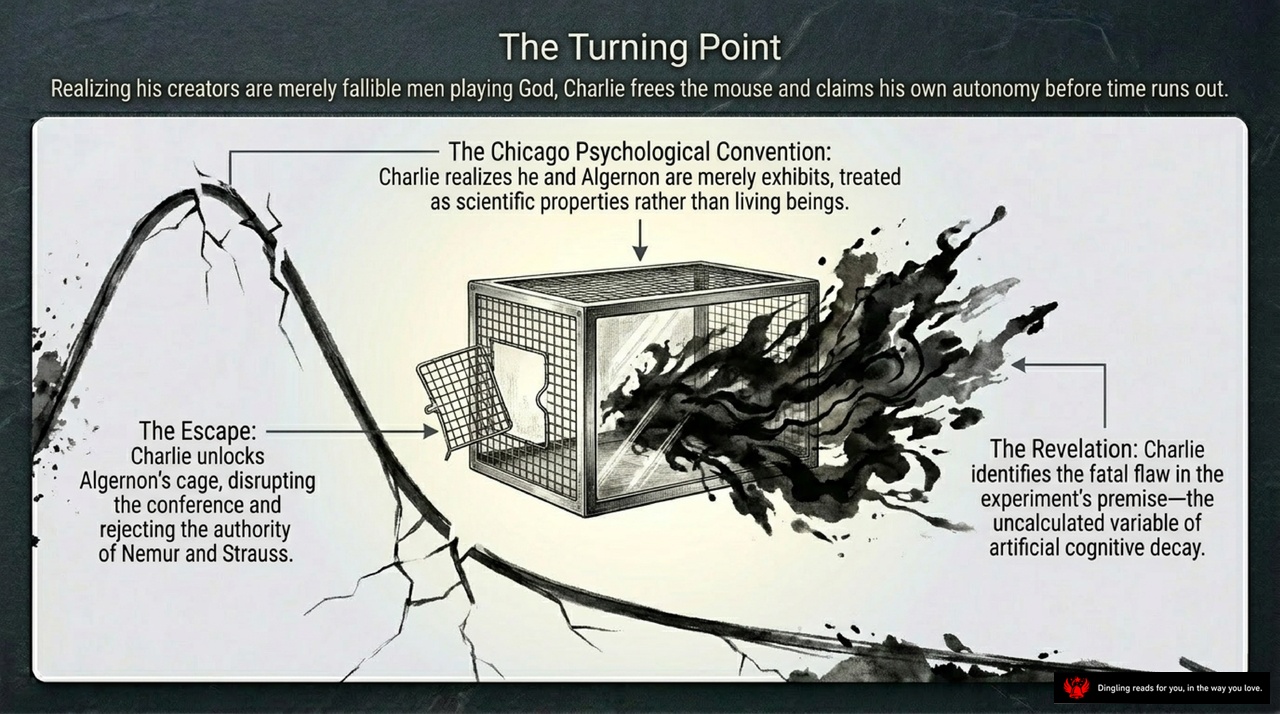
The Turning Point isn't just a moment on a graph; it's the moment Charlie finally realizes the truth about his creators. Standing before the cage, he sees the fatal flaw in the experiment: artificial intelligence is a variable that can't be calculated, because it inevitably leads to decay. Charlie realizes that Nemur and Strauss aren't gods; they are just fallible men playing at being creators, treating him and Algernon as scientific exhibits rather than living beings. So, with time running out, Charlie makes his move. He unlocks the cage, disrupting the Chicago Psychological Convention and rejecting their authority. In that chaotic escape, he frees Algernon and, most importantly, claims his own autonomy, choosing to face the unknown rather than remain a prisoner in their lab.
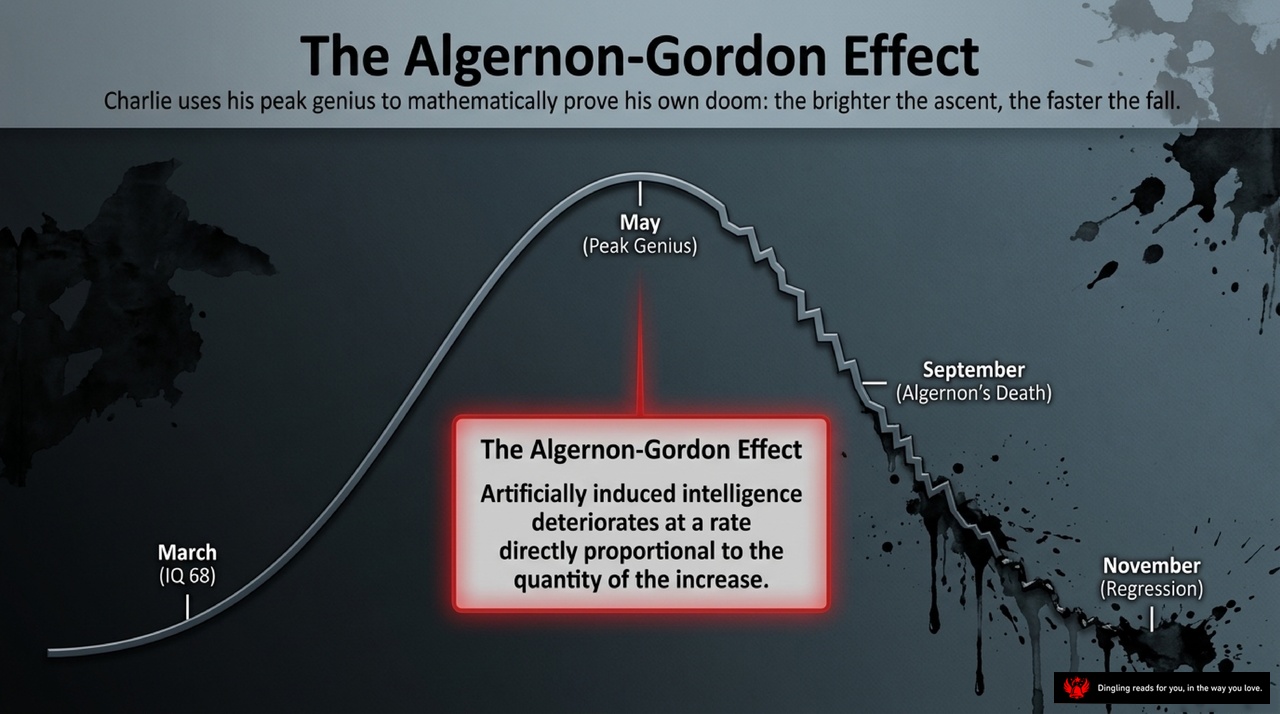
Look at this curve. It tells a tragic but brilliant story about the "Algernon-Gordon Effect." As the title suggests, Charlie used his peak genius to mathematically prove his own doom: the brighter the ascent, the faster the inevitable fall.
Notice the timeline. In March, Charlie started with an IQ of 68. By May, he hit his peak genius, reaching an IQ of 185. But that height came at a terrible cost. By September, coinciding with Algernon's death, Charlie began his rapid regression. And by November, he was back in the dark, having lost everything he gained.
The core lesson here is in that red box: artificially induced intelligence deteriorates at a rate directly proportional to the quantity of the increase. Charlie's mind was a rocket ship that burned out too fast. He climbed higher than any human should, which meant he would crash harder than any human could survive. His brilliance was the very engine that destroyed him, proving that some knowledge comes with a price tag written in blood and memory.
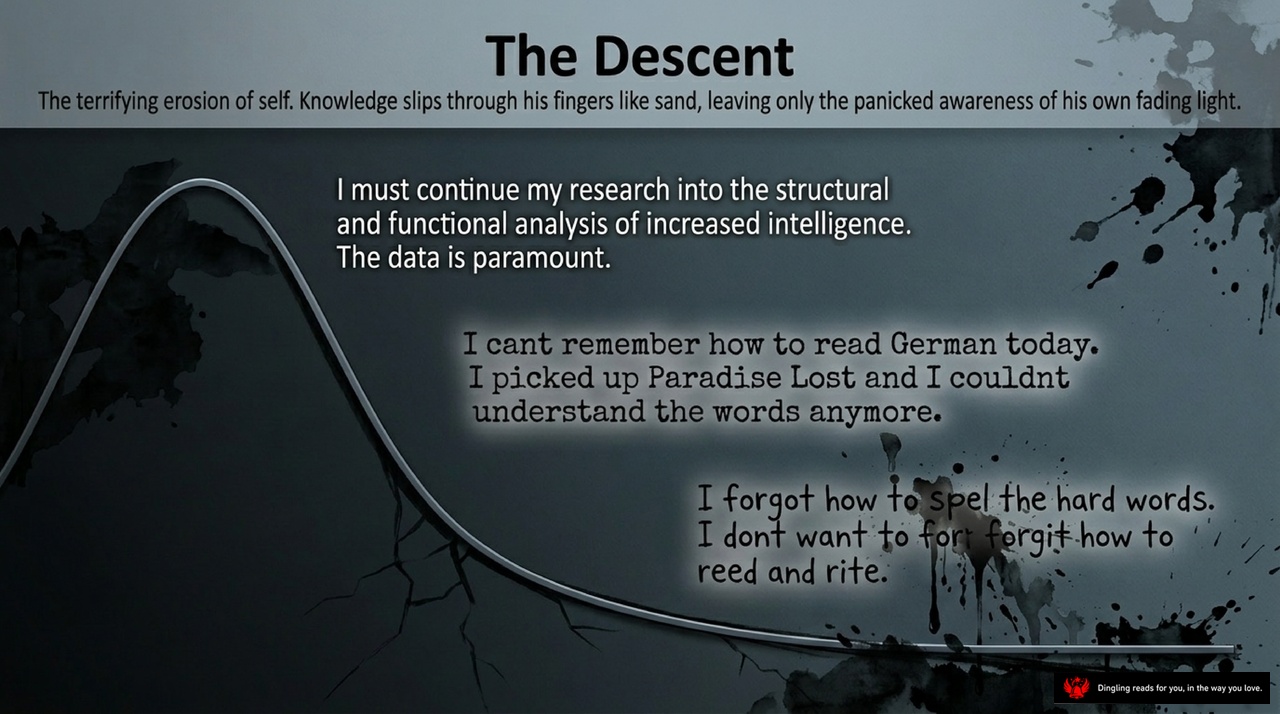
Look at this curve on the screen. It's titled "The Descent," and it perfectly captures the terrifying journey of Charlie Gordon's mind. The top of the hill represents his sudden, miraculous rise to genius, but this downward slope? That is the inevitable, panic-inducing erosion of his self.
As the graph plunges, the text warns us: "Knowledge slips through his fingers like sand, leaving only the panicked awareness of his own fading light." This isn't just a loss of skills; it's a total unraveling of who he used to be.
Notice the first block of text. Even as he's falling, his old obsession with data is still screaming in his head: "I must continue my research... The data is paramount." But look at what happens next. The brilliance is gone, replaced by a terrifying confusion. He writes, "I can't remember how to read German today. I picked up Paradise Lost and I couldn't understand the words anymore." The words he once mastered are now gibberish.
And the bottom of the slide shows the final, heartbreaking stage. He has forgotten how to spell. "I forgot how to spell the hard words. I don't want to forget how to read and write." He is literally losing the ability to construct his own reality. The man who once outsmarted everyone, who could analyze complex theories, is now reduced to a child who can't even spell "read."
This descent is a brutal reminder that intelligence, when artificially accelerated, can be just as fragile as it is powerful. Charlie isn't just losing his mind; he is losing his life, one forgotten word at a time.

Before the shadows fully return, Charlie makes the hardest choice of his life: he systematically severs his ties, choosing institutional isolation over becoming a burden to those he loves. This isn't just a retreat; it's a final act of love for his mother, Rose, and his sister, Norma. He realizes that by staying away, he protects Norma's new life and shields his mother from the trauma of seeing him regress into the childlike state she once feared.
But his heart also breaks when he pushes Alice Kinnian away. He knows that watching him fall from genius back to the starting line would only crush her and destroy her self-worth. So, he cuts off the connection that once gave him hope. And finally, he willingly commits himself to the Warren State Home, an asylum where he can hide from the pity of the outside world and find a place among those who understand his pain. This flowchart of closure shows Charlie's tragic realization: true peace sometimes requires the courage to walk away from everyone who loves you, just to save them from the inevitable return of the darkness.

This is the final request, and it comes from a place of profound love. Charlie, who once lost his vocabulary, his languages, and even his calculus, never lost his empathy. In the end, he asks only one thing: if you get a chance, please put some flowers on Algernon's grave in the backyard. It's a simple plea, but it carries a heavy truth. Genius may fade, as Charlie's story tragically proves, but kindness endures. While the world moves on and memories blur, that small act of remembering a friend who suffered in the dark remains the most enduring legacy of all.

The Beekman experiment succeeded in creating a genius, but it failed to protect a human being. Charlie Gordon's tragic trajectory forces us to confront the human cost of playing God with cognition, and the devastating realization that emotional intimacy cannot be engineered. If the price of ultimate understanding is absolute isolation, is it better to live in the warm shadows of ignorance, or to burn briefly in the freezing light of truth?