
Fortress Besieged: Complete Chapter-by-Chapter Summary
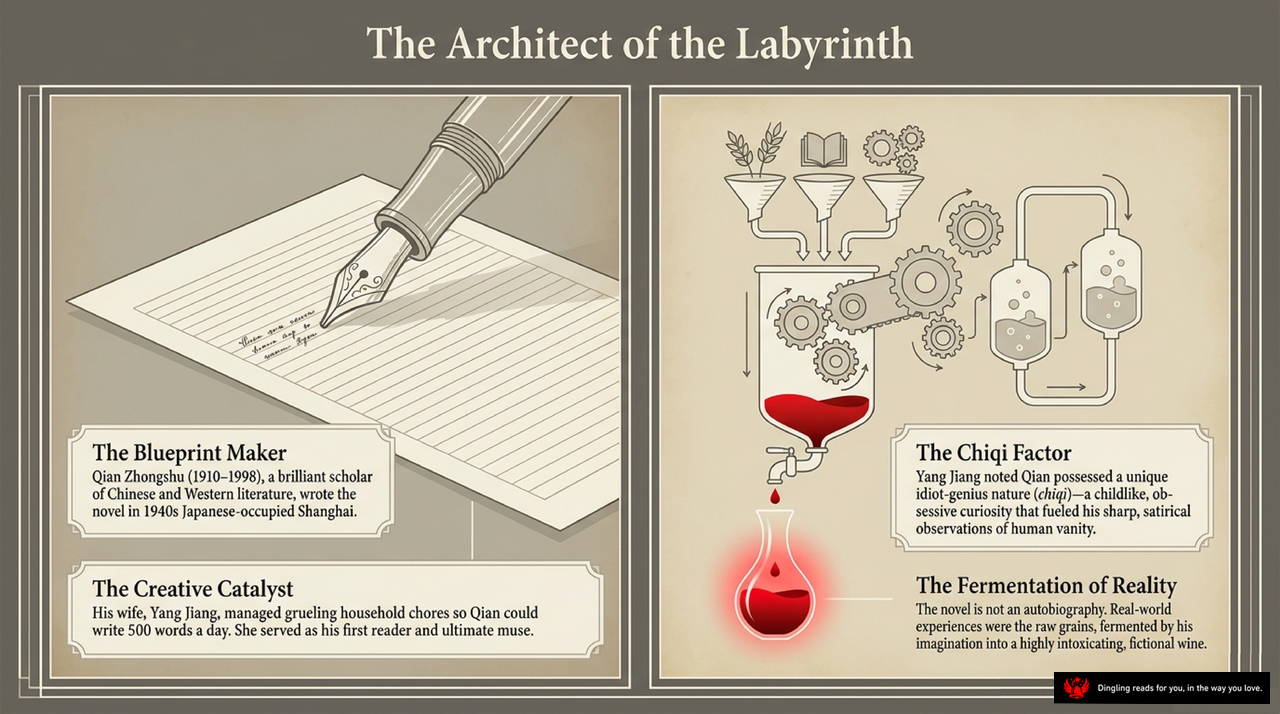
Welcome back. Today, we're peeling back the layers of *Fortress Besieged* to understand who built this intricate world. Look at this slide: "The Architect of the Labyrinth."
On the left, we have "The Blueprint Maker." This is Qian Zhongshu himself. A brilliant scholar who penned this masterpiece in the 1940s, during the Japanese occupation of Shanghai. It wasn't an easy time, but he produced this classic. He designed the structure of the story, much like the blueprint on the paper. Every character, every twist, was part of his design.
But he didn't write alone. Enter "The Creative Catalyst": his wife, Yang Jiang. She managed the grueling household chores, freeing up Qian to write 500 words a day. She wasn't just a housekeeper; she was his first reader and ultimate muse. Without her support, the blueprint would have remained just ink on paper. She helped him navigate the chaos of life so he could focus on the chaos of the story.
On the right, we see the mechanics of his genius. First, "The Chiqi Factor." Yang Jiang noted Qian had a unique "idiot-genius" nature. It was a childlike, obsessive curiosity that fueled his sharp, satirical observations of human vanity. He saw the absurdity in everything, from the petty arguments in Shanghai to the grand schemes of the world. He didn't judge; he observed with a kind of detached humor.
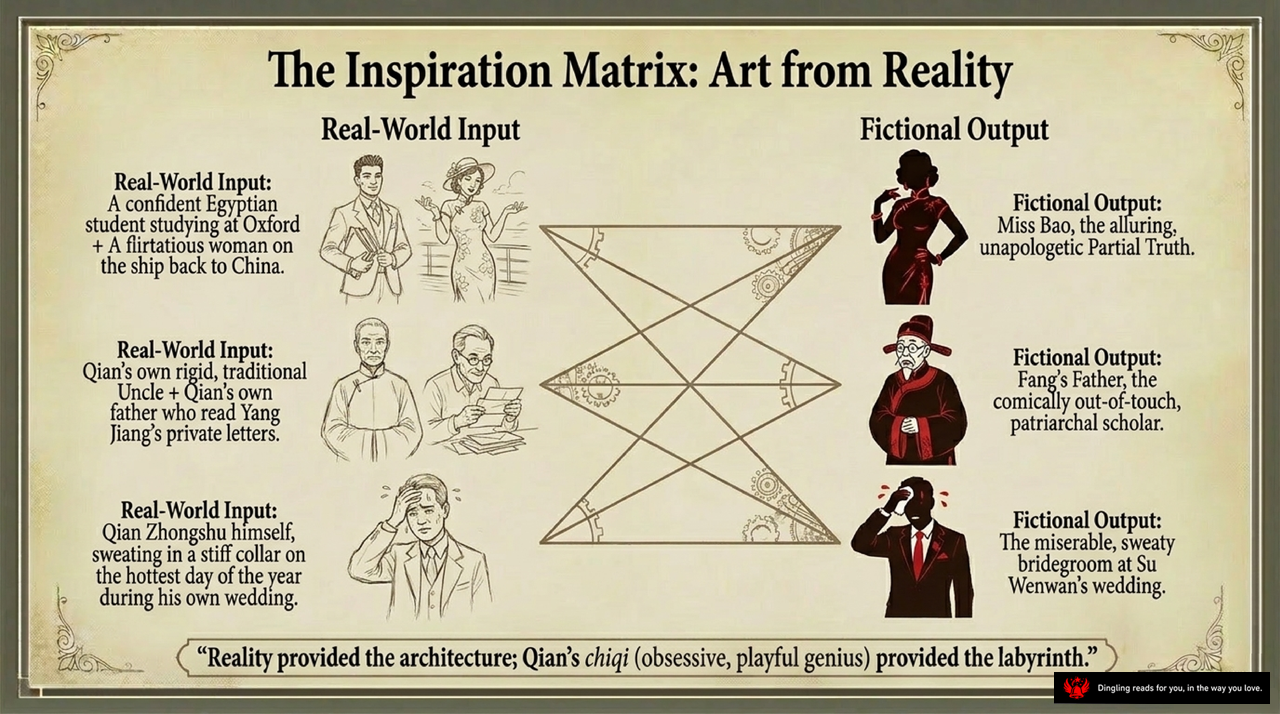
Then, "The Fermentation of Reality." This is crucial. The novel isn't an autobiography. Real-world experiences—think of the chaos, the war, the travel, the human struggles we see in the story—were the raw grains. Qian fermented them with his imagination into a highly intoxicating, fictional wine. Just as the diagram shows, the gears of reality turn into the gears of fiction. The pain of the war becomes the comedy of the journey.
So, this isn't just a story about a man named Fang Hongjian. It's a reflection of the human condition, crafted by a man who could find the profound in the ridiculous. He turned the chaos of reality into a structured, biting satire. This is the foundation of why this book still resonates with us today. It's a labyrinth we all step into, and Qian built the walls. He created a world where everyone is trapped, yet everyone is free to be ridiculous. That is the true genius of this work.
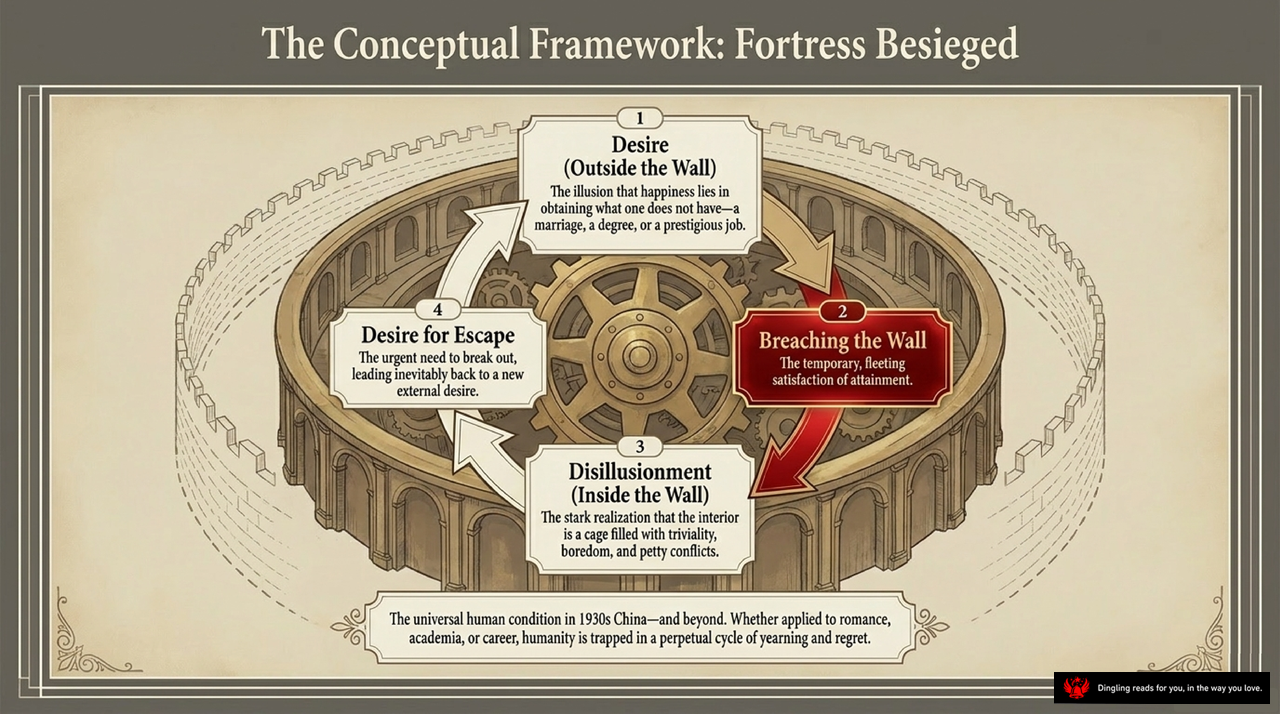
Let's dive into the core framework of Fortress Besieged. This diagram captures the relentless cycle of the human condition. We start at the top with Desire, Outside the Wall. It's the illusion that happiness lies in obtaining what one does not have. In the story, Fang Hongjian believes that a degree or a prestigious job will fix his life. He buys a fake PhD just to hide his emptiness, thinking that success is the key to happiness.
Once he gets what he wants, we move to Breaching the Wall. This represents the temporary, fleeting satisfaction of attainment. Fang feels triumphant when he secures his position or gets close to a woman like Tang Xiaofu. It's a rush, a brief high point. But the excitement never lasts.
Then comes the crash: Disillusionment, Inside the Wall. The stark realization that the interior is a cage filled with triviality, boredom, and petty conflicts. Think about Fang's time at Sanlu University. It's not an ivory tower of learning; it's a bureaucratic nightmare filled with jealous colleagues and fake scholars. The romance turns sour, and the career feels like a trap.
This pain drives us to Desire for Escape. The urgent need to break out leads inevitably back to a new external desire. He tries to leave the university, then he tries to escape the marriage he just rushed into. He chases the next person, the next job, the next thing.
As the bottom of this slide notes, this is the universal human condition. Whether applied to romance, academia, or career, humanity is trapped in a perpetual cycle of yearning and regret. We want to get in, but once we're in, we want to get out. It's a paradox we all live with, regardless of the era. This framework explains why we are never truly satisfied, because the moment we reach the goal, we realize the fortress was the problem all along. The book even uses the famous quote about marriage being a besieged fortress, where those outside want in, and those inside want out. It's a timeless truth about how we chase happiness, only to find it was never really there. Think about your own life. Have you ever felt like you're stuck in a room you built for yourself? That's the feeling of being inside the wall, looking out for something better, while knowing that the outside might just be the same thing, just with a different label. We are all trapped in this cycle, constantly seeking the next thing to make us feel whole, only to find that the wall is always right there.
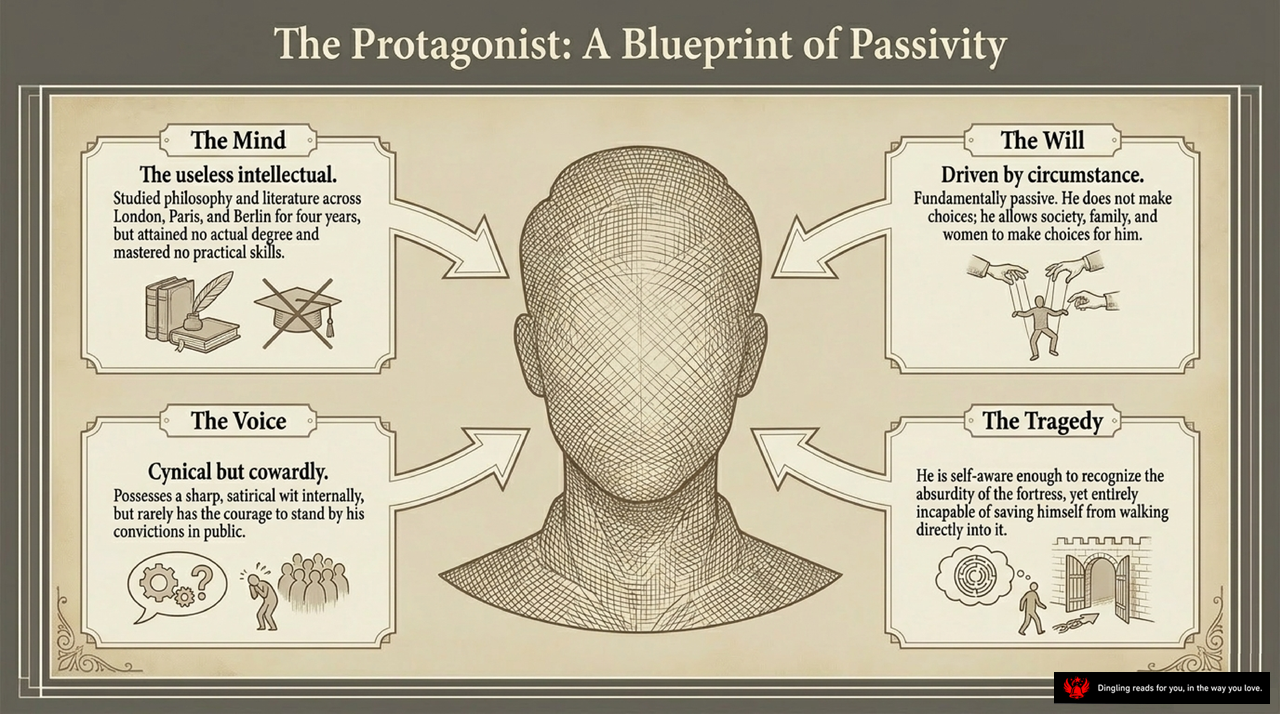
Let's dive into the core of our protagonist. This slide describes him not as a hero, but as a blueprint of passivity. Why? Because every aspect of his life screams a lack of agency.
First, look at his mind. He spent four years studying philosophy and literature across London, Paris, and Berlin. On paper, that sounds impressive. But in reality, he attained no actual degree and mastered no practical skills. He's essentially a useless intellectual, an armchair scholar who knows everything about nothing. He bought a fake degree from a fraudster just to cover his emptiness. It's like wearing a costume to feel confident. He thinks he's smart, but he's actually just hiding his ignorance. He never learned how to navigate the real world.
Second, his will. He is fundamentally passive. He doesn't make choices. Society, family, and women make choices for him. Think about it: his father arranged his marriage, his father-in-law funded his education, and he chased a woman only to be rejected. He is a puppet, not the driver. He lets others decide his fate, from his career path to his romantic life. He's a passenger on his own life.
Third, his voice. He is cynical but cowardly. He possesses a sharp, satirical wit internally. He can mock others, like Cao Yuanlang's bad poetry. But rarely does he have the courage to stand by his convictions in public. He hides his fake degree behind a smile, knowing it's a lie but never speaking the truth. He criticizes the world but never changes his own situation. He's a critic who never takes action.
Finally, the tragedy. He is self-aware enough to recognize the absurdity of the fortress. He knows he's trapped. Yet, he is entirely incapable of saving himself from walking directly into it. From the fake degree to the failed marriages, he keeps choosing the path of least resistance. He sees the walls closing in, but he keeps walking forward anyway. He knows the fortress metaphor perfectly, yet he walks right into the trap.
So, why does this matter? Because Fang Hongjian represents a specific kind of failure. Not failure of ability, but failure of agency. He knows the game, but he refuses to play it. That's the real tragedy. He could have been different, but he chose the easy path. This is a warning for all of us: knowing the truth is easy, acting on it is hard.
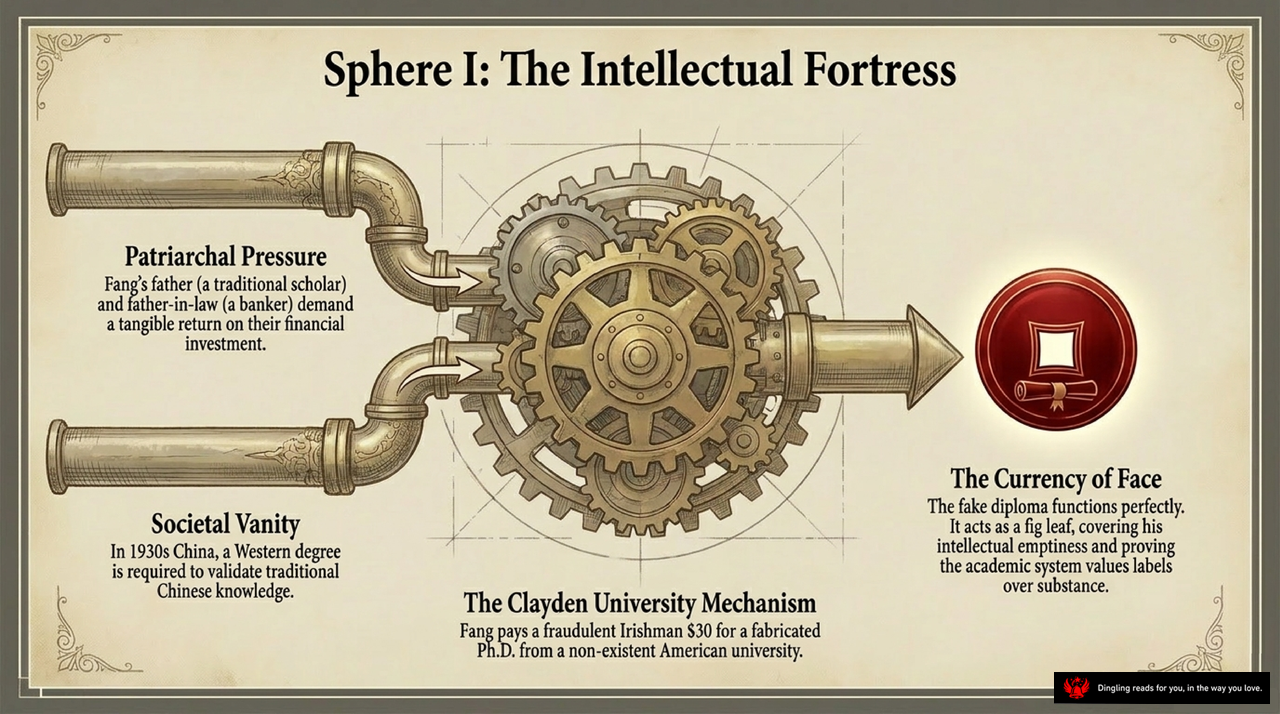
Let's dive into Sphere One: The Intellectual Fortress. This diagram illustrates the very trap Fang Hongjian falls into. It's not just about learning; it's about the walls we build to protect our self-worth in a society that demands performance over substance.
Look at the inputs on the left. First, we have Patriarchal Pressure. Fang's father, a traditional scholar, and his father-in-law, a banker, both treated Fang's education as a financial investment. They demanded a tangible return. They weren't asking for wisdom; they wanted a trophy to show off. They needed a degree to justify the money they spent on his education. It wasn't about his growth; it was about their return on investment.
Then, there's Societal Vanity. In 1930s China, a Western degree wasn't just a credential; it was the only key that unlocked the door to validate traditional Chinese knowledge. Without it, you were invisible. You couldn't even speak about your own culture without a Western stamp of approval. It was a time when local wisdom needed foreign validation to be taken seriously.
This pressure forced Fang into the center of our diagram: The Clayden University Mechanism. Here, we see the moment of transaction. Fang pays a fraudulent Irishman just thirty dollars for a fabricated Ph.D. from a non-existent American university. It's a bargain, but the cost is his integrity. He buys a piece of paper to hide the fact that he learned nothing. He's essentially renting a reputation.
Now, look at the result on the right: The Currency of Face. The fake diploma functions perfectly. Why? Because it acts as a fig leaf. It covers his intellectual emptiness. But more importantly, it proves the academic system values labels over substance.
This is the core irony of this chapter. The system he is trying to join is so corrupt that a piece of paper bought for thirty dollars is worth more than years of actual study. The 'Fortress' isn't built to keep knowledge in; it's built to keep his shame out. He succeeds in hiding his failure, but in doing so, he validates the very system that deceived him. It's a tragic cycle where the lie becomes the truth because everyone agrees to play along.
So, Sphere One teaches us that when you build your identity on a lie, the lie becomes the only reality you can trust. It's a warning about the cost of 'face' in a culture that prioritizes appearance over authenticity. We see how easily a system can be gamed when the rules are written by vanity rather than merit.
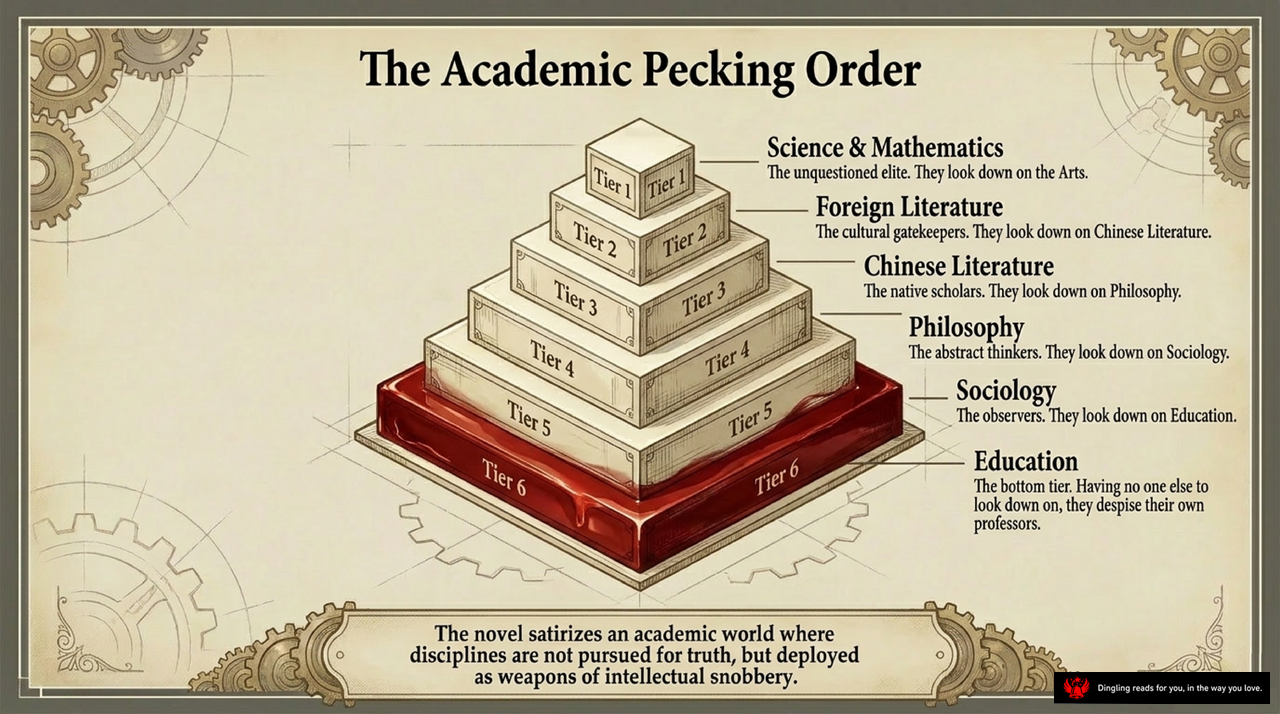
Look at this pyramid. It's called the Academic Pecking Order, and it perfectly captures the satirical heart of the novel. It maps out exactly how the university system views itself. At the very top, you have Science and Mathematics. They are the unquestioned elite, looking down on the Arts. Below them is Foreign Literature, acting as the cultural gatekeepers who look down on Chinese Literature. Then comes Chinese Literature, Philosophy, Sociology, and finally, Education at the very bottom.
The bottom tier is the funniest part. Education has no one to look down on, so they end up despising their own professors. It creates a closed loop of pure snobbery.
In the story, this hierarchy comes alive at Sanlu University. The principal, Gao Songnian, is a scientist, so he naturally believes the hard sciences are superior. He uses a biological metaphor to justify hiring "unknown" professors over famous ones. He compares the university to an organic body and professors to cells. If the cells are too arrogant, the whole body suffers. So, he hires people like Fang Hongjian who have nothing to lose.
But here's the twist. While Fang Hongjian is at the bottom, another professor, Han Xueyu, claims to have a Ph.D. from Clenden University. Fang knows this is a lie—Clenden doesn't even exist. But Han uses this fake credential to jump up the ladder, earning a higher salary and status than Fang, even though they both have fake degrees. Fang almost slips up when he realizes Han's degree is from the same fake school.
The text shows Fang realizing that in this world, truth doesn't matter. It's all about who you know and what fake titles you wear. The disciplines aren't about seeking knowledge; they are weapons used to assert superiority. The novel satirizes this academic world where truth is discarded for the sake of intellectual snobbery.
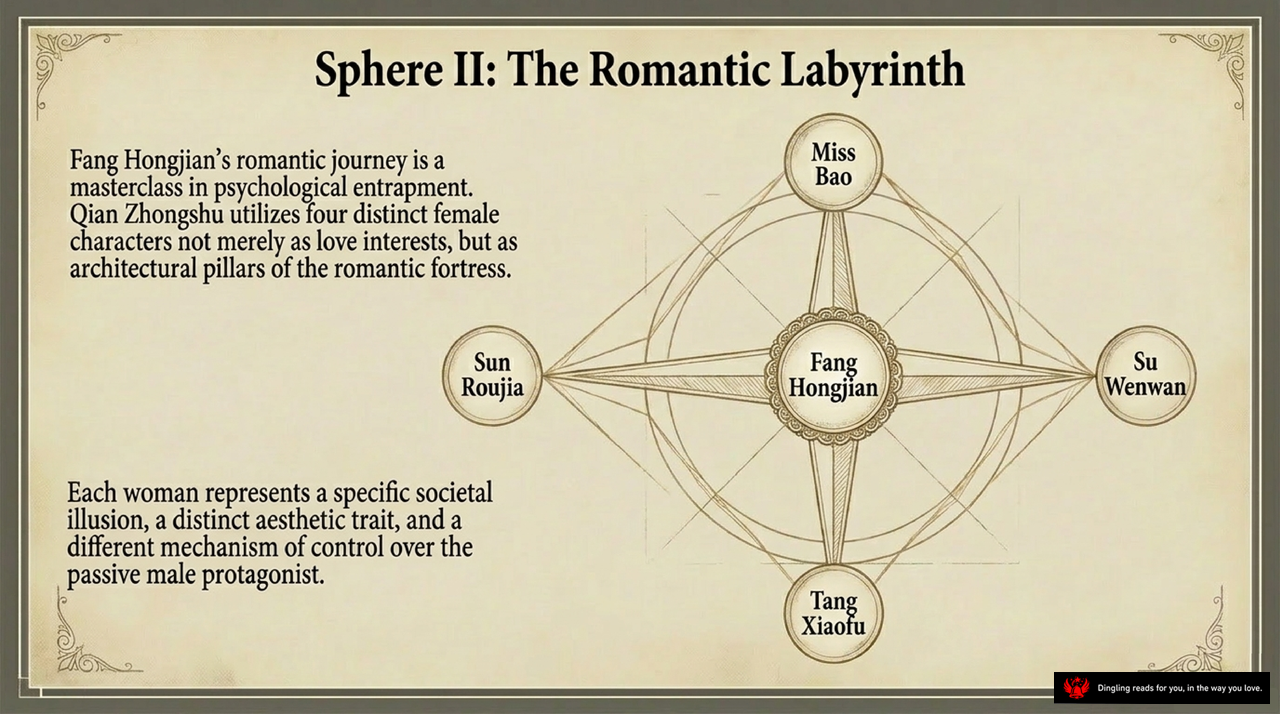
Sphere II: The Romantic Labyrinth. This slide perfectly captures the tragic core of Fang Hongjian's story. It’s not a story about finding love; it’s a story about being trapped in a design.
Look at the center: Fang Hongjian. The text calls his journey a "masterclass in psychological entrapment." Qian Zhongshu uses these four women not merely as love interests, but as "architectural pillars of the romantic fortress."
Let's look at who these pillars are. Miss Bao represents the illusion of physical desire. Su Wenwan represents the illusion of social status and intellectual pretension. Tang Xiaofu represents the illusion of pure, unattainable perfection. And finally, Sun Roujia represents the harsh reality of pragmatic compromise.
The slide notes that "Each woman represents a specific societal illusion, a distinct aesthetic trait, and a different mechanism of control over the passive male protagonist." Notice how the diagram connects them all to Fang. He is the hub, but he has no power. He is the "passive male protagonist" constantly being pulled in different directions.
Miss Bao pulls him with lust. Su Wenwan pulls him with social expectation. Tang Xiaofu pulls him with an idealized dream. Sun Roujia pulls him with a calculated, subtle trap.
In the text, we see this play out. On the ship, Miss Bao uses her body to trap him. In Shanghai, Su Wenwan uses her family connections to pressure him. Tang Xiaofu represents the one woman he truly loves, but she rejects him because of his past. Sun Roujia is the one who eventually marries him, trapping him in a domestic reality he didn't choose.
In the end, Fang Hongjian isn't navigating a relationship; he's walking through a maze built by these four women and the society they represent. He thinks he has choices, but the "Romantic Labyrinth" ensures he is always controlled. This is the defining tragedy of his character.
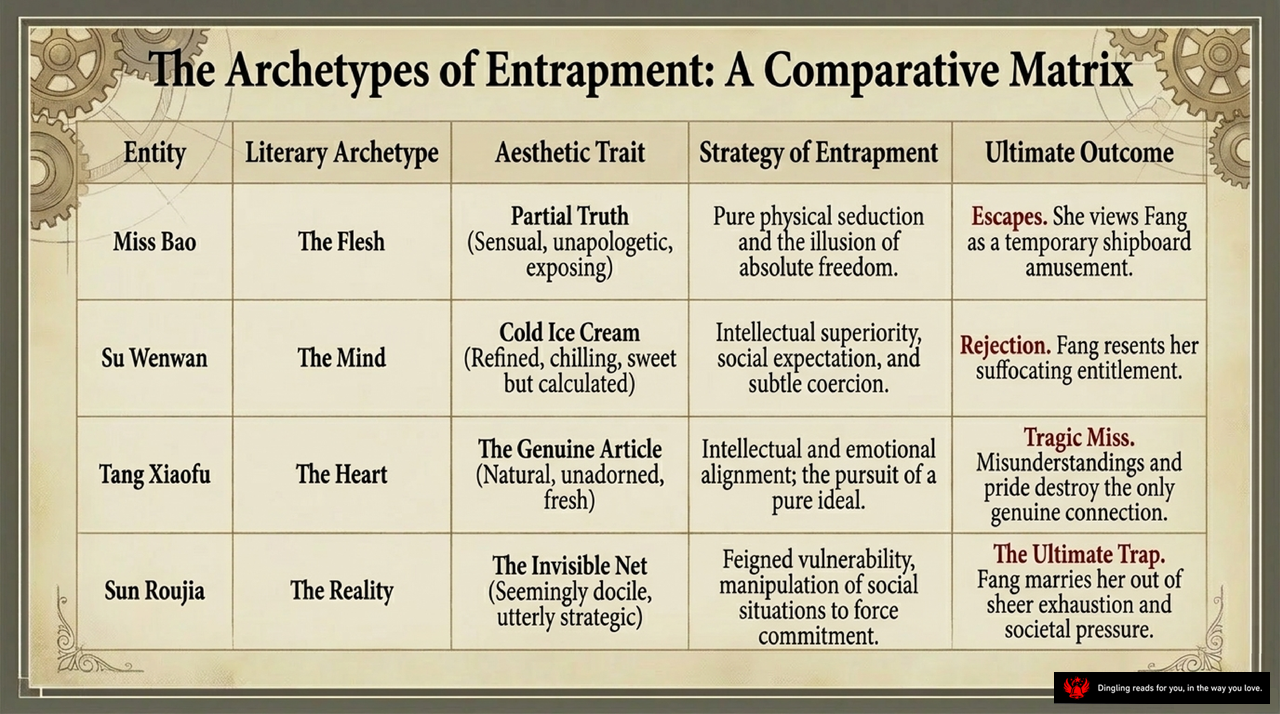
So, let's dive into the four women who defined Fang Hongjian's life. This matrix categorizes them by how they trapped him, moving from physical attraction to the harsh reality of marriage.
First, Miss Bao represents "The Flesh." She's all about physical seduction. On the ship, she's the "Partial Truth"—sensual and unapologetic. She treats Fang like a temporary shipboard amusement. She escapes him quickly when things get real, leaving him confused and wanting more than just a fling.
Second, Su Wenwan is "The Mind." She's refined but calculated, like "Cold Ice Cream." She uses intellectual superiority and social pressure to trap him. But Fang resents her entitlement. The result? Rejection. She walks away, leaving him feeling inadequate and unable to connect with her on a real level.
Third, Tang Xiaofu is "The Heart." She's the "Genuine Article"—natural and fresh, like unspoiled fruit. She seeks pure connection. Fang Hongjian falls hard for her, writing letters late at night, unable to sleep without reading them. But misunderstandings and pride destroy their only real chance. It's a tragic miss. He loses the one person who truly understood him, realizing love isn't enough without trust.
Finally, Sun Roujia is "The Reality." She's "The Invisible Net." She seems docile but is utterly strategic. She uses feigned vulnerability to force commitment. Fang Hongjian, exhausted by societal pressure, marries her out of sheer exhaustion. This is "The Ultimate Trap." He ends up in a marriage that feels like a prison, filled with arguments and silence.
Looking at the matrix, we see a clear progression. It starts with lust, moves to intellectual games, then emotional longing, and finally settles into the harsh reality of marriage. Each step feels like a different kind of cage. Miss Bao offers fun but no depth. Su Wenwan offers status but no warmth. Tang Xiaofu offers love but no future. And Sun Roujia offers a home but no freedom. In the end, Fang Hongjian realizes that none of these women could truly save him from his own entrapment. They were all mirrors reflecting his own inability to escape. This is the core tragedy of the book.
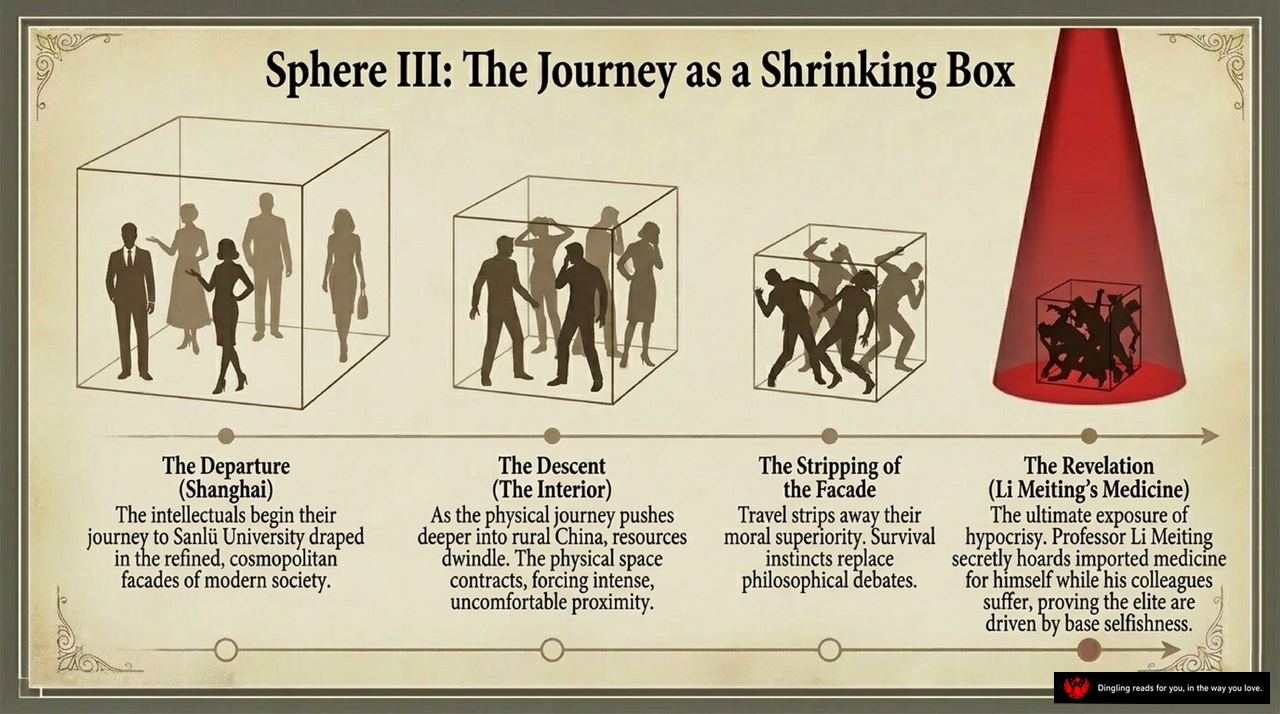
Welcome to Sphere III: The Journey as a Shrinking Box. This visual perfectly captures the arc of our protagonist's trip to Sanlu University. It's not just a physical trip; it's a psychological test of character.
It begins with The Departure in Shanghai. You see the silhouettes standing tall in a box. That represents the intellectuals leaving the city, draped in the refined, cosmopolitan facades of modern society. They believe they are going to a place of opportunity, escaping the chaos of war. They feel confident, dressed in their best suits, ready for a new chapter.
But as they move into the next phase, The Descent, that box gets smaller. As the physical journey pushes deeper into rural China, resources dwindle. Think about the rain, the mud, and the crowded car. The text describes them getting soaked in a downpour, ending up in a village inn where the walls are damp and the air smells of urine. The physical space contracts, forcing intense, uncomfortable proximity. They are no longer individuals; they are trapped together. The distance between them vanishes, and they are forced to confront each other's flaws.
This leads to the third stage: The Stripping of the Facade. Travel strips away their moral superiority. Before, they were discussing philosophy and culture. Now, survival instincts replace those debates. They are fighting over a train ticket or arguing about how to get money. The pretense of the elite is gone. They are just people trying to survive. The 'box' is shrinking, and their illusions are being crushed.
Finally, we reach the Revelation, highlighted by Li Meiting. Look at the red spotlight on the small box. Li Meiting is carrying a large iron box. In the book, it's filled with Western medicine. He claims it's for the school, but he's secretly hoarding it for himself. He sees the medicine as a commodity to sell later for profit. When his colleagues are suffering or sick, he prioritizes his own potential gain. He even hesitates to share it unless forced. This is the ultimate exposure of hypocrisy. He proves that even among the educated elite, base selfishness drives the behavior.
So, this journey isn't just about geography. It's a psychological shrinking box. As they move from Shanghai to the interior, they lose their illusions about themselves and the world. The box closes in, and what remains is just survival. It's a stark reminder that the journey often reveals who we really are when the comfort is gone. The box gets smaller, and the truth gets bigger. This is the cost of the journey.
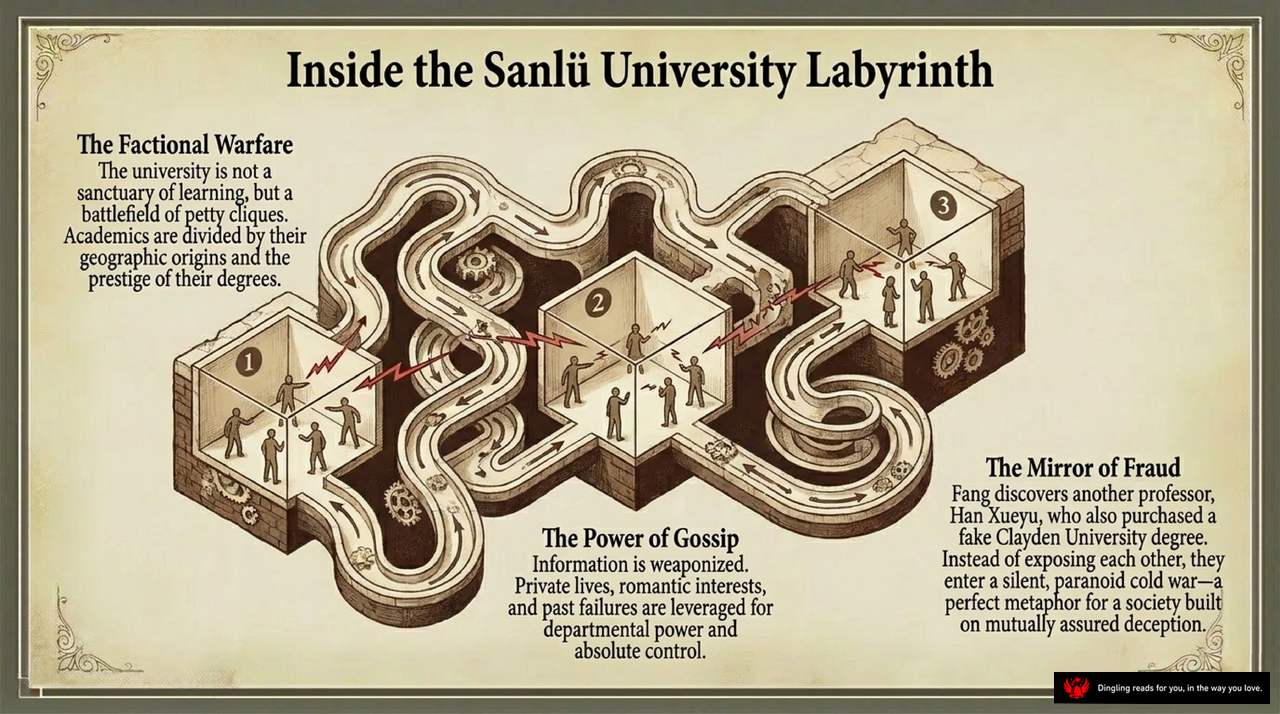
Imagine stepping into a maze that isn't made of stone, but of office politics and human weakness. This slide captures the essence of Sanlu University, a place that looks like an institution but functions as a trap. The text on the screen breaks this labyrinth down into three deadly chambers.
First, look at the left side: The Factional Warfare. The university isn't a sanctuary of learning; it's a battlefield of petty cliques. Academics are divided by their geographic origins and the prestige of their degrees. In the book, we see this clearly with Han Xueyu. He, like Fang Hongjian, purchased a fake degree from Clayden University. Instead of competing on merit, they compete on who has the better lie.
Moving to the center, we have The Power of Gossip. Here, information is weaponized. Private lives, romantic interests, and past failures are leveraged for departmental power and absolute control. Fang's relationship with Sun Roujia becomes ammunition against him. Later, when a communist book is found in his room, it's not treated as a mistake, but as a weapon to destroy his career. Personal privacy is sacrificed for power.
Finally, on the right, we see The Mirror of Fraud. Fang discovers that Han Xueyu also bought a fake degree. Instead of exposing each other, they enter a silent, paranoid cold war. It's a perfect metaphor for a society built on mutually assured deception. They both know the truth, but neither speaks it.
So, what happens to Fang? He gets expelled. He realizes that the university wasn't about teaching; it was about survival in a maze of lies. He leaves with nothing but a broken heart and the realization that he was just a pawn in someone else's game. This isn't just a story about a school; it's a warning about any system where truth is less valuable than the ability to deceive.

Look at this clock. It’s not just a timepiece; it’s the final verdict on Fang Hongjian’s life. The novel doesn’t end with a grand tragedy, a bang, or a dramatic explosion. Instead, it ends with a suffocating whimper. It’s quiet, heavy, and deeply unsettling.
Fang Hongjian, the protagonist we’ve followed for so long, has retreated from the academic world. He tried to find himself, but he failed at genuine love. Now, he finds himself trapped in a dismal marriage with Sun Roujia. It’s a quiet cage, far more suffocating than any battlefield.
Think about the final scene. After a bitter, exhausting argument, Fang sits alone in the dark. The room is silent, but the ancestral clock begins to strike. You might expect it to ring the correct time, right? But no. The clock is broken. It strikes the wrong hour.
This is the core of the tragedy. The clock symbolizes the ultimate tragedy of the Besieged Fortress. Time moves forward for everyone else. The world keeps spinning. But Fang’s life remains fundamentally stagnant. He is broken. He is trapped within walls of his own making.
In the final pages, we see the physical manifestation of this break. Fang pushes Sun Roujia, and she retaliates with an ivory comb. They are fighting, but they are fighting in circles. The fight doesn't solve anything; it only proves they are stuck. The clock strikes six, but it is five hours slow. It’s like their relationship. It’s supposed to be the time for dinner, the time for connection, but it’s broken.
There is no escape. There is no grand redemption. There is only endurance. He is stuck in the moment, just like the clock that refuses to keep the right time. This is the inescapable trap. We all face moments where time moves forward, but we feel like we aren't moving at all. That is the feeling of the end. That is the feeling of the clock. It’s a reminder that sometimes, the hardest part of life isn't the struggle, but the realization that you are just waiting for a time that never comes. We often think success means moving forward. But sometimes, success is just surviving the stillness. Fang thought he could fix his life, but he only built another wall. And now, he sits there, listening to a clock that lies to him.
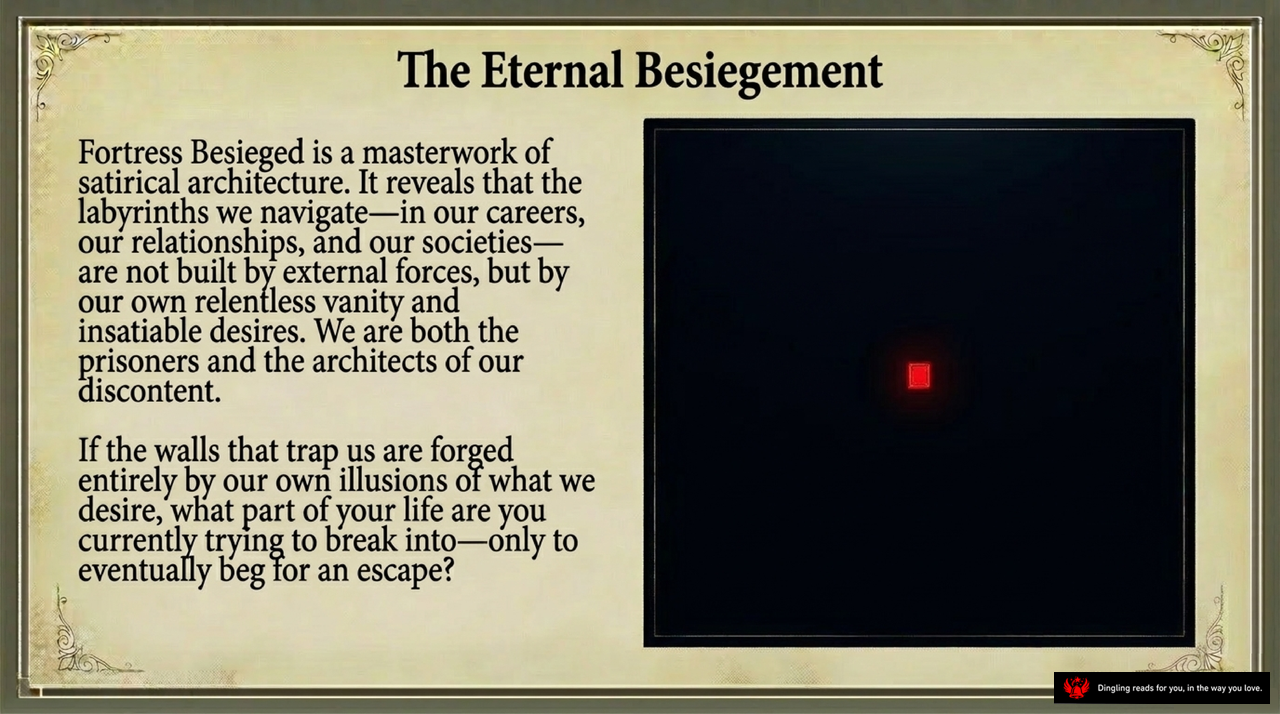
Look at that red square in the center of the darkness. It is small, isolated, and surrounded by nothing but void. That visual perfectly captures the feeling of being trapped in Fortress Besieged.
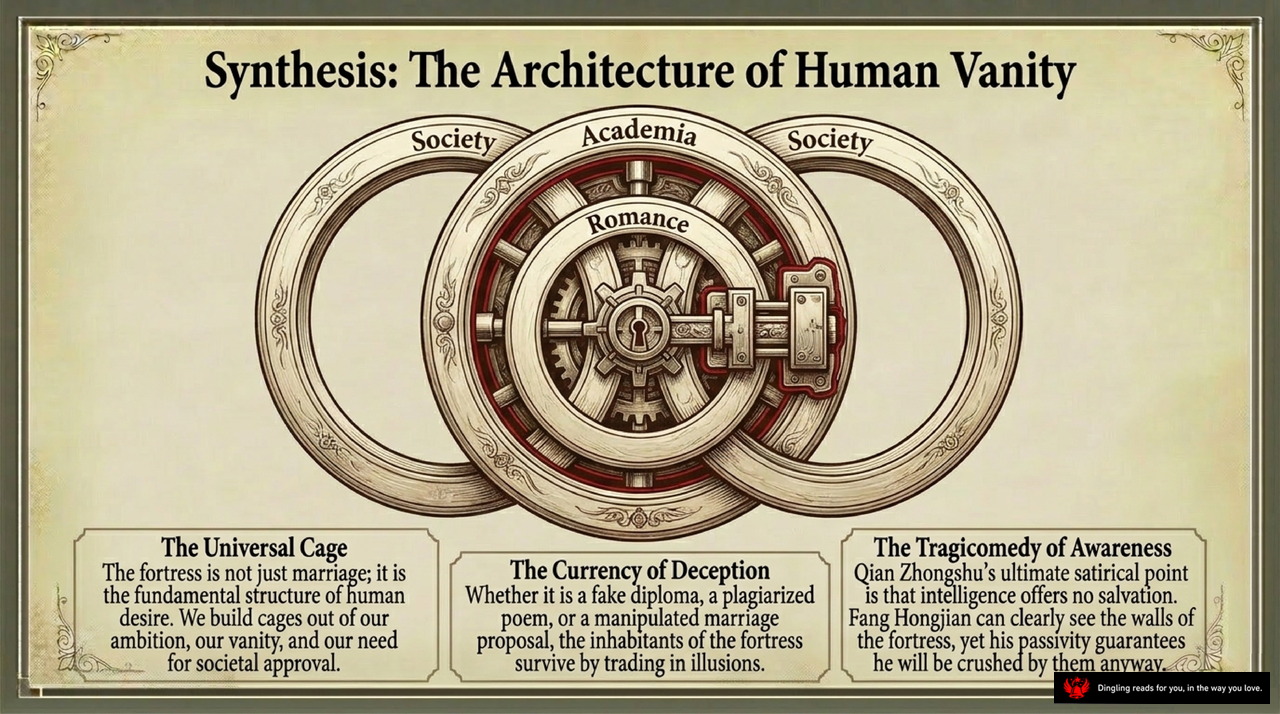
The title above, The Eternal Besiegement, is the core message of this book. Fortress Besieged is a masterwork of satirical architecture. It reveals that the labyrinths we navigate—in our careers, our relationships, and our societies—are not built by external forces, but by our own relentless vanity and insatiable desires. We are both the prisoners and the architects of our discontent.
Think about Fang Hongjian's journey. He buys a fake degree to cover his lack of real achievement. That piece of paper becomes a wall he builds to protect his ego from the world. He thinks it elevates him, but it only isolates him. Later, he falls into the trap of marriage. He thinks love is the answer, but he ends up trapped in a relationship that suffocates him. The book describes marriage as a besieged castle, where those outside want to rush in, and those inside want to escape. Fang Hongjian spends his life running from one illusion to another, chasing status, then love, only to find himself trapped in the very things he created.
The walls that trap us are forged entirely by our own illusions of what we desire. We build careers we do not love, relationships we cannot sustain, and lives we do not want, all because we are terrified of being ordinary. We want to be special, so we build fortresses of expectation and judgment.
The book mocks the academic world where everyone pretends to be smarter than they are. It mocks the social world where everyone pretends to be more in love than they are. It shows how we trap ourselves with rules and expectations that we invented ourselves. We are the architects, designing the prison, and then we become the prisoners, begging for a key that we never gave ourselves.
The word Eternal in the title is chilling. It suggests that this cycle of building and being trapped never ends. We keep building new walls to hide our insecurities, only to find ourselves locked in tighter than before.
So, I want you to look inward. If the walls that trap us are forged entirely by our own illusions of what we desire, what part of your life are you currently trying to break into—only to eventually beg for an escape?
Are you building your own fortress, or are you just waiting for the walls to fall?