
Foundation: Complete Chapter-by-Chapter Summary

Welcome to the universe of Isaac Asimov's *Foundation*. This isn't just a story about space travel; it's a masterclass in grand strategy, showing how power evolves from academic isolation to economic hegemony. It serves as a mathematical blueprint for galactic survival.
At the center of this epic is Hari Seldon, a mathematical genius who invented Psychohistory. This revolutionary science allows him to predict the future behavior of large populations, revealing that the mighty Galactic Empire is doomed to fall within a mere 500 years. To shorten the ensuing dark age from 30,000 years down to just 1,000, Seldon devises a daring plan: he will send thousands of scientists to a remote, barren planet at the galaxy's edge called Terminus.
This image captures the vast scale of his vision, tracing the evolution from a single point of knowledge to a new empire. While the original text focuses on the early chapters where Seldon travels to the capital city of Trantor to recruit his first disciple, Gale Dornick, the core theme remains the same. Seldon knows that survival depends on preserving human knowledge when the empire crumbles. By building a sanctuary at Terminus, he ensures that civilization can be reborn long after the stars go dark. It is a bold gamble, relying on math rather than force, to save humanity itself.

The 12,000-year Galactic Empire isn't just fading; it's collapsing under its own weight. Without a miracle intervention, humanity is staring down the barrel of 30,000 years of barbarism. But there is a mathematical shortcut. The Seldon Plan offers a way to compress that dark age into just a single millennium and ignite the Second Empire.
Look at the stark reality on the left: the 12,000-Year Empire is a dying giant. It faces a critical vulnerability—40 billion administrators are entirely dependent on just 20 agricultural worlds. It's a fragile house of cards. Once the supply lines are cut, the entire civilization crashes into 30,000 years of darkness.
But look at the solution on the right. This is the 1,000-Year Shortcut. Instead of a slow, inevitable decline, we see a sharp, engineered ascent toward The Second Empire. By strategically placing a few thousand scientists at the edge of the galaxy, we preserve the knowledge of the old world. We turn a catastrophic collapse into a controlled reboot. It's not magic; it's math. It's the difference between extinction and a new dawn, all calculated in advance by Hari Seldon.

Hari Seldon's mathematical sociology cannot predict the actions of a single individual, much like physics cannot track a single gas molecule. However, when applied to the quadrillions of humans inhabiting the Galactic Empire, the unpredictable actions of individuals average out into precise, inevitable macro-historical trends.
This slide beautifully illustrates that fundamental concept through the "Gas Molecule Analogy." On the left, we see "Part 1: Micro-Chaos," representing individual free will. Just like gas molecules bouncing erratically in a box, every person in the Empire makes unique, unpredictable choices. You cannot foresee what one person will do tomorrow.
But look at the center: the funnel. As billions of these chaotic individual paths converge, the randomness cancels itself out. This leads us to "Part 2: Macro-Order" on the right. When you zoom out to look at the "Mass Action of Quadrillions," the result is a smooth, mathematically predictable curve. The chaos of the individual transforms into the order of history.
This is the core of Psychohistory: it doesn't care about you or me. It doesn't predict our personal lives. But by understanding the statistical behavior of the entire population, Seldon can forecast the rise and fall of empires with terrifying accuracy. It turns the storm of human history into a predictable, navigable current.

Imagine a building that looks like a harmless library but hides a secret supercomputer underground. This is the brilliant deception known as "The Master Decoy," a strategy devised by Hari Seldon to save humanity. To trick the paranoid Galactic Empire, Seldon framed his life's work as a purely academic endeavor: compiling the *Galactic Encyclopedia*. It was a non-threatening facade that successfully maneuvered 100,000 vital personnel to the edge of the galaxy, Terminus.
But look beneath the surface. While the "Academic Front" focused on compiling knowledge, the "True Objective" was far more strategic. It was the establishment of a self-sustaining scientific stronghold safely removed from the Empire's inevitable fall. By gathering this critical mass of scholars and scientists, Seldon planted the seed for the Second Empire right under the Emperor's nose. This clever ruse ensured that when the Empire inevitably crumbled, humanity wouldn't face a 30,000-year dark age. Instead, this hidden foundation would become the spark for a new civilization, proving that sometimes, the greatest power lies in what you pretend is just a book.

Fifty years after the Encyclopedia was founded, Terminus faces its first existential threat. Cut off from the galactic core, it is surrounded by four newly independent, heavily armed barbarian kingdoms. The Board of Trustees' reliance on a meaningless Imperial Charter leaves the planet completely defenseless.
As the map shows, Anacreon, Smyrno, Koldas, and Loris now encircle Terminus, their expansion arrows pointing inward with aggressive intent. While the Board of Trustees believes they can simply Rely on the Imperial Charter, Ignore Border Threats, and Await Imperial Rescue, this strategy is fatally flawed. The red slash through their cycle diagram reveals the harsh reality: the Empire is gone, and no rescue is coming.
In this crisis, the idealistic Chairman Louis Pheenna insists that the only priority is continuing the Encyclopedia compilation, dismissing the military danger as a temporary political nuisance. But Mayor Cavor Hardin sees the truth clearly. Without metal imports, Terminus cannot maintain its civilization, let alone its science. Hardin argues that they must arm themselves, but the Council is paralyzed by denial.
It is then that Jude Faren suggests they remember the true purpose of Terminus: the Trantor Dome. The image of Hari Seldon appears, revealing that the Encyclopedia was merely a cover to gather ten thousand people. The real mission is to shorten the Dark Age from thirty thousand years to just one thousand. Seldon's final instruction is stark and clear: Terminus and the other Foundation must become the seeds of a new Galactic Empire. The path is now marked. The time for hiding is over; the time for survival has begun.

In this pivotal moment, Mayor Salvor Hardin confronts the very heart of the Foundation's survival: the choice between noble ideals and cold, hard pragmatism. The image before us perfectly captures this tension. On one side, we see the heavy weight of "Academic Idealism," representing the obsession with the Encyclopedia and the belief that knowledge alone can save us. On the other, Hardin's "Realpolitik" rises higher, proving that in a collapsing empire, violence is indeed the last refuge of the incompetent.
Hardin understands that the Foundation cannot survive by waiting for protection from a dying Empire. When the Anacreon Kingdom cuts off their metal supply, the academic leadership refuses to act, paralyzed by the fear of war. But Hardin sees the truth: if they don't act decisively, the Foundation will be crushed. He realizes that to save the human race, he must become the villain in the eyes of the idealists. By orchestrating a bloodless coup against the Board of Trustees, Hardin shifts the Foundation from passive isolation to active geopolitical manipulation. He trades his political life for the future of humanity, proving that sometimes, the most effective weapon isn't a laser or a bomb, but the willingness to break the rules when the rules themselves are about to destroy us.

Crisis II: The Religion of Science. This isn't just about technology; it's about how power truly works when the old guard collapses. To control hostile, technologically regressed kingdoms, Hardin weaponizes knowledge. The Foundation provides vital nuclear power, but disguises it as a mystical religion.
Look at this cycle. First, we export nuclear technology to barbarian worlds. Then, we wrap that tech in mystical rituals—calling it "The Galactic Spirit." The barbarian masses worship the machinery, treating science as divine magic. Finally, only Foundation-trained "priests" can maintain the power plants. This creates a closed loop where the barbarians revere the tech as something they can't understand or fix, while the Foundation 'priests' serve as the sole operators.
This strategy secures Terminus's dominance without an army. It's a perfect ideological and technological hegemony. By making science seem like a religion, Hardin ensures that the only people who hold the keys to survival are the ones he wants in charge. It's a brilliant, cold, and utterly effective method of control.
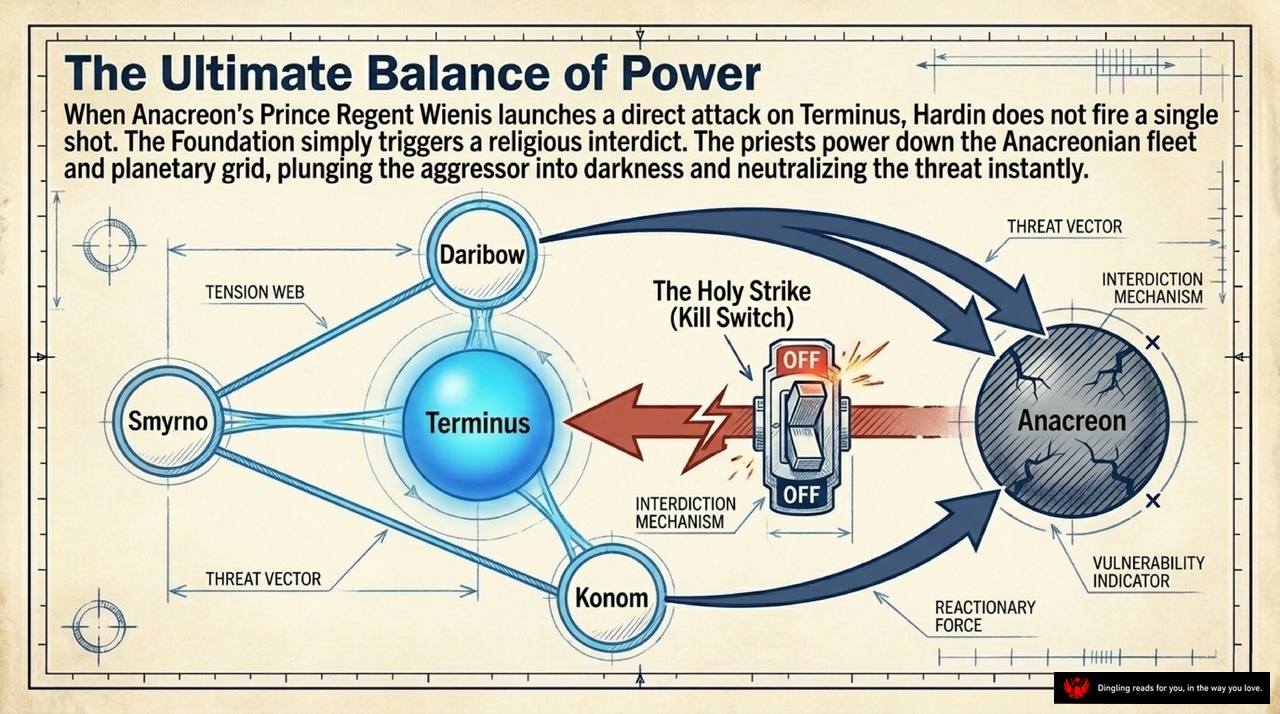
Imagine a galaxy on the brink of chaos, where a rogue prince named Wienis of Anacreon decides to strike directly at Terminus. In a classic military scenario, you'd expect a fleet of battleships to open fire. But here, the response is something far more terrifying: absolute silence.
Look at this diagram. You see the "Threat Vector" coming from Anacreon, aiming straight for the Foundation's heart. Yet, instead of a counter-attack, the Foundation triggers "The Holy Strike." This isn't a weapon of metal and fire; it's a weapon of faith. The priests of the Foundation simply flip a switch labeled "OFF," plunging the entire Anacreonian fleet and planetary grid into darkness.
This is the ultimate balance of power. It relies on a clever psychological trick: the priests, trained by the Foundation, pretend to be independent religious leaders. When the Foundation orders them to stop all energy production, the priests, believing they are obeying a divine mandate to protect the sacred, comply instantly. The aggressor is neutralized not by force, but by a sudden, total loss of electricity. It's a brilliant demonstration of how soft power can defeat hard power, turning the enemy's own reliance on technology against them in a single, decisive moment.

Look at this map. It illustrates a critical turning point in the Foundation's history: "The Paradigm Shifts Again." As the timeline moves forward, we see the blue area labeled "Religious Influence" slowly eroding against the red territory of "The Republic of Korell." This visual perfectly captures the failure of the Foundation's first strategy. Decades after Hari Seldon's initial plan, the outer worlds have grown wise to the Foundation's ideological manipulation. Nations like Askone and Korell have strictly banned Foundation missionaries, rendering the "Religion of Science" obsolete.
But the situation is even worse. Notice the golden emblem in the diagram labeled "Secret Imperial Tech Support." This represents the hidden danger Korell has begun receiving: secret supplies of advanced Imperial nuclear warships. While the Foundation was busy preaching, Korell was secretly arming itself with technology the Empire itself had abandoned. This shift forces the Foundation to abandon its reliance on religious control and confront a new, more dangerous reality where the enemy is not just ideologically opposed, but militarily superior.

Crisis III: Enter the Merchant Princes. As religious expansion stalls, the independent 'Traders' become the Foundation's vanguard. Leading them is Hober Mallow, a pragmatic Merchant Prince who realizes that ideology is now a liability. To penetrate closed borders, Mallow abandons religion entirely, offering pure, lucrative trade.
Look at the strategic advantage here. While the old regime relies heavily on moral ideology, Mallow's strategy is built on 100% pragmatism and 100% economic leverage. The scale on the right perfectly illustrates this shift: Moral Ideology is weighed down by a single feather, while Profit and Trade tip the scales decisively. Mallow's Trader's Vessel is designed for one thing: high-capacity cargo holds and pragmatic operations, with no ideological markings to slow him down.
In a world where faith has failed, Mallow proves that profit is the only language the galaxy still speaks. By trading nuclear tech for raw materials and ignoring religious dogma, he doesn't just survive the crisis; he turns it into an opportunity. This is the power of the Merchant Prince: when empires fall, commerce rises.

Welcome to the final chapter of our journey through the Foundation's greatest crisis. Look at this slide: "The Hober Mallow Doctrine." It's a stark split between two opposing forces. On the left, we see crossed swords, a missile, and a church marked with a giant red X. This represents "Aggressive Retaliation & Ideological Warfare"—the old way of doing things. On the right, on a grid of graph paper, stands the simple, terrifying command: "I shall do nothing." This is "Deliberate Inaction."
In a time of war, our instinct screams for action. We want to fight back, we want to strike first, and we want to use our faith or ideology as a weapon to rally the troops. That is exactly what the old guard wanted from Hober Mallow. They accused him of cowardice, claiming he was a traitor who let the priest be dragged away to his death while he stood by. They wanted him to fight with the sword, or at least pretend to.
But Mallow understood something the others didn't. He realized that in a crisis, the most powerful move is often to do absolutely nothing. By refusing to intervene, by refusing to save the priest, he forced the enemy to reveal their true hand. He saw that the "priest" was actually a spy, and the chaos was a trap designed to provoke a military response. By staying silent, he avoided the trap. He didn't fight the war; he fought the economy.
Mallow's doctrine teaches us that sometimes, the best strategy isn't to build a bigger wall or fire a bigger gun. It is to step back, let the other side exhaust its own resources, and then strike when they are weakest. It's a lesson in patience, in seeing the bigger picture, and in trusting that doing nothing can be the most aggressive act of all.

Trade is often called a two-edged sword, but in the hands of a master like Hari Seldon, it becomes a weapon of precision. This slide illustrates the concept of "Weaponized Interdependence," a strategy where economic reliance is engineered into the very foundation of an enemy's society.
Look at the flow here. First, the Foundation sells highly profitable, nuclear-powered luxury and industrial goods to the Korellian economy. This isn't just trade; it's a trap. The Korellian standard of living becomes fully dependent on these specific technologies. They build their entire infrastructure around products they cannot make themselves.
Then comes the trigger: war is declared. The moment the first shot is fired, the Foundation completely cuts off all supply and maintenance. No spare parts, no fuel, no repairs. Instantly, Korellian factories halt, power grids fail, and consumer panic ensues. The economy, built on borrowed strength, collapses overnight.
The final result is internal economic collapse forcing Korell's immediate surrender. By embedding their technology into the absolute foundation of the Korellian economy, the Foundation engineered a scenario where a declaration of war was simultaneously a declaration of economic suicide. This is the power of strategic interdependence—making the enemy's strength their ultimate vulnerability.

Survival isn't static; it demands constant paradigm shifts as the environment evolves. Today, we synthesize the entire arc of Foundation's journey, moving from the preservation of knowledge to the inescapable gravity of economic interdependence.
Look at this Strategic Evolution Matrix. We begin with **The Encyclopedists**, led by Pirenne. Their core paradigm was purely **Knowledge**. They relied on isolation and imperial protection, but this strategy inevitably led to **vulnerability**. They built a library but forgot how to survive in a changing world.
Then came **The Mayors**, led by Hardin. He shifted the paradigm to **Ideology**. Using mysticism and a balance of power, he achieved regional hegemony without firing a shot. But even this political maneuvering wasn't enough to stop the inevitable collapse.
Finally, we reach **The Merchant Princes**, led by Mallow. Here, the paradigm shifts to **Economics**. Through trade dependency and strategic blockades, Mallow turned the galaxy's economy into a weapon. The result? Plutocratic expansion and total control.
This progression proves that when knowledge and ideology fail, only economic leverage can secure the future. By mastering the flow of resources, the Foundation didn't just survive; it conquered.

Look at this striking visual: two figures suspended by invisible threads, controlled by unseen forces. This image perfectly captures Hari Seldon's chilling revelation about the nature of history. The text at the top asks a profound question: Did Salvor Hardin and Hober Mallow truly invent their own masterful solutions, or were they merely following a script written long ago? According to Seldon's recordings from the Time Vault, they didn't. The crises they faced were mathematically engineered to allow only one logical path forward.
Notice the equations flanking the scene—$\frac{\partial\Psi}{\partialt} = i\nabla^2\Psi - V\Psi$. These aren't just abstract symbols; they represent the rigid laws of psychohistory that dictate the flow of human events. Just as the puppets in the diagram have no choice but to move along their strings, so too did Hardin and Mallow. Their brilliance was real, but their freedom was an illusion. Historical inertia forced these leaders into their specific strategic paradigms. Every decision they made, every crisis they navigated, was the inevitable result of forces beyond their control. The "turning points" marked on the graphs show where history could have diverged, but Seldon's calculations proved that only one path was viable. In the grand design of the Foundation, there was no room for improvisation—only obedience to the mathematical destiny of the galaxy.
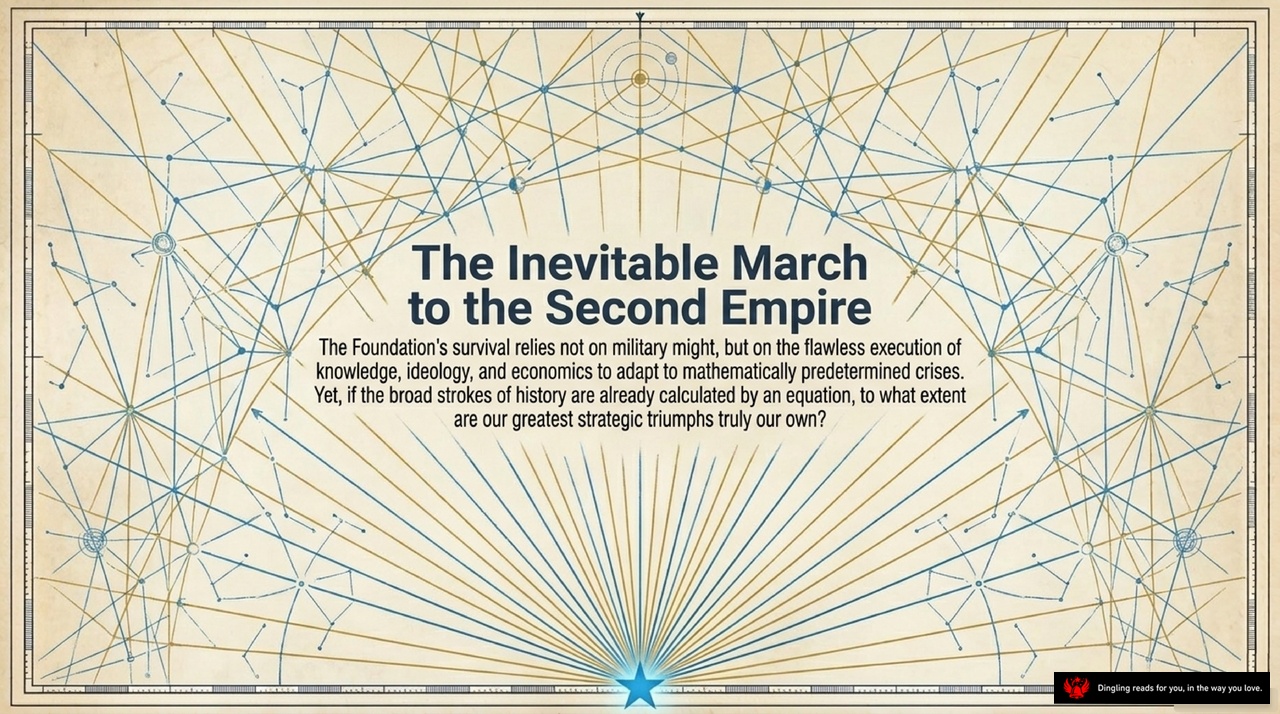
The slide highlights a critical turning point in the Foundation's history: the inevitable march toward the Second Empire. It reminds us that the Foundation's survival never relied on military might, but rather on the flawless execution of knowledge, ideology, and economics to adapt to mathematically predetermined crises. This strategic shift was orchestrated by Hari Seldon, who realized that the collapse of the Galactic Empire was not a random event but a calculable trajectory. By placing ten thousand scientists in a small, isolated world, Seldon aimed to compress a thirty-thousand-year Dark Age into merely a millennium. The image's intricate web of lines symbolizes this complex, interconnected plan where every crisis serves a specific purpose. As we see in the story, whether it's Seldon's initial exile or later leaders like Cavor Hal and Hober Malik navigating political and economic traps, every challenge was a necessary step in this grand equation. The slide asks a profound question: if the broad strokes of history are already calculated by an equation, to what extent are our greatest strategic triumphs truly our own? In the end, the characters believe they are making free choices, but they are actually playing out a script written centuries in advance, guiding humanity safely toward a new golden age.