
Freakonomics: Complete Chapter-by-Chapter Summary

Welcome to Freakonomics: The Complete Collection. This isn't just another economics book; it's a rogue economist's toolkit for seeing the hidden side of everything. Written by Steven D. Levitt and Stephen J. Dubner, this collection strips away the noise to reveal how the world actually works. Forget the abstract charts and complex theories you've heard before. Instead, we're diving into the messy, often surprising reality of human behavior. From the hidden motives behind cheating and the power of information asymmetry to the true drivers of crime rates and the myths of parenting, these pages challenge everything you think you know. It's about understanding the incentives that drive us, the secrets we keep, and the logic behind the chaos. Whether you're curious about why parents name their kids or how real estate agents manipulate deals, this book has the answers. Let's turn the page and discover the truth behind the everyday.

Imagine a funnel where "Conventional Wisdom" pours in—filled with assumptions, emotional biases, and our obsession with proximate causes. But what if we could filter out the noise to reveal "The Hidden Reality"? That's exactly what happens when we apply the logic of *Freakonomics*.
Look at the three layers of this filter. First, we have **Data Verification**. Instead of trusting our gut, we demand hard evidence. Take the famous Israeli daycare experiment: parents were fined $3 for being late. Conventional wisdom says this should reduce tardiness. But the data told a different story—late arrivals doubled. Why? Because the fine replaced a moral cost with a financial one, turning guilt into a paid service. The money didn't stop the behavior; it actually incentivized it.
Next, we move to **Incentive Tracking**. We must ask: what is the real driver here? Is it a noble cause or a hidden reward? Consider blood donation. When small cash incentives were introduced, donations dropped. The incentive transformed an act of altruism into a low-paying job, killing the moral motivation that originally drove people to give. Incentives are powerful, but they can easily backfire if they clash with our deeper values.
Finally, we reach the bottom with **Correlation Severing**. This is where we stop seeing connections that aren't there. We often blame the wrong things for our problems. For instance, we assume stricter gun control or more police officers automatically lower crime rates. But data reveals a more complex truth: the decline in crime in the 90s was largely linked to the collapse of the crack cocaine market, not just policy changes. Similarly, we might blame parenting styles for a child's success, but data shows that peer influence and genetics play a far larger role.
By running our observations through this funnel—verifying the data, tracking the true incentives, and severing false correlations—we stop being victims of conventional wisdom. We stop assuming we know why things happen. Instead, we uncover the hidden reality: the truth about human behavior, often counterintuitive and surprisingly logical.

Today's slide breaks down the three distinct flavors of motivation that drive human behavior: Economic, Social, and Moral. Let's look at the mechanisms behind each. Economic motivation is all about the bottom line—financial gain or loss. The social flavor relies on reputation, shame, and status. Finally, moral motivation taps into our conscience, guilt, and the desire to simply do the right thing.
The real power here lies in the "X-Ray Reveal" examples at the bottom. Consider a $3 sin tax on cigarettes; that's a direct economic hit to the wallet, reducing sales by targeting the cost. Contrast that with banning smoking in restaurants. This leverages public shame and social isolation, appealing to our social need for acceptance. Then there's framing illicit cigarette trades as funding terrorism. This triggers deep moral revulsion, forcing us to confront the ethical cost of our actions.
But here is the critical takeaway from the "Rule of Rogue Economics" at the bottom: a misaligned incentive in one category will inevitably be exploited by another. If you try to solve a problem using only economic tools, you might accidentally destroy the social or moral constraints that were actually holding behavior in check. Understanding how these three forces interact is the key to predicting what people will actually do.

Imagine you're a parent rushing to pick up your child from daycare. You feel a pang of guilt when you're late, a moral cost that weighs on your conscience. But now, picture a rule change: a simple $3 fine for being 10 minutes late. Suddenly, that guilt vanishes. Why? Because the fine transforms your internal moral struggle into an external transaction. You've paid your "penalty," so you've technically bought the right to be late. The psychological burden is gone, replaced by a cold calculation: "I've paid the price, so I'm free to go."
This is the core of Paul Feldman's famous bagel experiment, where he left unmonitored cash boxes with bagels in 140 companies. The result was staggering: 87% of people paid up honestly, even without any surveillance. But here's the twist—when conditions shifted, honesty dropped. Interestingly, the data reveals that bad weather actually reduces payment compliance, as the stress of rain or cold makes people less likely to honor their word. Even more shocking is the "Executive Illusion": higher-ranking executives cheated significantly more than lower-level employees. This suggests that privilege, not morality, often drives dishonesty.
The experiment proves a counterintuitive truth: human nature is inherently honest. We don't need economic threats or constant surveillance to do the right thing. Our moral compass works best when we feel personally responsible, not when we can simply buy our way out of our mistakes. When we replace moral motives with economic ones, we don't just change behavior; we dismantle the very integrity that holds our society together.

Look at this seesaw. On one side, we have "The Expert," sitting heavy with hoarded data and specialized knowledge. On the other, "The Consumer," who feels lighter but is desperate to catch up. This imbalance is the currency of information asymmetry.
For decades, experts held an artificial monopoly on truth. They knew the market rates, the hidden costs, and the real value of a product, while consumers were left guessing. This gap created power. But then came the great equalizer: the Internet. Suddenly, sunlight and data transparency flooded the market. You can now compare insurance quotes in seconds or check a car's true value instantly. The expert's monopoly is crumbling.
However, the game isn't over. While the Internet levels the playing field, it hasn't eliminated the incentive to cheat. Experts are still human, and they respond to incentives. When business slows down, a mechanic might suggest unnecessary repairs, or an obstetrician might push for more C-sections. Why? Because their compensation is tied to the volume of services, not the patient's actual needs.
Even in the housing market, where information is supposed to be king, agents manipulate the flow. They might tell a seller their house is undervalued to push a quick sale, while telling a buyer the seller is desperate to accept a low offer. They know that selling a client's house quickly for less money yields them the same commission as selling it slowly for a higher price. They hoard the best data to keep you in the dark, just as they did before the Internet.
So, the lesson here is clear: Information asymmetry is a powerful tool. The Internet gives us the weapons to fight back, but it doesn't remove the temptation to exploit the remaining gaps. True transparency requires not just data, but the courage to share it honestly.

Hoarded Information as a Weapon. This slide brilliantly compares two very different groups: the Ku Klux Klan and modern real estate agents. At first glance, one is a violent historical terrorist group, and the other is a legitimate profession. But the underlying logic is strikingly similar.
Look at their goals. The KKK wanted to maintain social terror and mystique. Real estate agents want to maximize their commission with minimal extra effort. Now look at their weapons. The KKK used secret handshakes, passwords, and hidden rituals. Real estate agents use exclusive access to housing data, market trends, and buyer psychology. In both cases, power comes from keeping information hidden.
Who are the victims? For the KKK, it was minorities and the public kept in fear of the unknown. For home sellers, it's people convinced they cannot navigate the market alone. Finally, look at how this dynamic was defeated. Stetson Kennedy exposed the KKK's secret passwords on a national radio show, turning fear into mockery. Similarly, public real estate databases now expose historical pricing, destroying the agent's monopoly on data. The lesson is clear: when you hoard information to create an advantage, the moment that secret is revealed, your power collapses.
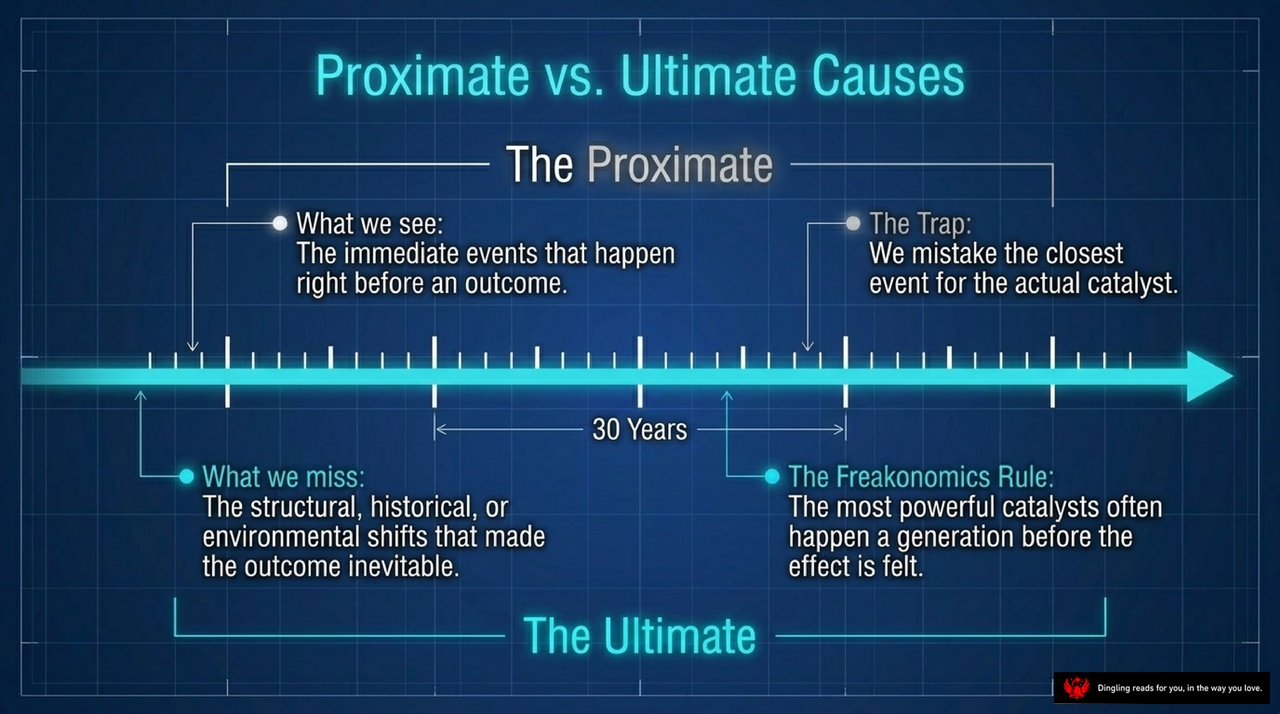
Have you ever wondered why some people cheat, not because they lack morals, but because the rules themselves invite it? In Freakonomics, we peel back the layers to reveal that cheating is often just a rational response to hidden incentives.
Consider the infamous Israeli daycare experiment. Parents were already running late, driven by a sense of guilt and a moral obligation to keep their promises. But when the daycare introduced a $3 fine for being more than 10 minutes late, something strange happened: tardiness doubled. Why? Because the fine replaced a moral cost with a financial one. Suddenly, being late wasn't a betrayal of trust; it was just a service you could purchase for three dollars. The guilt vanished, replaced by a simple calculation: "I paid my fee, so I can leave whenever."
This is the core lesson of the "proximate versus ultimate causes" trap. We often mistake the immediate event—the $3 fine—for the real catalyst. But the ultimate cause was the destruction of the parents' internal moral compass. The fine didn't just punish the behavior; it destroyed the very constraint that kept them honest in the first place. When the fine was lifted, tardiness didn't drop back to normal because the moral lesson had already been lost.
The same logic applies everywhere. When you pay a child to do their homework, you might think you're encouraging good habits. But you've actually turned a moral duty into a wage-earning job, often reducing their intrinsic motivation. Or when a company rewards employees with bonuses for honesty, they might just start lying to get the bonus.
Freakonomics teaches us to look past the obvious trigger and ask: What deeper shift made this behavior inevitable? It's not about judging people as good or bad. It's about understanding how our environment—whether it's a daycare, a school, or a market—shapes our choices. By seeing the invisible hand of incentives at work, we can stop being surprised by human behavior and start designing systems that actually work.

Look at this tree. Above the surface, we see the common excuses for the drop in US crime during the 1990s: strict gun control, a booming economy, and more police. The graphic marks these with big pink X's, telling us they are red herrings. Gun laws mostly punish law-abiding citizens while criminals buy from the black market; economic cycles don't strongly correlate with violent crime; and while more prisons reduce the short-term supply of criminals, they fail to break the generational pipeline that creates them.
But the image reveals the real story in the roots. The hidden driver was the 1973 Roe v. Wade decision. By legalizing abortion, millions of children who would have been born into poverty, broken homes, and abusive environments never came into existence. These were precisely the demographic conditions most likely to produce violent criminals. Because these potential offenders were never born, the crime rate plummeted two decades later. This isn't about policing or economics; it's about the long-term demographic shift caused by that specific legal mechanism. The crime drop wasn't a policy success; it was a demographic consequence.

Have you ever wondered why the most glamorous jobs often pay the least, while the most dangerous ones command the highest salaries? It sounds counterintuitive, but this chart reveals the hidden logic of the labor market.
On the left, we see jobs with high supply and low skill. The rule is simple: if anyone can do the job, wages trend toward zero. This applies regardless of how dangerous or illegal the work might be. The insight here is that glamour and prestige actually lower wages. Why? Because an oversupply of people is willing to work for the status alone, flooding the market and driving pay down.
Now, look at the right side. Here we have low supply and high skill. The rule flips completely: if the required skill is rare or demand is highly concentrated, wages spike exponentially. The insight is that mundane but highly specialized jobs command massive premiums that dangerous but common jobs simply cannot match.
So, the key takeaway isn't about the danger of the job, but the scarcity of the skill. Specialization is the true driver of wealth in the modern economy.
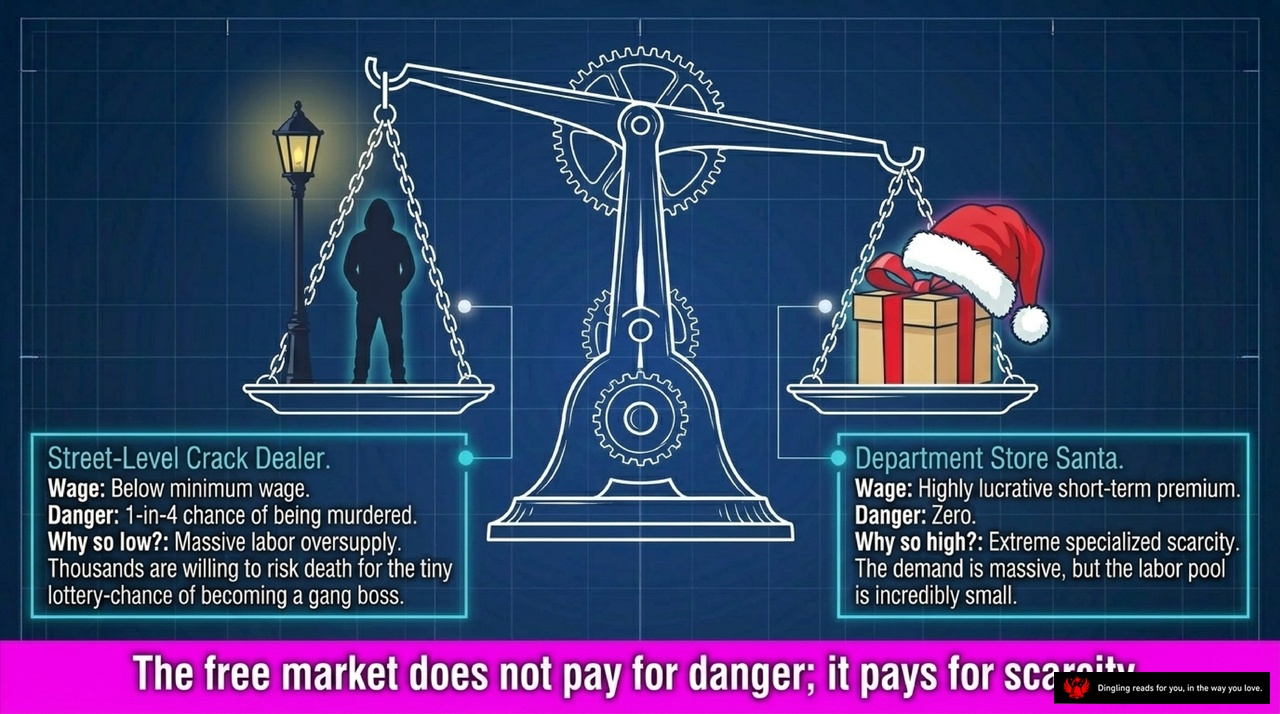
Imagine a giant scale balancing the life of a street-level drug dealer against a Department Store Santa. On one side, you have a hooded figure standing under a lonely streetlamp. The wage here is below minimum wage, and the danger is terrifying—a 1-in-4 chance of being murdered. Why is the pay so low? Because there is a massive oversupply of people willing to risk their lives for a tiny lottery chance of becoming a gang boss.
On the other side of the scale sits a Santa Claus with a gift box. The wage is highly lucrative, offering a short-term premium, while the danger is zero. Why is the pay so high? Because of extreme specialized scarcity. The demand is massive, but the pool of people willing and able to do this specific job is incredibly small.
This visual perfectly captures the core truth of the free market: it does not pay for danger; it pays for scarcity. If you are dangerous but common, you are cheap. If you are safe but rare, you are priceless. This logic explains everything from why the most dangerous jobs in the world pay the least, to why a holiday helper can earn more than a criminal. It's not about the risk you take; it's about how hard it is to find someone who can do the job without taking that risk.

Imagine you're standing at the entrance of a locked door. On one side, you have the "Conventional Limit"—the mindset of accepting the rules as they are. It's the trap of asking, "How can I do this slightly better, but exactly the same way?" This approach leads to marginal, incremental improvements, constantly fighting against a hard physical ceiling. It's about optimizing the game without questioning the board itself.
But look at the other side: "The Boundary Repositioning." This is where true breakthroughs happen. Instead of accepting artificial limits created by history or tradition, you ask a different question: "What is the fundamental mechanic here, and how can I bypass it entirely?" By ignoring the invisible walls we've built around ourselves, we stop trying to climb the mountain and instead find a way to fly over it. The result isn't just a little bit faster; it's an exponential breakthrough that shatters existing records.
The central image of this slide is a padlock. In the conventional view, that lock represents the problem we must solve within the given parameters. But in the boundary repositioning mindset, that lock is an illusion. We often mistake the constraints of the game for the game itself. When you redefine the problem, you realize that many of the obstacles you face aren't real barriers; they are just boundaries we've drawn for ourselves. True innovation doesn't come from working harder within the box, but from realizing the box doesn't exist in the first place.

Imagine a graph that doesn't just show a limit, but shows a breakthrough. On the left, you see the "Conventional Limit Curve," where the world record for hot dog eating hovers stubbornly around 25. This is the old way: the question was simply, "How do I fit more food in my stomach faster?" The strategy was to eat like a normal person, just quicker. But the barrier was biological and psychological—the brain signals fullness, and the throat physically refuses to swallow more.
Then, look at the sharp spike on the right: the "Redefined Problem Curve," soaring past 50 hot dogs. This is the moment Takeru Kobayashi changed everything. He asked a completely different question: "How do I make this mass easier to ingest?" Instead of fighting his biology, he treated eating like a physics and engineering problem. His strategy was simple but brilliant: snap the hot dog in half, cut the bun in half, and dunk the bread in warm water to soften it. By reframing the challenge from a biological endurance test to an engineering optimization task, he didn't just break the record; he doubled it in a single year. This illustrates a powerful truth: when you stop trying to work harder within the old rules and instead redefine the problem itself, you can achieve results that were once thought impossible.

So, let's design the perfect trap to finally separate the innocent from the guilty. The problem we face is a "pooling equilibrium"—a messy situation where everyone looks the same, making it impossible to tell who is honest and who is lying.
To fix this, we need a three-step process. First, we take our input: a mixed pool of honest and dishonest actors. You can't just ask them a normal question; they will all give you the same, safe answer.
So, step two is the engine—the trap itself. We need to introduce a bizarre, specific, or extreme condition that only makes sense if you truly care about the core truth. Think of King Solomon's famous test: cutting a baby in half. Only a real mother would beg to spare the child; a liar wouldn't hesitate. Or look at the Van Halen example: removing all the brown M&Ms from a backstage gift. Only a diligent promoter who actually cares about the details will notice and remove them. A lazy liar will trip the wire and leave them behind.
Finally, step three is the reveal. The honest actor, driven by their core values, will pass the test. The liar, trying to cut corners, will fail. By creating a situation where the cost of lying is too high or the reward for honesty is too specific, we force the truth out. It's not about asking "Are you guilty?" It's about creating a scenario where only the innocent can survive.

Imagine you're a real estate agent, and you have a choice: sell your own house or sell a client's house. Which one do you prioritize? If you're purely rational, you might think, "I should get the highest price possible." But the data tells a different story. When agents sell their own homes, they list them for an average of 10 days longer and secure a price 3% higher than market value. But when selling a client's home? They rush the deal, often pushing the price down, just to close the transaction and pocket their commission faster. Why? Because the math is simple: selling a $100,000 house 10 days sooner might only earn an agent an extra $1,500, but it frees them up to close another deal. This isn't about malice; it's about incentives.
This is the power of information asymmetry. The agent knows the true market value and the urgency of the seller, while the seller is often flying blind. They might hear phrases like "the market is cooling" or "this is the best offer you'll get," which are just tactics to lower expectations. Even in the digital age, where we have access to data, this gap persists. Agents use their expertise to interpret information in ways that favor a quick sale, leaving the seller to wonder why their property isn't selling at the price they thought was fair.
It's a classic trap. We often assume that experts are working in our best interest, but their financial incentives can quietly steer outcomes away from what's objectively best for us. Whether it's a house sale, an insurance policy, or even a job interview, understanding these hidden motivations helps us see through the noise. The real lesson here isn't to distrust everyone, but to recognize that every transaction is a negotiation of information. When you know who holds the cards, you can make smarter choices and avoid getting left on the table.
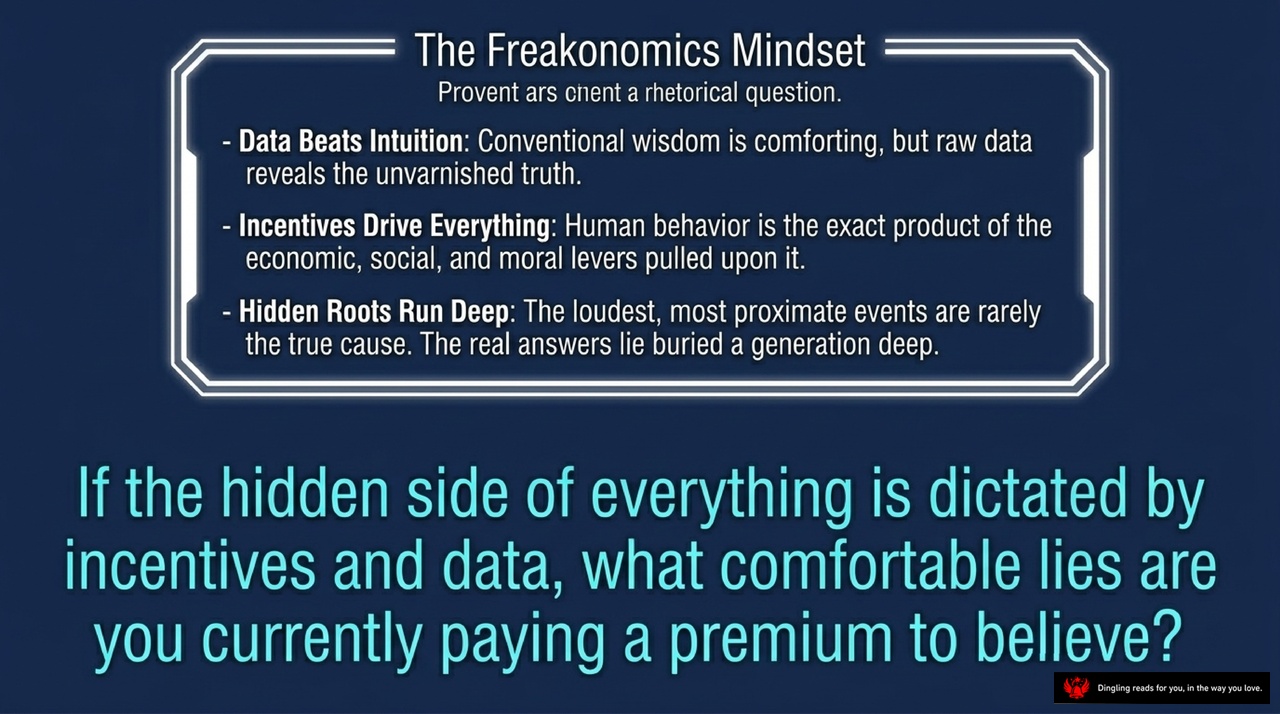
Imagine a world where the loudest explanations we hear are often just surface-level distractions, hiding the true drivers of human behavior. This is the essence of the Freakonomics mindset. It teaches us that data consistently beats our gut intuition; while conventional wisdom feels comforting, raw numbers reveal the unvarnished truth we need to see.
Consider the concept that incentives drive everything. Human behavior isn't random; it is the exact product of the economic, social, and moral levers being pulled on us. When we understand this, we see that the hidden side of everything is dictated by these forces.
Furthermore, we must remember that hidden roots run deep. The events that seem most obvious and proximate are rarely the true cause. The real answers lie buried a generation deep, often requiring us to look past the immediate chaos to find the structural forces at play.
So, if the hidden side of everything is dictated by incentives and data, what comfortable lies are you currently paying a premium to believe? It is time to stop trusting our instincts and start trusting the evidence.