
Free to Choose: Complete Chapter-by-Chapter Summary
Ever wondered what’s the secret to a thriving, free society? Today we’re starting our journey through Free to Choose—Milton and Rose Friedman’s iconic work that connects economic freedom directly to human liberty.
The Friedmans make a powerful case: the market’s “invisible hand” isn’t just an economic theory—it’s the engine that lifts people up, far better than the heavy, top-down hand of government control. This book isn’t just about numbers; it’s about how the choices we make (and let markets make) shape our freedom and prosperity. Let’s dive in to explore their timeless insights.
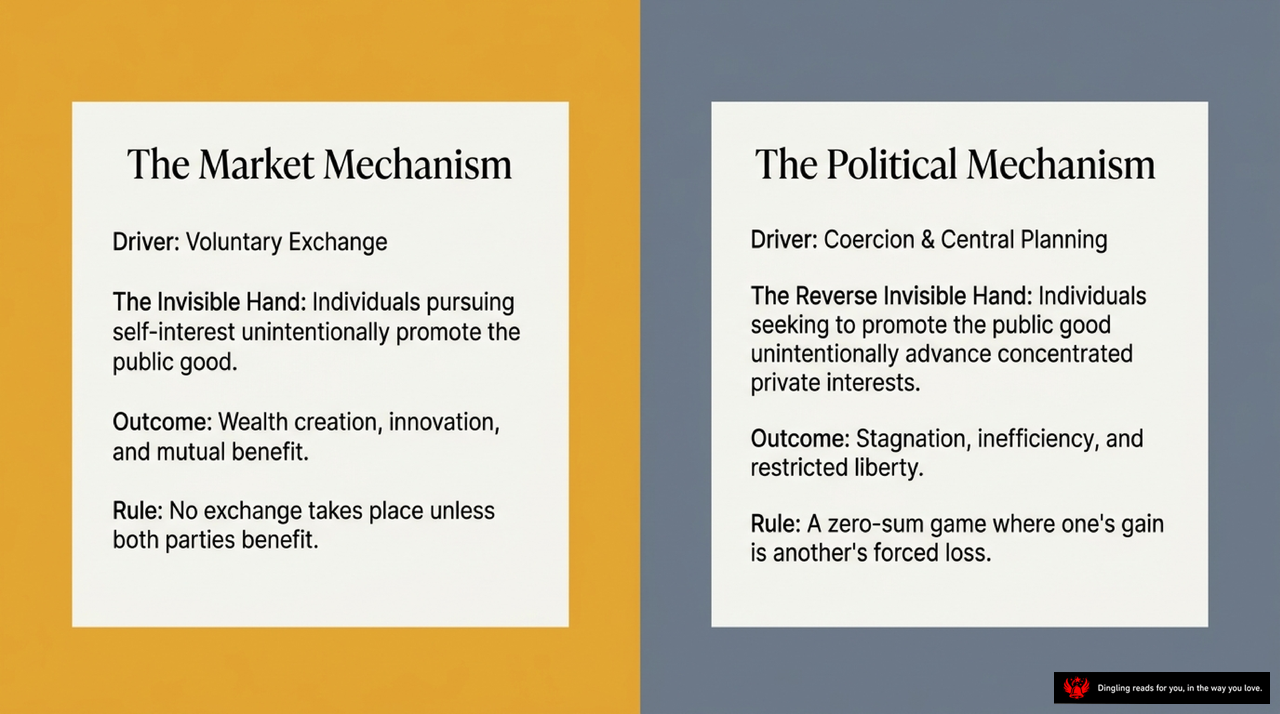
Let’s take a look at the two sides of this slide—they lay out the core differences between how free markets and central planning organize economic life.
First up, the Market Mechanism. Its engine is voluntary exchange—people trade because both sides think they’re getting a good deal. Adam Smith’s famous invisible hand is what makes this tick: when individuals chase their own self-interest (like a farmer selling crops to make money, or a factory worker making parts to get paid), they end up unintentionally benefiting everyone. Think about the pencil story: no one person knows how to make a pencil from start to finish, but thousands of people across the globe—cutting cedar in California, mining graphite in Sri Lanka, shaping brass in a foundry—collaborate without any central boss. They do it for their own gain, but the result is a pencil you can pick up at the store. The rule here is simple: no exchange happens unless both parties win. That’s why free markets lead to wealth creation, innovation, and mutual benefit—just look at those Soviet farmers with tiny private plots (only 1% of the land) who produced a third of the country’s farm output.
Now the Political Mechanism. This one runs on coercion and central planning—top-down orders from the government. Here, there’s a reverse invisible hand: when people try to plan the economy to help the public good, they often end up helping small, powerful groups instead. The outcomes are stagnation, inefficiency, and restricted liberty. The rule here is zero-sum: one person’s gain comes from someone else’s forced loss. For example, the Soviet Union’s state farms had all the resources but were so inefficient that the country depended on those small private plots. Or Cambodia’s tragedy when they tried to eliminate markets entirely—total disaster.
These two systems couldn’t be more opposite, and their results speak for themselves: free markets build prosperity, while central planning leads to decline.
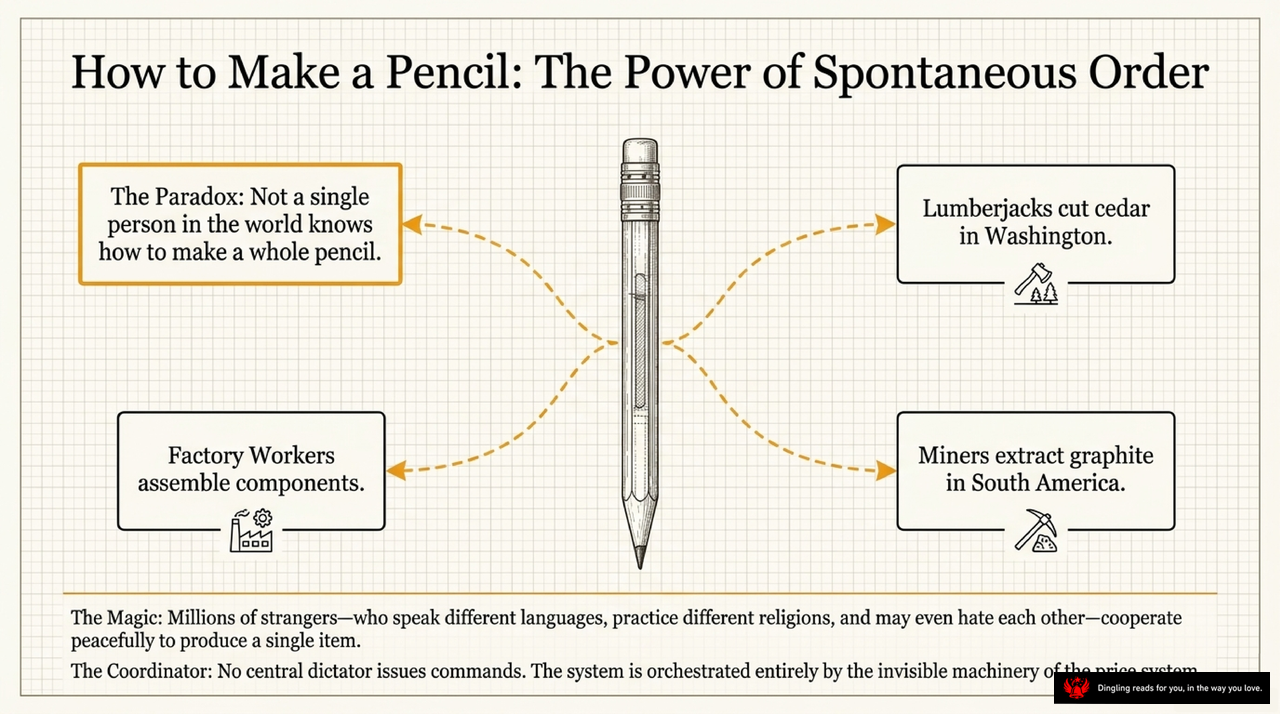
Have you ever held a simple pencil and thought: how does this tiny thing come into being? Here’s a mind-blowing fact—no single person on Earth knows how to make a complete pencil from start to finish. Let’s unpack it: the wood is cedar from Northern California, cut by lumberjacks who might never see the final product. The graphite core? Mined in Sri Lanka, then processed through layers of refinement. The brass ferrule holding the eraser? Made from copper and zinc sourced from different corners of the globe. The eraser itself? Its rubber could come from Southeast Asia, blended with chemicals from elsewhere. Thousands of people are involved—farmers, miners, factory workers, truck drivers—most of whom don’t know each other, don’t understand the full purpose of their work, yet they all collaborate to create that pencil in your palm.
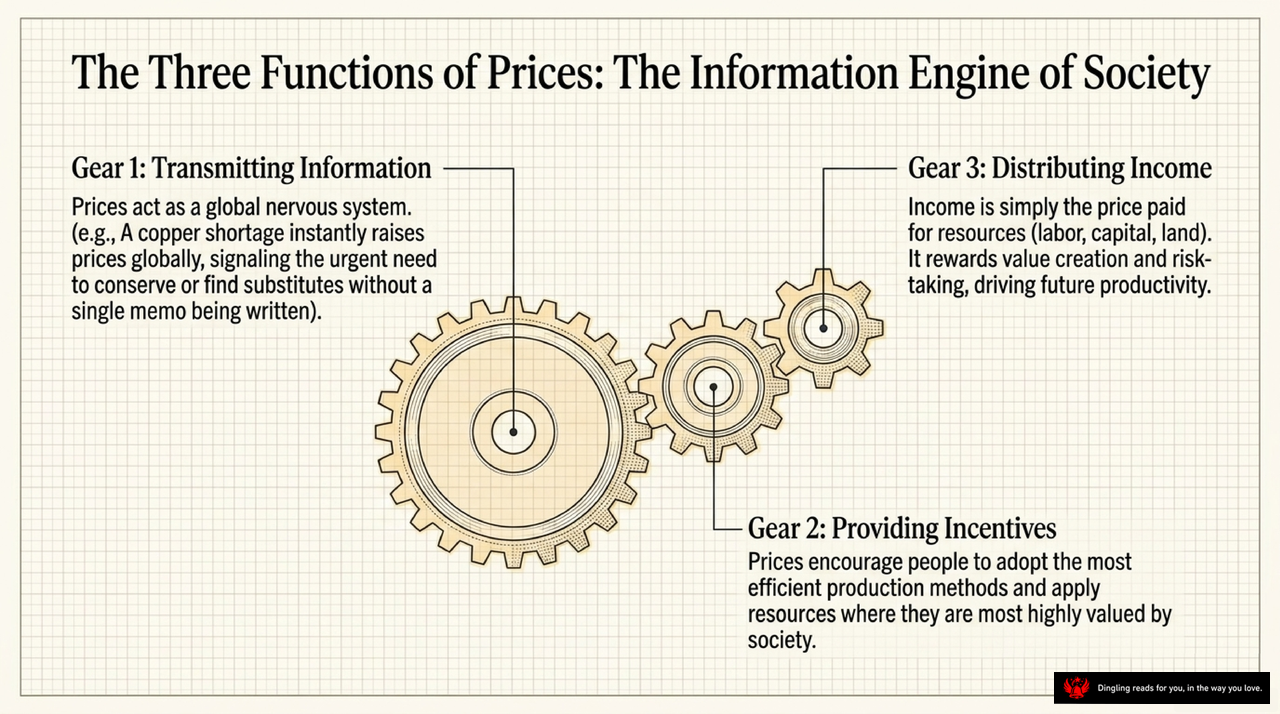
How does this magic happen without a central authority dictating every step? Adam Smith’s answer from two centuries ago still holds: the price system. It’s the invisible hand coordinating all these scattered efforts. Suppose demand for pencils rises—retailers order more from wholesalers, who then ask factories for more. Factories need more raw materials, so they offer higher prices for cedar, graphite, etc. Those higher prices send a clear signal: “Produce more!” And since everyone wants to maximize their gains, they find the most efficient, cost-effective ways to do so.
But when we interfere with this system—like government price controls—chaos ensues. Remember the U.S. oil embargo? The government capped oil prices, leading to long lines at gas stations. Why? Because the price couldn’t signal scarcity, so no one had an incentive to conserve or increase production. Meanwhile, Germany and Japan, which let prices adjust freely, avoided those lines entirely.
Next time you pick up a pencil, remember: it’s more than just wood and graphite. It’s a living example of voluntary exchange and the power of the price system—proof that when people are free to trade and respond to market signals, incredible things can happen without anyone pulling the strings.
Let’s be real—most of us want to help people who are struggling. But have you ever stopped to think why so many welfare programs don’t actually work? The book we’re discussing today breaks it down perfectly, and it all comes down to how the money is spent.
There are four ways to spend money, right? If you’re spending your own cash on yourself, you’re careful—you want the best value for your dollar. If you spend your own money on someone else, you’re still thrifty but might miss what they really need. But here’s the problem with most welfare: it’s the third or fourth type—spending other people’s money on others. A bureaucrat handling a welfare check? They don’t care about saving money, and they don’t know the recipient’s real needs. So the money gets wasted on red tape instead of helping those who need it.
Take Social Security. We’re told it’s a trust fund, but that’s a myth. It’s pay-as-you-go—today’s workers pay for today’s retirees. Back in 1950, 17 workers supported one retiree. By 1970, it was 3. Now? It’s even fewer. That’s a ticking time bomb. And the system is unfair: low-income workers pay a higher share (since it’s a regressive tax), and some people get benefits they don’t need while others struggle.
Public aid is no better. There are hundreds of overlapping programs, costing billions, but most of the money goes to bureaucrats, not the poor. Housing programs often backfire too—public housing becomes slums, and urban renewal projects displace the very people they’re supposed to help.
But there’s hope. The book suggests a negative income tax: if you earn below a certain amount, the government tops you up. It’s simple, incentivizes work (since you keep more of what you earn), and cuts through the bureaucracy. For Social Security, we could abolish the payroll tax, let current retirees keep their benefits, and let workers save for their own retirement with personal accounts.
These ideas make sense, but political hurdles are real. Still, as more people see the flaws in the current system, change might be on the horizon. After all, the goal should be to help people get back on their feet—not trap them in a cycle of dependency.
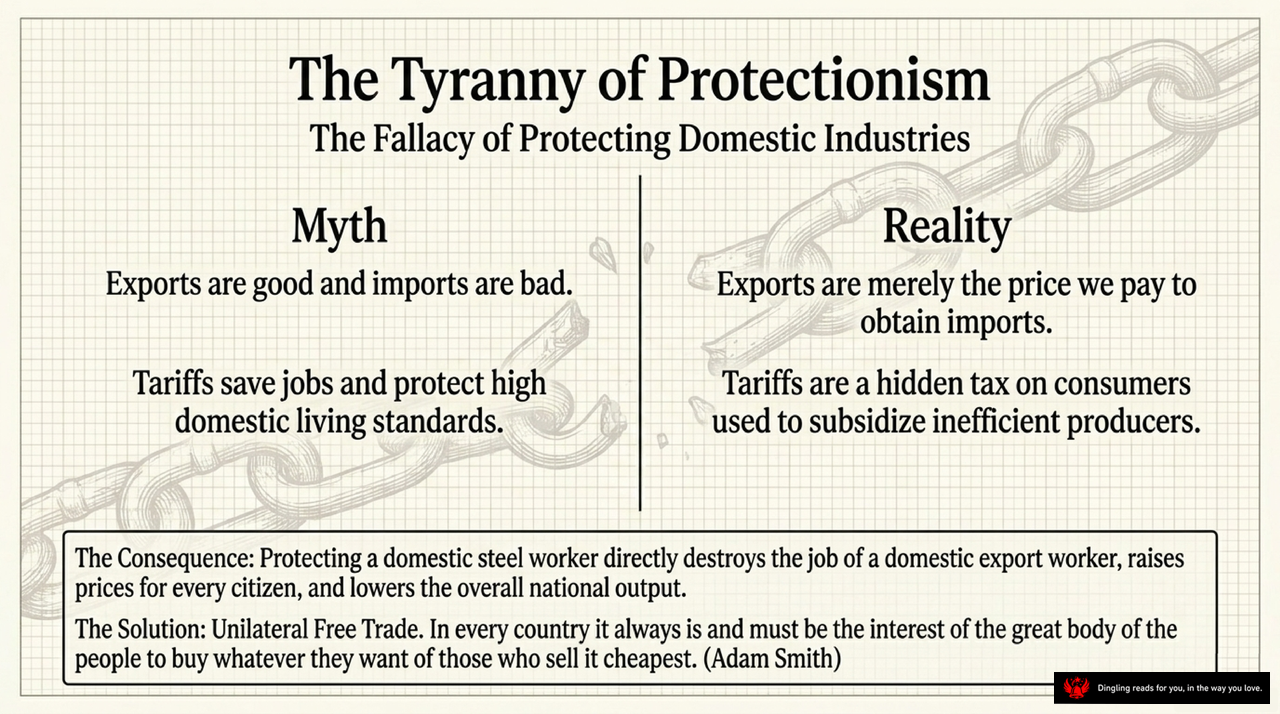
今天我们来聊聊“保护主义的暴政”——也就是保护国内产业这一说法背后的谬误。
首先,我们来打破几个常见的迷思。第一个迷思:出口是好事,进口是坏事。但事实正好相反——出口不过是我们为了获得进口商品而付出的代价。想想看,我们把商品卖到国外,不是为了单纯地输出,而是为了换回我们需要或想要的东西,无论是巴西的咖啡还是日本的汽车。
第二个迷思:关税能保住工作岗位,保护国内的高生活水平。但真相是:关税是对消费者的隐性税收,用来补贴那些效率低下的生产者。举个例子,如果我们对外国钢铁征收关税来保护本地钢铁工人,会有什么后果?这会直接摧毁我们出口行业的工作岗位——因为其他国家会报复性地对我们的商品征收关税。而且,我们每个人都会为钢铁制品支付更高的价格,从汽车到家电,整体国民产出也会下降。
那么,解决方案是什么?单边自由贸易。正如亚当·斯密所说:“在每个国家,购买那些售价最便宜的商品,无论其来自国内还是国外,始终是且必须是广大民众的利益所在。”这意味着即使其他国家有关税,我们也应该开放市场。为什么?因为这对我们有利——我们能得到更好、更便宜的产品,经济会变得更高效,长期来看还能创造更多就业机会。
保护主义表面上看起来是在帮忙,但实际上是一种暴政,伤害了我们所有人。通往繁荣的道路,从来都是自由贸易。
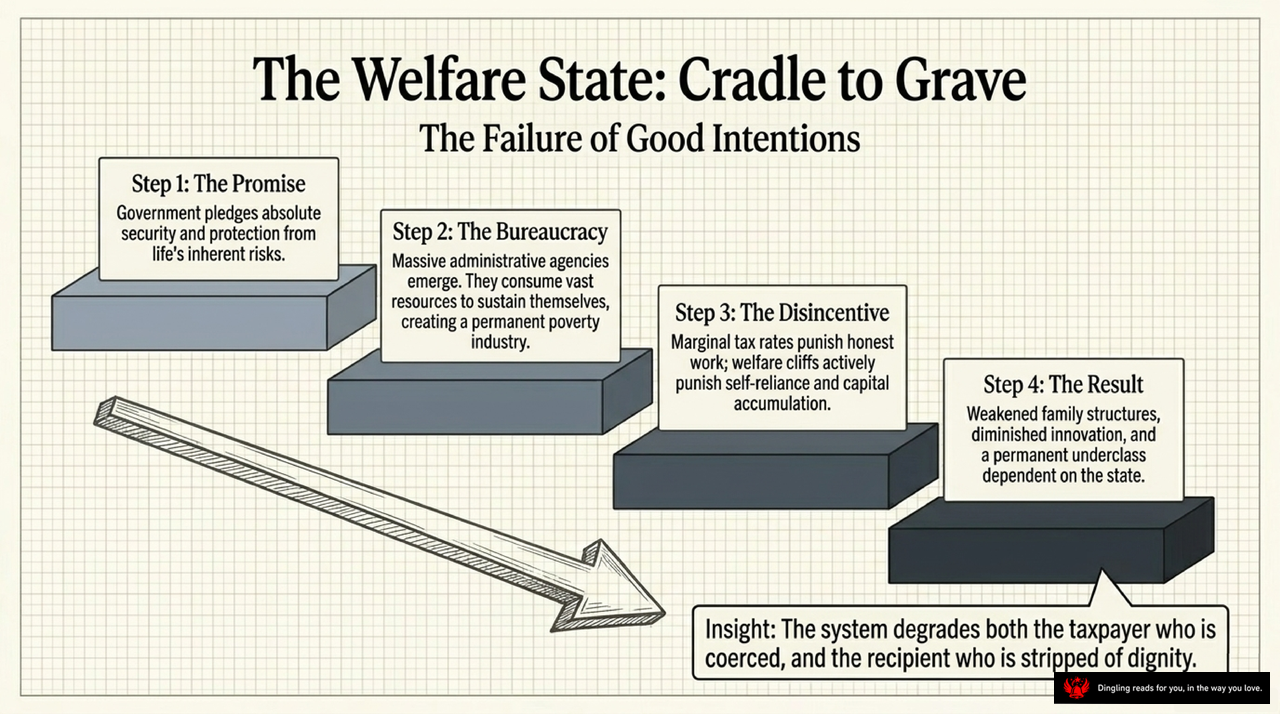
Let’s start with that initial promise—you know, the government saying they’ll have your back from cradle to grave, right? They pledge absolute security, no more stress about life’s inherent risks. Sounds nice, but here’s what actually happens.
First, those massive bureaucratic agencies pop up. They don’t just help people—they gobble up resources just to keep themselves running. Think about all those federal welfare programs: hundreds of them, overlapping, and most of the money never even reaches the poor. It goes to bureaucrats with fat salaries or folks who game the system, not the families that really need it.
Then come the disincentives. Marginal tax rates punish you for working hard—earn a little extra, and suddenly you’re in a higher bracket. And those welfare cliffs? Make one more dollar, and you lose your benefits entirely. Why bother saving or trying to get ahead if it doesn’t pay off? It kills self-reliance and stops people from building capital.
The end result? Weakened family structures, less innovation, and a permanent underclass stuck depending on the state. Look at places like New York City—all those welfare policies led to a fiscal crisis, or the UK’s NHS where people wait years for surgeries.
And here’s the tough truth: this system drags everyone down. Taxpayers are forced to shell out more, and the people getting help? They lose their dignity, trapped in a cycle they can’t break. Good intentions don’t always lead to good outcomes—this is the failure of trying to control every part of life from the top down.
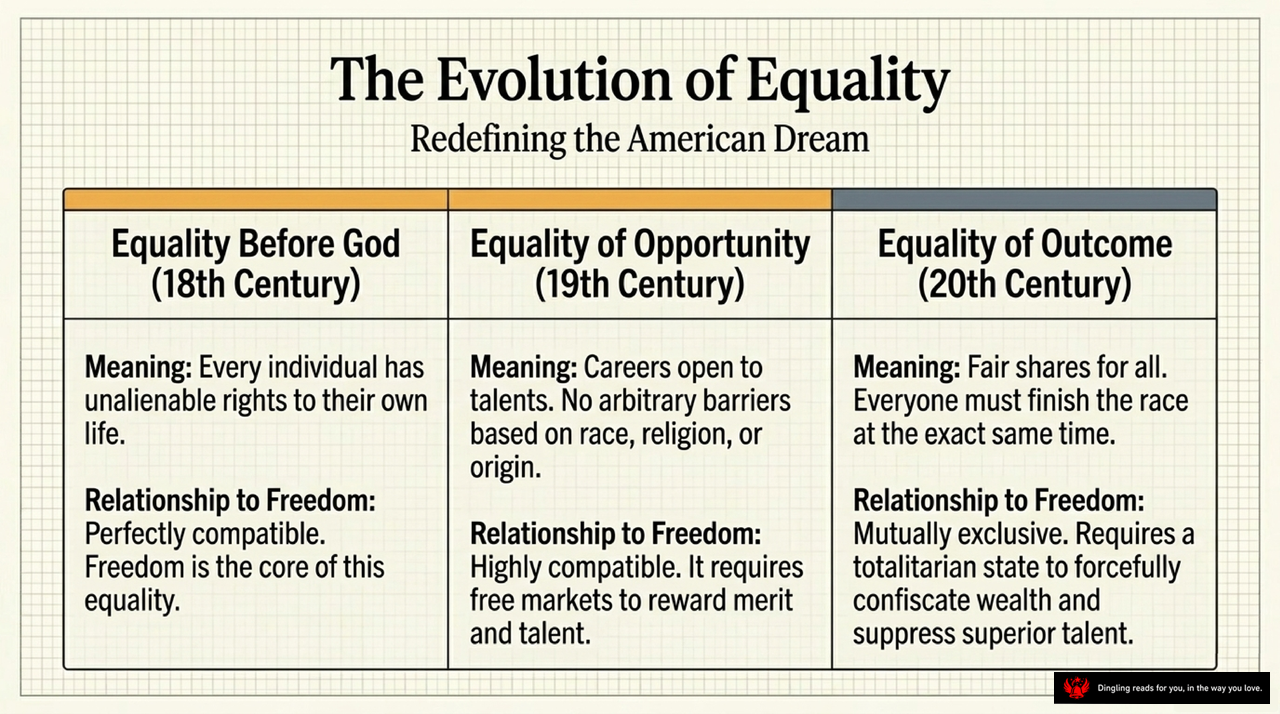
Let’s dive into how our understanding of equality has evolved over the centuries—because it’s a story that’s shaped America’s identity. The slide here outlines three key phases, each with its own take on what equality means and how it interacts with freedom.
Starting in the 18th century: Equality Before God. This was the idea that every individual has unalienable rights to their own life—think the Declaration’s promise of life, liberty, and the pursuit of happiness. This equality was perfectly compatible with freedom; in fact, freedom was the heart of it. It meant no one could be arbitrarily denied their right to choose their own path.
Then, the 19th century brought Equality of Opportunity. After the Civil War abolished slavery, this idea took root: careers open to talent, no barriers based on race, religion, or origin. This was still highly compatible with freedom—it relied on free markets to reward merit and hard work. It let people climb the ladder based on what they could do, not their background.
But the 20th century introduced a different concept: Equality of Outcome. This is about fair shares for all—everyone finishing the race at the exact same time. But here’s the problem: this equality is mutually exclusive with freedom. To make everyone end up equal, you need a totalitarian state to forcefully confiscate wealth and suppress superior talent. It’s a trade-off: you can have equal outcomes, or you can have freedom—but not both.
This isn’t just theoretical. When we push for outcome equality, we disincentivize hard work and innovation. When we focus on opportunity and individual rights, we get a society where people can thrive, and equality becomes something earned, not enforced. That’s the difference between a society that grows and one that stagnates. It’s a choice we’re still grappling with today.
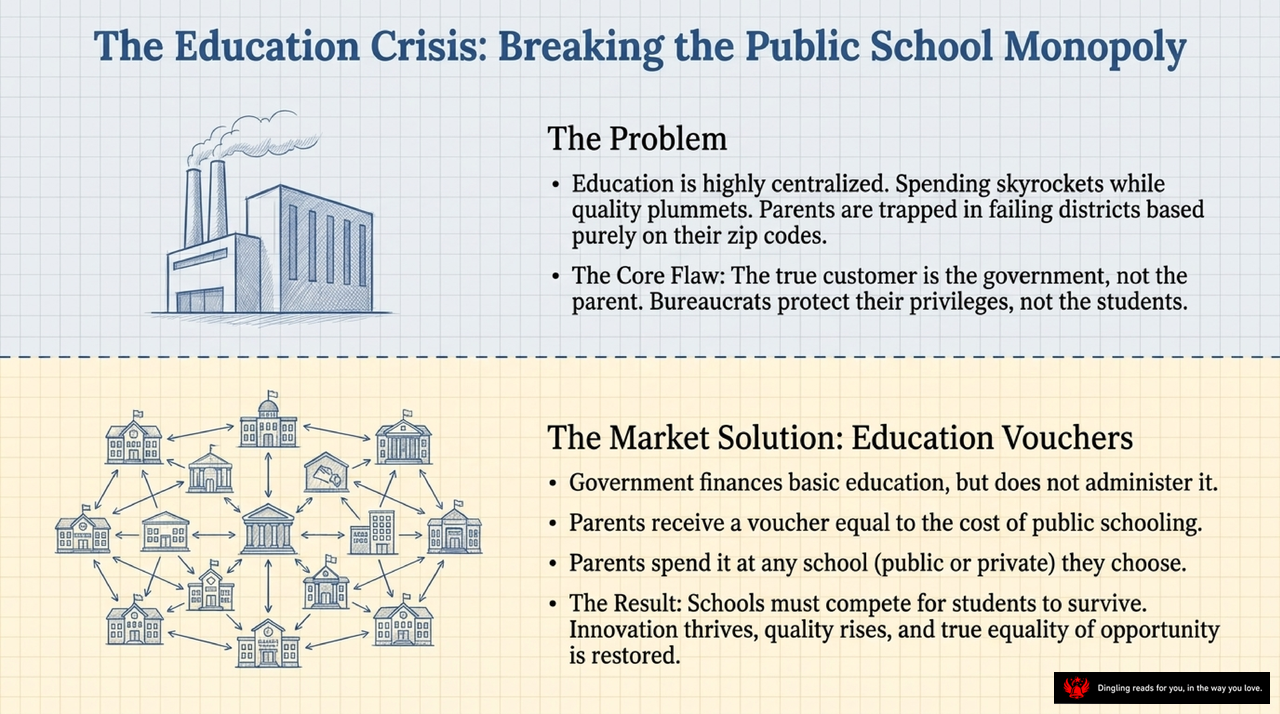
Today we’re diving into “The Education Crisis: Breaking the Public School Monopoly”—and a solution that could change everything for our kids.
Let’s be real: How many of us have stared at our child’s report card or heard about safety issues at their school and thought, “There’s got to be a better way”? The problem is our education system is way too centralized. We’re spending more money than ever, but test scores keep dropping, and too many kids are stuck in failing schools just because of their zip code. Why? The core flaw here is that the real customer of our schools isn’t you or me—it’s the government. Bureaucracies care more about protecting their own rules and jobs than about what our kids actually need.
Now, the market solution: Education vouchers. Here’s how it works: The government still funds basic education, but it doesn’t run the schools. Instead, parents get a voucher equal to what the public school would cost per student. Then we can use that voucher at any school—public, private, whatever fits our child’s unique needs.
What happens next? Schools have to compete for students to survive. Suddenly, they’re incentivized to innovate, improve quality, and listen to parents. Think about Harlem Prep back in the day: Parents and teachers started it with no fancy funding, and it turned around dropout rates for kids who’d given up on school. But when the bureaucracy took over, it lost its magic. Vouchers would bring that magic back.
The result? True equality of opportunity. No more being trapped by where you live. Every parent gets to choose the best school for their child, and every school has to step up. That’s how we fix our education system—by putting parents in charge, not the government.
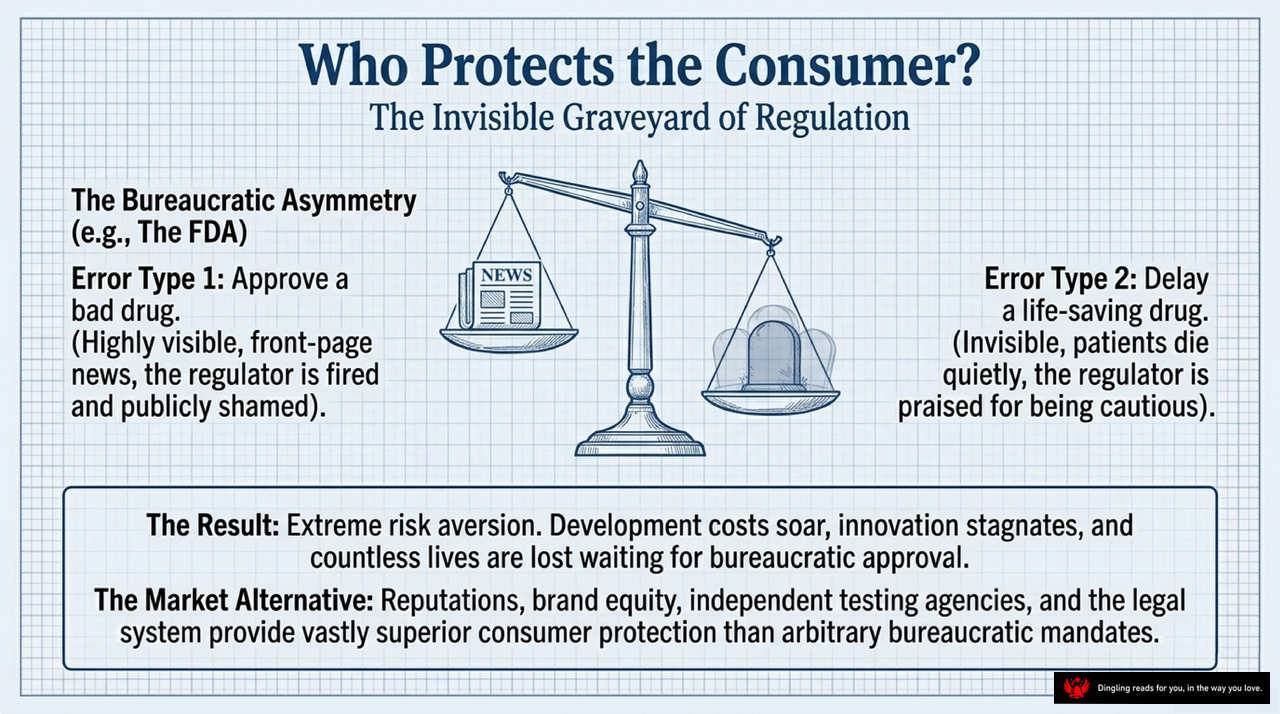
Let’s start with a question that hits close to home: Who truly protects you when you buy a drug, a toy, or any product? Is it the government regulators we’re told to rely on, or is there a more effective force at play?
Take the FDA as an example. Regulators here face a lopsided dilemma—what we call “bureaucratic asymmetry.” If they approve a drug that turns out harmful, it’s front-page news: headlines scream, careers end, public trust collapses. But if they delay a life-saving drug? The patients who die waiting are invisible. No cameras follow their families, no headlines demand accountability. In fact, regulators are often praised for being “prudent” or “careful.”
This imbalance pushes regulators to extreme risk aversion. They make drug companies spend years on extra trials, fill mountains of paperwork, and wait months (or even years) for approval. Drug development costs skyrocket—sometimes to billions of dollars. Innovation slows because companies fear taking risks. Worst of all, countless lives are lost waiting for treatments already available in other countries.
But here’s the good news: The market itself offers a far better solution for consumer protection. Brands build reputation over decades—Apple or Toyota can’t afford unsafe products, as customers will flee to competitors. Independent testing agencies like Consumer Reports do rigorous checks with no political pressure. And the legal system? If a company harms you, you can sue, forcing them to prioritize safety.
These market forces are dynamic and responsive, adapting quickly to new risks—unlike slow bureaucracies. So next time you wonder who’s looking out for you, remember: The invisible hand of the market often does a more effective job than overregulation that costs lives and stifles progress. It’s not perfect, but it’s far better than the alternative.
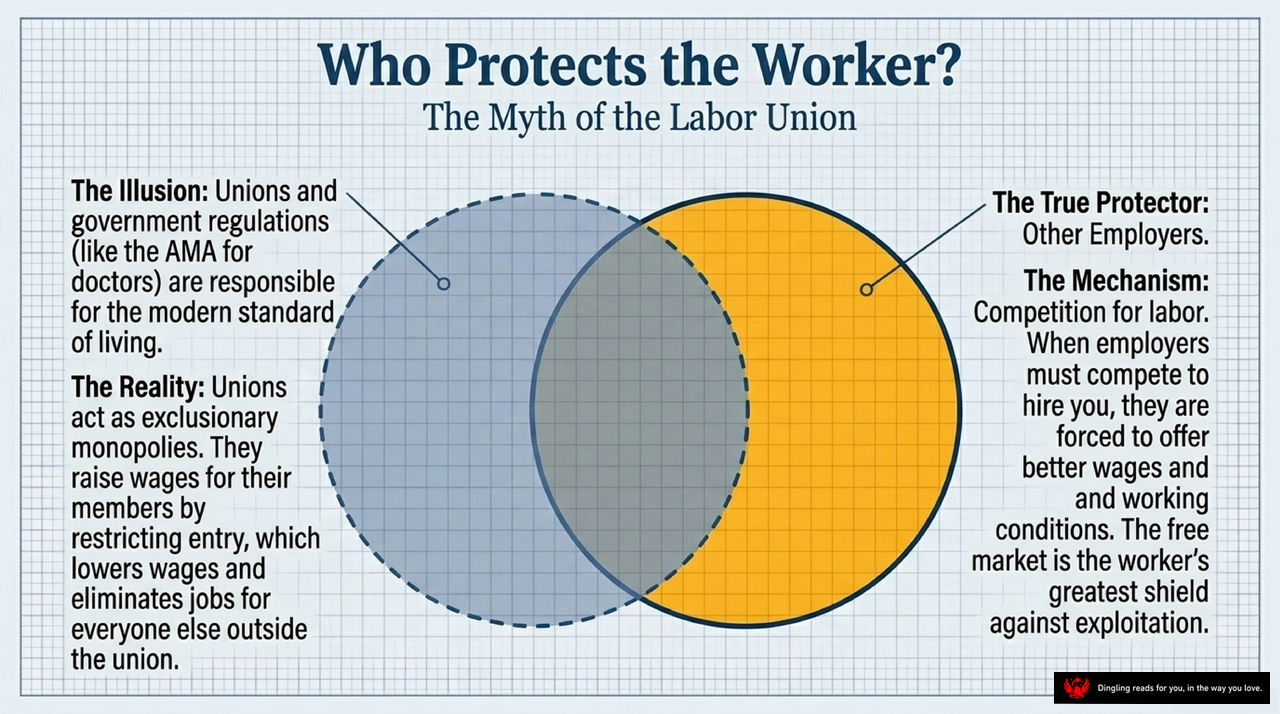
Who do you think really looks out for workers? If you asked most people, they’d probably say labor unions or government regulations—like the ones that set minimum wages or safety standards. That’s the common illusion we often hear about, right? But let’s take a closer look at what the data and real-world examples tell us.
Unions do help their members get higher wages, but here’s the catch: they often act like exclusionary monopolies. They restrict who can join their ranks—whether through strict apprenticeship rules, certification barriers, or closed-shop agreements. When they limit entry into a trade or industry, they drive up wages for their members, but at a cost: fewer jobs for non-union workers, and lower wages in other sectors where those excluded workers end up. It’s a zero-sum game for many, not a win for all workers.
So who’s the true protector of workers? It’s other employers. Let me explain: the mechanism that really improves wages and working conditions is competition for labor. When employers have to fight to hire the best talent, they’re forced to step up their game. They offer higher pay, better benefits, safer workplaces, and more flexibility—all to attract and keep good employees.
Take the tech industry, for example. Companies like Google, Apple, and Amazon are constantly competing for engineers and designers. That’s why they offer six-figure salaries, free meals, remote work options, and generous parental leave. No union is needed here; competition does the heavy lifting. Or think about the restaurant industry: when a new café opens up in a neighborhood, the existing ones have to raise wages or improve working conditions to keep their staff from leaving.
The free market is the worker’s greatest shield against exploitation. Because when you have choices—when there are other employers who want your skills—you hold the power. You don’t have to stay in a job that pays poorly or treats you badly. Unions might help some, but the real, widespread progress for workers comes from having multiple employers vying for their time and talent. That’s the reality we should focus on.
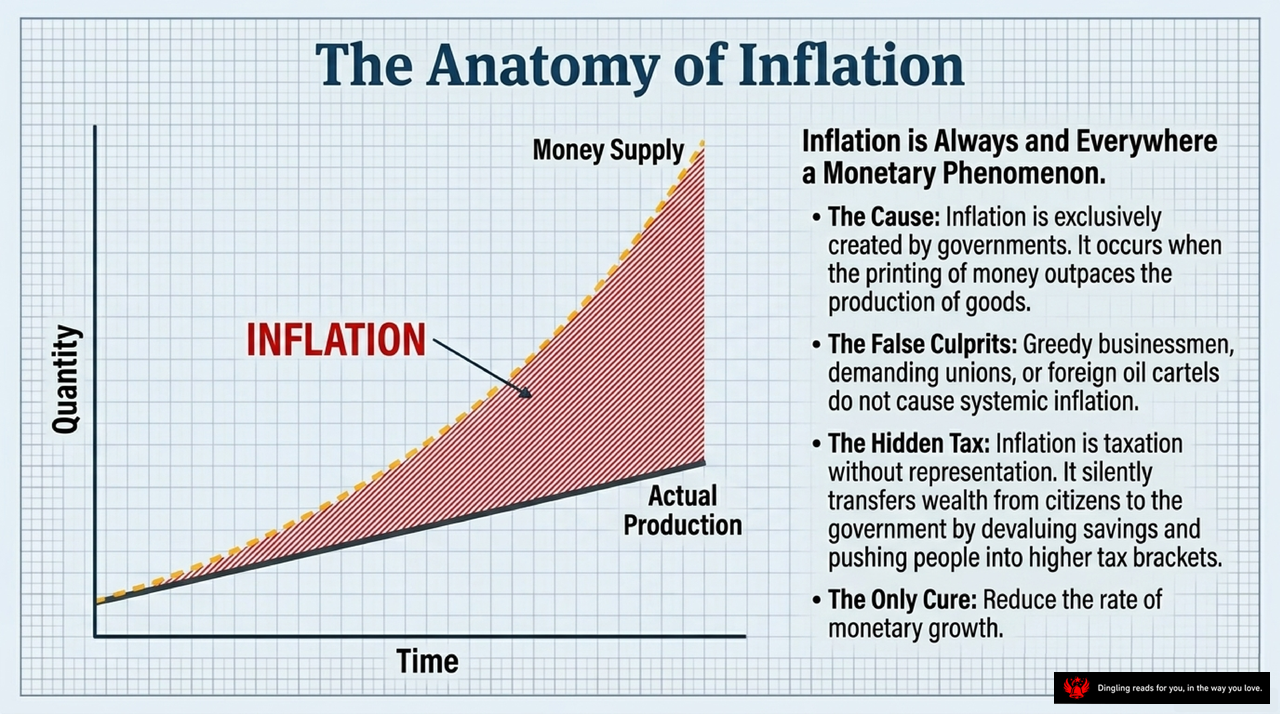
Ever wondered why your dollar doesn’t stretch as far as it used to? Why groceries cost more, gas prices jump, and your savings feel like they’re slowly melting away? Today, we’re diving into the anatomy of inflation—and the truth might surprise you.
First off, let’s get straight to the core: as the slide says, inflation is always and everywhere a monetary phenomenon. That’s not just a fancy phrase—it’s a lesson from history. Take colonial Virginia: they used tobacco as currency. When farmers grew way too much tobacco, every leaf became worth less, and prices shot up 40 times over. Or post-WWI Germany: hyperinflation made money so worthless, people burned it for heat instead of buying firewood.
So who’s really to blame? The slide points it out: governments. Inflation happens when the money supply grows way faster than the production of goods and services. Think of it like too many people trying to buy the same pizza—each slice costs more. You’ve probably heard folks blame greedy CEOs, unions demanding higher wages, or oil cartels. But those only affect specific prices, not the whole economy. Systemic inflation? It’s always about too much money printed too quickly.
And here’s the kicker: inflation is a hidden tax. No legislation, no tax forms—just silent theft. Your $100 saved last year might only buy $90 worth of stuff today. It pushes you into higher tax brackets even if your real income hasn’t gone up. Plus, it lets the government pay off its debt with devalued dollars—great for them, terrible for you.
So what’s the cure? Simple, but hard: reduce the rate of monetary growth. It’s like a drunk cutting back—short-term pain (maybe higher unemployment, slower growth) but long-term gain. Japan showed us in the 70s: stick to it, and you can beat inflation and get back to stable growth.
The bottom line? Inflation isn’t an accident. It’s a choice governments make. And the only way to stop it is to rein in the money supply. No shortcuts, no scapegoats—just plain common sense.

Hey everyone, let’s start with a question: Have you ever looked at a government policy and thought, “That’s obviously bad—why does it still exist?” Today, we’re diving into Public Choice Theory to answer that, specifically the core idea of Concentrated Benefits vs. Dispersed Costs.
Let’s break it down using the example on the slide. Imagine a subsidy that gives $10 million to a small group—let’s call them the 1%. For this group, this is a life-changing sum. They’ll lobby relentlessly, fund political campaigns, and even base their entire vote on whether this policy stays. Why? Because the benefit is concentrated—every dollar directly impacts their bottom line.
Now, who foots the bill? The 99%—100 million taxpayers, each chipping in just 10 cents. Think about it: Would you take time off work to protest, march in the streets, or change your vote over 10 cents? Probably not. The cost is dispersed so widely that no one feels it enough to take action.
And here’s the kicker: This dynamic leads to a highly motivated minority (the 1%) successfully exploiting a disorganized, apathetic majority (the 99%). Over time, this results in endless, unchecked government expansion—because each small policy adds up, and the majority never pushes back.
This isn’t just a hypothetical. Think about farm subsidies in the U.S.: A small number of corn or soybean farmers get massive checks, while millions of taxpayers pay a little extra each year without noticing. Or tariffs on imported steel—they protect a few thousand jobs in the steel industry, but everyone pays more for cars, appliances, and construction materials.
So next time you see a bad policy that just won’t go away, remember this: It’s not that people are ignorant. It’s that the incentives are stacked against the majority. The ones who gain a lot fight like hell, and the ones who lose a little don’t fight at all. That’s Public Choice Theory in action, and it explains why so many bad policies survive in democracies.

Imagine a baseball game where the umpire doesn’t just call balls and strikes—they start swinging the bat, running the bases, and changing the rules mid-game. Total chaos, right? That’s exactly what happens when government oversteps its role. Today we’re diving into The Proper Role of Government: The Umpire, Not the Player—because a prosperous free society depends on getting this balance right.
A free society still needs a limited government, but its duties are strictly confined to four core areas. First off: Defense. This means protecting our society from external violence and invasion—think our military, border security, and ensuring we’re safe from threats outside our nation’s borders.
Second: Justice. We need a system that shields every individual from coercion and fraud. Whether it’s a business scamming customers, someone stealing your identity, or a neighbor violating your property rights, the courts and police are there to enforce fair play and ensure an exact administration of justice for everyone.
Third: Public Works. These are the necessary public institutions that private enterprise can’t build profitably but we all rely on—like roads, bridges, water treatment plants, and public infrastructure that keeps our economy moving. You can’t have a thriving community if people can’t get to work or businesses can’t ship their products, so government steps in here to fill that gap.
Fourth: Protect the Vulnerable. This is for members of our community who can’t be regarded as responsible individuals—kids, the mentally incapacitated, and those who can’t care for themselves. We’re talking about child protective services, care facilities for people with severe disabilities, and ensuring no one falls through the cracks when they can’t help themselves.
The bottom line? Government’s job isn’t to run the economy, pick winners and losers, or tell us how to live our lives. It’s to set the rules, enforce them fairly, and take care of the basics so we can all play the game of life with equal opportunity and freedom. That’s the foundation of a prosperous free society.
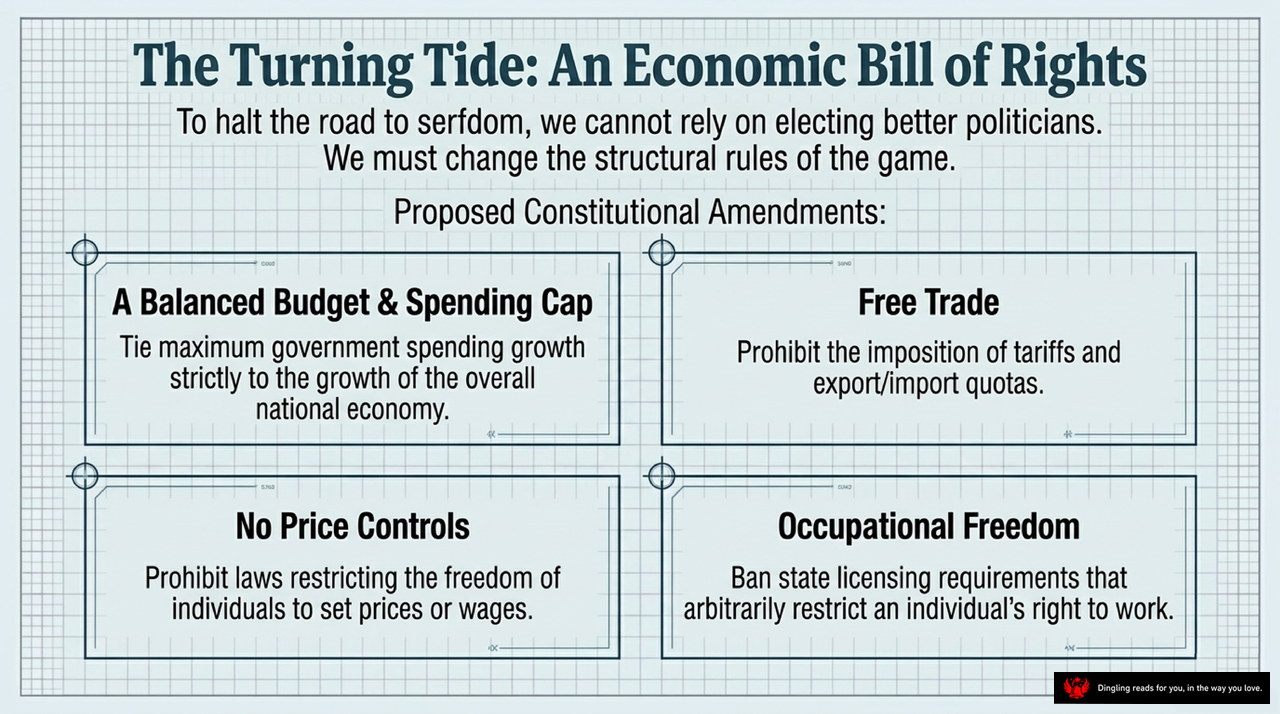
Alright, let’s zero in on this slide: The Turning Tide: An Economic Bill of Rights. The core message here is unflinching: To stop the slide toward losing our economic freedom, we can’t just vote for “better” politicians—we have to rewrite the structural rules of the game.
For years, we’ve chased the illusion that electing the right leader would fix our fiscal mess or unshackle our economy. But time and again, even well-intentioned officials get tangled in a system designed to expand government power. So what’s the solution? Locking in limits with constitutional amendments—rules that don’t depend on who’s in office.
First, the Balanced Budget & Spending Cap: Tying government spending growth strictly to the national economy’s growth. Why does this matter? When the government overspends, it either hikes taxes or prints more money (which fuels inflation, eating away at your savings). This amendment forces fiscal discipline, so politicians can’t keep passing debt to our kids.
Next, Free Trade: Prohibiting tariffs and import/export quotas. Trade barriers sound like they protect jobs, but they actually make everything more expensive for you—think higher prices for cars, electronics, even groceries. Free trade lets us buy the best products at the best prices and pushes businesses to innovate.
Then, No Price Controls: Banning laws that restrict setting prices or wages. Price controls might seem fair, but they always backfire—remember the 1970s gas lines? Or rent controls that make affordable housing scarce? Letting the market set prices balances supply and demand, so we don’t face shortages or surpluses.
Finally, Occupational Freedom: Ending arbitrary state licensing that blocks people from working. How many qualified folks can’t start a business or practice a trade because of unnecessary red tape? Like a cosmetologist needing 1,000 hours of training just to cut hair, or a small farmer being shut out by licensing fees. This amendment lets people use their skills without government roadblocks.
These amendments aren’t about gutting government—they’re about keeping it in check. When we change the rules, we take power back from the system and put it where it belongs: in your hands, to work, trade, and build without unnecessary interference.
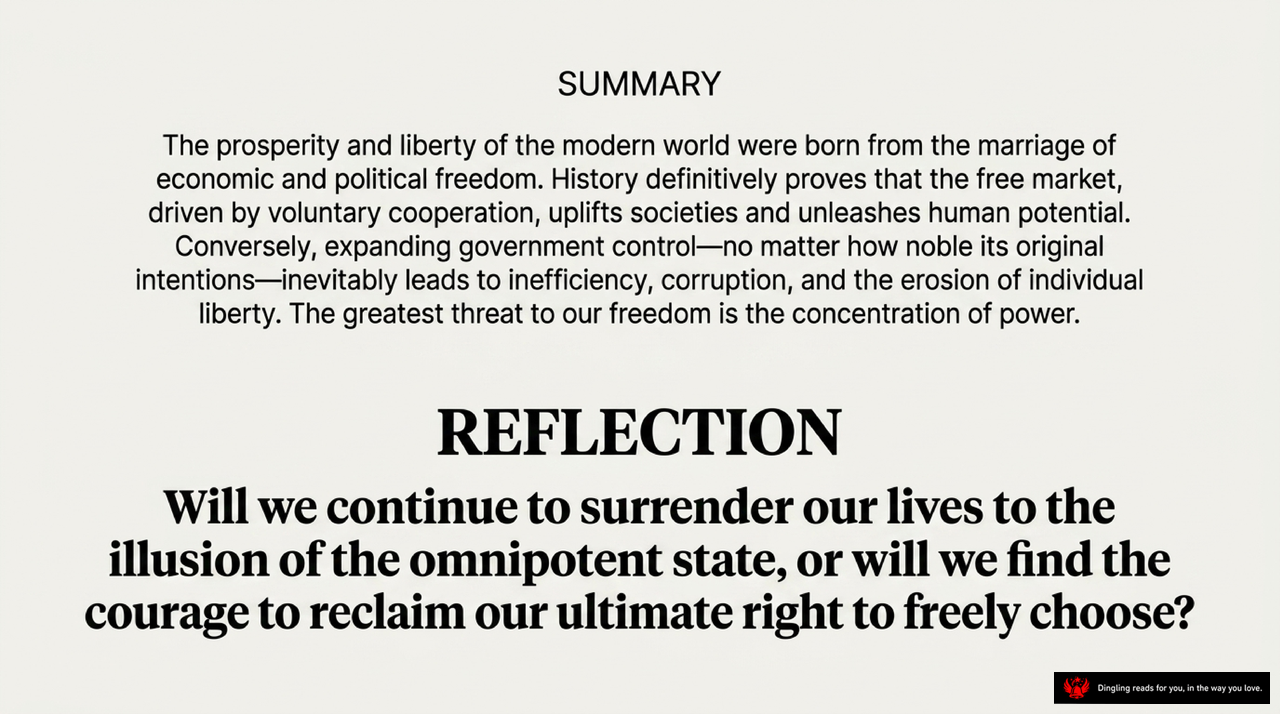
Have you ever stopped to think why we have the prosperity and freedom we enjoy today? It’s not because some government plan dictated it—it’s because of the powerful combination of economic and political freedom. History is clear: when people are free to work together voluntarily in a market, societies lift themselves up. Think about the smartphones in our pockets, the grocery stores stocked with food from around the world, the ability to start a business if you have an idea—all of these are gifts of free markets, where people choose to trade, innovate, and create value for each other without someone pulling the strings.
But here’s the hard truth: when government expands its control, even with the best intentions, it always leads to trouble. It creates inefficiency—like the long lines for gas in the 70s when the government capped prices. It breeds corruption, as special interests lobby for favors that hurt everyone else. And slowly but surely, it erodes our individual liberty—taking away the choices we should be able to make for ourselves. The greatest threat to our freedom isn’t some foreign enemy; it’s the concentration of power right here, in too few hands.
So let’s pause and reflect: Are we going to keep surrendering our lives to the illusion that an all-powerful state can solve all our problems? Or are we going to find the courage to reclaim our ultimate right—the right to choose freely, to shape our own lives, and to build a future where freedom still matters? That’s the question each of us has to answer, because the path we take next will define the kind of country we leave for our kids and grandkids.