
Freedom From Fear: Complete Chapter-by-Chapter Summary
Welcome to today's session on *Freedom From Fear* by David M. Kennedy. Set against a backdrop of early 20th-century industry, this book explores how two massive crises reshaped the American state and redefined our social contract around the pursuit of security. We begin with the profound contrasts of the 1920s, a decade of stark duality. While cities buzzed with the promise of modernity, the South remained trapped in a cycle of extreme poverty and racial segregation, where Jim Crow laws and economic collapse kept millions in a state of fear. Yet, amidst this darkness, seeds of change were sown. Women entered the workforce in record numbers, challenging traditional roles, while education expanded dramatically, offering a ladder out of poverty for many. However, these gains were fragile. The financial system, built on speculative excess, collapsed in 1929, plunging the nation into the Great Depression. This crisis exposed the deep flaws in our economic model and forced a fundamental rethinking of government's role. From the failed voluntary cooperation of the Hoover era to the bold, interventionist measures of the New Deal, America was forced to confront the question of how to provide security for all. As we dive into the pages, we will see how fear drove these transformations, ultimately forging the modern American identity we recognize today.

Look at this house of cards. It's a perfect metaphor for the American economy in the 1920s. On the surface, it looked impressive, but as we can see, it was built on an incredibly fragile foundation of uneven prosperity, ready to collapse at any moment.
Let's look at the first layer: Unequal Wealth Distribution. This was the core structural flaw. While industrial output doubled, the money didn't flow to the workers. Instead, capital went disproportionately to the owners, choking off mass purchasing power. When the average worker can't buy the products they make, the whole system starts to rot.
Next, we see Irregular Employment. The working class had no security. High technological turnover meant frequent shutdowns and layoffs. There was no safety net; one bad turn meant losing your income entirely.
Then, look at the bottom left: Agricultural Depression. This was a massive, ignored pressure point. With 44% of the population still rural, farmers were suffocating under mountainous surpluses and debt. Cotton prices plummeted from 35 to 16 cents per pound. When the foundation of the economy—the farmers—is drowning in debt, the house above them has no support.
Finally, at the base, we have Risky Consumer Credit. By 1929, 26 million cars were on the road. But here's the catch: they were driven by installment buying and debt, not actual wealth. People were buying things they couldn't afford, borrowing against their future to keep the illusion of prosperity alive.
All these pieces were balanced precariously on a timeline leading straight to 1929. When one card falls, the whole structure collapses. That's exactly what happened when the Great Depression arrived, wiping out this entire fragile architecture of uneven prosperity.

Look at this diagram titled "The Anatomy of a Crash." It illustrates the terrifying, self-reinforcing cycle that destroyed the American market in October 1929. The entire process was fueled by one dangerous element: high leverage. Because investors were using borrowed money to buy stocks, even a small initial price dip triggered a domino effect.
The chain reaction began with the call loan spigot, where banks flooded the market with cash, allowing investors to buy on as little as 10% margin. When prices dipped, brokers immediately issued margin calls, demanding immediate cash coverage. This forced investors into liquidation. Without enough cash, they were forced into simultaneous mass sell-offs. On Black Tuesday alone, a record 16.4 million shares were traded, creating a liquidation avalanche that crashed the market.
The result was value evaporation. By mid-November, roughly $26 billion—about one-third of the value recorded in September—vanished into thin air. This wasn't just a correction; it was a systemic collapse driven by the symmetry of leverage, where falling prices forced more selling, which drove prices down further. This graphic perfectly captures how financial engineering can accelerate a crash into a total disaster.
Before Franklin D. Roosevelt took the helm, the U.S. banking system was on the brink of total collapse. In early 1933, a panic swept across the nation, forcing banks in nearly every state to close their doors. Depositors, terrified and desperate, stood in lines outside, only to find locked gates and cold notices. Life savings vanished overnight, and a wave of rumors spread through the streets, painting a picture of a nation on the verge of anarchy.
Faced with this crisis, Roosevelt chose a path of calm over chaos. While the public clamored for a dictator, he remained steady, projecting confidence and refusing to abandon democratic traditions. His cool demeanor helped restore faith in the government. Once in office, he immediately transformed the White House into a direct communication channel, holding open press conferences to speak plainly with the American people. He also took bold political steps, such as legalizing beer, which signaled a shift from rigid moralism to practical governance.
But his most decisive action was the "Bank Holiday." He ordered all banks to close, giving the government time to inspect their books. Once only the soundest institutions reopened, the public's fear began to fade. To protect the remaining banks and prevent future runs, he signed the Emergency Banking Act and later established the Federal Deposit Insurance Corporation, guaranteeing up to $2,500 in every account. This simple promise of safety was a turning point, effectively ending the panic and stabilizing the financial system. With the economy finally breathing again, Roosevelt could turn his attention to the deeper structural problems that had caused the Great Depression in the first place.
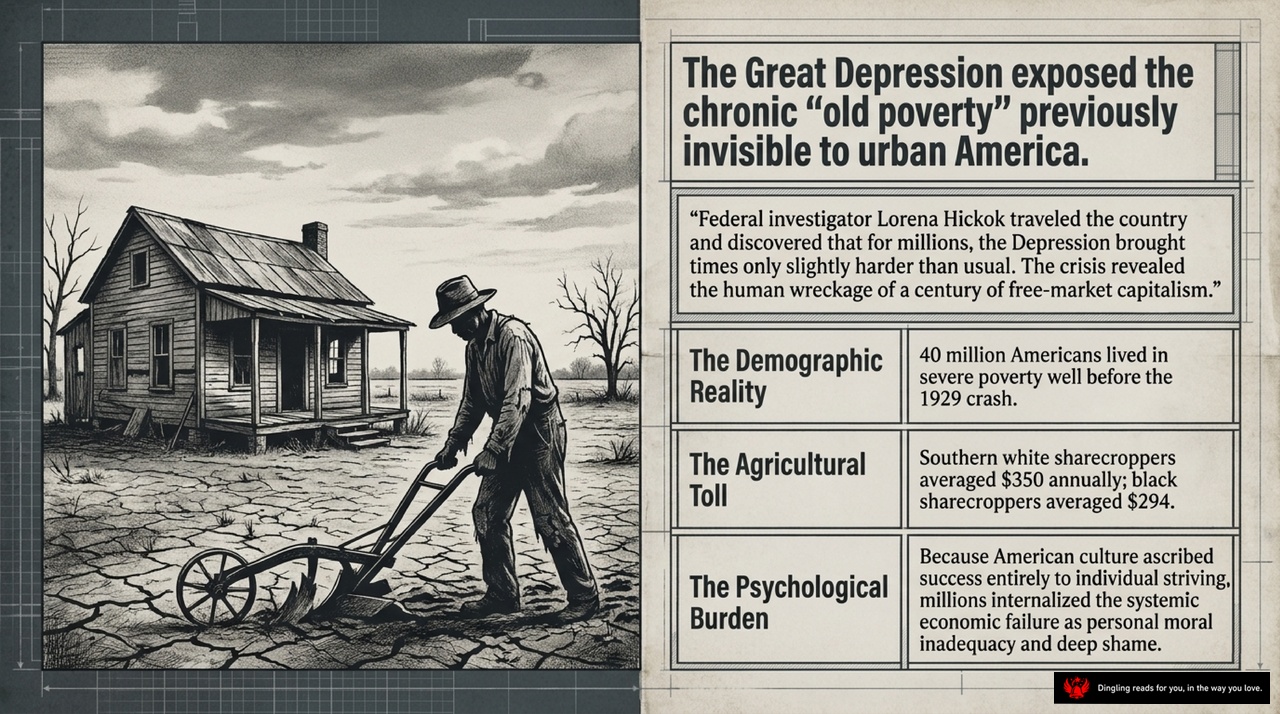
The Great Depression didn't just crash the stock market; it shattered the American Dream, turning a land of opportunity into a landscape of desperation. By 1934, the economy had stalled completely. Industrial production flatlined, and unemployment remained stubbornly above 20%, leaving more than 10 million workers without a paycheck. The reality on the ground was brutal: while some agricultural prices ticked up due to government mandates, the average farmer's income plummeted to just one-third of what it was in 1929. Wheat and corn prices collapsed, forcing millions into debt and off their land, with foreclosure rates in the Midwest soaring to 25%.
But the economic pain sparked a fire of social unrest. Farmers, feeling betrayed by policies that seemed to protect landowners over them, took to the streets. In 1933, the Iowa Farm Blockade and the formation of the Farmers Holiday Association showed just how angry people had become. Leaders like Milo Reno declared a stark ultimatum: "We have had it up to here. Either give us a fair price, or let the whole country starve." This wasn't just protest; it was a threat that forced the government to react.
As the first New Deal measures failed to deliver quick relief, a wave of radicalism swept across the country. On the right, Father Coughlin used his massive radio audience to blame Jewish bankers and international forces for the crisis, turning millions of listeners against the government. On the left, Huey Long of Louisiana proposed the "Share Our Wealth" plan, promising every family $5,000 in cash and a guaranteed $2,000 a year. His message of economic justice resonated deeply, with millions joining his movement. Meanwhile, Dr. Townsend's pension plan for the elderly and the growing influence of the Communist Party pushed the boundaries of political discourse.
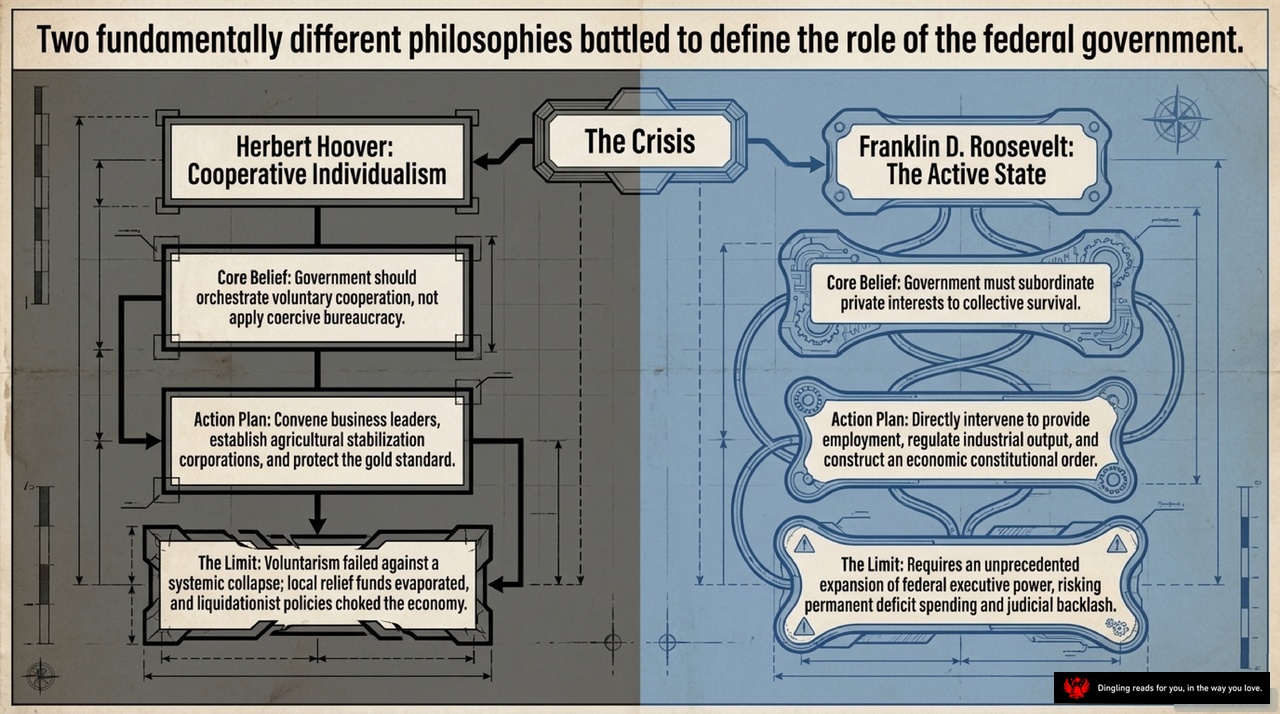
Faced with this mounting pressure and the undeniable failure of the status quo, Franklin D. Roosevelt knew the time for gentle reforms was over. The public demanded a fundamental restructuring of society. This was the moment the First New Deal gave way to the Second New Deal—a shift from emergency relief to deep structural reform. It was a turning point where the government finally acknowledged that economic security was a right, not a privilege, setting the stage for the landmark Social Security Act and the bold labor protections that would define America for decades to come.

The slide you see here captures the dramatic turning point of World War II: the day the United States was finally pulled from the shadows of isolationism into the center of global conflict. It all began on December 7, 1941, when Japan launched a surprise attack on Pearl Harbor. In just a few hours, the American fleet was devastated—18 ships sunk or damaged, nearly 2,000 lives lost, and a nation shocked into action. President Roosevelt famously called it a "date which will live in infamy." That very next day, Congress voted unanimously to declare war, shattering the long-held belief that the U.S. could stay out of foreign conflicts.
But the impact went far beyond the battlefield. This battle for the Pacific quickly became a clash of industrial might. In June 1942, the Battle of Midway emerged as the true strategic pivot. By breaking Japanese naval codes, the U.S. Navy set a trap that led to the destruction of four Japanese aircraft carriers in a single day. This victory not only stopped Japan's expansion but also marked the rise of the aircraft carrier as the dominant force in naval warfare, replacing the old battleship era.
While the Pacific burned, the war was also being fought in North Africa and Europe. The "Torch" landing in 1942 brought Allied forces to Morocco and Algeria, eventually pushing Axis troops out of Tunisia by 1943. Later that year, the invasion of Sicily toppled Mussolini's government and led to the fall of Rome. Meanwhile, behind the scenes, America's economy underwent a miraculous transformation from civilian to total war production. Factories like Ford's Willow Run churned out B-24 bombers every 63 minutes, while millions of women, famously known as "Rosie the Riveter," stepped into industrial roles, breaking traditional gender barriers.
As the war turned in favor of the Allies, the final push began. The massive D-Day landings in Normandy in June 1944 opened the Western Front, while the Soviet Union advanced from the East. The German resistance crumbled after their failed counterattack in the Ardennes, leading to their surrender in May 1945. But the war's end also brought profound domestic changes. The internment of Japanese Americans, though a dark chapter, and the executive order banning discrimination in defense industries, planted the seeds for the civil rights movement that would flourish after the war. Ultimately, World War II didn't just destroy fascism; it forged a new American identity—one defined by global leadership, industrial supremacy, and a transformed society.
By the time the war ended in 1945, the United States had undergone a transformation so profound that it would never be the same again. What began as an isolated nation, paralyzed by the Great Depression and obsessed with neutrality, emerged as the undisputed global superpower. The attack on Pearl Harbor shattered the myth of American invulnerability, instantly mobilizing a nation that had once hesitated. In just a few short years, the U.S. industrial machine, previously idled by the crisis, roared to life, producing more weapons than the rest of the world combined. This total war effort didn't just win the battle; it rebuilt the economy, ending the Depression and launching a golden age of prosperity that defined the next half-century.
But the cost of this victory was high, and the changes were often controversial. We saw the tragic injustice of Executive Order 9066, which forced over 120,000 Japanese Americans into internment camps, a dark stain on our history that we only began to heal decades later. Yet, amidst this fear, there was also progress. The desperate need for labor during the war broke down barriers, bringing women like "Rosie the Riveter" into factories and opening doors for African Americans who had long been excluded from industrial jobs. These shifts laid the groundwork for the civil rights movements that would follow.
The war also reshaped the global map. Europe, once the center of world power, was left in ruins, creating a vacuum that was quickly filled by the United States and the Soviet Union. The Cold War was born, a tense standoff that would define international relations for decades. As the fighting ceased in 1945, the world was left with a new reality: the United States was no longer just a participant in history; it had become the architect of the future.
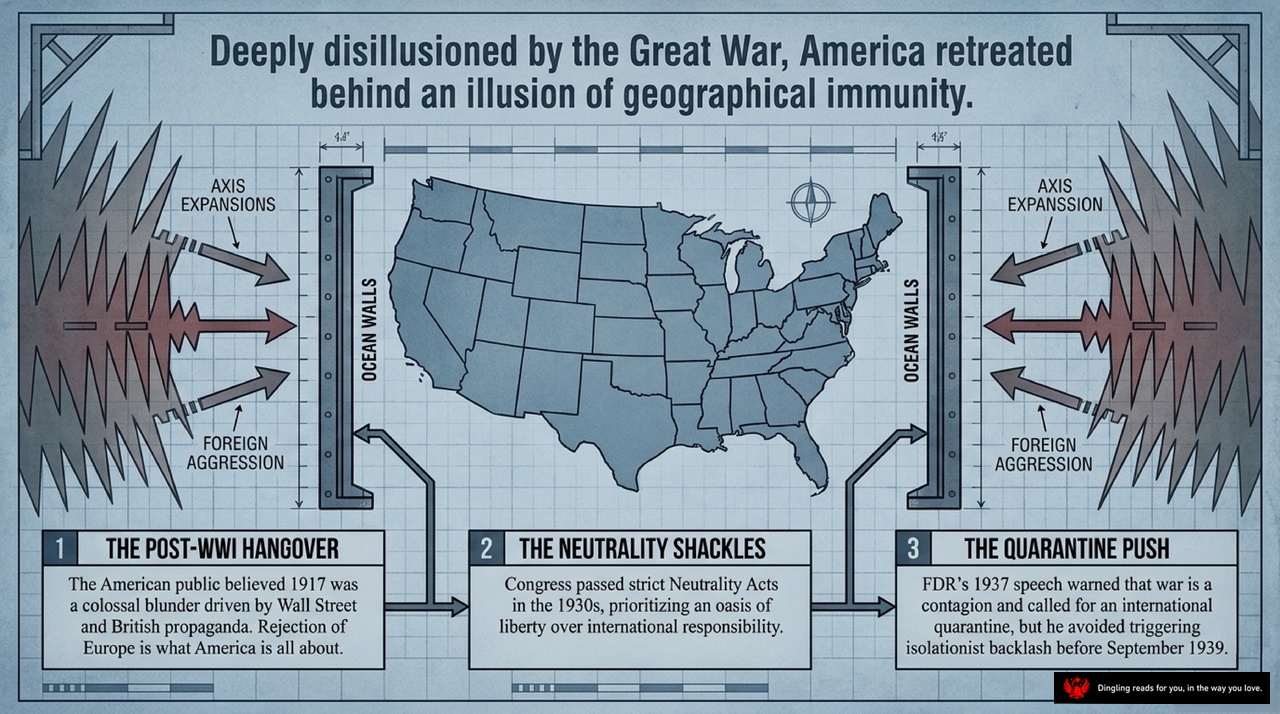
In the final chapter of this story, we see how the United States transformed from a reluctant bystander into the undisputed engine of the world's liberation. The turning point arrived on December 7, 1941, when Japan's surprise attack on Pearl Harbor shattered the illusion of isolationism. That day, defined by President Roosevelt as a "date which will live in infamy," forced America to finally wake up. Overnight, the nation mobilized with a speed and scale that stunned the world, converting its peacetime economy into a war machine of unprecedented power.
While the Pacific burned, the European theater saw its own decisive moments. The invasion of Normandy in June 1944, known as D-Day, remains the largest amphibious assault in history, breaking the back of Nazi Germany. But it was the relentless pressure from the East that ultimately sealed the deal. As Soviet forces pushed westward, the final battle for Berlin culminated in Hitler's suicide and Germany's unconditional surrender in May 1945, ending six years of global devastation.
The war's conclusion brought profound and lasting changes to American society. It didn't just end the conflict; it ended the Great Depression. The massive demand for goods and the influx of millions of women into the workforce, symbolized by "Rosie the Riveter," created a booming economy and a new middle class. However, the victory came at a moral cost. The internment of over 120,000 Japanese Americans, despite their loyalty, stands as a dark stain on our history, a stark reminder of how fear can override justice. Yet, the war also sowed the seeds of progress. The ban on discrimination in defense industries opened doors for African Americans, while the unprecedented role of women in the industrial sector challenged traditional gender roles forever.
Ultimately, this period reshaped the global order. With Europe weakened, America and the Soviet Union emerged as superpowers, setting the stage for the Cold War. The United States learned that its prosperity and safety were now inextricably linked to the fate of the world, marking the end of the 1930s era of fear and the beginning of a new chapter of global leadership and responsibility.
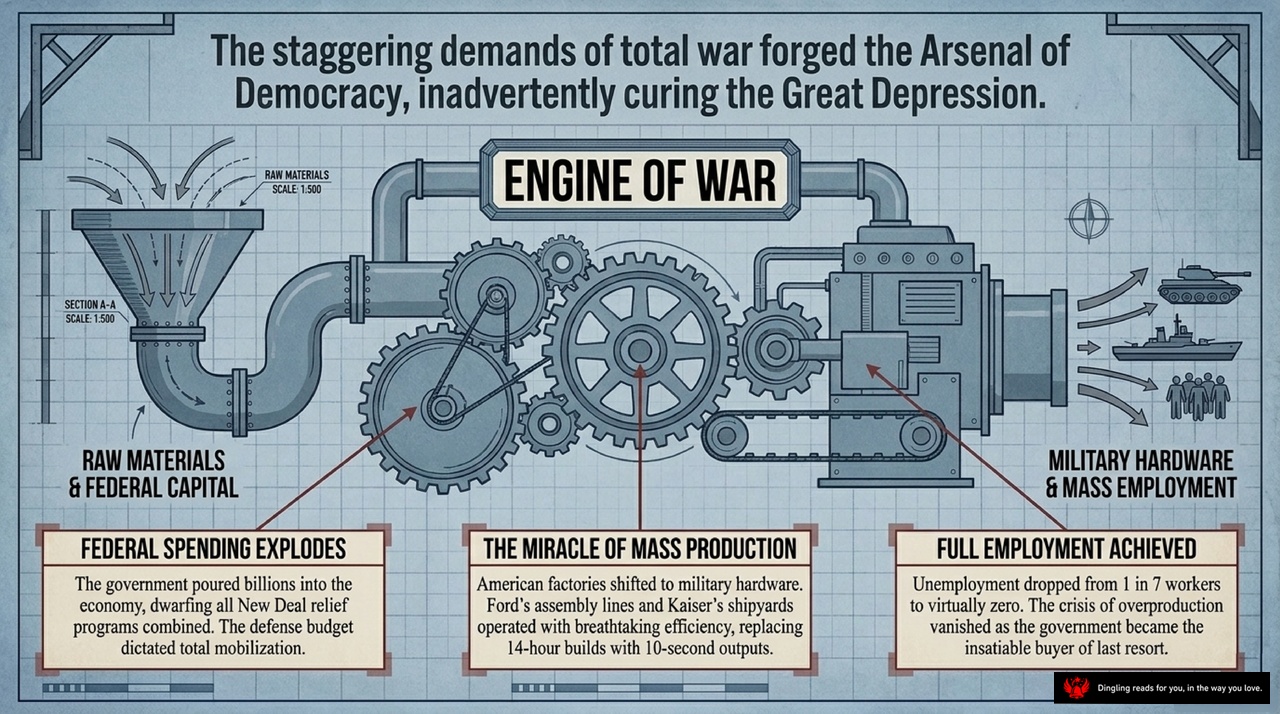
The image you see here captures the dramatic transformation of America during World War II. It illustrates how the staggering demands of total war forged the "Arsenal of Democracy," inadvertently curing the Great Depression. Think of this entire system as a massive "Engine of War." On the left, you have the raw materials and federal capital pouring into the system. The government poured billions into the economy, dwarfing all New Deal relief programs combined. The defense budget dictated total mobilization, with federal spending exploding to an unprecedented scale.
In the center, you see the "Miracle of Mass Production." American factories shifted entirely to military hardware. Companies like Ford and Kaiser operated with breathtaking efficiency, replacing 14-hour builds with 10-second outputs. This industrial machine turned out tanks, ships, and planes at a rate the world had never seen before.
On the right, the output is clear: military hardware and mass employment. The crisis of overproduction that had plagued the 1920s vanished completely because the government became the insatiable buyer of last resort. As a result, full employment was achieved. Unemployment dropped from 1 in 7 workers to virtually zero. This engine didn't just win the war; it healed the economy, proving that total war could be the catalyst for total recovery.

Industrial mobilization didn't just build weapons; it rewrote the American DNA. As the infographic shows, the war shattered a decade of paralysis, forcing radical demographic shifts that would echo for generations.
First, look at the Great Migration. Millions of African Americans fled the Jim Crow South, leaving behind rural peonage for defense jobs in industrial hubs like Oakland and Detroit. This wasn't just an economic move; it was an escape from a system designed to keep them in chains.
Simultaneously, women entered the forges. "Rosie the Riveter" wasn't just a poster; she was a cultural reality. For the first time, millions of women took on heavy industrial jobs previously reserved entirely for men. They proved that the home front was also a battlefield where gender roles were dismantled.
But these changes planted the seeds for future revolutions. Although many women were pushed out after 1945, and racial tensions sparked urban riots, the wartime disruption of traditional roles laid an irreversible groundwork. The civil rights and feminist movements we see today didn't start in the 1960s; they were forged in the fires of the war, proving that the industrial home front was the true cradle of modern America.

The war fatally exposed the contradiction between America's professed democratic creed and its practice of segregation. This wasn't just a moral failing; it was a structural collapse. In 1944, Swedish economist Gunnar Myrdal published *An American Dilemma*, outlining the Principle of Cumulation—a self-reinforcing cycle where discrimination forced Black Americans into lowly positions, which whites then used to justify further prejudice. But World War II shattered this cycle. The hypocrisy of fighting Nazi racism with a segregated army made the status quo untenable. Pressured by Black leadership, FDR issued Executive Order 8802, banning discriminatory hiring in defense industries. This was the catalyst. Black soldiers and workers realized that betterment must come from their own efforts, returning from the war with a rising militancy. The system, once a closed loop of systemic discrimination, finally cracked under the weight of ideological contradiction.

The atomic bomb wasn't just a weapon; it was the ultimate, terrifying triumph of the modern American managerial state. Look at this blueprint. It shows how the Manhattan Project fused government, science, and industry into a unified, $2 billion apparatus that no other nation could ever replicate.
On the left, we see "The Military Manager." General Leslie Groves embodied the American genius for massive organization and industrial logistics. He was the engine that kept the project moving. In the center is "The Scientific Vision," where J. Robert Oppenheimer led a diaspora of international scientific genius to solve the theoretical hurdles of critical mass and assembly. Without their brilliance, the bomb wouldn't have been possible.
But on the right, we have "The Industrial Reality." Creating the bomb required an unprecedented concentration of resources, orchestrating the entirety of American industrial might toward a single, apocalyptic objective. Every factory, every worker, every dollar was pulled into this machine. All three of these elements—the military, the science, and the industry—fed into the final product at the bottom: The Bomb. This wasn't just a scientific breakthrough; it was a total mobilization of the nation's power, proving that the modern state could concentrate resources like never before.

America emerged from World War II economically triumphant, a global superpower standing taller than ever before. But let's be honest: that victory came with a staggering price and a moral compromise we can't easily ignore.
On the left, you see the triumph. Look at that graph labeled "Economic Ascension"—it tells the story of how America alone among the belligerents emerged with its infrastructure untouched and its civilian population prospering. While Europe burned and Asia crumbled, the U.S. industrial machine churned out the weapons that won the war, fueling a boom that would last for decades.
But look to the right. That's where the tragedy lies. Under "The Human Toll," the numbers are devastating: 405,399 American soldiers, sailors, marines, and airmen died. The Pacific war degenerated into a brutal, racially charged war of annihilation. And then there's "The Moral Ledger." The nation profaned its constitution by interning tens of of thousands of Japanese-Americans, stripping them of their rights without evidence of guilt. Furthermore, the demand for unconditional surrender culminated in the incineration of hundreds of thousands of Japanese civilians via firebombing and nuclear blast.
So, while the nation celebrated its economic dominance, it did so by paying a heavy debt in blood and conscience. The victory was real, but the cost was written in the lives of the fallen and the dignity of the displaced.

The 16-year crucible of the Great Depression and World War II didn't just change the United States; it fundamentally reinvented it. Look at this "Two Americas" matrix. In 1929, the federal government was minimal, consuming just 15% of the GNP and remaining virtually invisible in daily life. By 1945, it had transformed into a massive managerial state regulating industry, labor, and welfare.
Foreign policy shifted dramatically from deep isolationism, where the U.S. rejected European entanglements like the League of Nations, to becoming the architect of global interdependence through the UN and the World Bank. The industrial base went from being plagued by overproduction and technological unemployment to becoming the "Arsenal of Democracy," operating at full capacity with a global reach.
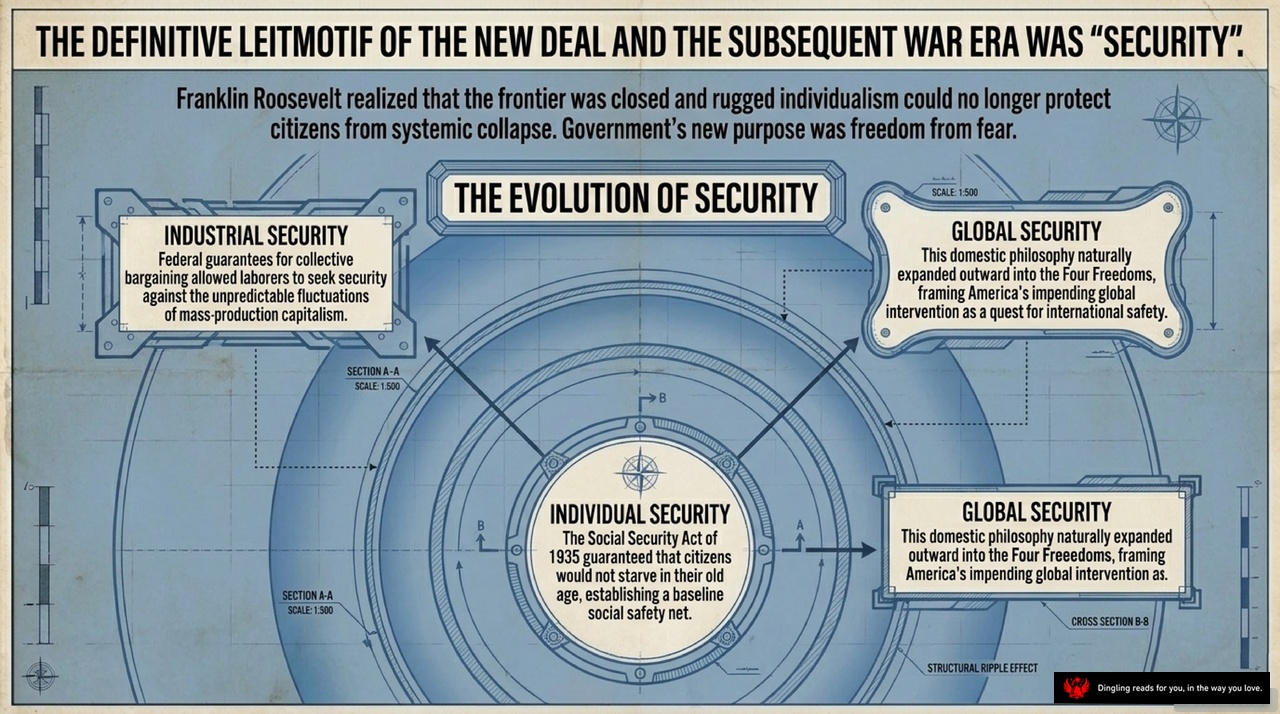
The social contract itself was rewritten. We moved from rugged individualism, where failure was viewed as a personal moral inadequacy, to a system of systemic security where the state guaranteed a basic safety net via Social Security. Finally, demographics changed entirely. The 1929 America was rigidly segregated, with women largely relegated to the domestic sphere. By 1945, we saw massive internal migration, and minorities and women were mobilized into heavy industry. This wasn't just a recovery; it was a complete transformation of the American experiment.
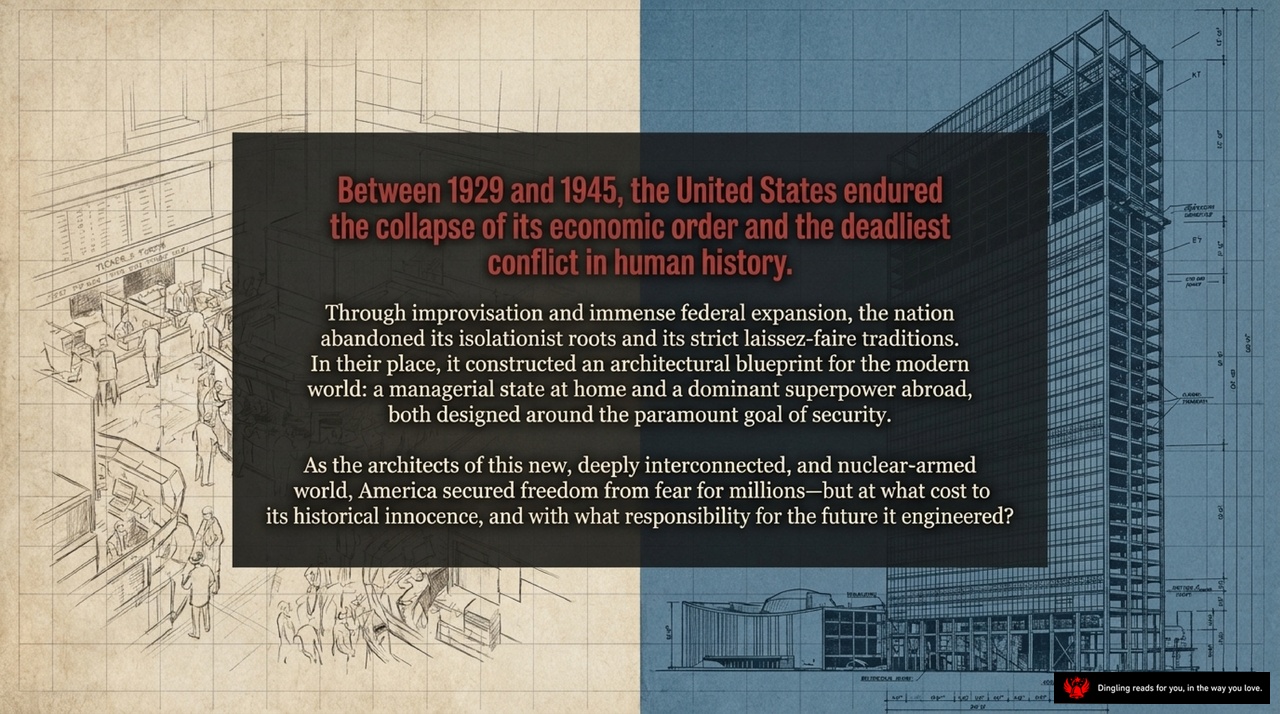
Between 1929 and 1945, the United States endured the collapse of its economic order and the deadliest conflict in human history. This slide captures the dramatic transformation of America from an isolationist nation to a global superpower. On the left, we see the chaotic, improvisational spirit of the 1930s—a time when the country abandoned its strict laissez-faire traditions and isolationist roots. Through immense federal expansion, America constructed a new architectural blueprint for the modern world: a managerial state at home designed to provide security, and a dominant superpower abroad.
The image on the right symbolizes this shift toward a deeply interconnected, nuclear-armed world. As the architects of this new era, America secured freedom from fear for millions, but at what cost to its historical innocence? The transition from the agrarian struggles of the 1920s to the industrial might of the post-war period wasn't just about building factories; it was about redefining the very role of government. The nation moved from balancing its budget to actively intervening in the economy, creating a safety net and regulating markets in ways that were once considered radical. This era forged a legacy where security became the paramount goal, shaping not just America's future, but the fate of the entire globe.