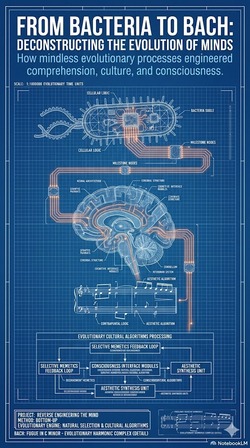
From Bacteria to Bach and Back takes readers on a sweeping, rigorously researched journey to answer one of humanity’s most profound questions: How did conscious minds and rich cultural systems emerge from the unthinking physical processes of evolution? Drawing on 50 years of work in philosophy, cognitive science, and evolutionary biology, Daniel C. Dennett dismantles the long-standing Cartesian dualism that splits mind from matter, introducing concepts like 'Cartesian gravity'—the cognitive trap that locks us into first-person subjective views—and 'free-floating rationales' to explain how traits evolve without being understood by the organisms that possess them. Dennett traces the path from bacteria’s 'competence without comprehension' to humans’ unique ability to use thinking tools like language and mathematics. He explores the co-evolution of genes and memes, the cultural equivalent of genes, showing how they shaped everything from language origins to Bach’s musical genius. Central to his argument is the radical claim that consciousness is not a mysterious, non-material entity, but an evolved 'user illusion'—a simplified interface that lets us navigate the world without grasping the complex neural processes beneath. This book challenges readers to set aside intuitive biases and see the mind as a product of gradual, unguided evolution, bridging the gap between biology, philosophy, and culture.






 Ask about the book's ideas and how they relate to your life.