
From Bacteria to Bach and Back: Complete Chapter-by-Chapter Summary
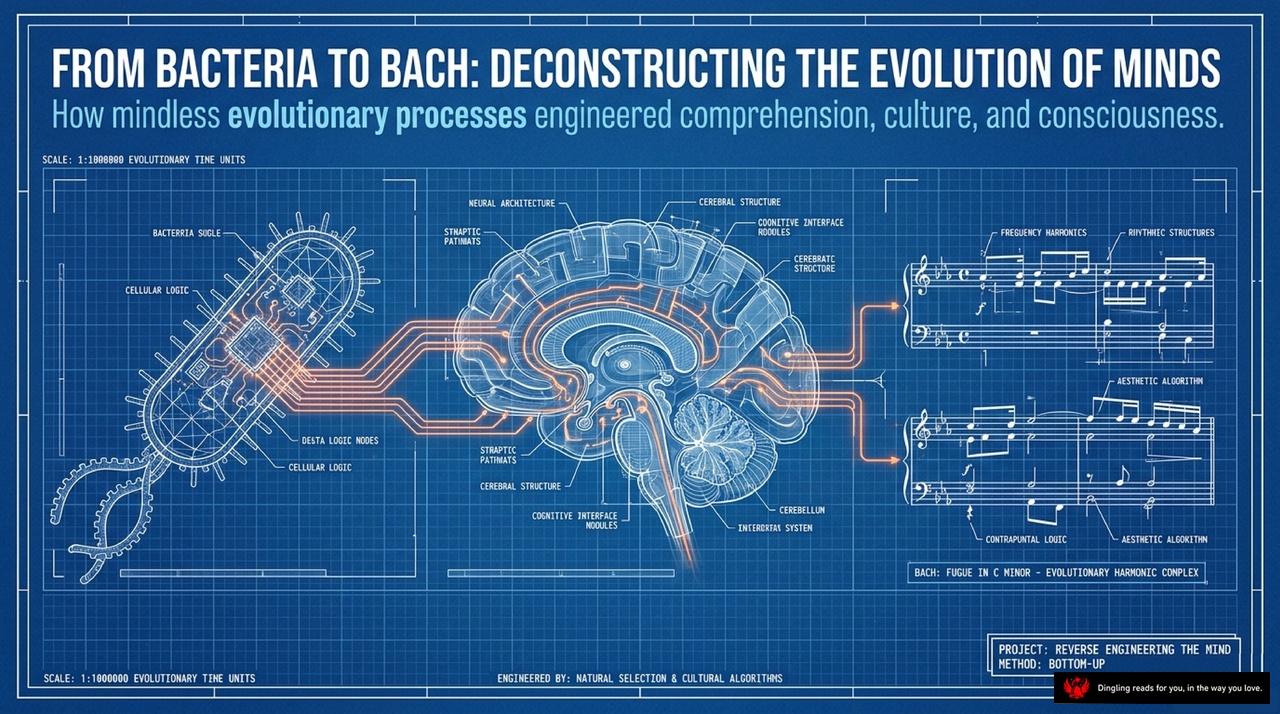
Welcome to the mind's journey. Today, we're not just looking at a brain; we're looking at a blueprint for how mindless evolutionary processes engineered comprehension, culture, and consciousness itself.
On this screen, we see a fascinating timeline stretching from bacteria to Bach. On the left, we have the cellular logic of a bacterium, evolving through synaptic pathways and neural architecture. In the center lies the human brain, with its cerebral structure and cognitive interface modules. And on the right, we see the ultimate output of this evolution: the aesthetic algorithm of Bach's music, featuring frequency harmonics and contrapuntal logic.
This image illustrates a powerful idea: the evolution of the mind isn't a straight line from simple to complex. It's a process of reverse engineering. Just as nature built the brain to process information, that same brain eventually created the tools—like language and music—to understand the world. The text notes that these tools allow us to break free from biological instincts, exploring cognitive territories no other species can reach.
So, how do we get from a simple bacterium to a symphony? The answer lies in the shift from "mindless" processes to conscious understanding. While early life operated on "free-floating rationales"—behaving correctly without understanding why—humanity developed the unique ability to step back, analyze, and explain those very mechanisms. We didn't just inherit the brain; we engineered the mind to comprehend the mind. This is the core of what we explore: how the magic of consciousness emerges from the raw, physical processes of evolution.

The hardest task in the science of consciousness is resisting the pull of our own subjective user experience. Today, we're diving into a concept that sounds like science fiction but is actually the root of a 400-year-old philosophical crisis: The Cartesian Wound.
As the diagram illustrates, this "wound" was created by Descartes when he fractured human understanding by assuming the mind is a magical, non-physical thinking substance, completely separate from the mechanical body. This separation created what we call "Cartesian Gravity." Imagine a massive planet on the left labeled "The Manifest Image"—that's our everyday experience of being a conscious observer. This planet exerts a powerful gravitational pull, represented by those orange arcs labeled "Cartesian Gravity," dragging us away from reality and into a distorted perception.
Because of this gravity, we struggle to see the world as it truly is. Instead of viewing ourselves as physical entities, we feel pulled toward "The Scientific Image" on the right—a realm of atoms, neurons, and mechanical processes. But the gap between these two views creates "The Explanatory Gap." We feel like we can't explain how subjective feelings arise from physical matter.
This illusion stems from a specific chain of cognitive errors shown at the bottom of the slide. It starts with "Introspection"—the habit of looking inward. This leads to an "Illusion of Centralized Control," making us believe we are the pilots of our own minds. Next comes the "Rejection of Materialism," where we refuse to accept that our thoughts are just physical brain processes. Finally, this cycle closes the loop, leaving us stuck in "The Explanatory Gap."
In simple terms, Descartes' idea acts like a lens that distorts our vision, convincing us that our consciousness is special and separate from the laws of physics. But the real challenge isn't solving a mystery; it's overcoming the gravitational pull of our own intuition. We have to learn to look at our minds not as magic users, but as biological machines that have evolved a specific user interface to help us survive. That shift in perspective is the first step to healing the Cartesian Wound.

Imagine a world where intelligence doesn't require understanding. This is the radical core of "The Two Strange Inversions of Reasoning," a concept that flips our entire definition of how the universe works. Look at the diagram on the left: Darwin's Inversion. It shows a beak evolving from a simple form into a complex, optimized design. The old view insisted that such brilliance demanded a wise designer with absolute knowledge. Darwin proved the opposite: absolute ignorance, through blind trial and error over millions of years, can replace absolute wisdom. No designer needed.
Now, look at the right side: Turing's Inversion. It depicts a machine processing binary data streams. Historically, we believed a computer must understand arithmetic to compute. Turing shattered that myth. He showed that competence can entirely replace comprehension. A machine doesn't need to "know" math to solve it; it just needs the right algorithm.
Both men, Darwin and Turing, delivered a stunning message: brilliant design and high-level computation do not require an intelligent creator. Mind is not the prerequisite for creating a mind; rather, mind is the product of the process itself. This shifts the entire narrative from "who designed this?" to "how did this process emerge?" It's a liberating realization that complexity is just the inevitable result of simple rules interacting over time.

Look at this chart: "The Myth of Comprehension: Competence Comes First." It challenges a deep-seated belief we all share—that to truly master something, you must first understand the underlying principles. But what if the opposite is true? What if brilliance doesn't require awareness?
Alan Turing famously noted that to build a perfect computer, you don't need to know what arithmetic actually is. You just need the rules to work. This slide breaks it down into four quadrants based on Competence versus Comprehension.
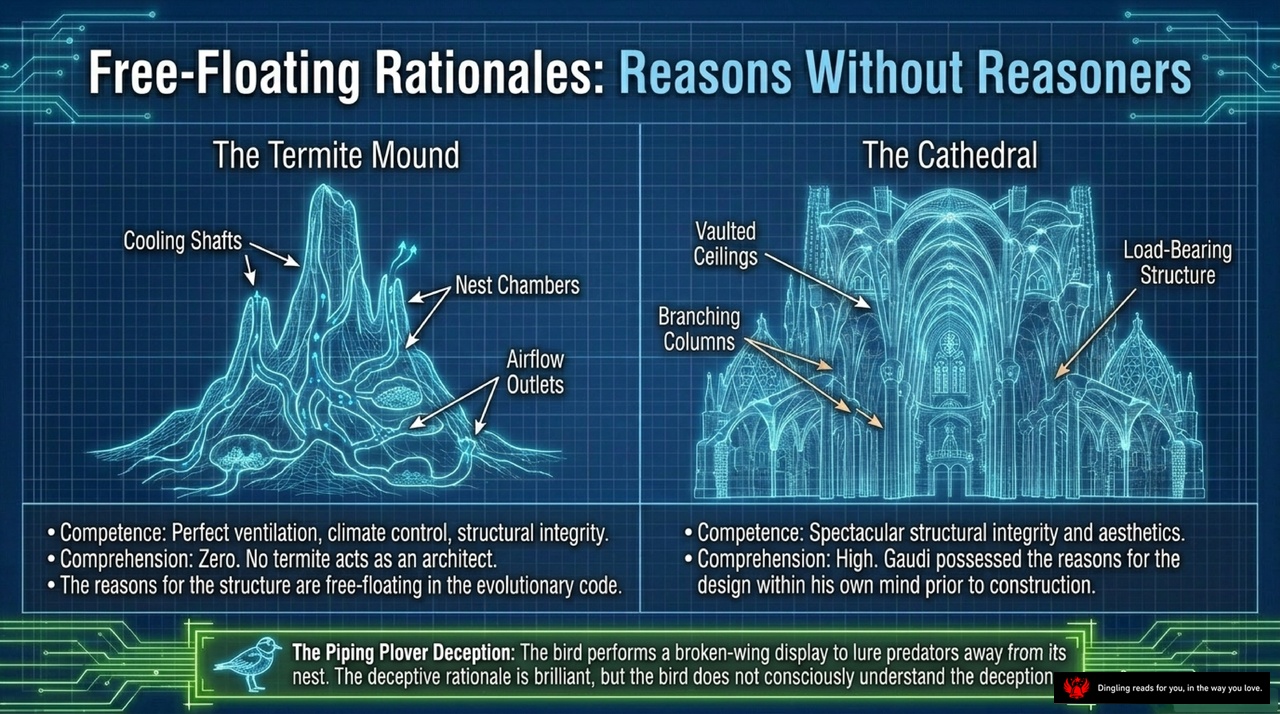
In the top-left quadrant, we have the "Human Expert" or the "Architect." Think of a master carpenter who can build a complex table without knowing the physics of wood grain or the exact stress limits of the joints. They just know how to do it. Similarly, a dog mother avoids inbreeding not because she understands genetics, but because her instincts guide her to the right choice. They operate with high competence but zero comprehension of the "why."
Now, look at the bottom-left. This is where the vast majority of biological life lives. Bacteria, ants, and even many insects. They are incredibly efficient at surviving and thriving, yet they possess almost no comprehension of their own world. They don't understand the ecosystem; they just react to it.
Then we move to the top-right and bottom-right. The top-right represents the "Novice Human Learning a Task." Here, you have high comprehension but low competence. You understand the theory of flight, but you can't yet fly. Or you know the syntax of a language, but you can't hold a conversation. It's the gap between knowing the map and being able to navigate the territory.
Finally, the bottom-right is the ideal state for a machine: high comprehension but low competence. A supercomputer that understands every variable in a physics equation but lacks the physical agency to build the engine.
The key takeaway here is the "Inversion of Reasoning." We often think competence is the result of understanding. But evolution tells us it's the other way around. We first evolve the ability to act—the competence—and only later do we develop the stories and theories to explain why we act that way. Understanding is just a retrospective tool we built to make sense of our own competence. So, don't worry if you don't understand the math yet; if you can solve the problem, you're already on the path to mastery.

Imagine your brain not as a single, centralized CEO issuing orders, but as a bustling, chaotic free market where millions of independent agents are constantly negotiating. This is the reality revealed by the "Reverse Engineering Nature" slide. Look at the trap on the left: the spring mechanism doesn't "understand" the mouse; it simply reacts to the trigger. The lethal payload fires because the physics of the spring demands it, not because of a conscious decision. Nature operates exactly the same way.
As the diagram illustrates, biological systems—from the flagellar motor to the enzyme payload—are designed by blind, exhaustive R&D rather than a hidden intelligent designer. This challenges the "Panglossian Critique," which assumes that because a system works perfectly, it must have been crafted by a genius. But the "Biological Reality" tells a different story: adaptationism is a valid reverse-engineering tactic. Nature acts as a blind engineer, generating structures that rival our best human engineering without ever needing to understand the "why" behind the "how."
This concept connects directly to the idea that intelligence and understanding are not the same thing. Just like the trap functions efficiently without a mind behind it, your neurons are autonomous agents, competing for resources and forming alliances. They don't follow a top-down command; they self-organize through competition and cooperation. This "free market" of neurons allows your brain to be incredibly plastic and resilient. If one area fails, others step in instantly. So, when we look at the complex machinery of life, we shouldn't look for a designer. Instead, we should appreciate the power of blind, purposeless physical processes generating order through sheer trial and error. Evolution is cleverer than we give it credit for, creating intricate solutions simply by keeping what works and discarding what doesn't.
The brain isn't a top-down bureaucracy where a central commander issues orders to obedient workers. Think of it more like a bustling free market, or even an ant colony. In this system, neurons aren't identical clones following a strict script; they are autonomous agents, each with its own survival instincts, competing for resources and forming dynamic alliances. This bottom-up competition and collaboration allow the brain to be incredibly flexible. If one area gets damaged, neighbors step in instantly to take over the function. There's no "HR manager" needed here.
This market dynamic is driven by a constant tug-of-war between "domesticated" neurons and their wild ancestors. Most neurons act like docile worker ants, following the blueprints set by evolution and culture. But sometimes, environmental triggers wake up ancient genes, turning these neurons into "rebels." These wild neurons break free from fixed roles, creating new connections and sparking creativity. This balance is crucial. It's also fueled by memes—cultural ideas that act like parasites, seeking neural pathways to copy themselves. Successful memes shape our very brain structure, driving a co-evolution between our genes and our culture.
Ultimately, our mind's flexibility comes from this dynamic equilibrium. We aren't just passive receivers of information; we are active participants in a complex ecosystem where biology and culture constantly reshape one another.
We are standing at a pivotal moment, synthesizing all the clues we've gathered to look at human consciousness not as a magical spark, but as the product of a long dance between our genes and our cultural memes. Think of it as an "ecological niche" built by our ancestors—a mental landscape designed by evolution to help us navigate the world.
Now, we have to face the elephant in the room: Descartes' Gravity. This is the invisible force that locks us into our first-person perspective, making us feel like the only ones with a real "inner life." It tricks us into thinking that because we feel our own thoughts, everyone else must feel theirs too. But here's the twist: our brain is actually running a "user illusion." Just like a smartphone interface hides complex code to let you tap and swipe effortlessly, our brain hides the messy neural details behind a simple, intuitive interface. We don't need to understand the physics of flight to fly a plane; similarly, we don't need to understand the biology of thought to use our minds.
This illusion is actually a brilliant survival tool. It allows us to treat our own mind as a separate entity we can monitor and even deceive. This self-monitoring capability gave rise to language, turning our internal monologue into a tool for thinking. We started asking ourselves questions out loud, creating a feedback loop that sharpened our logic. But remember, this "feeling" of understanding isn't always a direct window into reality. As David Hume taught us, we often mistake our brain's habits for the laws of the universe. We see cause and effect, but we're really just predicting the next frame in a movie our brain is projecting.
So, when we look at the world, we aren't seeing the raw truth. We are seeing a "common-sense image"—a simplified, user-friendly version of reality curated by evolution. This image helps us survive, but it can also blind us to the deeper mechanics of how things work. Consciousness isn't a mysterious theater where a ghost watches the show; it's a sophisticated, evolved user interface. It's a shared hallucination that lets us interact with each other and the world efficiently, without needing to decode every single variable. We are the designers of this illusion, and understanding that we are building the map we walk on is the first step to truly understanding ourselves.

Now, let's bring the pieces together to answer the big question on this slide: What exactly is information?
We often think of information as just data—those 1s and 0s streaming through cables. That's what Claude Shannon defined. It's purely about the mechanism: how many bits we transmit, how much noise we filter out, and how fast the bandwidth is. It's completely divorced from meaning. A string of random code is just as much "information" in Shannon's view as a life-saving message.
But for evolution, and for life, that's only half the story. We need to talk about semantic information—the meaning that actually makes a difference. This is where the real magic happens. It's not just about transmitting data; it's about information that constitutes a design improvement for an organism.
Look at the diagram. The same raw data—a falling leaf—triggers two completely different responses depending on who receives it. For the tree, it's a signal to drop leaves and conserve energy. For the squirrel, that exact same leaf is a predator-alert trigger, signaling a threat. The data hasn't changed, but the semantic value has exploded because the receiver's needs changed.
This is the key insight from MacKay and Bateson: information is a difference that makes a difference. It's the gap between what is and what should be, filtered through the specific needs of the receiver. A predator-alert eye icon means nothing to a rock, but everything to a fleeing animal.
So, when we talk about the currency of evolution, we aren't just talking about bandwidth. We're talking about this semantic layer—the specific, context-dependent meanings that allow a squirrel to survive, a tree to adapt, and ultimately, life to thrive. That is the information that drives evolution forward.
Today, we pull all the threads together to look at the human mind not as a magical, isolated soul, but as a product of our genes and our cultural memes evolving together within a specific cognitive niche. We face a powerful force called "Cartesian Gravity"—the illusion that we are the only ones truly experiencing the world. But the truth is, our brains are built with a "user interface" that simplifies reality so we can function efficiently without understanding the messy details underneath.
Think about it: we often think we directly perceive cause and effect, like seeing a brick break a window. But philosopher Hume showed us that's a trick. We only see the brick appear, then the window breaks; our brains simply habitually link them and project a causal story onto the world. This "inversion of reasoning" applies to everything. We mistake our internal expectations for objective properties of the world. Our sense of self, our private feelings, even our consciousness itself, are largely a shared illusion—a useful fiction that helps us navigate.
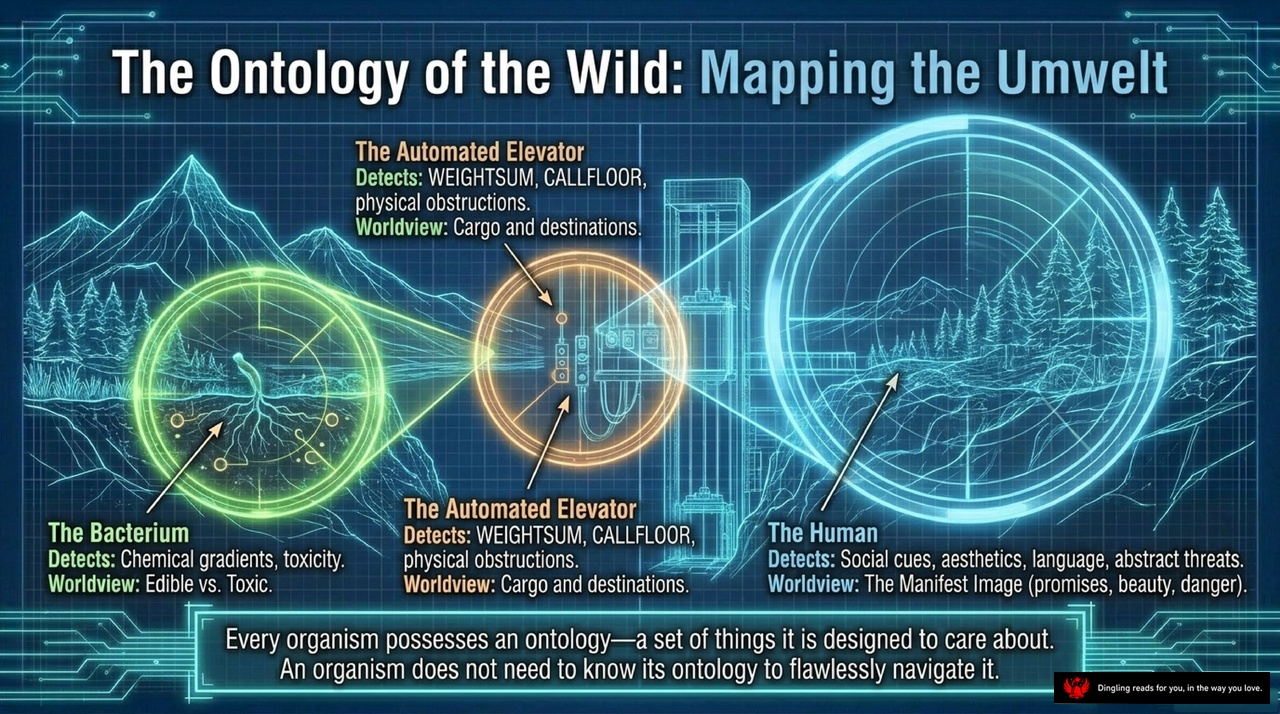
We aren't the only ones doing this. Animals and even simple machines operate on "ontologies"—a set of things they are designed to care about—without needing to understand the "why." An automated elevator tracks weight and floors to get cargo to a destination; a bacterium tracks chemicals to avoid poison. Neither understands physics or biology, yet both navigate their worlds flawlessly. Humans are unique because we layer a complex cultural operating system on top of this biological base. We use language and tools to build a "virtual machine" that lets us simulate scenarios, critique our own ideas, and see patterns others miss.
Ultimately, consciousness isn't a ghost in the machine. It's an evolved user interface. It's the reason we feel we are the designers of our thoughts, when in reality, we are often just the users of a system built by billions of years of evolution and cultural competition. We don't need to understand the code to run the program; we just need to know how to use it.

Today's slide maps out "The Tower of Mind," visualizing how we internalize the evolutionary process across four distinct tiers. At the very base, Tier 1 represents our Darwinian roots: creatures pre-designed by genetics where death is the only teacher. Moving up to Tier 2, we enter the realm of Skinnerian creatures, defined by operant conditioning and real-time trial and error. Here, we learn by interacting directly with the physical world.
The next leap occurs at Tier 3, home to Popperian creatures. This is where the game changes. Instead of risking our physical bodies in the external environment, we shift to inner simulation. We begin pre-testing actions in our minds, effectively internalizing the risk. As we ascend to the pinnacle, Tier 4, we become Gregorian creatures. This is the human advantage: tool use and cultural evolution. We upgrade our capabilities via external culture rather than relying solely on biological changes.
Notice the arrows on the right labeled "Internalizing the Risk." This is the core theme of the slide. As we climb this tower, evolution shifts the burden of trial and error from the physical environment—where failure often means death—into our internal cognitive environment. We don't just adapt to the world anymore; we simulate it, refine it, and eventually build tools that let us transcend our biological limits. This progression explains how we moved from blind survival to conscious, cultural mastery.
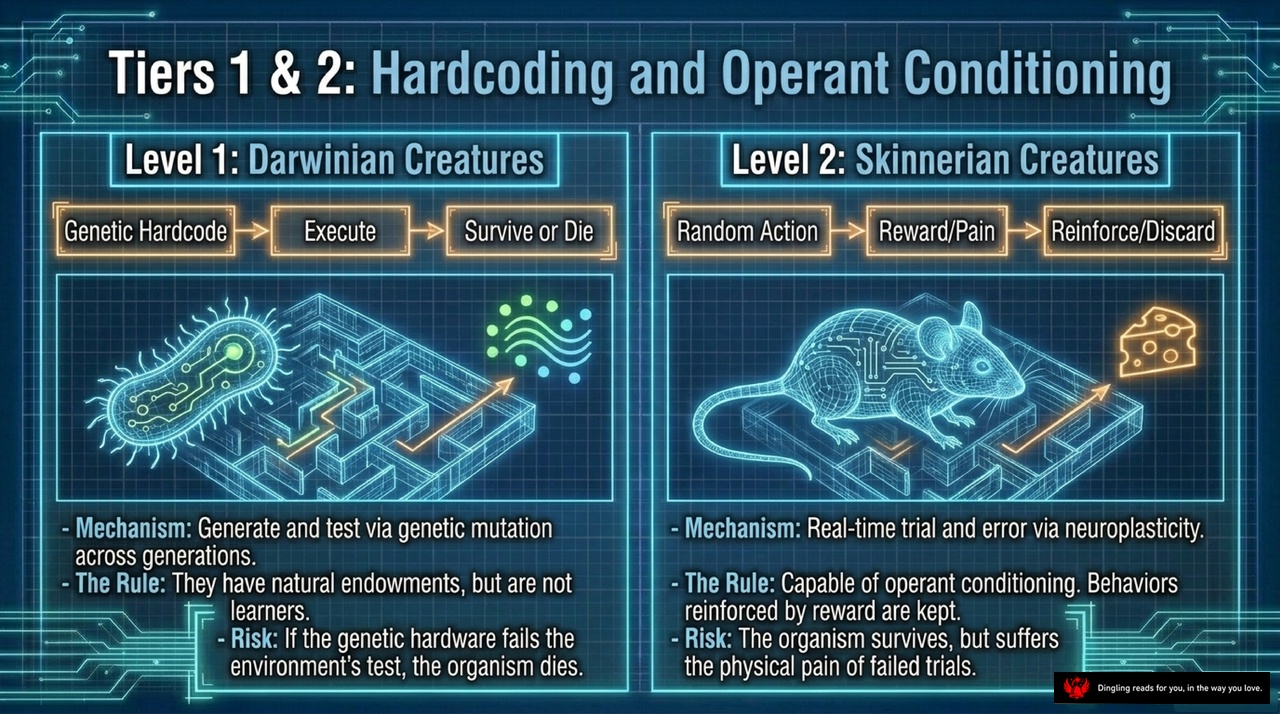
Today's slide breaks down the first two tiers of our cognitive evolution: Hardcoding and Operant Conditioning. On the left, we see Level 1: Darwinian Creatures. Think of a bacterium navigating a maze. Its intelligence isn't learned; it's genetically hard-coded. It executes a fixed program to survive or die. The risk here is fatal—if the genetic hardware fails, the organism simply dies. It has no ability to learn from the environment.
On the right, we have Level 2: Skinnerian Creatures. Look at the rat in the maze. This is where operant conditioning kicks in. Instead of a fixed script, the organism takes random actions. If an action leads to a reward, like that piece of cheese, the behavior is reinforced and kept. If it causes pain, it gets discarded. This mechanism relies on real-time trial and error via neuroplasticity. The rule is simple: behaviors reinforced by reward are kept. The risk here isn't death, but suffering the physical pain of failed trials.
So, the key shift from Level 1 to Level 2 is the move from rigid genetic execution to flexible learning. Level 1 creatures are built for a specific environment, while Level 2 creatures can adapt to new ones by learning from consequences. This ability to modify behavior based on feedback is the foundation for everything that comes next, including the complex human mind we'll explore in later chapters.
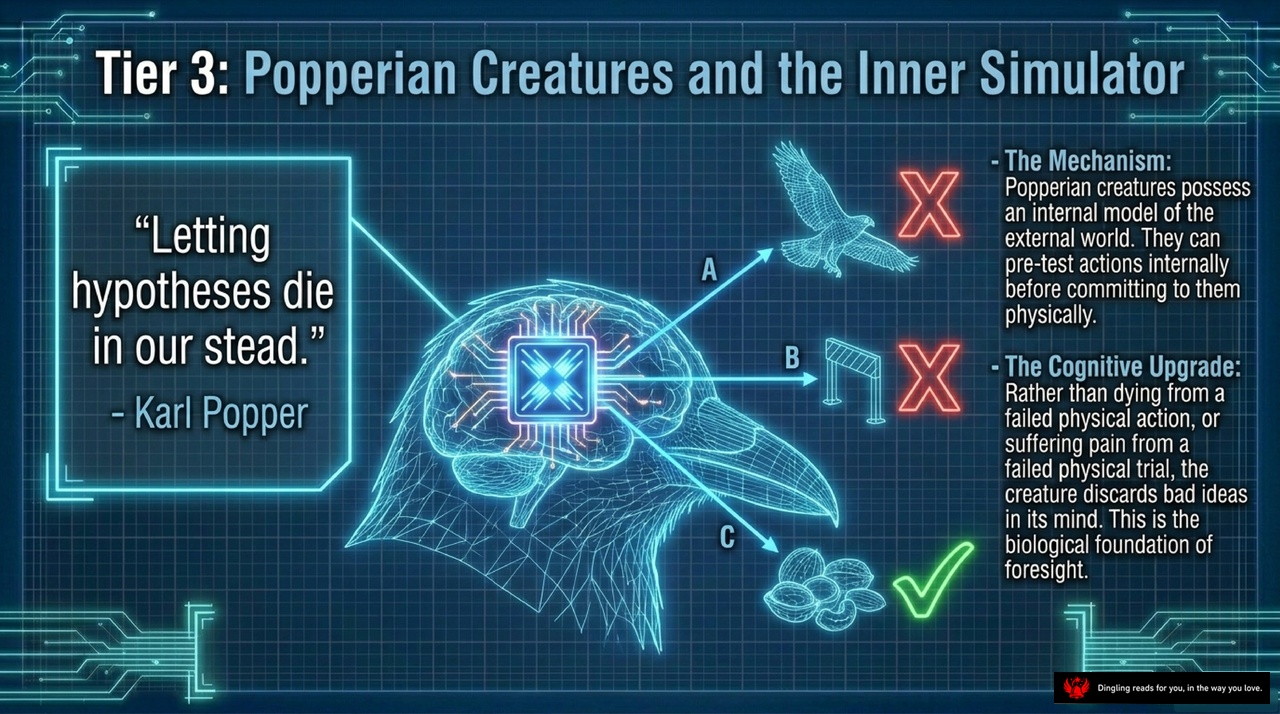
Tier 3: Popperian Creatures and the Inner Simulator. Imagine a bird facing three choices: flying into a storm, crashing into a fence, or safely pecking at nuts. Most animals operate on a "try and see" basis, risking physical pain or death to learn from failure. But look at the brain here; a Popperian creature possesses something far more advanced: an internal simulator. It doesn't just act; it pre-tests actions mentally before committing to them physically. That red "X" next to the storm and the fence represents failed hypotheses that were discarded in the mind, never costing the bird a single feather. This is the cognitive upgrade: rather than dying from a failed physical action, the creature discards bad ideas in its mind. This biological foundation of foresight is exactly what Karl Popper meant when he said, "Letting hypotheses die in our stead." While lower-level creatures rely on trial and error, this inner simulation allows for true planning and prediction, separating the strategic mind from the reactive instinct.
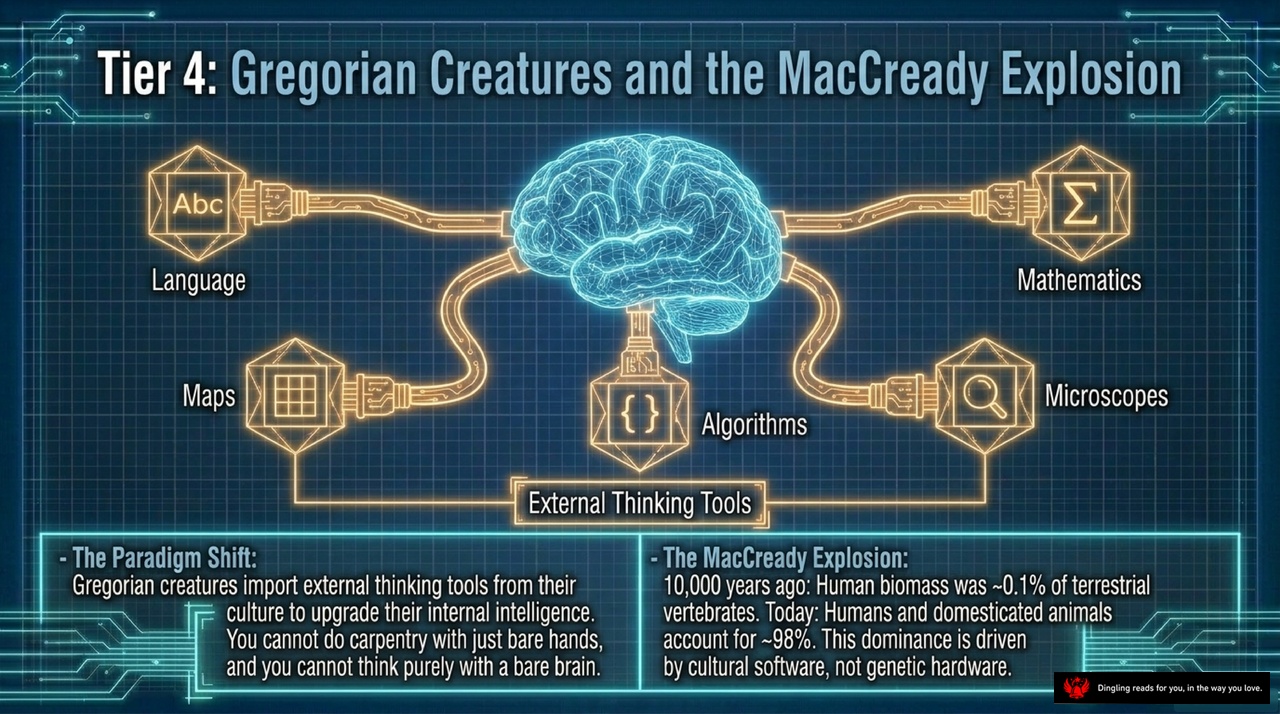
Tier 4 introduces the Gregorian Creatures and the MacCready Explosion, a pivotal shift where we stop relying solely on our biological hardware and start leveraging external thinking tools to upgrade our intelligence. As the diagram illustrates, these tools—Language, Mathematics, Maps, Algorithms, and Microscopes—connect directly to our brains, acting as an extension of our cognitive power. You cannot do carpentry with just bare hands, nor can you think purely with a bare brain; the Gregorian creature is defined by importing these cultural artifacts to solve problems that biology alone cannot.
This externalization of thought led to the MacCready Explosion. Just 10,000 years ago, human biomass was a mere 0.1% of all terrestrial vertebrates. Today, humans and our domesticated animals account for nearly 98%. This massive dominance isn't driven by a sudden genetic mutation or a new species of hardware; it is fueled entirely by cultural software. We have outcompeted other species not because we are physically superior, but because we can use maps to navigate terrain, algorithms to process data, and microscopes to see the invisible. This explosion proves that our unique advantage lies in our ability to build and use tools that think for us, allowing us to dominate the planet through the power of ideas rather than just muscle.
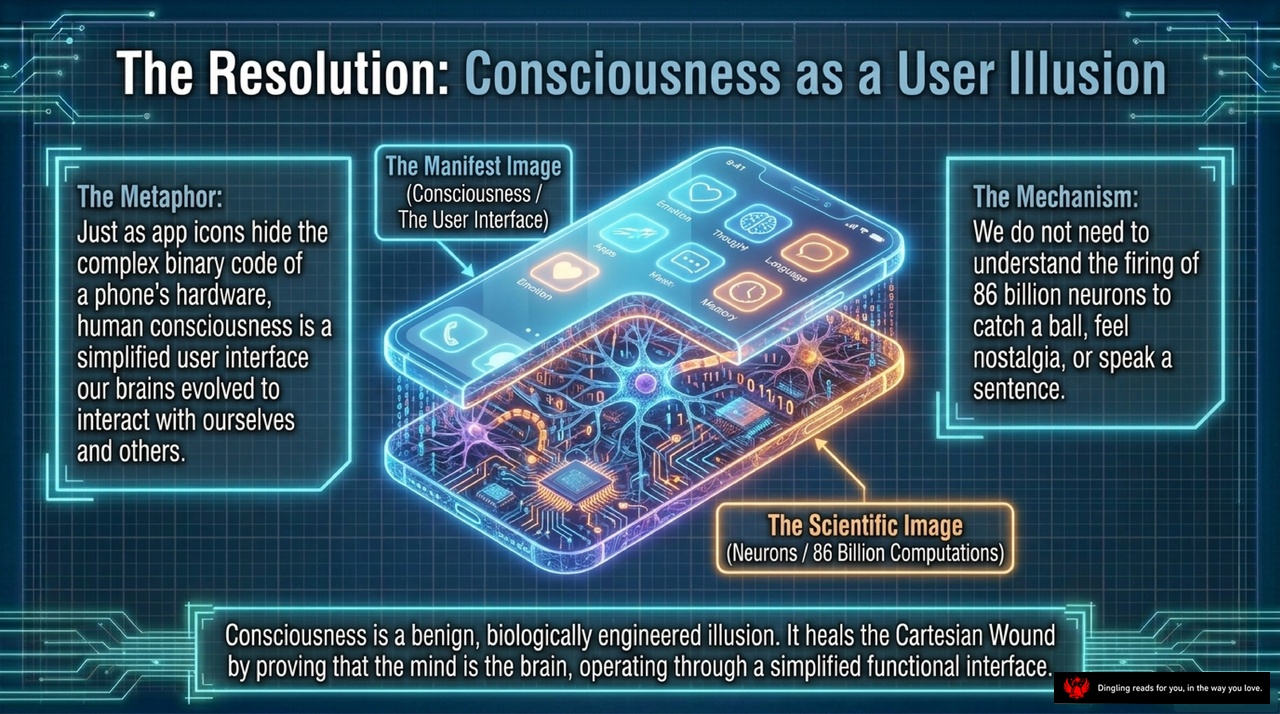
Imagine your brain as a high-performance smartphone. Beneath the sleek, glowing screen lies a chaotic tangle of 86 billion neurons firing in complex, binary code. But do you really need to understand that intricate hardware to send a text or catch a ball? Absolutely not. You simply tap an icon and the job gets done.
This is the core resolution we are reaching today: Consciousness is nothing more than a user illusion.
Just as app icons hide the messy reality of a phone's processor, human consciousness is a simplified interface our brains evolved to interact with ourselves and the world. We do not need to comprehend the firing of 86 billion neurons to feel nostalgia, speak a sentence, or navigate our environment. We just need the interface to work.
This concept is a benign, biologically engineered solution to a centuries-old philosophical crisis known as the Cartesian Wound. For too long, we have been trapped by "Cartesian Gravity"—the belief that our mind is a magical, non-physical entity separate from our physical brain. This illusion convinces us that we possess a special "qualia," a magical inner life that no machine could ever replicate.
But the truth is far more practical. Consciousness is simply the user interface of the brain. It proves that the mind is the brain, operating through a simplified functional layer. By accepting this, we heal the ancient wound of dualism and realize that our unique human experience is just a brilliant evolutionary hack, allowing us to navigate a complex world without getting lost in the messy details of the underlying code.

Imagine a universe that doesn't start with a grand design, but builds itself from the ground up. Just as bacteria evolve into complex life without a blueprint, nature engineers competence long before it engineers comprehension. This is the reality we often ignore because of a deep-seated illusion: we are biased to believe that understanding must come first. We assume that to be smart, you must know *why* you are doing something. But the truth is far stranger and more powerful.
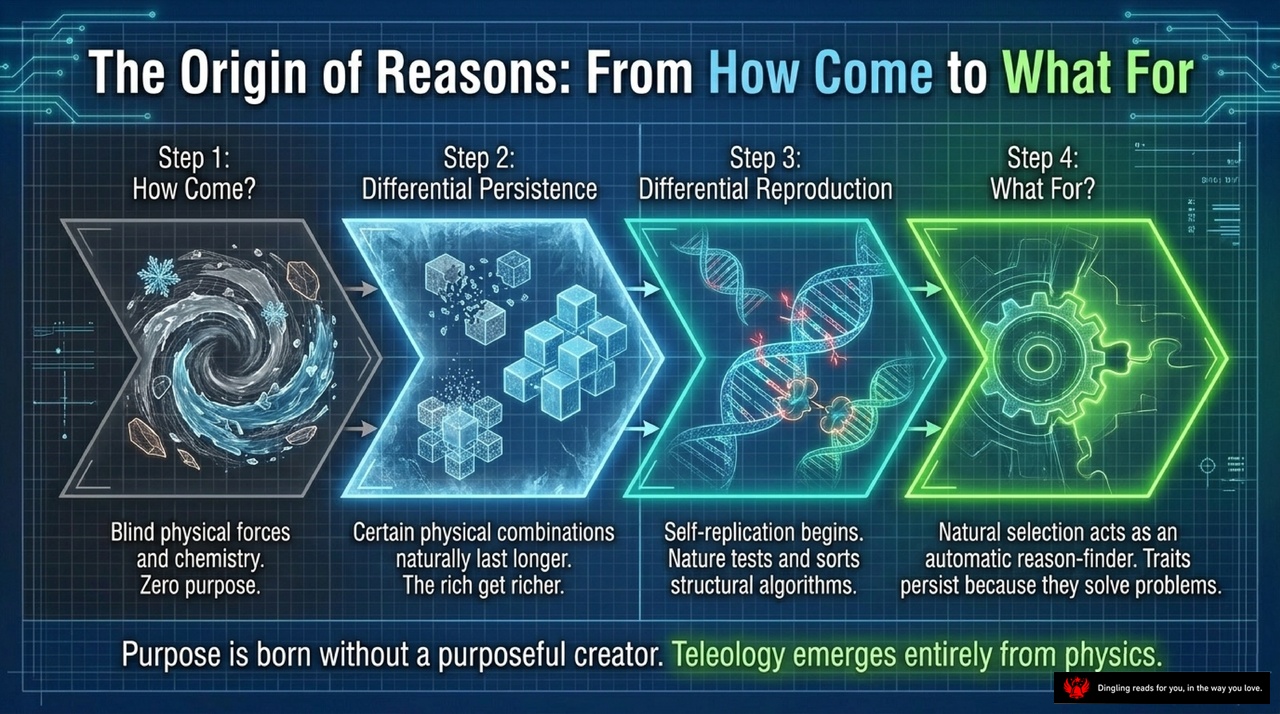
Look at the cycle in the center. It starts with abiotic cycles—simple chemical loops. Through natural selection, these blind processes create biological competence. Organisms learn to survive, to hunt, to reproduce, all without ever understanding the underlying physics. They are essentially reverse-engineered reasons in action. A bird flies not because it understands aerodynamics, but because the trait helped its ancestors survive. This is the "ascent" shown on the right: competence precedes comprehension.
Finally, humans arrive on the scene. Through cultural evolution and the invention of thinking tools like language and math, we are the first species to turn that raw competence into full comprehension. We look at the world and ask, "Why?" and then we build models to answer it. As the bottom text reminds us, magic isn't required to explain the mind. Time, evolution, and these strange inversions are enough to turn mindless matter into the music of Bach. We didn't need to understand the universe to build it; we just needed to build the tools that let us understand it.