
Fundamentals: Complete Chapter-by-Chapter Summary

Welcome to our journey into the fundamentals of reality with Frank Wilczek. Today, we are stepping into a strange, magnificent universe that demands we unlearn our childhood intuitions.
Look at this cosmic backdrop blending galaxies with neural networks. It perfectly captures the book's core promise: ten keys to reality that will reshape how you see the world. We are not just observing the universe; we are being reborn into it.
The first realization is about space. We often think of space as just the empty void outside us, but reality is far richer. While the external universe stretches infinitely, making us feel like a single atom as Pascal once lamented, our internal space is equally vast. Inside your own body lie roughly 10 to the 28th power atoms—a number so huge it dwarfs the stars in the entire visible universe. As Walt Whitman declared, "My heart expands to embrace all things." We are not small; we are a universe within a universe.
But the journey goes deeper. The laws governing this vast space and time are surprisingly simple. The entire complexity of our world—from the atom to the galaxy—is built on just a few fundamental principles and a tiny set of particles. It is a universe of few components, few laws, and a single origin, yet it generates infinite complexity through simple rules iterating over time.
As we explore further, we find that reality is not a single, fixed picture. It is a landscape of complementary perspectives. Just as a musician hears both melody and harmony, or a physicist sees both particles and fields, we must learn to hold seemingly contradictory truths in our minds to understand the whole. This is the essence of the fundamental shift Wilczek invites us to make.
So, let's begin by unlearning what we thought we knew, and stepping into the true, interconnected, and profoundly simple reality that underlies everything we see.
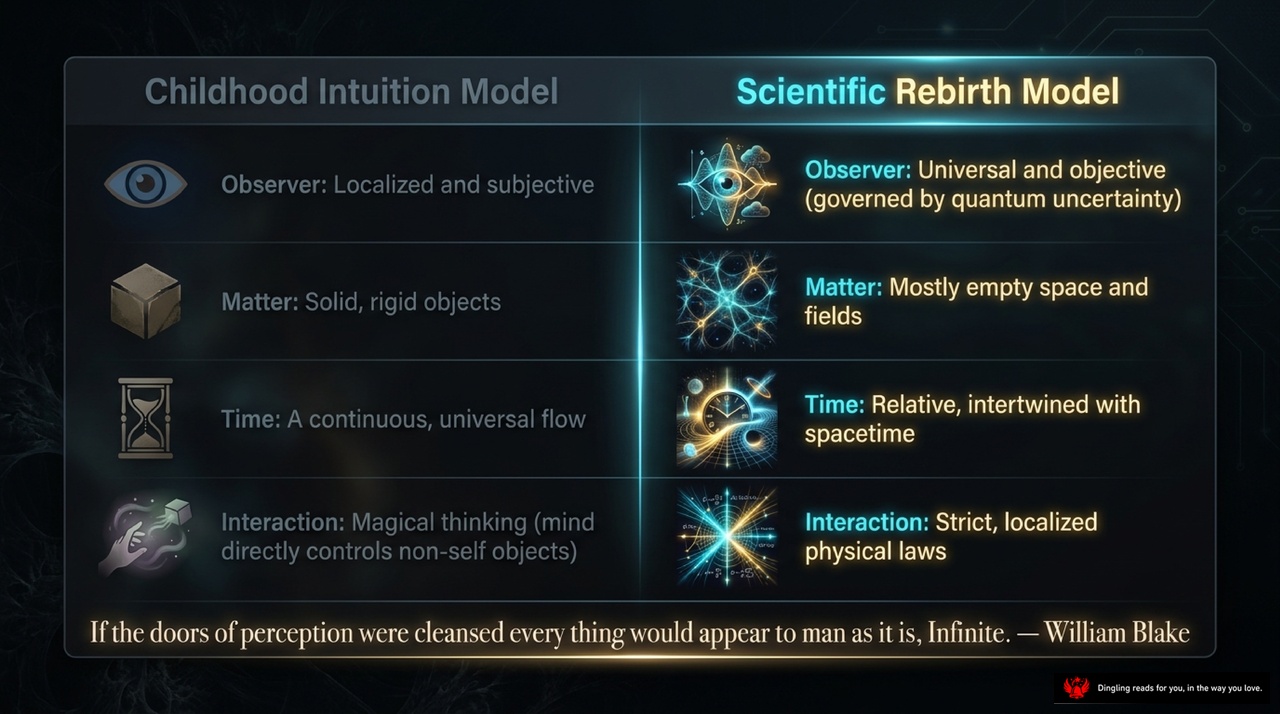
Imagine you've been raised believing the world is solid, that time flows like a river, and that you can magically control objects with your mind. That's our "Childhood Intuition Model"—the lens we all wear by default. But what if that lens is cracked? Today, we're swapping it for the "Scientific Rebirth Model," a radical upgrade that shatters our everyday reality.
Look at the observer first. In our childhood view, you are a localized, subjective point in space. But in the scientific rebirth, you are universal and objective, governed by the wild uncertainty of quantum mechanics. You aren't just watching the universe; you are woven into its fabric.
Now, consider matter. We think of it as solid, rigid blocks. Science reveals a stranger truth: matter is mostly empty space and invisible fields. It's not a solid cube; it's a dynamic field of energy. Time, too, changes completely. We see it as a continuous, universal flow, but physics tells us it's relative, intertwined with space itself into a single fabric called spacetime.
Finally, think about interaction. We used to believe in "magical thinking"—that our minds directly control non-self objects. Reality is far more disciplined. Interactions follow strict, localized physical laws. Nothing happens without a cause, and no force reaches across the void instantly.
As William Blake famously wrote, "If the doors of perception were cleansed, everything would appear to man as it is, Infinite." By cleansing those doors, we move from a childish fantasy of magic and solidity to a profound, infinite reality governed by elegant, counter-intuitive laws. This isn't just a shift in physics; it's a rebirth of how we see everything.

Welcome to the world of the subatomic, where the invisible rules of our universe finally reveal themselves. Today, we dive into the four fundamental forces that shape everything we see, touch, and experience.
First, let's look at the forces that build our everyday reality. Electromagnetism is the master architect of the macroscopic world. It binds electrons to atomic nuclei, creating the structure of atoms, molecules, and the complex chemistry of life. Without this force, you couldn't touch a table or see the colors of the world. Then there is the Strong Force, governed by Quantum Chromodynamics. This is the ultimate glue holding the atomic nucleus together, overcoming the electrical repulsion between protons. Without it, the nucleus would instantly fall apart, and matter as we know it wouldn't exist.
On the other side, we have the forces that govern the cosmos and the subatomic decay. Gravity, described by General Relativity, is the weakest of all, yet it is the dominant force on a large scale. It keeps the Earth in orbit around the Sun and holds galaxies together. Finally, the Weak Force acts as a subtle regulator. It is responsible for particle transformation, like the decay of neutrons, which powers the slow, steady nuclear fusion in our Sun. If this force were stronger, the Sun would burn out in a blink; if weaker, it wouldn't shine at all.
Physicists have a grand dream: to unify these four distinct forces into a single theoretical framework. We know that at extremely short distances, their strengths converge, hinting at a deeper, unified reality. While we haven't yet found the final proof, this pursuit drives the frontier of physics. From the core theories that gave us lasers and transistors to the search for proton decay, we are slowly stitching together the fabric of reality. We are learning that the universe is not a chaotic mess, but a symphony conducted by just four simple, elegant forces.

Imagine a world where the most profound discoveries come not from adding more rules, but from stripping everything away until only the essential remains. This is the core of our journey into the universe's deepest secrets. We are guided by four simple, universal principles that act as the bedrock of all physical reality. First, the laws of nature only describe how things change, not why they are the way they are. Second, these laws are universal; what we discover in a lab holds true across the entire cosmos. Third, locality dictates that an object's future depends only on its immediate surroundings, rejecting the idea of spooky, instant action at a distance. And fourth, these laws are exact, with no exceptions, expressible through precise mathematics.
These principles seem simple, yet they represent a monumental shift from ancient beliefs. For centuries, humanity clung to models that violated these rules, like astrology's idea that distant stars could instantly influence our lives. Science broke free by insisting on locality. Even Isaac Newton, the father of classical physics, struggled with this. His law of universal gravitation suggested an instant pull across empty space, which felt absurd to him. He knew there had to be a deeper, local explanation. It took the invention of the concept of "fields" to solve this mystery, showing that forces ripple through space rather than jumping across it instantly.
Beyond these governing rules, we find that the entire material universe is built from just a handful of basic ingredients. Richard Feynman once said that if we could only pass down one sentence of scientific knowledge, it should be: "Everything is made of atoms." Modern physics refines this: the fundamental properties of any particle boil down to just three things—mass, charge, and spin. Mass gives particles inertia and gravity; charge determines how they interact; and spin is an intrinsic quantum property, like a tiny, un-rotatable rotation.
Nature uses these few components to build everything we see. We have "building particles" like electrons, photons, and quarks that form the fabric of our world. But nature is also creative in unexpected ways. Inside materials, particles interact to create "quasiparticles"—new entities with unique properties that don't exist in a vacuum. Think of "holes" in a semiconductor, which act like positive particles and are the foundation of modern electronics. Or consider "anyons," exotic quasiparticles that can store memory, holding the key to stable quantum computing.
So, we have a universe governed by four simple laws, constructed from a tiny set of particles, yet capable of infinite complexity. This minimalism is not a limitation; it is the source of our vast reality. By understanding these few components and laws, we unlock the blueprint for everything from the atoms in our bodies to the stars lighting up the night sky.

The slide presents a profound map of our reality, built on the idea that the universe is governed by "radical conservatism"—applying simple, tested local laws to unlock cosmic truths. At the center lies our "Human Earth," the anchor point from which we measure everything.
To our left, we see "Measuring the Macro." This is the story of how we map the vast cosmos. It starts right here with Earth radar and GPS, relying on the speed of light to establish our baseline. From there, we step up the ladder: using stellar parallax to gauge nearby stars, then standard candles like Cepheid variables for distant galaxies, and finally cosmic redshift to map the expanding universe itself, all rooted in Hubble's groundbreaking work.
To our right, we explore "Measuring the Micro," diving into the intricate architecture of life and matter. We begin with X-ray diffraction on salt crystals, which unlocked the secrets of complex molecules like penicillin and cholesterol. This technique climbed the ladder to reveal Rosalind Franklin's and Watson and Crick's discovery of the DNA double helix.
The brilliance of this framework is that whether we are looking at the birth of galaxies or the twist of a DNA strand, we are using the same fundamental principles. By starting with what we know locally and scaling out or in, we can understand the entire universe.

Imagine you're holding a single atom. It's not just a tiny speck; it's a powerhouse of complexity. In just one gram of matter, you have roughly 10 to the power of 23 atoms. That's a number so vast it dwarfs the total count of stars in our entire observable universe. This sheer abundance is the secret ingredient for complexity.
But it's not just about quantity. It's about how these atoms interact. They follow the rules of quantum mechanics and electrodynamics, snapping together into chemical bonds. This allows them to form an infinite variety of molecules, from simple gases to the incredibly intricate structures of life itself.
Think of it as a massive library where the alphabet is limited to just four letters—DNA's nucleotides—or twenty letters for proteins. Yet, by arranging these letters into long chains, branching structures, and loops, you can generate trillions upon trillions of unique combinations. It's a combinatorial explosion.
This is where the real magic happens: temporary stability. On Earth, our temperature sits at a sweet spot of about 20 degrees Celsius. It's warm enough to keep molecules flexible and active, yet cool enough to hold those chemical bonds together without breaking them apart. Contrast this with the Sun's surface, blazing at 6,000 degrees, where the energy is so high it shatters bonds instantly. It's this delicate balance between heat and cold that allows complex structures to exist long enough to do something useful.
Take the human brain. It contains roughly 100 billion neurons, each connected to hundreds of others. The sheer number of possible connections between them is astronomical—far exceeding 10 to the power of 27. This network is the peak of dynamic complexity, capable of storing and processing information in ways no other system can match.
So, where does all this energy come from? The Sun. It acts as a giant fusion reactor, converting hydrogen into helium and releasing a staggering amount of energy. In fact, the amount of solar energy hitting Earth every year is about 10,000 times greater than all the energy humans currently consume.
This energy fuels the dynamic complexity that defines life. Gravity keeps our planet in a stable orbit, maintaining a temperate climate. Electromagnetism builds the molecules that make up our bodies. The strong force holds atomic nuclei together, making nuclear reactions possible. And the weak force acts as a regulator, ensuring the Sun burns slowly and steadily over billions of years instead of exploding in a flash.
However, we face a critical choice. We are currently burning through fossil fuels, which are finite and pollute our atmosphere. If we continue on this path, we risk triggering a runaway greenhouse effect, similar to what happened on Venus, where the surface temperature is hot enough to melt lead.
The future of complex systems depends on our ability to harness energy sustainably. We have the potential to tap into solar, wind, and nuclear power on a scale that could support civilization for millennia. But we also face a darker possibility: the misuse of nuclear energy. The same physics that allows us to power cities also gives us the power to destroy them.
Ultimately, our ability to expand our influence into the cosmos relies on mastering these principles of energy and complexity. We can build machines to explore distant worlds, or we can create digital systems that process information faster than any biological brain. But it all comes down to one thing: our choices. Will we use the abundant energy of the universe to build a flourishing future, or will we let our own complexity become our undoing? The universe offers us the tools; it is up to us to wield them wisely.

Welcome to the chapter on the history of the universe. Imagine the cosmos not as a finished product, but as an unfinished book waiting to be read. We know we've uncovered some of its most important chapters, but there are still pages left blank.
Let's look at the evidence we've gathered. We see distant galaxies moving away from us, and the farther they are, the faster they recede. This is Hubble's Law, and it tells us the universe is expanding. If we rewind the tape, everything converges to a hot, dense beginning—the Big Bang. We also have the cosmic microwave background, the faint afterglow from 380,000 years after the birth of the universe, which perfectly matches our predictions. Plus, the mix of light elements like hydrogen and helium in the early universe lines up exactly with what our models say should happen. These three pieces of evidence form a rock-solid framework for how our universe began.
But the story doesn't stop there. We have to ask: what happened right at the very start? How did the universe become so smooth and flat? This is where the theory of cosmic inflation comes in. It suggests a brief, explosive expansion that smoothed out the fabric of space and set the stage for galaxies to form. It's a powerful idea, but it's still a work in progress.
We are also hunting for even older clues. While light takes time to reach us, neutrinos and gravitational waves could carry messages from the first few seconds of existence. And there's the mystery of dark matter. We know it's there because of how galaxies spin and how light bends around them, but what is it? Some scientists think it might be made of axions, a new particle we are racing to detect. Finding an axion would solve two huge puzzles at once: the nature of dark matter and a long-standing mystery about time symmetry.
Then we hit the ultimate philosophical wall: the origin of time itself. If the universe began at a singularity, what was there "before"? As St. Augustine pondered centuries ago, if there was no change and no matter, the concept of "before" might not even make sense. Time itself might have started with the universe.
So, the book is still open. We have the inflationary epoch, the search for primordial neutrinos, the hunt for axions, and the question of time's beginning. Every answer we find leads to a new, deeper question. The history of the universe is a story of endless discovery, and we are just turning the page.

We've spent enough time looking at the universe as a collection of separate, solid objects—like tiny billiard balls bouncing around in empty space. That was our comfortable, classical view. But the reality is far stranger and far more fluid. The true fabric of our world isn't empty space filled with particles; it's a vast, interconnected web of energy called quantum fields.
Think of these fields as a dormant, glowing grid that stretches across the entire cosmos. This is the reality. What we perceive as a particle—like an electron or a photon—isn't a solid ball at all. Instead, it's just a localized ripple, a concentrated wave, or a "glowing peak" rising up from that underlying field. When you disturb the field, you create a particle. When the ripple settles, the particle disappears.
This shift in perspective is revolutionary. It means that matter and force aren't two different things; they are simply two aspects of the exact same entity. To study particles is to study fields; to study fields is to study forces. We aren't just watching objects move through space; we are watching fields interact and ripple. This field-based reality is the foundation of everything from the chemistry of life to the structure of atoms, replacing our old illusion of solid matter with a dynamic, unified dance of energy.

Imagine a world where your senses are no longer confined by biology. For decades, we've been limited by the narrow window of human perception, but nature has evolved creatures with far superior capabilities. Dogs possess hundreds of millions of scent receptors, while bats navigate using ultrasonic frequencies we can't even hear. Some shrimp see sixteen different colors, including infrared and polarized light. But science isn't just about observing nature; it's about expanding our own limits through "planned discovery."
Consider the hunt for the Higgs boson. To find this elusive particle, we had to build the Large Hadron Collider, a 27-kilometer tunnel smashing protons together at near light-speed. It took years of sifting through billions of collisions, but in 2012, we finally confirmed the particle's existence, rewriting our understanding of the vacuum itself. Similarly, LIGO detected gravitational waves—ripples in spacetime caused by colliding black holes—opening a new window into the universe we couldn't see before.
But what happens when we push our physical boundaries? Think about the "rubber hand" illusion. When you watch a fake hand being touched while your real hand is hidden, your brain eventually accepts the fake one as your own. This proves that our sense of self isn't fixed inside our skin. Scientists are now taking this further with remote presence technology. By controlling a robot's eyes and hands, you can effectively "be" in a different room or even another country, interacting with people as if you were there. Within minutes, the robot becomes your "second body," allowing your consciousness to travel instantly across the globe.
However, there's a deeper barrier: the quantum world. As Richard Feynman famously said, "Nobody understands quantum mechanics." Our brains are wired to see a predictable, three-dimensional reality, but the quantum realm is a soup of probabilities where particles exist in multiple states at once. We can't perceive this directly. Yet, we can build a bridge using computation. By simulating these complex quantum states on supercomputers, we can translate them into images and data that our brains can understand. This allows us to "see" the quantum world, exploring a reality that was previously invisible to us.
The future of perception is about breaking the cage of the physical body. Whether through advanced sensors, remote presence, or quantum simulation, technology is allowing us to extend our senses and consciousness far beyond what was ever possible for the human animal. We are no longer just observers of the universe; we are beginning to experience it in entirely new dimensions.

Imagine a world where the fundamental rules of physics seem to break down under our very eyes. This is the realm of the Jet Phenomenon, a mind-bending illustration of how nature behaves at the smallest scales.
Here, we see a high-energy electron strike a proton, violently knocking a single quark out of its orbit. This is "The Strike." But here's the twist: as that quark tries to escape, the color field connecting it to the rest of the proton doesn't snap like a rubber band would. Instead, it stretches. And paradoxically, the stronger the pull, the stronger the force becomes. This is "The Stretch," a unique property of the strong force that grows with distance.
Eventually, the field reaches a breaking point. In "The Snap," the stored energy explodes, snapping the field apart and converting it into a cascading jet of brand-new quarks and antiquarks. This is why we can never observe an isolated quark. Quarks are permanently confined. We can only ever see the localized jets of newly birthed particles they leave behind.
This phenomenon isn't just a curiosity; it's the engine behind our understanding of matter itself, proving that even in the most extreme conditions, nature follows a logic that is as strange as it is beautiful.
Welcome back. Today, we're diving into the final frontier of our journey: the mind itself. While we've explored the vastness of space and the depth of time, the most complex system in the universe is right here, inside your head.
The slide highlights a fascinating concept called "Complementarity," originally proposed by physicist Niels Bohr. Think of it as the ultimate rule for understanding reality: to get the full picture, you often need two seemingly contradictory perspectives that work perfectly together.
Consider the difference between looking at a gas balloon from the outside versus the inside. From the outside, you see smooth, predictable air pressure and temperature. That's the macroscopic view. But zoom in to the atomic level, and you see chaotic, unpredictable individual atoms. You can't have both views at once, yet both are necessary to fully understand the gas. This is the essence of complementarity: simplicity and complexity, order and chaos, are not enemies; they are partners.
This idea extends far beyond physics. In music, you can listen to a single melody or the rich harmony of the whole orchestra, but you can't do both simultaneously. In art, Picasso shattered our single-point perspective by showing us multiple angles at once. Even our own free will fits here. When predicting social behavior, we rely on personality and choice, ignoring strict physical laws. But when predicting someone's survival in a nuclear blast, physics takes over, and free will disappears. Both models are true, just for different contexts.
In the age of AI, this becomes even more critical. Supercomputers can calculate quantum physics with perfect accuracy, but the results are so complex that humans can't intuitively understand them. We need the machine for precision and human intuition for meaning. We need the algorithm's cold logic and our warm creativity.
Ultimately, complementarity teaches us humility and expansion. We are not the center of the universe, but our minds are incredibly powerful. By embracing these dual perspectives—seeing both the simple rules and the complex details, the machine's power and our own soul—we unlock a deeper understanding of reality. The universe isn't just one thing; it's a symphony of complementary truths.

Welcome back. Today, we're diving into the most counterintuitive yet profound concept in modern physics: Complementarity.
Look at this slide. It captures a fundamental truth about how we understand reality. For decades, scientists struggled with the bizarre nature of the quantum world. Particles seemed to be in two places at once, or behaving like waves and like solid objects simultaneously. It felt impossible. But Niels Bohr, the father of quantum mechanics, realized that the answer wasn't to choose one over the other. Instead, he proposed that both descriptions are necessary, yet mutually exclusive. You can't see the wave and the particle at the exact same time.
Think of it like listening to a complex piece of music. If you focus on the melody, you hear the story of the tune. But if you switch your attention to the harmony, you hear the rich chords underneath. You can't fully experience both simultaneously. In the quantum realm, measuring a particle's position forces it to act like a particle, while measuring its speed forces it to act like a wave. The act of observation itself shapes the reality we see.
This idea extends far beyond physics. It's a lens for understanding everything from art to human nature. Consider Picasso's cubist paintings. He didn't try to draw a person from a single angle. He placed multiple perspectives on the same canvas. He showed us the front, the side, and the top all at once, challenging our brain to hold these conflicting views in mind to understand the whole. That is the essence of complementarity.
It also applies to our own lives. When we try to predict human behavior, we rely on free will—personality, mood, and choice. But if we are looking at a person in the path of a nuclear explosion, we must switch to a deterministic model based on physics. Neither is "wrong"; they are just tools for different questions.
In the age of AI, this wisdom is more critical than ever. Supercomputers can calculate quantum phenomena with perfect accuracy, often revealing patterns that are mathematically true but completely unintelligible to the human mind. Here lies the tension between accuracy and understanding. We need the machine for its raw power, but we need human intuition to make sense of the results. We need both the hard data and the human story.
Complementarity teaches us that the world is not a single, rigid picture. It is a spectrum of perspectives. By embracing seemingly contradictory ideas—whether it's free will and determinism, or the wave and the particle—we unlock a deeper, more complete understanding of our universe. We stop trying to force reality into one box and start appreciating its infinite complexity.

The universe is a vast, uncharted ocean, and what we experience as reality is merely the tiny, illuminated shoreline we can see. Did you know that 95% of the cosmos is actually invisible to us? This is the "Dark Sector," a realm of profound mystery that shapes everything we know.
On one side, we have the 5% of "Known Reality"—the stars, planets, biology, and the Standard Model that we can touch and measure. But the other 95%? That's the unseen universe. It consists of Dark Matter, the invisible scaffolding holding our galaxies together, possibly made of ghostly particles called Axions left over from the Big Bang. And then there's Dark Energy, a mysterious density of space itself that is actively accelerating the expansion of the cosmos.
Think about it: our current reality is just the tip of the iceberg. The greatest mysteries remain untouched, waiting for us to explore the vast, dark depths beyond the light.

The Principle of Complementarity is the ultimate lesson for our minds: to understand reality, you must hold two opposing truths simultaneously. Physics is real; consciousness is real. Both models are true, but neither is complete on its own.
Look at the left side, "The Reductive Lens." Here, we see ourselves as a collection of particles governed strictly by unyielding mathematical equations. Free will is an illusion of the physics. This is the view of the atom, where every action is determined by prior causes, and the universe operates like a giant clockwork machine. It's the cold, hard logic of the subatomic world.
Now, shift your gaze to the right, "The Emergent Lens." Here, we are conscious, feeling beings capable of choice, art, and meaning. This is the view of the human experience, where our thoughts shape our reality and our actions create new futures. It's the warmth of the lived experience.
These two perspectives often feel like enemies. One says we are just matter; the other says we are creators. But the principle of complementarity tells us they are not mutually exclusive. They are two necessary sides of the same coin. You cannot understand the full picture by choosing just one. To truly grasp who we are, we must embrace the tension between the deterministic universe of physics and the free, creative universe of consciousness. Both are true, and both are essential.

We often think of the universe as a cold, distant place governed by rigid equations, but the reality is far more profound. As we look up at the night sky, we feel small, yet science reveals a startling truth: the universe orchestrated a combinatorial explosion from just three properties and five particles, giving rise to conscious minds capable of deciphering the very laws that created them.
But here lies the central mystery. If the universe is merely a collection of simple atoms governed by strict equations, how is it that the universe is now looking back at itself, wondering what it is?
This paradox is the heart of our journey. We are not just observers; we are the universe's way of understanding itself. From the vastness of space to the intricate dance of particles, every discovery brings us closer to answering that ultimate question: How did matter become mind, and how does the whole reflect upon the part?