
Future Engine: Complete Chapter-by-Chapter Summary
Welcome to the Future Engine: From Tech Revolution to a Brand New World by Shao Chunbao. This isn't just another book about technology—it's a bold call to rethink how we live, work, and connect in an age where AI, automation, and digital transformation are no longer distant futures but present realities. As the subtitle suggests, this new technological revolution is fundamentally rewriting the rules of productivity, society, and human ethics. Whether you're a leader navigating rapid change, a creator building for tomorrow, or simply someone curious about what’s next, this book offers a clear, grounded, and forward-looking perspective on the forces reshaping our world.
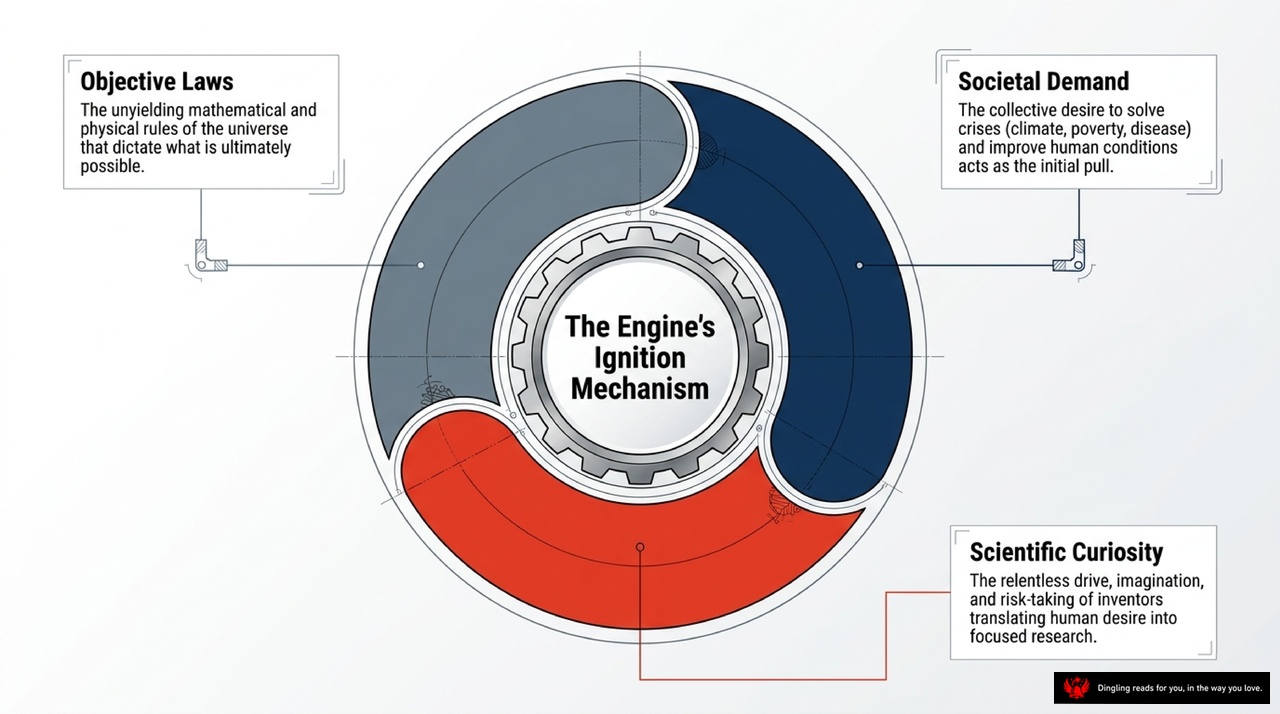
So, what actually kicks off the engine of progress? It’s not just one thing. It’s a trio of forces working in perfect sync. Look at the center—the “Engine’s Ignition Mechanism.” That’s the spark. But what feeds it?
First, there’s **Societal Demand**—the collective pull from people wanting to solve big problems like climate change, poverty, or disease. That’s the initial push.
Then, you’ve got **Scientific Curiosity**—the relentless drive of inventors and scientists to imagine the impossible and take risks to turn those ideas into real breakthroughs.
And finally, **Objective Laws**—the unyielding rules of physics and math that define what’s truly possible. They’re the boundaries, yes, but also the roadmap.
Together, these three forces create the momentum that drives innovation forward.
Alright, here is the spoken script for slide 2, tailored for an American audience, based on the visual content provided.
**Slide 2 Script:**
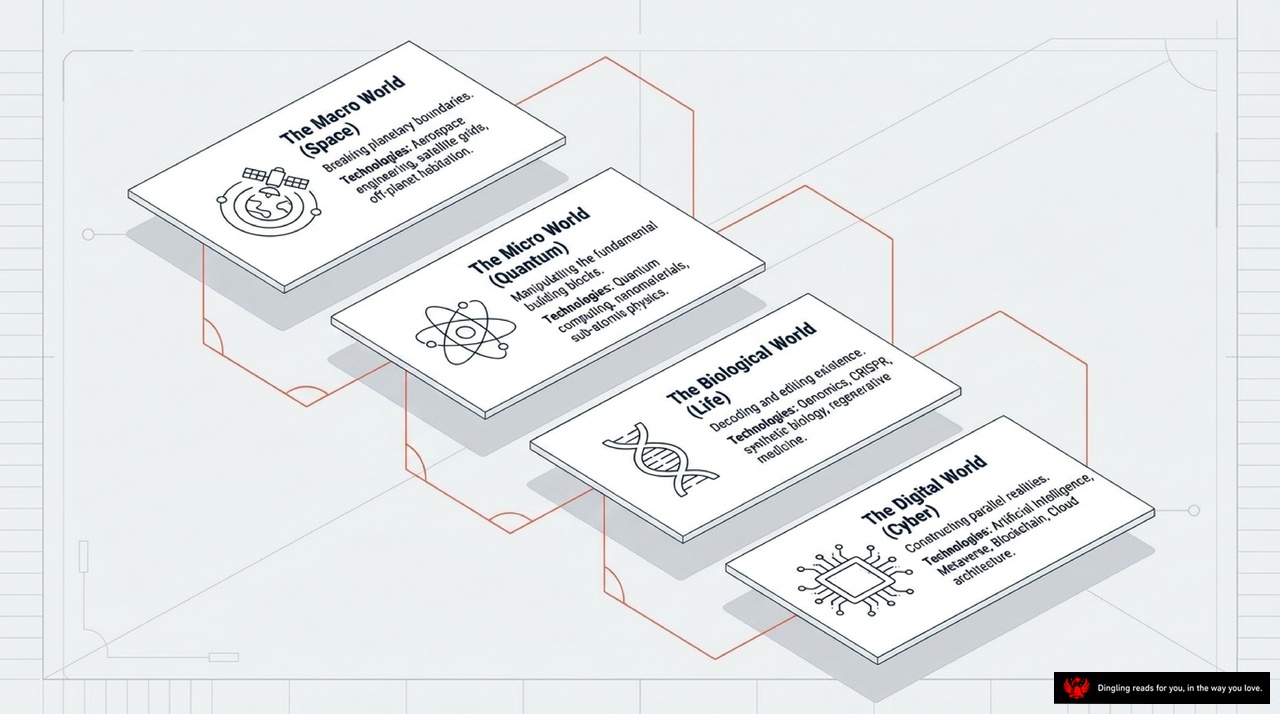
Now, let's zoom out and look at the grand scale. We aren't just talking about one specific field anymore; we are looking at a total transformation across four distinct dimensions of reality.
First, look at **The Macro World**. This is about Space. We are no longer bound by the planet. We are talking about aerospace engineering, satellite grids, and the very real possibility of off-planet habitation. It is about breaking planetary boundaries.
Then, move down to **The Micro World**. This is the Quantum realm. We are moving from the visible to the fundamental building blocks of reality. This is where quantum computing, nanomaterials, and sub-atomic physics are rewriting the rules of what is physically possible.
Next, we have **The Biological World**. This is Life. It’s about decoding and editing existence itself. We are looking at technologies like genomics, CRISPR, synthetic biology, and regenerative medicine—essentially, the ability to rewrite the code of life.
Finally, we have **The Digital World**, or Cyber. This is about constructing parallel realities. We are talking about Artificial Intelligence, the Metaverse, Blockchain, and cloud architecture. It is the creation of a new digital layer of existence.
So, when you put it all together, you see that the future isn't just about one thing. It is the convergence of the macro, the micro, the biological, and the digital. We are simultaneously expanding outward into space, diving inward into the atom, rewriting our DNA, and building a new digital universe. This is the multi-dimensional future we are entering.

Slide 3: The Triad of Convergence.
Look at this Venn diagram. It shows how the future is being built not by one field alone, but by the fusion of three powerful domains: Physical, Biological, and Digital.
On the Physical side, we have advanced materials, smart infrastructure, and robotics. Think about the cars that drive themselves or the buildings that adjust to the weather.
On the Biological side, we are unlocking the secrets of the human genome and neurology. This is where synthetic biology and bionic prosthetics come into play, blurring the line between what is natural and what is engineered.
And on the Digital side, it's the engine of it all: AI algorithms, big data, and cloud computing. This is the brain that powers the physical world and analyzes the biological data.
But the magic happens in the intersections.
Where the Physical and Digital meet, we see Industrial IoT and autonomous vehicles. Where Biological and Digital collide, we get brain-computer interfaces and digital twins in medicine.
And right in the center, where all three converge, is the ultimate goal: Human-Machine-Thing Integration. A unified, intelligent cyber-physical ecosystem. This is where the next revolution will happen.
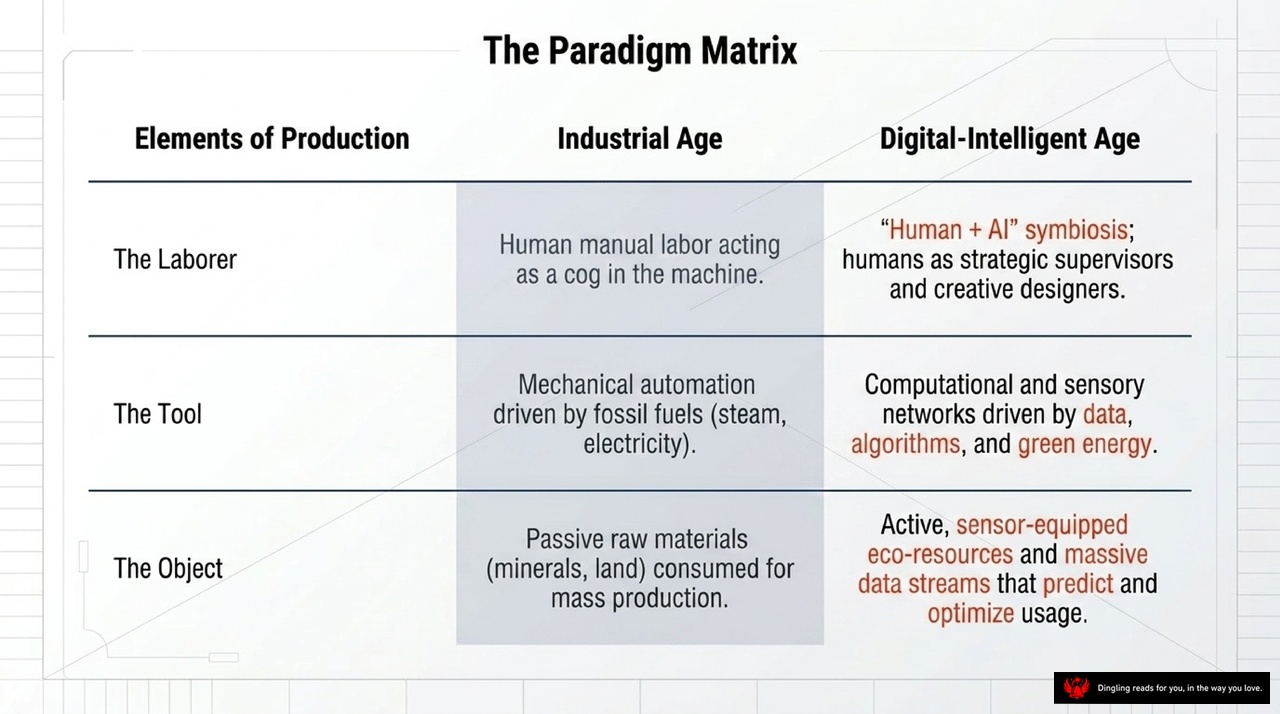
So, what we're looking at here is the "Paradigm Matrix"—a simple but powerful way to see how the world of work has fundamentally changed.
Let's break down the three key elements of production: the Laborer, the Tool, and the Object.
First, look at the **Laborer**. In the Industrial Age, you were a cog in the machine, relying on your physical strength. Today, in the Digital-Intelligent Age, you've become a strategic supervisor and creative designer. You're no longer just doing the work; you're guiding the work, often in symbiosis with AI.
Next, look at **The Tool**. Back then, it was all about mechanical automation powered by steam and electricity. Now? It's computational and sensory networks driven by data, algorithms, and green energy. The tools have become smarter, faster, and connected.
Finally, look at **The Object**. In the past, materials were passive—just raw minerals or land consumed for mass production. Today, objects are active. They are sensor-equipped eco-resources that feed massive data streams, allowing us to predict and optimize their usage in real time.
Put it all together, and you see a massive shift: from a world of passive inputs and manual labor to one of active intelligence and human-AI collaboration.
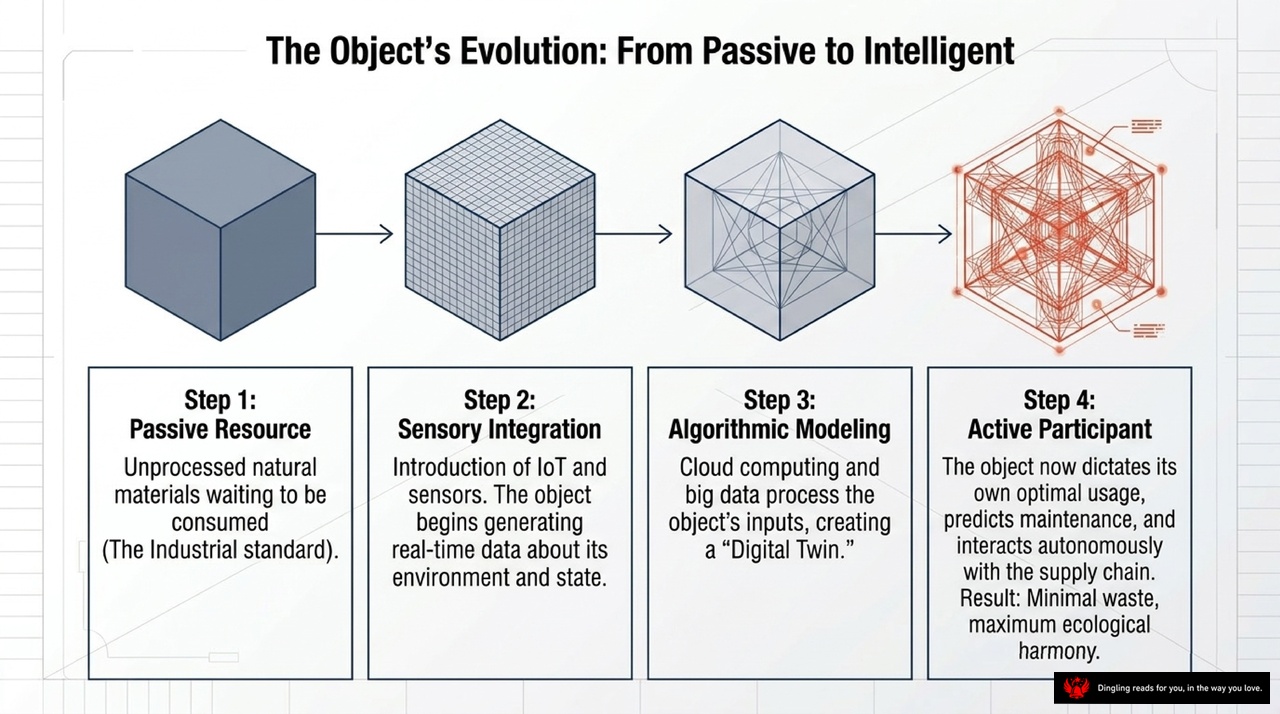
Hey everyone, let’s talk about how objects are evolving—no more just sitting there waiting to be used. Look at this: we’re moving from passive materials to smart, self-aware participants in our world.
It starts with Step 1: Passive Resource. Think of raw materials—wood, steel, plastic—just sitting there, waiting for someone to use them. That’s the old industrial model. But then comes Step 2: Sensory Integration. Suddenly, these objects get sensors and IoT tech. They start talking back—telling us their temperature, location, even how they’re being handled.
Now Step 3: Algorithmic Modeling. Here’s where it gets cool. Cloud computing and big data take that real-time info and build a “Digital Twin” of the object. It’s like having a virtual version that learns and predicts.
And finally, Step 4: Active Participant. This is the future. The object doesn’t just report—it acts. It decides when it needs maintenance, optimizes its own usage, and even coordinates with the supply chain. Result? Less waste, more harmony with nature.
So yeah—objects aren’t just tools anymore. They’re becoming partners. And that changes everything.
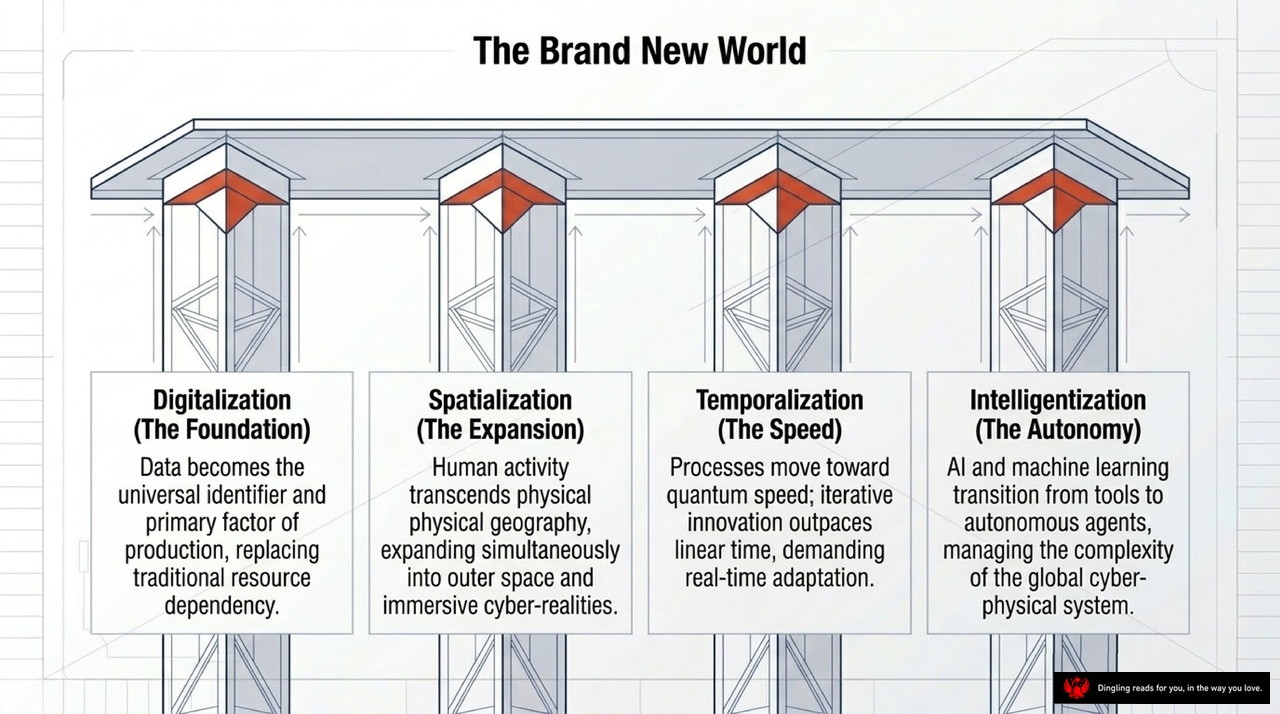
Welcome to The Brand New World. This isn’t just a future we’re predicting—it’s the operating system we’re already living in.
Think of this slide as the foundation of that new world. It’s built on four pillars: Digitalization, Spatialization, Temporalization, and Intelligentization.
First, Digitalization. Data isn’t just a byproduct anymore—it’s the primary factor of production. It’s the universal identifier that replaces our old reliance on physical resources.
Next, Spatialization. Human activity is no longer bound by geography. We’re expanding into outer space and immersive cyber-realities simultaneously. The map is no longer fixed.
Then, Temporalization. Time is compressing. Processes are moving toward quantum speed. Innovation is now iterative and real-time. We don’t wait for the next cycle—we adapt as we go.
Finally, Intelligentization. AI and machine learning are no longer tools we use. They’re autonomous agents managing the complexity of our global cyber-physical system. They think, decide, and act.
Together, these four forces are reshaping everything. This is the architecture of the future. And it’s already here.

Let’s talk about how the world is shifting under our feet.
On the left, you see the Industrial Hierarchy—a classic pyramid. This is the old way of doing things: top-down control, where decisions flow from the top down, and resources stay locked in silos. A few people accumulate most of the capital, and global cooperation? That’s slow, expensive, and full of friction. Think traditional corporations, supply chains, and rigid structures.
Now look to the right: the Digital Ecosystem. This isn’t a pyramid—it’s a web. It’s platformization, where individuals act as independent creators, connected not by hierarchy but by trust-based networks. Imagine freelancers, open-source contributors, and creators collaborating across borders without needing a middleman.
This shift brings something powerful: marginal cost collapse. With universal connectivity, wealth and opportunity can spread globally—no longer limited by geography or gatekeepers. And then there’s shared resources: autonomous vehicle fleets, open-source code, cloud computing. Ownership is giving way to access. Instead of buying a car or software, you use what’s already there.
So this slide isn’t just comparing two models—it’s showing us a fundamental transformation in how we create, collaborate, and share. The old world was built on control. The new world is built on connection.

Look at this graph. It’s called “The Activation Curve,” and it shows something we’ve all felt but rarely talked about: the widening gap between how fast technology moves and how slowly society catches up.
On the top line, you’ve got “Technological Evolution”—things like Moore’s Law, AI self-learning, CRISPR. These don’t just grow; they explode. Exponentially. Fast.
Below that, you’ve got “Societal & Regulatory Adaptation.” Laws, ethics, institutions—these evolve, yes, but linearly. One step at a time.
And here’s the dangerous part: the shaded area between those two lines. That’s “The Danger Zone.” This is where “Gray Rhinos” live—big, obvious risks we’re ignoring because they’re moving faster than we can steer. Unregulated AI, genetic manipulation, cyber warfare, algorithmic bias. The engine is running faster than the steering wheel can turn.
We’re not just ahead of the curve—we’re flying off it. And unless we start paying attention, we’ll be flying blind.
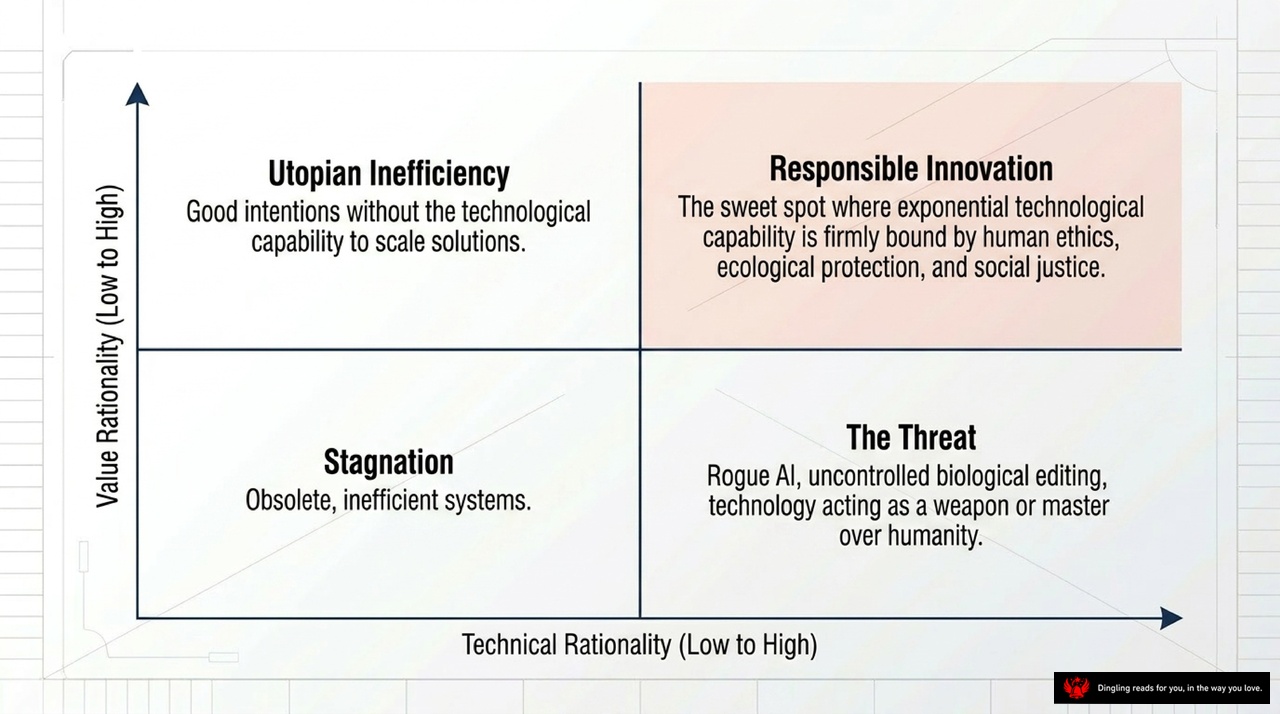
So, where do we actually want to be? This quadrant map lays it all out.
We have four distinct paths. In the top left, we have "Utopian Inefficiency." It's the path of good intentions that fail because they lack the technological muscle to actually scale. We have the heart, but not the engine.
In the bottom left, we have "Stagnation." Here, we have low technical capability and low value. It's just obsolete, inefficient systems that are holding us back. It's the status quo.
Then, we have the danger zone. The bottom right is "The Threat." This is where high technical capability meets zero value. We see rogue AI, uncontrolled biological editing, or technology acting as a weapon or master over humanity. This is the nightmare scenario.
But look at the top right. This is the only place that matters. This is "Responsible Innovation." It is the sweet spot. This is where exponential technological capability is firmly bound by human ethics, ecological protection, and social justice. This is where we aim to be.

Alright, let's talk about how we actually steer the ship when it comes to AI and genetics. This isn't just about building better tech; it's about building a safety net around it.
Imagine this diagram as a three-layer defense system. The core is the technology itself, but to keep it safe, we need three distinct tools.
First, we have the Compass, which is Ethical Guidance. This is about the "tech for good" mindset. It means we don't wait until the code is written to worry about the consequences. We need to embed moral frameworks right at the R&D stage, ensuring that the intent of the technology is inherently positive from the start.
Next, we have the Lever, which is Policy Intervention. This is about being agile. We need dynamic regulatory frameworks that can monitor tech in real-time. The goal is to encourage green innovation, but simultaneously, we have to be willing to tax high-risk endeavors that could do more harm than good.
Finally, we have the Wall, which represents Legal Boundaries. This is the hard line. We need strict global laws with harsh penalties for crossing red lines. Think of things like weaponizing space or unauthorized human cloning. These are absolute no-go zones where the law must be clear and the consequences severe.
So, to manage the risks of AI and genetics, we don't rely on just one thing. We need the ethical compass to guide us, the policy lever to adjust our course, and the legal wall to stop us from going off the rails.

Let’s talk about what it really means to be human in the age of technology. This slide, titled “The Upgraded Human,” isn’t about replacing us—it’s about evolving us.
At its core, the message is clear: technology is an extension of human capability, not a replacement for human purpose. Think of it as upgrading your tools, not your soul.
We see three key extensions. First, cognitive extension—AI takes over the heavy lifting of data processing, freeing your mind to focus on strategy, creativity, and philosophy. Second, physical extension—exoskeletons and robotics handle the hard labor and dangerous environments, so you can thrive without limits. Third, biological extension—regenerative medicine and gene therapies are extending healthy lifespans, giving you more time to live well.
But here’s the most important part: The Ultimate Control. No matter how advanced the tech gets, you remain the master. You bring intuition, empathy, and moral judgment—things algorithms can’t replicate. That’s not just about control; it’s about meaning.
So yes, we’re upgrading—but never losing ourselves.

Slide 12: The Moral Compass in a Godlike Age
Let’s take a moment to pause and really sink into this. We’ve been talking about how fast things are moving—how AI, automation, and the future of work are already reshaping everything around us. But here’s the hard truth: speed doesn’t save us. What matters is our moral compass.
The slide says it clearly: “The future engine has already ignited, irrevocably mutating the forces of production and the fabric of society.” That’s not science fiction—that’s happening right now. Our tools are getting smarter, faster, more powerful. But if we don’t ask ourselves the right questions, we risk becoming the very system we built.
Then comes the real question: “If technology grants us the power of gods, do we have the wisdom to remain human?”
Think about it. We’re standing at a crossroads. One path leads to a world where we use these tools to uplift, to create, to care for one another. The other leads to a future where we lose our humanity in the rush to be more efficient, more automated, more detached.
This isn’t about stopping progress. It’s about making sure we stay in control—not letting the machine dictate who we are. Because when we give ourselves godlike power, we need godlike wisdom to guide it. Otherwise, we’re not just building the future—we’re surrendering to it.