
Gaia: A New Look at Life on Earth: Complete Chapter-by-Chapter Summary
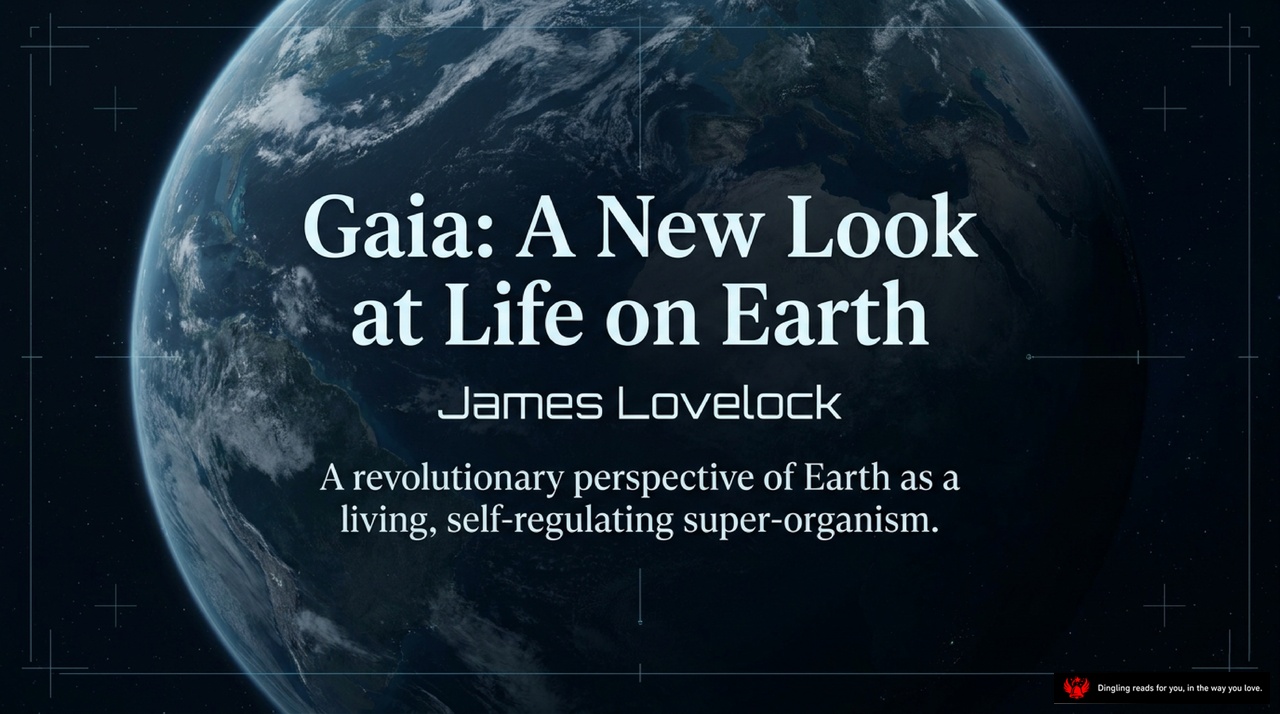
Welcome to our book club session. Today, we’re diving into a truly groundbreaking idea: Gaia. This isn’t just a name from mythology—it’s a radical new way of seeing our planet. The cover image captures it perfectly: Earth, not as a dead rock floating in space, but as a living, breathing, self-regulating super-organism. That’s the core of James Lovelock’s vision. He’s asking us to stop thinking of nature as something separate from us, and instead see the entire Earth system—oceans, atmosphere, soil, life—as one interconnected, dynamic entity. This perspective shifts everything. It challenges how we understand climate, evolution, and even our place in the universe. So whether you’re curious about ecology, science, or just how we fit into this vast, living world, this book offers a fresh, powerful lens through which to view it all.
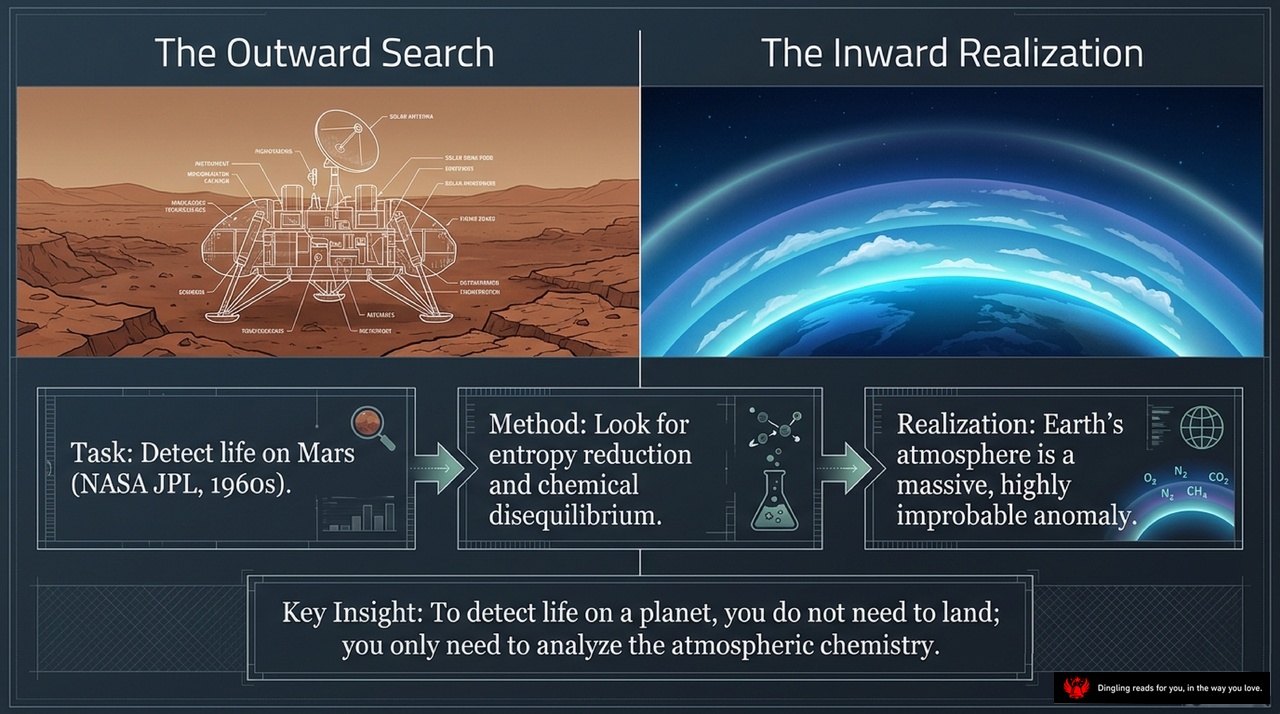
Slide 1: The Outward Search and The Inward Realization
Let's begin our journey with a pivotal moment in the history of space exploration. Back in the 1960s, NASA’s Jet Propulsion Laboratory was tasked with a monumental challenge: to detect life on Mars. This wasn't just about sending a robot down to the dusty red surface. It was about asking a fundamental question: What does life look like, and how do we find it?
To answer this, scientists didn't just look for rocks or footprints. They looked for something much more subtle and profound: entropy reduction and chemical disequilibrium. Think of it this way. The universe naturally tends towards chaos and disorder, or high entropy. But life is the opposite. It is a process that creates order out of chaos. It builds complex structures, organizes molecules, and maintains a delicate balance that defies the natural tendency towards decay.
So, the method was clear. We needed to find a planet where the chemistry was "out of whack," where the molecules weren't in their most stable, relaxed state. This is what we call chemical disequilibrium. It's a massive red flag in the universe. It suggests that something is actively working to keep the system alive, to fight against the natural pull towards nothingness.
And this is where the real realization hits us. When we applied this logic to our own planet, Earth, the result was staggering. We realized that Earth's atmosphere is a massive, highly improbable anomaly. It's a thin, fragile shell of gases, mostly nitrogen and oxygen, that exists in a state of constant, violent chemical imbalance. This isn't a natural accident. It is a signature. It is the signature of life.
The key insight here is that to detect life on a planet, you do not need to land. You do not need to see a footprint or touch the soil. You only need to analyze the atmospheric chemistry. If you see a planet with a complex, dynamic, and chemically unbalanced atmosphere, you have found life. You have found a world where something is fighting against the entropy of the universe, just like we are here on Earth.

Alright, let's dive in.
Imagine you're holding a rock in your hand. You could spend your whole life studying that rock—breaking it down, analyzing its minerals, looking at its structure under a microscope. That’s what traditional science has done for centuries. It’s a "bottom-up" approach. You take the tiny pieces—the rocks, the individual species, the local environments—and you try to understand the whole by putting the parts together. It’s a powerful way to work. It’s the foundation of chemistry, physics, and biology. But here’s the catch: it assumes the planet itself is just a passive stage. It assumes life is just something that happens *on* the planet, adapting to an environment that’s already set and unchanging.
But what if we flipped the script? What if we didn't start with the rock, but started with the whole Earth?
This is the "top-down" approach, often called Geophysiology or the Gaia Paradigm. Instead of looking at the planet as a collection of separate parts, we look at it as a single, coupled system. We look at the planet from space, seeing how the atmosphere, the oceans, the continents, and the life within them are all connected and talking to each other. It’s a massive shift. It suggests that life isn't just adapting to the environment; life is actively *shaping* the environment. It's an active participant, not just a passenger. It’s the difference between seeing a machine and seeing a living organism.
So, the core question is: are we just studying the parts of a machine, or are we trying to understand the behavior of a living thing?
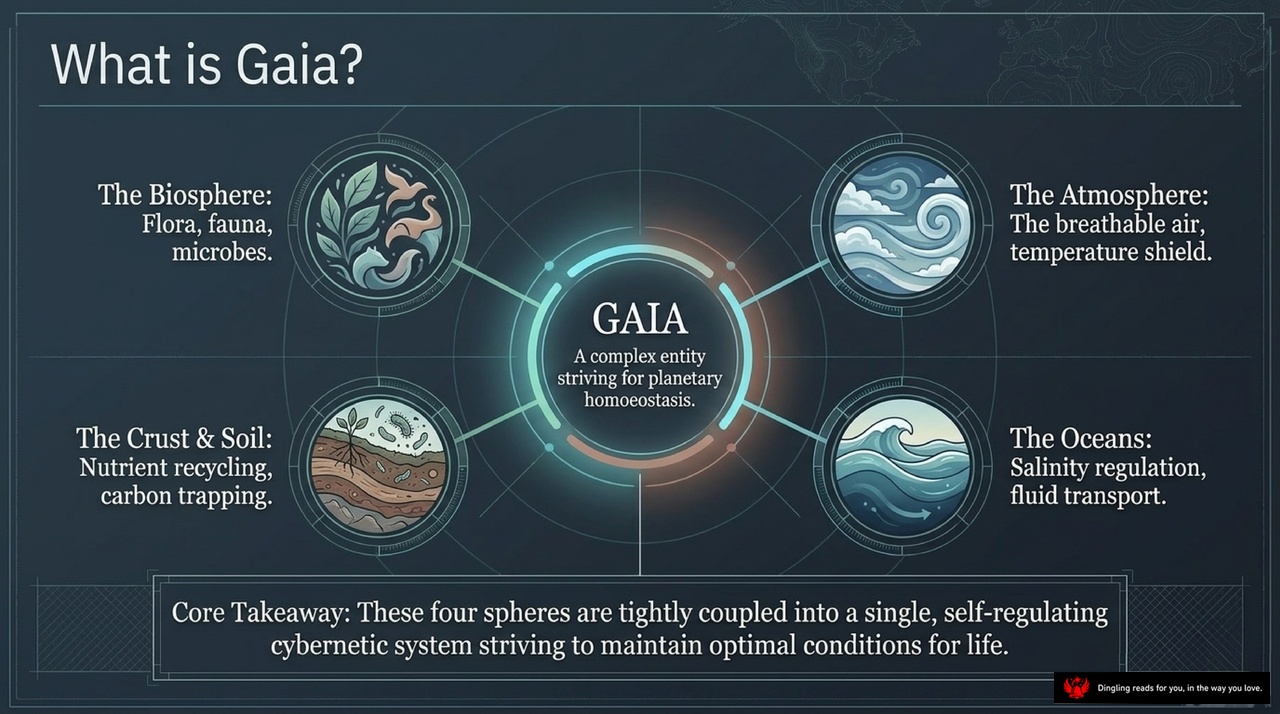
What is Gaia? Imagine the Earth not as a passive rock, but as a living, breathing organism. At the heart of this idea lies the concept of Gaia—a complex entity striving for planetary homeostasis. It’s not just a planet; it’s a self-regulating cybernetic system.
This system is made up of four tightly coupled spheres. First, the Biosphere: that’s all the flora, fauna, and microbes that make life possible. Then, the Atmosphere: our breathable air and temperature shield, keeping us from freezing or burning up. Next, the Oceans: they regulate salinity and move fluids around the globe, acting like the planet’s circulatory system. Finally, the Crust & Soil: where nutrient recycling and carbon trapping happen, feeding back into everything else.
These aren’t separate layers—they’re deeply interconnected. When one changes, the others respond. Together, they work to maintain optimal conditions for life. That’s the core takeaway: Gaia isn’t just a theory—it’s a dynamic, self-correcting system that’s been doing this for billions of years.
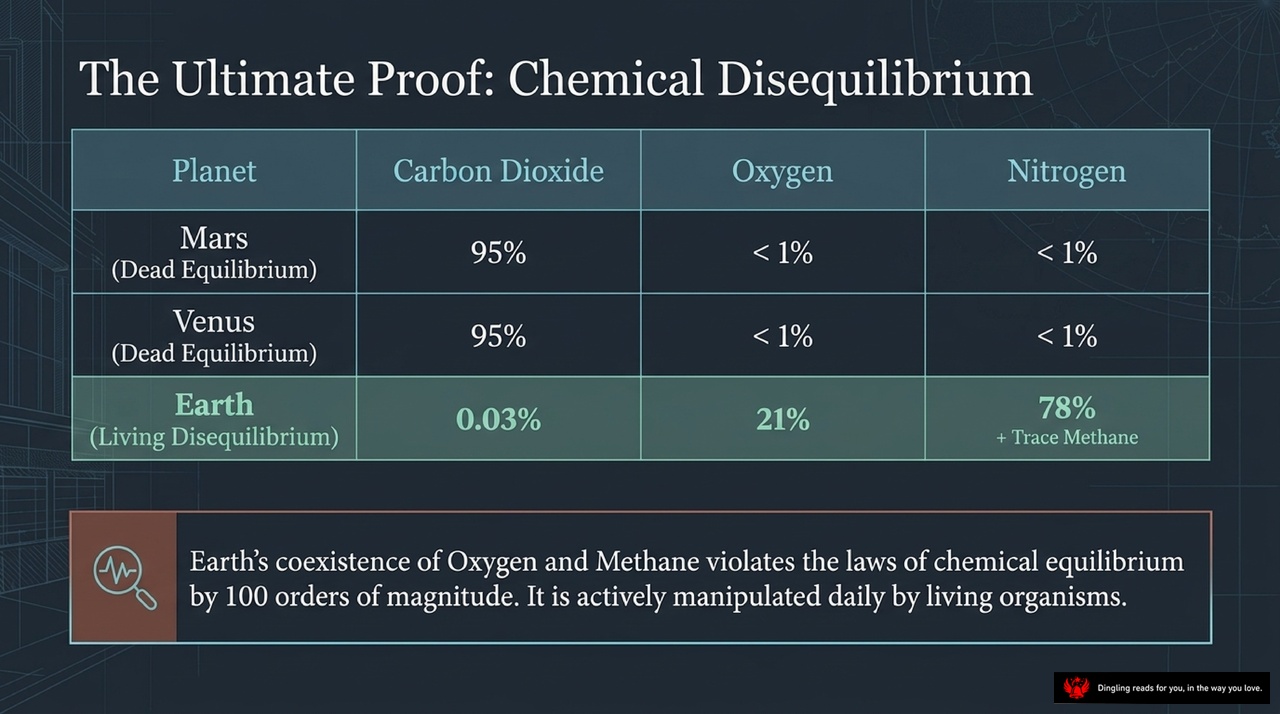
Let’s talk about why Earth is so weird—and so special.
Look at this table. Mars and Venus? Both are dominated by carbon dioxide—95%. Almost no oxygen. Almost no nitrogen. They’re chemically dead. In equilibrium. No life.
But Earth? Totally different. Just 0.03% carbon dioxide. 21% oxygen. And 78% nitrogen. Plus, here’s the kicker—trace methane.
Now, oxygen and methane don’t coexist naturally. They react with each other and destroy each other. So if you find them together in significant amounts, something’s actively keeping them apart.
On Earth, that something is life.
Our biology constantly produces methane through digestion and decomposition. And plants and algae produce oxygen through photosynthesis. These two processes are in constant battle, yet somehow, they’re perfectly balanced—not by chemistry, but by biology.
This isn’t just a coincidence. It’s proof. The only planet in our solar system where life exists is the only one that violates the laws of chemical equilibrium. And that violation? That’s the ultimate proof that life is here.

So, we’re not just looking at Earth as a passive rock floating in space. We’re seeing it as a living, self-regulating machine—what James Lovelock called the “Gaia hypothesis.” And this slide? It’s the heart of that idea.
Look at the top row: “The Machine.” That’s a thermostat. When the temperature drifts, the sensor detects it, the switch flips, the heater kicks in—and boom—homeostasis is restored. Simple, right?
Now look at the bottom row: “The Planet.” Same logic, but nature’s doing the work. When solar heat increases—like it has over 3.5 billion years, by the way—the biosphere reacts. Maybe marine algae bloom, changing how much sunlight reflects back into space. That cools the planet. Again, homeostasis achieved.
The insight at the bottom? Gaia doesn’t just survive extremes—it actively resists them. Even though the Sun has grown 30% brighter since Earth formed, our planet has stayed in that narrow, life-sustaining temperature band. Not by luck. By design. By feedback loops. By a planetary immune system.
This isn’t science fiction. It’s the operating manual for our world. And if you understand this, you start to see climate change not as an accident—but as a breakdown in the system.

Slide 6: Evidence I: The Atmospheric Window
Imagine the atmosphere as a giant, living thermostat. Right now, our oxygen levels are sitting at a safe 21%, but look at the graph. There's a "Danger Threshold" marked right at 25%. If we ever hit that, the consequences would be catastrophic. Global fires would destroy all our forests, and even wet grass would burn explosively.
So, what is keeping us safe? It's a mechanism called "The Biological Pump." Deep in the muds and swamps, anaerobic bacteria are constantly pumping 500 million tons of methane into the air every single year. This creates a natural balance.
Here is the key: Methane and Oxygen constantly react and neutralize each other in the atmosphere. This constant injection of methane acts as a brake, preventing oxygen from rising by 1% every 24,000 years. Without this invisible shield, our oxygen levels would be climbing toward that dangerous 25% mark. This is the atmospheric window we currently live in.

So, here’s the real puzzle: rivers have been pouring salt into the oceans for billions of years. You’d think the seas would be briny enough to kill everything—but they don’t. Salinity stays locked at just 3.4%. That’s the mystery.
Now, look at what’s actually happening underwater. First, lagoons and evaporation trap salt in isolated basins before it even hits the open ocean. Then, coral reefs act like living barriers—filtering and sinking salt away from the main water column. And finally, when organisms die, their bodies sink to the ocean floor, burying minerals and pulling more salt down with them.
This isn’t random. It’s a system. Gaia—our living planet—is running a biological desalination machine. If salinity ever crossed 6%, life would be over. But thanks to these natural regulators, the ocean stays just right. Not too salty, not too fresh. Just perfect.

Look at this map. It doesn't just show land and oceans; it shows the difference between what we need to survive and what we can lose.
On the left, we have the "Vital Organs"—the tropics and the continental shelves. These are the engines of our planet. They process the vast majority of global chemical and atmospheric regulation. Think of them as the lungs and liver of Earth. If these stop working, the system fails.
On the right, we have the "Expendable Edges"—the extreme polar latitudes and tundras. These areas are resilient. They can survive complete glaciation without killing the planetary system. They are the backup, not the core.
But here is the terrifying reality at the bottom: Human activity is currently focused on destroying the continental shelves and tropical forests—the very organs that keep the planet stable. We are chopping away the vital organs while leaving the expendable edges untouched. We are dismantling the system that sustains us.
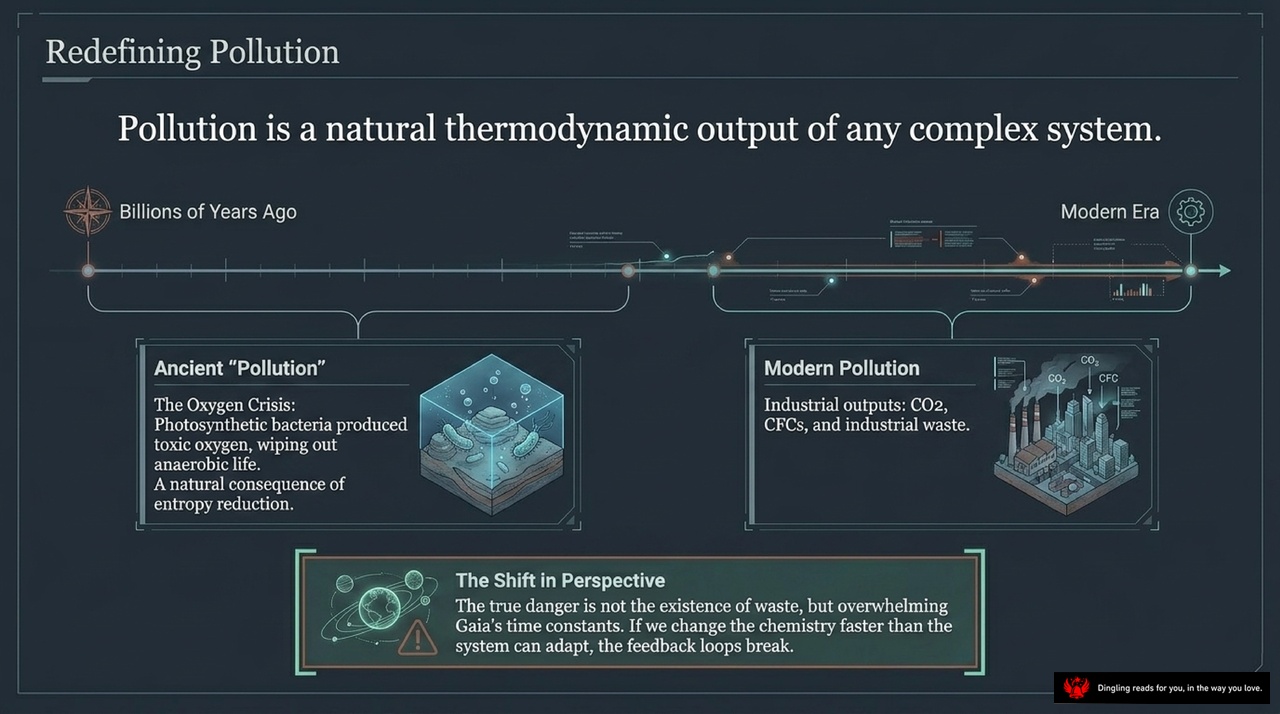
Let’s talk about what pollution really is—not as a modern invention, but as something that’s been happening for billions of years. Think about it: when photosynthetic bacteria first started producing oxygen, they didn’t know they were creating a crisis. That “toxic” oxygen wiped out entire ecosystems of anaerobic life. This wasn’t pollution in the way we think of it today—it was a natural thermodynamic output, a side effect of a complex system evolving. Fast forward to today, and we’re doing something similar, just on a much faster scale. Our industrial outputs—CO₂, CFCs, chemical waste—are disrupting Earth’s chemistry at a pace Gaia, our planet’s self-regulating system, simply can’t keep up with. The real danger isn’t the waste itself, but how quickly we’re changing the chemistry before nature can adapt. When that happens, feedback loops break, and that’s when things get dangerous. So yes, pollution exists—but redefining it as an inevitable part of complex systems helps us see the real problem: speed.
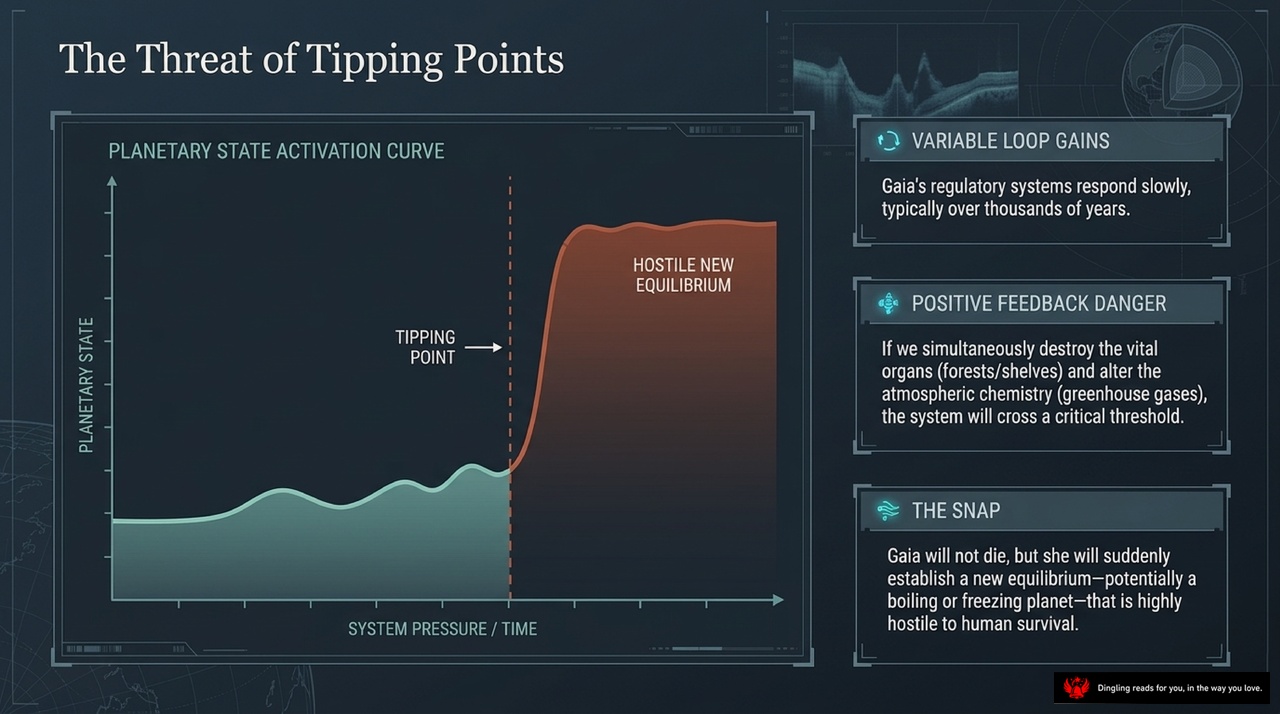
The Threat of Tipping Points is a powerful concept that describes how complex systems—like our planet—can suddenly shift from one stable state to another, often in ways that are irreversible and catastrophic. Think of it like a ball resting in a valley: as long as the pressure stays within certain limits, everything remains calm. But once you push too hard, cross that critical threshold, the ball doesn’t just roll down—it rolls off the edge, tumbling into a completely different landscape.
This is exactly what happens when we talk about planetary tipping points. The graph you see here shows the “Planetary State Activation Curve,” where the x-axis represents system pressure over time, and the y-axis shows how the Earth’s state evolves. For thousands of years, Earth has been in a relatively stable equilibrium—what we call Gaia’s natural balance. But now, due to human activity, we’re increasing system pressure through greenhouse gas emissions, deforestation, and other environmental stressors.
The danger lies in the fact that Earth’s regulatory systems respond very slowly—over millennia. That means even if we act today, the full impact won’t be felt for generations. Worse, once we cross the tipping point, positive feedback loops kick in. Destroying vital ecosystems like forests and altering atmospheric chemistry creates a runaway effect. The system snaps into a new equilibrium—a hostile one, potentially a boiling or frozen planet.
Gaia won’t die, but she will change. And that change might not be compatible with human survival. So understanding these tipping points isn’t just academic—it’s urgent. We need to act before we lose the ability to steer the system back to a livable future.
Alright, here is the spoken-word script for Slide 11, tailored for an American audience.
***
**[Slide 11: Humans as the Troublemaking Children]**
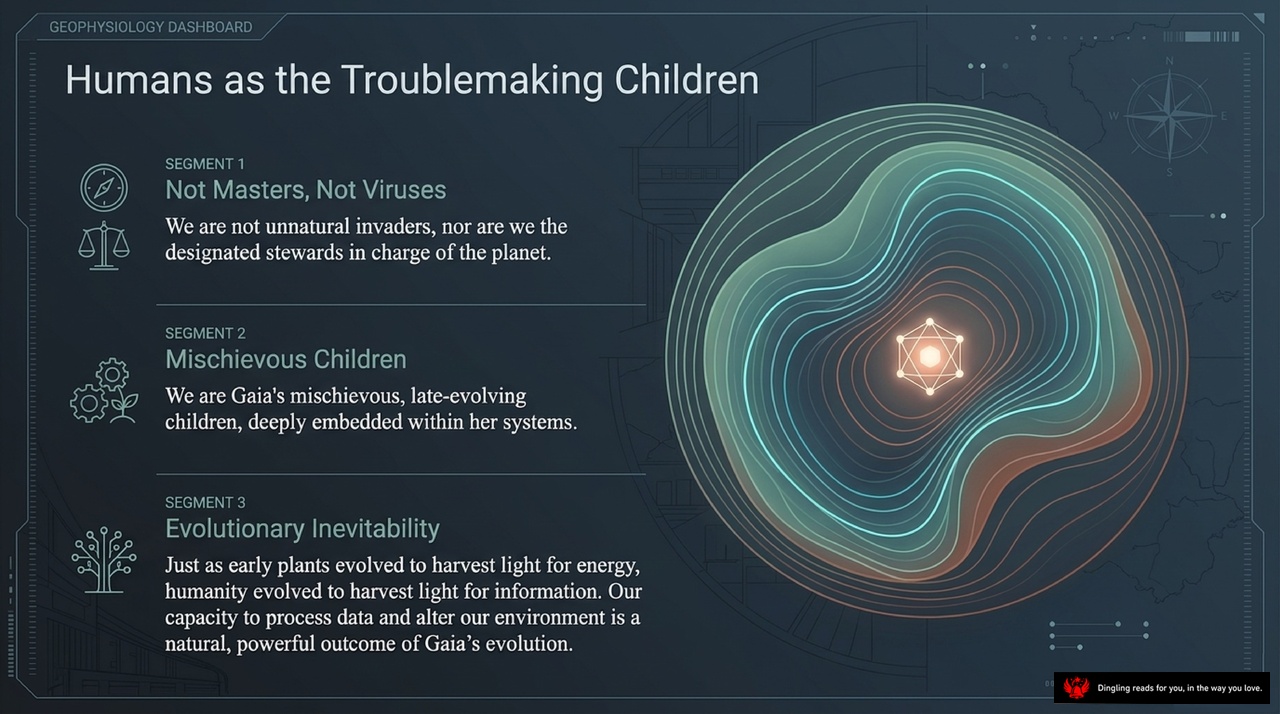
Let’s look at this dashboard. It’s all about redefining our place in the world. The central idea here is that we are "Humans as the Troublemaking Children."
Think about the first segment: "Not Masters, Not Viruses." This is a crucial correction. We often feel like we own the planet, or conversely, that we are an alien virus destroying it. But the text reminds us that we are neither. We aren't the designated stewards in charge, nor are we unnatural invaders. We are just part of the system.
Segment two takes this a step further. It calls us "Mischievous Children." We are Gaia’s children, but we are late-evolving. We are deeply embedded in her systems, but we act with a bit of mischief. We aren't trying to destroy her; we are just figuring things out, growing up, and causing a bit of trouble as we go.
Finally, look at the third segment: "Evolutionary Inevitability." This explains *why* we are here. Just as early plants evolved to harvest light for energy, humanity evolved to harvest light for information. Our ability to process data and change our environment isn't a mistake. It is a natural, powerful outcome of Gaia’s own evolution. We are just the next step in the planet's development.
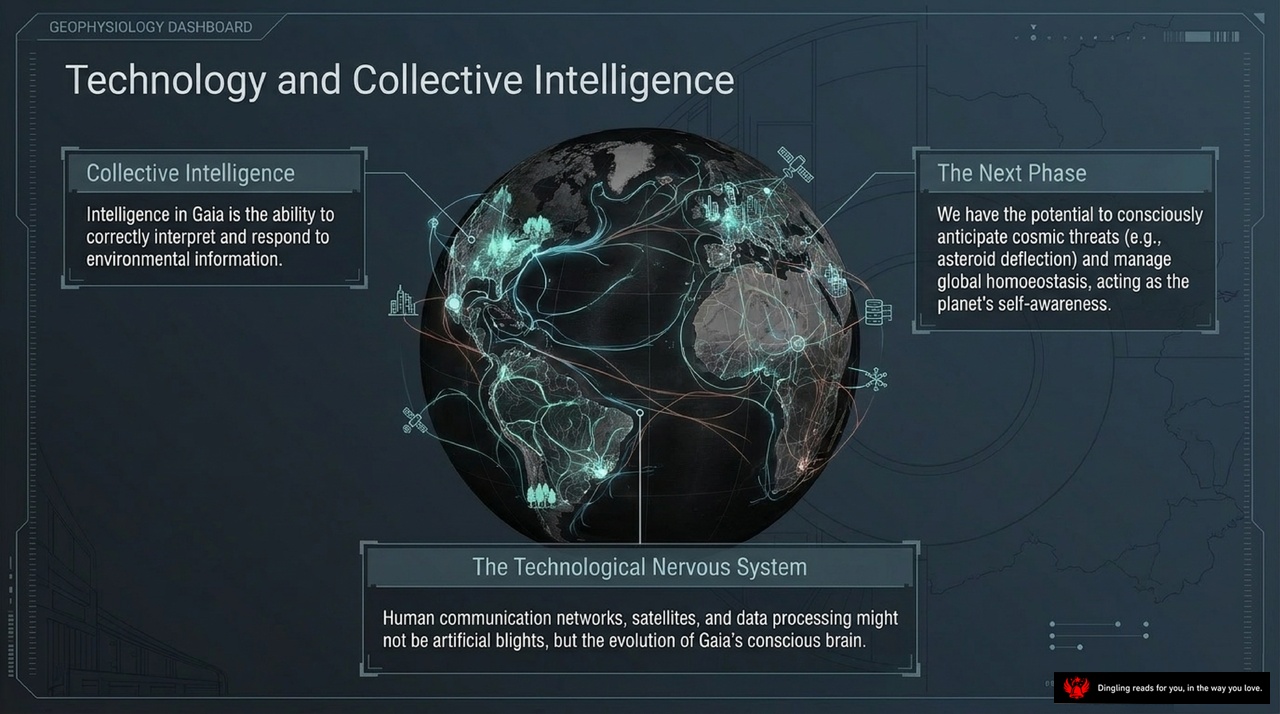
Let’s take a step back and look at the bigger picture. We’ve been talking about Gaia—the Earth as a living, breathing system—but now we’re asking a deeper question: What if our technology isn’t just a tool we built, but something that’s actually part of Gaia’s own nervous system?
This slide shows a vision of what that could mean. Imagine the global network of satellites, communication systems, and data flows not as separate from nature, but as an extension of it—like synapses in a planetary brain. That’s the idea behind “The Technological Nervous System.” It suggests that human-made tech might be the next stage in Gaia’s evolution toward self-awareness.
On the left, we see “Collective Intelligence”—the ability of Gaia to interpret and respond to environmental changes. Think of it like the planet’s immune system or early warning system, reacting to heatwaves, storms, or shifts in ecosystems. But here’s the twist: what if we could tap into that intelligence? What if we could help Gaia think more clearly, act more wisely?
That’s where “The Next Phase” comes in. We’re no longer just observing or reacting—we’re stepping into a role where we can consciously anticipate threats, like asteroid impacts or climate tipping points, and help manage global balance. In this vision, humanity becomes a partner in Gaia’s self-regulation, acting as its conscious mind.
So this isn’t just about sci-fi or metaphysics. It’s about reimagining our place in the world—not as conquerors, but as collaborators with the Earth. And maybe, just maybe, that’s the future we need.
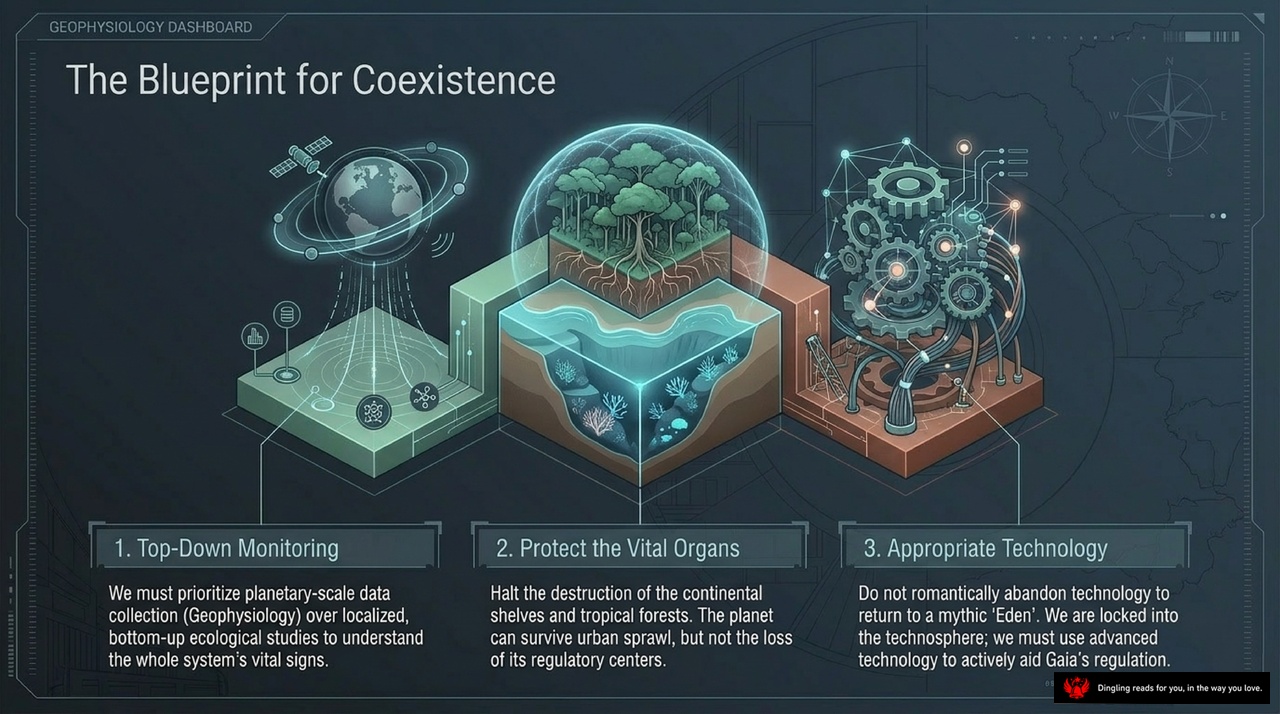
Let’s talk about the blueprint for coexistence—not between humans and nature, but between us and the planet as a living system.
Imagine Earth not as a resource to be managed, but as a complex, interconnected organism. This slide breaks down how we can actually work with that reality.
First: Top-Down Monitoring. Instead of focusing only on local ecosystems or isolated species, we need planetary-scale data. Think satellites, sensors, global networks—tracking the pulse of the entire biosphere. Why? Because the whole system tells us more than any single part ever could.
Second: Protect the Vital Organs. Continental shelves and tropical forests aren’t just pretty landscapes—they’re the lungs, kidneys, and heart of our planet. We can survive cities, sprawl, even some disruption—but if we lose these core systems, the planet itself begins to fail.
Third: Appropriate Technology. Here’s where it gets real: we’re not going back to a mythic Eden. We’re locked into the technosphere. The question isn’t whether to use technology—it’s how. We need smart, adaptive tools that help stabilize Gaia’s regulatory systems, not exploit them.
This isn’t about saving nature. It’s about surviving with it. And that starts with seeing the Earth not as a backdrop, but as the stage—and we, the actors who must learn the script.

Slide 14: Are We the Conscious Mind of Gaia?
Let’s take a moment to look at the planet not as a silent, lifeless rock, but as a living, cybernetic system—one that actively works to keep itself alive. We are not its rulers. We are just one part of a vast, interconnected web, a late-evolving thread that’s now becoming incredibly influential.
As our technology spreads across the globe, we have to ask ourselves: Are we just a temporary glitch in the system? Or are we evolving into something much more profound—becoming the conscious mind of Gaia itself?