
Gamification Marketing: Complete Chapter-by-Chapter Summary

Welcome to the world of Gamification Marketing. Today, we're diving into a concept that's reshaping how brands connect with people: turning passive consumers into active brand advocates through the psychology of play.
Think about it—playing isn't just for fun; it's wired into our DNA. As psychologist Brian Sutton put it, "The opposite of play is not work, it's despair." Play and work aren't enemies; they're partners in helping us meet our emotional needs. From video game champions to CEOs who built empires on gaming, the line between "serious business" and "having fun" is disappearing.
Traditional marketing often feels like a sales pitch, pushing products at people. But gamification marketing flips the script. It uses the core mechanics of games—like feedback loops, flow states, and social interaction—to make marketing feel like an adventure. Instead of forcing attention, we create experiences people choose to join. In the next chapters, we'll explore how to design these engaging experiences and turn your customers into your biggest fans.

Look at this slide. On the left, we see the "Traditional Marketing Funnel"—a crumbling structure where "Ad Fatigue" and "Defensive Filters" cause a "Massive Drop-off." That's the problem. We're bombarding consumers with ads until they tune us out, and our sales funnel collapses under the pressure.
But on the right, there's the solution: the "Gamified Conversion Funnel." Instead of a broken pipe, imagine a spiral—a vortex of engagement. This is because play is human nature. As the text reminds us, games don't conflict with work; they conflict with despair. When we remove the pressure and replace it with effortless participation, we unlock a powerful form of entertainment that naturally draws people in.
The proof is already here. Think about Barack Obama's campaign. He didn't just slap billboards on the side of the road; he embedded his message natively into games like *Burnout Paradise* and *NFL 13*. By using environmental immersion instead of interruption, he bypassed traditional ad fatigue and reached the elusive 18-to-34 demographic. This shift from annoying interruption to engaging immersion is the key to modern marketing.

Four psychological drivers make gamified experiences biologically irresistible. Let's break down the four quadrants that turn ordinary tasks into addictive fun.
First, feedback mechanisms. Think of those satisfying "ding" sounds when you level up. Constant, immediate responses—whether positive or negative—keep users hooked. Just like a progress bar eliminating the anxiety of loading screens, instant feedback tells the brain exactly what to do next.
Next, the flow state. This is that perfect balance where skill meets challenge. If a task is too easy, you get bored; too hard, and you feel anxious. Gamification finds that sweet spot, keeping you in a state of focused excitement where time just disappears.
Then, achievement and pride. We all crave tangible recognition. Badges, announcements, and leaderboards validate your effort and prove your capability. That little trophy icon isn't just decoration; it's a powerful psychological boost that makes you want to keep going.
Finally, social connection. Humans are wired for relationships. Shared goals, friendly competition, and seeing where we stand compared to others create meaning. Whether it's a leaderboard or a team challenge, these social ties transform a solo activity into a communal experience.
Together, these four drivers create a loop that is hard to break, turning passive consumption into active, joyful participation.

Sustainable campaigns transition users from external bribes to internal fulfillment. Think about it: most of us are hooked initially by tangible rewards—cash, discounts, or prizes. That's the "hook," the extrinsic motivation designed to overcome that first barrier of participation. Look at live trivia apps; they lure you in with massive cash pools just to get that initial download. It works, but here's the catch: external rewards attract, but they don't retain. If you rely solely on bribes, users will leave the moment the money stops.
The real magic happens when you shift the focus to intrinsic motivation—what we call "the engine." This is where you stop selling them things and start giving them status, mastery, and competition. Users don't stay for fractions of a cent; they stay to prove their intelligence, to climb the leaderboard, and to feel that deep psychological satisfaction. It's the difference between playing a game just to win a dollar versus playing to be the best. When you master this transition from the external hook to the internal engine, you build brand loyalty that lasts. External rewards get the click, but internal rewards keep them coming back.
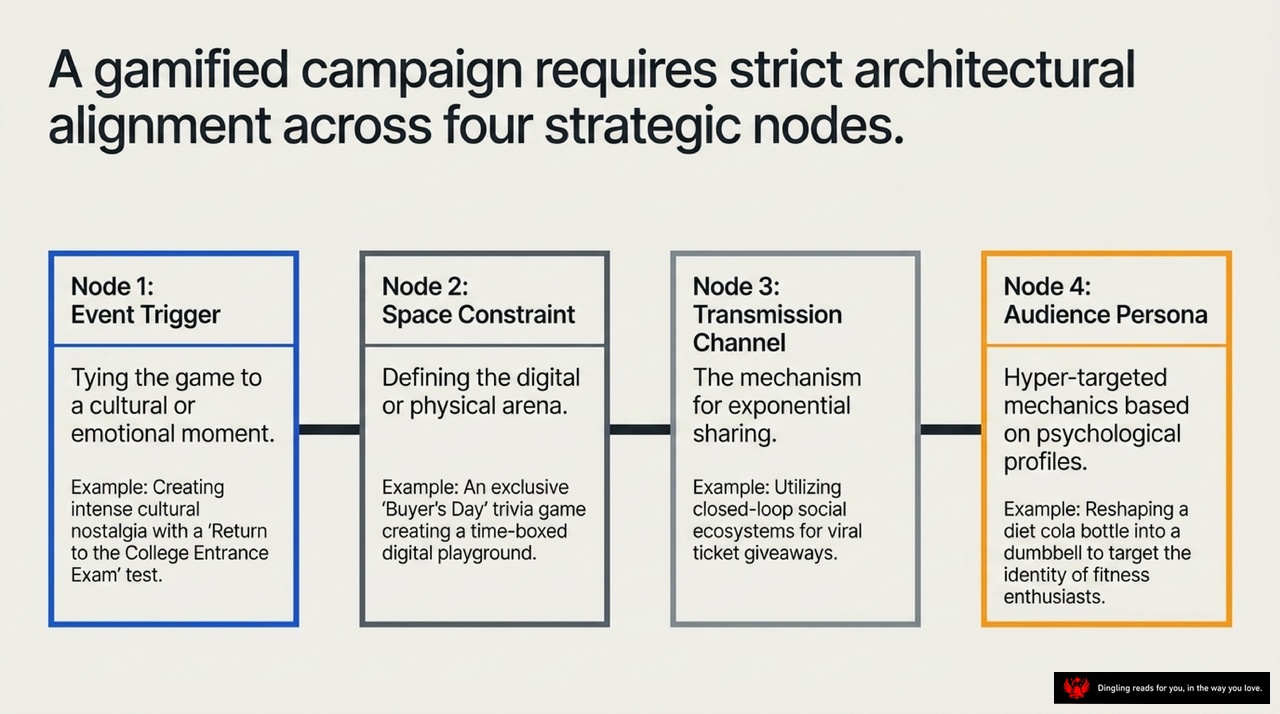
So, let's talk about what actually makes a marketing game stick. It's not just about slapping a "play now" button on an ad; it's about engineering five specific traits that turn a boring task into a genuine experience.
First, you need fun. Think of Kugou Live's "Where is Mao Buyi?" H5 game. Instead of just listing concert dates, they built a mystery escape room where users helped a missing singer find clues. It was immersive, story-driven, and naturally wove their products into the narrative. When it's fun, people share it.
Next, challenge. Humans love proving themselves. Games like "Getting Over It with Bennett Foddy" show that high difficulty paired with clear rewards creates obsession. Even if you fail repeatedly, that desire to conquer the next level keeps you coming back.
Then, competition. Rankings are powerful. Seeing someone else score higher triggers our competitive spirit. In the 2017 Taihu Marathon, even without cash prizes, the leaderboard drove thousands to push their limits just to prove they were the best.
Fourth, progression. You can't just dump all the fun at once. Games like "Candy Crush" use stages, unlocking new mechanics as you advance. It keeps the experience fresh and prevents boredom, guiding users from easy wins to harder challenges.
Finally, and most critically, instant feedback. This is the heartbeat of live streaming. Platforms like Douyu use points, badges, and leaderboards to reward fans the second they give a gift. That immediate "ding" and the public recognition create a dopamine loop that drives massive engagement.
So, when you design a marketing game, don't just think about the brand message. Think about the story, the challenge, the rivalry, the journey, and the instant reward. Nail these five elements, and you've got a product people actually want to play.

Marketing games only work if they're actually fun. If you strip away the enjoyment, users leave instantly. So, what makes a marketing game stick? It all comes down to five key traits.
First is fun. This is non-negotiable. You need to minimize the "work" aspect and let users absorb your brand message in a relaxed atmosphere. Take Kugou Live, for example. To promote their 2017 Music Awards, they created an H5 escape room game themed around "Mao Buyi is Missing." Players used a time machine to find clues and help the singer perform on time. The game cleverly integrated their products like the Super K-Singing Machine and Kugou Music Store. By using immersive 360-degree technology and adjusting clue difficulty for all ages, they turned a boring ad into a shareable event, completely flipping the traditional promotion model.
Second is challenge. Humans have an innate desire to prove their worth by overcoming obstacles. When you pair moderate challenges with rewards, you ignite real participation. Think of the indie game *Getting Over It with Bennett Foddy*. It's simple—just use a mouse to swing a hammer up a mountain—but incredibly hard. One mistake sends you back to the start. There's no real penalty for failing, but the frustration makes the eventual triumph feel huge. The positive feedback loop gets stronger as the difficulty rises, keeping players hooked despite repeated failures.
Third is competition. Ranking systems tap directly into our need for social comparison. As psychology professor Kenneth Locke noted, the value of a score comes from how it relates to others. That's why games like *Flappy Bird* are so addictive; even when you fail repeatedly, seeing that others are doing worse pushes you to try again. Real-world examples include the 2017 Taihu International Marathon, where tens of thousands of runners competed. Even without cash prizes, the ranking itself validated their skill and fueled their competitive spirit.
Fourth is progression. You need layered levels to avoid monotony. Games like *Happy Match* use big stages containing 10 to 20 small levels, gradually increasing difficulty. Breaking through a stage unlocks new mechanics, ensuring users aren't bored by simplicity or overwhelmed by difficulty. This logic applies beyond games too; look at the 2018 Hunan TV Gala. It started with warm-up acts, built up to high-energy performances by stars like Wang Feng and Han Hong, used TFBOYS as a buffer, and closed with a finale. This smooth rhythm kept the audience engaged all night, topping the ratings charts.
Finally, you need an instant feedback system, often called PBL. This is the engine of live streaming platforms. Since 2015, the live streaming industry in China has exploded, reaching 325 million users by 2016. Platforms drive interaction through points, badges, and leaderboards. Fans send virtual gifts to boost streamers' heat and climb the charts. In 2017, Douyu streamer A-Ling earned over 20 million yuan in gift revenue in just six months. Custom badges and "height" upgrade mechanisms on Panda TV further fueled this rivalry. Interestingly, when Wang Yuan went live on Yizhibo and banned gifts, the lack of a leaderboard interaction showed exactly how crucial this feedback loop is.
Ultimately, the type of game matters. Companies should tailor their approach to their product. You can use story-based games like NetEase's "Where Did Yongzheng Go," which embedded intangible cultural heritage into a mystery quest. Or challenge users with wisdom puzzles, like Six God Nuts' poetry relay game. You can tap into emotions with农夫山泉's "Music Bottle" that displays lyrics via AR, or let users express themselves through DIY apps like Uniqlo's UTme. Or simply entertain, like Huawei's collaboration with *Monument Valley 2* to match phone colors with game art.
To make these games truly engaging, you must design "temptation" elements using diverse rewards. Think of *Counter-Strike Online 2* or *League of Legends*'s "Canyon Top" servers, where exclusive skins and icons are locked behind ranks and top-tier performance. These elements hit the user's desire to collect, compete, and win. But remember, you also need to understand the user's psychological motives—whether they're driven by emotion, logic, or habit. Only by deeply binding these temptation elements with real user psychology can you create a marketing game that is not just fun, but profitable.

The most potent campaigns don't just sell a product; they transform your daily struggles into a shared, gamified victory. Look at this radar chart: it maps the real-world stressors we all face—exhausting commutes, crushing overtime, isolation, and the relentless pressure of high costs. These aren't just problems; they are the raw material for deep emotional connection.
Take the "Vampire Overtime Building" case study as proof. Instead of ignoring the brutal reality of young professionals in top-tier cities, this campaign leaned right into it. It turned the pain of "blood-sucking" office buildings into a voting game. Users didn't just complain; they actively voted for the most grueling workplaces, turning collective exhaustion into a powerful, shared grievance. The reward? High-value ride vouchers for the top 100 buildings. The result was explosive: 1.6 million clicks and 400,000 unique votes in just 48 hours, all with zero media spend. By gamifying real-world pain points, brands stop being annoying advertisers and become empathetic allies, forging a resonance that traditional marketing simply cannot achieve.
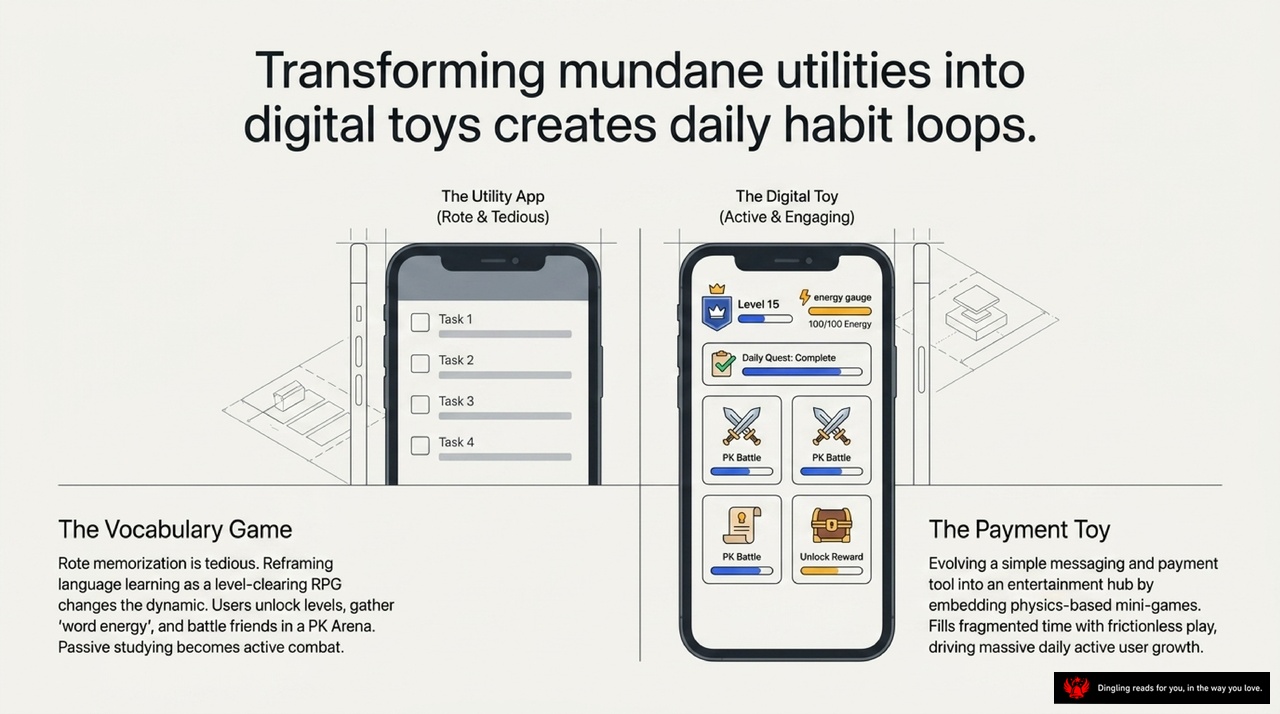
Transforming mundane utilities into digital toys creates daily habit loops. Think about your daily routine: checking emails, paying bills, or even studying—these often feel like chores. But what if we reframed them as games? That's exactly what modern marketing does.
Look at the left side: the traditional utility app. It's just a list of tasks—Task 1, Task 2, Task 3. It feels rote and tedious. But on the right, we see the transformation into a digital toy. Suddenly, those tasks become an active, engaging experience with levels, energy gauges, and PK battles.
Take language learning, for instance. Memorizing vocabulary used to be a dry, passive chore. But by turning it into a level-clearing RPG, users unlock new levels, gather "word energy," and battle friends in a PK Arena. Passive studying becomes active combat. Or consider a simple messaging tool. By embedding physics-based mini-games, fragmented time gets filled with frictionless play, driving massive daily active user growth.
The core idea is simple: make life's necessities feel like a game. When you tap into that playful instinct, you don't just complete a task; you build a habit. You turn "work" into "play," and in doing so, you create a loyal, engaged user base that comes back every day.
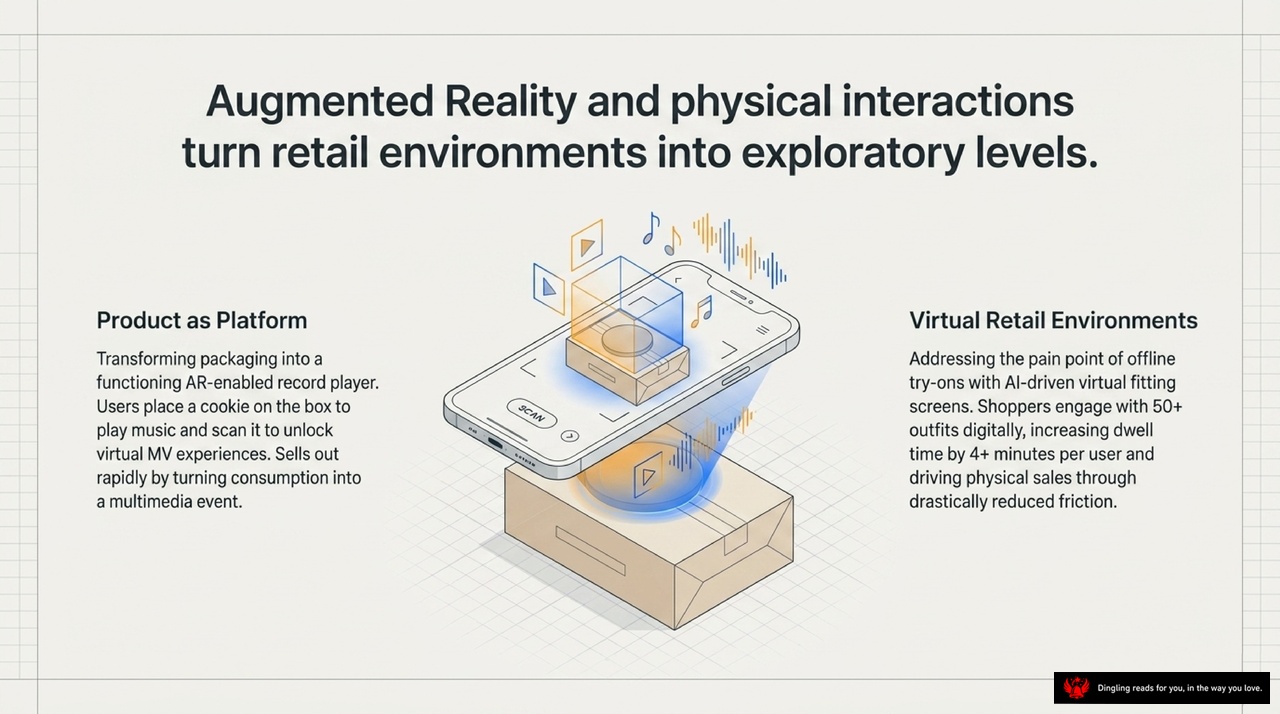
Welcome to the world of cross-industry gaming marketing, where brands break free from traditional boundaries to create something truly magical. Think about it: why should a candy brand only sell sweets, or a tech giant only sell gadgets? The answer lies in blending your product with the fun people already love.
Take Beijing Lemon Microfun's hit game, *Candy Cute*, for example. It built a massive community of young, female gamers who crave something sweet and cute. Instead of just running ads, the brand partnered with a real-life artisanal candy company called "Climb Up." They co-created custom candies that matched the game's aesthetic. This wasn't just a transaction; it was a celebration. Existing players got a delightful surprise, while new candy lovers discovered a fun digital world. It's a perfect 1+1 equals 3 moment, strengthening that "sweet and cute" identity for both brands.
Then there's Blizzard Entertainment, the masters of IP. With *World of Warcraft*, they didn't stop at the game. They built an entire ecosystem—movies, novels, comics—turning a virtual world into a cultural phenomenon. When their movie hit theaters, it wasn't just a film; it was a pilgrimage for millions of fans, proving that great storytelling can bridge the gap between gamers and the general public.
Fast-moving consumer goods are also jumping in. Lay's didn't want to be seen as just "unhealthy snacks." So, they hijacked the popular *Happy Farm* game on Renren. Users could plant real Lay's potato seeds in the game, harvest them, and even run a virtual factory to make chips. It was an interactive masterclass in their "100% natural" claim. The result? Millions of users engaged, and a significant portion actually bought the chips later.
Even the food industry is gaming up its wait times. Haidilao, famous for its service, turned the boring queue into a game. Their "Sea Sea" platform lets diners play while waiting, offering free dishes as rewards. It turns a frustration into a highlight, keeping young customers entertained and loyal.
From cars racing in virtual worlds to education turning farming into a classroom, the lesson is clear: when you treat your marketing like a game, you don't just sell a product. You invite people into an experience they can't refuse.
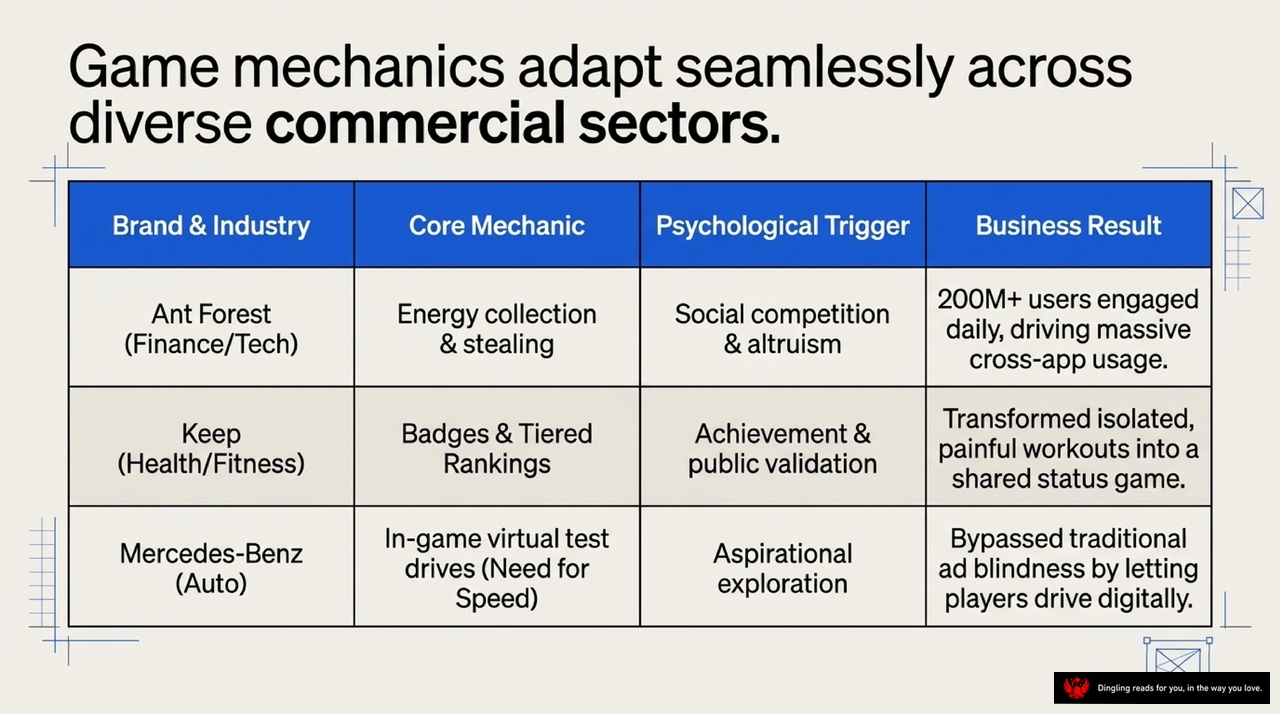
Game mechanics aren't just for entertainment anymore; they've seamlessly adapted to transform how businesses operate across diverse sectors. Look at this slide: we're seeing a powerful shift where core game loops drive real-world business results.
Take Ant Forest, a fintech giant. By gamifying energy collection and turning it into a social competition, they tapped into the psychological triggers of altruism and rivalry. The result? Over 200 million daily active users, completely changing how people engage with finance apps.
Then there's Keep in the health and fitness space. They replaced the isolation of a solo workout with badges and tiered rankings. This taps into our deep need for achievement and public validation, turning painful exercise into a shared status game that keeps people coming back.
Finally, look at Mercedes-Benz in the auto industry. Instead of traditional ads that people tune out, they let you drive their cars digitally in Need for Speed. This aspirational exploration bypasses ad blindness, letting players experience the brand firsthand and driving genuine interest.
The takeaway is clear: when you align the right core mechanic with the psychological trigger, you don't just sell a product—you create an experience that people actually want to participate in.

Here is the spoken-word script for Slide 10, tailored for an American audience with a natural, engaging tone:
"Here is the real-world magic happening when scarcity meets variable rewards. Think about it: when you buy a physical meal, your brain expects a predictable outcome. But look at this flow—80% of the time you get a common reward, but that 5% chance of landing an 'Epic Virtual Item' triggers a massive dopamine spike. This isn't just about food; it's about the thrill of the unknown.
This is the 'Fast-Food & Gaming Alliance' in action. Fast-food chains partnered with games to turn a boring lunch into a high-stakes treasure hunt. By giving points for meals that unlock rare in-game items, they completely bypassed our rational spending filters. The psychology is simple: the random nature of the reward, combined with the extreme scarcity of that virtual item, made people visit restaurants over and over again.
The result? The pursuit of that digital loot eclipsed the actual cost of the food, driving a 6.6% year-over-year sales growth. It proves that when you mix the dopamine hit of a loot box with the daily habit of grabbing a burger, you don't just sell a meal; you create an addiction to the experience. That's how modern brands turn customers into loyalists."
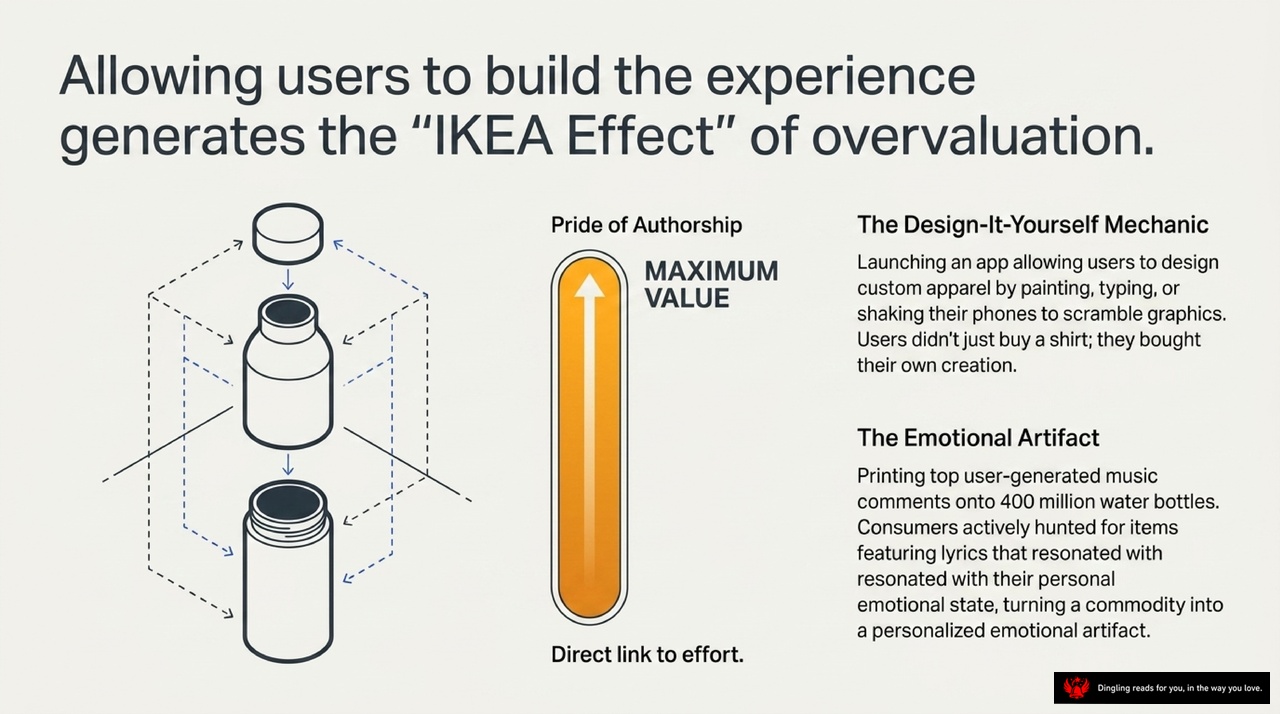
Allowing users to build the experience generates the "IKEA Effect" of overvaluation. Have you ever noticed that when we put effort into something, we tend to value it much more than if we just bought it off the shelf? That's the core of what we're seeing here today.
On the left, we see the "Design-It-Yourself Mechanic." Think about apps that let you design custom apparel by painting, typing, or even shaking your phone to scramble graphics. Users aren't just buying a shirt; they are buying their own creation. This sense of authorship creates a direct link to effort, driving the value up to a maximum point.
Then, look at the "Emotional Artifact." Remember when water bottles were printed with top user-generated music comments? Consumers actively hunted for items featuring lyrics that resonated with their personal emotional state. By turning a simple commodity into a personalized emotional artifact, brands create a much deeper connection.
Ultimately, when you allow users to build the experience, you trigger this psychological phenomenon where the effort they invest makes them overvalue the product. It's not just about the item; it's about the pride of ownership and the story they've helped write.
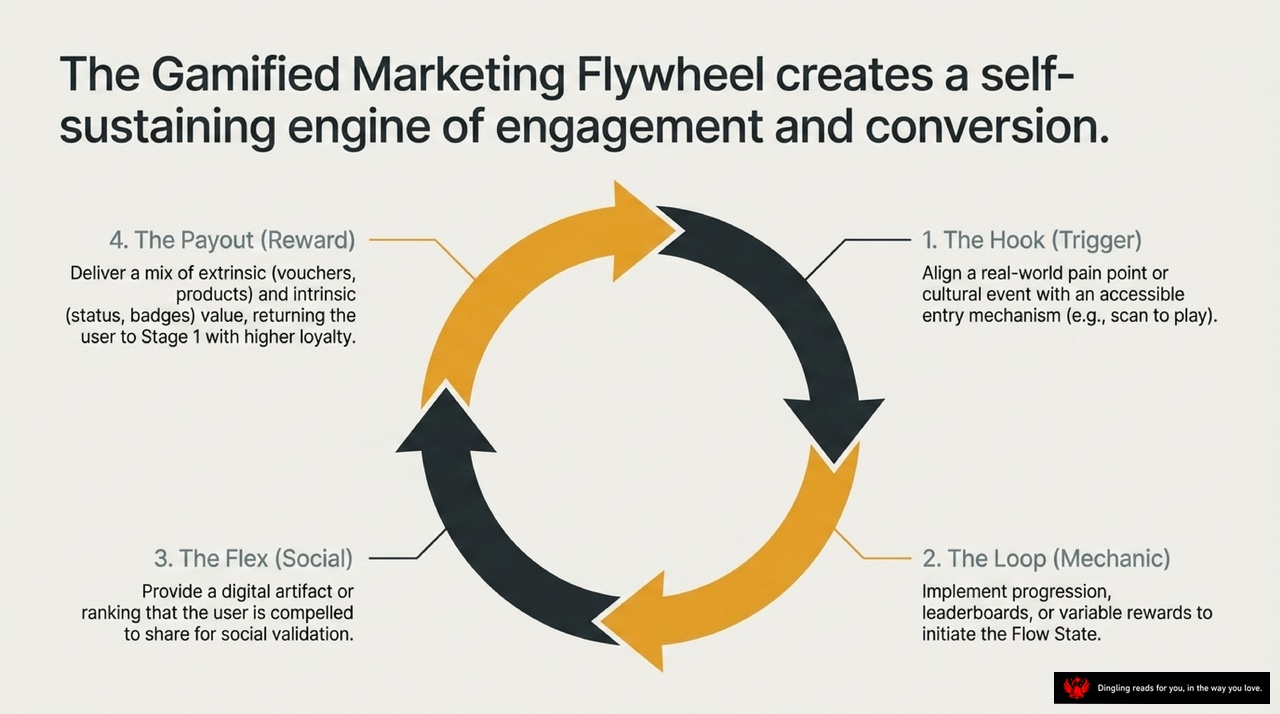
Let's dive into the engine that keeps gamified marketing spinning: the Flywheel. Think of it as a self-sustaining loop where every step fuels the next, creating a relentless cycle of engagement and conversion.
It all starts with **The Hook**, or the Trigger. Just like in a game, you need an accessible entry point that aligns with a real-world pain point or a cultural moment. Maybe it's a simple "scan to play" action that instantly grabs attention.
Once users are hooked, they enter **The Loop**, the core mechanic. Here, you implement progression systems, leaderboards, and variable rewards. This is where the magic happens—triggering that "Flow State" where users get completely absorbed and motivated to keep going.
But a game isn't just about playing; it's about showing off. That's **The Flex**, or the Social stage. You provide digital artifacts, rankings, or badges that users are compelled to share. This social validation turns individual players into brand advocates, spreading the word organically.
Finally, the cycle closes with **The Payout**, or the Reward. You deliver a mix of tangible perks like vouchers and products, alongside intrinsic rewards like status and exclusive badges. Crucially, this reward doesn't just end the experience; it loops the user back to Stage 1 with higher loyalty, ready to start the cycle all over again.
By mastering this four-stage flywheel, you transform passive observers into active participants, building a loyal community that drives growth automatically.

Optimization isn't just about squeezing more money out of a game; it's about finding the delicate balance between commercial goals and the purity of play. Think of your product as a dashboard with three critical gauges. First, look at **Friction**. This is your enemy. Every mandatory, non-game step you add—like forcing a user through a clunky login process—drops conversion by 10 to 50%. The path from discovery to purchase must be seamless, or you're killing the user's momentum.
Next, check your **Intrinsic Joy**. This is where the magic happens. If you over-emphasize extrinsic rewards, like cash or points, you trigger the "Crowding Out Effect." You might get a quick spike in activity, but the moment the cash stops, the user leaves because the fun was never there to begin with. The game itself must be the primary reward; commercial conversion should just be a natural byproduct of genuine enjoyment.
Finally, watch out for **Extrinsic Reward**. When money becomes too prominent, it destroys the intrinsic joy of the experience. The golden rule is simple: make the game itself the prize. When you do this, users stay because they love what they're doing, not just what they're earning. By balancing these three elements, you turn a transaction into an experience, and that's how you build a brand that people actually want to be part of.
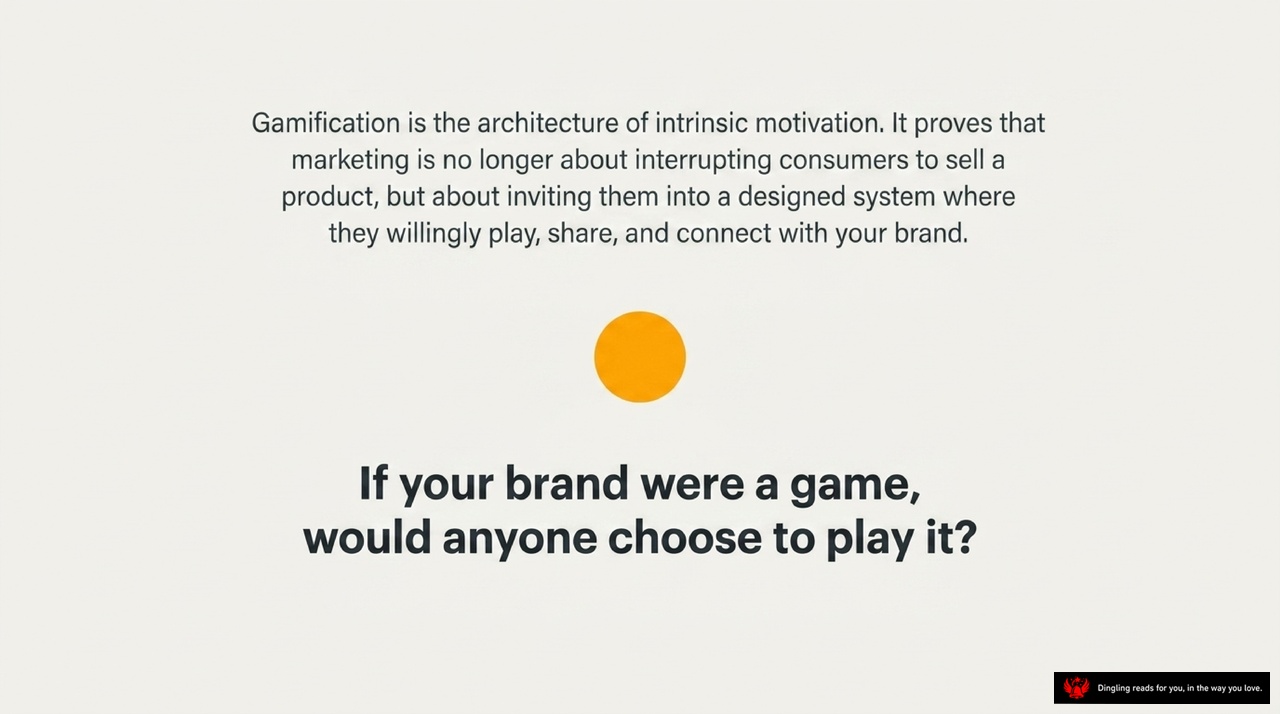
Gamification isn't just about adding points or badges; it's about building the very architecture of intrinsic motivation. Think of it this way: modern marketing is no longer about interrupting consumers to push a product. Instead, it's about inviting them into a designed system where they willingly play, share, and connect with your brand.
When you design your brand as a game, you tap into that deep-seated human desire for fun and achievement. But remember, the real magic happens when you balance external rewards with internal satisfaction. Start with tangible incentives—like cash prizes or exclusive items—to hook users initially. But don't stop there. You must guide them toward intrinsic motivation, where the act of participation itself becomes the reward.
Look at live-streaming platforms or fitness apps. Users might start chasing a cash prize, but soon they find themselves hooked by the competitive spirit, the sense of mastery, and the community recognition. They play not just for the money, but for the feeling of being part of something bigger. That's the sweet spot. So, if your brand were a game, would anyone choose to play it? If the answer is no, it's time to rethink your mechanics.