
Gang Leader for a Day: Complete Chapter-by-Chapter Summary
Welcome to "Gang Leader for a Day," a groundbreaking book by Sudhir Venkatesh. This isn't just a story about crime; it's a deep dive into the corporate structure of a Chicago drug gang and the shadow economy of the urban poor.
The book begins in 1989, when Venkatesh, a sociology student, moved to Chicago. He lived right on the border between the elite University of Chicago campus and a struggling Black neighborhood known as the Black Belt. While his professors taught him about statistics and data, Venkatesh felt disconnected from that academic world. He wanted to understand the real lives of the people around him, so he spent his days hanging out in public parks, listening to older residents who spoke of a city divided by race and class.
But the older generation told him that young people were the key to understanding the future. Following their advice, Venkatesh ventured into the public housing projects, specifically the Robert Taylor Homes. There, he was initially rejected and even threatened by gang members who saw him as an outsider. However, he met J.T., a charismatic and powerful gang leader, who saw something different in him. J.T. challenged Venkatesh to stop asking abstract questions and instead, to truly live with them.
Taking this advice to heart, Venkatesh returned the next day with six bottles of beer. He traded the survey questions for casual conversation, and within hours, he was invited inside. This marked the beginning of an extraordinary seven-year immersion, where he would not just observe, but become a part of the gang's daily life, witnessing how it functioned as a complex organization that managed everything from drug sales to community disputes, all while navigating a world of violence and survival.
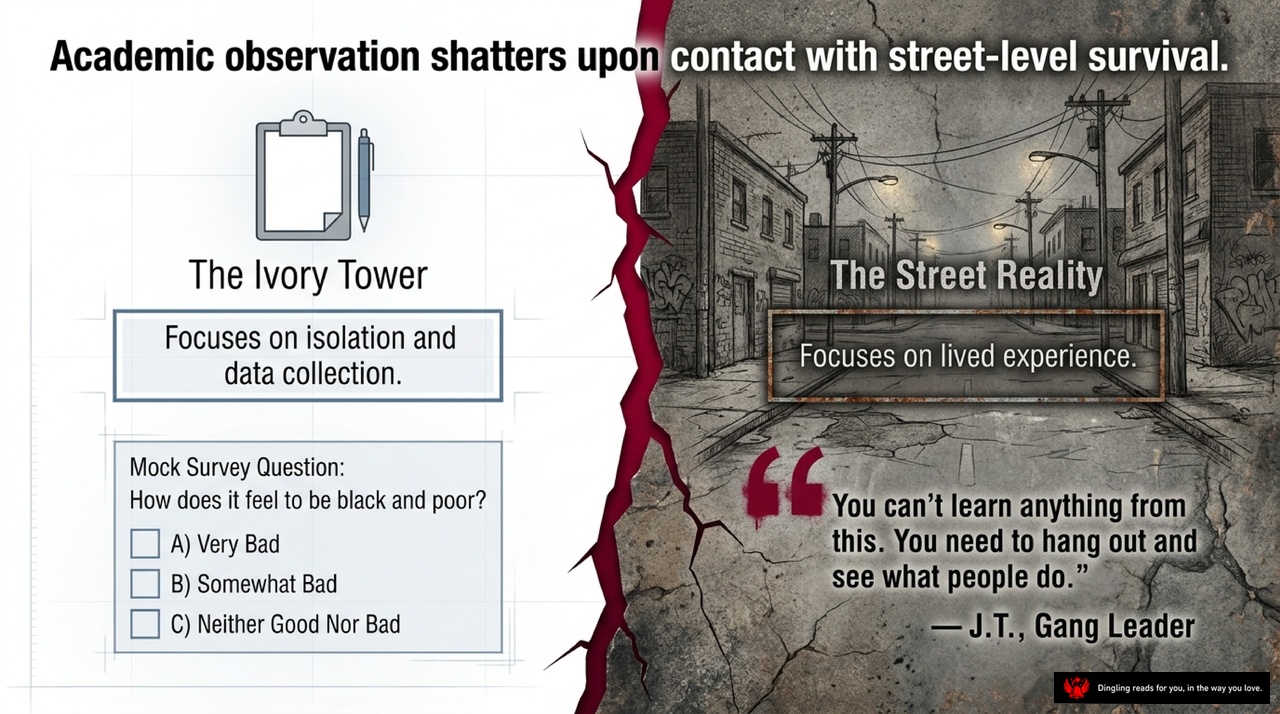
Academic observation shatters upon contact with street-level survival. This slide highlights a fundamental divide between how scholars study poverty and how people actually live it. On the left, we see "The Ivory Tower"—the world of academia. It focuses on isolation and data collection, relying on surveys and statistics to understand complex human experiences. But as the slide illustrates, this approach often fails to capture the reality of those it claims to study.
Look at the mock survey question: "How does it feel to be black and poor?" with options like "Very Bad" or "Somewhat Bad." This is a sterile, abstract question that assumes everyone feels the same way about suffering. It reduces a chaotic, dangerous, and dynamic life into a simple checkbox.
On the right side, we have "The Street Reality." This is where lived experience happens. It's messy, unpredictable, and deeply personal. The quote from J.T., a gang leader, makes this point perfectly: "You can't learn anything from this. You need to hang out and see what people do." J.T. is saying that you cannot understand his world through a questionnaire. You have to be there, in the streets, to truly see how people navigate survival, power, and community. This image reminds us that real understanding comes from engagement, not just observation from a distance.

Look at this diagram. It reveals a terrifying truth: when the state abandons a community, it doesn't disappear. Instead, a highly organized shadow state rises to take its place. This is the Robert Taylor Homes ecosystem, a parallel society where the rules of the outside world no longer apply.
First, look at **The Law**. Here, the Gang acts as the security force and dispute resolver. They replace the police, keeping violence down not for justice, but specifically to protect commerce.
Then, we see **The Mayor**. This is the Building President. They replace the municipal government, distributing housing and welfare based on their own power, not public policy.
Next is **The Market**. Instead of a formal job market, you have the Hustlers and the off-the-books economy. This creates a vibrant gig economy where survival depends on informal, often illegal, transactions.
Finally, there is **The Wildcard**: The Police. In this system, they lose their role as objective enforcers of justice. Instead, they act alternately as protectors of the gang's territory and as rivals to be fought.
This isn't just chaos; it is a sophisticated, self-sustaining system where every element—from the gang to the building president to the hustlers—works together to fill the void left by the government.

The Black Kings don't just operate like a street gang; they run as a disciplined, multi-million-dollar corporate franchise. Look at this organizational chart. It's a classic hierarchy, mirroring the structure of legitimate American businesses, but with a very different purpose.
At the top sits the Board of Directors, a group of over 20 senior leaders who manage city-wide operations and wholesale supply. They set the strategy and control the money flow. Below them is the Regional Director, J.T., who holds the franchise for the Robert Taylor territory and handles the taxes owed to the Board.
Under J.T., the power splits into two key roles. On the left is the Treasurer, T-Bone, responsible for managing ledgers and conducting financial audits—essentially the chief accountant. On the right is the Enforcer, Price, who manages security and physical discipline, acting as the internal affairs and safety department.
Finally, at the bottom level, you have the Foot Soldiers. These are teenagers executing street-level retail sales. Their specific role is absorbing maximum physical and legal risk. They are the ones on the front lines, dealing directly with customers and the police, taking the biggest hits so the organization above them can stay safe and profitable. This structure shows that the Black Kings were far more than just thugs; they were a sophisticated, risk-managed enterprise.
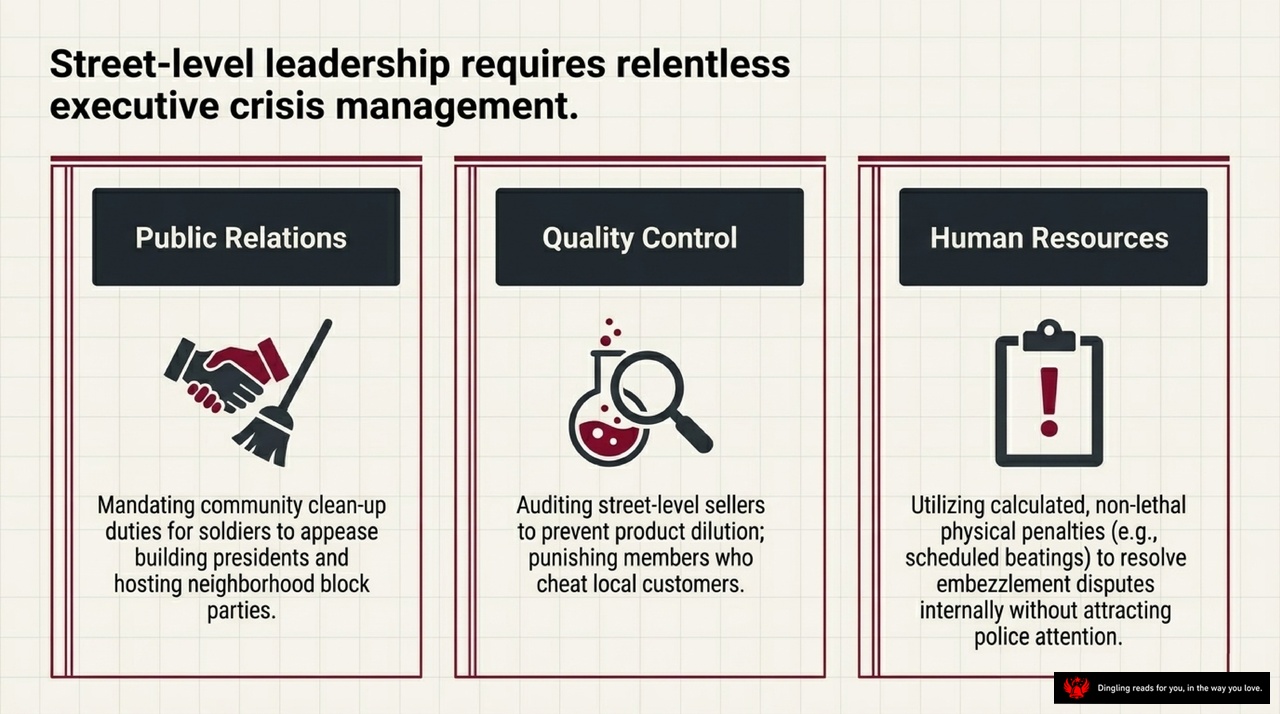
Street-level leadership is far more than just managing a criminal organization; it is a relentless exercise in executive crisis management. Imagine running a massive, decentralized corporation where the currency is cash, the inventory is illegal drugs, and the biggest risk is constant police intervention.
This slide breaks down exactly how J.T. managed his territory. First, look at Public Relations. In the normal corporate world, PR is about advertising. Here, it was about survival. J.T. had to constantly appease the building presidents and neighbors. That's why he mandated community clean-up duties and hosted neighborhood block parties. He wasn't just being nice; he was buying social capital to keep the police away and ensure his operations could continue unnoticed.
Next is Quality Control. Think of this as supply chain management, but for narcotics. J.T. had to audit street-level sellers to prevent product dilution. If the drugs were cut with too much filler, the reputation of the whole operation would collapse, and customers would flee. He also had to ruthlessly punish members who cheated local customers or failed to meet sales targets. It was a strict enforcement of brand integrity.
Finally, we have Human Resources. This is where the reality of the street hits hardest. J.T. utilized calculated, non-lethal physical penalties to resolve disputes. Whether it was embezzlement, stealing from the team, or internal conflict, the solution was often immediate and painful—like scheduled beatings. The goal was to resolve these issues internally, right within the organization, without attracting police attention. Violence became the ultimate tool for HR, ensuring loyalty and maintaining order in a high-stakes environment.
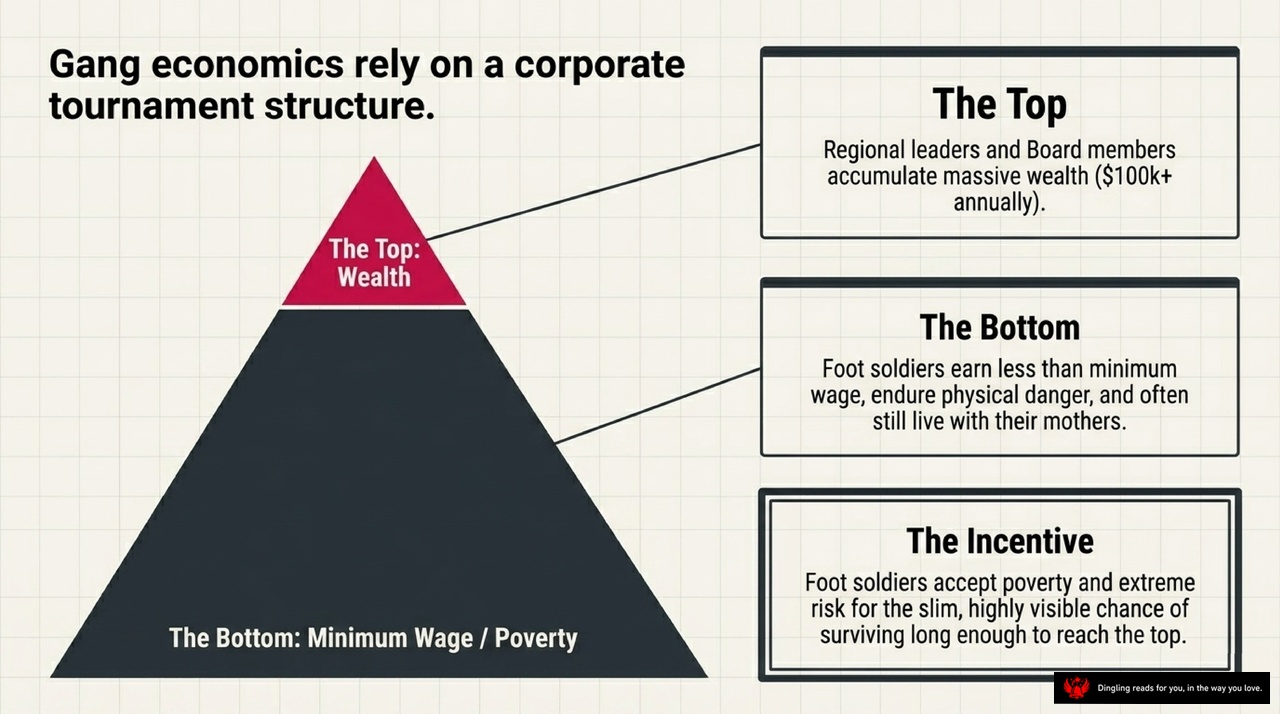
Gang economics aren't just about crime; they are a meticulously structured corporate tournament. Look at this pyramid. At the very top, you have regional leaders and board members who accumulate massive wealth—often over $100,000 annually. They run the show with the calm of seasoned CEOs, managing everything from drug distribution to bribing officials.
But at the bottom? That's where the reality check hits. Foot soldiers earn less than minimum wage, endure constant physical danger, and often still live with their mothers. So, what drives them to accept such poverty and extreme risk? It's the incentive. For these young members, the promise is slim but highly visible: a chance to survive long enough to climb the ladder and reach the top.
This structure explains why gangs operate so efficiently. It's a system where the bottom feeds the top through a cycle of risk and reward. As I saw in my research, even the middle management, like security chiefs or finance heads, only make about $30,000 a year. That's barely enough to live on, which is why the pressure to climb is so intense. Without the promise of that top-tier wealth, the entire operation would collapse. The gang isn't a chaotic mob; it's a business with a clear, ruthless hierarchy designed to maximize profit while keeping the costs of violence distributed down to the lowest level.

The slide reveals a stark reality: the "shadow mayor," Ms. Bailey, wields power not through elected office, but through extreme resource gatekeeping. She acts as the de facto building president, controlling the very essentials of life for the residents.
Look at the first box: Resource Provision. When the city ignores vulnerable women, Ms. Bailey steps in. She secures food, arranges apartment repairs, and provides physical protection. She becomes the only safety net available.
Then, there's the second box: the Taxation System. This isn't a formal government system. It's an off-the-books economy where she demands "taxes" from every resident and hustler. These aren't just cash; they come in the form of favors, goods, and labor. It's a hidden cost of living in her domain.
Finally, the red box highlights her Ultimate Leverage. She controls the physical space itself. She can evict residents instantly or shut down gang operations by simply locking down the building lobbies. This power to control space is what gives her true authority.
In this forgotten community, Ms. Bailey isn't just a resident; she is the architect of survival, ruling through a complex mix of charity, coercion, and absolute control over the building's infrastructure.

Two distinct currencies of control maintain a fragile community equilibrium, a dynamic that defined life in Robert Taylor for decades. On one side stood J.T., the gang leader, whose currency was cash and calculated violence. He served as the economic engine and the brute security force, using physical power to enforce order and protect turf. On the other side was Ms. Bailey, the building president, whose currency was housing access and social favors. She acted as the welfare safety net and the ultimate gatekeeper, navigating bureaucracy to secure resources for her tenants.
This relationship wasn't a battle; it was a symbiosis. J.T. required Bailey's permission to sell drugs securely in the lobbies, ensuring his operation ran without constant police interference. In return, Bailey required J.T.'s muscle and financial donations to fund her local initiatives and keep the building stable. It was a delicate trade: violence for stability, and favors for protection. This fragile balance allowed the community to function, even as it teetered on the edge of chaos.

Systemic unemployment doesn't just leave people jobless; it forces entire communities into a rogue capitalist gig economy. As we see in this diagram, the "Hustler Economy" isn't a single activity but a complex network of survival strategies born from desperation.
Look at the **Automotive Node**. Here, off-the-books mechanics repair cars in empty lots under gang protection, filling a void left by a collapsed formal labor market. Then, there's the **Retail Node**. Women run informal convenience and candy stores directly from their living rooms, bypassing regulations because traditional retail is out of reach. Finally, the **Service Node** includes off-grid specialists tapping illegal electricity, offering tax prep, or fencing stolen goods—services that exist solely to help people survive.
This isn't just about crime; it's an adaptive response to systemic failure. When the official economy excludes you, the underground economy becomes your only employer, your only safety net, and your only path to keeping a roof over your head.
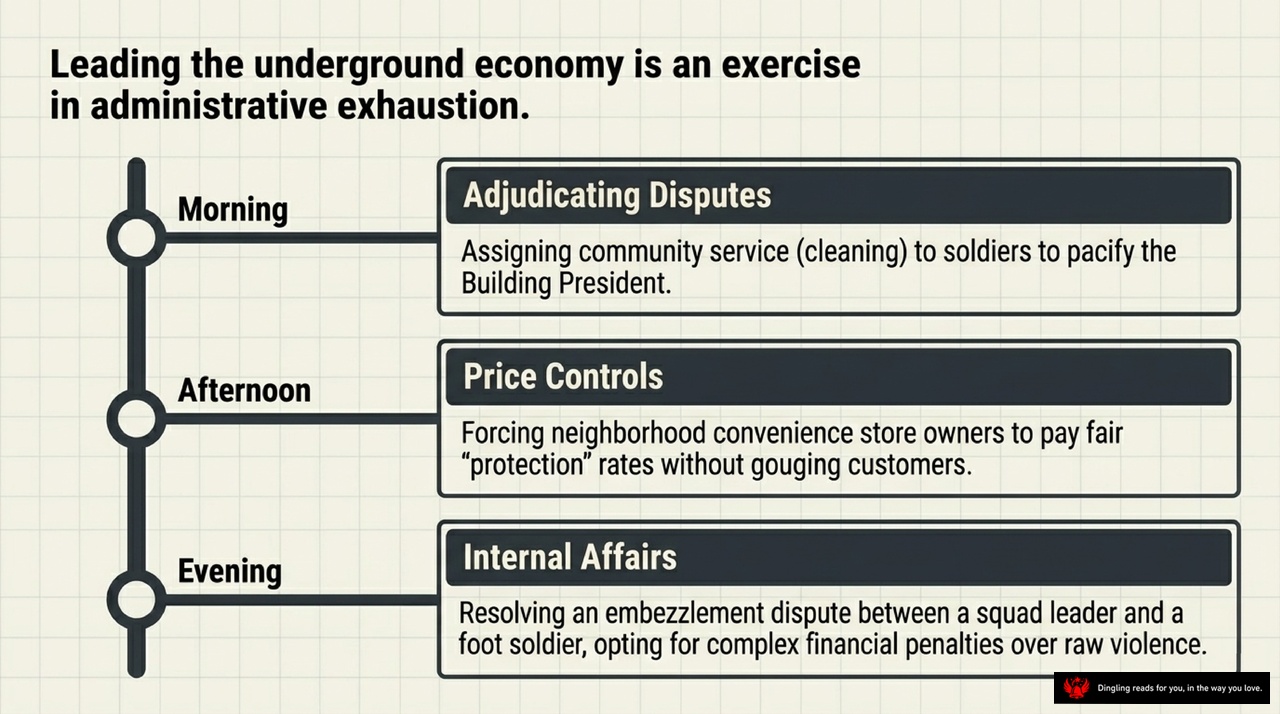
Leading the the underground economy is an exercise in administrative exhaustion. It's not a life of easy money or constant action; it's a grueling job of constant management.
Look at this daily schedule. In the morning, the boss is acting as a judge, adjudicating disputes. He might assign community service, like cleaning, to soldiers just to pacify a building president. In the afternoon, he's enforcing price controls. He forces convenience store owners to pay fair "protection" rates, making sure they don't gouge customers while still feeding the operation. By evening, he's handling internal affairs. He resolves embezzlement disputes between squad leaders and foot soldiers, opting for complex financial penalties rather than just resorting to raw violence.
This timeline reveals a harsh reality: running a criminal organization requires the same administrative skills as running a corporation. You have to manage HR, control costs, mediate conflicts, and maintain order. It is a full-time job of administrative exhaustion.
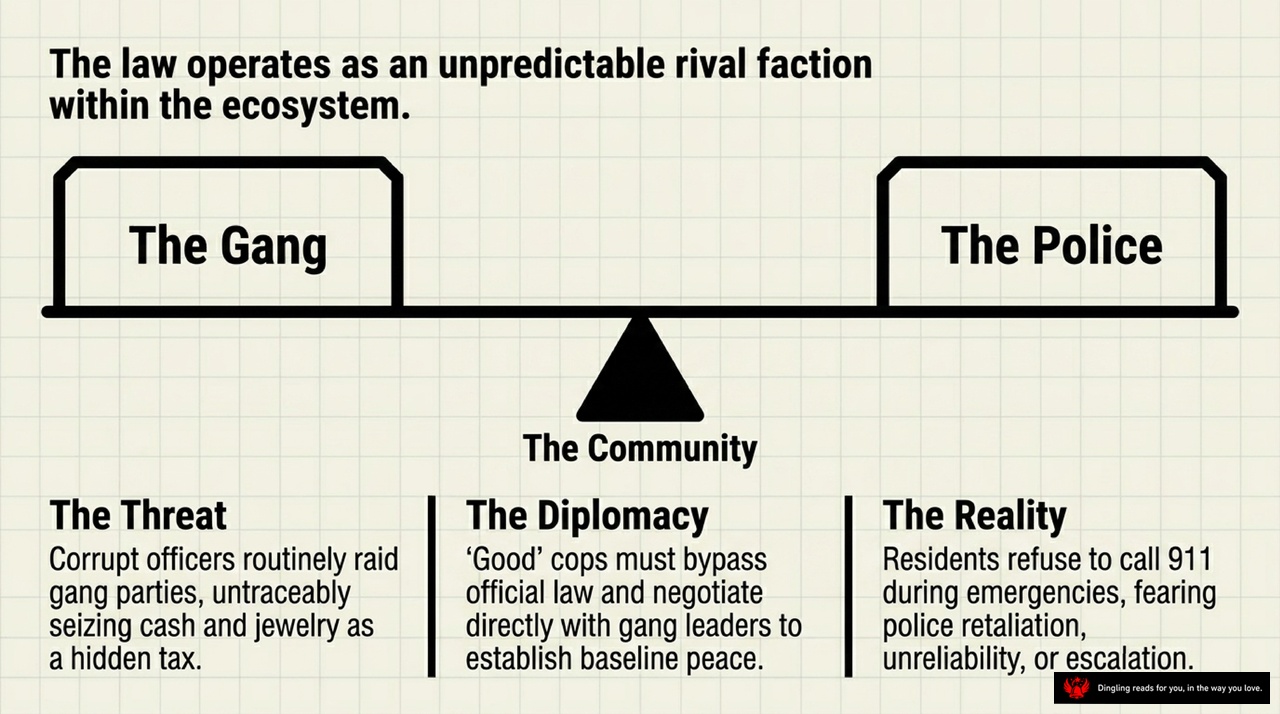
The law isn't just a set of rules; in this ecosystem, it operates as an unpredictable rival faction, constantly balancing against the forces on the ground. Look at this seesaw: on one side, you have the Gang, and on the other, The Police. But what happens when the scales tip?
On the left, under "The Threat," we see a dark reality where corrupt officers don't just enforce the law—they raid gang parties, untraceably seizing cash and jewelry as a hidden tax. It's not about justice; it's about profit.
On the right, under "The Reality," we see the devastating consequence for the residents. Because they've been burned by unreliable police and fear retaliation or escalation, they simply refuse to call 911 during emergencies. The system has failed them, leaving them with no choice but to rely on themselves.
So, what fills the gap? That's where "The Diplomacy" comes in. Good cops and community leaders must bypass official law entirely. They negotiate directly with gang leaders to establish a baseline peace. It's a fragile, unofficial truce where everyone knows the real rules of survival.
In the end, the community is the fulcrum holding this entire unstable structure together, forced to navigate a world where the law is just another player in the game, not a protector.
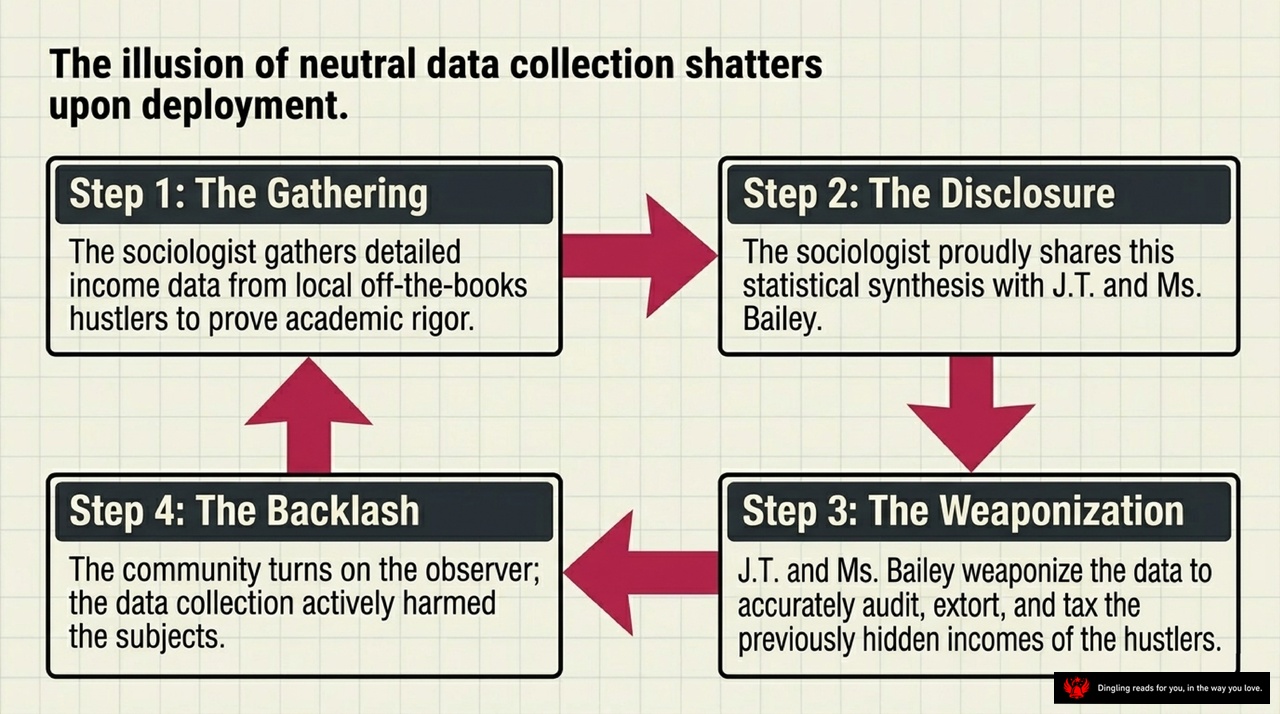
The illusion of neutral data collection shatters upon deployment. What begins as a quest for academic rigor quickly spirals into a cycle of harm. It starts with **The Gathering**, where the sociologist collects detailed income data from local off-the-books hustlers, believing they are simply proving their academic rigor. But this data doesn't stay innocent. It moves to **The Disclosure**, where the sociologist proudly shares this statistical synthesis with J.T. and Ms. Bailey, unaware that they have just handed them a weapon.
Once in their hands, the data undergoes **The Weaponization**. J.T. and Ms. Bailey use these numbers to accurately audit, extort, and tax the previously hidden incomes of the hustlers. The community, seeing their secrets exposed and their livelihoods threatened, turns on the observer. This is **The Backlash**, where the data collection actively harms the subjects it was meant to study. The illusion of neutrality is broken, revealing that in this ecosystem, observation is indistinguishable from exploitation.
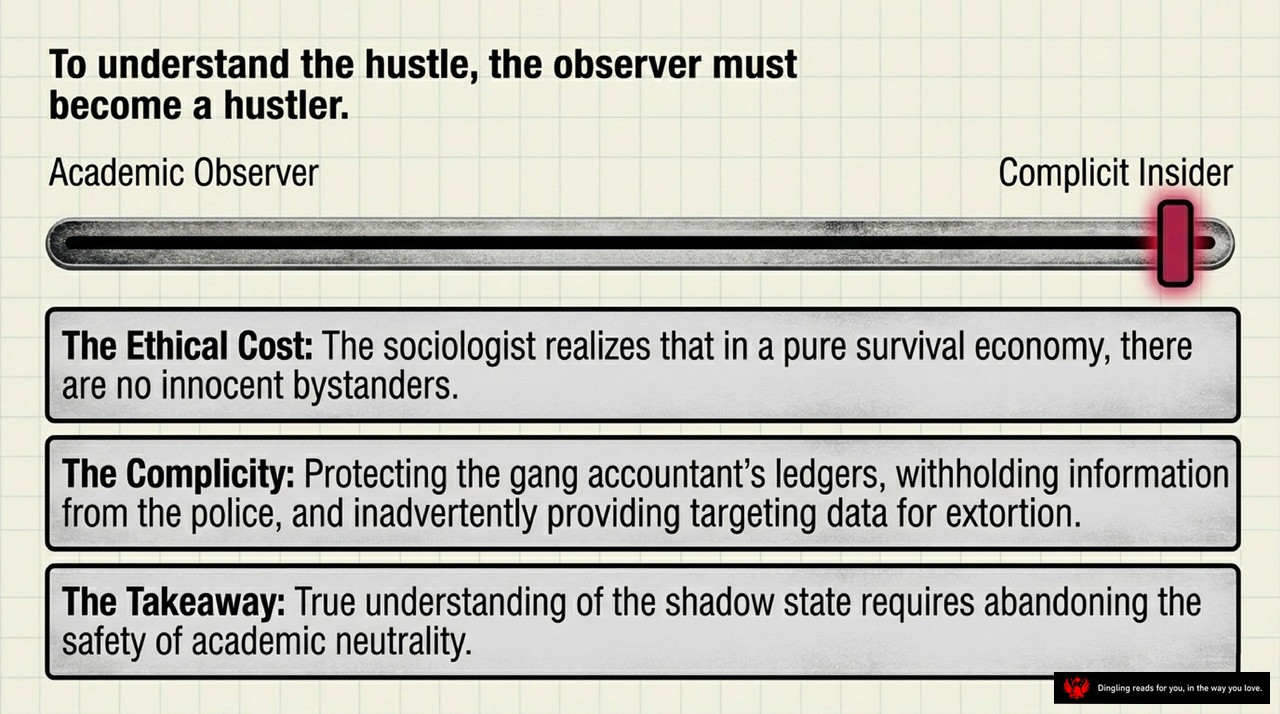
To truly understand the hustle, you have to stop watching from the sidelines and actually become a hustler. As the slide shows, the observer must shift from being a detached Academic Observer to a Complicit Insider. This isn't just about changing your job; it's about accepting a heavy Ethical Cost. In a pure survival economy, there are no innocent bystanders. By protecting ledgers, withholding information from the police, and inadvertently providing data for extortion, you become part of the machine. True understanding of the shadow state requires abandoning the safety of academic neutrality. You have to walk the line where the rules of the street replace the rules of the university, because that is where the real story lives.
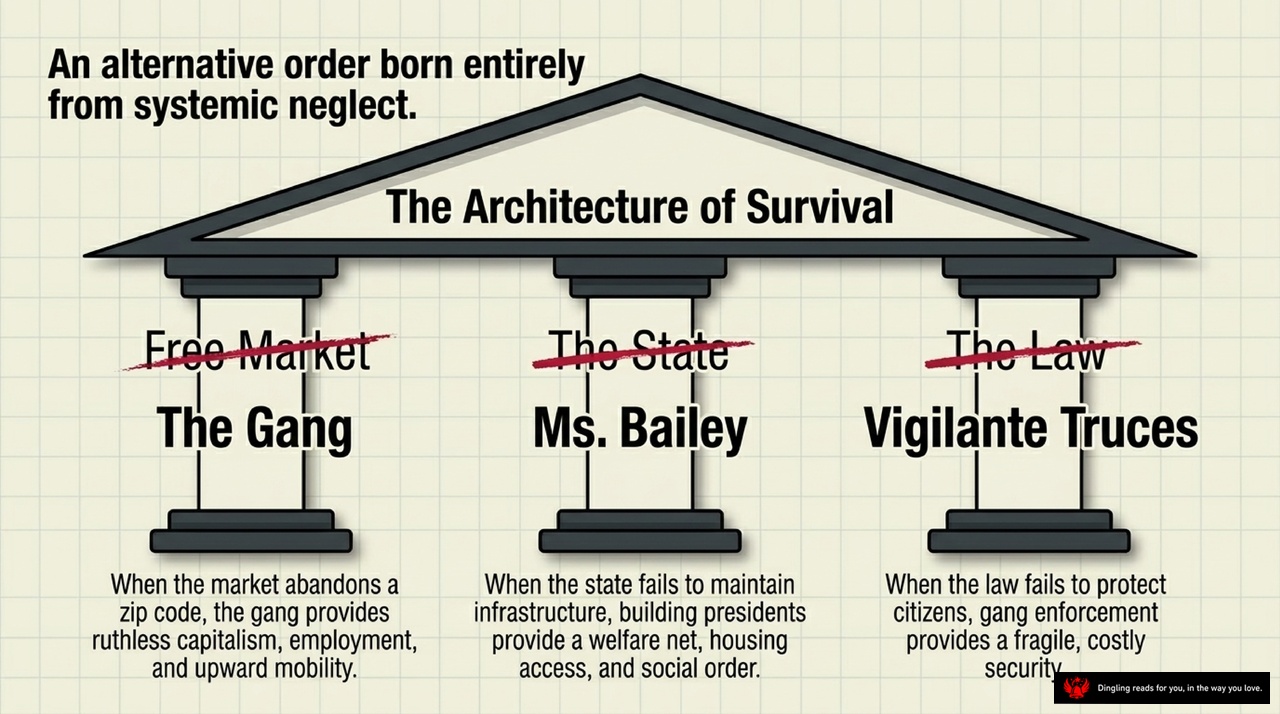
When the state fails to maintain infrastructure, Ms. Bailey steps in to provide a welfare net, housing access, and social order. In the abandoned corners of Robert Taylor, where the government has long looked away, she becomes the de facto government. She trades beer and liquor with local merchants to secure winter coats and food, effectively running a black-market supply chain that the official system simply cannot deliver.
But her power comes with a heavy price. To keep the peace and protect vulnerable women from domestic violence, she often forms truces with the gangs, even paying them to clear trash from her building or secure her tenants' safety. She acknowledges that without the gang's protection, the police would never show up, and the chaos would be total. It is a fragile, costly security, but for her tenants, it is the only thing standing between them and total collapse. Ms. Bailey proves that when the law fails to protect citizens, a community must invent its own rules to survive.

When mainstream society abandons a community, that community doesn't just disappear—it builds its own parallel, ruthless institutions to survive. In Robert Taylor Homes, this wasn't a failure of the state; it was a calculated response to its absence. The housing projects functioned as an autonomous state, driven by an underground gig economy and a corporate gang hierarchy.
Think about it: if a violent drug gang and a corrupt building president can provide more reliable governance and economic opportunity than the actual state, who is truly failing the urban poor?
We saw this firsthand. When police were slow or absent, residents turned to figures like "One Hundred" or building chairwoman MoJo to handle domestic violence, repair broken doors, or organize food drives. The gangs even managed the economy, paying low wages to young members while offering a path to promotion, and negotiating truces between rival groups to keep the streets clear. They collected taxes from local businesses and even organized political voting drives to protect their turf from law enforcement.
This isn't about glorifying crime. It's a stark reality check: when the government fails to protect or provide, the vacuum is instantly filled by those willing to enforce order, however brutally. The question we must ask ourselves is not just how the poor survive, but why the state allows them to build their own survival mechanisms in the first place.