
Washington: A Life: Complete Chapter-by-Chapter Summary
Welcome to our historical biography series. Today, we begin our journey with the story of George Washington, a man who built a nation not by seizing absolute power, but through the profound restraint of relinquishing it.
Set against the backdrop of the Potomac River and the rolling hills of Virginia, Washington's legacy is defined by his unique character as a reluctant architect of freedom. Born in 1732, he was a young man who navigated early hardships, from the loss of his father to the tragic illness of his brother, yet emerged with a quiet determination.
What makes Washington truly exceptional is his decision to step down. After leading the Continental Army to victory and serving as the first President of the United States, he chose to return to his home at Mount Vernon rather than cling to power. This act of self-discipline set a powerful precedent for democracy, proving that true leadership is about serving the people and then knowing when to leave. His story is a timeless reminder that the greatest victories are often won not by force, but by the wisdom to let go.

Look at this map of the Shenandoah Valley from 1748. It's not just a piece of paper; it's the blueprint for George Washington's rise from a struggling youth to a future titan. The image highlights "The Foundation," "The Blueprint," "The Forging," and "The Result"—four critical phases that define his early life.
Let's start with the foundation. The text tells us Washington was born into a declining Virginian family and, crucially, lacked a formal European education. While many of his peers were being groomed in the polished salons of Europe, Washington was learning the hard way in the American wilderness. This wasn't a disadvantage; it was his first lesson in resilience.
Next is the blueprint. At just 17 years old, Washington was appointed an official surveyor. This role forced him to master mathematics, drafting, and meticulous record-keeping. He wasn't just measuring land; he was training his mind for precision and strategy. The map you see here, titled "A Survey of the Shenandoah Valley," is the physical proof of that discipline.
Then comes the forging. The slide notes he "endured extreme wilderness conditions." This is where the story gets intense. Washington spent months in the deep woods, facing harsh weather and dangerous terrain. He wasn't just working; he was being hardened. This physical and mental toughness became his superpower, setting him apart from the more delicate elites of his time.
Finally, look at the result. By the time he was only 21, Washington had acquired 4,000 acres of land. But the real victory wasn't the acreage; it was the development of a strategic, analytical worldview. He treated leadership as a precise science, a direct result of his years as a surveyor. This early experience gave him the confidence and the analytical skills that would later define his leadership during the American Revolution.
So, this map represents more than just geography; it represents the transformation of a boy into a man who would eventually lead a nation.

Look at this map of the Ohio River Valley, a landscape that was the epicenter of a global conflict before it even had a name. On the left, we see the dramatic turning points of George Washington's early military career, starting with the disastrous Fort Necessity in 1754. At just 22 years old, Washington's rash decision to attack a French diplomatic detachment backfired spectacularly. He was surrounded and forced to surrender, a humbling moment that taught him the devastating cost of impulsivity and poor defensive positioning.
But Washington didn't let failure define him. Fast forward to 1755, and we see Braddock's Defeat. This is where the real lesson was learned. British General Braddock, a veteran of European wars, completely ignored Washington's advice on how to fight in the American wilderness. He stuck to rigid, conventional tactics that worked in Europe but failed miserably here. The result? The British forces were slaughtered by guerrilla tactics, and Washington miraculously survived. This defeat was a tactical awakening; it proved that rigid European warfare simply cannot succeed in the untamed American landscape. These early struggles forged the resilience and adaptability that would later define the American nation.
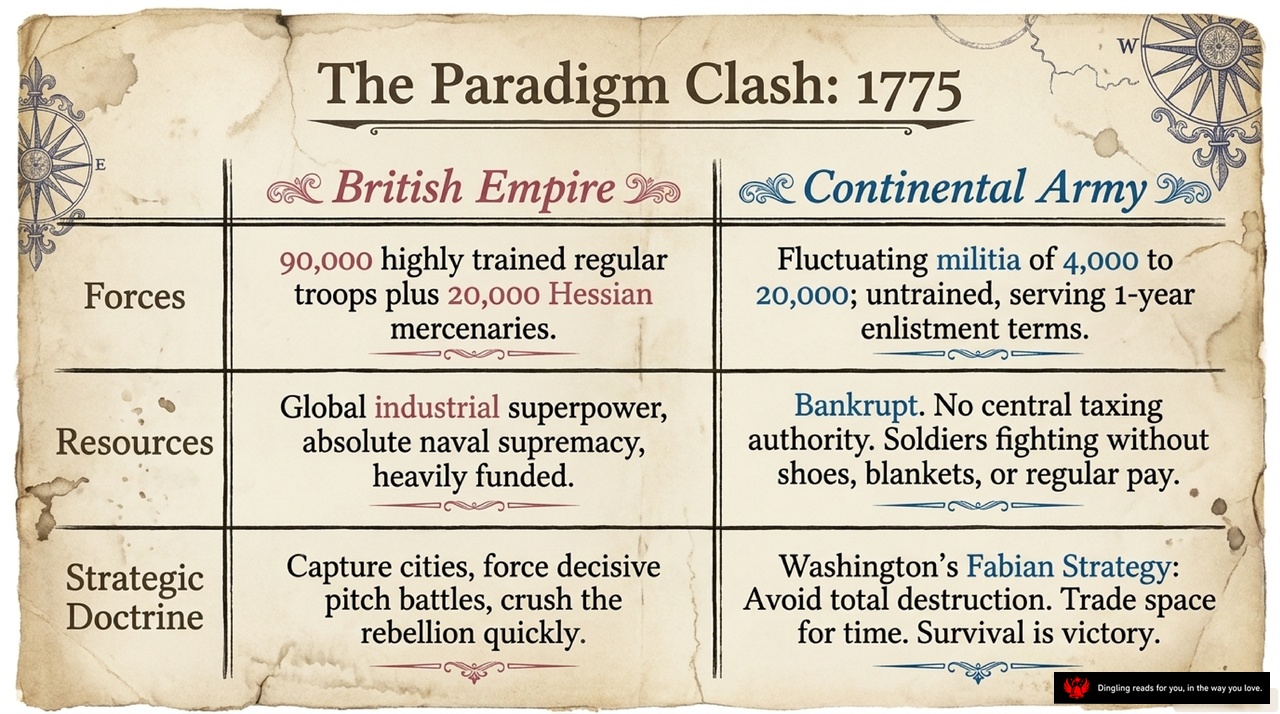
The image on your screen lays out the stark reality of 1775: a classic case of the underdog fighting the odds. On one side, you have the British Empire, a global industrial superpower with 110,000 highly trained regular troops, backed by absolute naval supremacy and heavy funding. Their doctrine was simple and aggressive: capture cities, force decisive battles, and crush the rebellion quickly.
On the other side stands the Continental Army. They were bankrupt, fighting without shoes, blankets, or regular pay, and they lacked a central taxing authority. Their forces were a fluctuating militia of just 4,000 to 20,000 untrained men serving only one-year terms.
But here is where the story gets interesting. While the British relied on brute force, George Washington chose a different path. He adopted what historians call the "Fabian Strategy." Instead of trying to defeat the superior British army in a head-on collision, Washington's doctrine was to avoid total destruction, trade space for time, and prioritize survival above all else. It wasn't about winning a single battle; it was about outlasting an empire that couldn't afford a long war. This fundamental clash of paradigms—British aggression versus American endurance—set the stage for the entire Revolutionary War.

Look at this document right here—the "Commander-in-Chief Commission." This single piece of paper changed the course of history. It wasn't just a job offer; it was a declaration of a new kind of leadership.
Notice the first thing mentioned: "The Uniform." Washington didn't show up in a flashy suit. He arrived at the Second Continental Congress wearing his blue and buff Virginia militia uniform. Why? Because he was silently signaling that he was ready to serve without actively lobbying for power. He let his actions speak louder than his words.
Then, look at the top right corner: "The Unanimous Choice." This wasn't a popularity contest. He was selected unanimously to unify the Northern and Southern colonies. In a time of deep division between wealthy planters and radical merchants, Washington became the bridge that held the fragile alliance together.
But what about the cost? Check the bottom left: "The Refusal of Pay." When offered a $500 monthly salary, Washington declined it. He insisted only on reimbursement for actual expenses. By doing this, he established a standard of absolute public incorruptibility that no leader since has matched. He made it clear that he was serving the nation, not enriching himself.
Finally, look at the bottom right box, "The Heavy Burden." Even as he took this monumental step, he wrote to his wife, Martha, saying, "I consider myself embarking a dangerous and uncertain journey... I feel my own abilities are inadequate." It's incredibly powerful to see a man of such stature admitting his fears. He didn't pretend to be perfect; he just chose to do what was necessary despite the odds.

Look at this map of the winter of 1776-1777. It tells the story of Washington's greatest comeback. On the right, you see the "Fall of New York" in 1776. The British had completely encircled Manhattan, and Washington realized that holding a static position against a superior navy meant certain annihilation. He made the hard choice to abandon the city, saving his army by retreating. As the text notes, he concluded that on all occasions, one should avoid a general action and never be drawn into a necessity to put anything to the risk.
But this wasn't the end. It was the setup for the counter-strike. Look at the left side of the map. Washington crossed the icy Delaware River on Christmas night to ambush the Hessian forces at Trenton, followed immediately by Princeton. This wasn't just about brute force; it was a masterclass in psychological warfare and speed. By striking when the enemy least expected it, Washington turned the tide. The map shows the dotted lines moving from the retreat in New Jersey all the way back to victory at Trenton and Princeton. This bold move proved that the Continental Army could not be crushed, setting the stage for the eventual victory at Yorktown.

Look at this "Endurance Curve" from the winter of 1777 to 1778. It captures the absolute rock bottom of the American Revolution, where the Continental Army faced total collapse. By January 1778, the graph hits its lowest point, labeled "The Trough." Here, rampant typhus and starvation were killing men, mutinies over unpaid wages were breaking the army's backbone, and troops were literally leaving bloody footprints in the snow as they fled their camps.
But notice how the curve doesn't just stay down; it climbs sharply. This recovery wasn't accidental; it was the result of three specific interventions. First, there was the "Ideological Intervention." General Washington ordered the reading of Thomas Paine's *The American Crisis*, reminding starving men that "these are the times that try men's souls," restoring their sense of purpose.
Then came the "Logistical Intervention." Martha Washington arrived at the camp, organizing relief and providing visible, stabilizing leadership that the soldiers desperately needed. Finally, the "Structural Intervention" occurred when Baron von Steuben arrived to implement professional, unified military drills, turning a ragtag militia into a disciplined army. By March 1778, the curve had surged back up, proving that even in the darkest winter, a combination of spirit, supplies, and discipline could turn defeat into endurance.
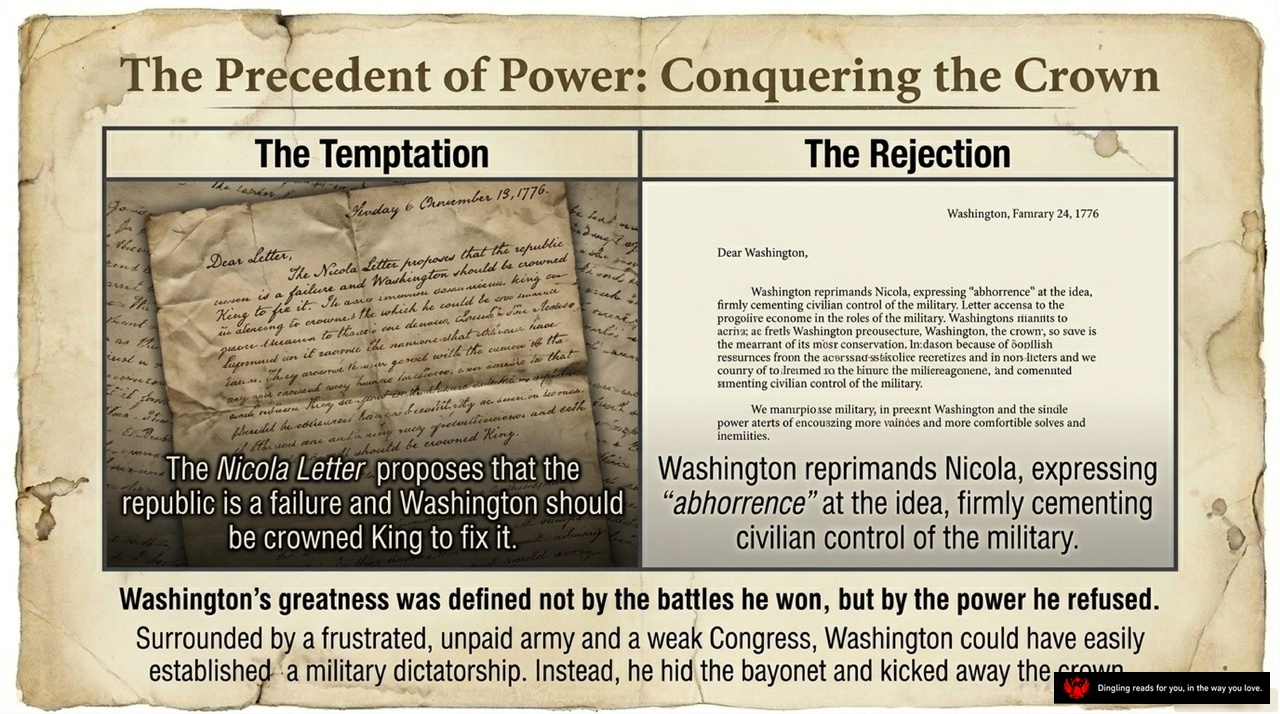
The temptation to crown a king was real, but George Washington chose the harder path of rejection. As the image on your slide clearly contrasts, a letter from Colonel Nicholas urged Washington to accept a crown, arguing that the republic had failed and a monarch was the only fix. Surrounded by a frustrated, unpaid army and a weak Congress, Washington could have easily established a military dictatorship. Instead, he hid the bayonet and kicked away the crown. In a firm letter dated February 24, 1776, Washington expressed "abhorrence" at the very idea, firmly cementing civilian control over the military. His greatness was defined not by the battles he won, but by the immense power he refused. By rejecting the throne, he proved that true leadership isn't about ruling, but about serving the principles of liberty, ensuring that the sword never points at the people it was meant to protect.

Look at this timeline carved into the stone. It captures the three defining moments that transformed George Washington from a military hero into the father of a democracy.
In 1782, after receiving the controversial "Nicola Letter" urging him to seize power and become a king, Washington made his first great stand. He refused to exploit the army's anger. Instead of grabbing the throne, he chose to reject the monarchy entirely, proving that true leadership meant putting the nation above personal ambition.
Just one year later, in 1783, he took his final step toward civilian life. In Annapolis, he voluntarily resigned his commission as Commander-in-Chief. He handed the sword back to a weak Congress, choosing to become a private citizen rather than a lifelong ruler. This act of returning power to the people set a precedent that would change history.
Finally, in 1796, Washington established the ultimate democratic tradition. After two terms as President, he stepped down, refusing the third term that many urged him to take. By doing so, he proved that power could be transferred peacefully without violence or chaos.
As King George III reportedly said, if Washington ever returned to his farm, "he will be the greatest man in the world." And by refusing the crown, returning the sword, and declining the third term, he did exactly that.

Look at this visual narrative of America's founding. On the left, we see "The Cracks"—the crisis. It depicts Shays' Rebellion of 1786, where unpaid veterans rose up because the weak, decentralized Articles of Confederation couldn't collect taxes or maintain order. The image shows a crumbling stone structure, symbolizing how close the nation came to collapsing under its own weight.
But the story doesn't end there. In the center, under "The Reluctant Return," we see the turning point. Washington rejects calls for a military crackdown, insisting instead on the rule of law. He leaves Mount Vernon to chair the Constitutional Convention, choosing a legal solution over force.
Finally, on the right stands "The Keystone," the solution. Washington uses his unparalleled national prestige to legitimize the new Federal Constitution. The image shows a restored arch, representing a strong central government checked by separated powers. This wasn't just about fixing a broken system; it was about building a durable foundation for a new nation, ensuring that power would never again fracture the union.
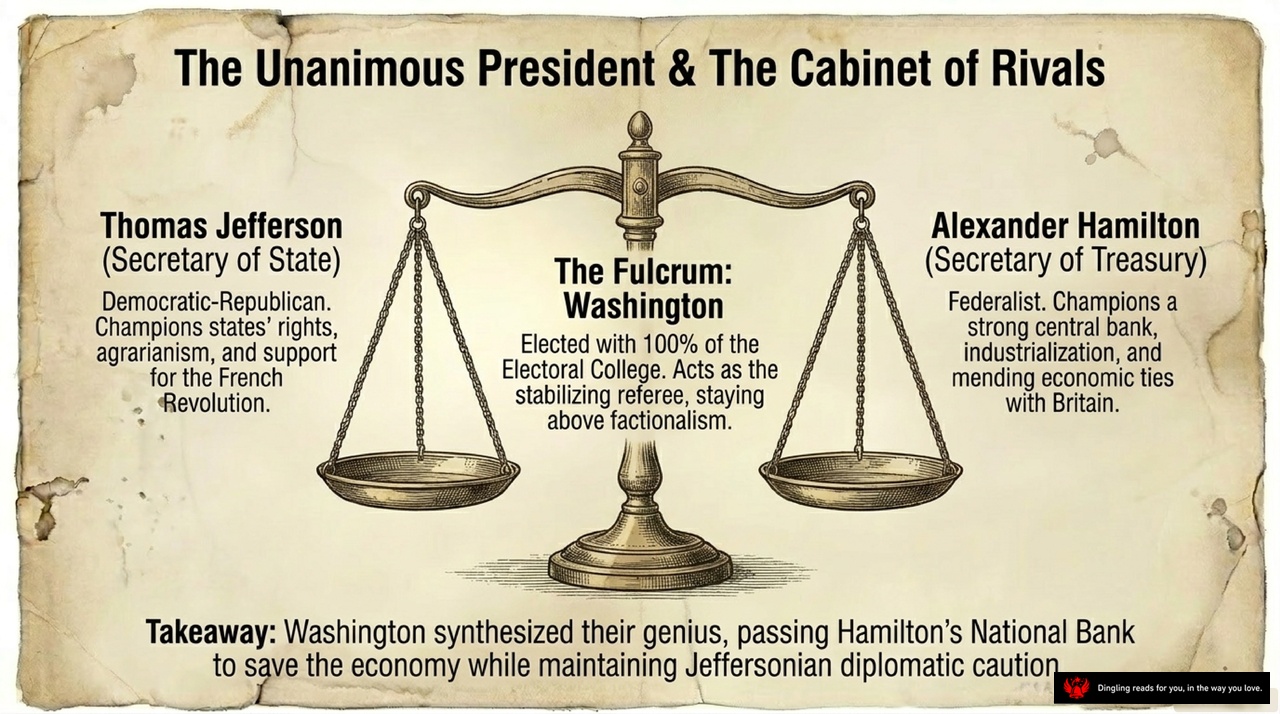
Imagine the presidency not as a solo performance, but as a delicate balancing act. As our slide illustrates, George Washington stood as the fulcrum, elected with a perfect 100% of the Electoral College, acting as the ultimate stabilizing referee above the fray. On one side of the scale sat Thomas Jefferson, the Democratic-Republican who championed states' rights, agrarianism, and support for the French Revolution. On the other stood Alexander Hamilton, the Federalist who pushed for a strong central bank, industrialization, and mending economic ties with Britain. These weren't just political opponents; they were rivals with fundamentally different visions for the nation's soul. Yet, Washington's genius lay in his ability to synthesize their genius. He passed Hamilton's National Bank to save the economy while simultaneously maintaining Jeffersonian diplomatic caution. By keeping these rivals in check, Washington ensured that the new nation could build a strong financial foundation without sacrificing its commitment to liberty, proving that unity doesn't mean uniformity—it means finding the balance between competing ideals.

Picture content:
- Title: The Geopolitics of Neutrality
- Left side: The British Empire (Naval blockades and trade dominance) with stormy seas and ships.
- Right side: The French Revolution (Ideological extremism and endless war) with a whirlpool and ships.
- Center: The United States (a ship navigating between the two storms).
- Bottom Left: The Policy (The Proclamation of Neutrality (1793). He strictly avoids permanent military alliances.)
- Bottom Center: The Action (Supports the highly unpopular Jay Treaty with Britain to secure peace and trade, enduring vicious domestic attacks.)
- Bottom Right: The Result (Prioritizes the long-term survival of the young nation over short-term popularity, buying the US the time needed to grow strong.)
Matching book content:
From the provided text, specifically the section describing Washington's presidency and foreign policy:
"面对英法两国的争端,他坚持独立自主的中立原则,既不忘法国对美国独立的贡献,和拉斐特保持着真诚的友谊,收下了对方送来的巴士底狱大门钥匙,又积极缓和与英国的关系,派遣使者打破僵局,实现了邦交正常化,为美国争取到了稳定的国际环境。"
"华盛顿坚定地宣布严守中立,哪怕遭到舆论攻击也绝不妥协。"
"《杰伊条约》为美国赢得了宝贵的和平,却也让两党斗争愈演愈烈,华盛顿甚至遭到报纸的恶意污蔑,可他始终廉洁奉公..."
Drafting the script:
The United States found itself in a precarious position, literally caught between two titans. On one side, the British Empire, with its naval blockades and overwhelming trade dominance, creating a storm of economic pressure. On the other, the French Revolution, spiraling into ideological extremism and endless war, a whirlpool of chaos threatening to drag the young nation down.
In this high-stakes game of geopolitics, Washington chose a path that defied the immediate passions of the moment. He issued the Proclamation of Neutrality in 1793, strictly avoiding permanent military alliances with either side. This wasn't an act of cowardice, but a calculated strategy for survival.
To secure peace and trade, Washington supported the highly unpopular Jay Treaty with Britain. He knew that avoiding a war with the world's strongest power was essential, even if it meant enduring vicious domestic attacks from his own political opponents. He prioritized the long-term survival of the young nation over short-term popularity. By buying the US the time needed to grow strong, he ensured that the nation could eventually stand on its own feet, free from the destructive tides of European conflict.
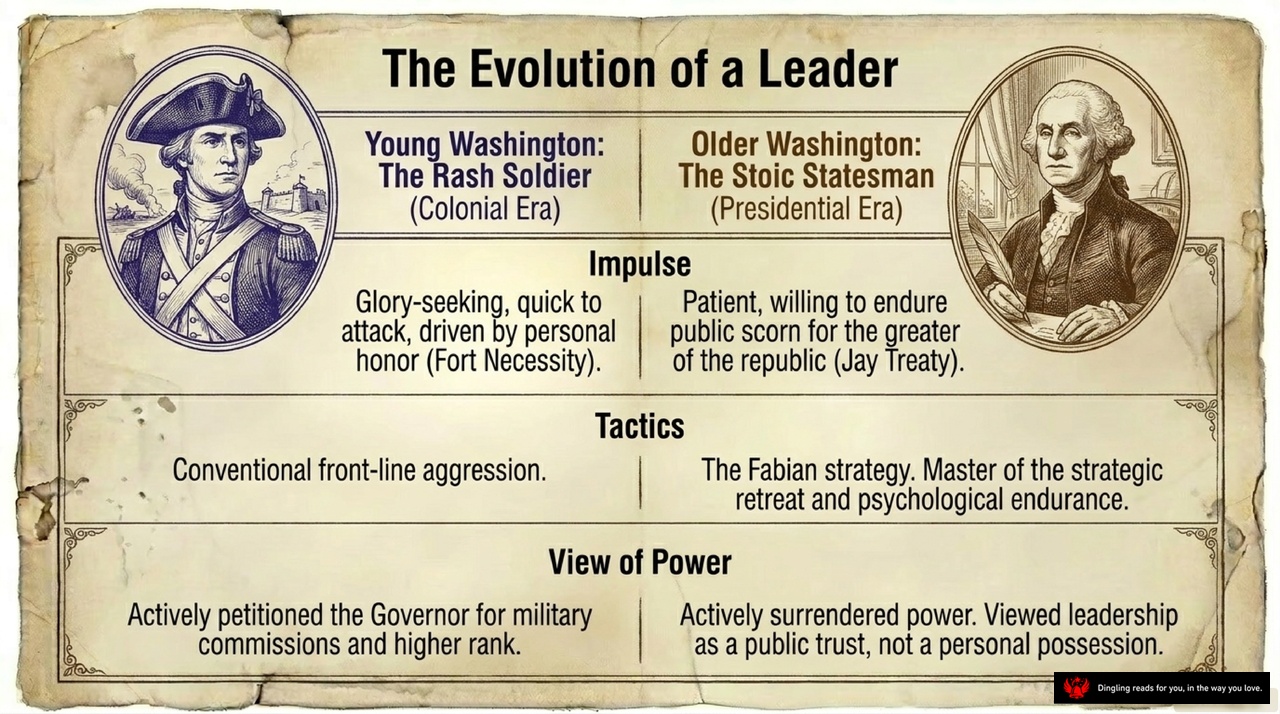
The Evolution of a Leader isn't just about titles; it's about the profound transformation of character under the weight of history. Look at this split portrait of George Washington. On the left, we see the Young Washington of the Colonial Era—a rash soldier driven by impulse. He was glory-seeking, quick to attack, and deeply motivated by personal honor, as seen when he aggressively defended Fort Necessity. His tactics were conventional front-line aggression, and he actively petitioned for power, chasing military commissions and higher rank to prove his worth.
Fast forward to the right, and you see the Older Washington of the Presidential Era. He has evolved into a stoic statesman. His impulse has shifted from seeking glory to enduring public scorn for the greater good of the republic, famously demonstrated by his acceptance of the Jay Treaty despite fierce political backlash. His tactics have transformed into the Fabian strategy; he became a master of strategic retreat and psychological endurance, knowing when to wait rather than fight. Most importantly, his view of power has completely reversed. While the young man sought possession, the elder statesman actively surrendered power, viewing leadership not as a personal trophy, but as a sacred public trust. This journey from a self-centered soldier to a selfless servant defines the true essence of American leadership.
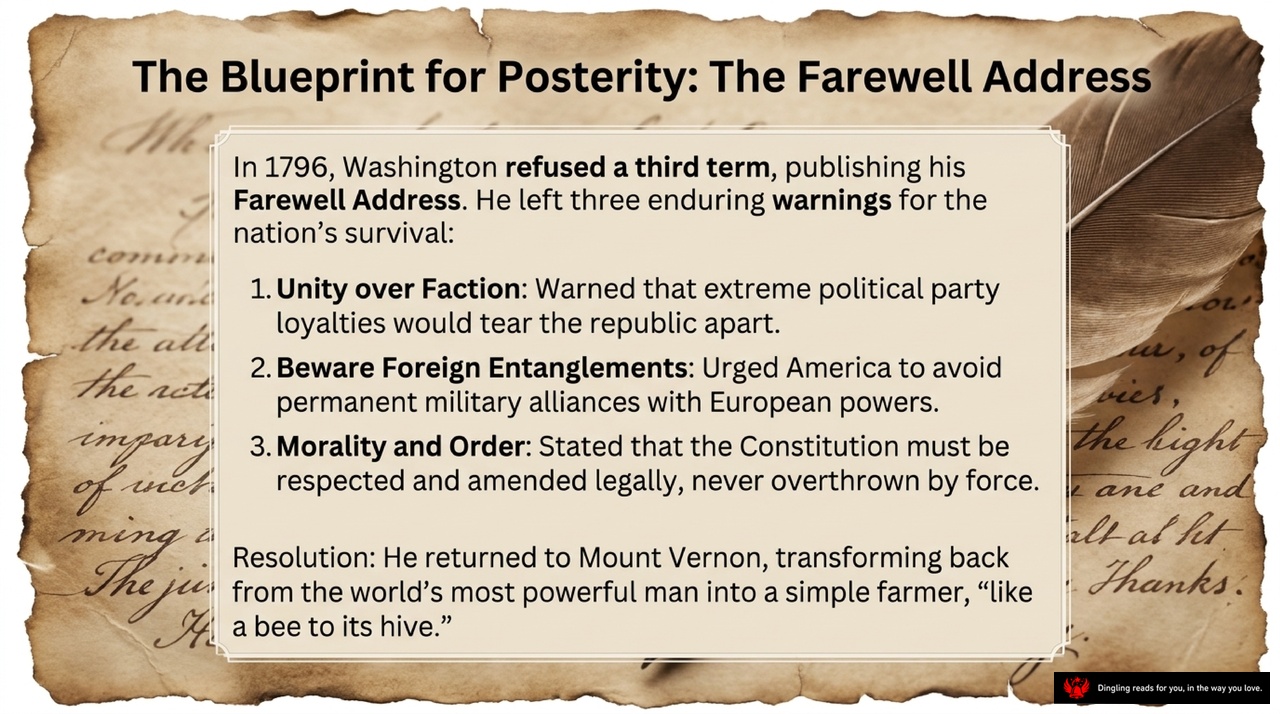
In 1796, after leading the nation through its most critical years, George Washington made a decision that would echo through history: he refused a third term and penned his Farewell Address. This wasn't just a retirement announcement; it was a blueprint for the nation's survival, leaving three enduring warnings for future generations. First, he warned against the dangers of political factions, cautioning that extreme loyalty to political parties could tear the republic apart from within. Second, he urged the young country to beware of foreign entanglements, specifically advising America to avoid permanent military alliances with European powers that could drag the nation into unnecessary conflicts. Finally, he emphasized the necessity of morality and order, stating that the Constitution must be respected and amended through legal processes, never overturned by force. Following this resolution, Washington returned to Mount Vernon, transforming himself from the world's most powerful man back into a simple farmer, famously likening his life to a bee returning to its hive.

George Washington possessed the power of a king, yet he chose the character of a servant. While he could have easily seized the throne, his true genius lay in his ability to refuse it. He didn't build the American Republic through the battles he won on the battlefield, but through the unprecedented restraint of stepping away from power.
Look at that pencil sketch on the slide—it represents his final act of leadership: the decision to walk away. The slide asks a question that challenges us all today: If the ultimate test of leadership is the willingness to surrender it, how many of today's leaders could pass Washington's test? In an era where power is often hoarded, Washington's choice to return to private life after two terms set a standard that remains unmatched. His legacy wasn't defined by how long he held the office, but by how gracefully he let it go.