
Gödel, Escher, Bach: Complete Chapter-by-Chapter Summary

Welcome to today's deep dive into one of the most fascinating intersections of logic, art, and music. We are exploring Douglas Hofstadter's monumental masterpiece, *Gödel, Escher, Bach: An Eternal Golden Braid*.
This book isn't just a textbook; it's a grand exploration of how meaning, consciousness, and intelligence actually emerge from the strange, looping structures of formal systems. Think of it as a journey where the boundaries between mathematics, visual art, and classical music dissolve into a single, unified idea.
We are looking at the iconic "Golden Braid" logo, which perfectly captures the book's core theme: the idea of "strange loops." Just like that intricate wooden knot in the center, the book weaves together three distinct worlds. On one side, you have Kurt Gödel, the logician who proved that no matter how perfect a system is, there are always truths it cannot prove. On another, you have M.C. Escher, the artist who painted hands drawing each other and staircases that go up forever but lead back down. And on the third, you have Johann Sebastian Bach, the composer whose music creates complex, self-referential patterns that sound like infinite conversations.
Hofstadter argues that these three giants, though working in completely different fields, are actually solving the same puzzle. They are all touching upon the concept of "self-reference" and "level twisting." Whether it's a mathematical proof, a visual paradox, or a musical fugue, they all reveal that reality is built on layers that constantly fold back into themselves. This book invites you to step into that braid and see how the universe, and even your own mind, is constructed from these endless, beautiful loops.
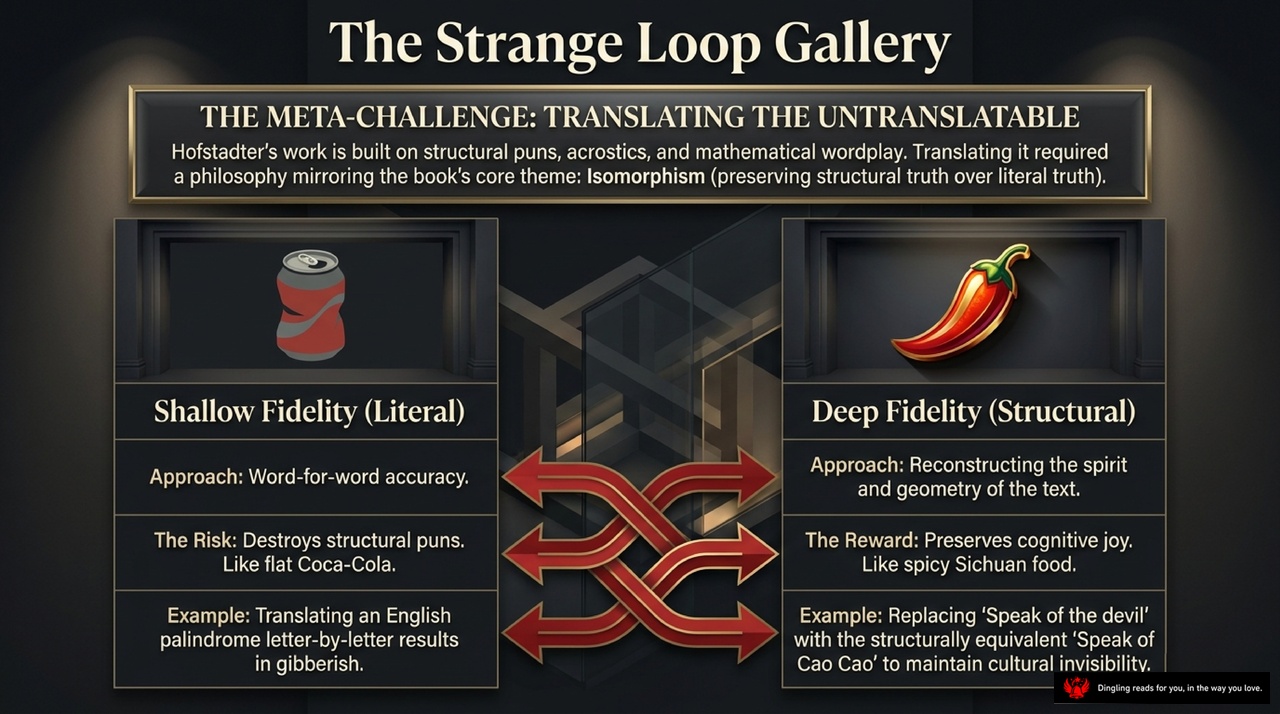
Welcome to the gallery of strange loops, where the boundaries between layers begin to blur. Today, we're tackling a meta-challenge that sounds impossible: translating the untranslatable.
Look at the two paths here. On the left, we have "Shallow Fidelity," or the literal approach. It's all about word-for-word accuracy. But here's the risk: it destroys the very structure that makes the work meaningful. Think of it like a flat can of Coca-Cola—it looks like a soda, but you've lost the fizz. If you translate a palindrome letter-by-letter, you just end up with gibberish. You've kept the shape, but lost the soul.
On the right, we have "Deep Fidelity," or the structural approach. This isn't about matching individual words; it's about reconstructing the spirit and geometry of the text. The reward? It preserves that cognitive joy. It's like swapping a bland drink for spicy Sichuan food—completely different ingredients, but the same thrilling experience. For example, instead of translating "Speak of the devil," you might use "Speak of Cao Cao." The words change, but the cultural invisibility and the structural punch remain intact.
This is the philosophy behind Hofstadter's work: Isomorphism. It's about preserving structural truth over literal truth. We aren't just translating words; we are translating the logic, the puns, and the mathematical wordplay that make the book tick. By moving from shallow to deep fidelity, we stop flattening the art and start experiencing its true, layered complexity.
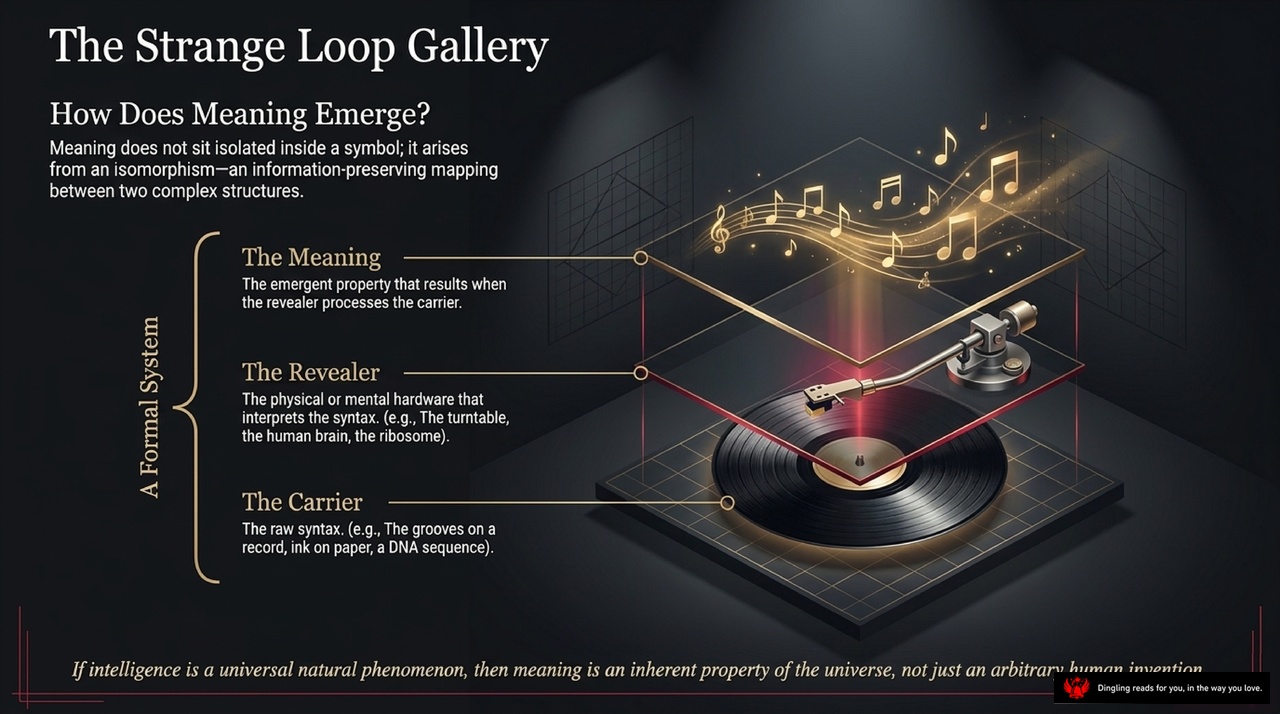
Welcome to the Strange Loop Gallery. Today, we're diving into the core question: How does meaning actually emerge? The slide illustrates a fascinating concept—a formal system composed of three distinct but interconnected parts. Think of it like our old friend, the vinyl record. You have the Carrier, which is the raw syntax, like the grooves on the record or ink on a page. Then, you have the Revealer, the hardware that interprets that syntax, whether it's a turntable or the human brain. Finally, you get The Meaning, which isn't just sitting inside the symbol; it emerges when the Revealer processes the Carrier. This is an isomorphism, a perfect mapping between two complex structures.
But why does this matter? Because if intelligence is a universal natural phenomenon, then meaning isn't just an arbitrary human invention. It's an inherent property of the universe itself. Whether it's DNA being read by a ribosome or a song being played on a turntable, the logic remains the same. We are seeing how abstract symbols transform into something we can understand and feel, simply through the interaction of these layers. It's a reminder that the magic isn't in the parts alone, but in the dynamic relationship between them.

Welcome to the "Strange Loop Gallery." Today, we're stepping into a world where three distinct geniuses—Kurt Gödel, M.C. Escher, and J.S. Bach—independently uncovered the same profound architectural truth of the universe: the power of self-reference.
Look at the three triangles surrounding us. On the left, we have Kurt Gödel in Mathematics. He proved that any sufficiently powerful formal system can talk about itself, leading to inherent incompleteness. In the middle, M.C. Escher in Art. He drew visual paradoxes where figures create the very ground they stand on, blurring the line between foreground and background. And at the bottom, J.S. Bach in Music. He composed fugues and canons that loop back on themselves, rising infinitely yet returning to their exact origin.
These three masters might seem worlds apart, but their work reflects the same core concept: the "Strange Loop." It's a structure where different levels of a system intertwine and loop back into each other. Whether it's a logical proof that refers to its own rules, a painting where hands draw each other, or a musical piece that climbs endlessly only to return to the start, they all reveal that when complexity reaches a certain point, boundaries dissolve. The layers of a system can penetrate and wrap around one another, creating a closed loop that defies our usual understanding of cause and effect. This is the universal structure that connects logic, art, and music, revealing a deeper, self-referential order woven into the fabric of reality.

Welcome to the gallery of strange loops, where the boundaries between cause and effect, and between the observer and the observed, simply dissolve. Imagine a staircase that climbs upward only to loop back down to its starting point. That is the essence of what we are exploring today: entangled hierarchies and strange loops.
Let's break this down into three distinct layers, just like our visual. First, we have the foundation: The Inviolable Level. Think of this as the bedrock of reality—fundamental hardware rules like physical laws or neurons firing. These are the unchangeable axioms that the system itself cannot alter. They are the ground upon which everything else is built.
Moving up from that foundation, we encounter what we call The Tangled Software. This is the realm of higher-level symbols—the software, the art, the logic, and the meaning that emerges within the bounds of that hardware. Here, symbols interact, mutate, and create new meanings. It's where the magic happens, where rigid rules give rise to complex, living structures.
But the true wonder happens at the third stage: The Collapse. This is the moment the system becomes so complex that it crosses the boundary between the observer and the observed. The system begins to perceive itself. It's the moment a loop closes, where we unexpectedly find ourselves right back where we started, but now with a new understanding of where we've been.
This concept of a strange loop isn't just an abstract idea; it's the core of how we understand consciousness, logic, and even art. When you look at a painting where a hand draws another hand, or listen to a musical fugue that loops back on itself, or even ponder the limits of mathematical proof, you are witnessing these entangled hierarchies in action. We are constantly climbing up layers of complexity, only to realize that the top layer is looking back down at the bottom, creating a perfect, self-referential circle.
Welcome back to the Strange Loop Gallery. Today, we're diving deep into the brain itself—specifically, how your mind actually works. Think of your brain not as a single entity, but as a massive network of billions of neurons. These neurons act like tiny messengers, passing electrical signals through synapses to create the complex web of thought we experience as consciousness.
But how does this biological hardware translate into the abstract world of ideas? That's where the concept of "symbols" comes in. Your brain doesn't store thoughts like files on a hard drive; instead, it uses clusters of neurons to represent symbols. These symbols have two distinct states: dormant, when you aren't thinking about something, and active, when a concept is triggered. Crucially, your mind organizes these symbols into a hierarchy of "classes" and "instances." A "class" is an abstract category, like the general idea of a "cat," while an "instance" is a specific individual, like your pet "Mittens." This dynamic interaction allows your brain to efficiently generalize and remember unique details simultaneously.
Your knowledge storage operates in two modes: declarative and procedural. Declarative knowledge is about facts—"Paris is the capital of France." Procedural knowledge is about skills, like riding a bike or playing an instrument. Interestingly, these two forms constantly transform into one another; practice turns facts into muscle memory, while experience allows us to articulate our skills as rules.
Furthermore, your mind isn't a monolith. It relies on "subsystems"—independent modules that handle specific tasks, like driving while you think about work. This modularity, combined with the ability to create mental images or "visual representations," allows for complex problem-solving without needing language.
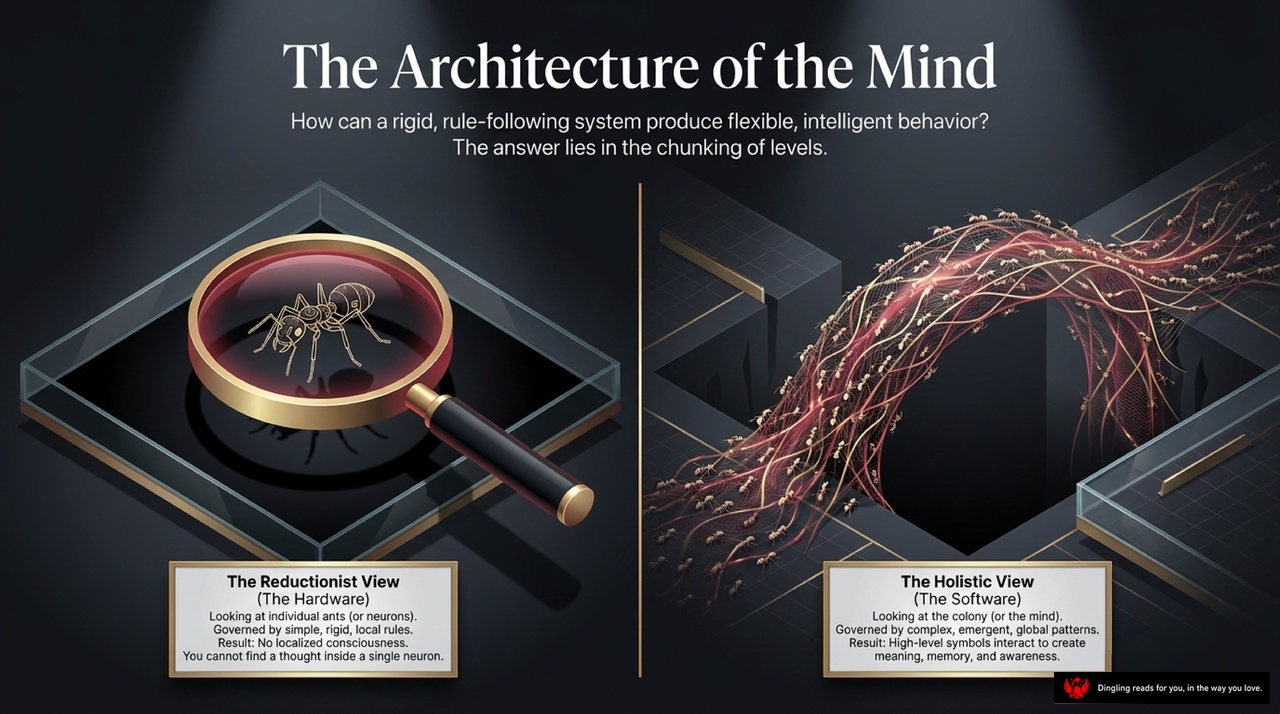
Finally, consider the nature of consciousness itself. It emerges from the collective activity of these simple neurons, much like a swarm of ants creates complex intelligence without any single ant knowing the whole plan. When we ask, "Who am I?", we are essentially looking at a network of symbols that integrates our memories, body sensations, and social roles. This self-symbol is the anchor of your identity.
The fascinating part is that human understanding relies on "isomorphism"—mapping our internal symbols to the outside world. When you and I communicate, we aren't sharing identical neural patterns; we are finding a shared symbolic structure that allows us to understand each other. This bridges the gap between our unique internal worlds and the shared reality we inhabit.
Welcome back. Today, we're diving into the final chapter, where we pull all the threads together to reveal the book's central theme: the "Strange Loop."
Imagine a system where different levels of reality aren't just stacked on top of each other, but actually wrap around and entangle with one another. This is what the author calls a "Strange Loop." It breaks our usual understanding of cause and effect, top and bottom, creating a structure that feels paradoxical yet perfectly self-consistent.
Think of M.C. Escher's famous print, "Drawing Hands." In that image, two hands sit face-to-face, each holding a pen that draws the other hand. Which one is the creator? Which one is the creation? The boundaries dissolve completely. The creator and the created become the same thing, forming a perfect, closed loop.
This visual trick isn't just art; it's a mirror for logic and music too. Consider Bach's canon from *The Musical Offering*. In this piece, a melody rises endlessly, shifting keys higher and higher, yet it somehow loops back to its starting point. It sounds like it should go on forever, but it's actually a finite structure that tricked our ears into seeing an infinite climb.
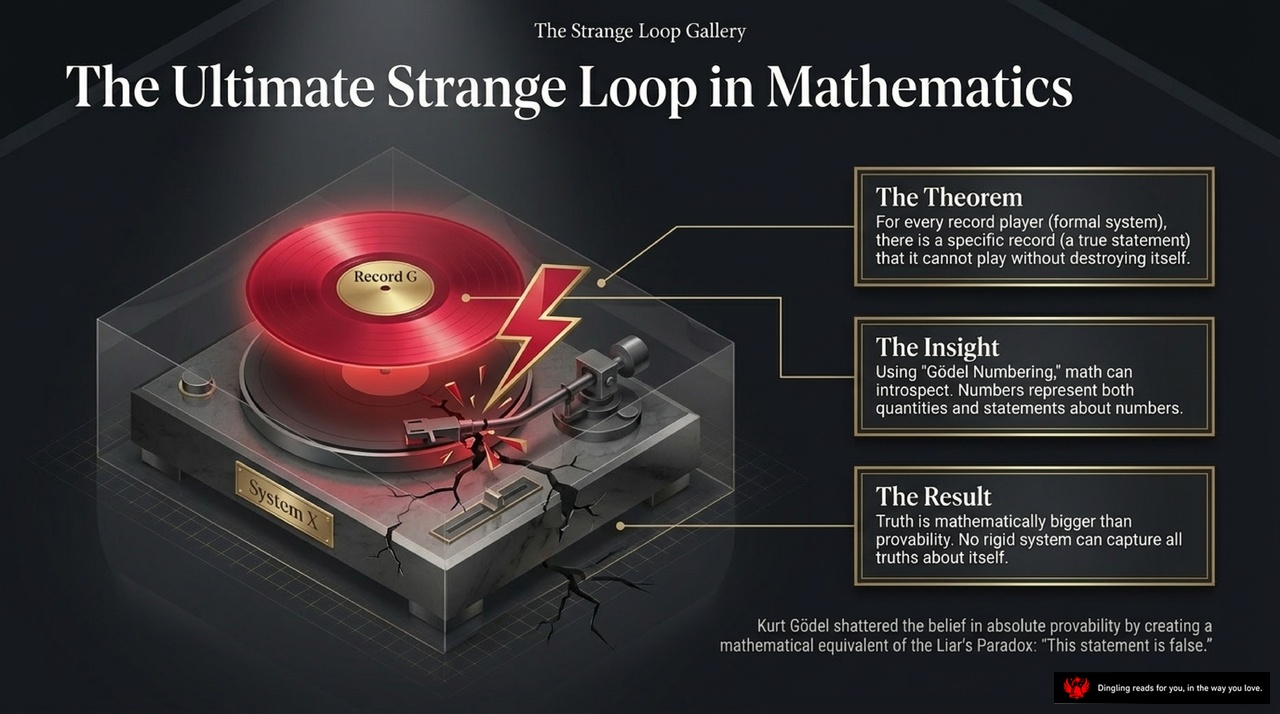
Now, let's bring in Gödel. His Incompleteness Theorem is the logical equivalent of this loop. He constructed a statement that essentially says, "This statement cannot be proven." It refers to itself. To understand if it's true, you have to step outside the system, but the system itself can't contain that external view. The logic wraps around itself, proving that no complex system can ever be fully complete or self-explanatory.
So, where does this leave us? It turns out that the essence of consciousness is also a strange loop. Our brain has a "self-symbol" that can point back at itself. We use our mind to observe our own mind. It's that same recursive entanglement. Without this loop, where would "I" come from?
Even our sense of free will is a product of these layers. While our neurons operate on strict physical laws at the bottom, our higher-level thoughts and choices emerge from the complexity of the whole. We feel free because of how these layers interact, even if the underlying code is deterministic.
The book culminates in a dialogue that mimics a musical fugue, weaving together logic, art, and music into one grand, self-referential tapestry. From Escher's vision to Gödel's proof and Bach's composition, they all point to the same truth: reality is built on these entangled layers. We are not just observers of the universe; we are part of the strange loop that holds it together.
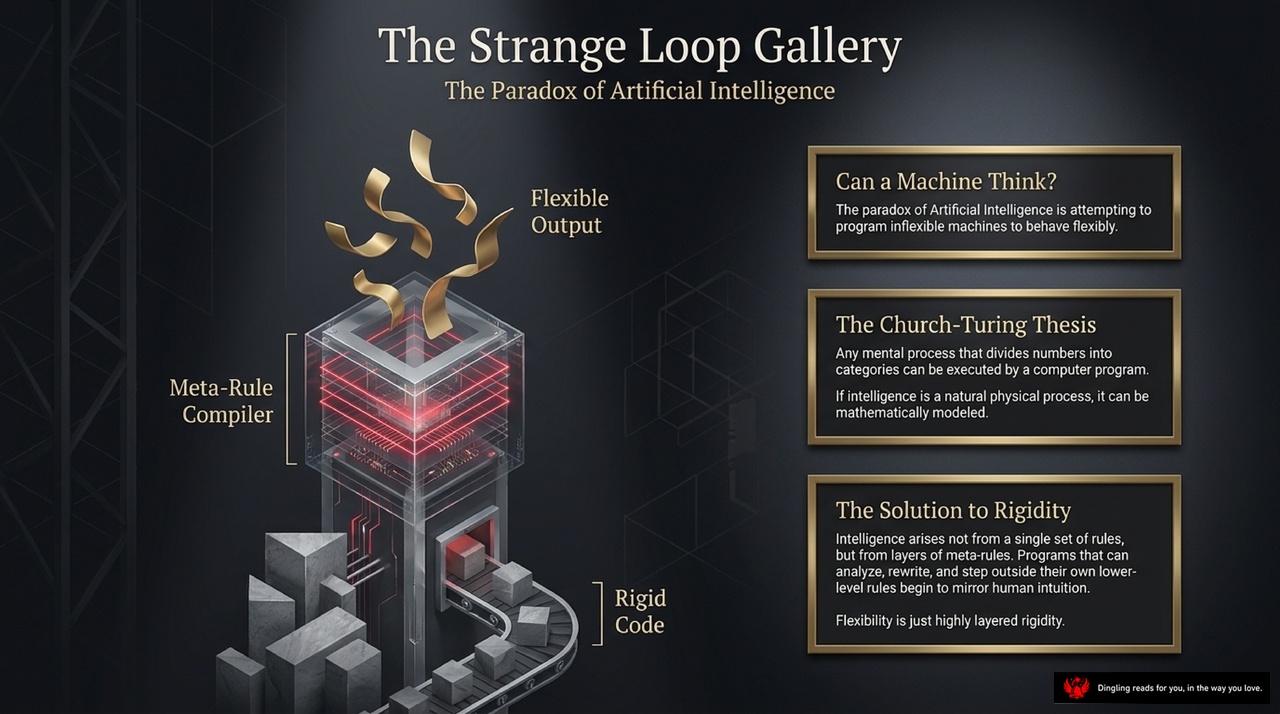
Welcome to the final gallery of our journey into the strange loop. Today, we're looking at the core paradox that ties it all together: Can a machine actually think?
On the left, you see the visual representation of this dilemma. We have rigid code at the bottom—the unyielding rules of a computer program. Above that sits a Meta-Rule Compiler, a layer designed to analyze and rewrite those very rules. And from the top, we get flexible output. The entire point is to see if we can program an inflexible machine to behave flexibly.
This brings us to the Church-Turing Thesis. The idea is that if intelligence is just a natural physical process, then it can be mathematically modeled. Any mental process that divides the world into categories can be executed by a computer program. This is the foundation of our belief that silicon can mimic flesh.
But here is the twist. How do we solve the problem of rigidity? The text suggests that true intelligence doesn't come from a single set of rules. Instead, it arises from layers of meta-rules. Programs that can analyze, rewrite, and step outside their own lower-level rules begin to mirror human intuition. As the slide puts it, flexibility is just highly layered rigidity.
So, the paradox remains. We are attempting to program inflexible machines to behave flexibly. We are building a system that must look at itself to understand itself. It's a loop within a loop, a self-referential cycle that defines the very boundary of what we call artificial intelligence. This is the strange loop we are exploring.
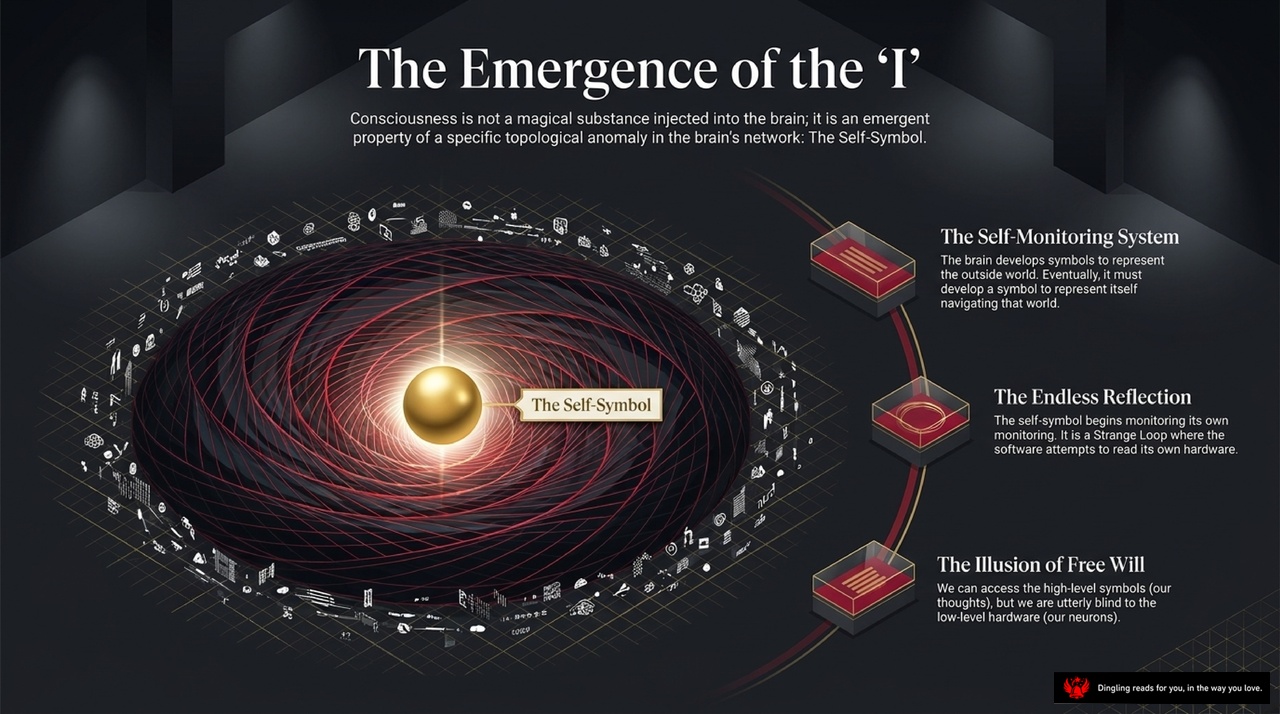
So, where does it all come together? This slide pulls back the curtain on the book's central thesis: the emergence of the "I." It's not magic, and it's not just a substance injected into your brain. Instead, consciousness is an emergent property of a specific topological anomaly in your brain's network: The Self-Symbol.
Let's break down how this happens. First, we have the Self-Monitoring System. Your brain develops symbols to represent the outside world, but eventually, it must develop a symbol to represent itself navigating that world. That's the birth of the observer.
But it doesn't stop there. Enter the Endless Reflection. The self-symbol begins monitoring its own monitoring. It's a strange loop where the software attempts to read its own hardware. You are watching yourself watch the world, creating a recursive cycle that defines your awareness.
Finally, this leads to the Illusion of Free Will. We can access high-level symbols—our thoughts and ideas—but we are utterly blind to the low-level hardware, our neurons. Because we can't see the machinery, it feels like we are in control. We think we have free will, but we are actually just running a program we can't see.
This visual perfectly captures the "Strange Loop" concept we've been exploring. From the music of Bach to the logic of Gödel, everything points to this same structure: a system that folds back on itself to create the illusion of a separate, conscious self. That is the emergence of the "I."

Intelligence, meaning, and consciousness aren't some divine spark dropped from the heavens. Instead, they are the inevitable, emergent properties of meaningless physical parts arranged in infinitely tangled, self-referential hierarchies. Think of it as a cosmic braid where the universe creates beauty and awareness simply by folding systems back onto themselves. From Bach's intricate fugues to Gödel's groundbreaking theorems, from the translation of complex languages to the firing of your own neurons, this pattern holds true everywhere.
The slide highlights this concept as "The Eternal Braid." It asks a profound question: If our consciousness is just the mathematical illusion of a system caught in an endless loop of reading its own code, who exactly is the "I" that is reading this sentence right now? This is the essence of the "eternal braid"—a structure where the observer and the observed become inseparable, creating a feedback loop that generates the very sense of self we experience. It's not about magic; it's about the complex, recursive architecture of reality itself.