



Explaining formal systems like TNT helped me finally understand how my brain works.
Your Review
Explaining formal systems like TNT helped me finally understand how my brain works.

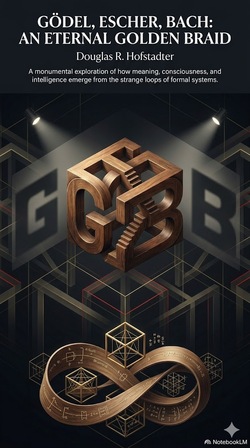
Hofstadter weaves logic, art, and music into one tight argument about how self-reference creates consciousness, using clear examples like Bach's canon and Escher's drawings to show that the same strange loop structure underpins both formal systems and human thought, ultimately convincing me that our sense of self is just a feedback cycle where the mind observes its own thinking, which feels both radical and deeply intuitive once you see how Gödel's theorem fits into this picture without needing to understand every mathematical detail.

The way Hofstadter connects Bach's infinite canon to Gödel's logic is mind-bending, showing how self-reference creates consciousness.

Hofstadter brilliantly connects Bach, Escher, and Gödel through the concept of strange loops, making complex ideas about consciousness feel surprisingly accessible and deeply interconnected in this mind-expanding journey.

Recognizing strange loops in social media algorithms helps me see how I become both the creator and the product of the engagement cycle.
Strange loops explain consciousness.

This book made me question my own mind forever.

The pq system shows that meaning isn't in the symbols themselves but comes from mapping them to real-world concepts like arithmetic outside the system.

Mind-bending ideas about loops.
Hofstadter brilliantly connects logic, art, and music through the concept of strange loops, making complex ideas about consciousness feel accessible and deeply interconnected.
Understanding how Gödel numbering lets TNT talk about itself reveals why any powerful formal system must have true statements it can never prove.

Hofstadter explains how our brain's ability to think about thinking creates a strange loop that feels like an infinite coffee-order analysis.

The book connects recursion in Bach's music and Escher's art to Gödel's logic to show how self-reference builds the strange loop of consciousness.

I tried to solve the WJU puzzle but kept failing because I couldn't stop applying rules even though the math proved WU was impossible to reach.

The idea of strange loops really changed how I see my own thoughts.

This book brilliantly connects logic art and music to explain how our minds create the illusion of a unified self.

Reading this felt like finally understanding why I keep questioning my own choices in that weird mental loop I get stuck in every morning.

This book made me finally understand why my brain feels like a loop when I try to think about thinking.

Hofstadter explains how self-reference creates our sense of self, using Bach's music, Escher's art, and Gödel's logic to show that consciousness is just a strange loop where the mind observes its own thoughts, turning a network of symbols into the unified feeling of being an 'I', though the book gets dense when discussing TNT and Gödel numbering, but the idea that limits in formal systems mirror our cognitive boundaries is a powerful insight for understanding why true creativity and self-awareness require breaking hierarchical boundaries rather than just adding more data.

Mind-bending paradox.