
Gone with the Wind: Complete Chapter-by-Chapter Summary

Welcome to *Gone with the Wind*, the sweeping epic by Margaret Mitchell. Set against a backdrop of burning skies and shattered dreams, this story is a raw tale of survival, love, and the ashes of a fallen era. It follows Scarlett O'Hara as she navigates the brutal collapse of the Old South, fighting to hold onto her land and her life when everything around her is being torn apart. This isn't just a romance; it's a fierce battle for existence in a world that's gone up in flames.
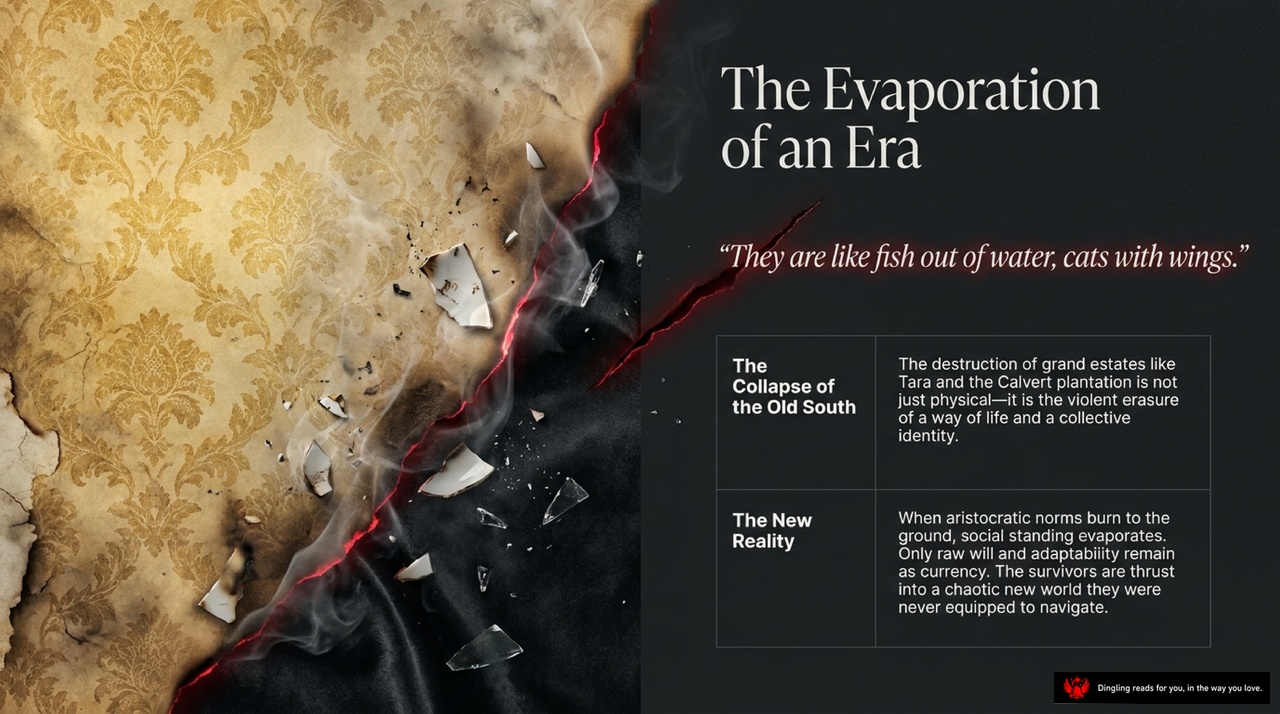
Look at this image. It depicts the violent erasure of an era. On one side, we see the ornate, golden wallpaper of the Old South—elegant but fragile. On the other, a dark, burning void where that world has been consumed by fire and smoke. The text calls this "The Evaporation of an Era," and it hits hard.
The slide breaks this down into two critical points. First, "The Collapse of the Old South." It notes that the destruction of grand estates like Tara isn't just physical; it's the violent erasure of a way of life and a collective identity. The old rules, the social standing, the entire hierarchy—it all burned away.
This leads directly to the second point: "The New Reality." When those aristocratic norms turn to ash, social standing evaporates. What remains? Only raw will and adaptability. The survivors are thrust into a chaotic, unpredictable world they were never equipped to navigate.
This is the defining moment for Scarlett O'Hara. She was raised in that golden world, believing she could command it. But now, the world has flipped. The men she relied on, the gentle traditions she cherished, are gone. She is no longer the daughter of a plantation owner; she is a survivor in a war zone where kindness gets you killed and only ruthless pragmatism keeps you alive. The era of the "ladies and gentlemen" is over. In its place is a brutal new reality where the only currency is survival.
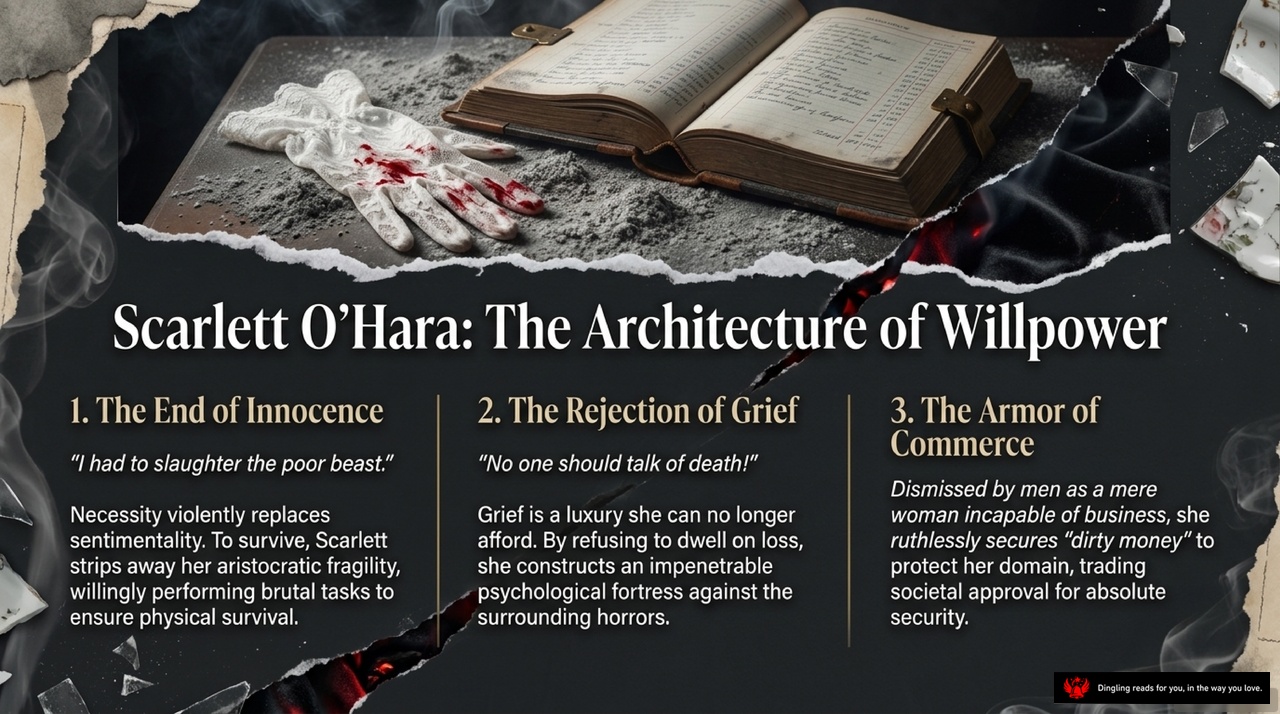
Scarlett O'Hara: The Architecture of Willpower. Look at this image. A bloody glove, an open ledger, and a world tearing apart. This isn't just a scene from *Gone with the Wind*; it's the moment Scarlett's entire identity shatters and rebuilds into something terrifyingly strong.
Let's break down the three pillars of her survival. First, The End of Innocence. Notice the quote: "I had to slaughter the poor beast." That's not poetic; it's a confession of war. Scarlett realizes that her old Southern fragility is a death sentence. To survive, she must strip away her aristocratic softness and perform brutal tasks, no matter how dirty.
Second, The Rejection of Grief. The text says, "No one should talk of death!" Because grief is a luxury she can no longer afford. By refusing to dwell on loss, she constructs an impenetrable psychological fortress. She doesn't let the horror of the war break her; she builds a wall around her heart so she can keep fighting.
Finally, The Armor of Commerce. Dismissed by men as a mere woman incapable of business, she ruthlessly secures "dirty money" to protect her domain. She trades societal approval for absolute security. In a collapsing world, money is the only language that still works.
This slide captures the brutal transformation of Scarlett O'Hara. She stops being a dreamer and starts being a survivor. She trades her soul for the land, and in doing so, becomes the most dangerous force in the South.
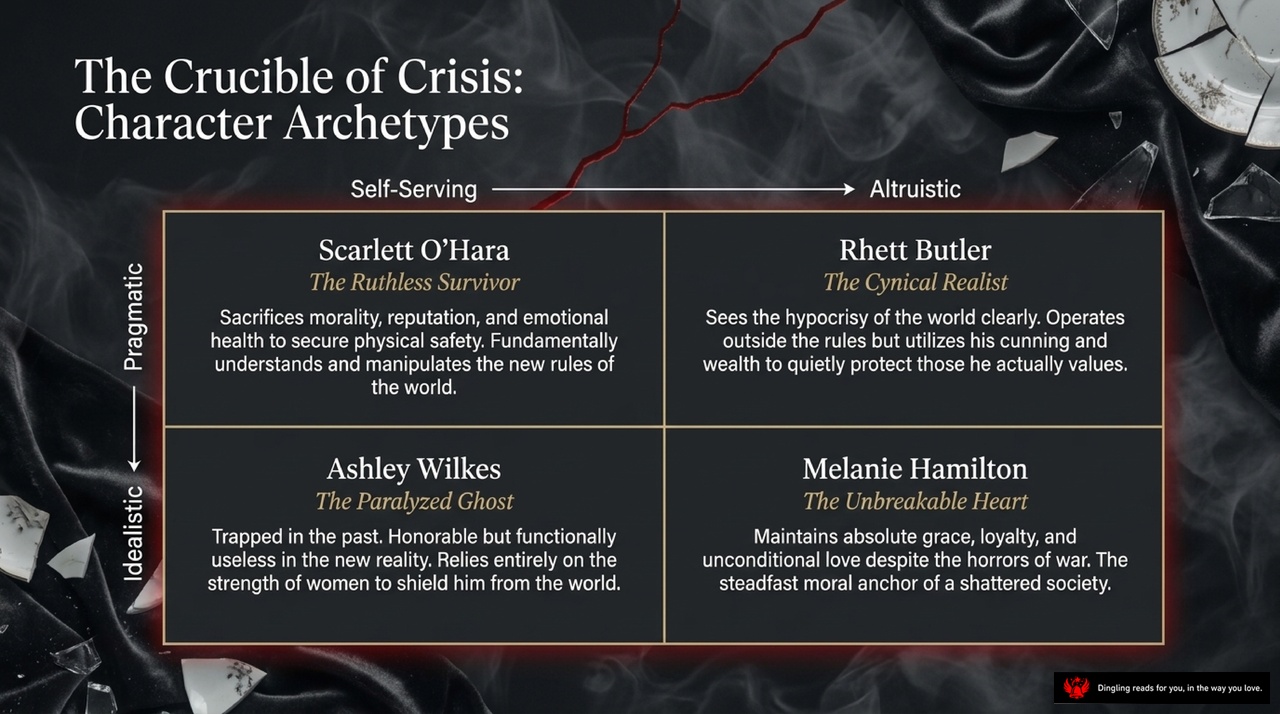
Look at this grid. We are mapping the souls of *Gone with the Wind* not by their actions, but by their core motivations. Notice the axes: on the left, we move from Pragmatic to Idealistic; across the top, from Self-Serving to Altruistic.
In the top-left quadrant, we have Scarlett O'Hara, the Ruthless Survivor. She is the ultimate pragmatist who sacrifices morality for physical safety. She understands that the world has changed, and she manipulates the new rules to secure her family's survival.
Across from her is Rhett Butler, the Cynical Realist. He sees the hypocrisy of the world clearly. He operates outside the rules, using his cunning and wealth not for power, but to quietly protect those he actually values.
Now, look at the bottom-left: Ashley Wilkes, the Paralyzed Ghost. He is trapped in the past. He is honorable but functionally useless in this new reality. He relies entirely on the strength of women to shield him from the world, unable to adapt.
Finally, in the bottom-right, sits Melanie Hamilton, the Unbreakable Heart. She maintains absolute grace, loyalty, and unconditional love despite the horrors of war. She is the steadfast moral anchor of a shattered society.
Essentially, this chart shows us that while Ashley stays stuck in a fantasy that kills him, and Scarlett stays so grounded in reality she almost loses her humanity, it is Melanie's unwavering altruism that saves them all.

War is over, but the nightmare at Tara has just begun. Scarlett stands at the edge of a cliff, and the only way down is to grab onto Frank Kennedy.
Look at this pivotal moment. The text on the left, "Scarlett's Denial," captures her internal conflict perfectly. She is clinging to the illusion of being a proper Southern lady while secretly operating as a ruthless warlord. She despises Rhett because he forces her to confront this true, unpolished self. But now, she's doing the exact same thing with Frank. She's pretending she doesn't want him, pretending she's just saving Tara out of duty, while her heart is screaming for his money.
On the right, we see "Rhett's Clarity." Rhett refuses to play the exhausting game of societal politeness. He sees her raw ambition and admires her survival instinct. He knows she's not a damsel in distress; she's a predator in a dress. He understands that their bond isn't built on romance, but on mutual survival and unapologetic ambition.
Finally, look at the bottom section labeled "The 'Poison' of Truth." Society views Rhett as a toxic influence, a man whose mere touch is poison. But the reality is far more complex. Their bond is forged in mutual survival, shared contempt for the weakness of the old world, and a refusal to let Tara fall. Scarlett chooses Frank not because she loves him, but because he represents the stability she desperately needs to survive the Reconstruction era. She is trading her heart for her land, and in doing so, she is slowly becoming the woman Rhett always knew she could be.

Look at this diagram. It's a brutal, no-holds-barred breakdown of why Scarlett's love story is so tragic. We aren't just looking at a love triangle; we're looking at a collision of two completely different worlds.
On the left, we have the reality: Rhett Butler. He loves the real, flawed, terrifyingly strong Scarlett. He offers her a genuine partnership, something she is too blinded by her obsessive illusions to accept. He sees her for who she is, not who she wants to be.
On the right, we have the fantasy: Ashley Wilkes. Scarlett loves a concept, not a man. She desires Ashley because he represents the untainted, aristocratic past she can never return to. She is chasing a ghost, a memory of a time that no longer exists.
And then, there is the dynamic between Ashley and Melanie. Ashley loves Melanie because she is the only person who allows him to remain peacefully in his illusions. Her love shields him from the harshness of Scarlett's reality. She is the perfect partner for his dream, but it's a one-sided arrangement built on avoidance.
This chart perfectly captures the core conflict. Scarlett is trapped in a loop. She chases Ashley, who is protected by Melanie, while Rhett stands right there, offering her a real connection she refuses to see. She chooses the safety of a fantasy over the danger of reality. That is the anatomy of a tragic obsession: loving a shadow instead of the person standing right in front of you.
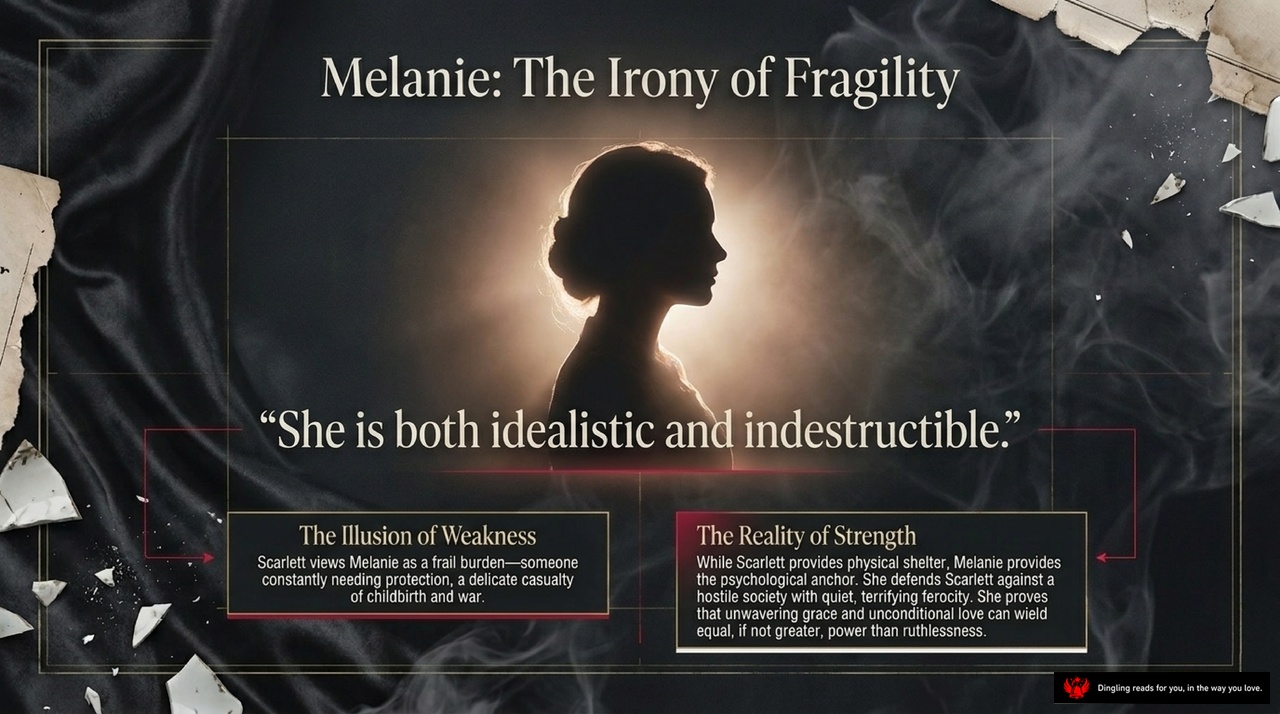
Melanie: The Irony of Fragility
Scarlett sees Melanie as a frail burden—someone constantly needing protection, a delicate casualty of childbirth and war. But look closer at the reality behind that illusion. While Scarlett provides physical shelter, Melanie provides the psychological anchor. She defends Scarlett against a hostile society with quiet, terrifying ferocity.
In a world where strength is defined by aggression and survival of the fittest, Melanie proves that unwavering grace and unconditional love can wield equal, if not greater, power than ruthlessness. Her kindness isn't weakness; it's a fortress. And in the end, it is Melanie's moral courage that saves them all, turning what seemed like fragility into an unbreakable shield.
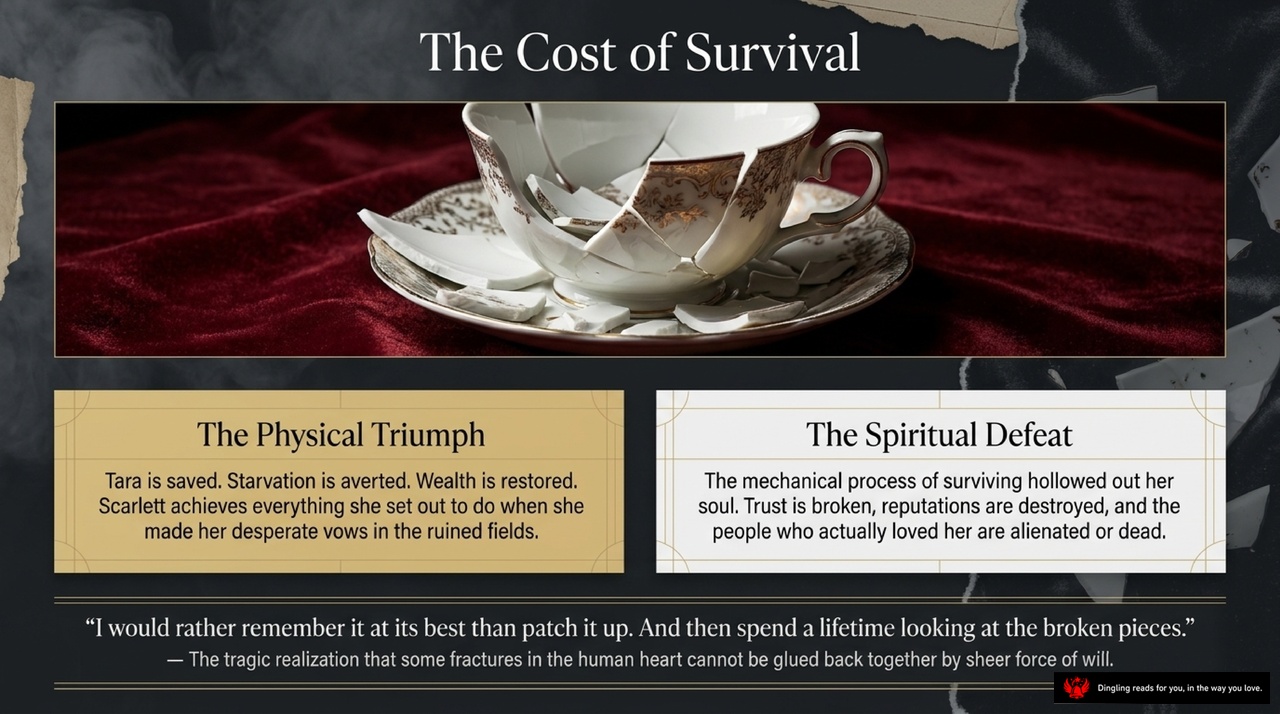
Survival is a cruel teacher. It can rebuild your body, but it often shatters your soul. Look at the broken teacup in front of us. That shattered porcelain perfectly captures the tragic cost of Scarlett's survival. On one side, we see her physical triumph: Tara is saved, starvation is averted, and wealth is restored. She achieved every desperate vow she made in the ruined fields. But on the other side lies her spiritual defeat. The mechanical process of surviving hollowed out her heart. Trust was broken, reputations were destroyed, and the people who actually loved her were alienated or dead.
As Scarlett herself realized, "I would rather remember it at its best than patch it up. And then spend a lifetime looking at the broken pieces." The tragedy isn't just that some fractures in the human heart cannot be glued back together by sheer force of will. It's that in the desperate race to survive, she traded her soul for a future she no longer recognizes.

Scarlett's journey is a brutal lesson in the cost of survival. She traded her innocence, her reputation, and her moral compass just to keep her physical world from turning to ash. But here's the tragic twist she eventually realizes: the true tragedy of surviving is that you end up alienating the only people who genuinely understood you. Think about that. When the world you know burns to the ground, what pieces of your humanity are you willing to sacrifice to survive—and will those ashes ever be worth ruling over?