
Good Strategy Bad Strategy: Complete Chapter-by-Chapter Summary

Good Strategy, Bad Strategy. This isn't just a book title; it's a wake-up call for anyone who thinks they're leading but is actually just guessing.
In a world full of noise, Richard Rumelt cuts through the fluff to show us what real strategy actually looks like. It's not about grand visions or empty slogans. It's about identifying the real challenge you face and then designing a coherent path to overcome it.
Think about the Battle of Trafalgar. Nelson didn't just follow the rules; he saw the chaos of the waves and the enemy's weakness, then broke the formation to win. That's the power of a good strategy: it finds the leverage point and focuses all your resources there.
But look around you. How many companies are stuck with "bad strategy"? They confuse strategy with marketing or IT projects. They set impossible goals like "becoming the most respected company" without any plan to get there. They mix up ambition with action.
Real strategy requires three things: a clear diagnosis of the problem, a guiding policy to navigate the obstacles, and a set of coordinated actions. Without these, you're just spinning your wheels.
So, how do you build it? Start by simplifying the complex. Don't try to fix everything at once. Find the bottleneck. Focus on the few things that will move the needle the most.
If you can do that, you won't just survive the competition. You'll define the game.

The Strategy Illusion is all about seeing the difference between what a strategy looks like on paper and what it actually does in the real world. Look at this slide: on the left, under "What it is NOT," we see a tangled mess of ambition, leadership, vision, and wish-lists like "Let's increase revenue by 20%." That's not strategy; that's just a goal. Many leaders mistake a grand aspiration for a strategic plan, but that's a trap.
On the right, under "What it IS," we see a clear, sharp arrow pointing forward. This represents the true essence of strategy: discovering the critical problem, designing a guiding policy, and focusing coordinated actions to overcome that exact obstacle. It's not about having a big idea; it's about solving a specific, painful problem. As the text explains, good strategy isn't about complex models or matrix charts. It's about identifying the key challenge and then aligning every resource and action to break through it. If you're just setting targets without a plan to overcome the barriers in your way, you're not building a strategy; you're just making noise. Real strategy is simple, direct, and relentlessly focused on the one thing that will move the needle.

Identifying Bad Strategy is all about spotting the red flags before you lose your way. Look at these four traps that derail even the best-intentioned plans.
First, watch out for "Fluff." This is just gibberish masquerading as deep strategy. Think of those high-level buzzwords like "customer-centric intermediation" that sound smart but actually mean nothing. It's a lack of substance dressed up in professional clothing.
Second, a failure to face the real challenge. If you can't clearly define the obstacle, you can't possibly solve it. Just like International Harvester, which ignored deep-rooted union inefficiencies and thought it could just grow its way out of trouble. You can't evaluate a strategy if you're blind to the actual problem.
Third, mistaking goals for strategy. This is a common mistake. Setting a desire—like "20% growth and 20% profit margin"—without a realistic plan to overcome the difficulties that stand in your way. It's just stating what you want, not how you'll get there.
Finally, bad strategic objectives. This looks like a dog's dinner of uncoordinated tasks. Or setting goals that are completely impractical given your current resources. When your objectives are scattered and unrealistic, you're not building a strategy; you're just making a wish list.
Real strategy isn't about empty slogans. It's about identifying the specific challenge you face and designing a coherent set of actions to overcome it.
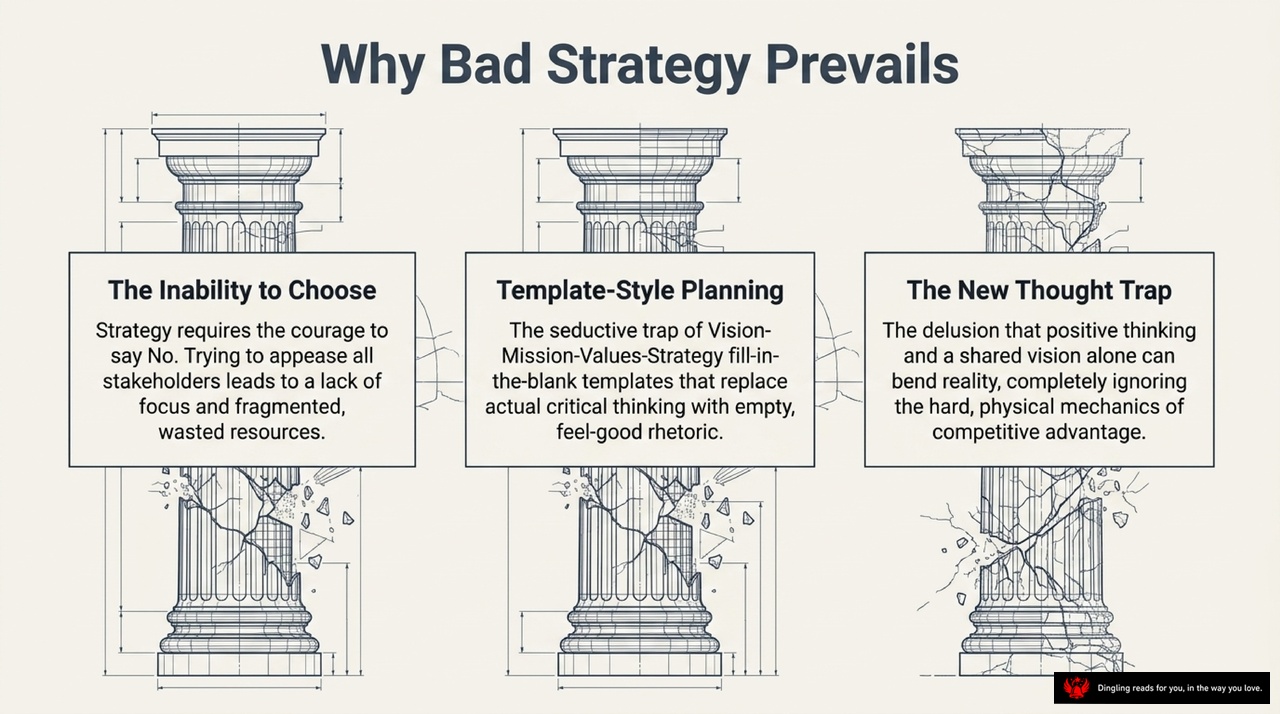
Why Bad Strategy Prevails isn't just a theoretical concept; it's a daily reality for leaders who fail to make the hard choices required for true success. Look at these three crumbling pillars representing the biggest obstacles to effective strategy.
First, we have The Inability to Choose. Real strategy demands the courage to say "no." When leaders try to please every stakeholder and appease all interests, they end up with a lack of focus. This fragmentation wastes resources and dilutes impact. You can't be everything to everyone; you must choose a specific direction and commit to it.
Next, we see Template-Style Planning. This is the seductive trap of filling in Vision-Mission-Values blanks without doing any actual critical thinking. It replaces rigorous analysis with empty, feel-good rhetoric that sounds professional but guides nothing. It's a bureaucratic exercise that creates the illusion of work while avoiding the messy reality of strategic decision-making.
Finally, there is The New Thought Trap. This is the dangerous delusion that positive thinking and a shared vision alone can bend reality. Many leaders ignore the hard, physical mechanics of competitive advantage, believing that attitude is the only thing that matters. But no amount of optimism can overcome a flawed business model or a lack of structural advantage.
These three failures explain why bad strategy prevails. To succeed, you must have the discipline to choose, the honesty to avoid empty templates, and the realism to understand the actual mechanics of winning.

Good strategy isn't about fighting on the opponent's terms; it's about shifting the very axis of advantage. Look at the classic story of David and Goliath. The myth tells us David was just an underdog relying on luck against Goliath's massive strength and heavy armor. But the reality is far more strategic. David explicitly rejected the heavy armor offered to him. Why? Because it would have slowed him down and made him vulnerable to Goliath's reach. Instead, David utilized speed, distance, and precision to render Goliath's traditional physical strength entirely useless. He found a hidden vulnerability in the giant's armor and used his own agility as a weapon.
This is the core lesson here: good strategy requires breaking free from traditional industry myopia to uncover hidden vulnerabilities and unseen leverages. In business, this means looking past the obvious battlefield. Just like David, smart leaders don't try to out-spend or out-arm their competitors. They identify what the competitor values—like speed, cost, or scale—and then find a different dimension where their own strengths matter most. By shifting the axis, you turn your perceived weaknesses into your greatest strengths and make the giant's armor irrelevant.

Good strategy is often about doing less, but doing it with much greater impact. Think of it like using a lever: find the right pivot point, and you can move a mountain with a single finger. This concept of the "strategic lever" is all about concentrating your wisdom, resources, and actions on a single, critical target to trigger a chain reaction of positive results.
Take Toyota, for example. While everyone else was rushing to build SUVs, Toyota made a bold prediction. They foresaw that long-term fuel efficiency would become the standard, and that competitors wouldn't follow suit because the technology was too risky. By focusing all their R&D on hybrid technology, they didn't just catch up; they set the industry's agenda. That single focus created a massive competitive advantage that took years for others to replicate.
Similarly, look at 7-Eleven. Their leverage came from one simple insight: Japanese consumers love novelty. Instead of trying to compete on everything, they built an entire system around this single trait. They created a feedback loop where store managers could instantly report what was selling, allowing headquarters to restock the right items at the right time. They didn't just sell convenience; they sold the ability to adapt faster than anyone else.
The key to this leverage is understanding that not all goals are created equal. Sometimes, trying to solve every problem at once is the fastest way to fail. True strategic power comes from realizing that you don't need to push on every door; you just need to find the one that is already slightly ajar and push hard enough to swing it wide open. It's about knowing what to ignore so you can focus everything on what truly matters.
So, let's talk about how a truly great strategy often comes from a simple shift in perspective. It's about seeing the battlefield differently than everyone else does.
Think back to the classic story of David and Goliath. Everyone assumed that armor and heavy weapons were the only way to win. But David saw the flaw in that logic. He realized that Goliath's heavy armor made him slow and predictable, while his own agility as a shepherd was the real advantage. By changing his viewpoint, David turned his perceived weakness into an unstoppable strength.
This same principle applies in business. Take Walmart. In the mid-20th century, the entire discount retail industry operated under one rigid rule: you had to locate your stores in large cities with populations over 100,000 to cover fixed costs. Every competitor followed this "law," fighting for space in crowded urban centers. But Sam Walton saw the flaw in this crowded marketplace. Instead of competing in the city, he looked at small towns that everyone else had ignored.
Walton didn't just open stores in these quiet areas; he built an entirely new system around them. He used daily low prices to attract residents, implemented computerized inventory systems for efficiency, and avoided expensive union contracts. Most importantly, he redefined what a "store" actually was. For Walmart, a single location wasn't just a shop; it was a node in a massive regional network of 150 stores. This network allowed them to share information, manage logistics centrally, and achieve a level of efficiency their competitors simply couldn't match.
While competitors like Kmart were stuck trying to manage hundreds of isolated locations with high overhead, Walmart leveraged its small-town network to crush them on cost and speed. The result was inevitable: Kmart went bankrupt in 2002, while Walmart became a global giant.
The lesson here is clear. Your competitive advantage often lies in seeing what others miss. By shifting your perspective, you can turn a non-strategic area into your exclusive territory and redefine the very rules of the game.
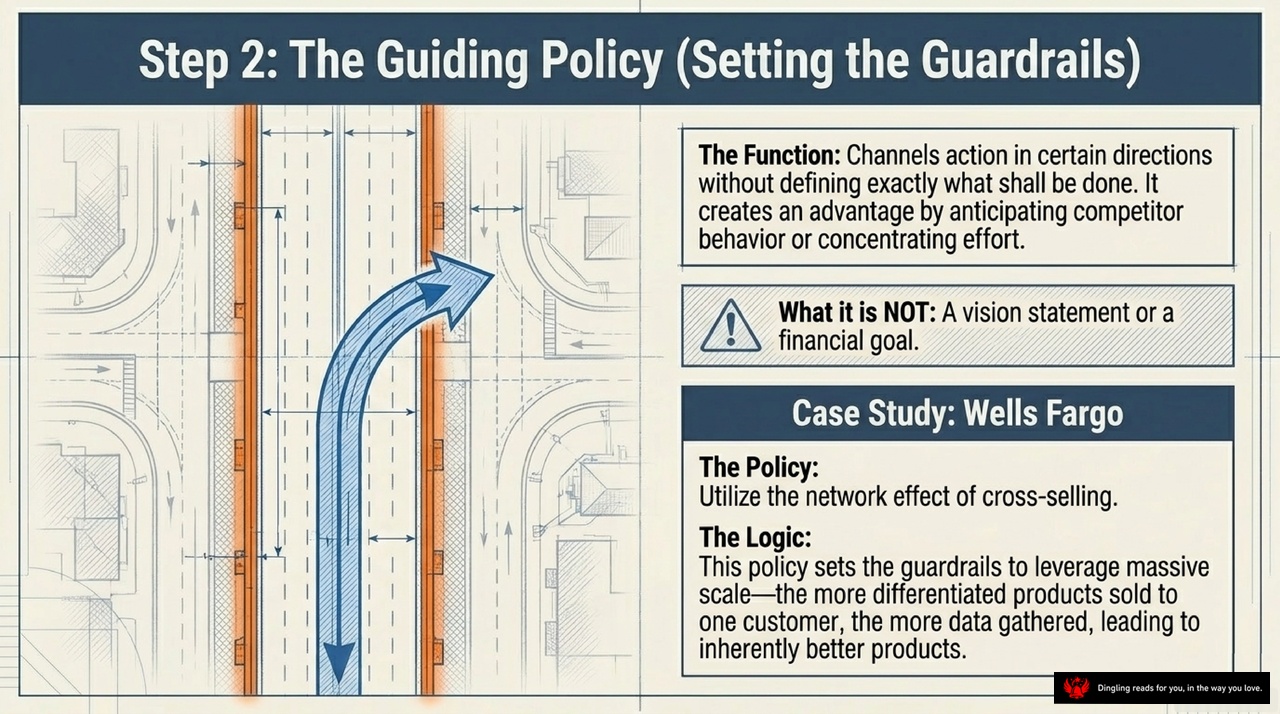
Let's talk about how a guiding policy actually works in practice. Think of it less like a destination sign and more like the guardrails on a highway. As our slide illustrates, a good policy channels action in certain directions without defining exactly what specific tasks need to be done. It creates a strategic advantage by anticipating how competitors will behave or by simply concentrating your team's effort where it matters most.
Crucially, we need to remember what a guiding policy is NOT. It is not a vague vision statement, and it is certainly not a financial goal. It's about direction, not just aspiration.
Take Wells Fargo as a real-world case study. Their guiding policy was simple yet powerful: utilize the network effect of cross-selling. The logic behind this was to set guardrails that leverage massive scale. The idea was that the more differentiated products you sell to a single customer, the more data you gather, which leads to inherently better products for everyone. By focusing on this specific channel, they could coordinate their entire organization around a single, coherent advantage, rather than scattering energy across every possible opportunity.

Look at this slide. We are now at Step 3: Coherent Actions. Think of it as aligning your vectors. The graphic on the left shows arrows pointing in every direction—chaos. But when you channel them through a funnel, they become one powerful, focused force hitting the target. That is the essence of strategy: making sure your policies don't cancel each other out, but instead work together to impose a coordinated action on the system.
Let's look at the real-world case study here: Operation Desert Storm in 1991. General Schwarzkopf didn't just set a goal; he perfectly aligned the Air Force, Marines, and Army to execute a single, secret maneuver known as the "Left Hook." You can see this coordination in action in the bottom left of the slide. But alignment alone isn't enough; you need coherence. That's what happened in the bottom right. The Marines acted as a highly visible decoy on the coast, forcing Iraqi forces to look the wrong way. This allowed the main flanking force to strike from the empty western desert without opposition.
This is the difference between confusion and clarity. Without this alignment and coherence, your efforts are scattered. With it, you create a decisive advantage that hits the target exactly where you want it.
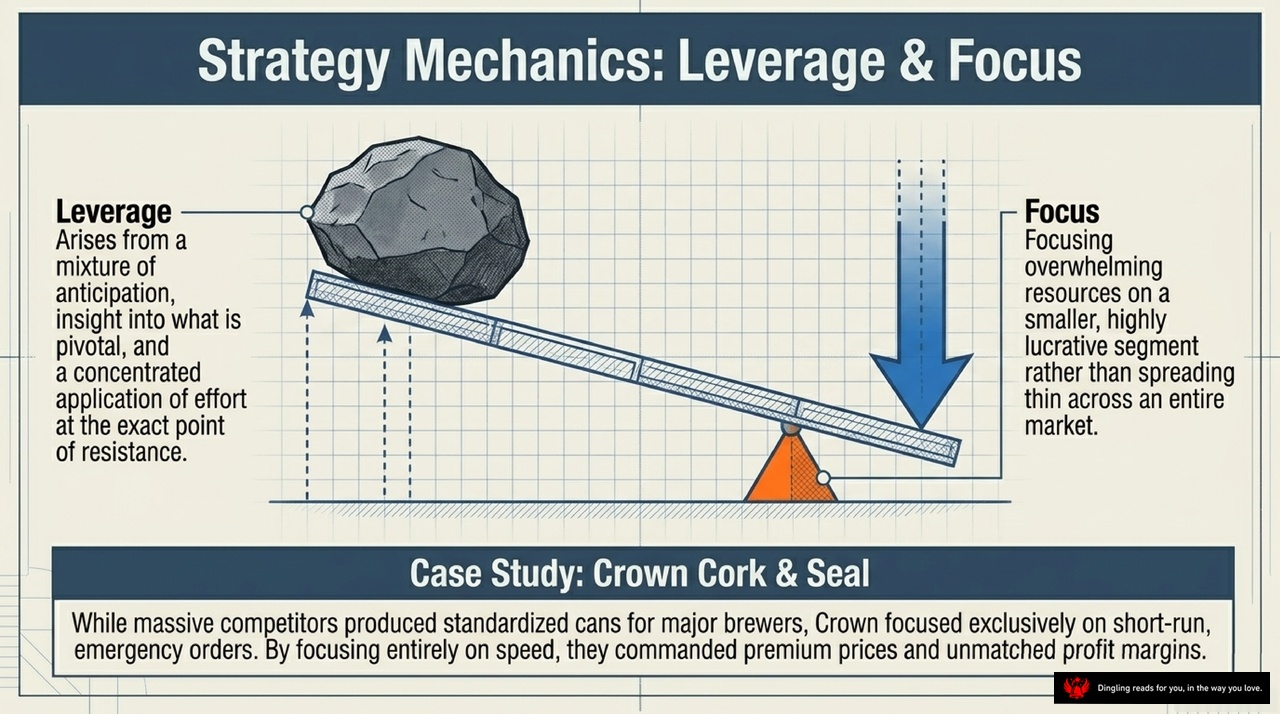
Look at this seesaw. It perfectly illustrates the mechanics of a great strategy: Leverage and Focus.
On the left, we have Leverage. The text defines it as a mix of anticipation, insight, and concentrated effort applied exactly where resistance is highest. Think of it like pushing down on that long lever arm. You don't need brute force; you need the right insight into what is pivotal. If you can find that single point of resistance and apply focused pressure there, you can lift a massive obstacle with surprisingly little effort. It's about multiplying your impact by hitting the right spot.
On the right, we see Focus. The graphic shows overwhelming resources pouring down onto a specific, smaller segment. A great strategy isn't about spreading yourself thin across an entire market. Instead, it's about identifying a smaller, highly lucrative segment and concentrating all your energy there. As the case study at the bottom reminds us, Crown Cork & Seal didn't try to compete with massive competitors on standardized, long-run production. They focused exclusively on short-run emergency orders. By narrowing their focus entirely on speed, they commanded premium prices and unmatched profit margins.
So, the secret to strategy isn't doing everything a little bit. It's about finding that leverage point and pouring all your focus into it. When you combine deep insight with concentrated action, you don't just survive the competition; you redefine the playing field.
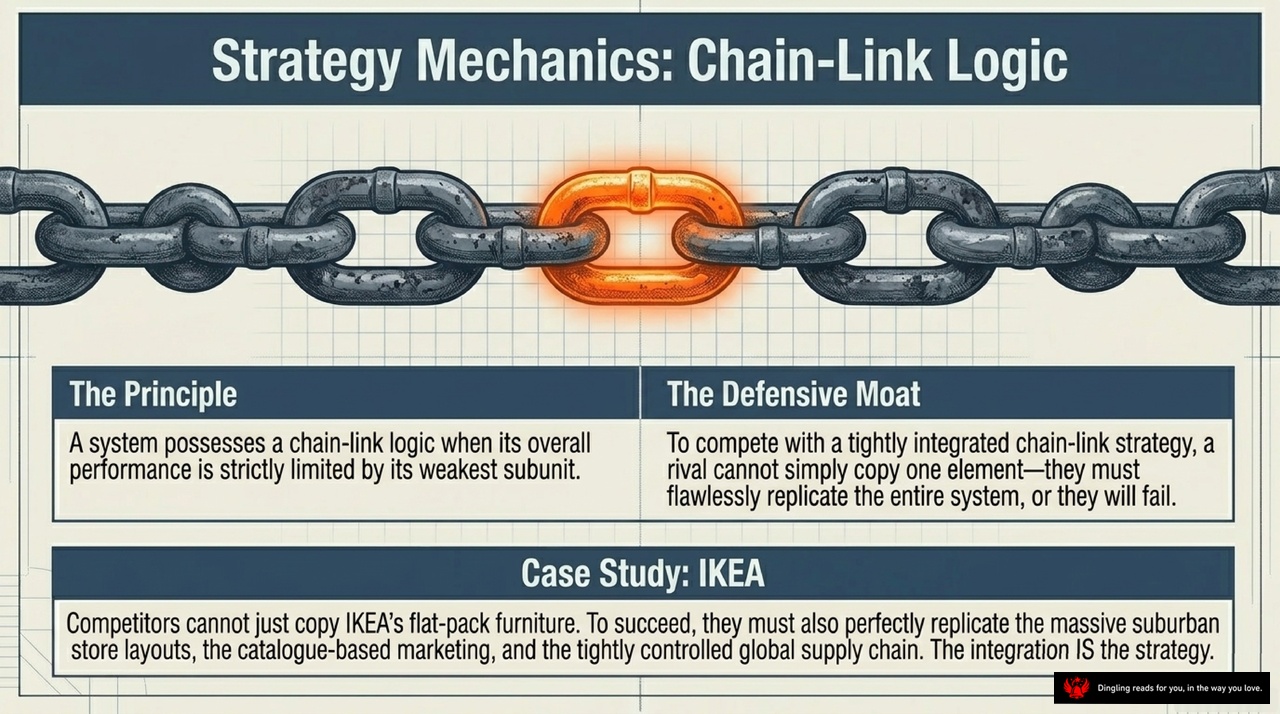
Strategy Mechanics: Chain-Link Logic. Look at this image. We're talking about how a system works not as a collection of parts, but as a single chain where the strength of the whole is determined by its weakest link.
The principle here is simple yet powerful: overall performance is strictly limited by that single weakest subunit. Think about the 1986 Challenger disaster. The shuttle had incredible engines and advanced technology, but one O-ring seal failed, and the entire system collapsed. You can't just upgrade the engines or improve the computer systems; if that critical link remains weak, the whole mission fails.
This concept also creates a formidable defensive moat for companies like IKEA. Competitors can easily copy one element, like flat-pack furniture, but they cannot simply replicate the entire system. To truly compete, a rival must flawlessly copy the suburban store layouts, the specific catalog-based marketing, and the tightly controlled global supply chain. If they miss even one link in this chain, the strategy breaks.
The integration of all these parts IS the strategy. When elements are tightly connected and mutually reinforcing, it becomes nearly impossible for anyone to copy you. This is why good strategy is designed, not just selected. It's about coordinating actions so that they support each other, creating a system that is stronger than the sum of its parts.

Strategy as Design. Most managers operate under a dangerous misconception: they treat strategy like a shopping list, simply picking from a menu of pre-packaged, off-the-shelf alternatives. Think of it like crossing items off a grocery list—apples, milk, bread—hoping that a random collection of standard parts will magically create something great. But that is not how winning works.
The reality is that true strategy is an intricate design, much like engineering a high-performance BMW. You cannot build the "Ultimate Driving Machine" by buying standard parts and hoping they fit. The chassis, suspension, steering, and weight distribution must be masterfully engineered and coordinated to hit an exact performance sweet spot. Every component is calibrated to work exclusively together for a specific purpose.
In the business world, this means constructing a completely custom solution rather than assembling a generic kit. A good strategy isn't just about setting a goal or having a vision; it's about designing a coherent system where every action reinforces the others to solve a specific, critical challenge. It's about finding the right leverage points and ensuring that no part of your operation is working against the others. If you rely on standard parts, you'll never achieve the kind of breakthrough performance that separates the leaders from the pack. You have to design the whole machine from the ground up.
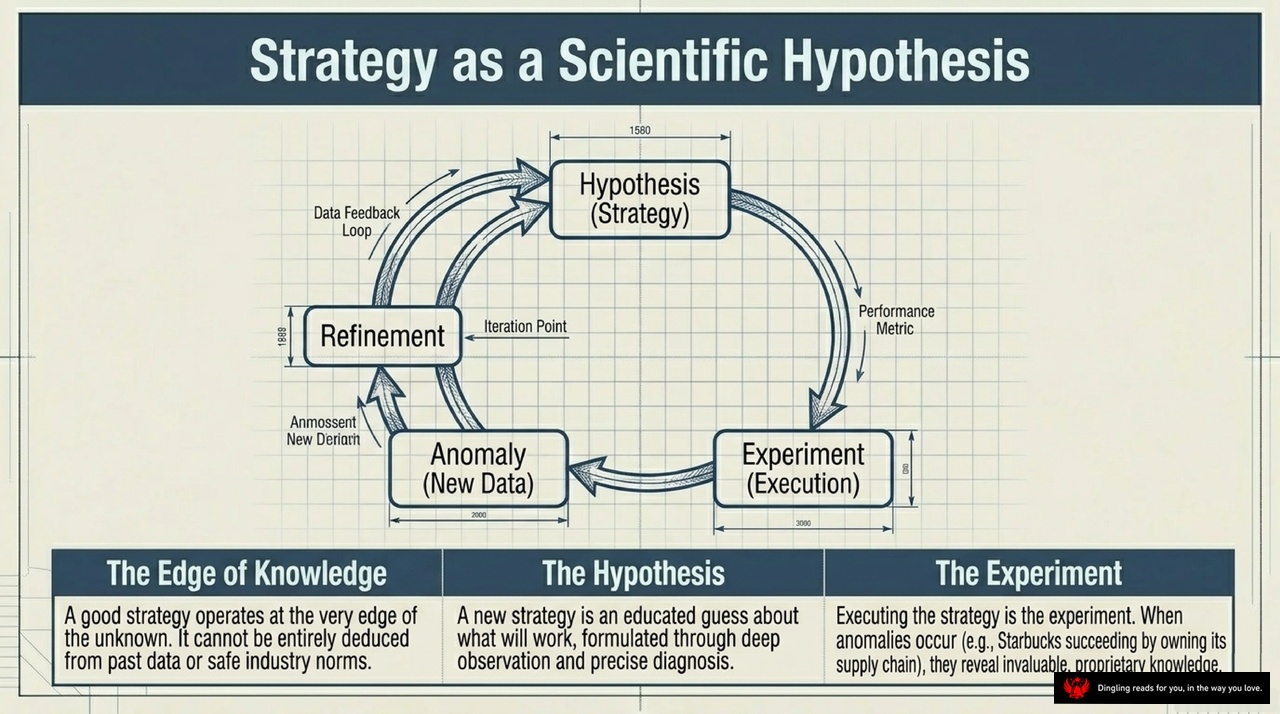
Strategy as a Scientific Hypothesis. Look at this diagram. It frames strategy not as a static plan, but as a dynamic, self-correcting loop. At the top, we have the Hypthesis—your strategy itself. This isn't a crystal ball prediction; it's an educated guess about what will work, formulated through deep observation. It operates right at the edge of the unknown, pushing beyond what past data or safe industry norms can tell us.
Once you execute that hypothesis, you enter the Experiment phase. This is where the real work happens. You put your strategy to the test in the real world. But here is the critical part: you must measure performance metrics. You need data. When you run this experiment, anomalies will occur. Maybe your sales dip, or a new feature fails unexpectedly. These aren't failures; they are valuable new data points.
That anomaly feeds back into the Refinement stage. This is your iteration point. You analyze what went wrong or right, adjust your approach, and formulate a new hypothesis. This creates a continuous Data Feedback Loop. As the text notes, executing a strategy is the experiment, and when anomalies occur, they reveal invaluable, proprietary knowledge. Think of it like the story of Starbucks or even historical battles; success often comes from adapting to these unexpected results rather than blindly sticking to the original plan.
In a world of uncertainty, this scientific approach is your only reliable path forward. Don't just hope your strategy works; treat it as a hypothesis, run the experiment, and let the data guide your next move.

So, how do we actually build the kind of independent judgment that separates good leaders from the crowd? The slide highlights two major traps we all fall into. First, there's the "Inside View"—that dangerous habit of ignoring history and assuming, "This time, it's different." Second, we have "Herd Mentality," where we assume that just because everyone else in the industry is doing something, it must be right.
But here's the solution, and it's one of my favorite mental models: cultivate a "Virtual Panel." Think of it as creating a mental boardroom of experts. Before you commit to a strategy, you need to interrogate your own logic from a brutal, objective, outsider's perspective.
In my experience, this means actively simulating conversations with people who challenge your assumptions. Imagine a professor like Bruce Scott questioning your logic, or a visionary like Steve Jobs asking if you're missing a bigger opportunity. By destroying your own flawed ideas before the market does, you stop following the herd. You stop relying on intuition alone. Instead, you build a system of checks and balances that forces you to see the truth, not just what you want to believe. That is the essence of cultivating independent judgment.
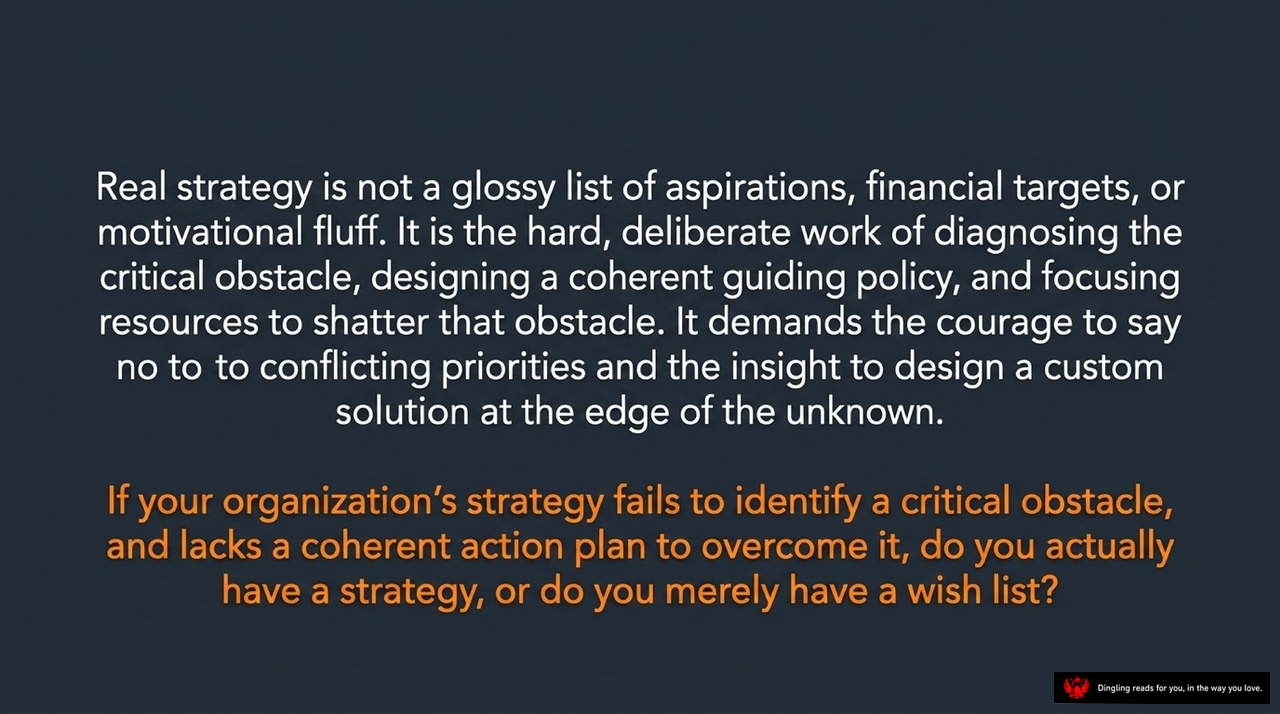
Real strategy isn't about glossy wish lists or motivational fluff; it's the hard work of diagnosing a critical obstacle and designing a coherent plan to shatter it. But here's the catch: you can't fix what you don't see. If your organization fails to identify the real problem, you don't have a strategy—you just have a wish list.
Consider the lesson from David versus Goliath. Everyone assumed the giant's armor made him invincible, a logic so obvious no one dared challenge it. But David saw past the armor to the single exposed spot on Goliath's forehead. He didn't try to match strength with strength; he used his own agility to strike the one weakness the giant couldn't defend.
That same principle applies to your business. Are you stuck fighting the same battles with outdated tactics, or are you willing to look for the "Goliath's weak spot"? True strategy demands the courage to ignore the obvious and find the leverage point that allows you to win with less effort. Don't just list your goals; first, ask yourself: what is the one critical obstacle standing between us and success, and where is the hidden flaw in that obstacle that we can exploit?