
Good to Great: Complete Chapter-by-Chapter Summary
Welcome to the book club session on "Good to Great" by Jim Collins. Today, we're diving into a powerful concept: the idea that there is a fundamental difference between being merely "good" and truly "great." The book argues that many companies get stuck in the "good" trap, mistaking mediocrity for success and settling for a status quo that prevents real growth.
Collins describes this transformation as the "eternal physics" of turning an average organization into a lasting, market-beating powerhouse. It's not about magic or luck; it's about a specific set of principles that separate the winners from the rest. The journey starts with a shift in mindset—moving from comfort and satisfaction to a relentless pursuit of excellence. It requires breaking free from the inertia of past successes and having the courage to do what is right, even when it's hard.
This isn't just theory; it's a proven path. Through extensive research, Collins identified the key drivers of this leap, starting with the most critical element: the leader. We'll explore how the right people, a clear vision, and a disciplined culture can propel any organization from good to great. So, let's turn the page and discover how you can build a company that doesn't just survive, but endures and thrives.

Good is the enemy of great. This isn't just a catchy slogan; it's the fundamental reason why so many companies, governments, and even schools get stuck. They settle for being "good" and mistake that comfort for the finish line. Once a company stabilizes and earns market respect, it often stops asking, "Can we do better?" and starts treating maintaining the status quo as the safest choice. That satisfaction becomes a cage, preventing them from breaking through to true greatness.
To understand how to escape this trap, we conducted a massive, five-year study. We started with 1,435 Fortune 500 companies. We analyzed their financial data over 15 years, reviewed 6,000 articles, and processed 384 megabytes of data. From this vast pool, we identified just 11 companies that successfully made the leap from "good" to "great." These elite companies didn't just outperform the market; they generated cumulative stock returns 6.9 times higher than the general market over that 15-year period.
The key takeaway is simple but hard to execute: greatness isn't about luck or industry trends. It's a function of conscious choice and systematic discipline. While the average company tries to maintain the status quo, the great ones build a flywheel of continuous improvement. They don't rely on external miracles; they rely on a rigorous framework that starts with the right people, faces the brutal truth without losing hope, and focuses on a single, clear vision. It's a journey that requires patience and the courage to let go of what used to work, even if it was successful.

Look at this diagram. It visualizes the entire journey from good to great as a mechanical flywheel. Notice the cycle: it starts with **Disciplined People**, moves to **Disciplined Thought**, and culminates in **Disciplined Action**, driving the system from a **Buildup** phase all the way to a **Breakthrough**.
The text at the bottom makes it clear: transformation is an organic, mechanical process of buildup leading to a breakthrough, not an overnight miracle.
So, how do we actually build this flywheel? The research points to three specific gears that must turn in perfect harmony.
First, you need **Disciplined People**. This isn't just about hiring; it's about getting the right people on the bus and the wrong ones off. It's about Level 5 Leadership—leaders who combine humility with will—and prioritizing talent before strategy. Without the right people, no strategy will work.
Second, you need **Disciplined Thought**. This is where you face the brutal facts of the current reality while never losing faith in the future. It's the Stockdale Paradox: knowing the worst could happen but believing you'll survive it. It's also about defining your Hedgehog Concept—finding the intersection of what you can be the best in the world at, what drives your economic engine, and what you have the passion for.
Third, you need **Disciplined Action**. This is the Culture of Discipline. Instead of relying on heroic leadership or complex command structures, you build a culture where everyone acts in concert toward the Hedgehog Concept. You use technology as an accelerator, not the driver, and you keep pushing the flywheel, even when no one can see the results yet.
The magic happens when these three dimensions lock together. You don't wait for a breakthrough moment; you create the conditions for it through relentless, consistent effort in these three areas. That is how you turn the flywheel until it breaks through into greatness.
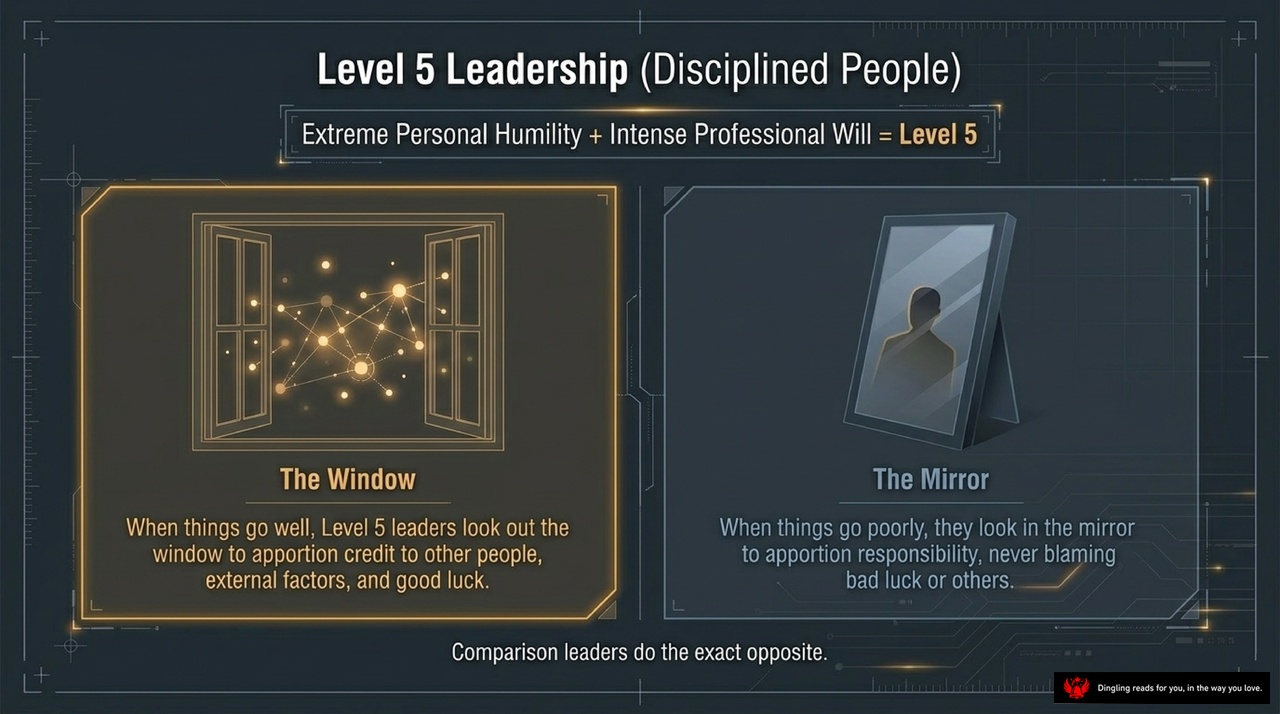
Look at this slide. It perfectly captures the heart of what it means to be a Level 5 leader. You see the equation at the top: Extreme Personal Humility plus Intense Professional Will equals Level 5. It's a powerful combination because these two traits often pull in opposite directions.
On the left, we have "The Window." When things go well, Level 5 leaders look out the window. They don't say, "I did this." Instead, they apportion credit to other people, external factors, and good luck. They deflect the praise. They stay humble.
But on the right, we have "The Mirror." This is where the real work happens. When things go poorly, they look in the mirror. They take full responsibility. They never blame bad luck or others. They own the failure.
This is the exact opposite of what comparison leaders do. Regular leaders tend to do the reverse: they take credit for success and blame everyone else for failure. That mindset destroys trust and stops growth.
But Level 5 leaders use this "Window and Mirror" test as a daily compass. By looking out the window when things are good and staring into the mirror when things are bad, they build a culture of accountability and humility. It's not about being perfect; it's about having the integrity to be honest about where you stand. That balance is what turns a good company into a great one.

So, we've talked about the leader, the people, and the reality. Now, let's talk about the destination. But here's the twist: before you can pick a destination, you have to get the right people on the bus. That's the "First Who, Then What" rule. It's not about finding the perfect strategy first; it's about finding the right people, and then the strategy will reveal itself.
The slide shows a bus. The logic is simple but powerful. You get the wrong people off and the right people on. Once you have the right people in the right seats, something magical happens. Motivation is no longer a problem. You don't need to force them; they are self-driven by an inner desire to produce the best results.
Think about this: if you try to build a strategy first and then try to find people to execute it, you often fail. If the genius leaves, the helpers are lost. That's why the "1 Genius with 1,000 Helpers" model fails. Revenue growth cannot outpace the ability to attract and keep the right people. That is Packard's Law.
So, don't get stuck trying to figure out where the bus is going before you've checked who is driving it. Get the right people on board, and you'll naturally find the right path to your destination.

Today's slide introduces the Stockdale Paradox, a mental discipline that separates truly resilient leaders from those who simply pretend things will get better. On the left, you see "The Brutal Facts," representing the absolute need to confront reality without any mask of false optimism. As the text reminds us, leadership doesn't start with a vision; it starts with getting people to face these harsh truths and act on them. On the right, we see "Unwavering Faith," which means retaining absolute belief that you will eventually prevail, no matter how deep the current crisis seems. This isn't about blind hope or wishing for a quick fix. It's about holding onto that conviction while doing the hard work of dealing with the brutal facts right now. Companies that fail often swing to one extreme: either they ignore the reality and live in a fantasy of imminent success, or they get so crushed by the difficulties that they lose all faith entirely. The paradox lies in doing both simultaneously. You must be clear-eyed about the present situation while being stubborn about your future outcome. This balance allows leaders to navigate uncertainty with clarity and courage, turning potential crises into opportunities for breakthrough.

The Hedgehog Concept isn't just a catchy diagram; it's the ultimate filter for decision-making. As this slide illustrates, true clarity only exists where three circles overlap. First, you must identify what you are deeply passionate about—what drives your heart. Second, you need to pinpoint what you can be the best in the world at, and equally importantly, recognize the boundaries of what you cannot be. Finally, you must find the single metric that best drives your economic engine, often something as simple as profit per 'X'.
The magic happens right in the center. The Hedgehog Concept is not a grand strategy or a distant goal to chase. It is a profound understanding of where these three forces intersect, distilled into a single, crystalline guiding principle. When you align your passion, your unique competitive advantage, and your economic logic, you stop guessing and start executing with precision. This focused clarity is what separates the companies that merely survive from those that achieve true, lasting excellence.
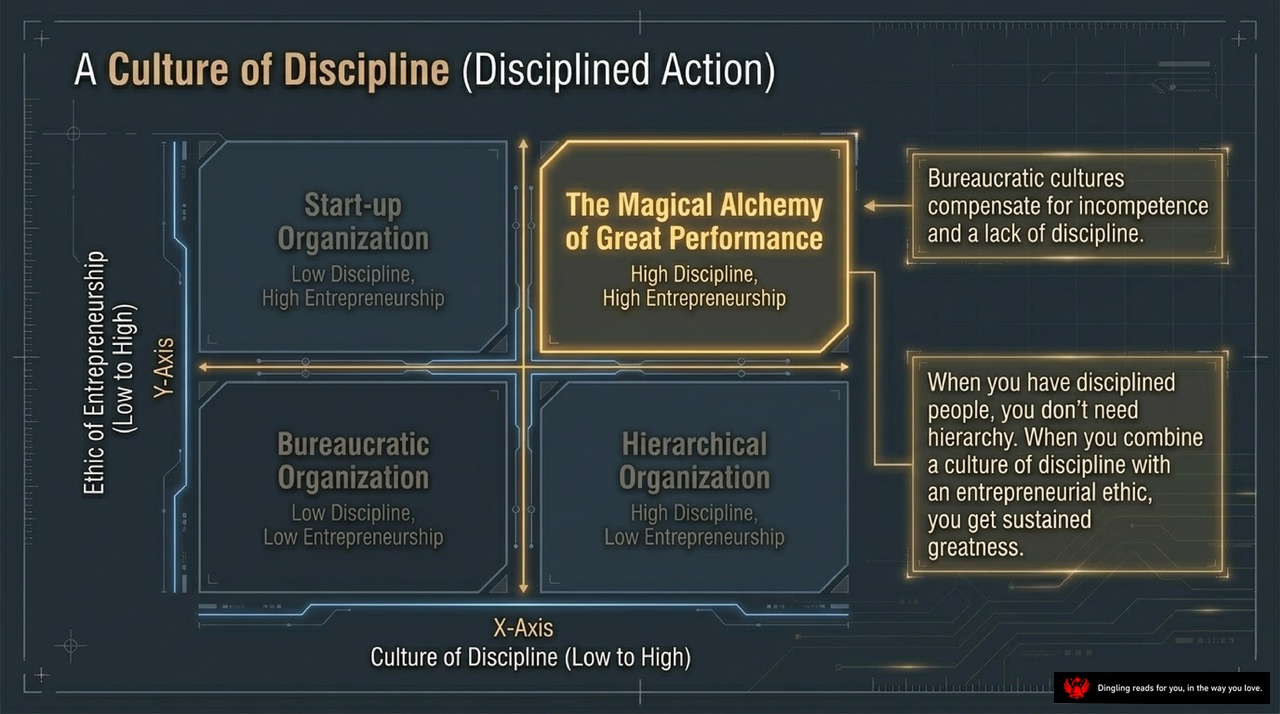
Look at this quadrant. We are visualizing the "Magical Alchemy of Great Performance." It sits right here at the top right, where high discipline meets high entrepreneurship. This is the sweet spot where sustained greatness lives.
Notice the axes. The vertical axis is the "Ethic of Entrepreneurship," and the horizontal one is the "Culture of Discipline." When you combine these two, you get a startup organization that doesn't just have ideas, but the discipline to execute them. This is the opposite of a bureaucratic culture, which, as the chart notes, often compensates for incompetence simply by relying on rigid rules and hierarchy.
In a bureaucratic setup, you need layers of management to tell people what to do because they lack self-discipline. But here, in the top-right quadrant, you don't need hierarchy. When you have disciplined people who also possess an entrepreneurial spirit, you create an environment where everyone takes ownership. You get a culture where the right people self-organize to solve problems without waiting for permission. This is the secret to lasting success: a culture of disciplined action where the team acts with the agility of a startup and the reliability of a well-oiled machine.

So, let's talk about where technology actually fits in the journey from good to great. It's a common myth that technology itself sparks transformation. But the reality, as our slide illustrates, is that technology is merely an accelerator. It's the golden arrow speeding up an arrow that is already flying. Good-to-great companies never use technology as the creator of momentum; they use it purely to amplify the momentum they've already built.
Look at that curve on the right. It shows "Accelerated Momentum." The breakthrough doesn't come from the technology dropping down from the sky, but from a foundation built on the left side of the screen: the Hedgehog Concept combined with Disciplined Action. That's the base. Only when you have a solid foundation of the right people, the right direction, and a trained culture does technology become relevant.
There is a simple rule of thumb here: a technology is only relevant if it directly fits squarely within the three circles of the Hedgehog Concept. If it doesn't align with your core strengths, your economic engine, and your passion, it's just noise. Take Walgreens. They didn't abandon their stores for online pharmacies during the dot-com boom. Instead, they used technology to make their existing stores more convenient. Or look at Gillette. They didn't just buy a new gadget; they invested heavily in the manufacturing technology needed to make their sensors and blades work better. Technology served their core strategy.
Without that disciplined foundation, technology becomes a distraction. Companies that try to lead with tech often end up running in circles. So remember, don't chase the shiny new tool. First, build your flywheel. Once it's spinning, then let technology be the fuel that makes it go faster.
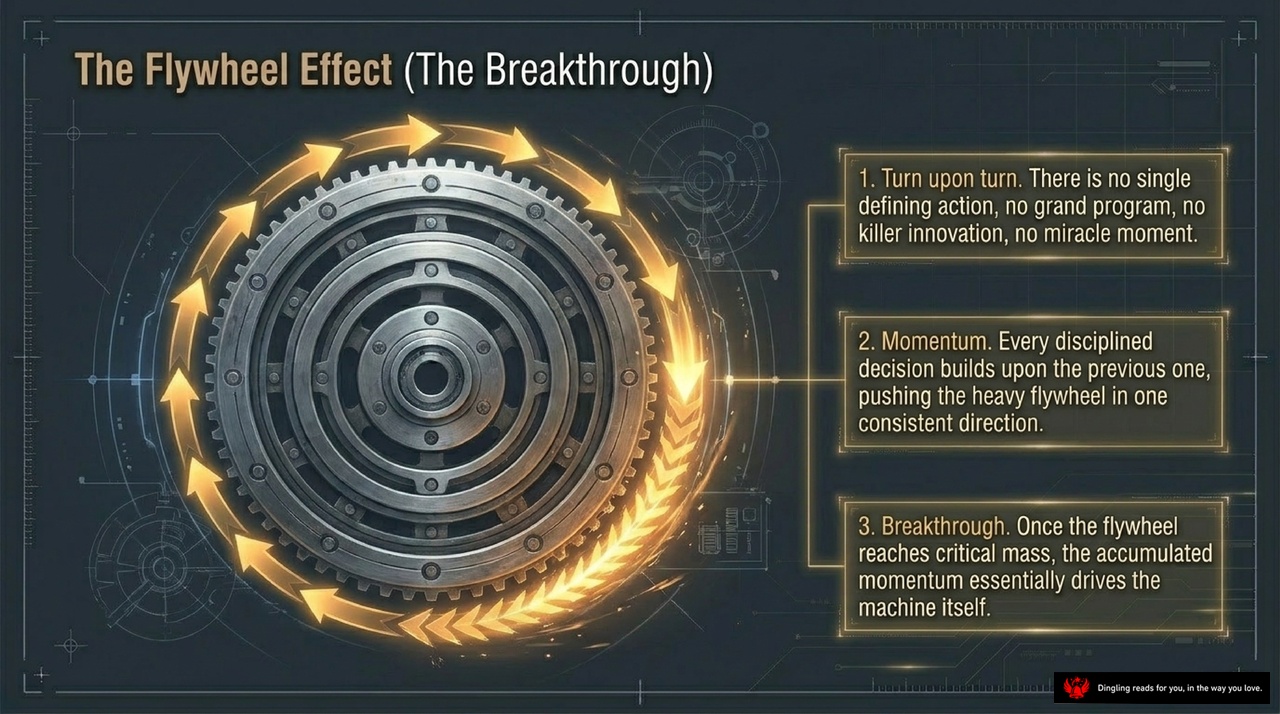
The Flywheel Effect is the breakthrough that turns steady progress into unstoppable momentum. Look at this diagram: it shows three key principles. First, turn upon turn. There is no single defining action, no grand program, no killer innovation, and no miracle moment. Great results come from thousands of small, consistent decisions made over time. Second, build momentum. Every disciplined decision builds upon the previous one, pushing the heavy flywheel in one consistent direction. You might not see immediate results, but you are adding weight to the wheel with every step. Finally, reach the breakthrough. Once the flywheel reaches critical mass, the accumulated momentum essentially drives the machine itself. At that point, the organization moves forward with such force that it becomes almost self-sustaining. This isn't about finding a magic bullet; it's about the power of persistence and alignment.
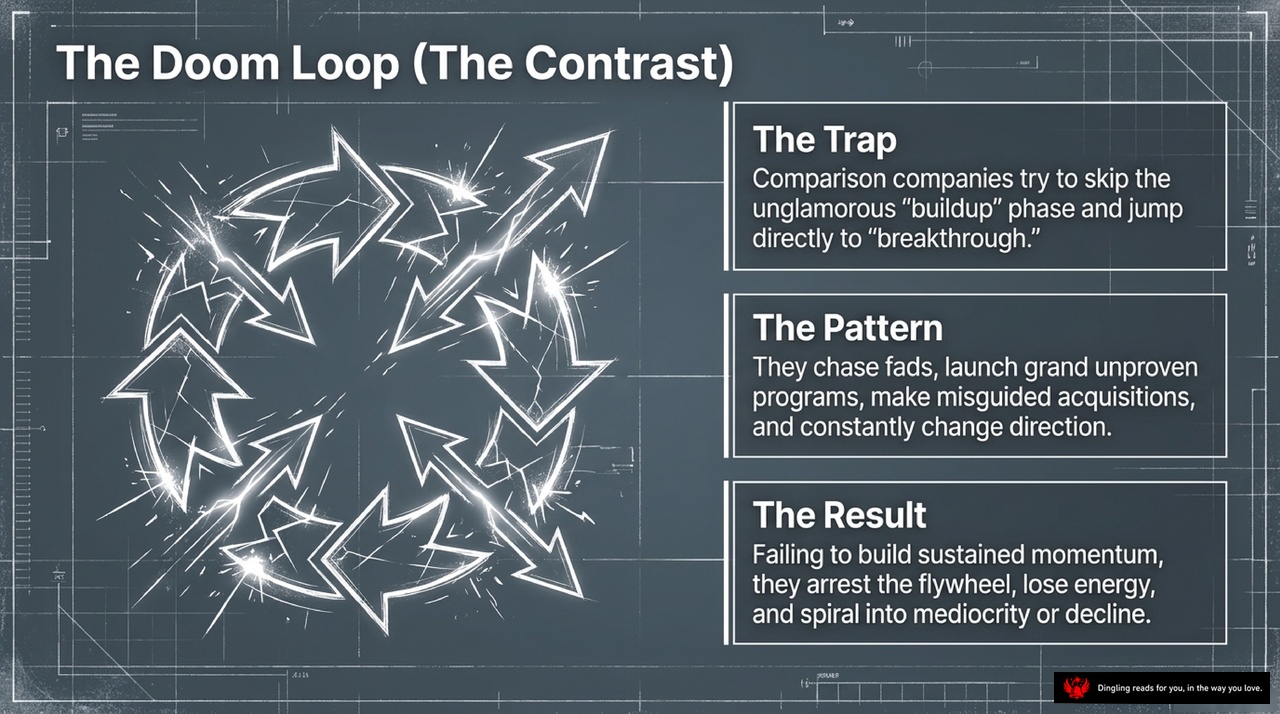
So, let's look at the "Doom Loop"—the stark contrast to the Flywheel. This isn't just a buzzword; it's the trap that keeps most companies stuck in mediocrity.
On the left, you see arrows spinning wildly in circles, representing a chaotic, self-destructive cycle. On the right, the slide breaks this down into three critical stages.
First, **The Trap**. Comparison companies try to skip the unglamorous "buildup" phase and jump straight to "breakthrough." They want the glory without the grind.
This leads to **The Pattern**. They chase fads, launch grand but unproven programs, make misguided acquisitions, and constantly change direction. They are reactive, not proactive.
And finally, **The Result**. Because they fail to build sustained momentum, they arrest the flywheel, lose energy, and spiral into mediocrity or decline.
This doom loop is the enemy of greatness. While the Flywheel relies on consistent, small pushes in the right direction, the Doom Loop thrives on frantic, disconnected activity. It's the difference between building a machine that keeps moving on its own, and spinning your wheels until you run out of gas.

Look at this Diagnostic Comparison Matrix. It's essentially the DNA that separates greatness from mediocrity. On the left, we have The Great Approach, and on the right, The Comparison Approach. Let's break down why one leads to lasting success while the other gets stuck.
First, look at Leadership. The Great Approach relies on Level 5 leaders who combine humility with professional will. They don't chase personal glory; they focus entirely on the organization's future. In contrast, The Comparison Approach is driven by ego, often relying on the illusion of a "genius" leader who needs the spotlight.
Next, consider People. Great companies follow a simple rule: "Who first, then What." They hire the right people before deciding on the strategy, trusting that the right team will find the right path. The Comparison Approach flips this, prioritizing a flashy strategy first and then scrambling to find anyone to execute it.
Then, there's Reality. Greatness demands confronting brutal facts without flinching. It's about seeing the truth, no matter how painful. The Comparison Approach, however, shields leadership with false optimism, burying problems under a layer of denial to protect the ego.
Strategy is another key differentiator. The Great Approach is built on deep understanding, what we call the Hedgehog concept—focusing on what you can be the best at. The Comparison Approach is all about bravado, constantly shifting goals and chasing trends without a solid core.
Finally, Transformation. Great companies build cumulative momentum through a flywheel effect, where every small win adds up to unstoppable force. The Comparison Approach relies on radical restructuring, constantly reinventing itself in a doom loop that never actually moves the needle forward.
The core takeaway here is simple: Greatness isn't about a single breakthrough or a heroic leader. It's about a disciplined, internal shift—from humility to ego, from people-first to strategy-first, from facing reality to hiding from it. When you align these dimensions, you stop chasing mediocrity and start building something truly great.
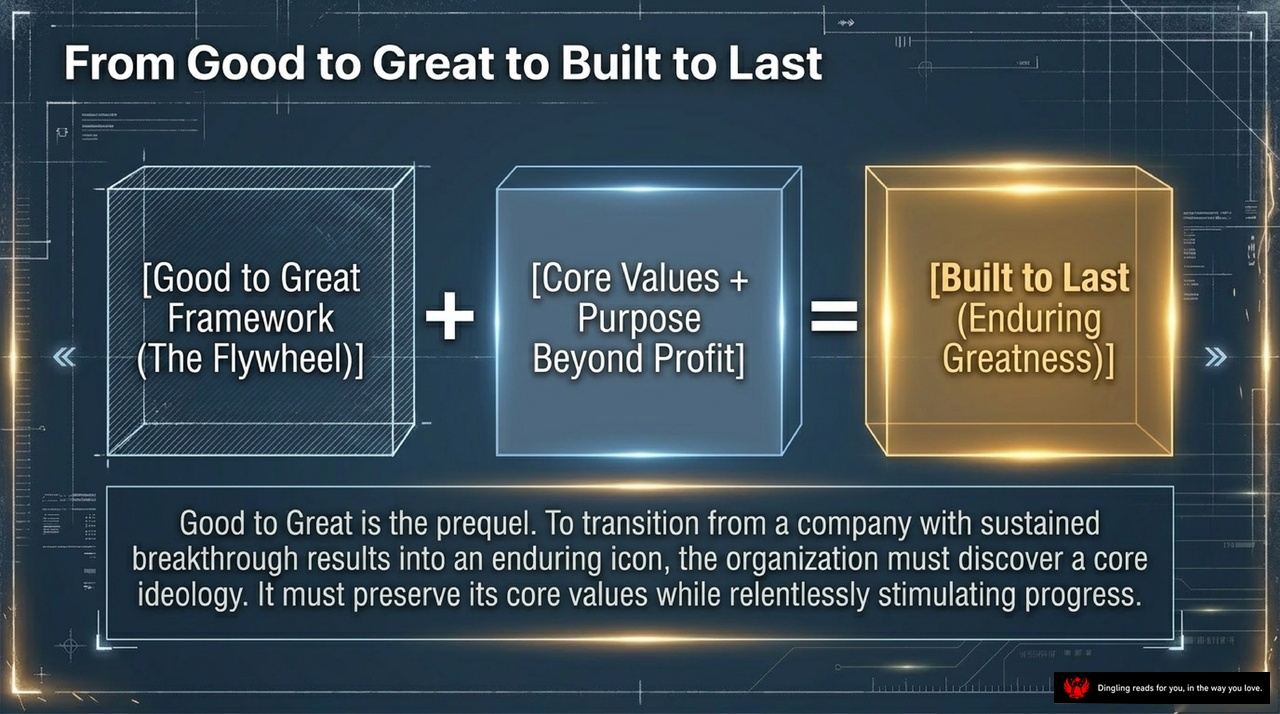
Good to Great is the prequel, but to truly become an enduring icon, we must move to the next stage: Built to Last. As our slide illustrates, this transition isn't just about maintaining momentum; it's about adding a crucial new ingredient to the equation. We take the proven "Good to Great Framework"—specifically the Flywheel effect we discussed earlier—and we add "Core Values plus Purpose Beyond Profit." When you combine these two, you unlock "Built to Last," or what we call Enduring Greatness.
Think of it this way: Good to Great gets you to the top of the mountain, but Built to Last ensures you don't just stop there or eventually slide back down. To make that leap, an organization must discover a core ideology. It's not enough to be great; you must have a belief system that transcends financial returns. You have to preserve your core values while relentlessly stimulating progress. This means building a culture where your purpose is bigger than just making money, creating an organization that can adapt to any era while staying true to its identity. That is the secret to lasting greatness.
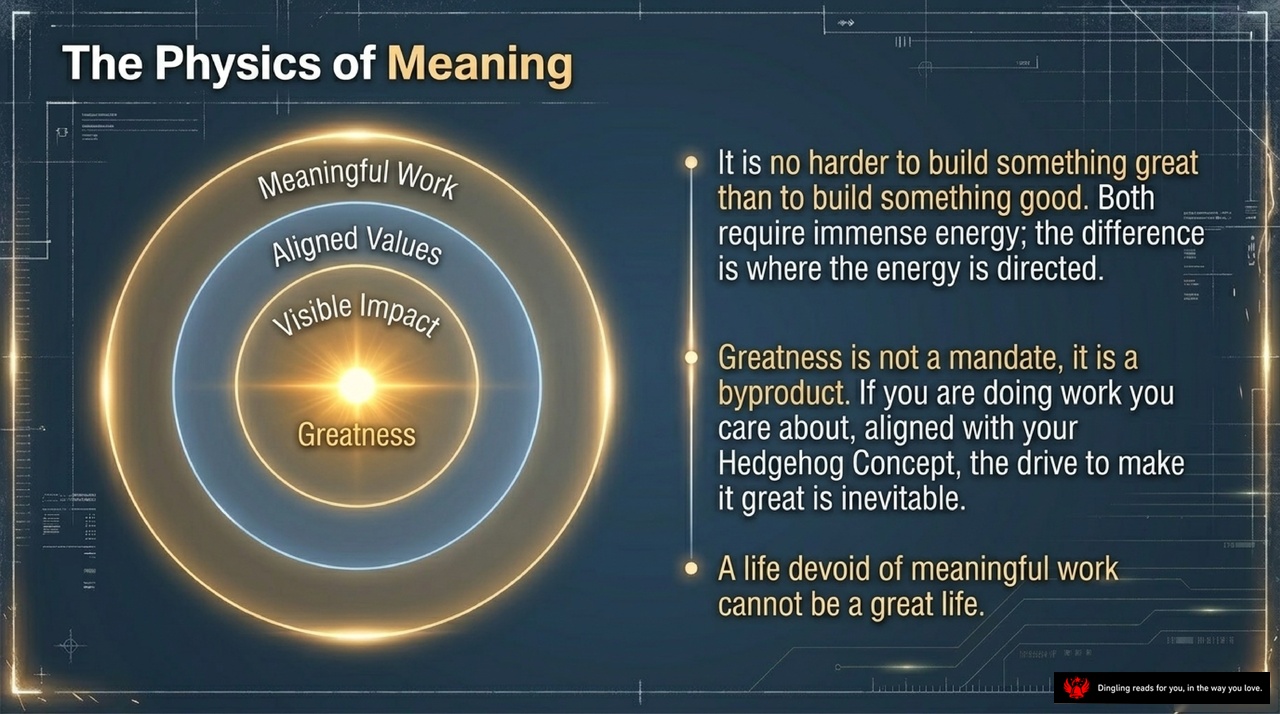
Look at this diagram titled "The Physics of Meaning." It visualizes a powerful truth: building something great is no harder than building something good. The energy required is identical; the only difference is where you direct that energy.
The image shows concentric rings expanding from a core of "Greatness." At the center lies "Visible Impact," surrounded by "Aligned Values," and finally, the outermost layer is "Meanful Work." This structure illustrates that greatness isn't a mandate you force upon the world; it is simply a byproduct. If you are doing work you genuinely care about, and that work aligns with your Hedgehog Concept, the drive to make it great becomes inevitable. You don't have to strive for greatness separately; it emerges naturally when your values, impact, and work are perfectly aligned.
Ultimately, the slide reminds us of a hard reality: a life devoid of meaningful work cannot be a great life. Without this alignment, even the most talented efforts will lack the momentum to reach true greatness.

Greatness isn't about where you start or the circumstances you face; it's entirely about the choices you make and the discipline you apply. As we've explored throughout this book, the path from good to great is paved with specific, repeatable behaviors: hiring the right people first, facing brutal facts while never losing faith, and focusing relentlessly on your "Hedgehog Concept."
But here is the most critical takeaway: this transformation isn't a single event or a magic bullet. It is not a function of circumstance. It is largely a matter of conscious choice and discipline. Think of it like pushing a giant flywheel. Every decision you make—hiring the right person, cutting the wrong one, sticking to your core concept—adds a little bit of momentum. At first, it feels like nothing is happening. The wheel barely moves. But if you keep pushing in the same direction, day after day, that momentum builds. Eventually, the wheel breaks free from gravity and spins on its own, carrying you into a new era of success.
So, ask yourself a hard question: If it takes no more effort to build something great than to build something good, what are you choosing to build? Are you willing to do the work of discipline, or will you settle for being merely "good"? The choice, and the discipline, are yours.