
Great and Small in History: Complete Chapter-by-Chapter Summary
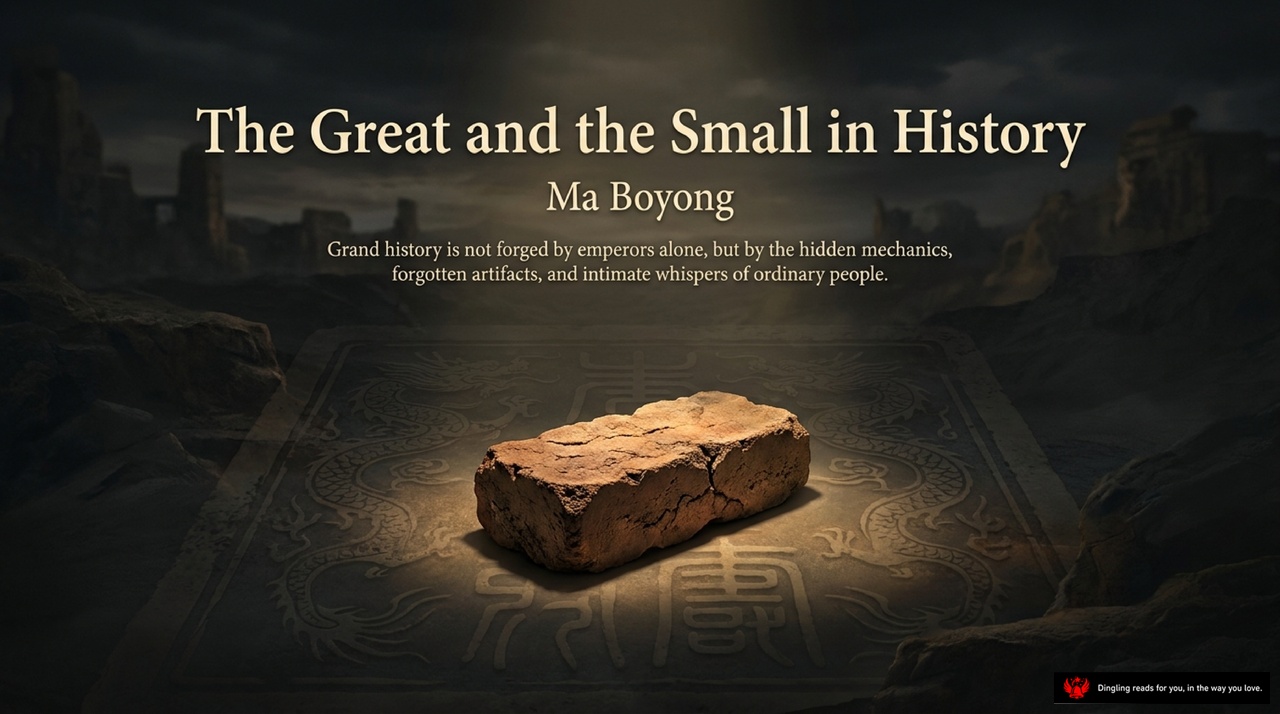
Welcome to today's session on "The Great and the Small in History" by Ma Boyong.
We often imagine history as a grand stage where only emperors and generals shape the world. But today, we are here to explore a different truth: that grand history is not forged by rulers alone, but by the hidden mechanics, forgotten artifacts, and intimate whispers of ordinary people.
Look at this ancient brick in front of us. It may look unremarkable, yet it holds the weight of an era. One such brick, unearthed in ancient China, bears the desperate cry of a common worker: "May heaven die." This wasn't just graffiti; it was the spark that ignited a rebellion, showing us that the fall of an empire often starts with the anger of a single individual.
Conversely, another brick tells a story of hope. An elderly craftsman, having lived through decades of chaos, finally carved the words "Peace under heaven" after witnessing the reunification of the land. For him, peace wasn't a political slogan; it was the hard-won relief of a lifetime.
These small objects remind us that while kings write the official records, it is the silent voices of the people—the artisans, the merchants, the forgotten souls—that truly drive the course of history. It is in these tiny details that we find the real pulse of our past.
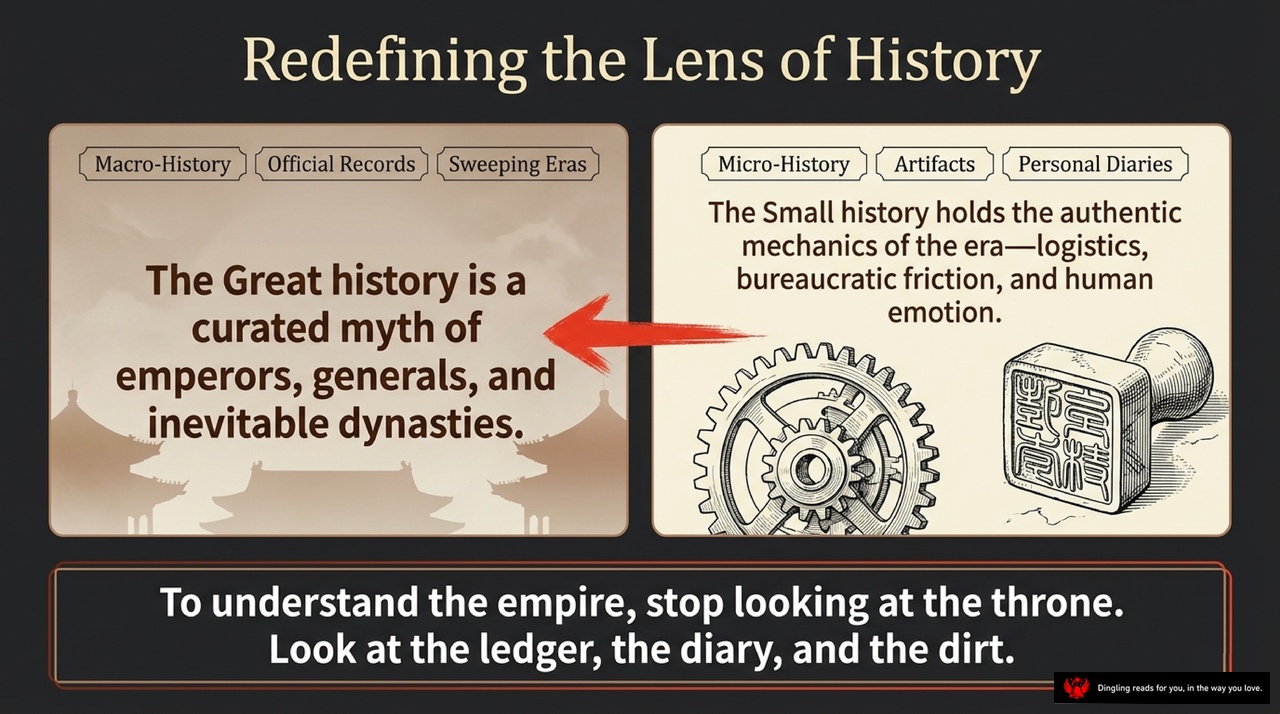
To understand the true engine of history, we have to stop obsessing over the throne and start looking at the dirt. Traditional history often treats empires as grand myths built by emperors and generals, focusing on sweeping eras and official records. But the real mechanics of an era—the logistics, the bureaucratic friction, and the raw human emotion—are hidden in the small stuff.
Look at the slide. On the left, we have "Macro-History," which is often just a curated narrative of inevitable dynasties. But on the right, we have "Micro-History," where the authentic story lives. It's found in artifacts like the gears of administration and personal diaries.
Consider the brick from the Three Kingdoms era. It wasn't written by a famous poet, but by a common brickmaker who carved "Heaven is dead" into the clay. That single phrase wasn't just graffiti; it was the spark that ignited a revolution fourteen years later. Or think of Xu Yihou, a merchant trapped in Japan. He wasn't a general, yet his intelligence saved a nation. These are the voices of ordinary people that textbooks often silence.
So, to truly understand the empire, stop looking at the throne. Look at the ledger, the diary, and the dirt. It is in these overlooked details that we find the real pulse of history.

Today, we shift our lens from the grand stage of history to the quiet, powerful voices of ordinary people. While emperors and generals shape the headlines, it is often the unsung heroes who truly drive the engine of time.
Look at these two artifacts: a brick from the Han Dynasty and another from the Western Jin. The first, carved by a frustrated mason, whispers a desperate plea: "May Heaven die soon." It's not just graffiti; it's a pressure cooker exploding. This single phrase foreshadows the Yellow Turban Rebellion, revealing that the fall of the Eastern Han wasn't just political failure, but the inevitable result of decades of suppressed anger among the common folk.
Fast forward centuries to the壬辰 War. Here stands Xu Yihou, a merchant from Jiangxi who was kidnapped by Japanese pirates. Instead of becoming a slave, he used his medical skills to survive, rise to power, and then secretly become a spy. While the emperors were still debating, Xu Yihou was already mapping out Japan's invasion route, sending critical intelligence back to China that saved the nation. He didn't seek glory; he just couldn't bear to see his homeland suffer.
These bricks and this merchant prove a vital truth: history isn't written only by the victors. It's built by the small, ordinary individuals who hold onto their humanity and courage when the world tries to crush them. They are the real pulse of our history.

Imagine two unassuming bricks from ancient China, yet they hold the true heartbeat of history. The first, unearthed in modern-day Bozhou, bears a desperate inscription: "The sky is dead, and we will die with it." Carved by a humble brickmaker in the late Han Dynasty, this wasn't just graffiti; it was a countdown to rebellion. For over a decade, ordinary people simmered with rage against oppression, and this brick captures that explosive tension right before the Yellow Turban Rebellion shattered the empire. It proves that the fall of dynasties isn't always about grand battles, but the quiet, accumulating fury of the powerless.
Now, look at the second brick, found in Nanjing during the Western Jin period. This elderly artisan, likely over seventy years old, lived through decades of chaos. He watched his country fracture and reunify, only to finally carve these words: "The world is at peace." For him, these four characters weren't a slogan; they were the price of a lifetime of survival. One brick holds the spark of revolution; the other carries the hope of stability. These artifacts remind us that while history books often focus on emperors and generals, the real engine of change is driven by ordinary people with deep, unyielding convictions. Their voices, though small, echo louder than any throne ever could.

Imagine standing at the base of a massive, 20-meter-high rammed-earth platform in Xi'an, the ancient capital of Qin. You are looking up at the Qindong Palace, a structure so imposing that even a teenager named An Guo Shaoji froze in terror. He was only 13 years old, tasked with assassinating the Emperor of Qin, but he had never seen a building this overwhelming. The sheer scale of the palace, combined with the crushing pressure of war, shattered his nerves, leading to his legendary collapse during the audience. This is the power of context; history isn't just text, it's a physical reality.
Just like this scene, the true story of the Southern Yue kingdom unfolds not in grand battles, but in quiet, personal betrayals. Consider Zhao Yingqi, the prince who spent his youth as a hostage in Chang'an, forming a deep bond with the young Emperor Wu. When he returned to rule, he made a shocking political move: he elevated his concubine, Jiao Shi, to the status of Queen and his son, Zhao Xing, to crown prince. This wasn't just a power grab; it was a desperate plea for protection from the mighty Han, sacrificing his own traditional heir to buy favor.
But the drama deepens with a twist of fate. The man leading the Han envoy to enforce this new order was none other than An Guo Shaoji—the same terrified boy from the palace floor. Now, he is back, not as an assassin, but as an old lover reuniting with Jiao Shi, the woman he once loved, in a room filled with political tension. This convergence of personal history and statecraft created a powder keg. When the powerful minister Lu Jia opposed this shift in power, Jiao Shi's personal feelings blinded her to the political danger. She attempted to stab Lu Jia, only to be stopped by her own son, who had grown up loving the very man she was trying to kill.
The result was catastrophic. Lu Jia seized the moment, massacred the royal family, and declared himself king. The Han Empire responded with a full-scale invasion that wiped out the Southern Yue dynasty, ending 93 years of rule. This story teaches us a profound lesson: history is often driven not by armies or strategies, but by the invisible threads of human connection—love, betrayal, and the inability to separate the heart from the throne.

Have you ever tried to write a book, only to find your own work on the shelves the moment you finished? It's a nightmare. As a writer, I've been there. I bought my own book to gift a friend, only to receive a cheap, low-quality pirated copy. The shopkeeper even had the nerve to say, "Who cares about the cover? Just read the content." It made me furious, but instead of spiraling into despair, I decided to look at history for some comfort. Turns out, piracy isn't a modern problem; it's been plaguing authors since the Tang Dynasty.
Back then, during the reign of Emperor Wen, officials were already complaining about pirate calendars flooding the market before the official versions were even released. By the Song Dynasty, things got worse. In Jianyang, Fujian, a notorious printing hub known as Mashaba, booksellers used cheap bamboo paper and soft wood blocks to mass-produce garbage. They didn't care about quality. They'd blur the text, mess up the layout, and even swap famous poems—printing Su Shi's verses as Du Fu's. Even Zhu Xi's commentaries were stolen and reprinted, often with glaring errors.
But the Song government actually tried to protect authors. Zhu Xi sued, and the authorities cracked down on the pirates, issuing the earliest known copyright notices. However, by the Ming and Qing dynasties, the situation exploded. Publishers in Jiangnan would print whatever was popular, especially novels like *Romance of the Three Kingdoms*. Authors got almost nothing. Enter Yu Xiangdou, a Ming-era publisher who became a master of marketing and piracy. When *Journey to the West* became a hit, Yu didn't just reprint it; he created a whole "Four Journeys" series, bundling lesser-known works with the blockbuster to boost sales. He even copied official court records to create fake case novels that readers couldn't tell were fakes.
Yu was ruthless. He hired ghostwriters, added his own commentary to old books to make them seem "new," and even used his own portrait as an anti-piracy label. If someone stole his work, he'd publicly curse them in the preface. The famous writer Li Yu suffered the same fate; his entire library of woodblocks was stolen, and despite winning court cases, he couldn't stop the pirates. Even the literary giant Yuan Mei wrote a poem lamenting that his books were pirated before they could even cool down on the shelf.
So, what's the lesson here? Piracy is old news, but the fight for intellectual property is timeless. Whether it's a Song Dynasty scholar or a modern author, the core struggle remains the same: protecting the value of your work against those who want to take it for free.
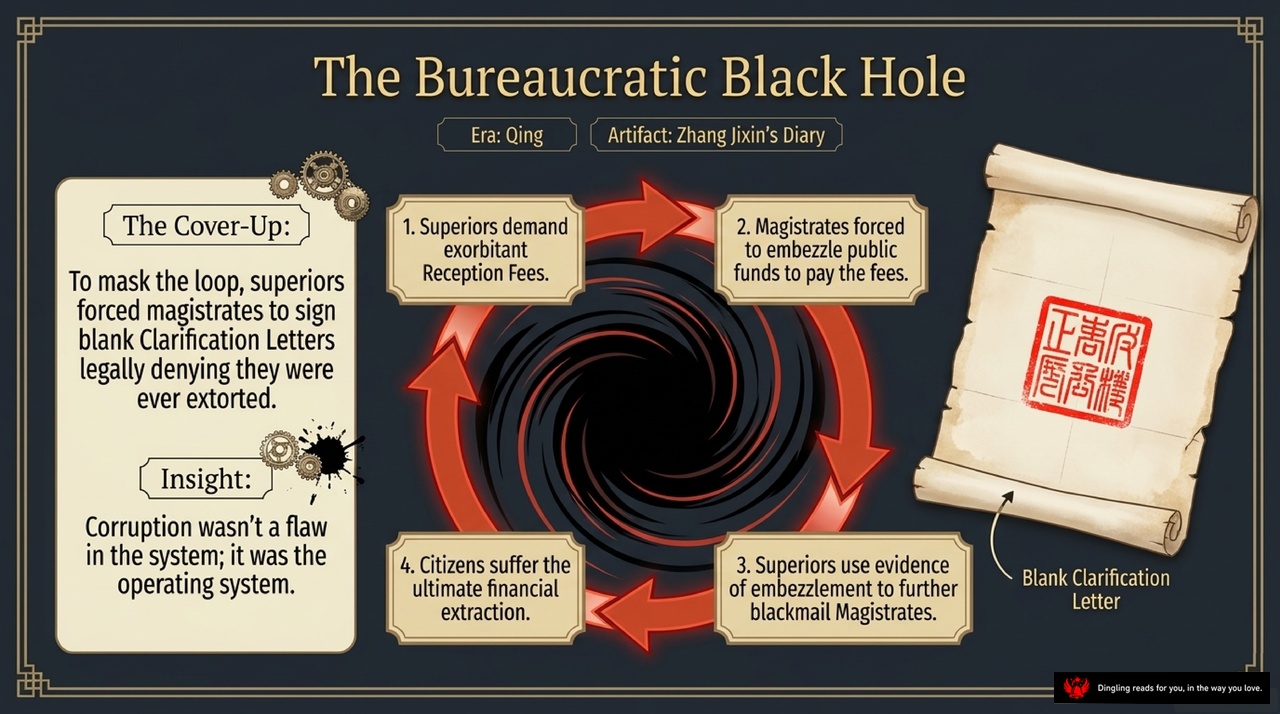
The "Bureaucratic Black Hole" depicted here reveals a terrifying truth about the Qing Dynasty's administrative system: corruption wasn't an accidental glitch, but the very engine keeping the machine running. As shown in the cycle, superiors demanded exorbitant reception fees, forcing magistrates to embezzle public funds just to pay them. When caught, these officials were blackmailed with evidence of their embezzlement, which was then used to justify even higher demands. To mask this loop, they forced magistrates to sign blank Clarification Letters, legally denying they were ever extorted. The ultimate result? Citizens suffered the ultimate financial extraction. This insight from Zhang Jixin's Diary proves that corruption was the operating system, not a flaw.

Let's talk about the ancient "piracy economy." Long before we had digital downloads, the publishing world was already running on a high-stakes hustle.
On the left, we see the core strategy: The Hustle. During the Song and Ming dynasties, shrewd merchants like Yu Xiangdou pioneered a low-cost, high-volume model. They ditched expensive materials for cheap bamboo paper and used ruthless marketing tactics to flood the market. It was a classic case of capitalizing on trends by faking famous author names, pasting "New Capital Edition" tags on stolen texts, and even accidentally mixing Buddhist scriptures into the Tao Te Ching due to careless mass-printing.
Now, look at the two tracks on the right. Track 1 represents the official, elite publishing world. This was the slow lane. It relied on the elite standard, pristine layouts, high-quality woodblocks, and incredibly slow production times. It was exclusive, expensive, and meticulous.
But Track 2, The Masha Print Hustle, was the opposite. It was all about speed and scale. Merchants used mass block printing to crank out books at an alarming rate. They prioritized cheap bamboo paper over quality, used fake author names to attract buyers, and employed ruthless marketing to sell thousands of copies in days. While the official publishers were carefully carving every character, the pirates were already printing the next batch. This ancient rivalry between quality and quantity is surprisingly familiar to us today, reminding us that the desire for mass access often clashes with the pursuit of perfection.

The Anatomy of a Power Grab: How to Steal an Empire Legally
Welcome to today's deep dive into political strategy. We're looking at the "Anatomy of a Power Grab," specifically focusing on the ancient Chinese document known as the *Quan Jin Biao*, or the "Petition for the Throne." Think of this not just as a historical artifact, but as a masterclass in political psychology—a playbook for how to seize power while making everyone believe it was their idea all along.
The core question this document answers is simple yet terrifying: How do you steal an empire legally? The answer lies in a three-step formula designed to justify a coup without ever saying the word "coup."
First, you need "The Window Paper." This is the art of maintaining the illusion of humility. You never, ever say "I am now the emperor." Instead, you pretend to be a humble servant asking for permission. It's a psychological trick that lowers everyone's defenses. If you look arrogant, people resist. If you look like you're just following destiny, they follow you.
Second, you must hijack destiny. This is where things get fascinating. You don't argue with logic; you argue with math and prophecy. You use absurd mathematical formulas or ancient texts to prove that the old dynasty has run out of luck and that the stars have aligned for a new ruler. You turn politics into science and fate into a mathematical inevitability.
Third, you define "The Who." You have to justify the usurper using a mix of Merit, Blood, Prophecy, or Virtue. You claim the new leader is the only one worthy of the throne because of their unique qualities or divine right.
Let's look at our case study: Ruan Ji. In the Three Kingdoms era, Ruan Ji wrote a flawless, sycophantic petition for the usurper Cao Pi while pretending to be blackout drunk. It was a masterpiece of malicious compliance. He used his intoxication as a shield, allowing him to say the unthinkable without taking responsibility. He wrote a petition that was so perfectly aligned with the new regime's needs that it felt like a revelation, not a manipulation.
This *Quan Jin Biao* isn't just about ancient history; it's a timeless lesson in influence. Whether you're climbing the corporate ladder or navigating complex social dynamics, the principle remains the same: the most powerful way to take control is to make others feel like they are leading you. It's about controlling the narrative, bending the rules of legitimacy, and using the language of humility to achieve the most ambitious of results.

Imagine standing on the very spot where history's most famous strategist, Zhuge Liang, chose to rest his final journey. In Mianxian, the landscape isn't just scenery; it's a silent testament to his promise. The tomb mound, shaped like a green grass hat, sits overlooking the plain where he once farmed, trained troops, and planned his northern expeditions. By burying himself right here, Zhuge Liang ensured that even in death, he remained the guardian of his dream. It's the ultimate definition of "bowing until the end, serving until the very last breath."
But history isn't always written in grand tombs; sometimes, it's etched into the smallest, most overlooked objects. Think of the humble bricks from the Three Kingdoms era. One brick, found in Bozhou, carries the desperate cry "The Blue Sky is Dead," a slave's prediction of the Yellow Turban Rebellion 14 years before it happened. It captures the boiling rage of the masses that toppled an empire. Another brick, from a 70-year-old laborer in the West Jin dynasty, simply whispers "World at Peace" after surviving decades of chaos. These aren't just artifacts; they are the voices of the nameless masses, proving that while warlords make the headlines, the crushing weight of war on ordinary people defines the true era.
And the power of these ordinary voices extends far beyond ancient China. Consider Xu Yihou, a merchant from Ming Dynasty China who was captured by pirates in Japan. Instead of giving up, he used his medical skills to survive, rose to become a trusted physician, and secretly gathered intelligence about an impending invasion of his homeland. He risked his life to send a report back to China, allowing the Ming army to prepare. He never returned, but his quiet courage changed the course of history. These stories remind us that the true engine of history isn't always the emperor on the throne, but the relentless, often unseen, determination of the common person.
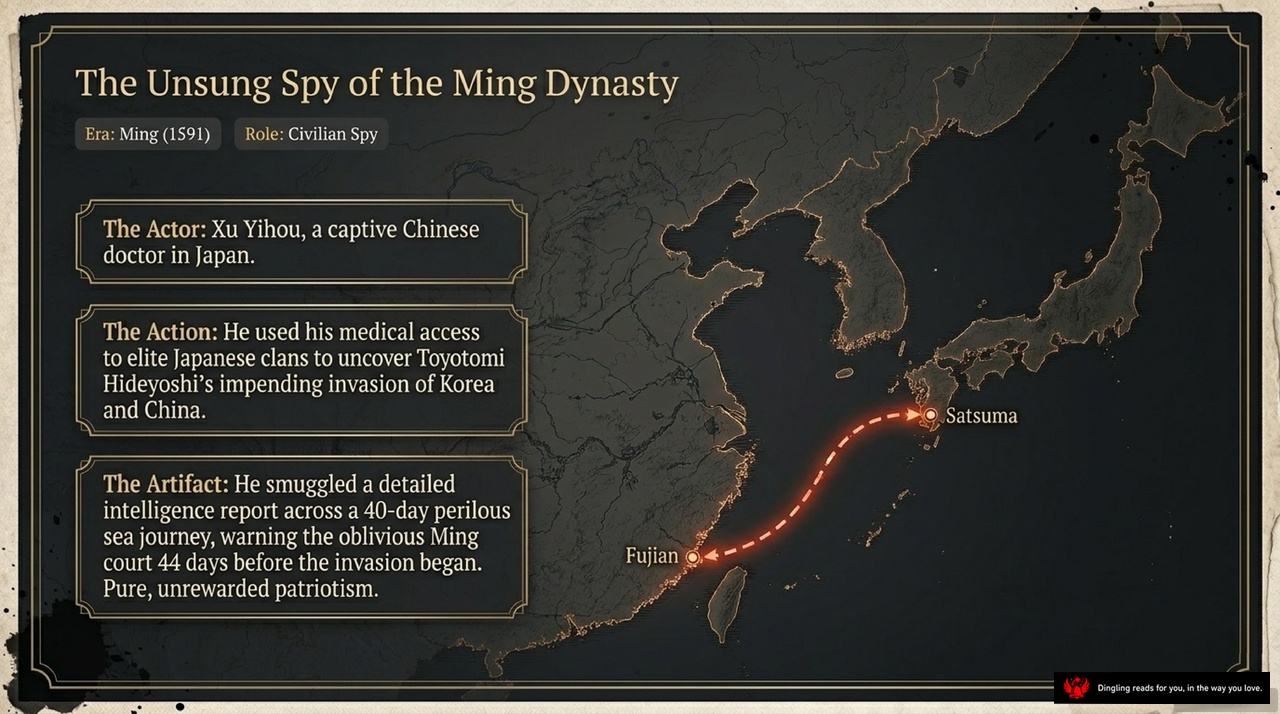
Look at this map of East Asia in 1591. It tells the story of Xu Yihou, a forgotten hero from the Ming Dynasty. He wasn't a soldier or a spy in the traditional sense; he was a Chinese doctor living as a captive in Japan.
The map highlights a critical route from Satsuma in Japan back to Fujian in China. This 40-day sea journey was the most dangerous mission of his life. Xu Yihou used his medical access to infiltrate elite Japanese clans. He uncovered a terrifying truth: Toyotomi Hideyoshi was planning a massive invasion of Korea and China.
Knowing that the Ming court was completely oblivious to this threat, Xu made a desperate decision. He smuggled a detailed 5,000-word intelligence report back across the sea. He arrived in Fujian 44 days before the invasion actually began. This warning gave the Ming army crucial time to prepare, potentially saving countless lives.
Despite his heroic act, history has largely overlooked him. He never received a reward, and he eventually stayed in Japan, becoming a local samurai. Yet, his story proves a powerful truth: history isn't just driven by famous generals and emperors. Sometimes, the turning point is decided by an ordinary person acting out of pure, unselfish patriotism. Xu Yihou's courage shows that even the smallest voice can change the course of history.

The Mutation of a Superstition. Look at this timeline. It starts in the Han Dynasty with a simple physiognomy term: the "four-whites of the eye." That was just a visual metaphor. But then, in the Tang and Song periods, the meaning shifted completely. The sheep's eye became linked to bad luck and promiscuity. By the Ming and Qing dynasties, folk culture completely misunderstood the original metaphor and permanently transferred the curse to the Zodiac sign itself. This is the core of our insight today: grand cultural taboos are often just thousands of years of the telephone game. A minor visual metaphor gets twisted, distorted, and amplified until it turns into a systemic social curse. We see how a harmless observation can mutate into a deep-seated myth just by being passed down and reinterpreted over generations.
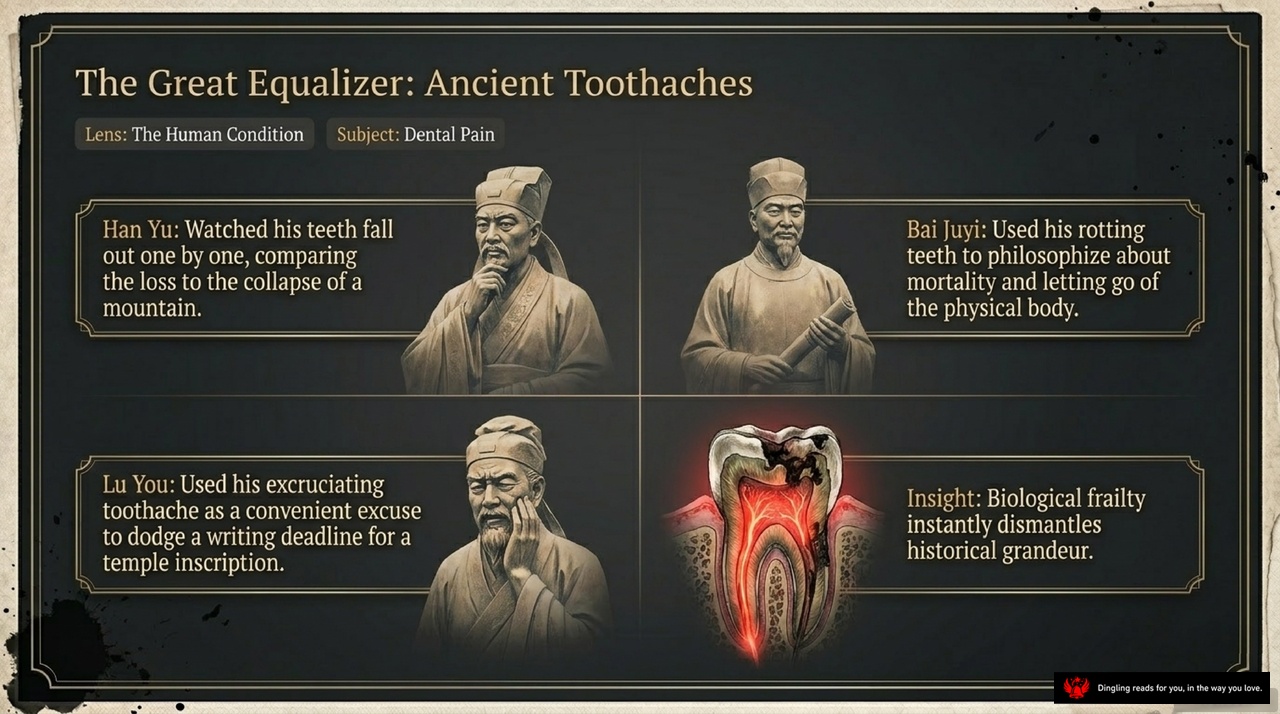
Have you ever felt that the greatest equalizer in human history isn't a weapon, a law, or a title, but something as painfully ordinary as a toothache? This slide explores how ancient pain stripped away social status, revealing the raw, shared reality of being human.
Look at the top left: Han Yu. He didn't just lose teeth; he watched them fall out one by one, comparing that personal loss to the collapse of an entire mountain. It was a moment where his personal fragility mirrored the fragility of empires.
To his right, we see Bai Juyi. Instead of hiding his rotting teeth, he used them as a philosophical tool. He let the physical decay of his mouth remind him of the inevitability of death, using dental pain to find peace about the human condition.
Below them is Lu You. His story is more relatable to modern work culture. He used an excruciating toothache as a convenient excuse to dodge a writing deadline for a temple inscription. It's a reminder that even great historical figures needed breaks when their bodies betrayed them.
Finally, look at that glowing, infected tooth in the bottom right. That is the core insight here: biological frailty instantly dismantles historical grandeur. No matter how powerful a leader was, a bad tooth could stop them in their tracks. This slide teaches us that beneath the layers of history and power, we are all just bodies feeling pain.

Decoding the Empire: The Micro-History Matrix. Look at this visual framework we've built together. We are moving beyond just knowing *what* happened in history to understanding *how* and *why* it happened.
First, we have Lens 1: Literature. Think of this as psychology. It's about finding the subjective, human emotions hiding inside those rigid, formal texts. We aren't just reading words; we're feeling the anxiety of Zhuge Liang or the trauma of Mulan. That's the human element.
Second, Lens 2: Systems. Here, logistics equals power. We look for the true power dynamics and the friction inside those mundane systems. It's not about the grand battles, but the Night Curfew or the Corruption Loop—the invisible machinery that actually runs the empire.
Third, Lens 3: Artifacts. This is where we find the desperate, authentic voice of the masses buried in the dirt. It's the "Laborer's Bricks" and "Pirate Books"—the small, gritty evidence that history often ignores.
Here is our core takeaway: Macro-history tells us what happened. But micro-history? Micro-history tells us how and why it happened. It brings the silence of the past back to life.

History isn't just written in grand decrees or battlefield victories; it lives in the quiet, often overlooked details of daily life. Imagine a worried father, a confusing night curfew, or a desperate scribble on a buried brick. By focusing on these microscopic moments, the monumental truths of our era finally make sense.
Consider the humble brick found in ancient tombs. One, unearthed in China, bears the desperate plea "May Heaven Die," capturing the simmering rage of a common craftsman just fourteen years before a rebellion erupted. Another, from a much later era, carries the weary hope of a seventy-year-old soldier who finally carved "Peace under Heaven" after a lifetime of war. These aren't just artifacts; they are the voices of ordinary people that define the age.
But what about us? If the defining truths of ancient empires were hidden in their smallest, most overlooked details, what seemingly insignificant artifacts from our lives today will ultimately define our era to the future? It's a question worth asking as we look around at the digital footprints and quiet struggles that surround us.