
Great by Choice: Complete Chapter-by-Chapter Summary
Welcome to "Great by Choice." Imagine standing at the base of a towering, storm-wreathed mountain. The clouds are thick, the winds are howling, and the path ahead is invisible. This is the world Jim Collins and Morten Hansen describe: a volatile, unpredictable landscape where success is not a matter of chance, but a rigorous choice and discipline.
Unlike the common belief that great leaders are fearless visionaries who can predict the future, the 10x companies we studied proved that true excellence comes from something far more grounded. It's about having the discipline to stick to a course, the empirical creativity to test your way forward, and a constructive anxiety that prepares you for the worst.
In this chaotic environment, luck plays a surprisingly small role. The data shows that successful companies and their failures experience roughly the same amount of good and bad luck. The difference lies in how they respond. Great leaders don't wait for a lucky break; they build buffers of cash and capability so that when the storm hits, they can keep flying while others crash. They turn bad luck into a catalyst for strengthening their discipline, and they seize good luck with both hands, maximizing its impact.
So, how do you climb this mountain? It's not about guessing the weather. It's about mastering your own actions, maintaining a consistent rhythm, and building a foundation so strong that no storm can knock you down. Success isn't about controlling the wind; it's about controlling the ship.
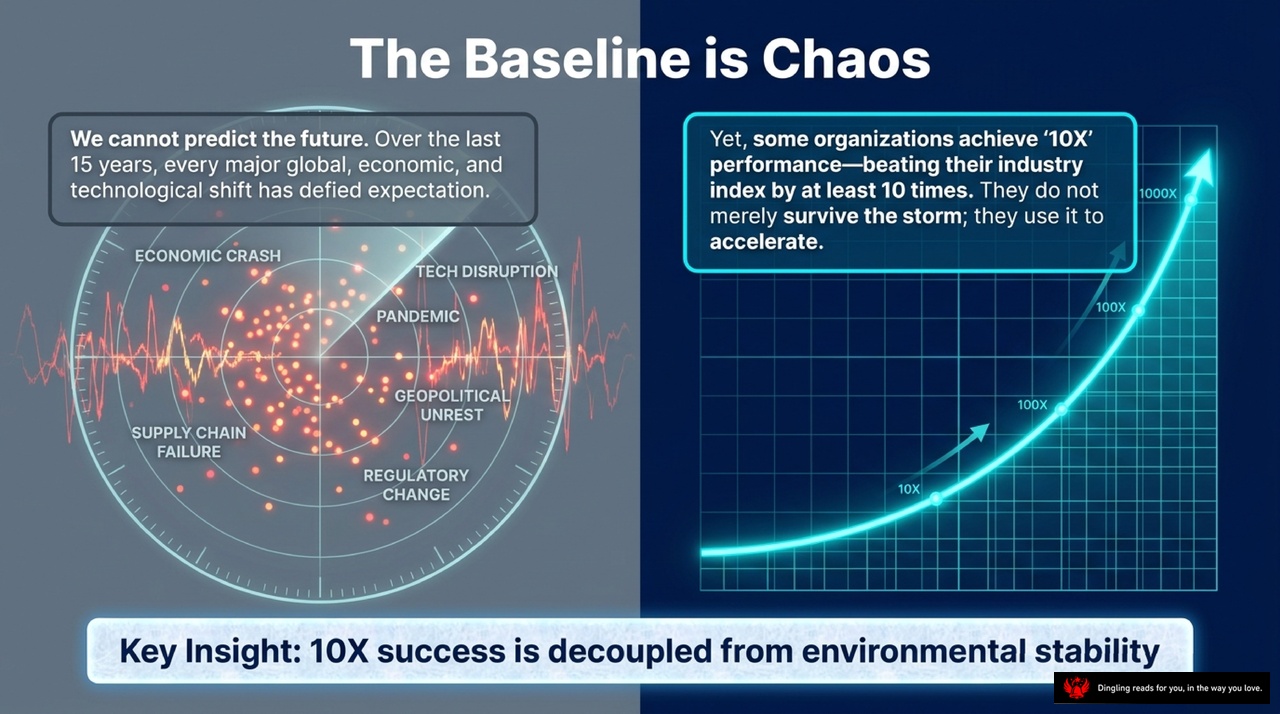
The Baseline is Chaos. Look at this radar screen on the left—it's filled with everything that's thrown at us over the last 15 years: economic crashes, tech disruptions, pandemics, supply chain failures, and geopolitical unrest. We can't predict the future. Every major shift has defied expectation. Yet, look at the graph on the right. While the world is in turmoil, some organizations aren't just surviving the storm; they are using it to accelerate, achieving 10X performance that beats their industry index by at least 10 times.
This is the core insight: 10X success is completely decoupled from environmental stability. In fact, the best companies often thrive *because* of the chaos. Take Southwest Airlines, for example. Between 1972 and 2002, the airline industry was absolutely brutal—facing skyrocketing fuel prices, deregulation, labor strikes, and the 9/11 attacks. While other carriers collapsed, Southwest didn't just survive; they turned that volatility into their greatest advantage. They didn't try to control the external world; instead, they focused on what they could control internally.
So, how do you build a company that can do this? The answer isn't about predicting the future or relying on luck. It's about building an unshakeable internal baseline. When the outside world is unpredictable, your internal discipline becomes your anchor. As we'll see, these leaders don't panic when the storm hits. Instead, they have a clear set of rules, a rigorous approach to evidence, and a mindset that treats anxiety as a tool for preparation rather than a reason to freeze. In a world of constant disruption, the only way to guarantee your future is to create a system so strong that nothing external can break it.

Imagine a race to the South Pole in 1911. Two teams, Amundsen and Scott, faced the exact same lethal Arctic conditions. The environment didn't change, yet the outcomes were worlds apart. One team survived and succeeded; the other perished. The difference wasn't the weather or the distance—it was their choices.
Look at Amundsen, the 10x Leader. He didn't rely on luck or unproven tech. Instead, he practiced rigorous empirical preparation. He cycled across continents to test his fitness, studied indigenous survival tactics, and built massive supply buffers. He treated every variable with data and discipline.
Now, look at Scott, the Comparison Leader. He bet on unproven technology like motor sleds, ignored safety margins, and lacked any systematic preparation. When the storm hit, he had no buffer. He didn't just face the environment; he let the environment dictate his fate.
This isn't just history; it's a blueprint for business. The core takeaway is simple: the environment does not dictate the outcome. The specific behaviors of the leaders do. In a chaotic world, success doesn't come from predicting the future or hoping for the best. It comes from preparing for the worst, trusting in evidence over intuition, and making choices that anchor you when everything else is shaking. You don't need to control the storm; you just need to build a ship that can sail through it.
Imagine you're investing in two companies that look almost identical on paper. Company A grows steadily at 25% a year, hitting that target consistently. Company B rockets forward at 45% on average, but its growth is wild—sky-high one year, crashing the next. Which one do you pick? The answer lies in the concept of "Marching 20 Miles a Day."
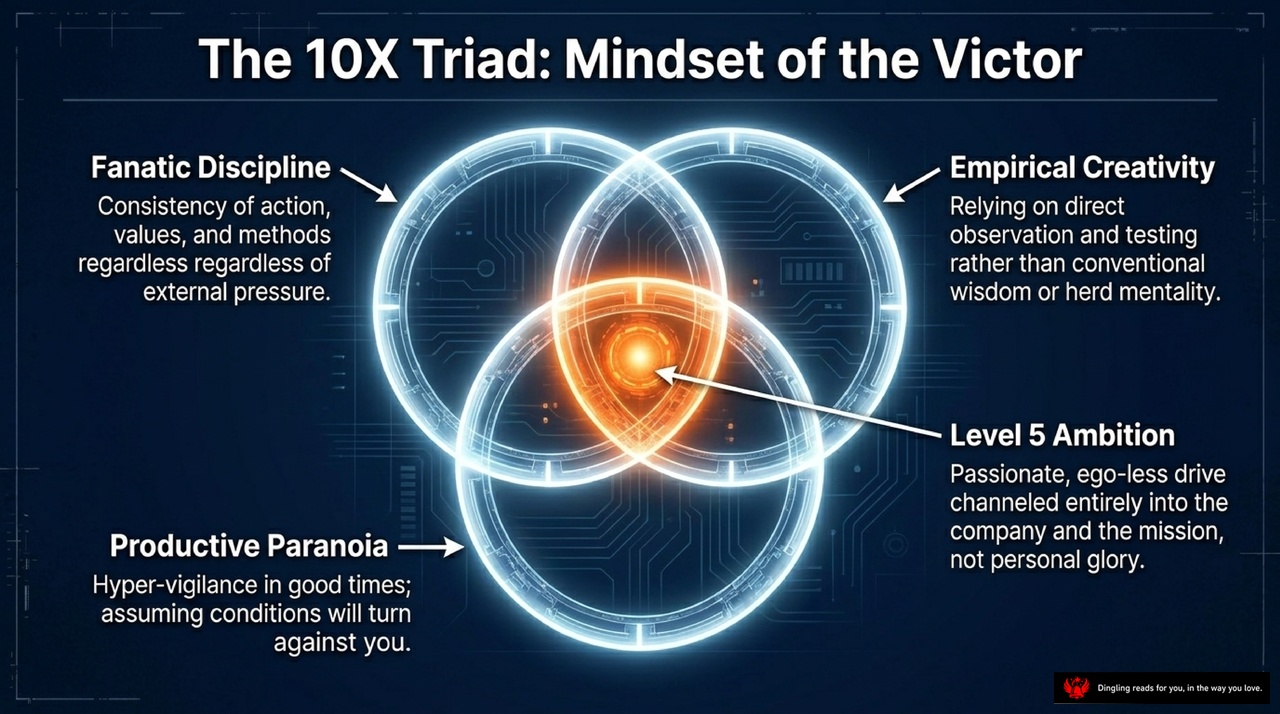
This slide outlines the mindset of the victor, specifically the pillar of Fanatic Discipline. It's not about how fast you run, but how consistently you move forward. Look at the first circle: Fanatic Discipline. This means sticking to your values, goals, and methods regardless of external pressure. It's about consistency over time.
Consider the story of Stryker versus American Surgical. Stryker committed to a strict 20% annual growth target, treating it like a law. Even when the market was booming and competitors were sprinting ahead, Stryker held the line. They didn't get distracted by short-term hype. In contrast, their competitor, American Surgical, chased high growth, over-expanded, and eventually collapsed. Stryker's steady march allowed them to survive recessions and outperform the market by a massive margin.
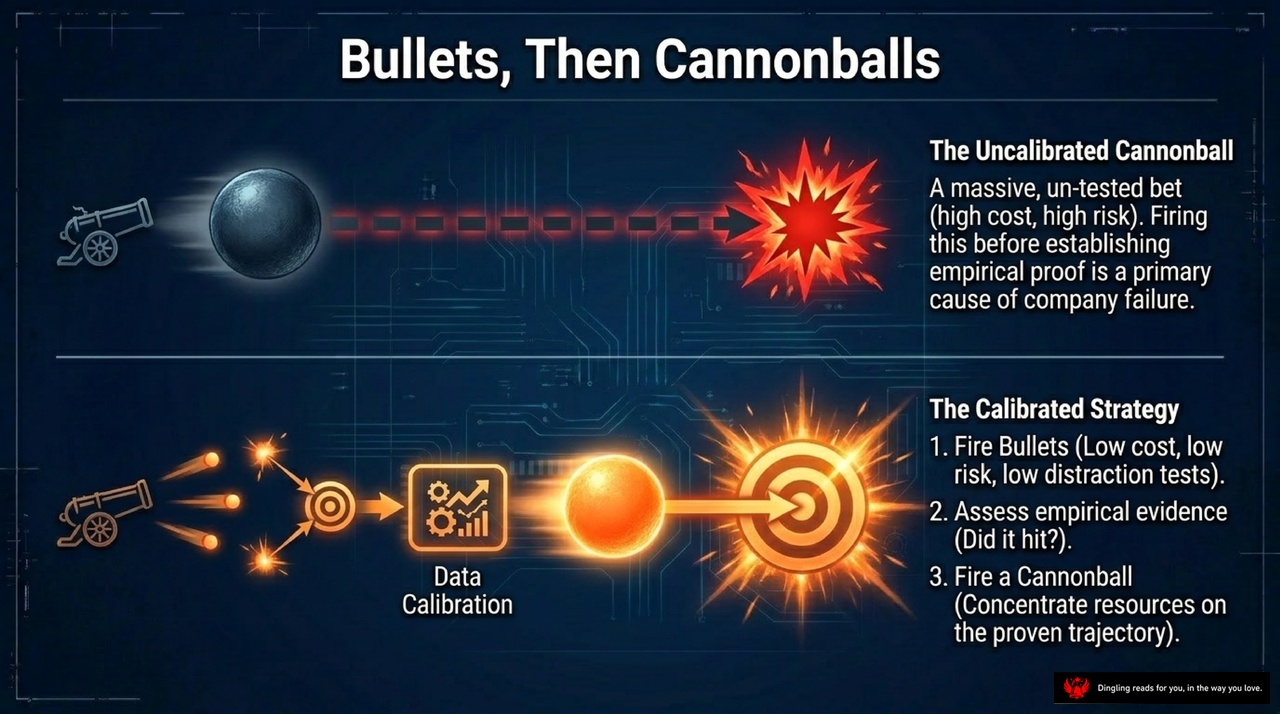
But discipline isn't just about restraint; it's also about Empirical Creativity, as shown in the second circle. This means relying on direct observation and testing rather than just following conventional wisdom or herd mentality. You don't guess; you test. You fire "bullets"—low-cost experiments—to find the right path before committing all your resources. This prevents you from wasting money on unproven ideas.
Finally, look at the center: Level 5 Ambition. This is the fuel that drives it all. It's a passionate, ego-less drive channeled entirely into the company and the mission, not personal glory. These leaders aren't trying to be famous; they are trying to build something that lasts. They take responsibility, even when things go wrong, and they stay focused on the long-term vision.
So, what makes a victor? It's the intersection of these three forces. You need the discipline to keep moving at a steady pace, the creativity to test and learn, and the ambition to care deeply about the outcome. Without any one of these, the other two lose their power. This triad allows leaders to thrive not despite the chaos, but because they have a system to navigate it.

Imagine a gauge with two distinct zones: on the left, the "Lower Bound," where you simply don't fail, and on the right, the "Upper Bound," where you refuse to overextend. This visual perfectly captures the essence of the 20-Mile March—a strategy of fanatic discipline that separates 10X companies from the rest.
Think of it like a journey across the United States. Some travelers are opportunistic; they sprint 40 or 50 miles when the weather is perfect, only to get stuck in a tent complaining when a blizzard hits. Others, like Stryker, march exactly 20 miles every single day, rain or shine. They set a clear performance floor—like Stryker's mandatory 20% net income growth—and a self-imposed speed limit to avoid catastrophic over-extension.
This balance is the secret to survival and compounding growth. While comparison companies boom in good times and bust in bad, 10X companies impose these constraints to ensure they never run out of gas. They don't chase the highs or fear the lows; they just keep marching their 20 miles, turning uncertainty into a predictable, steady path to excellence.
Imagine you're hiking across the American continent. One hiker commits to a simple, unshakeable rule: walk exactly 20 miles every single day, regardless of the weather. Whether it's scorching desert heat or freezing mountain storms, they keep moving. The other hiker is entirely at the mercy of the conditions. On a beautiful day, they sprint 50 miles; when the storm hits, they hide in their tent, complaining and waiting. Eventually, that second hiker gets caught in a blizzard, exhausted and stranded, while the disciplined walker has already reached Maine.
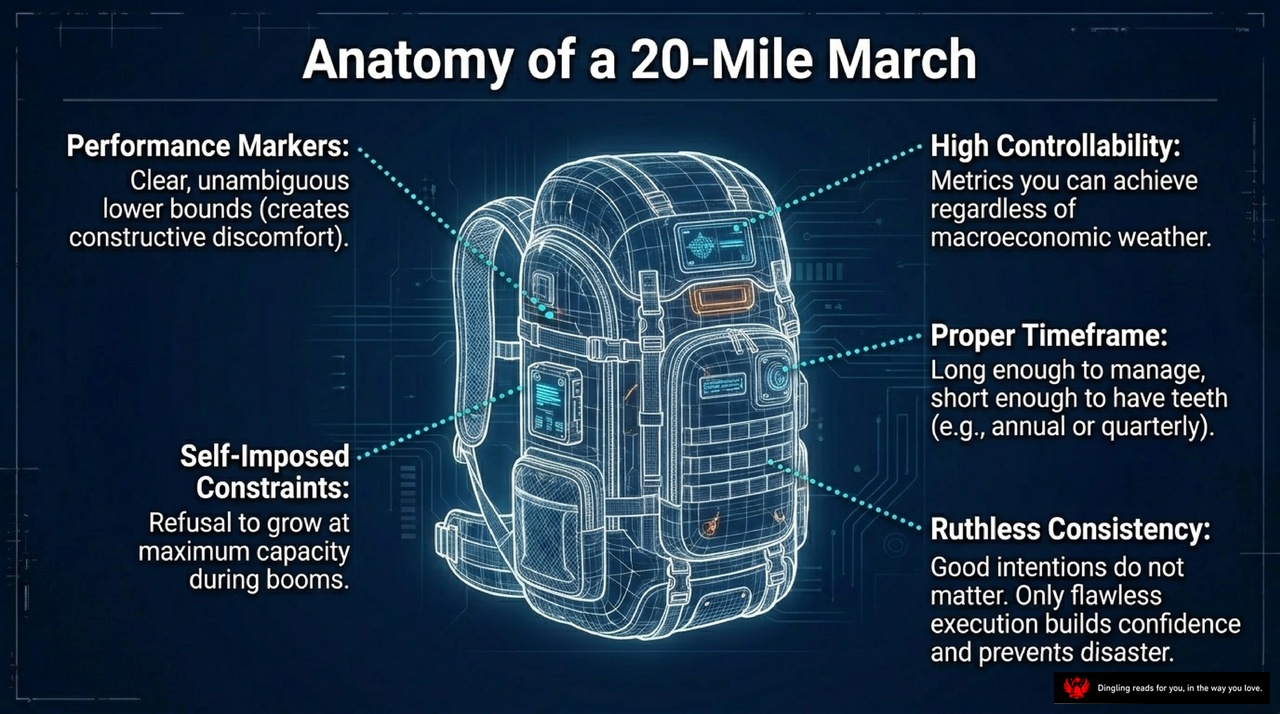
This is the "20-Mile March," and it's the secret to surviving chaos. As we see in our slide, this approach relies on three non-negotiable pillars. First, you need clear performance markers. You must set unambiguous lower bounds for success. Just like the hiker knowing exactly what 20 miles looks like, a company like Stryker sets a hard 20% revenue growth target every year. It's not a vague aspiration; it's a law. If you miss it, you hang a "vent tube" on your wall. This creates constructive discomfort, forcing the organization to stay focused on the essential task no matter what happens outside.
Second, you must embrace self-imposed constraints. This is the hardest part of all. When things are going well, when the economy is booming, the natural urge is to sprint faster and expand aggressively. But the 20-Mile March demands the opposite. You must refuse to grow at maximum capacity during booms. Southwest Airlines, for instance, spent nearly 25 years expanding slowly from Texas to the East Coast, even when over 100 cities begged them to open routes. They resisted the temptation to overextend, preserving their resources for the inevitable downturns.
Finally, this journey requires ruthless consistency. Good intentions don't matter; only flawless execution builds confidence and prevents disaster. The hiker doesn't stop to admire the view or change their route because the scenery looks better elsewhere. They simply keep walking. This consistency creates an unbreakable confidence that comes from daily, tangible achievements. It allows companies to navigate uncertainty not by predicting the future, but by maintaining a steady, controllable rhythm. In a world where everything else is volatile, the ability to control your own pace is the ultimate competitive advantage.
Imagine you are climbing Mount Everest with a team. You are at Camp 3, just 45 miles from the summit. The weather is perfect—sunny skies, calm winds. You could reach the peak in 24 hours. But a legendary mountaineer named Bret Horner looks around and sees something others miss: a massive crowd of climbers is already surging up, and a storm is brewing that will trap anyone who moves too fast. So, he makes the counter-intuitive decision to turn back. He pulls his team back, waits, and later returns when the path is clear. His team succeeds.
Contrast this with Rob Hall's team, who saw only the summit. They rushed forward in the good weather, ignoring the hidden dangers. They got trapped, ran out of oxygen, and tragically lost their lives. This isn't just about luck; it's about perspective.
In the business world, this is the difference between "Zooming Out" and "Zooming In." 10x leaders constantly practice this balance. When a crisis hits, like Intel facing a threat from Motorola's 68000 chip in 1979, they don't panic and react immediately. They first "Zoom Out." They step back to see the big picture: what are our core strengths? What is the market really asking for? They analyze the full landscape to avoid blind spots.
But once they have that clarity, they immediately "Zoom In." They lock onto their goal with laser focus. Intel didn't just analyze; they executed. Within a week, they approved a budget, assembled a 100-person team, and launched a global campaign. They won thousands of design orders, including the crucial IBM PC contract, in just one year.
This dynamic balance prevents two deadly traps. First, it stops you from missing the "Gorilla in the Room"—the obvious risks or opportunities right in front of you because you are too busy staring at your immediate task. Second, it prevents you from moving too fast and burning out before the path is safe.
The lesson is clear: in an uncertain world, you cannot afford to be either too reactive or too stagnant. You must be fluid. Zoom out to perceive the hidden risks and opportunities, then zoom in to execute with discipline. This ability to toggle between a broad, strategic view and a sharp, tactical focus is what allows 10x companies to navigate chaos without getting lost, turning potential disasters into stepping stones for long-term dominance.

Empirical Creativity in Action: The Myth vs. Reality
Today's slide cuts through the noise of modern business storytelling. It challenges the biggest myth we tell ourselves: that 10x companies succeed through massive, visionary leaps of faith. We often romanticize the "cannonball" moment—the idea that Apple's iPod was a blind bet on a future nobody else saw. But the reality, as shown here, is far more disciplined.
Look at the timeline. The iPod wasn't a lucky guess; it was the result of calibrated bullets. First, Bullet 1: acquiring MP3 player software like SoundJam. Then, Bullet 2: launching iTunes for Mac only. Finally, Bullet 3: releasing the iPod itself, also for Mac only. Only after proving demand with these small, low-risk steps did Apple open iTunes and iPod to Windows users, creating that massive, highly profitable ecosystem.
The takeaway is crystal clear: Innovation without empirical discipline is fatal. You can't just fire giant cannons into the dark hoping to hit the target. You must start with small, testable bullets to find the path. True success comes not from predicting the future, but from systematically validating your way there.

Imagine the difference between flying with a single tank of oxygen versus carrying ten. That is the core lesson of "Leading Above the Death Line." Look at the visual in front of you: the "Industry Average" operates with only 10% reserves, a fragile margin that turns into a death trap when the storm hits. In contrast, 10X leaders maintain 100% reserves, often holding three to ten times the cash-to-assets ratio of their peers. This isn't about hoarding wealth; it's about buying the freedom to survive the unexpected.
Consider the 1996 Everest disaster as our real-world case study. David Breashears, leading the IMAX team, made the calculated choice to carry massive oxygen reserves, allowing them to retreat safely when the storm arrived. Meanwhile, Rob Hall's team, operating right on the "death line" with no safety margin, was trapped by the same weather and lost their lives. Preparation before the storm dictates survival.
This metric is the first pillar of 10X leadership. It proves that in a chaotic world, you cannot predict the crash, but you can absolutely prepare for it. By carrying enough fuel to get home even if the engine fails, 10X leaders ensure that when the inevitable turbulence comes, they are the ones still flying.
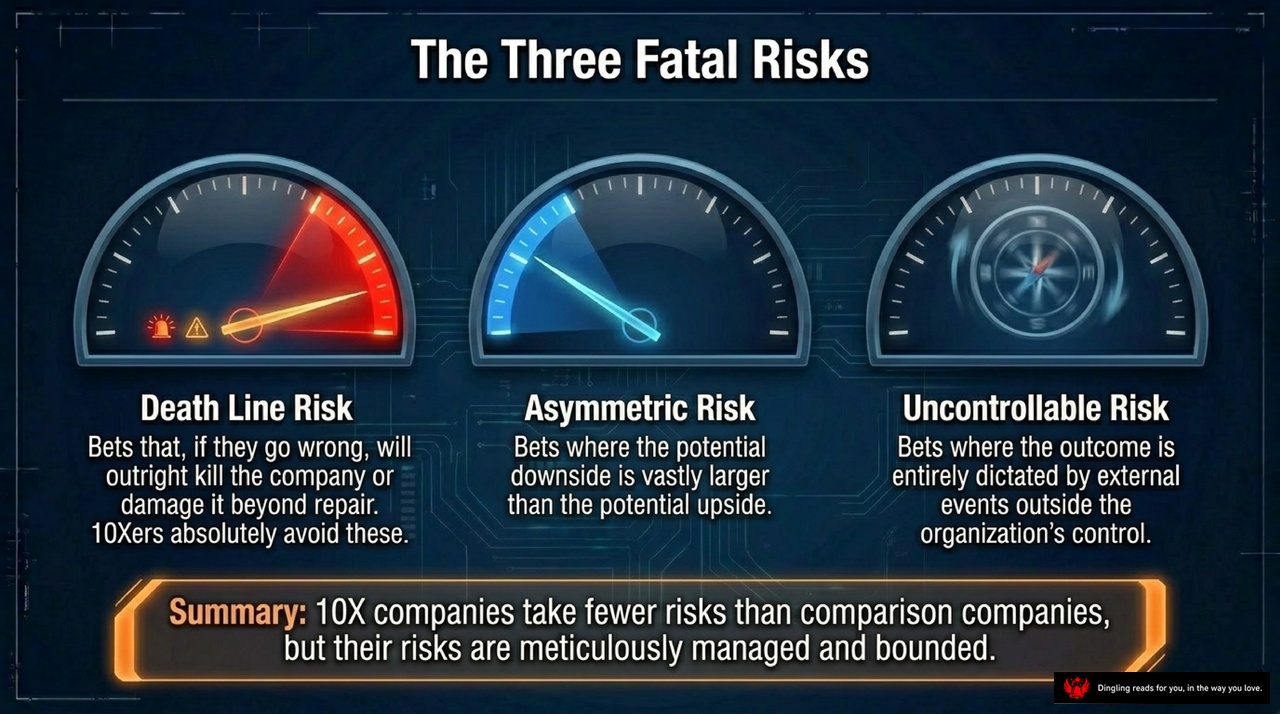
Look at this dashboard titled "The Three Fatal Risks." It highlights the exact pitfalls that kill companies before they can ever reach their potential.
First, we have Death Line Risk. These are bets that, if they go wrong, will outright kill the company or damage it beyond repair. Think of it as walking off a cliff with no parachute. TenXers absolutely avoid these at all costs.
Next is Asymmetric Risk. This happens when the potential downside is vastly larger than the potential upside. It's like buying a lottery ticket where you lose your entire savings if you lose, but only win a small amount if you win. Smart leaders never make these bets.
Finally, there's Uncontrollable Risk. These are bets where the outcome is entirely dictated by external events outside the organization's control. You can't steer the wind, but you can certainly choose not to sail into a hurricane.
The summary at the bottom is crucial: 10X companies take fewer risks than comparison companies, but their risks are meticulously managed and bounded. They don't fear risk; they simply refuse to take the kinds of risks that lead to failure. By staying away from these three fatal traps, they secure the freedom to take the calculated, high-reward bets that actually drive massive growth.
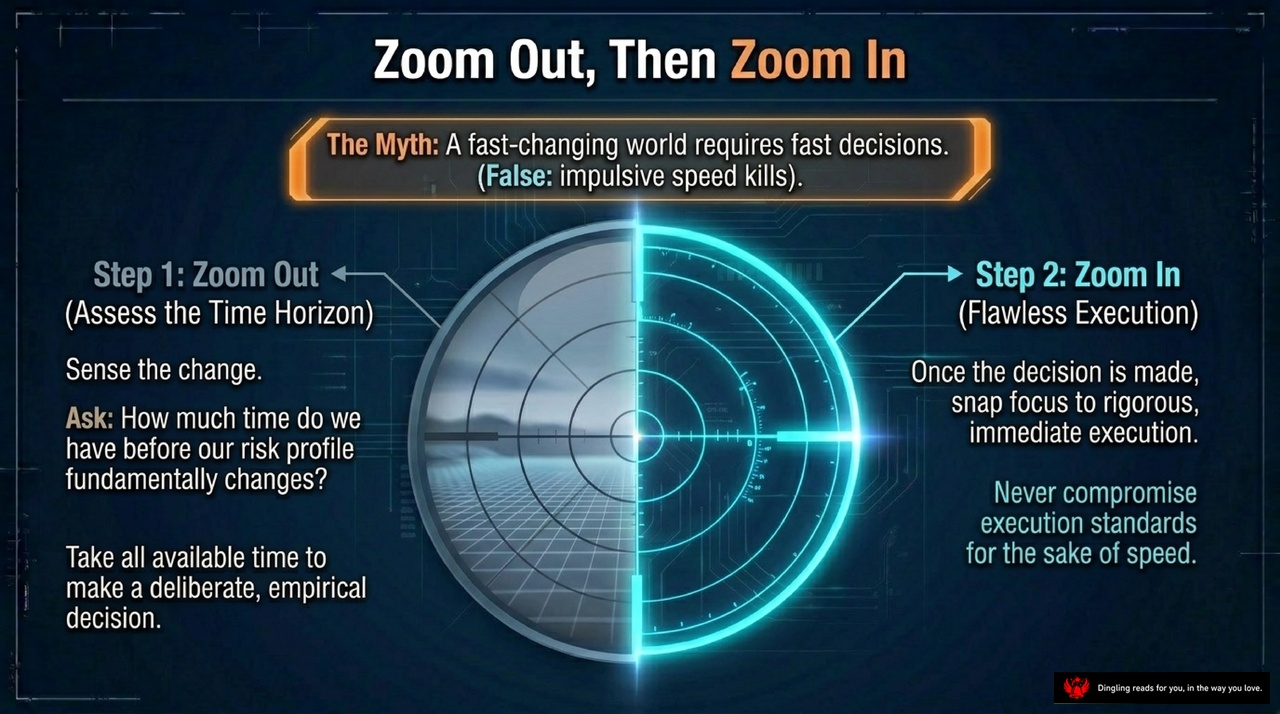
Zoom Out, then Zoom In. The slide reveals a powerful truth that contradicts our instinct: in a fast-changing world, speed isn't the answer; impulsive speed actually kills. The myth that we need to decide instantly is false. Instead, the winning strategy is a two-step dance.
First, we must Zoom Out. This means assessing our time horizon. Ask yourself a critical question: How much time do we have before our risk profile fundamentally changes? By sensing the change and taking all available time to make a deliberate, empirical decision, we avoid the trap of reacting too early. We don't rush; we gather data and understand the landscape.
Once that decision is made, Step Two is to Zoom In. Now, we snap our focus to flawless execution. We move with rigorous, immediate action, but never compromise our execution standards just for the sake of speed. The 10x Company leaders mastered this balance. They knew that while the world is chaotic, their internal discipline must be absolute. By spending time to think clearly before acting, and then acting with precision once the path is set, they turned uncertainty into a reliable engine for growth. It's not about being faster than everyone else; it's about being more deliberate and more disciplined.
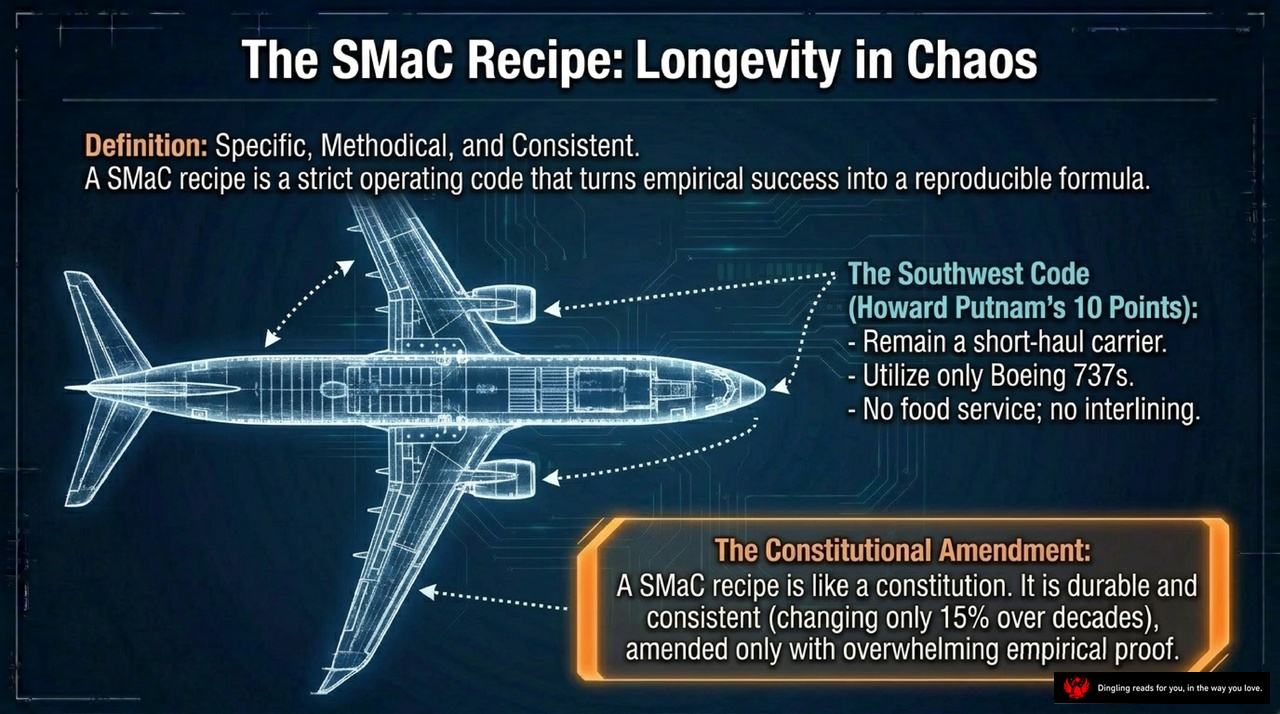
Imagine a world where success isn't about predicting the future, but about mastering a specific formula. Today, we're diving into the "SMaC Recipe"—the secret sauce behind companies that thrive in chaos. SMaC stands for Specific, Methodical, and Consistent. It's not a vague philosophy; it's a strict operating code that turns random success into a repeatable formula. Think of it like a constitution for your business: durable, consistent, and only amended with overwhelming proof.
Look at the blueprint of the airplane in the center. This represents Southwest Airlines, a perfect case study. In the 1970s, founder Howard Putnam codified his vision into "The Southwest Code." It was incredibly specific: remain a short-haul carrier, utilize only Boeing 737s, and eliminate food service and interlining. These weren't suggestions; they were non-negotiable rules. For decades, even through oil crises and the 9/11 attacks, Southwest stuck to this recipe. They changed their operations by only about 15% over decades, refusing to chase every new trend.
Compare this to the fate of competitors who lacked this discipline. When Southwest stayed focused, others like Pacific Southwest Airlines abandoned their core principles, tried to fly massive long-haul planes they weren't built for, and eventually collapsed. The SMaC recipe creates a buffer against chaos. It allows leaders to say "no" to distractions and "yes" only to what matters. It's about finding the calm in the storm by anchoring yourself to a few unshakeable truths. In an unpredictable world, the most powerful move is often to do exactly the same thing, day after day, with absolute consistency.

Look at this quadrant. It maps out a powerful truth about success: the difference between a company that just gets lucky, and one that builds a strategy around luck.
The data on the left is eye-opening. It tells us that 10x companies don't actually get more good luck or less bad luck than average companies. Everyone gets hit by bad luck, and everyone gets a break. The distribution is the same. So, why do some soar while others fall? The answer lies in the right-hand side of this chart: Return on Luck, or ROL.
In the top right, we see "Good Luck with High ROL." This is about seizing the moment. Think of Bill Gates dropping everything to program for the Altair. When opportunity knocks, these leaders don't hesitate; they swing the door open wide and run with it.
But the real magic happens in the bottom right quadrant: "Bad Luck with High ROL." This is where the real work begins. It's about using a disaster to tighten discipline, improve your core operating model, and emerge stronger. Instead of being crushed by the shock, they use it as fuel to rebuild with even more resilience.
The takeaway at the bottom drives it all home: Luck is just an event; it's random and uncontrolled. But Return on Luck is a strategy. It's the deliberate choice of how you respond when the unexpected happens. That's what separates the temporary winners from the true 10x companies.

Look at this blueprint of resilience. This isn't just a cool graphic; it's the operating system for 10x companies. Think of it as a high-performance engine where every gear is essential.
At the very center sits Level 5 Ambition. This is the fuel. It's not about personal fame or wealth; it's about a relentless drive to build something that outlasts the leader themselves. It's the internal compass that keeps the whole machine moving forward, even when the road gets rough.
Surrounding that core are the five critical gears that make it work. First, you have Fanatic Discipline. This is the "20-Mile March." It's the refusal to get distracted by market noise or temporary trends. It's about maintaining a steady, predictable pace—like walking 20 miles every day regardless of the weather. This discipline creates the stability needed to thrive in chaos.
Next, Empirical Creativity. This gear is labeled with the "SMAc Recipe." It stands for Specific, Methodical, and Consistent. It's the difference between guessing and testing. Successful companies don't just launch big bets; they fire low-cost "bullets" to test ideas first, only firing the big "cannonballs" once the data proves the path is clear.
Then there's Productive Paranoia. This connects directly to the "Oxygen Reserves" on the right side of the blueprint. It's about building massive buffers—hoarding cash, preparing for worst-case scenarios, and never getting complacent. As the synthesis at the bottom reminds us, this anxiety builds the oxygen companies need to survive when the storm hits.
Finally, look at the top: High Return on Luck. This is where the "Bullets and Cannonballs" come into play. While luck is random, 10x leaders maximize it. They prepare so well that when good luck strikes, they are ready to seize it instantly. When bad luck hits, their buffers and discipline protect them from being knocked out.
The synthesis at the bottom ties it all together: Discipline enforces the march, creativity tests the bullets, paranoia builds the oxygen, and the SMAc formula locks in the process. Together, they convert chaotic external luck into compounding internal growth. This is how you build an engine that runs forever.

The storm is coming. It cannot be predicted, and it cannot be controlled. Excellence in this environment is never an accident of luck or circumstance. It is the result of fanatic discipline, empirical calibration, and productive paranoia established long before the skies turn dark.
Look at that oxygen gauge in the center. When the storm hits, will your survival be dictated by the elements, or by the disciplines you chose to build today?
Think about it: why do some companies thrive in chaos while others crumble? The answer lies in preparation. True excellence isn't about predicting the future; it's about building a foundation that survives whatever comes. This means cultivating three critical traits. First, fanatical discipline. This isn't just about following rules; it's about maintaining consistency in values, goals, and actions over decades, refusing to be swayed by short-term temptations or market noise.
Second, empirical calibration. Great leaders don't guess; they test. They fire low-cost "bullets" to find the right path before committing all their resources to a big "cannon." They rely on data and evidence, not blind optimism. Third, productive paranoia. This is the ability to stay alert, to assume the worst might happen, and to build buffers—like cash reserves or operational flexibility—so you can weather the crisis without breaking.
In a world full of uncertainty, your safety net isn't luck. It's the deliberate, daily choices you make to prepare for the inevitable storm.