
Great Nation, Great City: Complete Chapter-by-Chapter Summary
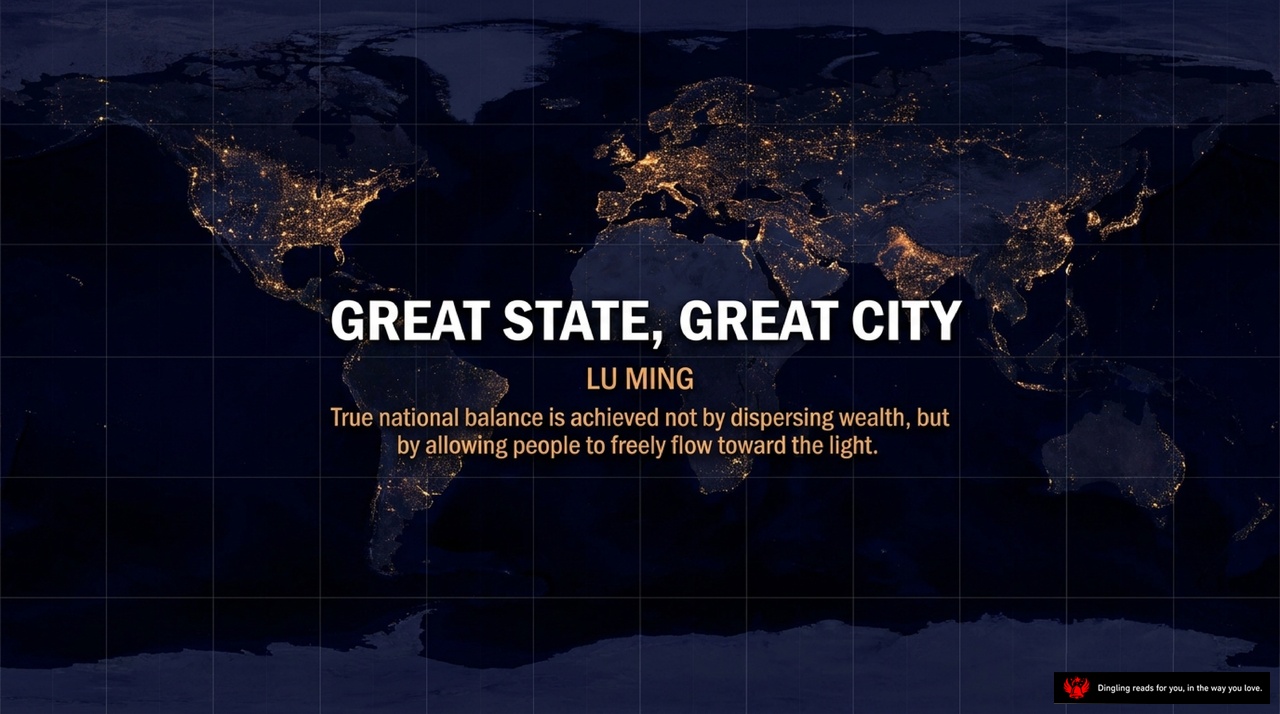
Welcome to today's reading session. We are diving into a powerful concept from Lu Ming's book: "Great State, Great City."
Look at the map behind us, illuminated by the lights of human civilization. This image captures a profound truth: true national balance isn't achieved by forcibly scattering wealth or artificially forcing people into empty regions. Instead, real prosperity comes from allowing people to freely flow toward the light.
As the text reminds us, a great state thrives when it builds great cities. These cities act as engines of growth, attracting talent, innovation, and capital through natural economic forces rather than administrative commands. When individuals can move where opportunities are greatest, the entire nation benefits. This freedom creates a dynamic equilibrium where efficiency and equity coexist, proving that the path to a balanced future lies not in restriction, but in liberation.

The "Impossible Trinity" of a Large Nation isn't just a theoretical concept; it's the daily reality for countries trying to grow without tearing themselves apart. Look at that broken triangle on the screen: National Unity, Economic Efficiency, and Uniform Spatial Balance. For decades, the trap was thinking we could have all three by forcing every region to be exactly the same. We tried to balance the GDP across the map, but the result was a sacrifice of efficiency. When you force resources into the wrong places—like building empty industrial parks in the wrong cities just to make the numbers look pretty—you kill innovation and drag down the whole economy.
The solution, however, is a simple but radical redefinition of what "balance" actually means. True equality isn't about having every region produce the exact same amount of total GDP. That's a recipe for stagnation. Instead, true balance is about equalizing per capita GDP and living standards. Imagine a country where a worker in a booming coastal city earns the same purchasing power as a worker in a developing inland region. How do we get there? Not by forcing people to move to the inland areas, but by letting them move freely to where they are most productive. When labor flows without barriers, the rich regions get the talent they need to grow, and the poorer regions benefit because their people can earn higher wages elsewhere, effectively raising the national average. We stop fighting the natural flow of the market and start building the bridges that let everyone share in the prosperity.
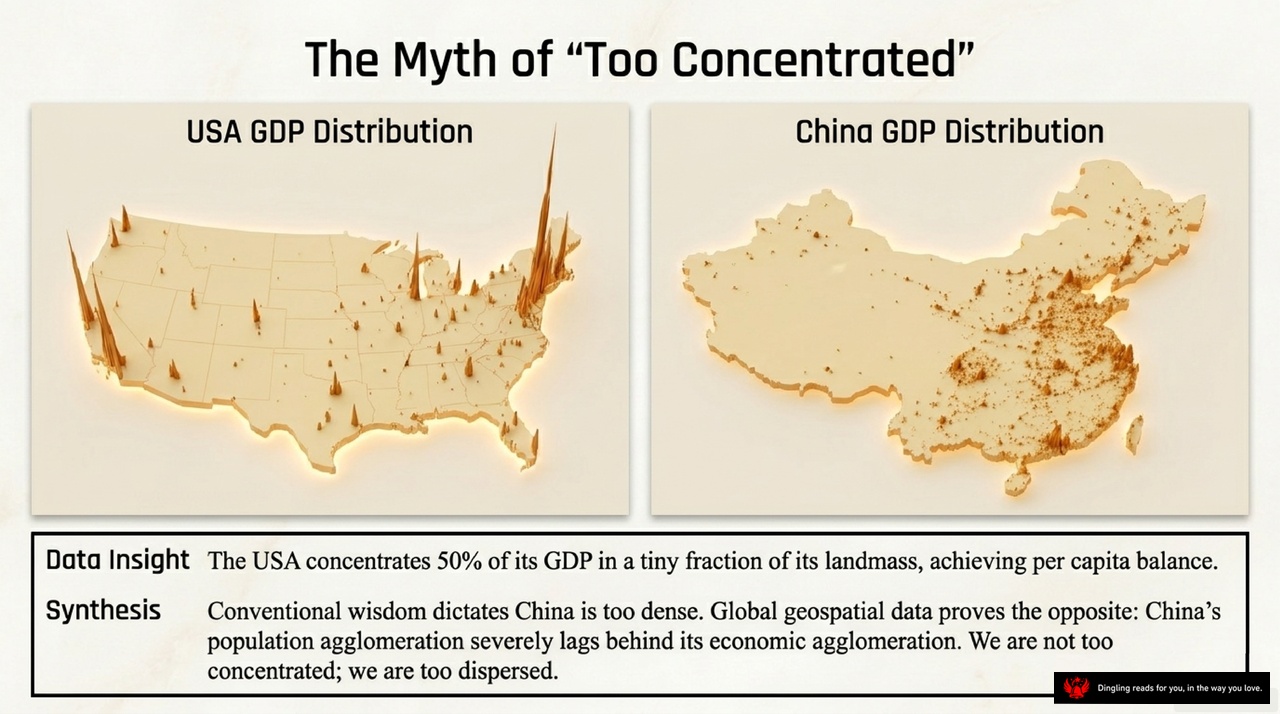
The slide reveals a striking contrast between the US and China. On the left, the US GDP map shows massive spikes concentrated in just a few coastal hubs, yet the data insight confirms that the US concentrates 50% of its GDP in a tiny fraction of its landmass. This isn't chaos; it's a sign of efficiency that achieves per capita balance. Now look at China. Our map shows a seemingly denser spread, which leads to a common myth: that China is "too concentrated." But the synthesis at the bottom flips this narrative entirely. Global geospatial data proves the opposite. While our population is agglomerating, our economic agglomeration is lagging far behind. We aren't too concentrated; we are actually too dispersed. Unlike the US, where economic activity and population align perfectly, China's resources are spread out inefficiently. This disconnect is the root of our structural imbalances. Instead of fearing density, we need to stop dispersing our resources and let the market guide where people and capital truly belong.
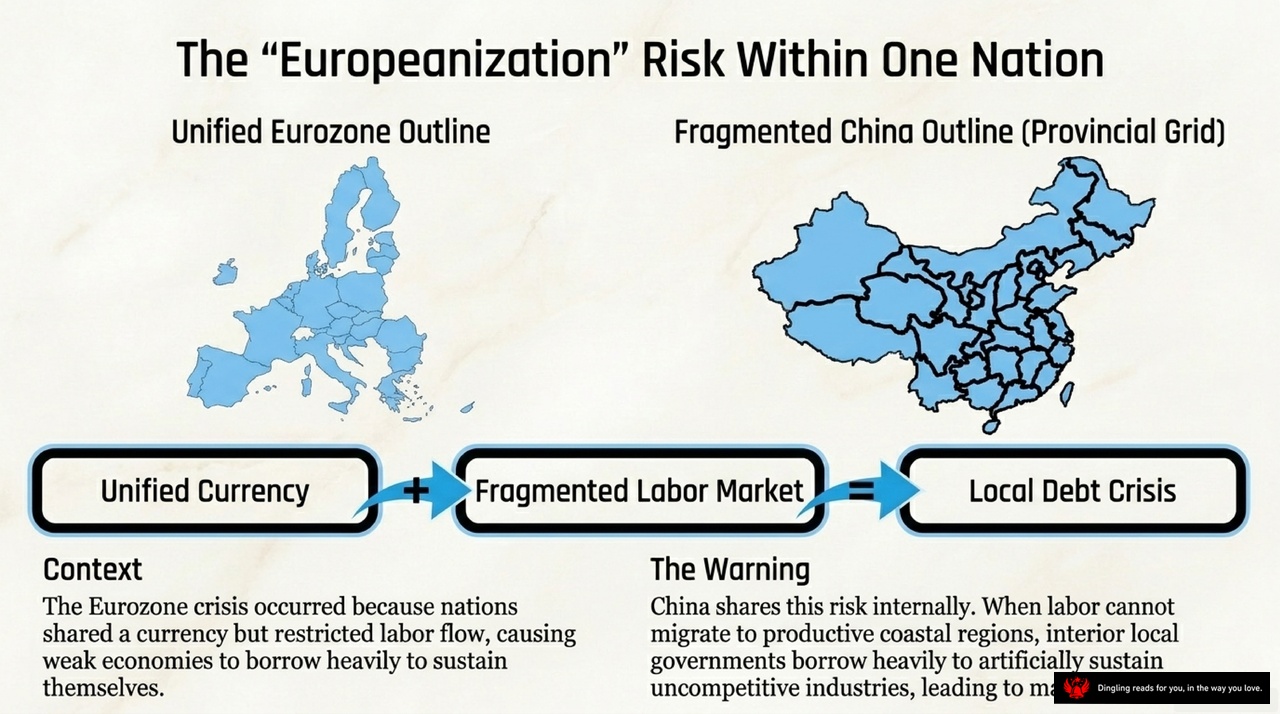
The slide illustrates a critical warning: China is facing an "internal Europeanization" risk. Look at the two maps side by side. On the left, we see the Eurozone—a unified currency area. On the right, we see China, divided by provincial borders. The logic is stark: a unified currency combined with a fragmented labor market inevitably leads to a local debt crisis.
This isn't just a theoretical comparison; it's a mirror of our current reality. The context on the left explains the Eurozone crisis: nations shared a currency but restricted labor flow. When weak economies couldn't adjust or borrow sustainably, the system collapsed. The warning on the right applies this directly to China. When labor cannot migrate freely to productive coastal regions, interior local governments are forced to borrow heavily to artificially sustain uncompetitive industries. This creates the exact same debt trap seen in Europe.
The core issue is that while we have a unified currency and a vast national market, our internal barriers—like the household registration system and land allocation rules—act as invisible walls. These barriers prevent labor from flowing to where it's most needed, forcing inefficient regions to over-leverage themselves just to survive. If we don't break these internal divisions and allow labor to move freely, we risk repeating the Eurozone's mistakes: a unified economy held together by fragile, unsustainable debt. The solution is clear—integrate our market, remove the barriers to mobility, and let the economy find its natural balance.
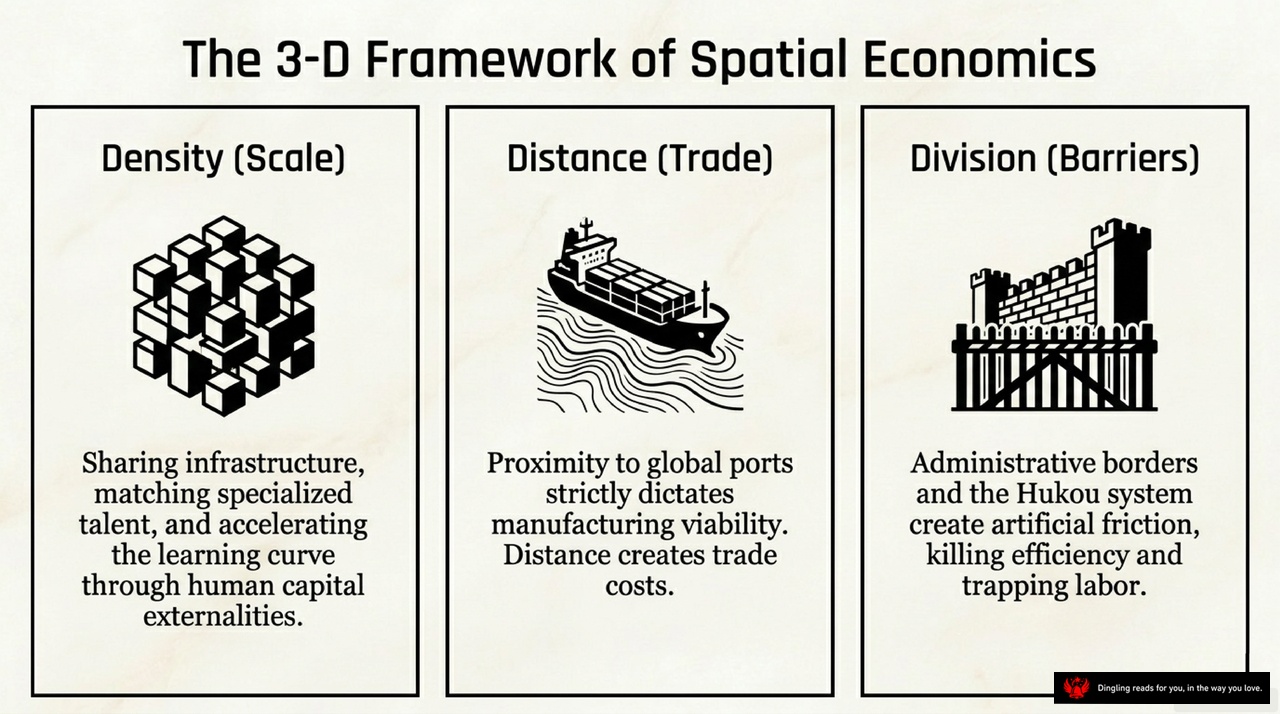
The 3-D Framework of Spatial Economics offers a powerful lens for understanding how nations thrive. Let's break down these three pillars. First, Density, or Scale. As the image shows, it's about sharing infrastructure and matching specialized talent. Think of it as the learning curve accelerating through human capital externalities—when people cluster, they become more productive together. Second, Distance, or Trade. The cargo ship illustrates that proximity to global ports strictly dictates manufacturing viability. Distance creates real trade costs; being close to the market is a massive competitive advantage. Finally, Division, or Barriers. The wall symbolizes administrative borders and systems like the Hukou that create artificial friction. These barriers kill efficiency and trap labor, preventing resources from flowing where they are most needed. To unlock a nation's true potential, we must maximize density, minimize distance, and eliminate division.
Most of us dream of a quiet, secluded life, but the truth is, human beings are wired for connection and noise. In a modern economy driven by industry and services, knowledge spreads through face-to-face interaction. That's why big cities aren't just crowded; they are diverse. This diversity allows for specialized jobs, from niche designers to unique artisans, creating a vibrant ecosystem that smaller towns simply can't match.
Yes, high housing costs and traffic congestion exist, but think of them as the "entry fee" for accessing these incredible resources. People commute to city centers, live in suburbs, or endure long commutes because the trade-off is worth it: they get closer to opportunities and a richer cultural life. Even with the internet, the need for in-person interaction remains strong. As incomes rise, people increasingly value experiences over material goods—attending concerts, joining salons, or exploring local cafes all require the density and cultural infrastructure only big cities can provide.
Contrary to popular belief, restricting small towns doesn't help; in fact, small towns thrive best when they are connected to and supported by major cities. The real danger isn't urban expansion, but the wrong kind of planning. Many cities mistakenly try to replicate a low-density "garden city" with wide roads and large squares. But history shows that high-density, walkable neighborhoods with narrow streets actually foster more diversity and vitality. When cities prioritize wide roads for cars over narrow streets for people, they end up creating "sleeping towns"—places that are empty at night and require long commutes just to buy fresh fruit.
The solution isn't to limit population growth, but to improve governance. We need to manage behaviors, not restrict people. Instead of banning cars, we should manage traffic through pricing and better public transit. Instead of limiting who can live in the city, we should ensure that services and jobs are distributed efficiently so everyone can thrive. Big cities are not the problem; they are the engine of prosperity, provided we plan them wisely to support both high-skilled innovation and the essential low-skilled services that keep them running.

Most of us secretly crave connection and the buzz of a bustling crowd; the idea of an isolated paradise appeals only to a few. In our modern world, where industry and services dominate, knowledge spreads through face-to-face interaction. Even the most introverted office worker needs that human touch to get ideas and build networks. The true magic of big cities lies in their diversity. They hold space for everything from avant-garde art to niche hobbies, creating a rich tapestry of life that smaller towns simply can't match.
This diversity fuels specialization. Designers can focus on unique styles, artisans can perfect their crafts, and businesses can thrive in specific markets, which in turn makes the city even more attractive. Yes, high housing costs and traffic jams are real, but think of them as the "entry fee" for access to these incredible resources. People commute to the suburbs or endure long hours simply to stay close to the opportunities and quality of life found in the center.
Some worry that technology, like the internet, makes physical presence obsolete. But the opposite is true. We still need to meet in person for interviews, business deals, and even casual hangouts. As incomes rise, our desire shifts from owning things to experiencing life—watching plays, attending concerts, or joining salon discussions all require the density and cultural infrastructure only big cities provide. History proves that even when urbanization rates hit 80%, people keep flocking to major hubs. Whether it's New York, Toronto, or Tokyo, knowledge-intensive industries demand that face-to-face exchange, and people are willing to pay a premium for the convenience and vibrant lifestyle that only a big city can offer.

Let's clear up a common misconception about urban living: many people believe that high density automatically destroys the environment. But the reality is quite the opposite. As we see in our diagnostic matrix, high density actually reduces the per-capita carbon footprint. How? Through shared resources and efficient public transit. Think about Tokyo or Manhattan—these are some of the world's most crowded cities, yet they often outperform sprawling suburbs in terms of environmental impact. Why? Because when people live closer together, they rely less on private cars and more on buses, subways, and trains. This concentration allows for better infrastructure efficiency and less waste per person. So, rather than fearing the crowd, smart urban policy should embrace density as a powerful tool for sustainability, proving that a bustling city can be both vibrant and green.

Let's be honest: everyone wants to be part of something bigger. We crave connection, diversity, and the vibrant energy that only a true metropolis can offer. That's why cities like Tokyo, New York, and London continue to draw people in, even when the surrounding countryside is shrinking. It's not about overcrowding; it's about access. In a big city, you get a unique mix of cultures, niche hobbies, and specialized jobs that simply don't exist in smaller towns. A designer can focus on a specific style, a chef can run a tiny restaurant, and a tech startup can find its perfect talent pool. This diversity fuels a specialized division of labor that boosts productivity for everyone.
Of course, high housing costs and traffic jams are real challenges. But let's reframe them. These aren't failures of the city; they are the "entry fee" you pay to access these incredible opportunities and resources. People commute or live further out because they want to be close to their jobs and the cultural life they love. And here's a crucial point: technology hasn't replaced the need for face-to-face interaction. In fact, it's the opposite. We still need to meet in person to build trust, negotiate deals, and share ideas. As income rises, people trade material goods for experiences—concerts, theater, and social gatherings—all of which thrive in dense urban environments.
The fear that cities will choke on their own population is a myth. Look at the data: even when national populations decline, major metropolitan areas keep growing. Why? Because knowledge-based industries rely on the instant exchange of ideas that only density provides. The real lesson from global cities isn't to limit growth, but to manage it. We need to stop trying to create low-density "garden cities" with wide roads and empty plazas. Instead, we should embrace high-density, walkable neighborhoods where life happens on the street. By focusing on efficient transit and mixed-use communities, we can keep our cities vibrant, sustainable, and open to everyone, proving that the future of living is not in the suburbs, but in the heart of the city.
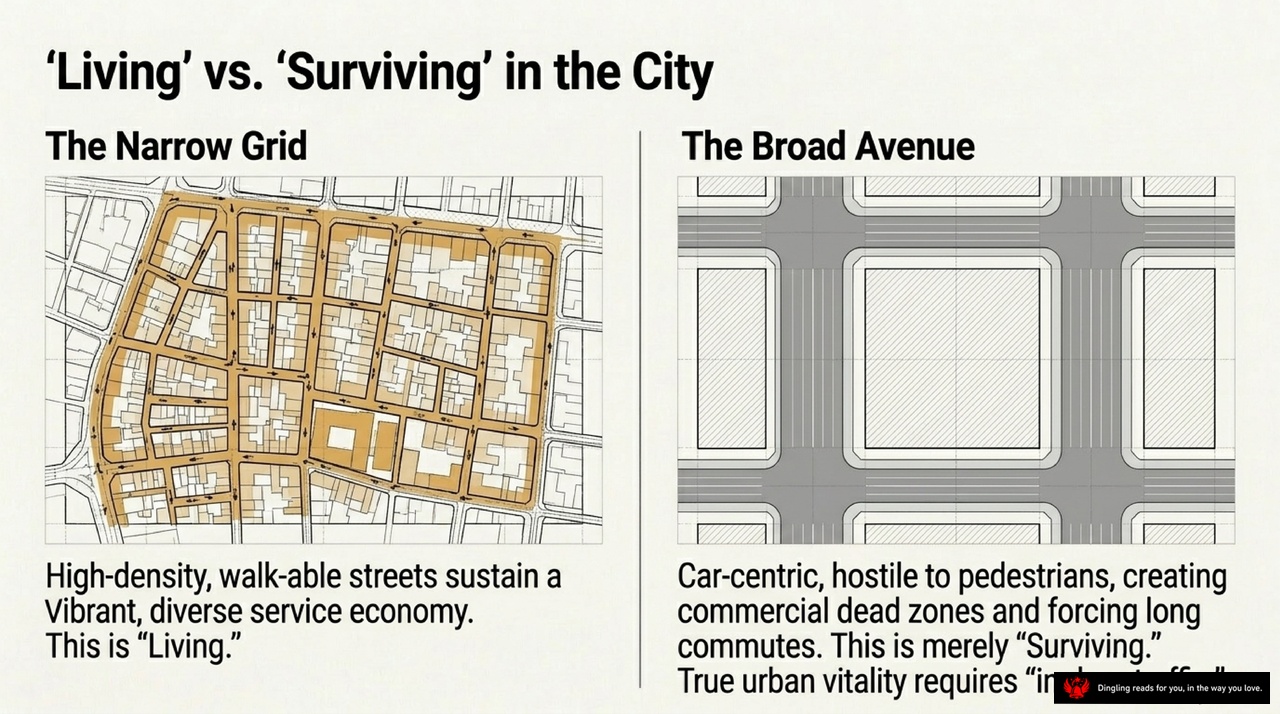
Most of us dream of a bustling city, a place where life happens, not just a place where we merely survive. But how do we actually design our cities to make that dream a reality? The answer lies in the difference between a narrow grid and a broad avenue.
Look at the first map: the narrow grid. This high-density, walkable layout sustains a vibrant, diverse service economy. It's about connection. When streets are narrow and dense, they naturally support local businesses, from corner cafes to boutique shops, creating a rich tapestry of life. This is what it truly means to "live" in a city.
Now, contrast that with the second map: the broad avenue. This car-centric design prioritizes speed over people, creating commercial dead zones and forcing long, exhausting commutes. When we design cities around cars, we become hostile to pedestrians. We stop walking, we stop interacting, and we stop discovering. This isn't living; it's merely surviving.
True urban vitality requires an "in-between" space—a human scale where people can move freely on foot. We need to stop treating our cities like highways and start treating them like living rooms. Because in the end, a city's greatest asset isn't its speed; it's its ability to connect us.
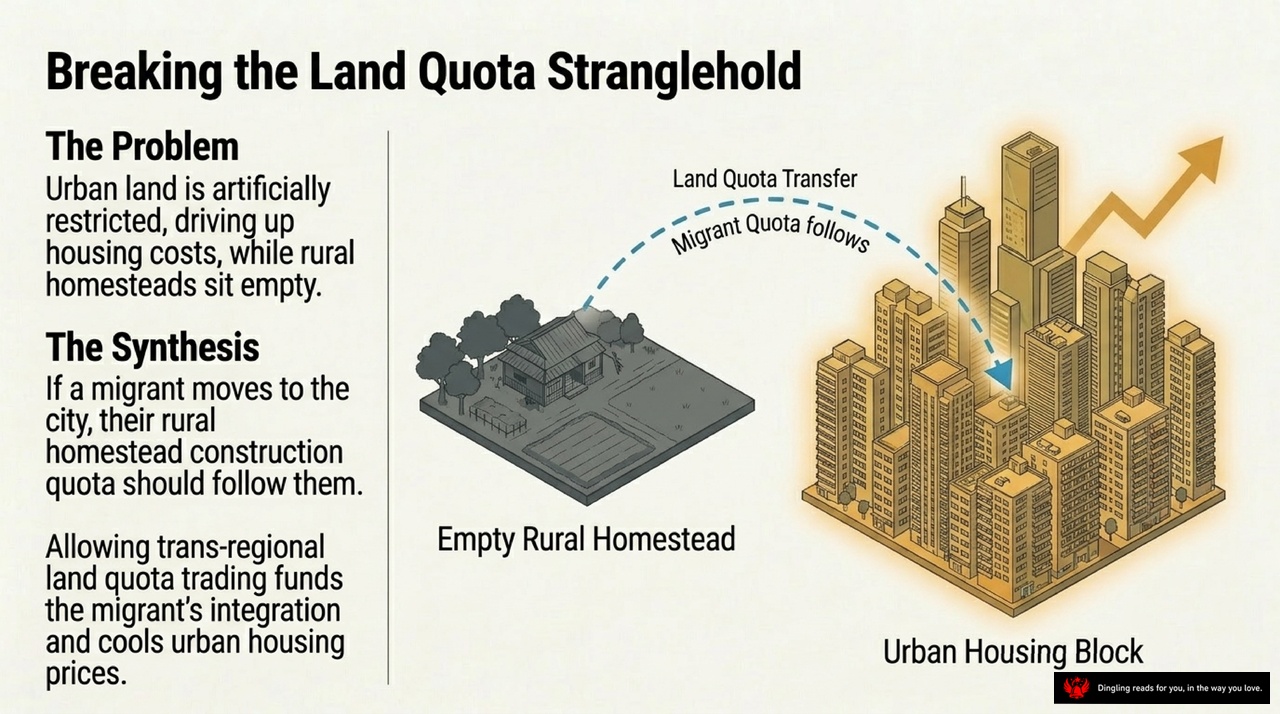
Breaking the Land Quota Stranglehold is all about unlocking a system that's currently holding our economy back. As the slide illustrates, we have a classic mismatch: urban land is artificially restricted, driving housing costs sky-high, while rural homesteads sit completely empty. The solution? Allow land quota transfers to follow migrants.
Imagine this: if a migrant moves to the city, their rural homestead construction quota should move with them. This isn't just about moving boxes; it's about creating a market. By allowing trans-regional land quota trading, we solve two problems at once. First, we fund the migrant's integration into the city, giving them the capital to settle down. Second, we cool urban housing prices by releasing the pent-up demand for land from the countryside.
The visual on the right shows the result: as quotas flow from the "Empty Rural Homestead" to the "Urban Housing Block," the city can actually build more homes, lowering costs, while the rural areas can finally utilize their idle land. This simple shift from administrative control to market logic breaks the stranglehold on land supply, making housing affordable again and allowing the country's resources to work for everyone, not just a few.

Imagine a city as a living patient. When it suffers from "disease"—like choking traffic or choking smog—do we treat the symptom by killing the patient? That is the false cure. The slide you see right now makes this terrifyingly clear. Look at those red "Traffic Choke Points" and "Smog Clouds." These aren't random accidents; they are the result of poor urban design and a fundamental misunderstanding of how cities work.
The diagnosis here is simple but often ignored: administrative population caps do not solve traffic. You cannot fix a congested system by simply banning people from entering. The real problem is poor urban design and a lack of better transit options. The prescription, therefore, is not to close schools to migrant children or restrict who can live here. The solution lies in building better transit, narrowing streets to prioritize people over cars, and implementing pricing mechanisms like congestion charges to manage demand.
Finally, we must follow the golden rule: target the behavior, not the person. We need to regulate driving and polluting, not the individuals migrating in search of opportunity. By punishing the wrong thing, we are not curing the city; we are merely suffocating it. True healing comes from smarter design and fairer rules, not from cutting off the lifeblood of the urban ecosystem.

Think about this: in an empty town, you can build roads, bridges, and skyscrapers. You can pour concrete until the ground shakes. But without people, that concrete is just expensive decoration. It's a static asset that sits there, useless and immobile.
The slide highlights a critical distinction. On one side, we have physical infrastructure in these empty towns. It's the traditional way we think about development—building places. But on the other side, highlighted in gold, is the real game-changer: Human Capital. This includes education and the quality of our teachers.
Why does this matter? Because unlike a bridge or a factory, human capital moves. An educated individual can leave a struggling region, succeed in a global market, and then send money and knowledge back home. They become a living bridge between the past and the future.
The takeaway is clear. To truly help underdeveloped regions, we must stop obsessing over building places and start investing in people. Education is the ultimate infrastructure because it is the only kind that travels.
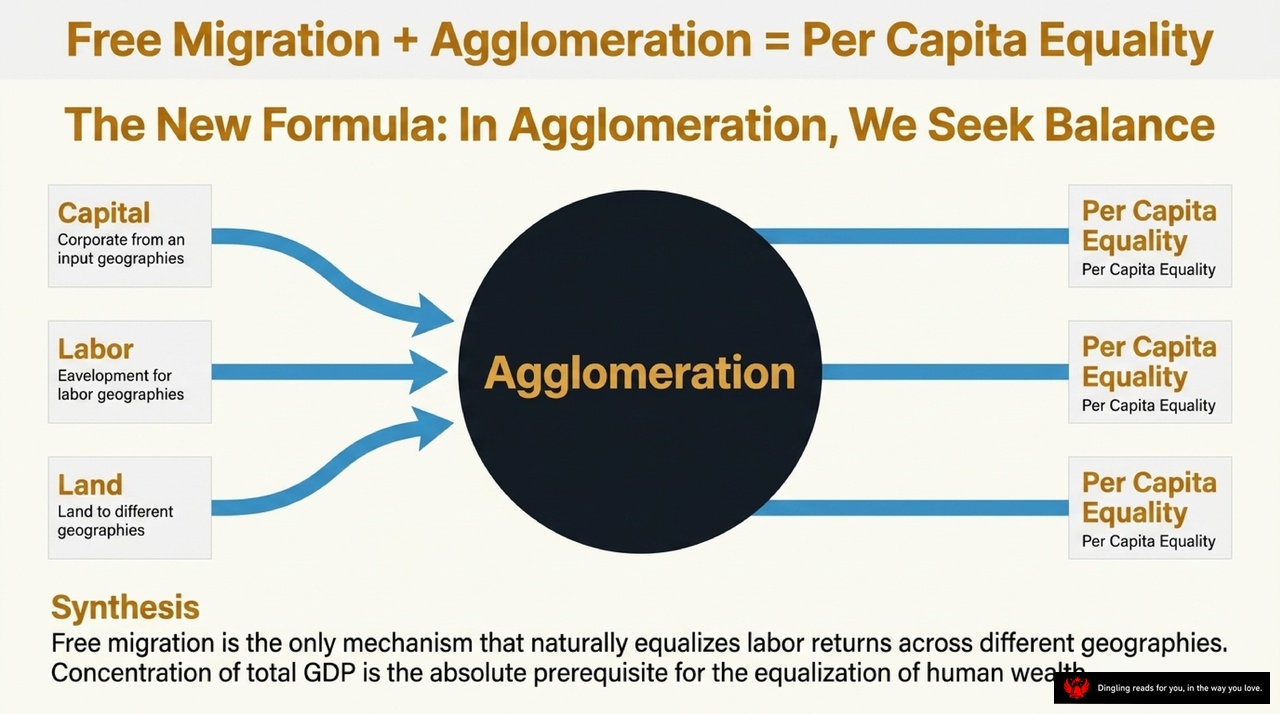
Free migration plus agglomeration equals per capita equality. This is the new formula for modern development: in agglomeration, we seek balance.
Look at this diagram. On the left, we have three key inputs flowing into the center: Capital, Labor, and Land. Capital moves from its original geography to where it's needed. Labor migrates to where job opportunities are highest. Land is allocated to different geographies based on demand. All these flows converge in the central hub of Agglomeration.
And what comes out on the right? Per Capita Equality. When people, money, and resources move freely, they naturally equalize returns across different regions. Free migration is the only mechanism that naturally balances labor returns. Concentrating total GDP in efficient hubs isn't about creating inequality; it's the absolute prerequisite for equalizing human wealth everywhere.
The lesson is clear: true balance isn't about spreading resources evenly across empty spaces. It's about letting people move to where they create the most value, ensuring everyone enjoys the same standard of living regardless of where they live.

Look at this bustling cityscape. The streaks of light from the cars tell us one thing: life in a great nation depends on the free, unstoppable flow of its people. When we try to restrict our megacities, we don't cure urban diseases; we merely suffocate the engines of our shared prosperity and deepen social divides.
So, here's the hard question we all need to ask: If the pursuit of a better life is a universal human right, why do we continue to build cities that welcome a migrant's labor but refuse their future?
Think about it. When people are blocked from moving to where the jobs and opportunities are, the result isn't a balanced society. It's a broken system. We end up with overcrowded, expensive cities that can't afford to keep everyone, and we leave behind vast regions where resources go to waste because no one wants to live there. This isn't just about fairness; it's about efficiency.
Real balance doesn't come from forcing people to stay in small towns or artificially spreading out the population. True balance happens when people are free to move. When a worker can choose to live in a city where their skills are most needed and where their family can thrive, resources flow to where they create the most value. This natural migration equalizes income and living standards across the country.
We see this pattern everywhere in the developed world. Tokyo, New York, London—they all have massive populations, yet they aren't failing. Why? Because they have integrated systems that allow people to move freely, access services, and find housing. They treat the city as a single, shared space, not a collection of walled-off zones.
In contrast, when we build barriers—whether through housing restrictions, unequal access to education, or fragmented social security—we create a "city within a city." The wealthy stay in the center, while the working class is pushed to the margins, unable to afford the very life they helped build. This segregation kills innovation and stifles growth. It turns a potential engine of prosperity into a source of conflict.
The solution isn't to stop people from coming to the big cities. It's to make sure that once they arrive, they can truly belong. This means reforming our land and housing markets so that affordable homes aren't a luxury. It means extending public services like healthcare and education to everyone, regardless of where they came from. It means recognizing that a diverse, mobile workforce is the greatest asset a nation has.
When we finally stop treating migrants as a burden and start treating them as the backbone of our economy, something incredible happens. The cities become more vibrant, the regions become more connected, and the whole nation grows stronger. We stop building walls and start building bridges. We stop asking "why are they here?" and start asking "how can we help them thrive?"
That is the path to a truly great nation. That is the future we must choose.