
Grit: Complete Chapter-by-Chapter Summary

Welcome to our deep dive into *Grit* by Angela Duckworth. Imagine a vintage brass compass set against a blueprint background, symbolizing the precise navigation needed to achieve lifelong success. This isn't just about finding direction; it's about understanding the true map of human potential. Today's slide introduces our core theme: dismantling the myth of talent and cultivating the psychological assets that drive real achievement.
Duckworth argues that what we often call "talent" is actually just our potential to get better at something when we practice. True success comes from multiplying that skill by our effort. In her groundbreaking research at West Point, she discovered that the difference between those who dropped out and those who graduated wasn't their SAT scores or athletic ability—it was their grit. It's a navigator's blueprint for understanding that while talent gets you in the door, only sustained passion and perseverance keep you moving forward. This book is your guide to unlocking that inner compass and steering your life toward lasting accomplishment.

The slide we see here perfectly captures the harsh reality behind the "illusion of talent." It illustrates the brutal funnel of West Point's admissions and the "Beast Barracks." We start with 14,000 applicants who are meticulously filtered by what we traditionally call talent: SAT scores, physical fitness, and high school rank. Only 1,200 make it through. But here is the critical insight: once those 1,200 enter the grueling seven-week Beast Barracks, their previous metrics—like their SAT scores or athletic ability—become completely irrelevant. The data shows that talent, or what West Point calls the Whole Candidate Score, has zero correlation to survival in this training. What actually predicts who becomes "The Survivor" is not being smart or fit, but possessing a specific quality: Grit. While the admissions process perfected the science of identifying potential, it failed miserably at predicting who would actually fulfill that potential. The lesson is clear: relying on the illusion of talent is dangerous. True success isn't about how smart you are at the starting line; it's about your ability to endure the pain and keep moving forward when everything tries to stop you.

Today's slide contrasts two very different ways of thinking about success: the "Talent Mindset," often called the Enron Model, versus the "Grit Mindset," exemplified by the Seattle Seahawks. Let's break down why this distinction matters so much.
On the left, we see the Fragile Perfects of the Talent Mindset. These individuals crumble at the first sign of failure because they view it as a permanent lack of inherent ability. Their goals are short-term, focused only on appearing smart through a "Rank-and-Yank" system. The result? Early burnout, ethical shortcuts, and eventual stagnation. This is the trap of believing success is about being born smart.
On the right, we see the Gritty Competitors of the Seahawks Model. Here, failure is not a dead end but necessary friction for growth. They analyze mistakes and learn from them. Their goal setting is long-term, focused on continuous evolution and, most importantly, "finishing strong." This leads to sustainable excellence, deep resilience, and high achievement.
The core message is clear: we must cultivate a culture of perseverance over a culture of innate genius. It's not about who is the smartest at the start, but who is willing to keep going when things get hard. As the Seahawks proved, it's the grit that wins championships, not just the talent.

So, here is the reality check that often gets lost in our conversation about success: talent is just the speed at which you improve. It doesn't guarantee the finish line. Look at the formula on the screen. It shows a "double-multiplier effect" of effort. First, effort multiplied by talent builds your skill. That's the foundation. But effort isn't done there. That same effort, now multiplied by your newly built skill, drives your actual achievement. In other words, effort counts twice. It builds the capability, and then it makes that capability productive.
Consider John Irving, who had an SAT verbal score of 475—far below average. Yet, through endless rewriting and a refusal to quit, he produced National Book Award-winning literature. His story proves that while talent is merely the rate of your growth, it is your relentless application of effort that turns potential into a legacy. As the slide reminds us, talent is only the speed; effort is the engine that keeps you moving toward your goal, no matter how slow the start.

True grit isn't about being stubborn in the face of every obstacle; it's about having a clear compass that guides your actions. Think of your life as a pyramid. At the very top sits "The Compass"—your ultimate concern, the singular philosophy that unifies everything you do. It's not a fleeting firework of passion, but a carefully calibrated direction. Below that are your mid-level goals: the strategic projects and milestones that move you forward. And at the base, you have low-level goals: the daily tasks and flexible tactics. Here is the crucial part: these tactics must be like an erasable eraser. If a specific strategy isn't working, you have the flexibility to change or delete it without losing sight of the ultimate goal. True grit requires macro-stubbornness regarding where you are going, combined with micro-flexibility on how you get there. Without that top-down focus, your daily efforts are just drifting. But with a clear ultimate goal anchoring you, you can adapt your tactics freely, knowing every change is a step toward your true destination.

Welcome back. Today, we're diving into the final piece of the puzzle: the environment. We've talked about internal drives like interest and purpose, but let's be honest—no one builds a ship in a vacuum. Your success is heavily influenced by the culture you swim in.
Look at this compass in the center of our slide. It highlights four internal assets: Hope, Interest, Purpose, and Practice. But notice the arrows circling around them. This visual tells us something critical: these assets don't just exist in isolation; they are shaped by the world around us. The text at the bottom reminds us that these aren't innate gifts we're born with; they are sequentially developed from the inside out over a lifetime, and that development happens in specific environments.
Think about the "LOB culture" at the San Francisco 49ers. It stands for "Love Our Brothers." Here, the environment isn't just a backdrop; it's an active force. When a player hears the chant "No whining, no complaining, no excuses," it stops being just a slogan and becomes a personal identity. It shifts the question from "What do I want to do?" to "What does a person like me do?" This is the power of cultural shaping.
Consider the story of Tom Dierks, a Marine who was shot in the leg. Doctors said he might never walk again. Yet, he ran a marathon in under two hours. Why? Not because he was the strongest physically, but because his identity was fused with his unit's culture. He wasn't just a runner; he was someone who didn't quit. The team's values became his values.
Similarly, look at Finland and their concept of "Sisu." It's a deep, gritty resilience born from centuries of survival. But it's not magic. Studies show that 83% of Finns believe Sisu can be learned through practice and community engagement. It proves that even a national trait is built on shared experiences and environmental reinforcement.
So, what does this mean for you? If you want to build these four assets—Hope, Interest, Purpose, and Practice—you need to choose your circles wisely. Surround yourself with people who value grit. Join a team that celebrates long-term effort over quick wins. As the slide implies, you become who you spend time with. By immersing yourself in an environment that demands and rewards persistence, you turn "grit" from a struggle into a habit. That is how you build a future that lasts.

Interest isn't something you stumble upon by accident; it's a skill you build through repetition. As the slide illustrates, this journey follows a clear path from the Initial Encounter to the Expert Phase. It starts at Point A, where an interest is barely noticeable, often mistaken for simple curiosity. But true passion doesn't ignite instantly; it requires the nurturing of Point B, the Novice Phase. This is where unpressured exploration, small wins, and supportive mentors become essential. Without these, that initial spark fades. Eventually, you reach Point C, the Expert Phase. Here, the brain craves novelty, and you find it in the subtle nuances and microscopic differences of your field, effectively preventing boredom. The key insight here is vital: following your passion is terrible advice if you haven't first put in the years required to actively cultivate it. You must water that seed before you expect it to grow into a tree.

So, here is the reality of becoming a champion: it requires two distinct, yet connected, forces. Look at the slide. On the left, we have "Deliberate Practice," and on the right, we have "Flow."
Think of Deliberate Practice as the grueling work behind the scenes. It's about targeting your specific weaknesses, operating from a place of conscious incompetence, and pushing your boundaries until it hurts. It is painful, highly effortful, and often frustrating. You are solving problems and forcing yourself to grow outside your comfort zone.
But look at the arrow pointing to the right. That is where the magic happens. When you master that difficult practice, you unlock "Flow." Flow is the ecstasy of execution. It is effortless, ecstatic, and you lose track of time. In this state, you are matching your peak skill to a peak challenge, executing the mastery you built through all that hard work.
The takeaway is clear: gritty individuals do more deliberate practice to build skill. That hard, painful work is the foundation. It is what allows them to experience more flow during their actual performance. You cannot have the ecstasy of flow without first enduring the agony of practice.

Transforming labor into a calling through other-centered purpose. Look at this pyramid: it illustrates the three tiers of work, moving from the bottom up. At Tier 1, we have the "Job." Here, the mindset is purely transactional. The thought is simply, "I am laying bricks." The motivation is survival, money, or just getting through the day. It's about the task itself, not the impact.
Move up to Tier 2, the "Career." Now the perspective shifts slightly. The internal monologue becomes, "I am building a church." The motivation here is advancement and progression. You care about your title, your promotion, and your personal growth. You are still focused on yourself, but you are starting to engage with a larger structure.
But at the very top, we reach Tier 3: the "Calling." This is where true transformation happens. The thought changes to, "I am building the house of God." The motivation is no longer about you; it's about a deep connection to the well-being of others. It's an intention to contribute to the greater good.
As the text on the right explains, purpose is defined by this intention to serve others. And here is the powerful takeaway: even a sanitation worker or a bricklayer can operate from a "calling" if their personal interest intersects with a macro-purpose. It doesn't matter what your job title is. What matters is the lens through which you view your work. When you align your daily tasks with a higher purpose that benefits others, ordinary labor becomes a calling. It's the difference between just doing a job and dedicating your life to something that matters.

So, let's talk about the "Fall 7, Rise 8" principle. It's a simple but powerful idea: resilience isn't about never falling down; it's about defining success as your willingness to rewrite the story when things go wrong. Look at this flowchart. It all starts with Step 1: a setback occurs. Life throws you a curveball, and that's inevitable. But here's where most people fail. They get stuck in the trap of the "Fragile Perfect" syndrome. If you've never faced failure, you literally lack the neuro-circuitry to recover later because you've never practiced the cognitive loop of recovery.
That's why we need Step 2: Analysis. This is where the magic happens. Instead of spiraling into self-doubt, you adopt an Optimistic Explanatory Style. You interpret the setback with grit: "This is a temporary, specific problem I can solve." You realize the failure isn't a permanent reflection of your worth, just a hurdle. From there, you move to Step 3: Adaptation. You adjust your strategy, learn from the mistake, and prepare for the next attempt. Finally, you reach Step 4: Execution. You take action again, stronger and smarter than before.
The core message here is that resilience is a muscle you build through this cycle. Every time you fall seven times and rise eight, you are rewiring your brain to handle future adversity. It's not about avoiding the fall; it's about mastering the rise.
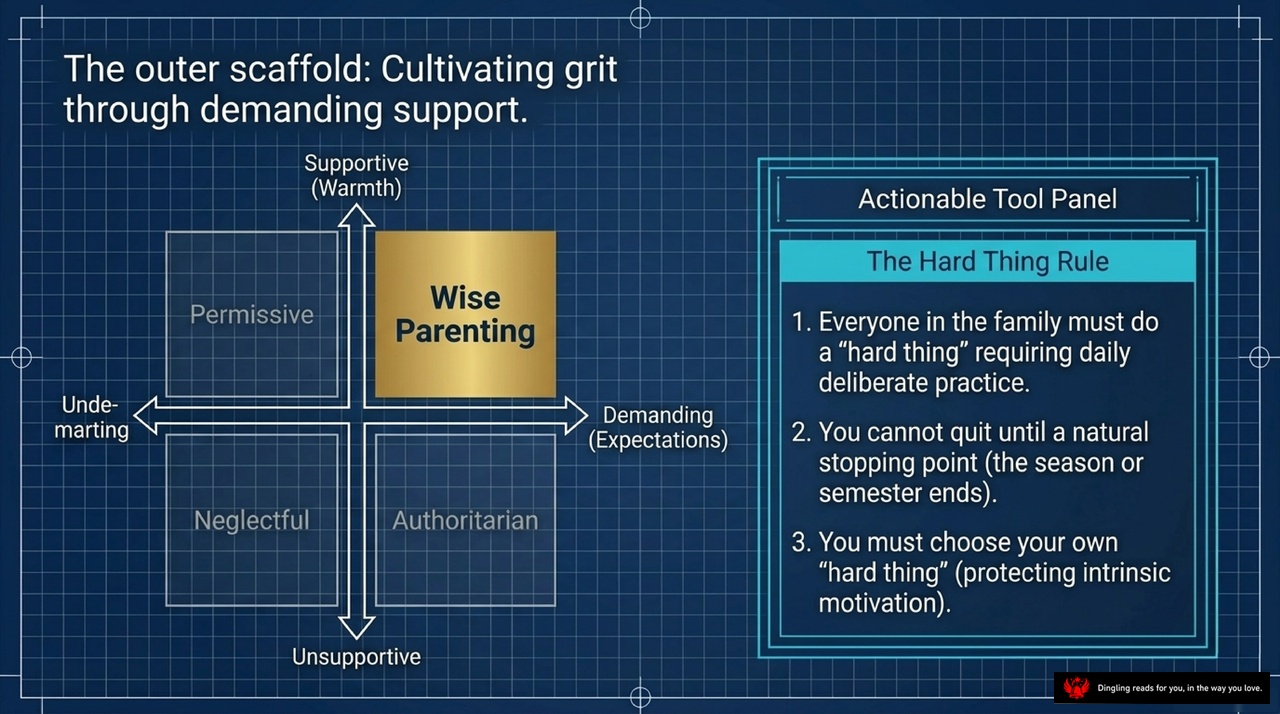
The outer scaffold for building grit is all about demanding support. As we see on this slide, wise parenting sits right at the intersection of warmth and high expectations. It's the sweet spot where you show your kids you care, but you also refuse to let them off the hook.
This brings us to a powerful concept from the book called "The Hard Thing Rule." Think of it as a family agreement. First, everyone in the household must pick a challenge that requires daily, deliberate practice. It doesn't have to be something difficult like learning an instrument or a sport; it could be something as simple as making your bed or managing your time. The key is that it's a "hard thing" that needs consistent effort.
Second, and this is crucial, you cannot quit until a natural stopping point arrives. If you're learning a new skill for the semester, you stick with it until the semester ends. If it's a season of sports, you ride it out until the season is over. This teaches children that quitting is a choice they make, not something they do when things get tough.
Finally, you must choose your own hard thing. This protects their intrinsic motivation. Instead of you forcing them to do something you think is good, they own the commitment. When a child chooses the struggle, they are much more likely to stick with it.
The contrast is clear when you look at the other quadrants. Permissive parenting lacks the necessary demands, while authoritarian parenting lacks the warmth. But wise parenting combines both, creating an environment where grit can actually grow. It's not about being tough on them; it's about giving them the tools and the expectation that they can handle life's challenges.
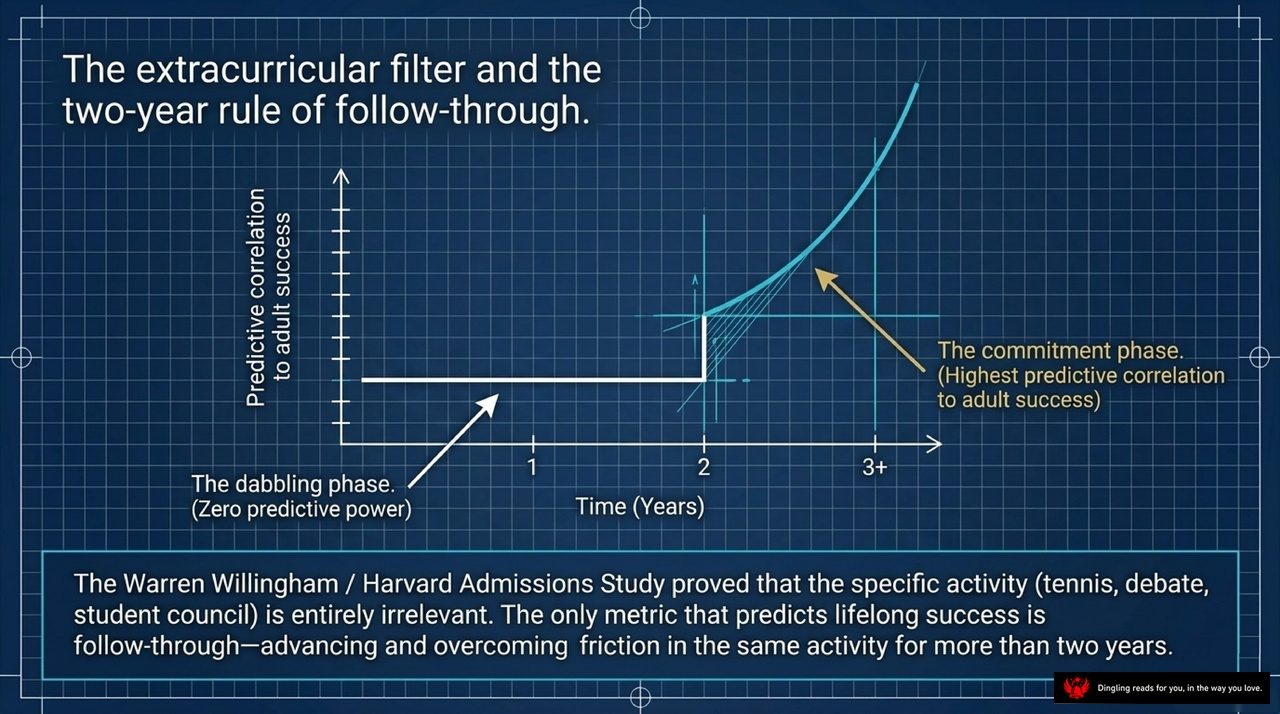
Look at this graph. It tells a simple but powerful story about what actually predicts success in adulthood. The key isn't the specific activity—whether it's tennis, debate, or student council—but the time you stay in it.
The first two years are what we call the "dabbling phase." Here, your predictive power is zero. Just showing up isn't enough. But once you cross that two-year mark, something shifts dramatically. You enter the "commitment phase." This is where the curve takes off. The longer you stick with it—three years, four years, and beyond—the higher your predictive correlation to adult success becomes.
This is the "two-year rule of follow-through." A landmark study by Warren Willingham and Harvard Admissions proved that talent or the specific activity itself is irrelevant. The only metric that truly predicts lifelong success is follow-through: advancing and overcoming friction in the same activity for more than two years. So, don't just start new things every season. Find one thing, commit to it, and push through the friction for at least two years. That's the real filter.
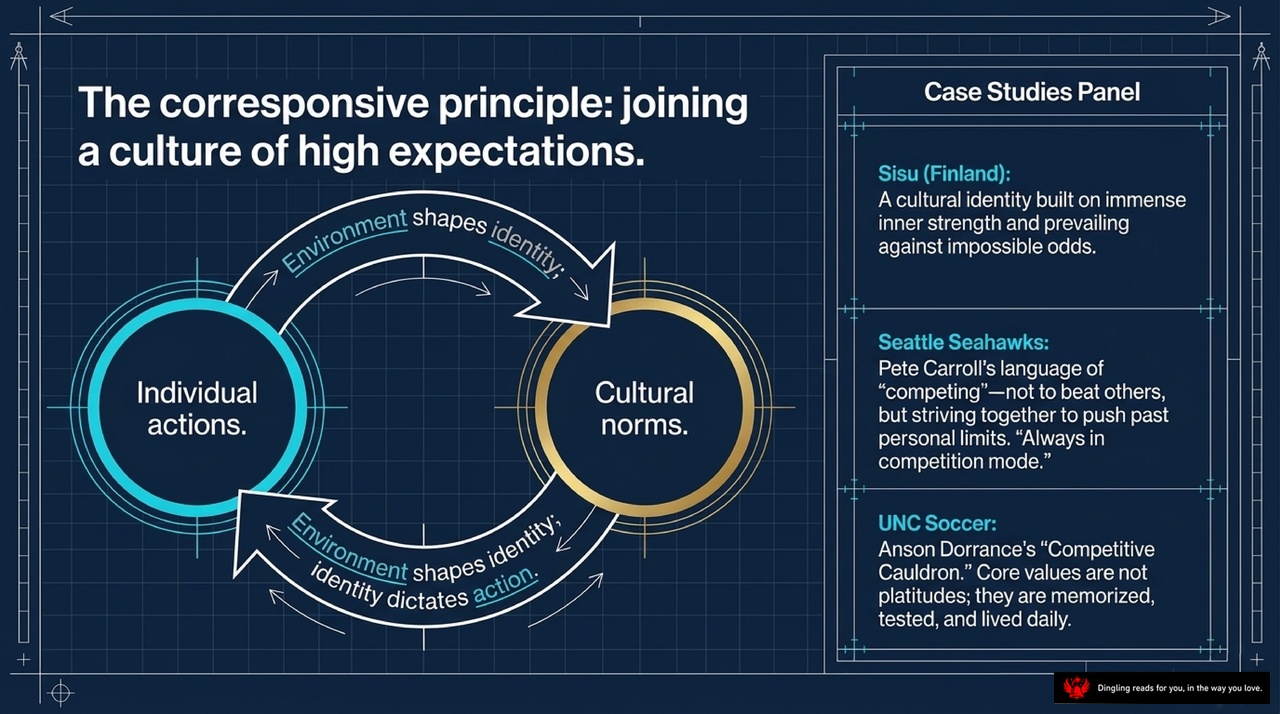
The corresponsive principle at work here is a powerful feedback loop: our environment shapes who we become, and that identity, in turn, dictates our actions. Look at the diagram: it's a cycle where individual actions and cultural norms constantly reinforce each other. When you join a culture of high expectations, that environment molds your identity, pushing you to act in ways that align with those elevated standards.
Let's look at the case studies on the right. In Finland, the concept of "Sisu" isn't just a word; it's a cultural identity built on immense inner strength, forged by a history of prevailing against impossible odds. Similarly, the Seattle Seahawks operate under Pete Carroll's philosophy of "competing"—not to beat others, but to push past personal limits, always staying in competition mode. And at UNC Soccer, Anson Dorrance created a "Competitive Cauldron" where core values aren't just slogans; they are memorized, tested, and lived daily.
These examples prove that culture isn't passive. When you immerse yourself in an environment that values grit, you internalize those norms. You stop seeing persistence as a chore and start seeing it as who you are. This is how a culture of high expectations transforms individual potential into sustained achievement, creating a self-reinforcing cycle where everyone around you is constantly striving for excellence.
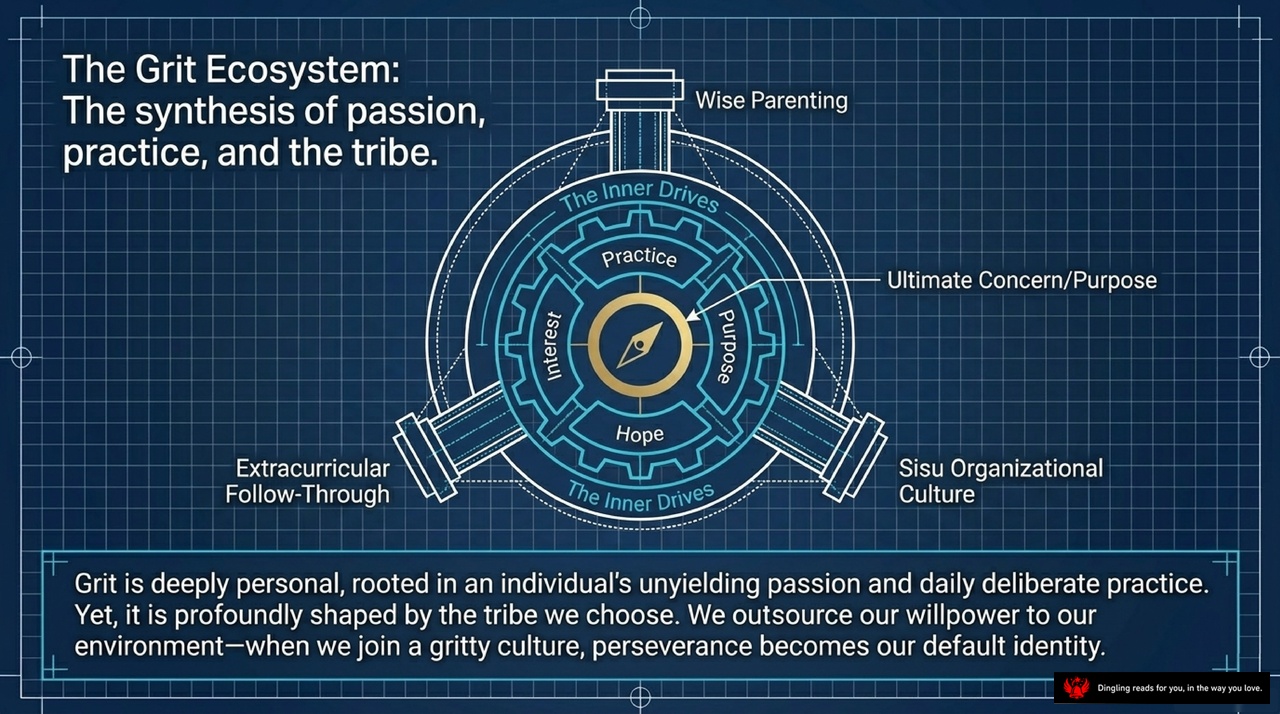
Welcome back to our exploration of Grit. Today, we're zooming out to see the big picture. Look at this blueprint of "The Grit Ecosystem." It's not just about individual willpower; it's a synthesis of passion, practice, and the tribe you belong to.
At the very core, we have the inner drives: Practice, Purpose, Hope, and Interest. These are the gears that turn when you face a challenge. But notice how they are supported by external pillars. On the top, we see Wise Parenting—setting the stage early with balanced support. On the sides, we have Extracurricular Follow-Through and Sisu Organizational Culture. This reminds us that the environment shapes us. As the text states, grit is deeply personal, rooted in unyielding passion and deliberate practice, yet it is profoundly shaped by the tribe we choose. We essentially outsource our willpower to our environment. When you join a gritty culture, perseverance stops being a struggle and becomes your default identity.
Finally, pointing outward is our Ultimate Concern or Purpose. This is the compass that guides all the inner drives and external supports. Without this clear direction, even the strongest practice and the best culture can lose focus. So, remember: true grit isn't just about gritting your teeth; it's about aligning your inner drives with a supportive tribe and a meaningful purpose.

Success isn't about hitting perfection on the first try; it's about the courage to rewrite your story when things go wrong. Look at that staircase in the slide—it's not a smooth climb. It's a series of steps marked with red Xs. That visual perfectly captures a powerful truth: genius is not the effortless execution of perfection; it is the absolute commitment to rewriting the horrible into the good.
As Ta-Nehisi Coates noted, the real challenge is facing your own "horribleness," going to bed, waking up the next day, and refining it until it is simply average. And then refining it again until it is good. Think of it this way: talent is just your starting line. It gets you to the gate, but effort is the double-multiplier that actually builds the skill and drives the achievement.
So, if talent is no longer a valid excuse for stagnation, what ultimate concern are you willing to fall seven times for, just to rise eight? That willingness to rewrite, to keep going despite the failures, is the true definition of success.