
Gulag: A History: Complete Chapter-by-Chapter Summary

Welcome to our deep dive into one of the most harrowing chapters of the 20th century: the history of the Gulag. Today, we're turning our attention to Anne Applebaum's groundbreaking book, *Gulag: A History*.
This isn't just a story about prisons; it's an anatomical exploration of the Soviet forced-labor camp system. Applebaum dissects the entire machinery—from the brutal economic engines that powered the USSR to the enduring, heartbreaking resilience of the millions who survived it.
The book begins by tracing how these camps were born out of necessity for the Bolshevik regime. What started as repurposed POW camps in the 1910s quickly evolved into a vast network of political prisons. By the 1930s, this system had transformed into a massive industrial complex, where human suffering was converted into steel, coal, and infrastructure. It was a dark reality where the state didn't just punish its enemies; it exploited their labor to build an empire, turning the Gulag into a central pillar of Soviet power.
Through her meticulous research, Applebaum reveals how this system expanded, how ordinary people were swept up in its terror, and how the camps became a shadow over every corner of the Soviet Union. Whether you are interested in history, politics, or the darkest corners of human nature, this book offers a profound and necessary look at a system designed to break the human spirit, yet which ultimately became a testament to its endurance.

Defining the "Meat-Grinder" of the Soviet State. At first glance, this image might look like a bureaucratic chart, but it reveals a terrifying evolution of power. We see the word "GULAG" in massive red letters, but the text around it tells the real story of how a government department became a machine of total destruction.
Initially, the Glavnoye Upravleniye Lagerei was just a single government department managing penal labor. It started as a bureaucratic function, a way to handle criminals and political enemies. But look at the shift described here. The "Evolved Reality" shows how it transformed into a catch-all term for the entire Soviet apparatus of repression. It wasn't just about prisons anymore; it was about control over the entire population.
The slide calls it the "Meat-Grinder," and that description is chillingly accurate. It was a merciless sequence of midnight arrests, freezing cattle cars, forced labor, shattered families, and meaningless death. This wasn't just punishment; it was a system designed to grind human lives into dust to fuel the state's industrial ambitions. From midnight knockouts to the crushing cold of the Siberian camps, every aspect of this system was built to break the spirit as quickly as it broke the body. This slide captures the essence of that era: a state that didn't just imprison its enemies, but systematically dismantled their existence.

This slide lays out a stark comparative matrix, dissecting the architecture of exile across three distinct historical regimes: 19th-century Tsarist exile, Nazi concentration camps, and the Soviet Gulag. Notice how the "Primary Purpose" column immediately reveals a fundamental divergence. While Tsarist exile focused on isolation and political punishment with notoriously lax security, and Nazi camps were designed for racial extermination and industrial-scale murder, the Soviet Gulag had a different, yet equally brutal, goal: unrelenting economic exploitation to fund state industrialization.
Look at the "Target Demographics" row. The Tsars targeted specific political dissenters, the Nazis targeted racial and genetic groups like Jews and the Romani, but the Soviet system cast a much wider, arbitrary net. It defined enemies based on broad categories of class or ideology, labeling anyone from "enemies of the people" to ordinary citizens as targets. Finally, observe the "Method of Destruction." While the Tsars used banishment to remote geography and the Nazis utilized gas chambers for immediate death, the Gulag's method was slower but just as deadly: death by sheer exhaustion, starvation, and impossible labor quotas. This matrix illustrates that while the methods and targets varied, the result was a systematic dehumanization that defined an entire era.

Look at this timeline titled "The Blueprint of Repression (1917–1929)." It maps the terrifying evolution of the Soviet prison system, starting from a single block of stone and expanding into a vast, interconnected web of suffering.
The journey begins in 1917, right after the Bolshevik Revolution. As you can see on the left, Lenin immediately issued decrees to isolate "unreliable elements" and class enemies in concentration camps outside major towns. These weren't new inventions; they were repurposed from abandoned prisoner-of-war camps from World War I, strategically placed in remote areas to keep the opposition under tight control.
Fast forward to the early 1920s, and the map shows a significant shift. The Solovetsky Islands, once a serene Arctic monastery, have been transformed into a prison known as SLON. This wasn't just about locking people up anymore; it was a deliberate move to destroy the dignity of the old elite, forcing them into humiliating labor like cleaning toilets. By 1921, this network had already grown to include 84 camps across the Soviet Union, where prisoners faced starvation, disease, and brutal forced labor in freezing conditions.
But the most critical turning point is labeled "The Laboratory" on the far right. This is where the Soviet state discovered its true weapon: forced labor as an economic engine. The camps transitioned from simple places of punishment into testing grounds for systematic exploitation. The regime realized they could turn political enemies into a massive, free workforce to fuel the country's industrialization. This blueprint, forged in blood between 1917 and 1929, laid the foundation for the Gulag system that would dominate the next few decades, turning human suffering into the raw material for a modern state.

The slide before us reveals the dark, twisted engine that drove the Soviet state from 1929 to 1953. It wasn't a machine built for prosperity, but a brutal cycle of exploitation designed to extract wealth from the earth and the bodies of the imprisoned.
It all starts with **State Demand**. Moscow didn't ask for the impossible; they set it. The state imposed unachievable industrial quotas, knowing full well that the remote North lacked the infrastructure and willing workforce to meet them.
This created an immediate **Labor Deficit**. To fill the gap, the NKVD—the secret police—didn't look for volunteers. They required a massive, disposable, and cheap labor force. This is where **Arbitrary Supply** comes in. The state swept up innocent civilians in waves of arrests, simply to fill the labor quotas.
These prisoners were then sent to **Extraction** sites in uninhabitable regions. Think of the White Sea Canal, the coal mines in Vorkuta, and the gold extraction in Kolyma. Prisoners were forced to work in freezing temperatures and hostile environments, building the very infrastructure the state claimed they couldn't afford.
Finally, the extracted wealth fueled **Industrialization**. The profits from these forced labor camps funded Soviet modernization. This success, however, prompted the state to demand even higher quotas, restarting the cycle.
In essence, the Soviet state turned human suffering into a fuel source for its industrial rise, creating a system where the survival of millions depended on the relentless, crushing demands of the machine.

The slide reveals the terrifying truth behind the Gulag: it wasn't about punishing individuals for specific crimes, but about meeting quotas for "Enemies of the People." As the graphic illustrates, the targets were entire categories of people, regardless of their actual actions.
First, look at the "Kulaks"—relatively successful peasants who were simply erased because the state demanded forced agricultural collectivization. Then, there were the "Saboteurs" and "Wreckers," who became convenient scapegoats blamed for any economic failure, no matter who was actually responsible.
The targeting also ignored national boundaries. Foreign nationals, including Poles, Balts, Chechens, and Volga Germans, were deported en masse based purely on their ethnicity. Even returning Soviet soldiers from World War II were treated as traitors, labeled as "contaminated" by mere exposure to the West.
This system operated on a chilling logic: if you belonged to the wrong group, you were condemned. It was a machine designed to target categories, not crimes, creating a vast network of suffering that defined the Soviet era.

Look at this map of the Soviet Union. It's not just a country; it's a vast network of red dots stretching across twelve time zones, from the freezing Arctic tundra to the hot Kazakh steppes. This visual represents the true geography of the Gulag.
As the slide highlights, this wasn't just about remote, isolated camps in the Taiga. The system was a "country within a country." While the extremes were brutal—like the Arctic coal mines in Vorkuta or the frozen gold fields in Kolyma—the camps were also hidden right in the center of Moscow and the suburbs of Leningrad.
The key insight here is the sheer scale: at least 476 distinct camp complexes existed, comprising tens of thousands of individual sites. This wasn't a scattered set of prisons; it was a fully integrated industrial machine. Every dot on this map represents a place where human lives were converted into raw materials for the state's industrialization. Whether it was digging canals, mining gold, or harvesting timber, the Gulag network provided the cheap labor that built the Soviet superpower, turning the entire nation into a prison and a factory simultaneously.

The pipeline to the zones wasn't just a journey; it was a meticulously engineered ritual designed to strip away everything that made a human human. As we look at this slide, we see four distinct stages of this dehumanization process, each step calculated to break the spirit before the body even arrives at its destination.
It all begins with Step 1: The Midnight Arrest. This wasn't a formal legal procedure; it was a sudden, disorienting extraction from civilian life. Victims were dragged away without cause or explanation, often in the dead of night, leaving their families in a state of helpless uncertainty. This immediate severance from their normal world was the first blow to their dignity.
Next comes Step 2: The Interrogation. Once behind bars in infamous prisons like Lubyanka, the real psychological warfare began. Sleep deprivation, torture, and forced confessions were used not just to extract information, but to shatter the prisoner's mind. The goal was to make them question their own reality and identity.
Then, Step 3: The Cattle Car. After the mind was broken, the body was packed into unheated "Stolypin" train wagons. These were essentially open-air cattle trucks where hundreds of people were crammed together for weeks-long journeys across the frozen continent. With minimal food or water, they were treated not as individuals, but as livestock being transported to a slaughterhouse.
Finally, Step 4: Arrival and Selection. Upon reaching the zones, the final transformation occurred. Prisoners were stripped of all clothing, shaved, and evaluated entirely on their physical capacity for hard labor. By this point, they were no longer people; they were inventory, sorted and assigned to become the fuel for the state's industrial machine. This entire pipeline was a systematic effort to erase humanity, turning complex human beings into expendable resources for a totalitarian regime.

Life Behind the Wire: The Brutality of the "Rezhim"
Look at this architectural blueprint. It's not just a drawing of a barracks; it's a map of human suffering. This slide exposes the raw, unfiltered reality of the Gulag system, specifically focusing on the "Rezhim"—the brutal regime that defined life behind the wire.
First, let's look at the environment. The image shows cramped wooden bunks stacked high, with arrows pointing to the tight, suffocating spaces. This wasn't just about overcrowding; it was a death trap. Prisoners were forced to sleep in these narrow cells while battling extreme sub-zero cold, rampant lice, and deadly diseases like typhus. There was no dignity, only a constant fight for basic warmth and survival.
But the hierarchy was even more cruel than the cold. Notice the labels pointing to different sections of the barracks. On the left, we have the "Article 58ers"—the "Politics." These were intellectuals, writers, and innocent civilians arrested for political crimes. Despite being often the most educated and harmless, they were placed at the absolute bottom of the social hierarchy. They were the first to starve and the last to receive medical care.
On the right, the arrows point to the "Urki," or hardened criminals. These were thieves and murderers who, ironically, held a higher status than the political prisoners. The camp guards actively empowered these criminals to terrorize, rob, and control the political prisoners. It was a system designed to break the spirit of the "enemies of the state" by letting the "criminals" run the show.
This slide captures the essence of the Gulag: a place where the environment was engineered to kill, and the social order was built on a foundation of betrayal and dehumanization. It was a machine that consumed millions, leaving nothing but silence behind.

The slide before us lays bare a terrifying truth: the Gulag wasn't just a prison; it was a machine designed to systematically starve people to death. The title, "The Currency of Calories," captures this horrific reality. In the freezing cold of the Gulag, food wasn't a basic human right; it was a transactional currency directly tied to impossible labor quotas.
Look at that downward spiral on the chart. It illustrates a brutal cycle of engineered starvation. If you failed to meet an impossible quota—digging coal or chopping wood in the snow—you didn't just get punished; your bread ration was cut. That immediate reduction in calories caused severe physical weakness. But here's the trap: that weakness guaranteed you couldn't work as hard the next day, which meant your ration was cut even further. It was a self-fulfilling prophecy of death.
This relentless downward spiral turned healthy humans into *dokhodyaga*—the term used for a "goner," someone on the verge of death—in just a matter of weeks. The system was so efficient at destroying life that it didn't even require execution; the prisoners simply starved themselves to death while trying to survive. This was the ultimate cruelty of the Gulag: making the prisoners kill each other, one crumb of bread at a time.

Look at this diagram illustrating "Tufta"—the systematic art of faking work that kept the Gulag running. Because the state's demands were physically impossible to meet, survival required a complete illusion of productivity.
The cycle starts with the prisoners themselves. To simply secure enough bread to survive the day, they faked their labor. They knew that if they didn't produce the numbers on paper, they would starve. This deception then moved up the chain. The camp guards, terrified of punishment from their superiors, certified this fake work as real. Finally, the camp commanders submitted these falsified ledgers to Moscow, proving they were meeting their quotas.
This created a self-sustaining loop of "The Illusion of Productivity." The entire economic data structure of the Gulag—and by extension, the Soviet state itself—was inherently corrupt, built entirely on this lie. It wasn't just about hiding the truth; it was about manufacturing a reality where work existed, even when there was none. This systemic corruption allowed the regime to continue its brutal expansion, convinced that its impossible goals were actually being achieved.

Look at this slide, "The Most Vulnerable: Women and Children in the System." It's a stark reminder that within the Gulag's brutal machinery, the most innocent were often crushed the hardest. On the left, we see "Women in the Gulag." The image of the tattered fabric symbolizes their stripped dignity. They weren't just prisoners; they were targets. The text reveals a horrific reality: systematic sexual exploitation by guards and criminals, forcing many into "camp marriages" where sex was traded for basic rations. Pregnancies in these freezing, starving conditions often ended in tragedy, with mothers forcibly separated from newborns.
On the right, under "Children of the Enemy," the cracked block represents a life broken before it began. Infants born in the camps were tossed into squalid orphanages with staggering mortality rates. Older children, meanwhile, were treated as mere future laborers. They endured the same extreme cold and starvation as adults, carrying the lifelong trauma of sudden separation from their parents. For women and children, survival wasn't just about enduring hunger; it was about fighting against a system designed to destroy them completely.
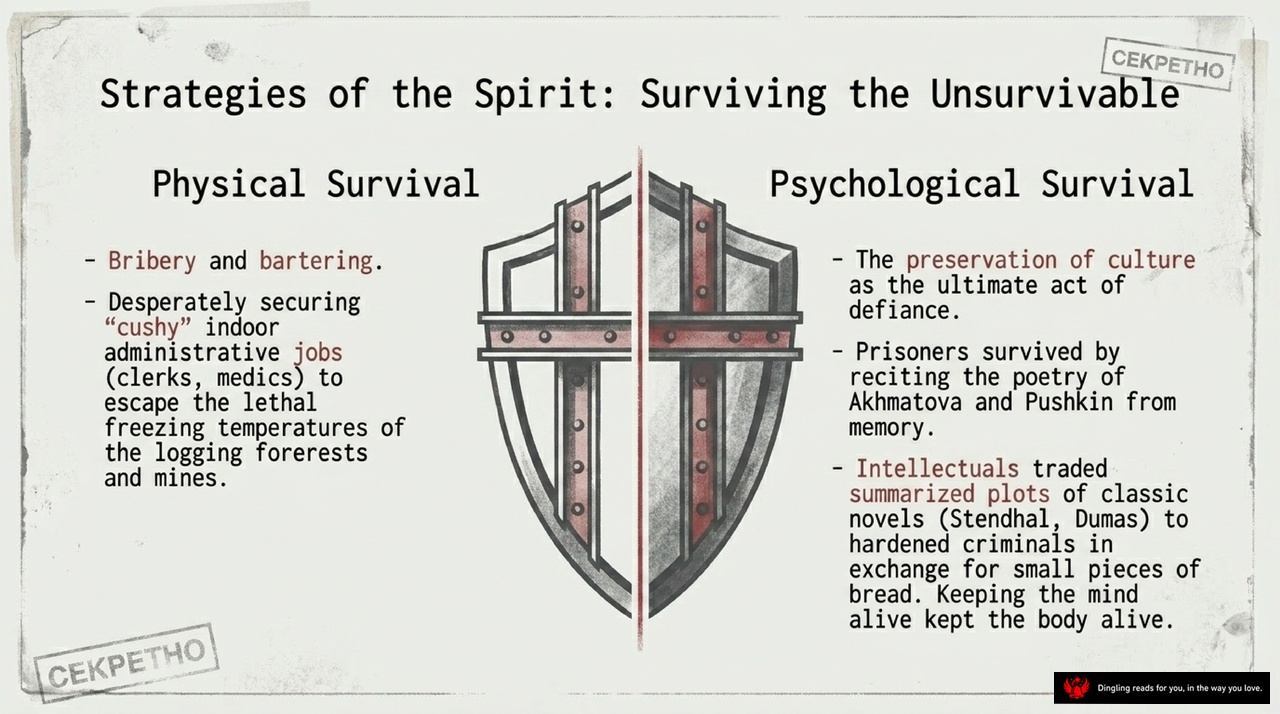
Today's slide breaks down the two distinct ways people fought to stay alive in the Gulag: physical survival and psychological survival. On the left, we see **Physical Survival**, where life depended on **bribery and bartering** to secure a place in the system. Inmates desperately sought **"cushy" indoor administrative jobs**, like working as clerks or medics, just to escape the lethal freezing temperatures of the logging forests and mines. Keeping the body alive was a constant, exhausting battle against starvation and the cold.
But on the right, the slide highlights **Psychological Survival**, which was often the harder fight. The **preservation of culture** became the ultimate act of defiance. Prisoners survived by reciting the poetry of Akhmatova and Pushkin from memory, keeping their minds sharp. Even **intellectuals traded summarized plots of classic novels**—from Stendhal to Dumas—with hardened criminals in exchange for small pieces of bread. This wasn't just about food; **keeping the mind alive kept the body alive**. By holding onto art and literature, they refused to let the system strip away their humanity.
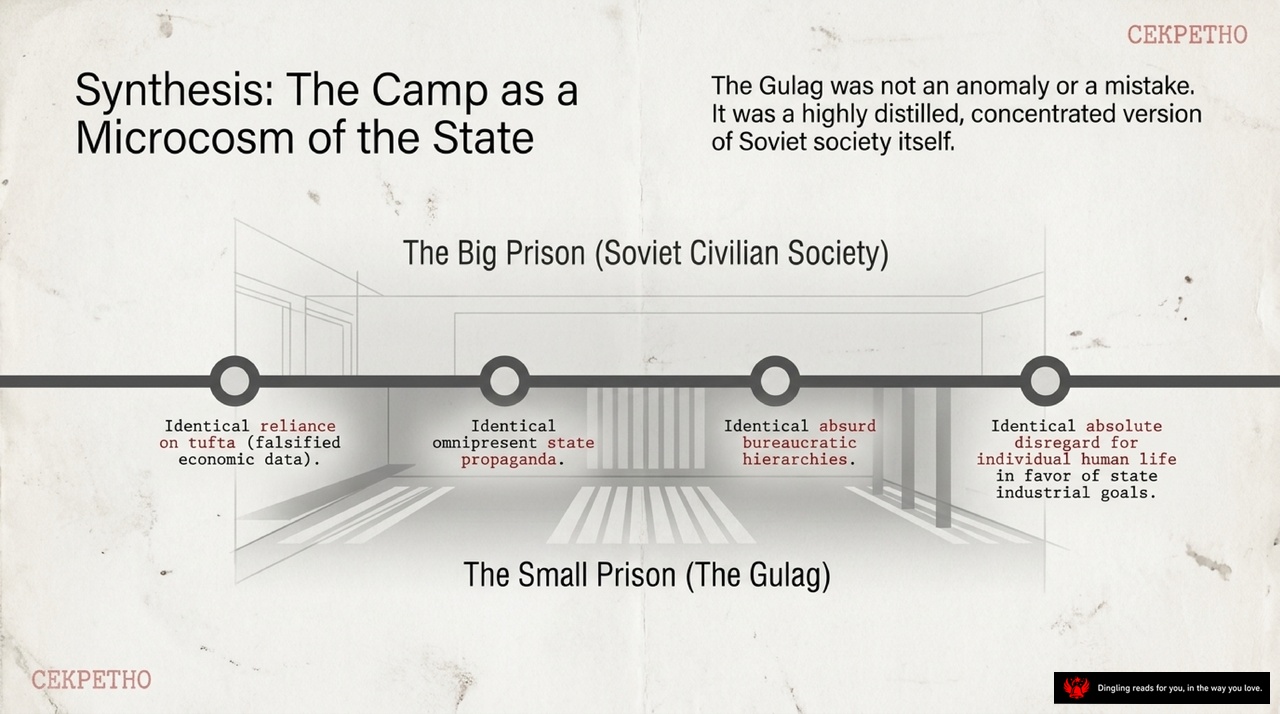
Synthesis: The Camp as a Microcosm of the State. The Gulag was not an anomaly or a mistake. It was a highly distilled, concentrated version of Soviet society itself.
Look at this timeline. It illustrates a terrifying truth: the Big Prison, which was Soviet Civilian Society, and the Small Prison, the Gulag, shared identical DNA. They relied on the exact same absurd bureaucratic hierarchies and the same omnipresent state propaganda. They both depended on falsified economic data and, most chillingly, they both showed an identical, absolute disregard for individual human life in favor of state industrial goals.
This means the camps weren't just isolated pockets of horror; they were a mirror reflecting the entire nation. The mechanisms that crushed the prisoners were the very same ones used to crush the citizens. The Gulag was simply the state's most honest face, stripped of all pretense, revealing the brutal reality of a system that valued production over people.

The Breaking Point: War, Death, and Uprisings.
After the chaos of World War II, the camps underwent a massive demographic shift. Suddenly, they were flooded with combat-trained veterans, former soldiers, and Ukrainian nationalists. These weren't just ordinary prisoners; they were men who knew how to fight and organize.
Then came the catalyst. In 1953, Joseph Stalin died. The moment his absolute terror vanished, the hardened prisoner population triggered a massive eruption. Strikes and armed rebellions exploded in camps like Kengir and Vorkuta. Without the iron fist of the dictator, the chains of control began to snap.
The result was inevitable. The Soviet leadership realized that this sprawling camp system had become a financial drain and was now too physically dangerous to maintain. The era of unchecked terror was over, replaced by a desperate struggle for survival and freedom.

The slide contrasts two distinct eras of Soviet repression: the brief "Thaw" under Khrushchev and the long, hardening "Freeze" that followed.
First, look at the Thaw. This was a period of shock and release. It began when Khrushchev delivered his famous "Secret Speech," denouncing Stalin. Suddenly, millions of people were released from the camps. The system wasn't just opening up; it was exploding with truth. Take Alexander Solzhenitsyn's 1962 book, *One Day in the Life of Ivan Denisovich*. This wasn't just a story; it was a bombshell. By revealing the brutal reality of camp life to the public, it shattered the state's carefully constructed lies. For a moment, the Soviet people saw the truth, and the system seemed to be thawing.
But then, look at the Freeze. This is the darker, longer reality that defined the Brezhnev and Andropov eras. The state cracked down again, and this time, it was more insidious. The camps weren't closed; they were repurposed. Instead of holding mass numbers of political enemies, the focus shifted to a new generation of human rights dissidents. If you spoke out, if you protested, you didn't just go to prison; you were often labeled mentally ill. This rise of "punitive psychiatry" meant that political dissent could be treated as a mental disorder, allowing the state to punish you in isolated psychiatric wards rather than facing the international scrutiny of a prison.
So, the narrative here is a tragic cycle. We have a moment of hope where the truth is revealed and millions are freed, only to be met by a prolonged period of repression where the state invents new, psychological ways to silence anyone who dares to speak. It shows that while the methods of control changed from physical labor camps to psychiatric isolation, the goal remained the same: total silence and total control.

The era of Gorbachev marked a turning point where the dam of censorship finally broke. As the slide illustrates, this period of "Glasnost" unleashed an unprecedented flood of truth, allowing the public to openly discuss and examine the dark chapters of Soviet history that had long been hidden.
This newfound freedom let people read harrowing survival accounts for the first time. Writers like Varlam Shalamov and Evgeniia Ginzburg shared their powerful testimonies, exposing the brutal reality of the Gulag system to a world that had previously been kept in the dark.
Driven by this need for truth, brave historians and citizens formed the Memorial Society. As the image shows with those scattered, declassified documents, this organization dedicated itself to digging through archives. Their mission was to document the exact locations of the camps and restore the names of the millions who vanished into the tundra, ensuring they would never be forgotten.

The image before us captures a haunting scene: a solitary watchtower standing guard over a line of barbed wire, set against a bleak, snowy landscape. This visual perfectly encapsulates the slide's core theme: "The Danger of Amnesia: The Erosion of Historical Memory."
Let's look at the first point, "The Contrast." While the world universally mourns the Holocaust, the memory of the Gulag often remains hazy or is entirely ignored in the West. It is frequently rationalized rather than confronted.
Then we see "The Symptom." Imagine the grim irony of tourists cheerfully buying Soviet memorabilia—KGB pins or hammer-and-sickle shirts—in cities like Prague. These are symbols of an ideology that slaughtered millions, yet they are treated as harmless collectibles. This disconnect is a dangerous symptom of our collective forgetting.
Finally, consider "The Warning." Failing to understand the Gulag as a systemic atrocity, rather than a distant, abstract event, invites a toxic form of authoritarian nostalgia. It leaves our society vulnerable to the very same patterns repeating themselves. We must remember not just the horror, but the mechanism that created it, to ensure history never repeats.

The Gulag was never just a collection of prisons; it was the terrifying economic and terroristic backbone of the Soviet state. It swallowed millions of lives, ruthlessly substituting morality with industrial quotas and truth with propaganda. This slide asks a haunting question: If the machinery of totalitarianism relies on turning humans into mere categories and truth into blind compliance, what safeguards exist in our modern world to prevent the architecture of the Gulag from being rebuilt under a new name?
We must remember that this system was designed to strip away individuality, reducing complex people to statistics and labor units. The danger isn't always the obvious brutality of the past; it's the subtle erosion of truth and the acceptance of systems that prioritize output over human dignity. Today, we live in a world where the tools of control have evolved, but the underlying mechanisms—categorizing the "other," silencing dissent, and prioritizing efficiency above all else—remain dangerously familiar. The lesson from the Gulag is not just about history; it is a mirror for our present. We must stay vigilant, protect the sanctity of truth, and ensure that no one is ever again reduced to a number in a machine designed for their destruction.