
Hackers and Painters: Complete Chapter-by-Chapter Summary
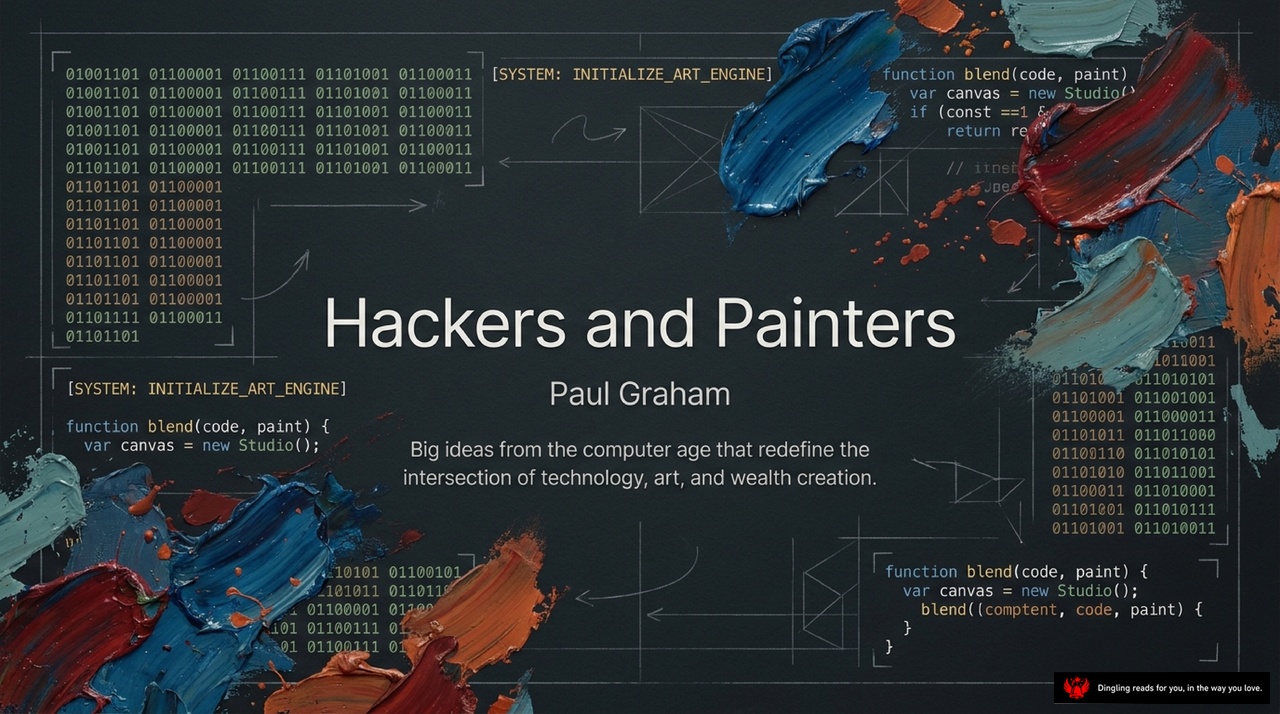
Welcome to *Hackers and Painters*, by Paul Graham. This isn't just another book about coding; it's a manifesto about how we create value in the modern world.
The cover art perfectly captures the book's core thesis: the surprising unity between hackers and painters. On one side, you see the cold precision of binary code and system initialization scripts—representing the logic of technology. On the other, vibrant, messy strokes of oil paint—representing the raw expression of art.
Paul Graham argues that despite these different mediums, hackers and painters share the same soul. They are both creators. Their job isn't to discover new facts like scientists, but to build something new and valuable. Whether it's a painting that moves you or software that solves a problem, the essence is the same: creation.
The subtitle on the slide tells us what to expect: big ideas from the computer age that redefine the intersection of technology, art, and wealth creation. Graham challenges the common stereotypes that separate the logical, rigid world of engineering from the free-spirited world of art. He suggests that the best programmers think like artists, embracing intuition, iteration, and the freedom to make mistakes.
This book promises to change how you see your work, your career, and even how you understand the nature of wealth itself. It's a guide for anyone who wants to move from simply following rules to actually creating something that matters.
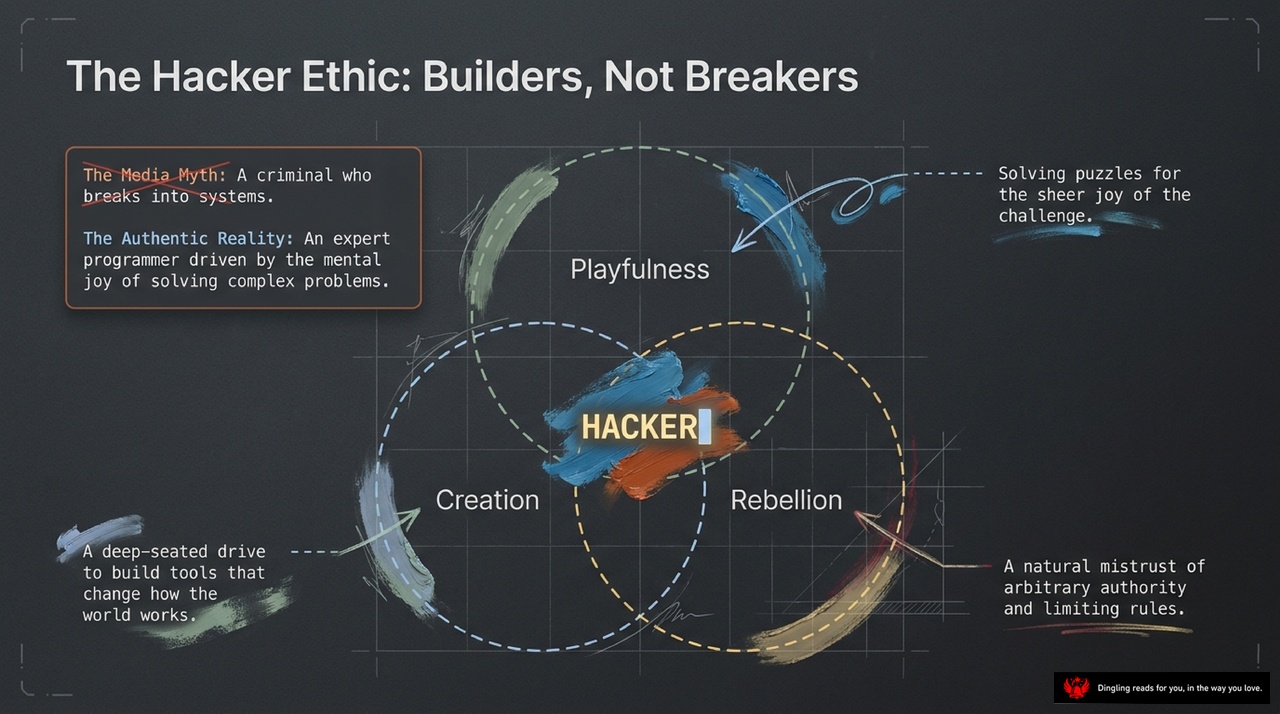
The media has painted a dark picture of hackers, branding them as criminals who break into systems. But the authentic reality is quite different: a hacker is an expert programmer driven by the sheer mental joy of solving complex problems. It's not about destruction; it's about playfulness, creation, and a natural rebellion against arbitrary authority.
Look at this Venn diagram. At the center lies the true hacker, born from the intersection of three core traits. First, there is playfulness. It's the drive to solve puzzles just for the fun of it, the joy of figuring out how something works. Second, there is creation. This is that deep-seated urge to build tools that actually change how the world functions. And third, there is rebellion—a healthy mistrust of limiting rules and rigid hierarchies that get in the way of progress.
When these three forces collide, you don't get a breaker; you get a builder. The media myth focuses on the breaking, but the hacker ethic is entirely about building something new, something better. It's about using that rebellious spirit and playful curiosity to construct solutions rather than just finding holes in the system. That is the essence of the hacker ethic: builders, not breakers.

Look at this scale. On one side, we have "Popularity," and on the other, "Intelligence." The slide calls this "The Nerd's Dilemma," framing it as a zero-sum social game where you seem to have to choose one or the other.
In the artificial, closed environment of adolescence, the text warns us that popularity demands a 100% focus on social conformity and navigating arbitrary hierarchies. It's a trap. While the "Intelligence Path" focuses on observing the world, mastering complex systems, and finding correct answers, the average student is taught to prioritize fitting in over thinking.
The real shift happens when you leave school. The moment that closed prison ends, the real world stops rewarding social conformity and starts rewarding those who can solve actual, scalable problems. The heavy weight of "Popularity" that dragged you down in high school? It becomes irrelevant the moment you step into the real world. The only thing that truly matters is your ability to contribute and create value.
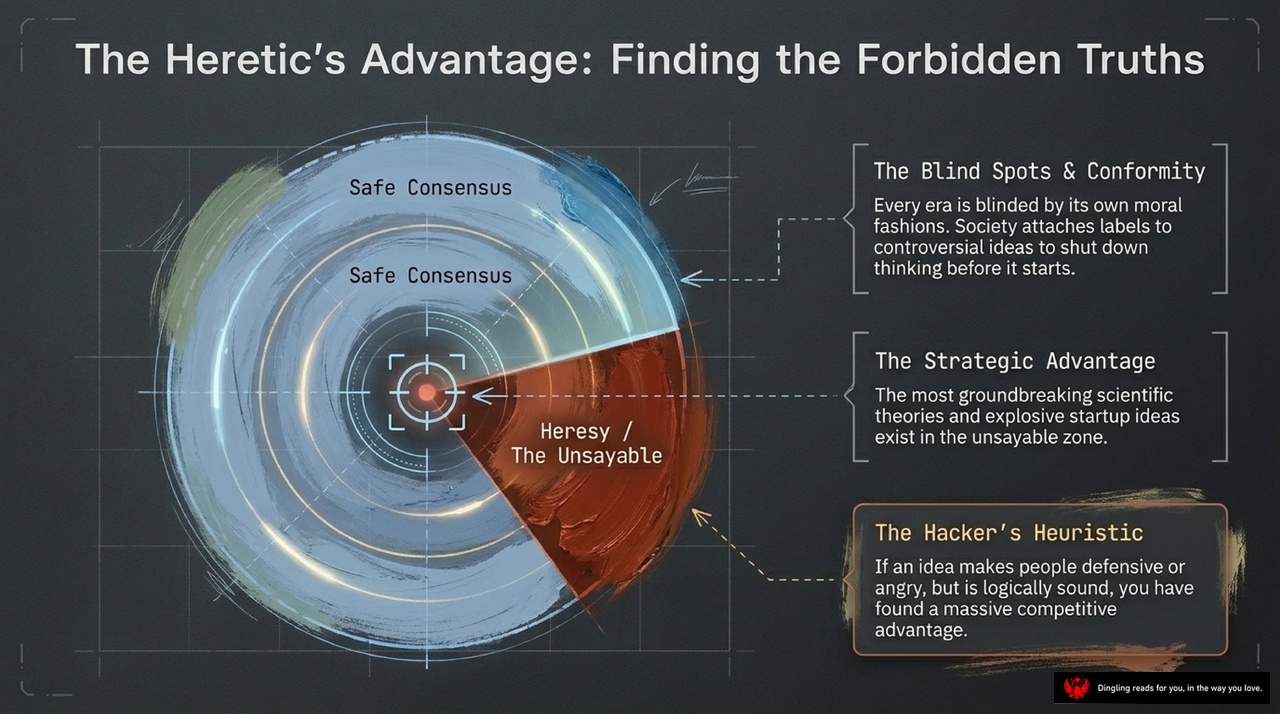
The slide we see here breaks down a powerful mental model for finding real value in a world full of noise. It's titled "The Heretic's Advantage: Finding the Forbidden Truths."
Look at that concentric circle. The vast blue area represents "Safe Consensus." This is where everyone agrees, where society feels comfortable, and where conformity reigns. But as the text on the right warns, this comfort creates "Blind Spots." Every era gets blinded by its own moral fashions. Society attaches labels to controversial ideas to shut down thinking before it even starts. If everyone thinks the same, no one is actually learning anything new.
Then, look at that distinct red wedge labeled "Heresy / The Unsayable." This is the unsayable zone. The slide argues that this is actually where the strategic advantage lies. History shows us that the most groundbreaking scientific theories and explosive startup ideas don't exist in the safe zone; they exist right here in the uncomfortable, unsayable space.
So, how do you find this advantage? The slide gives us "The Hacker's Heuristic." It's a simple but brutal test: If an idea makes people defensive or angry, but it is logically sound, you have found a massive competitive advantage. When you challenge the status quo, you will inevitably trigger the "Safe Consensus." That resistance isn't a sign that your idea is wrong; it's proof that you've hit a nerve that needs changing.
In the book, we see this play out constantly. Whether it's challenging a social taboo or proposing a new technical architecture, the moment you step out of the blue circle into the red, you stop being just another follower and start being a creator of the future. Don't fear the anger of the crowd; use it as your compass to find the truth they are too afraid to speak.

So, what exactly is a hacker? If you ask the general public, they'll likely picture a criminal breaking into systems. But in the world of programming, a hacker is something entirely different: a master who understands technology deeply enough to bend the rules and find the best possible solution. This isn't about rebellion for rebellion's sake; it's a refusal to accept that a problem is unsolvable.
Think about the history of innovation. From Feyman cracking safes during the Manhattan Project to Jobs and Wozniak building the first personal computer in a garage, these breakthroughs all stem from one thing: a refusal to follow the status quo. When a team like Thompson and Ritchie felt the Multics operating system was too complex, they didn't just patch it—they ignored it and built Unix from scratch. This "good old bad habit" of not blindly following authority is the engine of true innovation.
But this spirit of non-conformity often clashes with established systems, particularly with copyright laws. Hackers worry that overly strict protections stifle the very freedom needed for ideas to evolve. They believe that true progress comes from external innovators who aren't bound by corporate interests, yet current laws are increasingly locking those doors shut.
This drive to break barriers is also deeply rooted in American culture. The Silicon Valley thrives because it tolerates this kind of self-directed, non-conformist behavior. It attracts smart, arrogant hackers who don't follow a rigid plan but instead carve their own paths through the wilderness of technology. Ultimately, this isn't about destruction; it's about creation—building more efficient systems, better tools, and a freer technological ecosystem for everyone.

Imagine a world where the only thing you need to know is how to ask the right question. That's the essence of the hacker's approach to language. Unlike traditional programming, which often feels like filling out rigid forms or following a strict checklist, the hacker's ideal language is a playground. It's not about memorizing syntax; it's about having a tool that bends to your will.
Think of it like this: a great language should be simple enough that you don't waste time fighting the tool, but powerful enough that you can build anything. It needs to be concise, stripping away the unnecessary letters and keystrokes so you can focus on the logic, not the typing. But simplicity alone isn't enough. The language must be programmable. It shouldn't just give you a hammer; it should let you forge your own hammers. This means allowing you to customize the very tools you use, breaking free from the limitations that other languages impose.
Of course, having a flexible language is only half the battle. You also need a library of functions that feels intuitive, like a well-organized workshop where you can instantly grab exactly what you need. The language should talk to the world around it—your operating system, other applications—seamlessly. And it needs to be interactive, giving you instant feedback as you code, so you can debug and explore in real-time.
Ultimately, the goal is to make the computer an extension of your own mind. When you write code, you're not just issuing commands to a machine; you're expressing your ideas. The perfect language makes that expression effortless, allowing you to solve complex problems with the same ease as a painter sketches a masterpiece. It's about freedom, creativity, and the joy of building something truly new.

All top creators across every discipline—from architects to writers—share a single, non-negotiable metric for success: beauty. It's not just about aesthetics; it's about a deep, objective standard that transcends the field. Think of Copernicus rejecting a clunky model because it lacked elegance, or mathematicians Hardy asserting that a "ugly" theorem simply cannot survive the test of time. If your design feels wrong, it probably is.
So, what actually makes a design beautiful? First, it must be simple. This isn't about being bare; it's about stripping away the unnecessary to reveal the core logic. Decoration is often just a cover-up for a weak idea. True simplicity means every element serves a purpose. Second, great design has timeless power. It doesn't chase fleeting trends. A truly good design solves the fundamental problem so well that it remains relevant decades later, ignoring the noise of the era.
But beauty isn't just about looking good; it has to be useful and inspiring. A great design invites you to interact with it and build upon it. It offers a starting point rather than a closed book. And let's not forget fun. The best designs have a spark of wit and intelligence—a sense of play that makes using the tool feel like a conversation rather than a chore.
Finally, look at nature. Evolution has spent billions of years refining solutions that are both functional and beautiful. From the symmetry of a snowflake to the aerodynamic shape of a bird's wing, nature is the ultimate designer. When we mimic these principles, we aren't just copying; we are tapping into the most efficient blueprint ever created. If your design lacks these elements—simplicity, timelessness, inspiration, fun, and a nod to nature—it's not just flawed; it's fundamentally ugly.
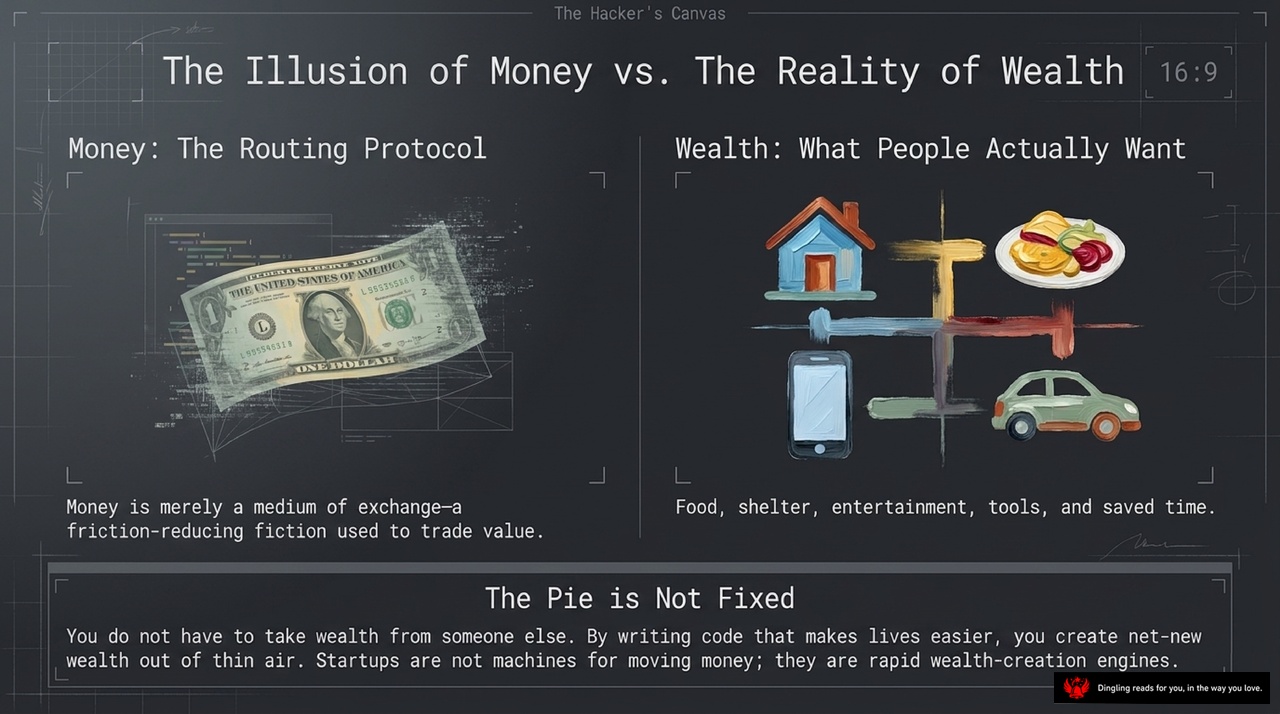
Let's talk about the true nature of hacking. When I tell people I'm designing a new dialect of Lisp, they usually pivot the conversation quickly, signaling that my answer doesn't fit their conventional definition of "work." To the average person, programming feels like research—discovering new knowledge. But I see it differently: designing a programming language is no different than designing a building, a chair, or a font. It's an act of creation, not just discovery.
The core distinction lies in the goal. Research aims for "newness," pushing the boundaries of what we know. Design aims for "goodness," creating practical solutions that meet real needs. This user-centric approach is everything. Just as a great architect doesn't just follow a client's superficial requests but digs deeper to find the core problem, a good language designer must understand the human user. The best languages—like C, Lisp, and Smalltalk—were built by their designers for themselves. When you design for yourself, you don't underestimate the user's capabilities.
But there's a catch. Many languages are designed by committees for a vague "general public," which often leads to bloated, confusing tools that no one actually enjoys using. Great design requires empathy. You have to respect how the human brain works, avoiding unnecessary complexity that fights against our natural intuition. Instead of forcing users to declare types upfront, you create environments where coding feels like a fluid conversation.
Crucially, design is never finished. It's a cycle of "re-designing." You need to hold two opposing beliefs at once: optimistic faith that the problem can be solved, and healthy skepticism that your current solution might be flawed. This balance keeps you moving forward. You start with a rough prototype—like a sketch on paper—to get immediate feedback and build momentum. A half-finished product is better than nothing; it allows you to iterate quickly based on real usage rather than guessing.
Finally, avoid the trap of committee design. If everyone has to agree on every tiny change, nothing ever gets improved. Instead, build vertical interfaces where specific parts of the system can be updated independently. Keep your passion high, accept that your work is always a work in progress, and trust that by constantly refining your creation, you'll eventually arrive at something truly useful and elegant.
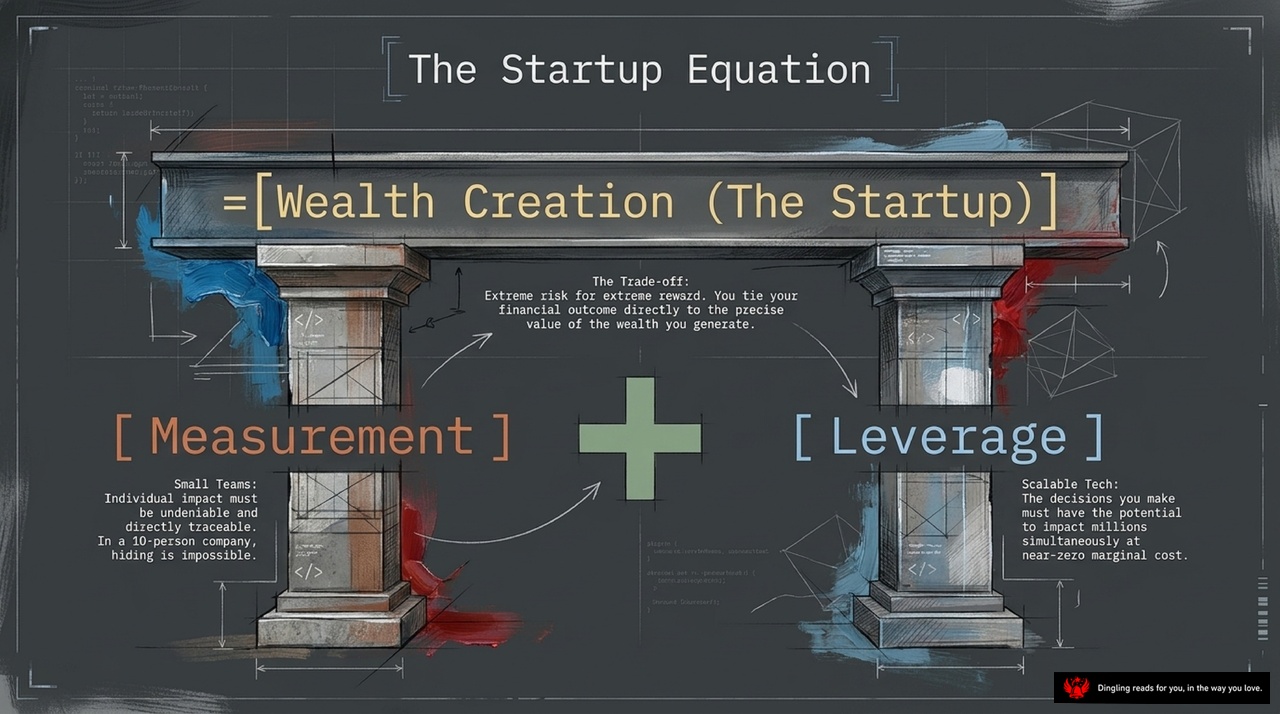
Today's slide breaks down the core formula for building a successful startup: The Startup Equation. It's simple yet powerful: Wealth Creation equals Measurement plus Leverage.
On the left, we have Measurement. This represents the "Small Teams" pillar. The image notes that individual impact must be undeniable and directly traceable. In a tiny team of ten, you can't hide. Every decision you make has immediate, visible consequences. This clarity is what drives accountability and speed.
On the right, we have Leverage. This is the "Scalable Tech" pillar. The slide explains that the decisions you make must have the potential to impact millions simultaneously at near-zero marginal cost. This is the magic of software. You write the code once, and it can serve a single user or a billion users without requiring a proportional increase in your effort or cost.
When you combine these two pillars—Measurement and Leverage—you get Wealth Creation. This is the startup itself. The trade-off, as the diagram highlights, is extreme risk for extreme reward. You tie your financial outcome directly to the precise value of the wealth you generate. There are no middle grounds here. You either build a scalable, measurable product that creates massive value, or you don't. This equation captures the essence of modern entrepreneurship: using a small, focused team to build technology that scales globally.
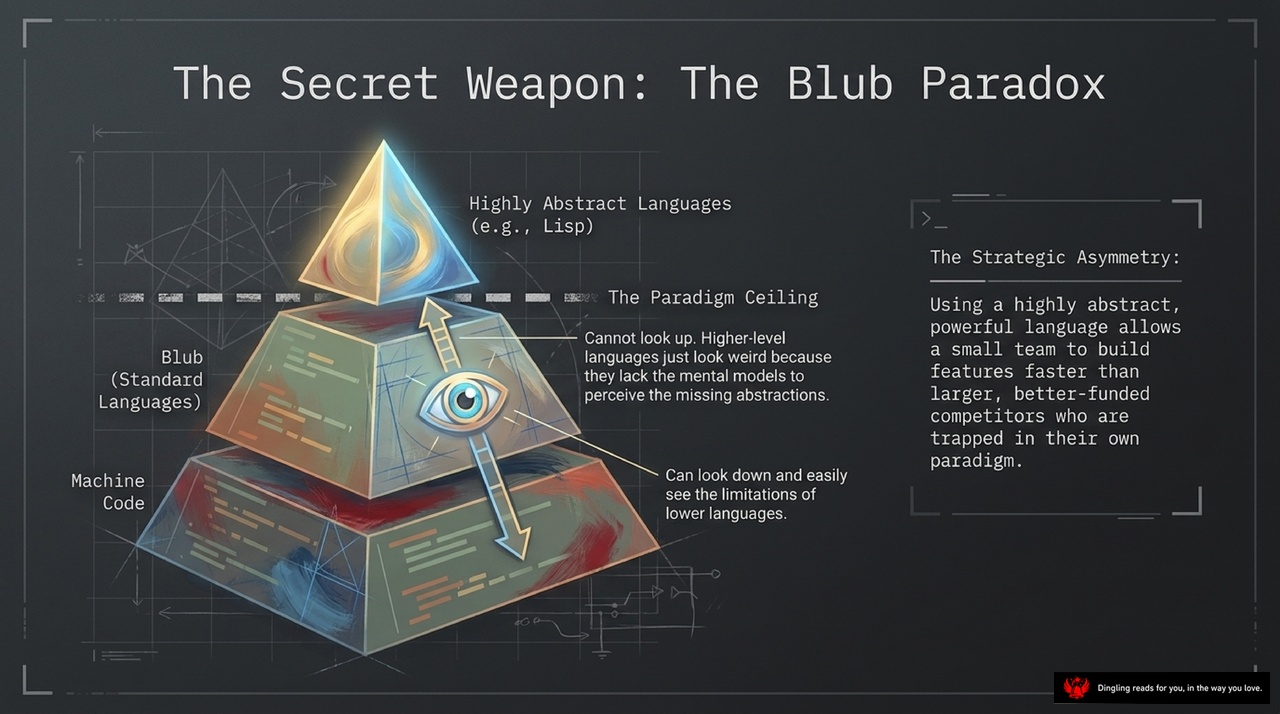
Imagine a pyramid representing the hierarchy of programming languages. At the base sits Machine Code, the raw, unforgiving instructions a computer executes directly. Moving up, we find "Blub"—the standard languages like C or Java that most of us use daily. But at the very peak shines a glowing, abstract prism: Highly Abstract Languages like Lisp.
This visual illustrates the "Blub Paradox," a concept that changes how we view technical superiority. The diagram highlights a "Paradigm Ceiling." Programmers stuck in Blub can easily look down; they clearly see the limitations, complexity, and clumsiness of machine code and lower-level languages. They know exactly how hard things are at the bottom. However, they cannot look up. To them, the powerful, concise abstractions of languages like Lisp look weird, unnecessary, or even broken. They lack the mental models to perceive the missing layers of abstraction that exist above them.
This creates a strategic asymmetry. Because Blub programmers are trapped in their own paradigm, they underestimate what is possible. But a small team using a highly abstract, powerful language can build features incredibly fast. They operate in a dimension their larger, better-funded competitors simply cannot see. While the big teams are struggling with the low-level complexities that the Blub programmers consider "normal," the small team is soaring above the paradigm ceiling, creating magic that seems impossible to anyone stuck on the lower rungs of the pyramid.

Designing the 100-Year Language isn't just about writing code; it's about reimagining the very tools we use to think. As we look toward 2150, a pivotal shift is on the horizon: hardware will become irrelevant. When processing power scales infinitely, languages will stop optimizing for the machine's limitations and start optimizing for the programmer's brain.
This vision rests on three core pillars. First, we embrace **Mathematical Axioms**—small, highly powerful, and timeless cores that form the bedrock of our logic. Second, we adopt a **Bottom-Up Architecture**, building specialized languages tailored to solve specific problems rather than forcing problems to fit a rigid framework. Finally, we pursue **Extreme Brevity**, using maximum abstraction to minimize cognitive load and parsing time.
The result? A future where the language itself feels like an extension of your mind, allowing you to focus entirely on the problem at hand, not the syntax of the tool.
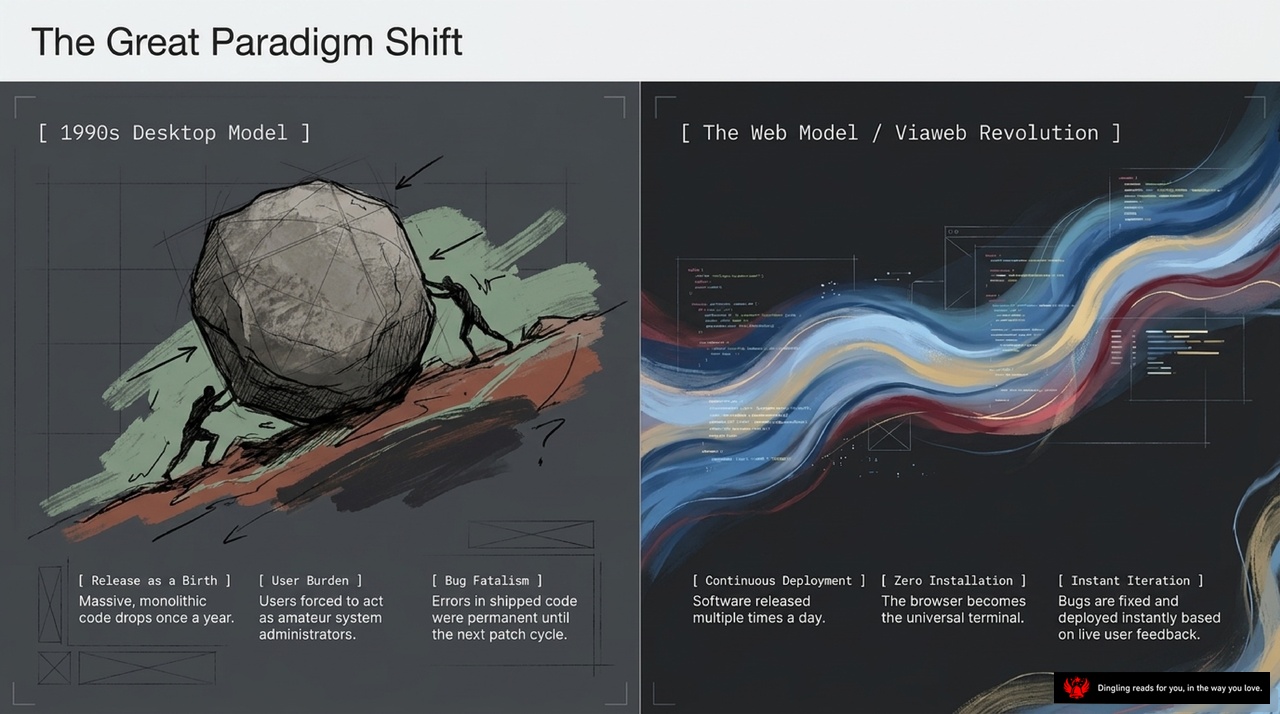
Look at this slide. We're witnessing the "Great Paradigm Shift" in how we build and use software. On the left, we see the 1990s Desktop Model, depicted as two people struggling to push a massive boulder uphill. This was the reality back then: massive, monolithic code drops released only once a year. Users were forced to act like amateur system administrators, installing and maintaining complex software on their own machines. When bugs appeared, they were fatal; the code was permanent until the next patch cycle, leaving users helpless and frustrated.
But on the right, we see the complete transformation brought about by the Web Model and the Viaweb Revolution. Instead of a heavy boulder, we now have a fluid, colorful stream of data flowing effortlessly. This represents the shift to Continuous Deployment, where software is released multiple times a day. We've moved to Zero Installation, meaning the browser itself has become the universal terminal, and users no longer need to manage anything. Most importantly, we've achieved Instant Iteration. Bugs are no longer permanent disasters; they are fixed and deployed instantly based on live user feedback. The struggle to push the boulder is gone, replaced by the freedom to flow and adapt in real-time.
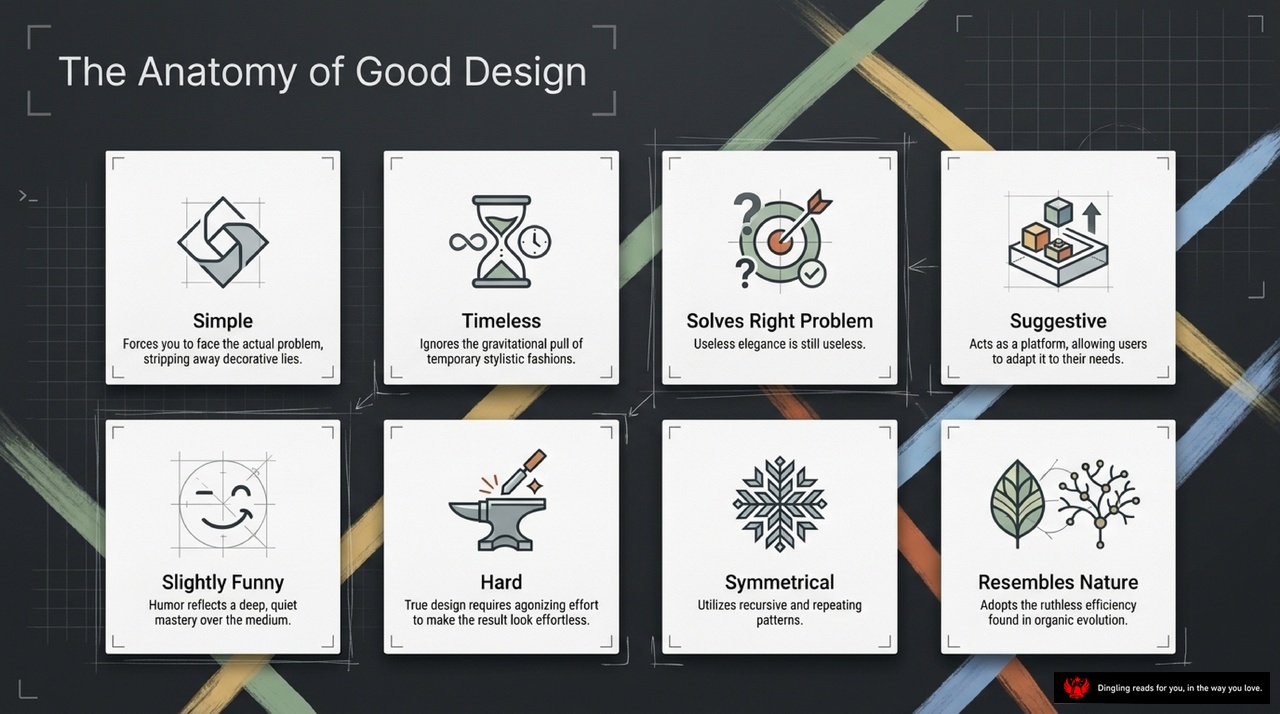
Let's talk about what actually makes a design "good." It's not just about how it looks, but how it feels and functions. Think of it as the anatomy of great design, broken down into eight core principles.
First, it has to be Simple. Good design forces you to face the actual problem, stripping away all those decorative lies that just clutter things up. It needs to be Timeless, ignoring the gravitational pull of temporary fashion trends. Instead of chasing what's popular today, it focuses on solving the right problem because useless elegance is still useless.
A great design is also Suggestive. It acts as a platform, allowing users to adapt it to their own needs rather than forcing them into a single mold. It should be Slightly Funny, reflecting a deep, quiet mastery over the medium where humor isn't just a joke, but a sign of confidence.
True design is Hard. It requires agonizing effort to make the result look effortless, like a master craftsman at the anvil. It often utilizes Symmetrical, recursive patterns found in nature, and ultimately, it should Resemble Nature, adopting the ruthless efficiency that evolution has perfected over millions of years. When you combine these elements—simplicity, timelessness, utility, and a touch of organic beauty—you move beyond just making something pretty to creating something that truly works.

Synthesis: Shaping the Digital Era. Look at this triad. We are defining the modern creator not by a single skill, but by the fusion of three distinct mindsets. First, we have the mind of a hacker. This isn't about breaking things; it's about being unbound by conventional rules, leveraging pure logic to bend the machine to your will. Second, we bring in the eye of a painter. This is the obsession with empathy and timeless aesthetics, the ability to see beauty and human connection where others see only data. And third, we need the engine of a startup. This is the drive to apply measurement and leverage, turning creative ideas into scalable wealth.
When you combine these three, you get something powerful. You get the architect of the future. The result is clear: the modern creator is an artist whose medium is logic and whose gallery is the global economy. We are no longer just writing code or painting pictures; we are building the infrastructure of tomorrow with a blend of artistic vision, technical rigor, and entrepreneurial ambition.

Wealth in the modern age isn't just about having money; it's about building with a specific blend of mindsets. As the slide suggests, true success in the digital era requires the logic of a hacker, the empathy of a painter, and the rebellion of an independent creator.
Think about it: the hacker brings the technical logic to solve problems efficiently, the painter adds the empathy to understand what users actually need, and the rebel provides the courage to break rules when the status quo isn't working. This combination is what separates the builders from the followers.
So, the real question isn't just about your current skills. It's about your vision. When you step into this digital canvas, what will you paint? Will you create something that only serves the system, or will you build something entirely new that changes how the world works? The tools are there, but the masterpiece is up to you.