



The cafeteria hierarchy story hit hard, explaining why smart kids get punished.
Your Review
The cafeteria hierarchy story hit hard, explaining why smart kids get punished.

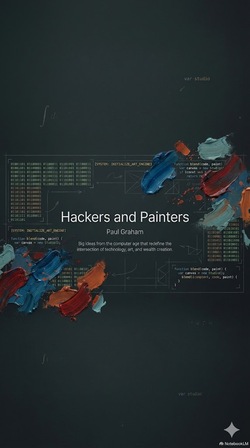
Graham compares hackers to painters, showing both create value rather than just following rules, a perspective that changed how I view coding work and shifted my focus from seeking popularity to building real skills instead.

The comparison between coding and painting as creative acts changed how I see my own work.

Love how Graham compares high school social hierarchies to modern conformity traps.

Graham argues high schools punish creativity by forcing conformity, but this very trait makes nerds successful adults who build real value instead of chasing empty popularity today.

Finally a book that treats coding as art instead of just math.

The comparison between hackers and painters as two sides of the same creative coin really changed how I view my own work as a developer, moving me away from seeing coding as just solving predefined problems.

Graham argues high school hierarchies punish independent thinkers who need to build real skills instead of chasing social status, a dynamic that stifles the creativity hackers and painters require to innovate, while modern schools still function more as custodial institutions keeping kids occupied rather than preparing them for meaningful work by prioritizing quiet compliance over intellectual curiosity in an environment without shared productive goals, ultimately training students to avoid standing out in ways that directly contradict the risk-taking and nonconformity necessary for breakthroughs in fields like tech where refusing to blend in is essential for success.

Graham brilliantly connects high school cafeteria hierarchies to modern tech taboos, showing how independent thinkers like hackers and painters thrive by ignoring conformity and focusing on creating real value instead of chasing empty popularity or status. This perspective shift helped me understand why my own past avoidance of social games actually prepared me for building something meaningful. The book also explains how tools like Lisp allowed small teams to outperform giants by iterating faster, proving that creativity and the right mindset are far more important than following rigid rules or pretending to fit in with the crowd. It feels like a powerful reminder that true success comes from thinking independently and building things that solve real problems for people, rather than just playing a game designed to keep everyone else quiet and obedient.

High school rules really do punish smart kids for no good reason.

Code is just paint on a canvas for the real creators among us.

Graham explains why high school nerds become successful creators later.

The idea that hackers are artists rather than criminals changes how I see tech.
Graham brilliantly reframes coding as art, comparing hackers to painters who create value through iteration rather than rigid planning, which explains why his choice of Lisp for Viaweb allowed rapid adaptation to user needs, proving that breaking conventional tool choices can unlock scalable wealth when you prioritize building something useful over following popular trends.

Graham explains how high school hierarchies punish creativity, showing why independent thinkers often fail socially but succeed later in life as hackers.

Graham's comparison of high school social hierarchies to the industrial roots of schools makes sense, but I still struggle with how he suggests we should navigate taboo ideas today without just becoming isolated in our own echo chambers.

Paul Graham brilliantly explains why high school hierarchies punish creativity and how hackers are actually creators like painters. He argues that the term computer science often mislabels true hackers who build useful tools rather than just solving theoretical problems. Graham contrasts the paper-first academic approach with his preferred iterative coding style, where you write rough code, test it, and refine it immediately. This creative process mirrors how painters sketch and adjust their work, making hacking an art form rather than just engineering. He also tackles the danger of social taboos that force people to copy existing beliefs instead of thinking independently. By keeping dangerous ideas private or using humor to deflect pressure, independent thinkers can avoid backlash while still developing original concepts. The book connects these ideas to wealth creation, showing that real value comes from building scalable solutions that serve many people, not from chasing a fixed pie. Graham's examples, like choosing Lisp for Viaweb to iterate faster than competitors, prove that questioning conventions leads to breakthroughs. Ultimately, the book challenges us to stop conforming to empty popularity races and start building something meaningful on our own terms.

I learned that writing code iteratively is the same creative process as painting a masterpiece.

Graham explains how high school popularity races punish the nerds who actually build the future through code.

The idea that hackers and painters are both creators using different tools to bring ideas to life changed how I see my own work.