
Hacking Growth: Complete Chapter-by-Chapter Summary

Welcome to "Hacking Growth" by Sean Ellis and Morgan Brown. This isn't just another business book; it's the definitive blueprint for building a cross-functional, data-driven engine that drives rapid and sustainable business growth.
Think of growth not as a lucky break or a marketing campaign, but as a repeatable system. The image you see here captures the entire architecture. At the very heart is the "Growth Engine Core," which acts as the brain of the operation. It connects everything: from rapid experimentation and data-driven insights to cross-functional collaboration and scalable acquisition.
This engine transforms growth from a series of random guesses into a scientific process. Instead of relying on expensive traditional advertising, you use a feedback loop that includes retention loops and monetization optimization. The goal is clear: break down the silos between engineering, data, and marketing. When these teams align around a single goal, they stop wasting time on internal politics and start focusing on what actually moves the needle.
Whether you're a startup with five people or a giant corporation, this framework gives you the tools to build your own growth machine. It's about turning user data into gold, testing hypotheses quickly, and scaling what works. Let's dive in and see how you can start building this engine today.

Have you ever wondered why some companies seem to explode in popularity overnight while others, even with massive budgets, slowly fade away? The answer lies in a fundamental shift in how we think about growth. On the left, you see the old way: Traditional Marketing. It's rigid, siloed, and slow. Product teams build features in isolation, marketing teams run expensive campaigns at the top of the funnel, and data analysts sit behind the scenes, disconnected from the action. It's a linear process where a mistake in one quarter can take months to fix.
Now, look at the right side. This is Growth Hacking. It's not just about marketing; it's a completely different operating system. Notice how the team structure changes from rigid departments to a cross-functional unit where engineers, marketers, and data analysts work side-by-side. This agility allows for continuous learning and integrated flow. Instead of focusing only on getting new users, the entire customer lifecycle—from acquisition to activation, retention, and monetization—becomes the focus.
The methodology is where the real magic happens. Traditional marketing relies on slow, massive campaigns that run for a quarter, hoping for the best. Growth Hacking, however, is about high-tempo, continuous agile testing. It's a cycle of Test, Optimize, Iterate, and Learn. Instead of guessing, you use data to find what works, scale it quickly, and discard what doesn't. This data-driven approach turns growth from a lucky accident into a repeatable, predictable system. By breaking down these silos and embracing this new paradigm, companies can achieve the kind of explosive, sustainable growth that defines the modern digital age.

So, before we even talk about how to grow, we have to answer one critical question: Is your product actually a must-have?
Look at this gauge on the screen. It's not measuring speed or revenue; it's measuring "Growth Readiness." And the magic number right there? It's 40%.
This is what we call "The 40% Rule." Imagine asking your users a simple question: "If you could no longer use this product, how would you feel?" If more than 40% of them say they would be "Very Disappointed," congratulations—you've hit true Product-Market Fit.
Here's the hard truth in the red warning box below: If you try to scale aggressively before crossing that 40% threshold, you aren't building a company; you're just burning capital and churning users. It's a fast track to failure.
Think of it like this: If only 25% of your users feel deeply disappointed without you, your product isn't essential yet. You might need to tweak your value proposition or refine your core features. But once you hit that 40% mark, you've unlocked the green light. That's the moment when product-led growth actually takes off.
So, don't fall in love with your own metrics yet. Validate that feeling of indispensability first. Because without that deep emotional hook, no amount of marketing spend will save you.

So, we've built our growth team, defined our core value, and established our metrics. Now, the real work begins: moving fast. But before we can run, we need to understand exactly how our users move through the product.
Let's look at this slide. It shows that user behavior analysis is the starting point for all our rapid experiments. We aren't just guessing; we are dissecting the user journey. We need to identify who our "best customers" are—those who actually love the product. For example, if we see that high-value users consistently use a specific feature like a shopping list or place orders above a certain threshold, that's our golden clue. We can then design experiments to guide more users to copy those behaviors.
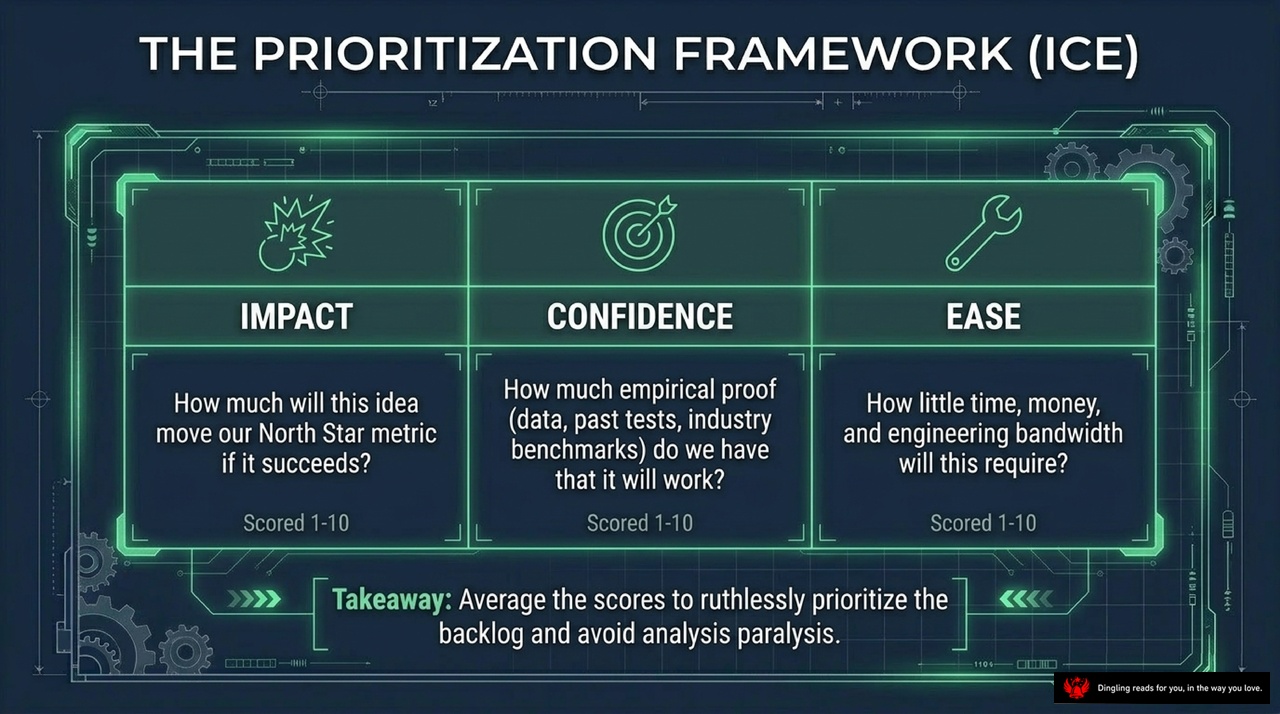
But we also have to ask: why do people leave? By combining our data funnels with direct user feedback, we can pinpoint exactly where the friction is. Is it a confusing checkout process? Or maybe users just don't understand the value? Once we have these insights, we turn them into testable hypotheses. We don't just generate ideas in a vacuum; we invite everyone from sales to external partners to brainstorm, then use the ICE model—Impact, Confidence, and Ease—to prioritize which experiments give us the biggest win with the least effort.
Finally, execution is about speed and learning. We run these tests, monitor the data in real-time, and then rigorously review the results. The goal isn't just to succeed; it's to learn. Every test, whether it works or fails, adds to our internal knowledge base. This cycle of analyzing behavior, generating ideas, and testing them is how we turn data into sustainable growth.

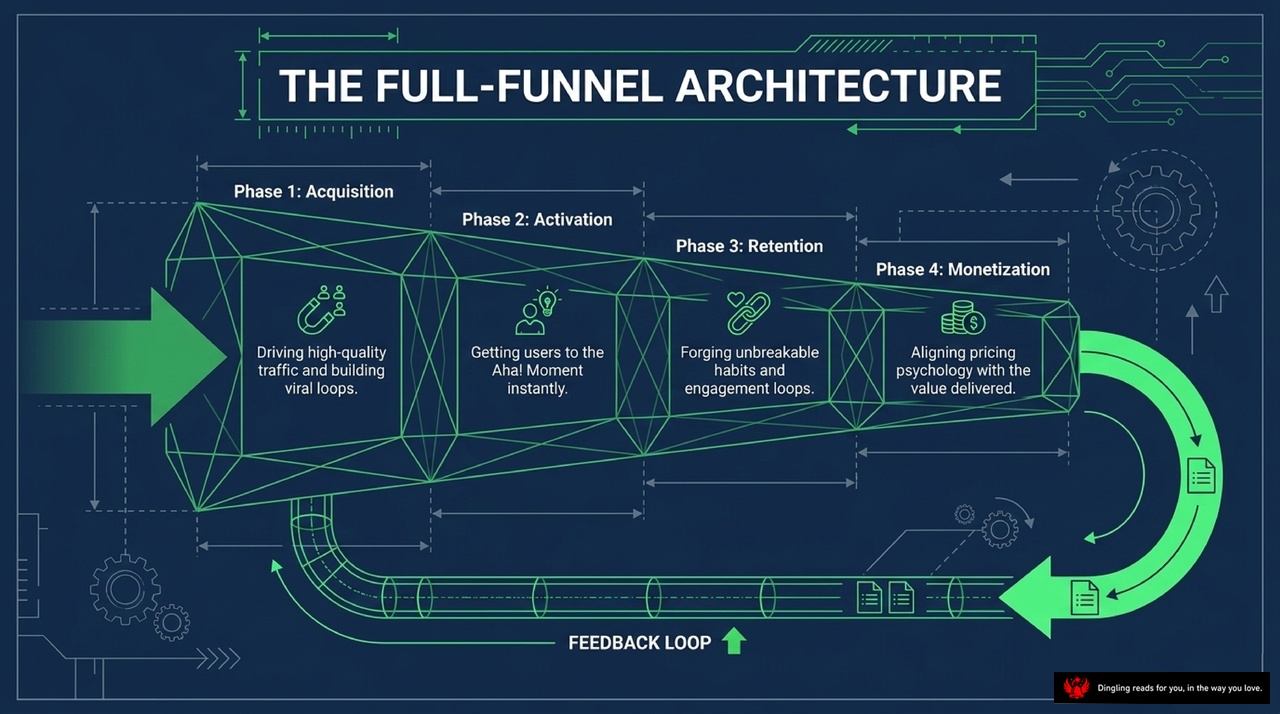
The engine of growth isn't just about one big idea; it's a relentless, high-tempo cycle that never stops. Think of it as a machine with four moving parts, constantly turning to find your next breakthrough.
First, you **Analyze**. You dive deep into user data and surveys to uncover real behavioral insights, moving beyond gut feelings to find where your users actually struggle or shine.
Next, you **Ideate**. Armed with those insights, you populate your idea pipeline with cross-functional brainstorms. This is where engineers, marketers, and designers collide to generate hypotheses.
Then, you **Prioritize**. Not every idea is equal. You objectively rank them to maximize ROI, often using frameworks like ICE—Impact, Confidence, and Ease—to ensure you're testing what matters most.
Finally, you **Test**. This is the fuel. You execute rapid, small-scale experiments at a weekly cadence. You launch, measure, and learn. If an experiment works, you scale it. If it fails, you learn why and move to the next idea.
This cycle repeats endlessly. It's how you turn guesswork into a predictable, scalable system for growth.
Stop chasing vanity metrics and start hunting for the real gold: your North Star Metric. This isn't just a number on a dashboard; it's the single metric that truly matters for your business's survival and success. Think about it: if you can't define what "success" looks like in one clear number, how can you possibly align your entire team?
Take eBay, for instance. Their North Star is Gross Merchandise Volume. Why? Because it directly reflects the transaction activity and satisfaction of both buyers and sellers. It's the heartbeat of their ecosystem. WhatsApp doesn't care about daily active users; their North Star is the number of messages sent. That's the core value of their service. Airbnb focuses on room bookings, not just website visits.
Choosing the right North Star requires three non-negotiable standards. First, it must be tightly linked to the core value you deliver to users. Second, it has to be quantifiable and trackable so you can monitor progress over time. Third, and most importantly, it must drive collaboration. When this metric is set correctly, marketing, engineering, and product teams stop working in silos and start pulling in the same direction.
But here's the catch: this metric isn't set in stone. As your company evolves, your North Star should too. Facebook, for example, shifted from monthly active users to daily active users as their advertising business matured. So, don't treat your North Star as a permanent badge. Keep it under review, ensure it aligns with your current business goals, and be ready to pivot when the landscape changes. Avoid the trap of vanity metrics like raw user counts that look great but don't actually drive revenue or retention. Stay focused on the one thing that truly moves the needle.
User retention is the heartbeat of your product's lifecycle, and it evolves through three distinct stages: early, mid, and long-term. In the early stage, users are still testing the waters. If they don't experience that "Aha!" moment repeatedly within a few days or weeks, they're likely to leave. Think of Pinterest: if new users visit fewer than three times in their first two weeks, their chance of staying drops dramatically. So, your immediate goal is to keep the momentum from activation alive, ensuring they hit that core value again and again.
Once they cross that initial threshold, you enter the mid-term phase. Here, the novelty wears off, and usage becomes a conscious choice. The real challenge shifts to habit formation. You want users to reach for your product automatically, like checking Amazon before shopping or scrolling Snapchat during lunch breaks. This is where you build "engagement loops." You can do this by reinforcing positive feedback—offering actual rewards like discounts or points, but also experiential rewards like social validation, badges, or public recognition. A powerful strategy here is turning your core users into brand ambassadors. Programs like Yelp's Elite list or The Skimm's ambassador initiatives show that when users feel valued and part of an exclusive group, they naturally become your most vocal advocates, driving both retention and acquisition.
Finally, long-term retention tests whether your product can keep delivering value as the market changes. You must balance refining existing features with introducing new innovations. But be careful not to fall into the trap of "feature bloat," which can actually hurt your user experience. You also need to identify and reactivate your "zombie users"—those who signed up but have gone silent. Instead of blasting them with generic emails, dig into why they left. Did they forget? Did the product stop solving their problem? Use personalized triggers, like reminding them of a saved item on sale or highlighting a new feature that solves their specific pain point, to bring them back. Remember, the goal isn't just to wake them up, but to re-ignite their belief in your product's value.

Welcome back. Today, we're diving into the engine that drives viral growth: The Viral Equation.
As you can see on the screen, we are in Phase 1: Engineered Acquisition. The core formula is simple but powerful: Virality equals Payload times Conversion times Frequency. Think of this as a machine where every gear must turn perfectly for the product to explode.
Let's break down these three components using the real-world case studies right here on the slide.
First, look at the Payload. This is the value you give the user for sharing. The classic example here is Hotmail. They used a passive payload—just a simple sign-up link embedded in every sent email. It wasn't flashy, but it was everywhere. On the other side of the spectrum, we have Dropbox. They perfected the two-sided incentive, offering 250MB of free storage to both the referrer and the invitee. This perfectly aligned the reward with the product's core value of file storage.
But a great payload isn't enough. You also need high Conversion. This is the percentage of people who actually sign up after receiving that invite. If your message is confusing or the sign-up process is clunky, your conversion rate drops, and the viral loop breaks.
Finally, we have Frequency. This is how often your users share. Even if your payload is amazing and conversion is high, if your users only share once and then stop, your growth will stall. You need to encourage them to keep spreading the word.
Hotmail and Dropbox both mastered this equation. They didn't rely on expensive advertising; instead, they engineered a system where every user became a salesperson. By optimizing the value of the share, the ease of signing up, and the habit of sharing, they turned their products into self-sustaining growth machines.
Remember, virality isn't magic—it's math. Get these three numbers right, and you unlock exponential growth.

Growth isn't a straight line; it's a cycle. Once you've optimized your acquisition channels and activated users, the real test begins: retention. As this slide outlines, we need to move beyond the initial "Aha!" moment and build a lifecycle that keeps users coming back.
The key here is understanding that retention isn't a single event but a journey divided into three distinct phases. In the early stage, typically the first week for apps or up to 90 days for e-commerce, the goal is simple: get them to experience that core value repeatedly. If a user doesn't hit that "Aha!" moment within this window, they are likely to churn. This is where your onboarding and triggers need to work hardest.
Once they pass that initial hurdle, we enter the middle stage. Here, the novelty wears off, and the challenge shifts from getting them to use the product to making it a habit. Think about Amazon Prime or Snapchat—these aren't just tools; they are woven into daily life. The strategy here is about reinforcing positive feedback loops, whether that's through actual rewards like discounts or experiential ones like social validation.
Finally, there's the long-term phase. This is where you prove your product's enduring worth. It's no longer about fixing bugs or onboarding; it's about continuous innovation and personalization to keep the experience fresh. If you stop evolving, users will leave.
But what about the "zombie" users—the ones who signed up but never engaged? Don't just ignore them. The goal is to wake them up by reminding them of specific value, like a discount on a saved item or a new feature that solves a problem they actually have. And remember, the ultimate metric isn't just how many people you get, but how long they stay. Because in the end, retention is the engine that drives sustainable, profitable growth.

Have you ever wondered why some triggers actually make us act, while others just sit there and fade away? The answer lies in the delicate balance between our motivation and our ability.
Look at this graph. It maps out "The Anatomy of a Trigger." On the horizontal axis, we have Ability—ranging from Hard to Easy. On the vertical axis, we have Motivation, from Low to High. The green curve cutting through this space is "The Action Line."
Here's the critical insight: For a trigger to work, it must land above this line. This is your "Success Zone." Triggers that fall above the line successfully prompt behavior because the user has both the desire to act and the capability to do so.
However, if a trigger falls below the line, it lands in the "Failure Zone," and the action simply doesn't happen. Think about it: if a task is incredibly hard to do—high friction—even having high motivation won't guarantee action. You might want to run a marathon, but if your legs are broken, you won't go. Conversely, if a task is super easy but you have zero motivation, you still won't do it.
This is why growth hackers design triggers only after increasing ability. By simplifying the user experience—making things easier to use, faster to load, or more intuitive—you shift the action line down. This expands your Success Zone, making it much easier for users to cross the threshold and take action. It's not just about pushing harder; it's about making the path clear enough that the user can naturally step through.

Phase 3: Retention & Habit Formation. The real game of growth isn't about getting new users; it's about making them stick. Retention requires a mental shift: moving users from relying on external prompts to building internal habits. Let's look at the classic engagement loop using Amazon Prime as our case study.
It starts with a **Trigger**: the customer simply wants a product. That leads to the **Action**: they buy via Prime. But what keeps them coming back? The **Variable Reward**. It's the immediate gratification of free two-day shipping. Every time they shop, that reward reinforces the behavior. Finally, comes the **Investment**. The $99 annual fee acts as a sunk cost that psychologically justifies returning to Amazon for every future purchase. This creates a behavioral monopoly, locking the user into the ecosystem.
When you design your product, don't just ask, "How do we get them in the door?" Ask, "How do we make them feel like they can't live without us?" That's how you turn a one-time buyer into a loyal habit.
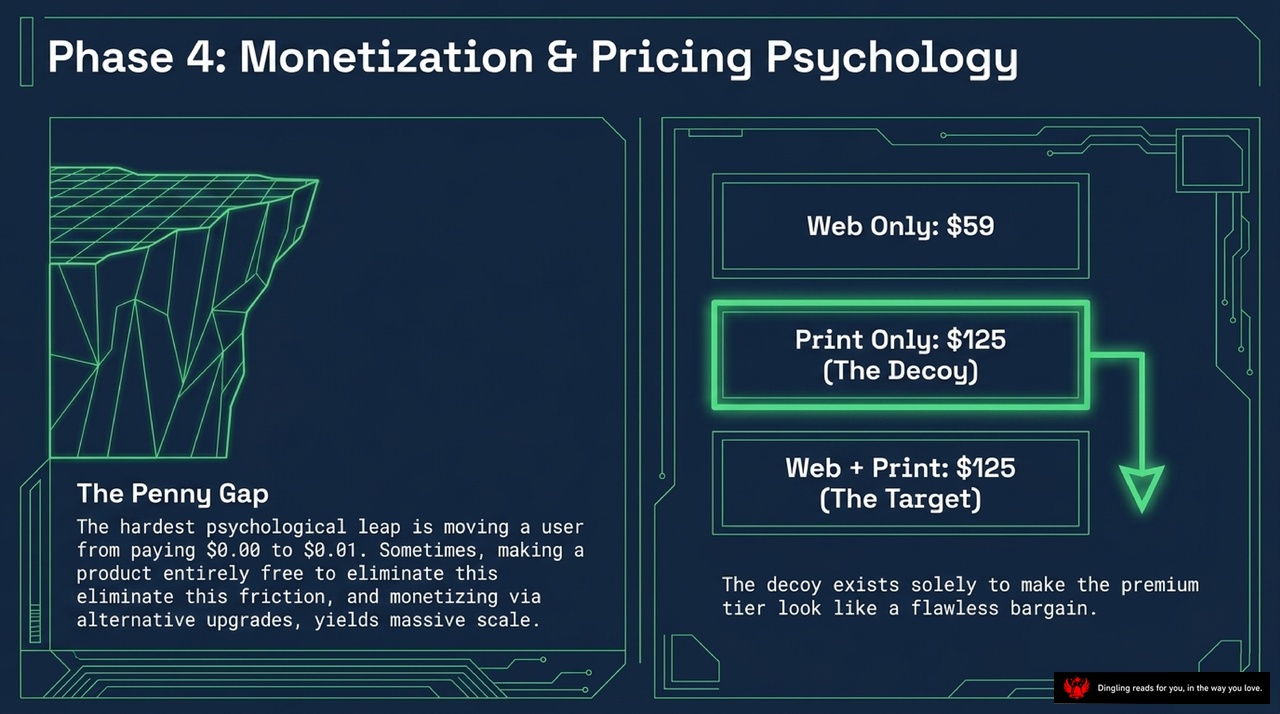
Phase 4 is all about monetization and pricing psychology. Look at the cliff on the left—that represents "The Penny Gap." Moving a user from paying zero to even one cent is the hardest psychological leap of all. Sometimes, the best way to eliminate that friction is to make the product entirely free upfront and monetize through alternative upgrades later. This strategy yields massive scale by removing the initial barrier to entry.
Now, look at the pricing tiers on the right. We see a classic "decoy" strategy in action. We offer a "Web Only" plan for $59, which is tempting but limited. Then, we place a "Print Only" option at $125. This is the decoy—it exists solely to make the final target look like a flawless bargain. When users see the $125 print-only option, the "Web + Print" combo at the same $125 price point suddenly seems like an incredible value because it includes everything they want without extra cost. By strategically positioning a slightly inferior option, we guide users toward the premium tier that drives our real revenue. This isn't just about setting prices; it's about engineering the choice architecture so the right answer feels obvious.

The image illustrates a powerful concept: sustainable growth isn't a straight line, but a rhythmic cycle of steady optimization and bold leaps. As the slide highlights, incremental tests combat stagnation, but periodic bold swings are required to achieve step-function leaps in scale.
Think of your business as a car. The "Micro-Optimizations," labeled as "The Steady Engine," are your daily maintenance—high-tempo A/B testing, tweaking copy, and adjusting button placements. These small, continuous improvements keep the engine running smoothly and prevent you from getting stuck. However, relying solely on this will only get you so far.
That's where "Macro-Innovations," or "The Fuel Injection," comes in. These are the moments you launch bold new features, expand into major markets, or create entirely new viral loops. Just like injecting fresh fuel allows a car to accelerate from a crawl to high speed, these bold moves are essential for breaking through your current growth ceiling.
The graph visually captures this dynamic. You see the baseline of constant, small fluctuations from your micro-optimizations. But look at the sharp spikes—those are your macro-innovations. They push your growth curve upward to a new level, creating a higher baseline for the next round of optimizations. Without these periodic, bold swings, you risk hitting a plateau where your steady efforts no longer yield significant results. True scale comes from balancing the reliability of your steady engine with the explosive power of your fuel injections.

Let's be honest: growth isn't a magic trick or a single marketing hack you can pull off once and forget. It's actually a systemic engineering discipline that requires breaking down the silos between your product, data, and marketing teams. You need to rely on hard data over gut intuition and test relentlessly.
So, what is the one assumption about your product that you are too afraid to test? The answer is simple: TEST.
Stop optimizing just for rented attention and start optimizing for the real value you deliver to users. Whether you are a startup or an established enterprise, the path to sustainable growth lies in building a flexible engine that covers the entire user journey—from acquisition to retention. Don't let fear of failure paralyze you. Instead, embrace the mindset of rapid experimentation, turn your user data into actionable insights, and keep iterating. Your growth strategy isn't about guessing; it's about building a system that learns, adapts, and scales.