
Has China Won?: Complete Chapter-by-Chapter Summary
Welcome to today's session. We are diving into Kishore Mahbubani's powerful analysis of the defining geopolitical rivalry of our time: "Has China Won? The Chinese Challenge to American Primacy."
This book isn't just about economics; it's a masterful look at how the 21st century's strategic choices will shape our shared future. The central question Mahbubani poses is whether China has truly won, or if the American challenge to its primacy is even the right frame for understanding our world.
As we explore these pages, we will examine the core arguments that challenge the traditional view of global power dynamics. We'll look at how the narrative of competition is being rewritten, and what the real stakes are for humanity. This is a conversation about the future, and it starts right here.

Let's look at the core dilemma driving today's global tension: an inevitable yet avoidable contest. The slide breaks this down into two opposing forces. On the left, we see "The US Fear." It's not just about economics; it's a psychological shock. After a century of dominance, the fear of losing the #1 global economic position is driving reactive, emotional policies. This is the "Yellow Peril" shadow—a deep-seated anxiety that China's rise is an existential threat.
On the right, we see "The Chinese Goal." The image shows upward-trending red arrows, symbolizing growth, but the text clarifies the direction: it's focused inward. China isn't trying to dominate the world or export an ideology. Their goal is national rejuvenation and improving citizen wellbeing. This creates the central paradox highlighted at the bottom: both nations are stumbling into a monumental conflict driven by emotion and assumption, rather than rational long-term strategy.
The slide makes a crucial point in the top banner: while the rivalry is driven by deep structural forces, it is not a zero-sum game. If the US focuses on its own competitiveness and China focuses on its people's welfare, they don't have to fight. Instead, they are trapped in a cycle where the US plays defense against a ghost, while China plays offense to build a better life. The tragedy, as the slide suggests, is that both sides are ignoring this opportunity for coexistence, letting fear dictate their future instead of logic.

America's Greatest Strategic Error isn't just a headline; it's a blueprint for failure. As this slide illustrates, the U.S. has entered the most significant geopolitical contest in history without a map. The core issue? A glaring lack of a comprehensive long-term strategy. Instead of a cohesive plan, the U.S. is reacting impulsively, firing off three distinct but disconnected arrows: tariffs, decoupling, and aggressive rhetoric.
Let's look at the bottom left, where it calls this "The Strategy Vacuum." Unlike the Cold War, where George Kennan engineered a meticulous containment strategy that actually worked, the U.S. is engaging China with tactical impulsiveness. Former Secretary of State Henry Kissinger confirmed this absence of a long-term plan. We are essentially playing chess by randomly moving pieces, hoping something sticks, rather than building a winning formation.
Then, look at the data point on the right regarding the "Failure of Tariffs." This isn't just theory; it's hard math. From 2009 to 2019, China's retail market tripled, growing from $1.8 trillion to $6 trillion. Meanwhile, the U.S. market grew slowly, only from $4 trillion to $5.5 trillion. When you enter a contest without a map, you aren't just losing ground; you're losing the game entirely. The U.S. needs to stop reacting with these three reactive tactics and start drawing the map first.

The slide highlights a critical strategic blunder: China's greatest error lies in alienating its most powerful potential allies for cooperation—American business leaders. The graphic vividly illustrates this disconnect, showing red arrows pointing away from China toward the US business community, symbolizing a fractured relationship. This misstep stems from a specific policy failure: by enforcing forced technology transfers and creating an uneven playing field, China inadvertently pushed away the very group that historically lobbied Washington for positive bilateral relations.
This approach triggers what the slide calls "The Middle Kingdom Risk"—a historical danger of closing off to the world. China thrives when open and integrated, but it stumbles when it adopts a self-sufficient, isolationist mindset. The text on the screen warns that by prioritizing protectionism over fair competition, China has lost the trust of the American business sector. These leaders, who once served as a bridge between the two nations, now feel marginalized. Instead of building a partnership based on mutual benefit, the focus on forced transfers and market barriers has created a wedge, turning potential collaborators into skeptics. This strategic miscalculation not only hampers economic growth but also weakens China's global standing, proving that even a rising power can falter by ignoring the fundamental need for open, inclusive engagement.

The slide titled "The Cold War Role Reversal" poses a chilling question: Is the US repeating the fatal mistakes of the Soviet Union? It presents a stark comparison across four strategic attributes.
Look at the decision-making style. The Cold-War USA was flexible and rational, but today, "USA Today" has become rigid and dogmatic, mirroring the USSR of the past. In contrast, China today is flexible and pragmatic.
Next, consider the military footprint. The Cold-War USA maintained a sustainable presence, whereas the USSR was bankrupting itself. Interestingly, "USA Today" has moved to an excessive footprint with 800 overseas bases, while China remains restrained with only 3.
Finally, look at diplomacy. The Cold-War USA built multilateral coalitions, but the current US approach is unilateral and alienating. Meanwhile, China is pursuing a multilateral path through initiatives like the Belt & Road.
This table suggests a dangerous irony: the US is adopting the very strategies that led to the Soviet Union's collapse, while China is quietly becoming the flexible, pragmatic power that history shows leads to long-term success.

Look at this slide. It highlights a critical flaw in America's current strategy: it's trying to fight tomorrow's war with yesterday's playbook. The comparison between Chess and Go perfectly illustrates this disconnect.
On the left, we see "The American Mindset," represented by Chess. It's all about speed and direct confrontation. The goal is simple: find the fastest route to capture the king. It's reactive, binary—either you win or you lose—and it relies heavily on immediate military deterrence. It's a game of quick kills.
On the right, we see "The Chinese Mindset," represented by Go. This isn't about a quick victory; it's about patience. The strategy focuses on patiently accumulating assets to slowly tilt the balance of power over time. It prioritizes long-term economic integration and defensive consolidation rather than direct confrontation. It's a game of building influence.
The slide warns us that misunderstanding the opponent is dangerous. If the U.S. continues to play Chess while the world is shifting toward Go, it risks losing the game before it even starts. The danger lies in using an old strategy designed for a different era to face a new kind of competitor. To succeed, the U.S. needs to stop viewing competition as a binary win-lose battle and start thinking in terms of long-term accumulation and strategic depth. Only by understanding this fundamental difference can they hope to level the playing field.

Imagine a world where the U.S. State Department is outpaced by the military band, where ambassadors are political appointees rather than seasoned diplomats, and where 90% of a diplomat's time is spent fighting for instructions from Washington instead of negotiating on the ground. This is the reality of American foreign policy today, and it is a direct result of a structural imbalance that has crippled U.S. influence.
Look at the numbers: the military budget is exploding, while the State Department's budget is being slashed. Former Defense Secretary Gates bluntly noted that the number of musicians in the military band now exceeds the number of professional diplomats. This isn't just a budget line item; it's a philosophical shift. The U.S. is treating global competition like a battlefield rather than a negotiation table.
This imbalance has led to the politicization of diplomacy. Ambassador positions are increasingly used as rewards for political donors rather than appointments based on expertise. Talented career diplomats are sidelined or fired, as we saw with the case of Mary Yovanovitch in Ukraine, who was removed for sticking to her professional principles. When the best minds are driven out, the system collapses from the inside.
Furthermore, the U.S. has lost its art of compromise. As the sole superpower, it grew arrogant, refusing to listen or adapt. Diplomats now spend their days in a loop, justifying rigid orders from the White House that leave no room for flexibility. This rigidity makes the U.S. an unattractive partner in negotiations.
The result is a steady decline in American soft power. The machinery of diplomacy is broken, replaced by a blunt instrument of force that fails to address the complex challenges of the 21st century. If the U.S. wants to compete with China effectively, it must stop treating diplomacy as a secondary function and start rebuilding the very institutions that make the world work.

The "Assumption of Virtue" Blind Spot is a dangerous cognitive trap that is quietly reshaping global geopolitics. As the slide illustrates, the belief in inherent American goodness creates a disconnect between how the U.S. sees itself and how the rest of the world sees it. This "American Exceptionalism" blinds policymakers to global resentment, leading them to assume their foreign policy naturally aligns with the world's desires. In reality, when the U.S. weaponizes the dollar or unilaterally abandons treaties, it often interprets these actions as virtuous leadership. However, the rest of the world sees a self-serving actor who underestimates the opposition while overestimating global loyalty. This fundamental misperception is turning allies into adversaries and accelerating the very decline it tries to prevent.

The Paradox of Chinese Governance isn't just a label; it's a mirror reflecting a reality that defies the old Western playbook. On the left, we see "Centralized Political Control," a concept the West often equates with oppression and inevitable collapse. But look at the right side: "Economic & Personal Freedom." This isn't a contradiction; it's the new reality. The CCP has actually overseen the greatest expansion of economic mobility in Chinese history. Think about this: 134 million Chinese tourists travel abroad every year, and they choose to come back. That's not forced loyalty; that's voluntary return because life at home is simply better.
This brings us to the most striking data point on the slide: Trust. While only 33% of Americans trust their government, a staggering 84% of Chinese citizens do. This isn't about propaganda; it's about results. When you prioritize lifting the living standards of the bottom 50% of your population rather than funding endless global military interventions, you build a foundation of genuine trust. The scale in the image isn't balanced in favor of freedom over control; it's balanced because the system delivers tangible prosperity. In a world where the West is struggling with polarization and declining trust, China's model proves that you can have order, stability, and rapid growth without sacrificing the core desire for a better life.

The world simply refuses to pick a side. As this map illustrates, forcing nations to choose between the US and China ultimately isolates the nation making the demand. Look at Europe: they prioritize deep economic integration with China while remaining cautiously wary of tech monopolies. ASEAN is deeply integrated economically via the RCEP yet desires a US security presence to maintain regional balance. India serves as a democratic counterweight to China but remains fiercely independent, refusing to act as a simple US proxy. Even Australia, while tied to US security architecture, is critically dependent on Chinese economic demand. This global reluctance to align confirms that in a multipolar world, rational states will prioritize their own long-term interests over any single superpower's pressure. The era of forced alliances is over.

Synthesis: The Five "Non-Contradictions"
Look at this star-shaped diagram. It represents a powerful argument: beneath all the geopolitical noise and rivalry, the core interests of the US and China are fundamentally aligned. The author identifies five specific areas where the two nations are not actually contradicting each other.
First, consider National Wellbeing. The text argues that the primary mandate for both governments is improving the living standards of their citizens. While the US has struggled with stagnation for its bottom 50%, China has made massive strides in poverty reduction. Both sides, in their own way, are trying to lift their people up.
Second is Climate Change. This is an existential threat that no borders can ignore. The book emphasizes that both nations face the same shared dangers from a warming planet. If they focus too much on competition, they risk sinking together.
Third, Ideology. A common misconception is that China is trying to export communism. The text clarifies that China is not exporting an ideology; it is merely reviving its own civilization and focusing on its national interests. This removes the fear of a global ideological takeover.
Fourth, Civilization. The idea that different civilizations must clash is a myth. The author points out that diverse civilizations can intertwine and share global spaces without fighting. In fact, there is a strong potential for cultural exchange and mutual learning.
Finally, Values. Even though domestic political values differ, this does not preclude mutual respect on the global stage. We can have different systems and still cooperate on shared goals like counter-terrorism and global stability.
The central message here is clear: if we look past the rhetoric, there are five solid pillars where the US and China can find common ground. Recognizing these non-contradictions is the first step toward a more rational and stable future for both nations.
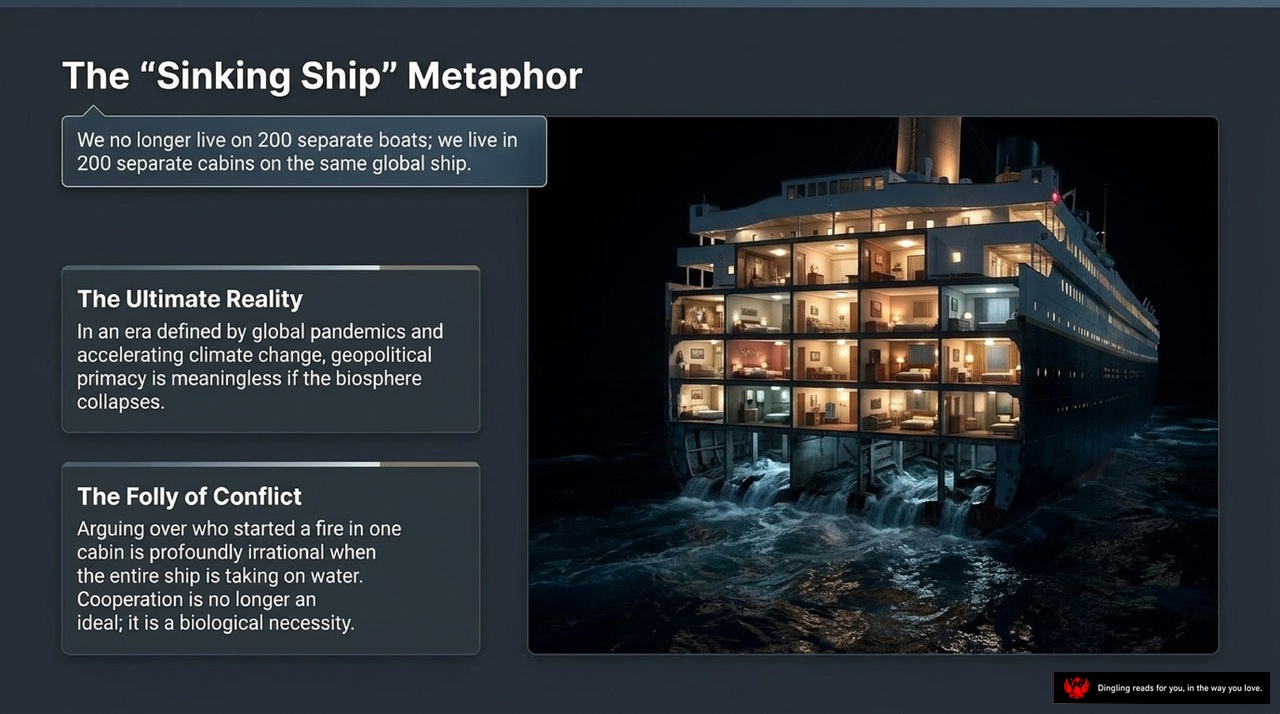
Look at this image of a massive ship sinking into the dark ocean. It perfectly captures the "Sinking Ship" metaphor that defines our current reality. We no longer live on 200 separate boats; we live in 200 separate cabins on the same global vessel.
This is the ultimate reality we face today. In an era defined by global pandemics and accelerating climate change, geopolitical primacy is meaningless if the biosphere collapses. When the ship is taking on water, arguing over who started a fire in one specific cabin is profoundly irrational. Blaming China for the flood or the US for the storm ignores the fact that the entire structure is failing.
When the whole ship is sinking, cooperation is no longer just an ideal; it has become a biological necessity. If we continue to fight over resources or territory while the water rises, everyone drowns. The only logical path forward is to stop bickering about which cabin is on fire and instead work together to plug the holes, stabilize the hull, and steer this fragile vessel to safety. Our survival depends on recognizing that we are all passengers on the same sinking ship, and our only chance is collective action.

The slide poses a profound question that cuts to the heart of our global future. It reminds us that while the rivalry between the U.S. and China is fueled by deep-seated anxieties, historical misunderstandings, and strategic blind spots, their core interests remain fundamentally aligned. Think of it this way: if the ultimate threat to both nations is the collapse of our shared global ecosystem, will we finally recognize our common humanity? Or will we continue fighting for the best cabin on a sinking ship?
This imagery of a sinking ship is not just a metaphor; it reflects the reality that neither country can afford to let the global system fail. The text challenges us to look past the noise of competition and ask ourselves: are we willing to cooperate to save the vessel, or are we too focused on outmaneuvering each other to notice the water rising around us? The answer to this question will determine whether the 21st century becomes a story of shared survival or mutual destruction.