
Hidden America: Complete Chapter-by-Chapter Summary

Welcome to *Hidden America* by Jeanne Marie Laskas. Imagine peeling back the floorboards of our modern civilization to reveal the invisible human labor that powers our everyday convenience. This book isn't just about jobs; it's about the hidden heroes keeping us alive. From the deep underground where miners dig the coal powering our homes, to the frozen tundra of Alaska where oil workers brave extreme cold, and even to the bustling streets where truckers and sanitation workers keep our society moving. These are the unsung stories of the people who work hard, often in dangerous or unseen conditions, so we can enjoy the comfort of daily life. Join us as we explore these hidden worlds and meet the remarkable individuals behind the scenes.
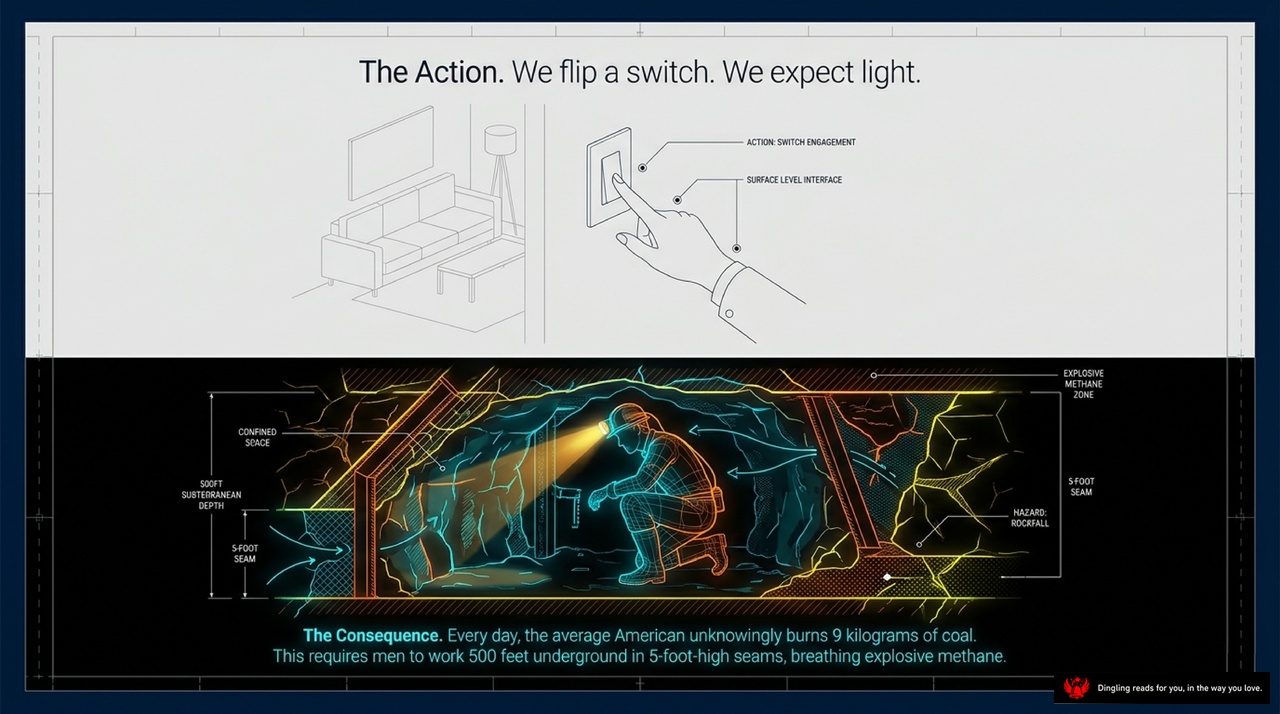
The Action. We flip a switch. We expect light. It's as simple as that, right? A tap, and illumination floods the room. But this slide reveals the hidden cost behind that effortless convenience.
Every time you flip that switch, you are unknowingly burning nine kilograms of coal every single day. That is the average American's daily contribution. But where does that coal come from? It requires men to work 500 feet underground in narrow, 5-foot-high seams. Imagine squeezing through a tunnel barely taller than a person, living in a confined space 500 feet beneath the earth's surface.
These aren't just numbers; they are the daily reality for miners breathing explosive methane while dodging the constant threat of rockfalls. They are the unseen heroes powering our modern lives, working in conditions that seem impossible to endure, yet they do it every day so we can simply flip a switch and expect light.

Welcome to the hidden architecture of convenience, a sprawling ecosystem that stretches from the frozen Arctic tundra down into the deep subterranean vaults beneath our feet. This isn't just a map; it's the invisible backbone of modern life, quietly powering everything we take for granted.
Look at the surface level first. This is Zone 1, Sustenance. Here, migrant farmers and cowboys work the fields and ranches, feeding the nation while the Alaskan permafrost stays locked at a bone-chilling minus 45 degrees right beneath them. Above, in Zone 2, Logistics and Safety, the sky and highways keep things moving. Air traffic control towers and eighteen-wheelers form a synchronized dance, ensuring food and goods reach your doorstep without a hitch.
But the real magic happens underground. In Zone 3, Fuel, we dive deep into coal mines and Alaskan oil rigs, battling extreme cold and darkness to extract the energy that lights up our cities. Finally, in Zone 4, The Aftermath, we send our waste down into 120-meter-deep landfills. Far from being just trash dumps, these subterranean vaults are engineered to turn waste into power, completing the cycle.
From the Arctic to the earth's crust, this hidden ecosystem works tirelessly, spanning every zone to deliver the ultimate convenience to your daily life.

Welcome back to the "Dingling Reads" book club. Today, we're diving into a chapter that feels like a rollercoaster of emotions, shifting from the high-stakes drama of the Super Bowl to the gritty reality of construction work.
Let's talk about Adria, the "Husky Lady." You might know her as the cheerleader who takes center stage on the big screen, the one with 60,000 eyes on her for just a few seconds. But before she was a star, she was pouring concrete on a construction site. She's the real deal, having spent eight years mixing cement and facing skepticism from male coworkers, all while balancing a full-time job and her studies.
Tonight is her big moment. She's the "Weekly Best Cheerleader." But just an hour before the game, she was throwing up in a bathroom stall, completely out of control. She had to fight her way back to the field, ignoring the rain that ruined her makeup and hair. Yet, she didn't care. She danced with everything she had, letting her family cheer her on from the stands.
Here's the twist: after that perfect performance, she didn't put her photo in a frame. Instead, she tucked it away in a box in her closet. Why? Because the next morning at 6:00 AM, she had to wake up and go back to the construction site to pour more concrete. It's a powerful reminder that behind every moment of glory, there's a lot of hard, unglamorous work waiting.
Adria's story shows us that the cheerleaders aren't just there for the fans. They're chasing a unique kind of honor, proving that you can be a tough worker and a perfect performer, all while keeping your head down and your heart strong.
Welcome to the world of air traffic control, where the view from the tower is a high-stakes game of life and death. Picture this: you're inside the old, cramped control tower at LaGuardia Airport, a place that feels more like a hangar than a command center. The air is thin, the AC is broken, and the roof leaks enough to warrant a bucket labeled "pee-pants" just to catch the water. Yet, from this dusty, cold room, a single controller named Gary is responsible for guiding nearly 300,000 passengers safely to their destinations every year.
It's a job born from tragedy. After a deadly 1956 crash in the Grand Canyon, the Federal Aviation Administration was created to prevent such disasters. But today, the system is under immense strain. With nearly 1,000 controllers retiring annually while demand soars, the gap is widening. To cut costs, the FAA has slashed training from five years to just two, leaving veteran controllers to mentor overwhelmed new hires. The result is a culture of burnout, where controllers are working six-day weeks, often forced to choose between their safety and their paycheck.
The tension isn't just about hours; it's about trust. The union and the FAA are locked in a cold war, each accusing the other of prioritizing profits over safety. Controllers know that fatigue is the enemy, yet they are often told that a quick nap during a break actually improves focus—a claim that remains fiercely debated. Then there's the technology. Instead of relying on modern screens, many still depend on faded green paper strips to track dozens of planes, a method that helps them avoid short-term memory overload but feels dangerously archaic in the digital age.
History reminds us why this precision matters. In 2009, when Captain Sullenberger miraculously landed a disabled plane on the Hudson River, saving 155 lives, the spotlight was on the pilots. But behind the scenes, controllers like Patrick Horton were racing against time, clearing runways and coordinating emergency responses with split-second decisions. Today, the pressure is even higher. With new towers taking decades to build and software projects running billions over budget, the human element remains the final line of defense. In a system where a single mistake can cost hundreds of lives, these unsung heroes in the concrete tower are the silent guardians keeping the sky safe, one flight at a time.

In the heart of Arizona's Yuma, the concept of a gun shop feels less like a restricted zone and more like a bustling, high-end sporting goods store. It's a world away from the anxiety I'm used to in the East. Here, buying a rifle is as routine as picking up laundry, and the air hums with a different kind of freedom.
My guide, Ron, immediately corrected my terminology, insisting there is no such thing as an "assault rifle" in their vocabulary—only "military-style" or "modern sporting rifles." The shelves are stocked with colorful boxes of ammunition that look like candy, and mounted coyote specimens hang proudly on the walls. The rules are simple: eighteen for rifles, twenty-one for handguns, and that's it. There are almost no restrictions.
This cultural shift hits hard when you consider the history of violence here. The 2011 Tucson shooting, where a gunman bought his ammunition at a Walmart, serves as a grim reminder of what's at stake. In that tragedy, a single cashier's refusal to sell bullets became the first line of defense against a mass shooting—a detail that feels lost in the East, where the focus is often on restricting access rather than empowering those on the ground.
Local shop owner Richard is proud of his family's legacy, operating this business for decades. He doesn't shy away from the fact that his store has been flagged for potential gun smuggling, but he emphasizes their vigilance against "straw purchasers." To him, owning a gun isn't about aggression; it's a personal responsibility to protect oneself, family, and country. It's a deeply ingrained belief here that without a firearm, you are sitting ducks.
The experience goes beyond just buying. I went to the desert range to try my hand at clay pigeon shooting, an activity that felt surprisingly like a night at the golf course. Then, I tried firing a new M&P15 rifle. While the gun felt incredibly easy to handle—so easy, in fact, that I jokingly considered buying something even cooler like an Uzi—the real impact was psychological. The sound of the gunfire, the recoil, and the immediate sense of control created a profound, almost cathartic relief. It wasn't about violence; it was about the confidence of being able to stop a threat instantly.
However, this freedom comes with its own burdens. The background check system, NICS, is a vital tool that has blocked hundreds of thousands of sales, but it's not perfect. Databases are often outdated or incomplete, allowing dangerous individuals to slip through the cracks. And for the average citizen, like me, carrying a concealed weapon becomes a source of constant anxiety. The fear of losing it, or having it stolen, hangs over every day. Even wanting to bring a gun to a school parking lot for safety results in a hard stop due to school policies.
Ultimately, my time in Yuma revealed a stark divide. To the locals, the gun is a tool of self-reliance and a symbol of liberty, a way to say "I am responsible for my own safety." To me, coming from a place where guns are stigmatized and often associated only with tragedy, it felt like crossing into a completely different reality. I left with a Glock in my bag and a mind full of questions, realizing that the gap between our two Americas isn't just geography—it's a fundamental difference in how we view the very nature of safety and freedom.

The Arctic tundra of the North Slope isn't just a harsh landscape; it's a sanctuary for some of America's most resilient workers. Imagine standing on a remote island, where the temperature plunges to minus 38 degrees and the sun refuses to rise for 56 days a year. Here, in the heart of the Beaufort Sea, lies the Prudhoe Bay oil field, the engine pumping 60% of the nation's domestic oil.
Meet "Dog," the drilling technician who has become the heart of this isolated camp. He's not just a worker; he's a father figure, a mentor, and a man fighting his own demons. For many of these men, this frozen wasteland is their last chance to escape broken homes or rewrite their pasts. Dog himself found redemption here after battling addiction, turning his pain into purpose. He watches over a diverse group of men, including "Kung Fu," a former gang member who has reinvented himself as a spiritual leader and a man named Brian.
But life down here is a high-stakes game. When a drill bit gets stuck two and a half miles underground, the stakes skyrocket. A single day of operation costs a quarter-million dollars, and the risk of a blowout is terrifying. Yet, amidst the danger and the monotony of a life spent between the drill rig and the mess hall, there are moments of pure joy. From the camaraderie of a shared ribeye steak on Sunday to the humor of a group dyeing their hair bright orange to mock a perfectionist coworker, these workers find ways to thrive. They are the unsung heroes keeping the lights on across America, proving that even in the coldest place on Earth, the human spirit can burn bright.

Look at this striking diagram of the North Slope oil rig. We are talking about a 36-acre man-made island floating in the freezing Arctic, where the temperature plunges to -45°C, with wind chills hitting a bone-numbing -72°C. Down there, workers live in a 36-acre man-made island, escaping broken pasts to find redemption in the cold.
The scale of their operation is immense. They drill down 2 kilometers into the earth, navigating a spiral path that seems to defy gravity. This isn't just about digging; it's about tricking Mother Nature into yielding oil. The workers manage steel pipes that twist deep underground, extracting 700,000 barrels of oil every single day.
Here lies the profound irony of their existence. The rig workers who extract this oil never actually see, touch, or smell it. They just manage the machinery that does the heavy lifting. They are the unseen hands, operating in a world of extreme isolation and danger, yet they are the lifeline for the entire nation's energy needs. It is a story of sacrifice, where the workers trade their comfort and safety for the fuel that powers our modern lives, all while battling an environment that would crush anyone else.
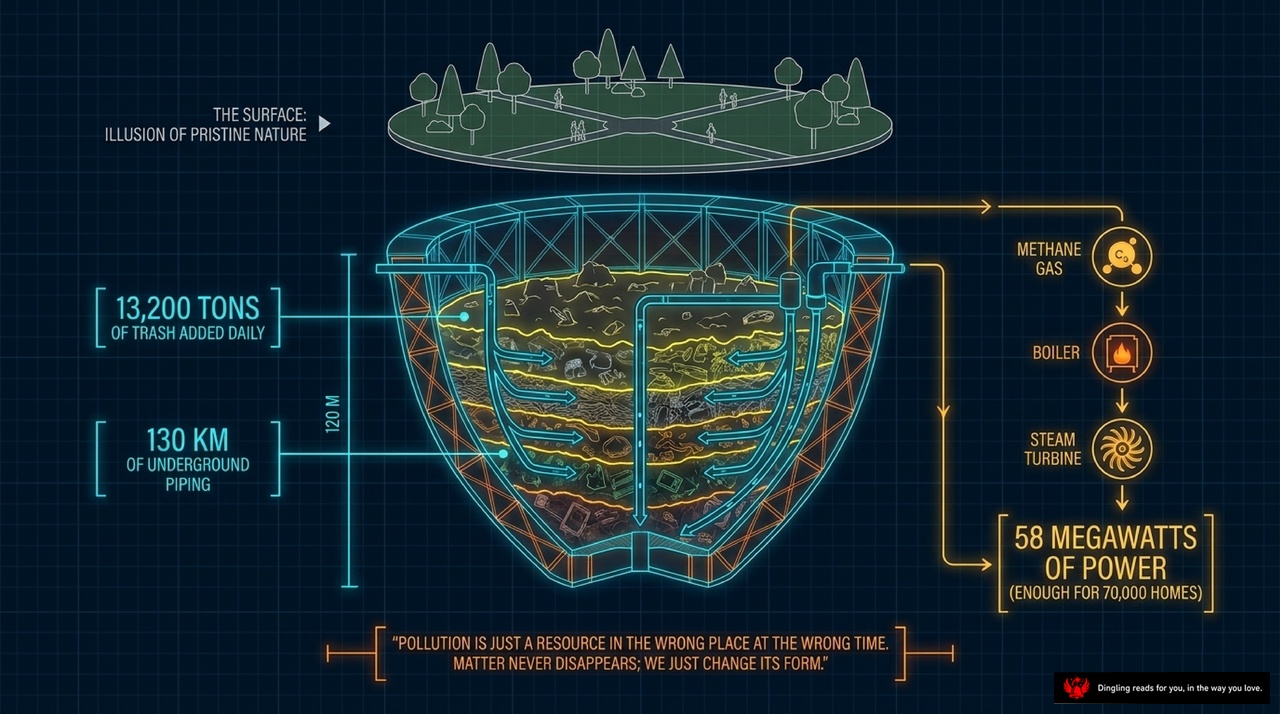
The surface of our planet often presents an illusion of pristine nature, a peaceful park where trees sway and people stroll. But beneath that green veneer lies a hidden, high-tech industrial engine: the landfill. This isn't just a hole in the ground; it's a massive energy facility. As the graphic illustrates, we dump an astonishing 13,200 tons of trash into these sites every single day. Over time, this waste accumulates to depths of over 120 meters, creating a complex ecosystem where organic matter rots and generates methane gas.
Instead of letting this potent fuel escape into the atmosphere, engineers have built an intricate network of underground piping—stretching over 130 kilometers—to capture this gas. This captured methane is then piped to a boiler, converted into steam, and spun through a turbine to generate power. The result? A single landfill can produce 58 megawatts of electricity, enough to power 70,000 homes. It transforms our biggest waste problem into a renewable energy source. As the quote at the bottom reminds us, pollution is simply a resource in the wrong place at the wrong time. Matter never disappears; we just change its form. By harnessing this buried energy, we turn our waste into a vital part of the grid, proving that even in the depths of the earth, there is power waiting to be unlocked.

Look at this grid. It maps out the invisible architecture of our modern world. On the surface, our lives are defined by simple consumer actions: flipping a switch, eating breakfast, flying home, or tossing a cup in the trash. But the slide reveals the stark, hidden reality behind these mundane moments.
When you flip a switch, you aren't just lighting a room; you are triggering a chain reaction that sends a coal miner into a claustrophobic 500-foot underground tunnel, working in a space barely five feet wide. When you eat breakfast, you are connecting to migrant farmworkers who are bending in the scorching sun for mere dollars a box. When you fly home, you rely on air traffic controllers managing high-stakes geometry with broken technology, bearing extreme psychological stress. And when you throw away a cup, you are relying on landfill operators driving 70,000kg compactors on precarious trash cliffs, facing isolation from a society that despises their work.
The slide highlights a profound paradox: the more successful these industries appear, the more invisible the human labor becomes. A perfect landfill looks like a nature park, and perfection in air traffic control equals total anonymity. Yet, this efficiency comes at a steep human cost. We see physical deterioration and claustrophobia for miners, undocumented shame for farmworkers, and crushing stress for those keeping our skies safe. This chart isn't just about jobs; it's a reminder that every convenience we enjoy is built on someone else's hidden sacrifice.

On the left, we see a schematic of the NFL cheerleaders, perfectly identical, labeled "The Visible Invisible." The text notes that while the league generates billions, these performers earn just $75 a game, striving to become a single, invisible entity hidden in plain sight. On the right, the image shifts to a lineup of assault rifles, part of "The Normalized Extreme." It highlights that 13 million hunters form the world's largest armed force, making buying a rifle as mundane as picking up dry cleaning—a worldview built on total self-reliance. These two images capture the book's core contrast: the suppression of the individual into a uniform spectacle in the sports world, versus the empowerment of the individual through the ownership of power in the gun culture. While one side seeks to erase the human behind the uniform, the other celebrates the individual's capacity to protect themselves, creating a stark divide in how Americans view their place in society and their relationship with authority and danger.
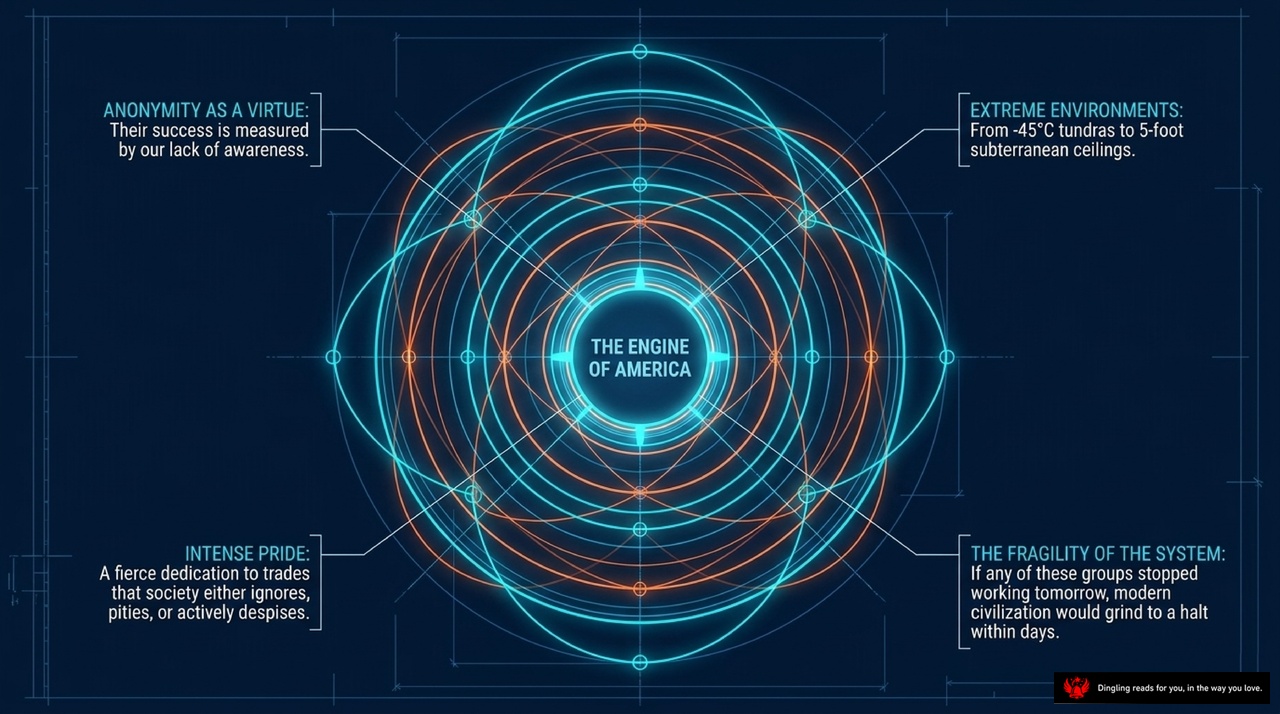
Look at the intricate web at the center of our modern existence. This isn't just a diagram; it's a map of the invisible gears that keep America spinning. At the core lies "The Engine of America," a system so complex and interconnected that its stability relies on four fragile pillars.
First, consider the extreme environments we've built. From -45°C tundras to five-foot subterranean ceilings, our infrastructure demands sacrifices in temperature and space that would break most systems. But what makes this engine truly unique is the people powering it. There is a fierce dedication to trades that society often ignores or even despises. Whether it's the anonymous miners in the dark, the truckers on the open road, or the sanitation workers burying our waste, their success is often measured by our lack of awareness. We don't see them; we just see the result.
Yet, this anonymity is a double-edged sword. It allows these groups to operate with a focus we can't match, but it also creates a terrifying fragility. The system is so tightly woven that if any single group stopped working tomorrow—be it the oil rig crews in the Arctic, the long-haul drivers, or the waste management teams—modern civilization would grind to a halt within days. We are all connected in a circle, and right now, we are standing on the edge of a very thin thread.

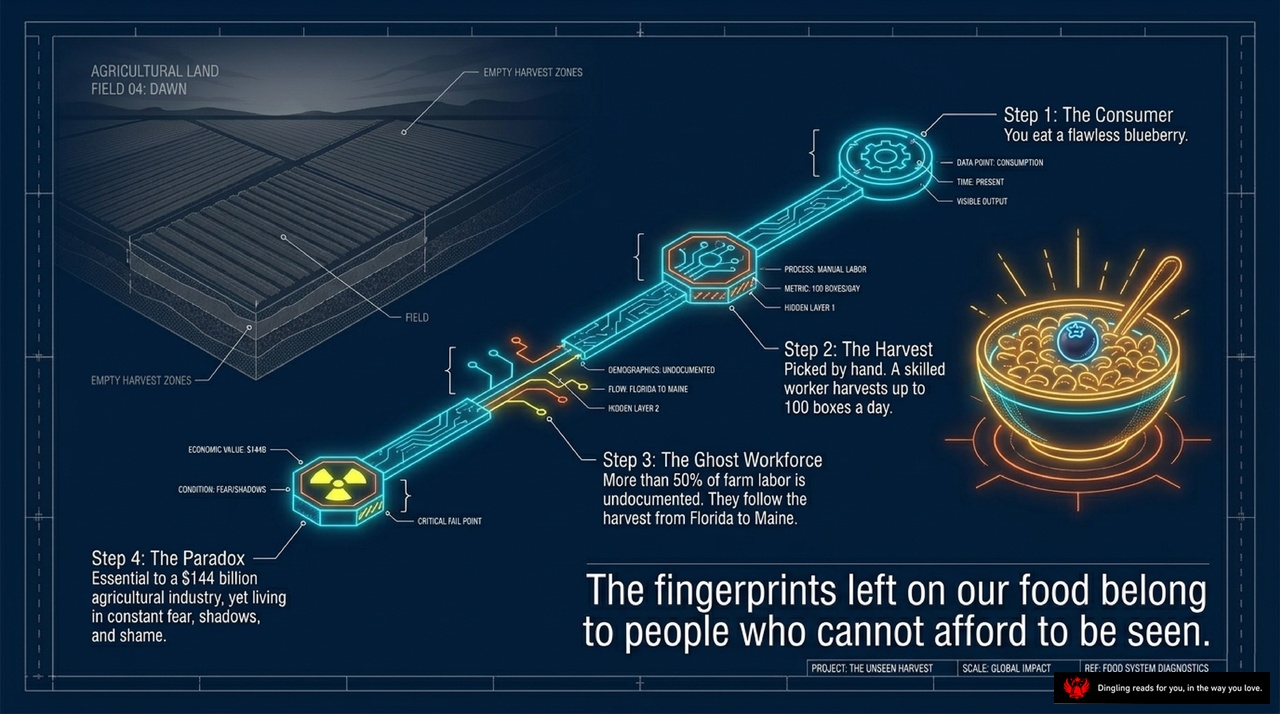
The modern world often feels like magic—a seamless flow of electricity, food, and convenience that we take for granted. But as we flip a light switch or toss out our trash, we are actually relying on a vast, invisible network of human sacrifice. Millions of anonymous individuals operate the complex, dangerous machinery of our daily lives, hidden safely behind the curtain of our comfort. They are the miners digging deep underground, the truckers driving endless miles, the oil workers battling the Arctic cold, and the sanitation crews managing our waste. We pretend not to see them, treating their labor as a distant abstraction. Yet, without their grueling, unseen efforts, our civilization would simply collapse. The next time you enjoy a simple meal or turn on a lamp, remember the real people whose lives power your convenience.