
Hidden Champions: Complete Chapter-by-Chapter Summary

Welcome to today's session on *Hidden Champions* by Hermann Simon. Imagine a vast, calm ocean at sunset. Beneath the surface, a massive creature swims silently—this is the metaphor for the world's most successful mid-sized global market leaders. They are the "Hidden Champions," as defined in this book.
These are not the flashy giants you see on every news feed. Instead, they are a strategic blueprint deconstructing the invisible operational DNA of these quiet powerhouses. While the world focuses on big corporations, these champions operate with a unique formula: they are the world or European leaders in their specific niches, yet they remain unknown to the general public.
Think of them as the secret weapon of Germany's global success. They are small by design but mighty in execution. The book reveals that these companies are not just lucky; they possess a distinct operational DNA that allows them to dominate narrow markets while expanding globally. Whether it's a company making every single pin used in Europe or manufacturing the lemon acid in every bottle of Coca-Cola, these leaders prove that being "hidden" is actually a superpower.
In the coming pages, we will peel back the layers to understand exactly how these companies achieve such extraordinary success without ever needing to shout for attention.

The Future Global Arena isn't just a map; it's a blueprint for where the world's economic gravity is shifting. Look at this triad defining the next two decades. First, we have the 2030 Triad. This is the undisputed First Group—nations like the US, China, and Europe—that are currently dominating global GDP. They are the established engines of today's economy.
But here's where the real story gets interesting. While the First Group holds the crown now, the future belongs to a different force: The 2050 Demographic Engine. The map highlights Africa in gold for a reason. Projections show the population there is set to double to nearly 1.99 billion. This isn't just a number; it's creating a massive, untapped frontier for growth that will redefine the global balance of power.
Finally, we have to look at the Export Reality. It's a common misconception that global trade is driven by the Fortune 500 giants. The data tells a different story. Germany's per capita export dominance, for instance, isn't driven by massive conglomerates, but by thousands of unknown, mid-sized market leaders. These are the "Hidden Champions"—the quiet architects of the global economy who operate in the shadows but hold the keys to the world's supply chains.
So, the future isn't about one winner. It's about the established giants of the 2030s, the explosive potential of the 2050s in emerging markets, and the incredible, specialized power of these mid-sized exporters who are quietly rewriting the rules of global trade.

The Tip of the Iceberg: Defining the Phenomenon. What makes a company truly "invisible" yet dominant? It all comes down to three non-negotiable criteria that separate the giants from the specialists.
First, Market Dominance. These aren't just players; they are the undisputed kings of their specific niches. They hold the top three global market share, or they are the number one player on their entire continent. In fact, they often command a staggering 70% to 90% of their niche. Think of it as being the only game in town, just on a global scale.
Second, Mid-Sized Scale. This is where the magic happens. Unlike the massive conglomerates everyone knows, these champions keep their annual revenue below €5 Billion. They are substantial enough to be powerful, but small enough to remain agile and focused. They are the "middle market" giants, avoiding the bloat that often plagues larger corporations.
Finally, Public Invisibility. This is the defining characteristic. These companies are largely unknown to the general consumer. They are obscured deep within complex B2B value chains. You might use their products every day without ever knowing their names. They don't need your attention because their customers—the world's biggest brands—already trust them implicitly.
So, the "Iceberg" metaphor is perfect. The visible tip is their market power and scale, but the massive structure beneath the water is their specialized focus and their quiet, unseen influence. They prove that you don't need to be everywhere to be the best somewhere.

Let's dive into the heart of what makes a "Hidden Champion" tick. Look at this matrix comparing the Fortune 500 giants to these niche powerhouses. The contrast is striking. While big corporations chase broad, diversified markets and rely heavily on outsourcing, Hidden Champions operate in extremely narrow niches with deep, in-house manufacturing capabilities. They don't just sell products; they own the entire value chain.
Notice how customer proximity differs. Big companies delegate this to middle management, creating distance, whereas Hidden Champions are led directly by their C-Suite executives. This ensures that leadership is always on the front lines, understanding exactly what the client needs. Their innovation model is also fundamentally different. Instead of spending huge sums for rare, high-risk breakthroughs, Hidden Champions achieve low-cost, continuous yield through steady, incremental improvements.
Finally, look at leadership tenure. Fortune 500 CEOs average a short-term tenure of about 6.8 years, often focused on quick quarterly gains. In contrast, Hidden Champions enjoy long-term leadership stability of roughly 20 years. This allows them to build lasting relationships and execute multi-year strategies without constant disruption. It's clear that while big companies trade stability for scale, these hidden champions trade scale for deep, sustainable focus and direct connection.

The strategic paradox that defines the "Hidden Champions" is simple yet profound: you must shrink to multiply. As the slide illustrates, sustainable dominance is born from the equation of extreme niche focus combined with global expansion.
On the left, we see "The Focus Constraint." This represents concentrating solely on a singular, narrow application or a specific customer need. It's about saying "no" to everything else to become an absolute expert in one thing. On the right, we have "The Global Multiplier." Because that niche is so small, survival demands selling to every single country on Earth. You can't just be the best in your town; you must be the best in the world.
When you combine these two forces, you get "The Result": a massive market size multiplied by the globe, fortified by specialization so deep that generic competitors simply cannot enter.
This approach flips traditional business logic on its head. Instead of trying to be a generalist everywhere, these companies find a tiny, specific problem—like making the perfect dog leash or a specific industrial component—and solve it perfectly for the entire planet. This strategy allows them to achieve scale without the bloat of a massive corporation, creating a fortress of dominance that is both incredibly focused and surprisingly expansive.
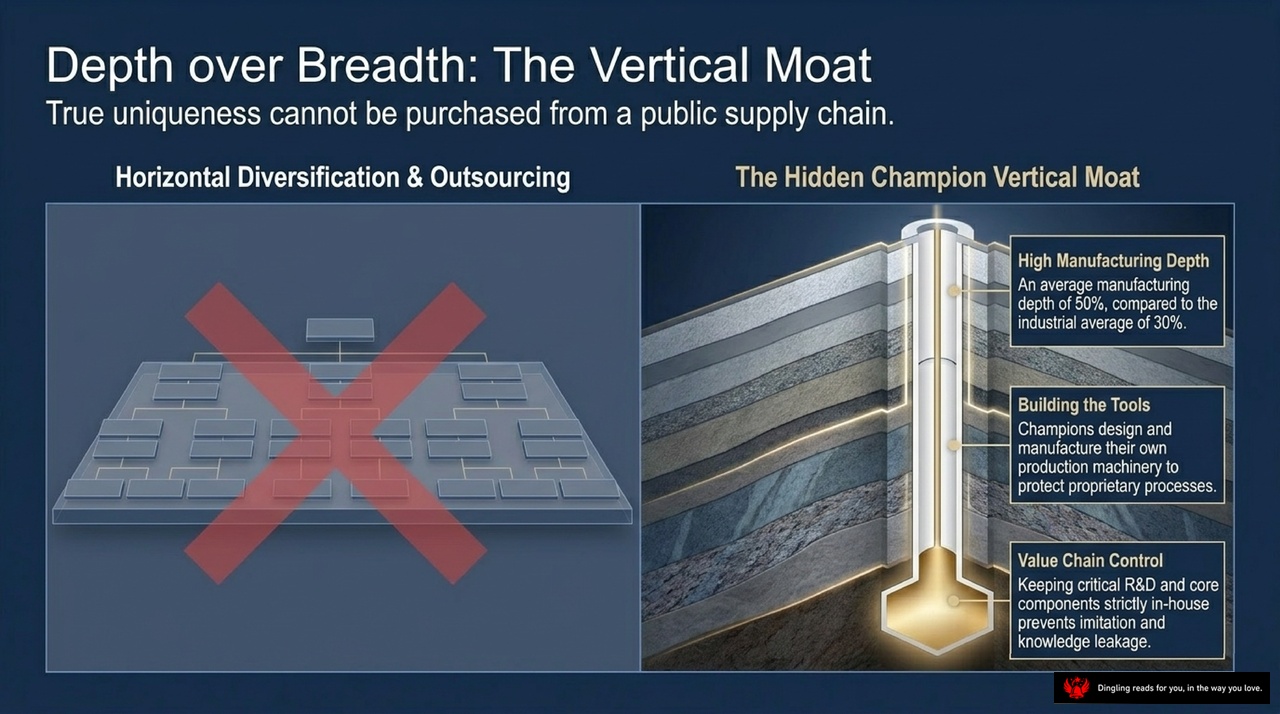
Real uniqueness cannot be purchased from a public supply chain, and that's the core lesson here. While many companies chase horizontal diversification and outsourcing—spreading themselves thin across too many products and partners—true Hidden Champions build a vertical moat by going deep.
Look at the contrast: on one side, you have the scattered network of outsourcing, which leaves you vulnerable. On the other, you have the power of vertical integration. This isn't just about owning factories; it's about control. Hidden Champions achieve an average manufacturing depth of 50%, compared to the industrial average of just 30%. They design and manufacture their own production machinery to protect their proprietary processes. Think of it as building your own tools; if you control the equipment, you control the quality and the speed.
Furthermore, by keeping critical R&D and core components strictly in-house, they prevent imitation and stop knowledge from leaking to competitors. This deep value chain control creates a fortress that is incredibly difficult for outsiders to breach. It's a strategic choice to prioritize depth over breadth, ensuring that your competitive advantage is rooted in what you do, not just what you buy.

Good morning, everyone. Today we're diving into the "Customer Proximity Web," a concept that reveals why the world's most successful "Hidden Champions" operate five times closer to their customers than massive corporations.
Look at the diagram on the left: the Standard Corporate Model. It's a tangled mess. You have the CEO, middle management, regional sales, and reps all weaving through layers of bureaucracy before they ever reach the client. It's a classic bottleneck where distance kills connection.
Now, look at the Hidden Champion Model on the right. It's incredibly simple. The Champion C-Suite connects directly to the Top-Tier Client C-Suite. No middle management, no red tape, just a direct, symbiotic relationship. This isn't just about being friendly; it's about strategy.
This direct link creates what we call "Symbiotic Dependency." These champions rely on their top clients, but those clients are equally dependent on the champions' unique, irreplaceable components. It's a partnership, not a transaction.
Furthermore, this model is "Top-Tier Driven." Serving the most demanding clients acts as an internal engine for continuous operational improvement. When you deal with the toughest customers, they push you to innovate and refine your processes constantly.
In contrast, the standard corporate model often relies on "C-Suite Integration" that gets bogged down by layers. Top executives bypass middle management only to get lost in the noise, whereas Hidden Champions integrate at the very top, ensuring that the vision of the leader matches the needs of the client instantly.
So, the takeaway is clear: true competitive advantage isn't found in scale or marketing budgets. It's found in the architecture of your organization. By flattening the hierarchy and placing the customer at the center of your decision-making web, you create a resilience and agility that large corporations simply cannot match.

Hidden Champions don't compete on being the cheapest; they win by delivering undeniable value. Look at this pyramid—it's a clear map of how they build that advantage.
At the very top sits **Premium Pricing Power**. This isn't about luck; it's the result of becoming an indispensable strategic partner. When you're essential to your client's success, price elasticity drops, and you can sustain a premium position.
Moving down, the middle layer is **System Solutions & Service**. The real competitive edge has shifted away from just selling a physical product. It's now about the extended services around it: consulting, deep integration, and rapid global servicing. This is where the real value gets created.
Finally, the broad base rests on **Top Quality & Deep Integration**. This is the foundation. It's built on an average Return on Assets of 14% and a robust equity ratio of 42%. These numbers aren't just accounting figures; they represent the strategic independence that allows these companies to weather storms and keep innovating.
So, the lesson is clear: true market leadership comes from building a fortress of quality and service, not from slashing prices. That's how you win on value.

Market leadership isn't about making one giant, disruptive leap; it's about the relentless power of continuous, microscopic improvements. This is the essence of the Innovation Flywheel. As we see in this diagram, it's a self-reinforcing cycle where every step fuels the next.
It all starts with **Customer Interaction**. These companies don't just sell products; they listen deeply. This direct feedback drives their **Rapid R&D**, ensuring they build solutions the market actually needs, not just what they imagine. Because they focus so intensely, their innovation is incredibly efficient. They achieve **5x More Patents Per Employee** compared to massive multinationals, proving that small, focused teams often out-innovate giants.
This efficiency creates a **Market Standard**. When you innovate faster and cheaper, you set the rules of the game. Competitors then try to catch up, which forces them to invest more, ultimately raising the bar for everyone. This standard becomes the new baseline, pushing the cycle forward to even higher levels of **Incremental Improvement**.
Finally, these improvements lead to a distinct **Cost Advantage**. Notice the text on the left: each patent costs only one-fifth of what it does for a multinational giant. Why? Because these companies are driven by elite, small teams rather than bloated bureaucracies. This lower cost allows them to reinvest more into the next round of innovation, keeping the flywheel spinning faster and faster.
So, the secret to sustaining market leadership isn't having the biggest budget; it's building a system where customer needs, rapid innovation, and cost efficiency feed into each other, creating an unbreakable cycle of growth.

Imagine a massive, gleaming anchor dropping into the deep blue sea. This isn't just a symbol; it represents the secret weapon of the world's most resilient companies. Today, we're diving into why two-thirds of these "Hidden Champions" are actually headquartered in rural areas or small towns, creating what experts call a powerful "cultural moat."
First, look at the anchor's top fluke. It points to "Hyper-Loyalty." In the corporate world, turnover is usually a nightmare, with the industrial average sitting at 7.3%. But for these rural champions? It's astonishingly low at just 2.7%. Why? Because their employees aren't just workers; they are part of the family.
This leads us to the middle section of the anchor: "Symbiotic Ecosystems." In these small towns, the company and the community are deeply intertwined. It's not just about a paycheck; it's about multi-generational employment. A father might work here, and so does his son. This intense corporate identification creates a stability that big-city corporations simply can't match.
Finally, look at the bottom part of the anchor, labeled "Zero-Tolerance for Passengers." This is about their lean organizational structure. They operate on a simple, powerful principle: "more work than people." They ruthlessly eradicate corporate bureaucracy. If a role doesn't add direct value, it gets cut. This forces a high-performance culture where everyone is essential.
So, the next time you think success requires a massive skyline or a sprawling headquarters, remember this anchor. Sometimes, the greatest advantage isn't size—it's the unshakeable stability of a small, focused, and deeply loyal team.
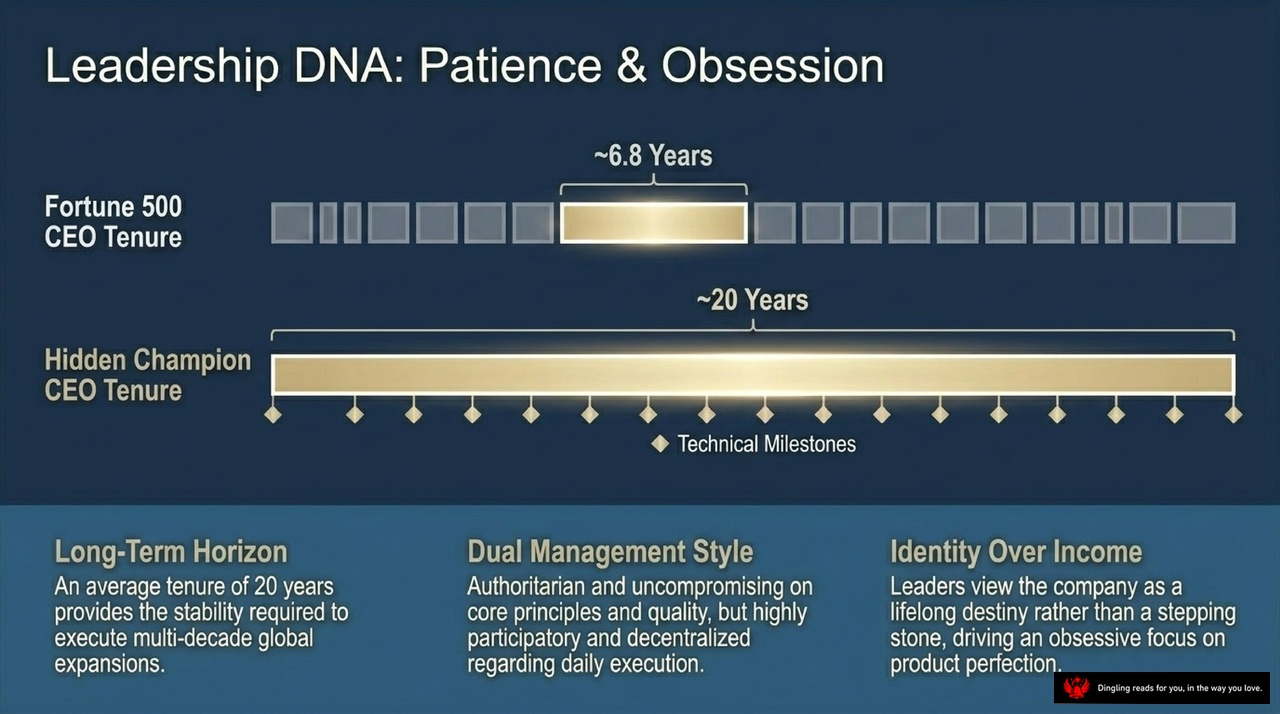
Leadership DNA: Patience & Obsession. Look at this timeline. While the average Fortune 500 CEO stays in office for just 6.8 years, the leaders of Hidden Champions often remain at the helm for nearly 20 years. That extended tenure isn't just about longevity; it's the foundation for a long-term horizon that allows them to execute multi-decade global expansions without the pressure of quarterly results.
But stability alone isn't enough. Their success comes from a unique dual management style. They are authoritative and uncompromising when it comes to core principles and quality, yet highly participatory and decentralized regarding daily execution. This creates a culture where innovation thrives under clear guidance. Perhaps most importantly, these leaders prioritize identity over income. They view the company not as a stepping stone for personal wealth, but as a lifelong destiny. This mindset drives an obsessive focus on product perfection, ensuring that every detail, from the smallest component to the final service, meets the highest standards. It is this deep, patient commitment that separates them from the rest.

Synthesis: The DNA of a Hidden Champion. You cannot copy their market share without copying their patience.
Look at this iceberg. What you see above the water—Global Market Dominance—is just the tip of the spear. Multinationals often fail because they try to buy the top of the iceberg, ignoring the submerged foundation that actually makes it uncopyable.
Below the surface lies the real secret: The Uncopyable Moat. It's built on three layers. First, you have Niche Focus, In-House Depth, and an Innovation Flywheel. These aren't just buzzwords; they represent the relentless, decades-long grind of refining a single craft. Second, deep down, you find Rural Talent Loyalty and 20-Year Leadership. This is the human element—stable teams and long-term vision that giants simply can't replicate.
Remember, true global dominance is just a trailing indicator of this operational depth. The giants fail because they chase the numbers above water, while the hidden champions build the roots below.

Look at this slide. It poses a bold question to any business leader: If your competitors are expanding horizontally, do you have the courage to drill vertically? This isn't just about strategy; it's about the fundamental philosophy of the "Hidden Champion."
The text on the screen highlights a critical truth: true market dominance isn't built on broad diversification or rapid outsourcing. Instead, it is forged through relentless focus, extreme operational depth, and generational patience. While the rest of the world chases the next trend, greatness is achieved by doing one difficult thing better than anyone else in the world.
Think about it. When your rivals are spreading their resources thin across multiple markets, the Hidden Champion chooses the opposite path. They reject the temptation to be everything to everyone. Instead, they double down on a specific niche, digging deep until they become the undisputed global leader in that exact corner. They prioritize vertical mastery over horizontal expansion.
This approach creates a unique advantage. By focusing intensely on a single, complex problem, these companies develop a level of expertise and operational efficiency that diversified giants simply cannot match. They don't try to compete on scale; they compete on superiority. They build a fortress around their core competency, making it nearly impossible for competitors to displace them, even when those competitors have more money or more brands.
So, the real challenge here is courage. It requires the discipline to say "no" to opportunities that don't align with your core mission. It demands the patience to invest years into perfecting a single product or service. It asks you to look at your competitors widening their net and decide whether you will instead sharpen your spear. The Hidden Champion philosophy proves that in a crowded world, the most powerful strategy is often the simplest one: find one thing you can do better than anyone, and do it relentlessly.