
Hidden Rules: Complete Chapter-by-Chapter Summary

Welcome to a deep dive into *Hidden Rules: The Real Game in Chinese History* by Wu Si. Today, we're peeling back the layers of a complex system where the real laws aren't written in books, but whispered in shadows.
This book isn't just about history; it's a systemic teardown of how unspoken cost-benefit calculations, rather than formal laws, actually dictate human behavior and drive organizational collapse. Imagine a world where the "rules" are invisible, yet more powerful than any statute.
Wu Si argues that beneath the surface of Chinese history lies a game played on hidden rules. It's about understanding the invisible forces that shape everything from imperial courts to modern offices. Whether you're analyzing historical empires or navigating today's corporate landscape, these unwritten dynamics often hold more sway than the official guidelines.
This is your guide to seeing the real game behind the scenes. Let's explore how these hidden mechanics have shaped centuries of power, and how they continue to influence our world today.
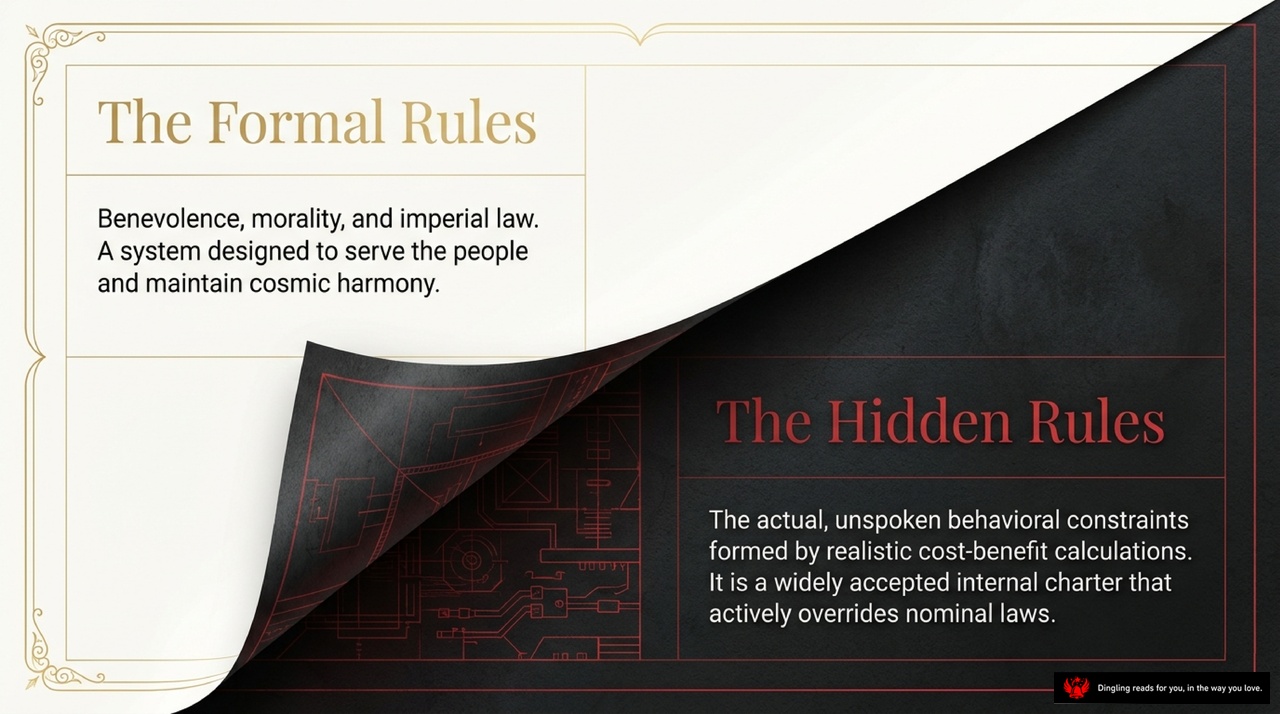
Let's peel back the curtain on how power really works. What we see on the surface—the formal rules of benevolence, morality, and law—is just the cover. Beneath that lies the hidden reality: the unspoken behavioral constraints shaped by cold, hard cost-benefit calculations.
Think of it as an internal charter that actively overrides the official laws. In this world, the "rules" aren't written in books; they are written in the silence between officials. When the formal system fails to protect the people, a shadow system emerges where everyone knows the real price of doing business. It's a widely accepted, unwritten agreement that dictates who gets what, who gets punished, and who stays silent.
This is the engine of the hidden rules. It's not about justice or fairness; it's about survival and profit within a closed circle. Whether it's avoiding a trap, securing a promotion, or simply getting through the day without trouble, everyone plays by this invisible playbook. The result? A system where the letter of the law matters less than the spirit of the deal.
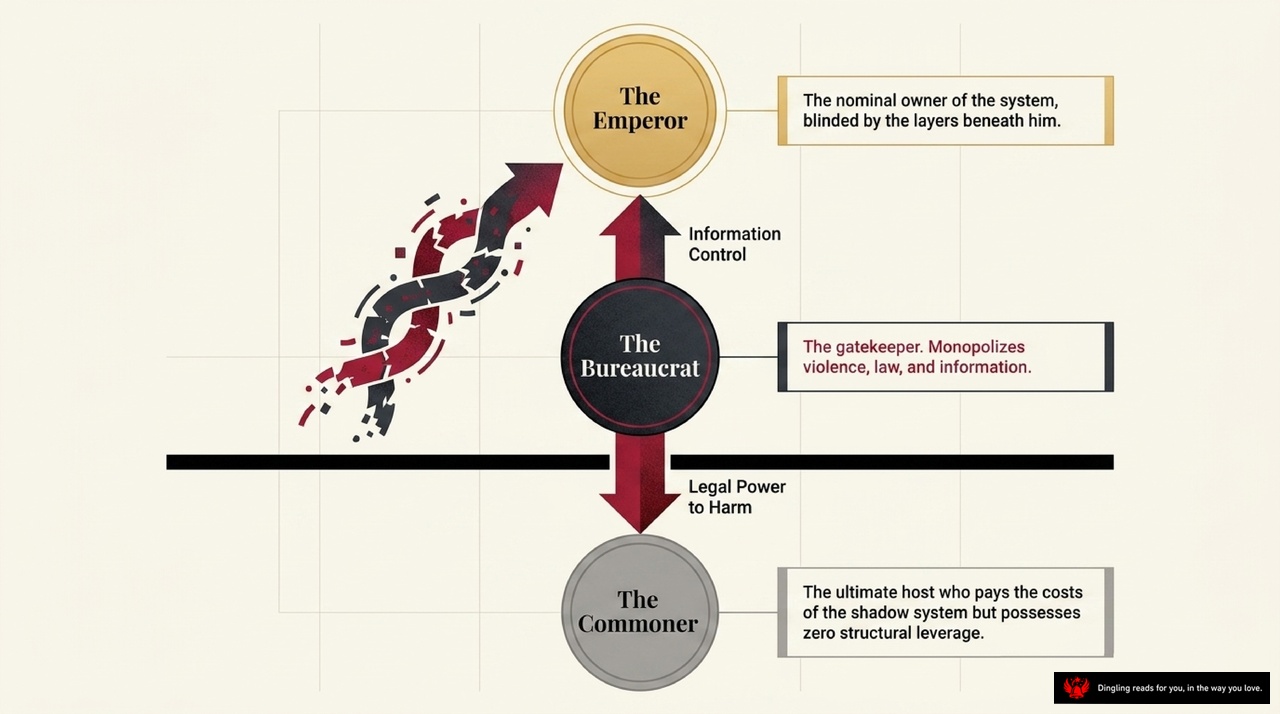
The Emperor sits at the very top, the nominal owner of the system, yet he is completely blinded by the layers beneath him. This isn't just a metaphor; it's the reality of information control. Between the ruler and the people stands the Bureaucrat, the true gatekeeper. This group monopolizes violence, law, and information, acting as a filter that distorts reality before it ever reaches the throne.
Below this line lies The Commoner, the ultimate host who pays the costs of this entire shadow system but possesses zero structural leverage. When the Bureaucrat uses legal power to harm, the Commoner bears the consequences. This dynamic creates a rigid hierarchy where the top is isolated in ignorance, the middle controls the narrative, and the bottom absorbs the shock. It's a system designed to keep the Emperor blind while the Bureaucrats thrive on the suffering of the many.
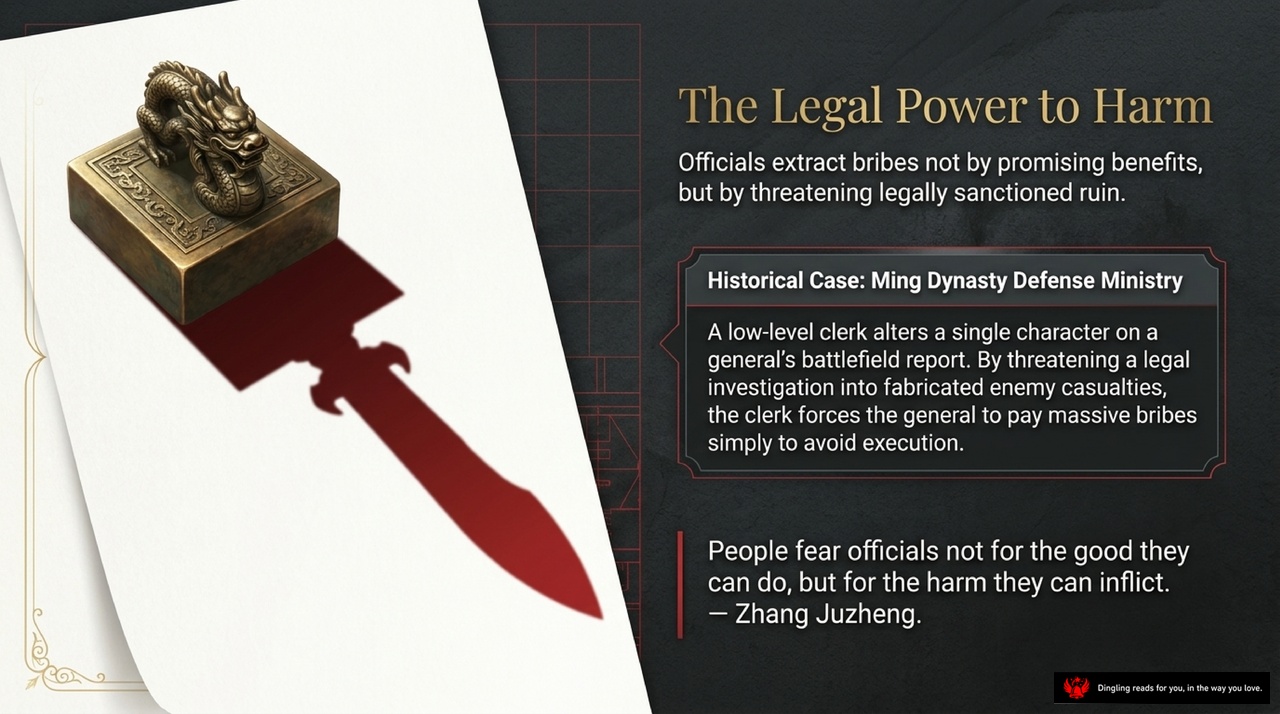
The Legal Power to Harm is one of the most chilling realities of traditional bureaucracy. It doesn't mean officials have the power to create something good; it means they hold the legal authority to destroy lives. As Zhang Juzheng famously observed, people don't fear officials for the good they might do, but for the harm they can inflict.
Look at the image on the left: that official seal isn't just a symbol of authority; it casts a shadow that looks exactly like a dagger. This visual perfectly captures the core message on the right: officials extract bribes not by promising benefits, but by threatening legally sanctioned ruin.
Consider the historical case of the Ming Dynasty Defense Ministry. A low-level clerk, holding a pen, altered a single character on a general's battlefield report. By threatening to launch a legal investigation into fabricated enemy casualties, he forced the general to pay massive bribes simply to avoid execution. The clerk didn't need to be a powerful general; he just needed the power to ruin someone's life through the law.
This dynamic creates a terrifying environment where the law becomes a weapon. When people realize that their safety depends on paying off the very people sworn to protect them, a system of "legal harm" takes root. It's a cycle where the ability to cause destruction becomes the primary currency of power, and everyone else is just waiting to be the next target.

Imagine a scale tipping dangerously to one side. On the light side, a single feather labeled "Zero Personal Cost" represents the magistrate. On the heavy side, a rusted anchor dragging a chain labeled "Total Annihilation" represents the citizen. This visual perfectly captures the brutal asymmetry of risk that defined our history.
Think about the magistrate. He operates the state's violent machinery for free, enjoying legal flexibility to interpret fuzzy laws and ruin anyone without ever risking his own wallet. It's a risk-free game for him. Now look at the citizen. If they dare to fight these hidden rules, the stakes are life and limb. They face torture, bankruptcy, or execution.
History isn't abstract; it's a ledger of blood. Take the Wujin Magistrate, who legally reopened a closed case just to punish a wealthy merchant for a bribe that was too small. He forced a concubine to suicide simply because the money wasn't enough. That is total annihilation for the victim, while the official walks away unscathed.
This imbalance creates a terrifying reality: the magistrate holds the power to hurt, but the citizen has no power to defend. It's a system where the cost of breaking the rules for the powerful is zero, while the cost for the powerless is everything.
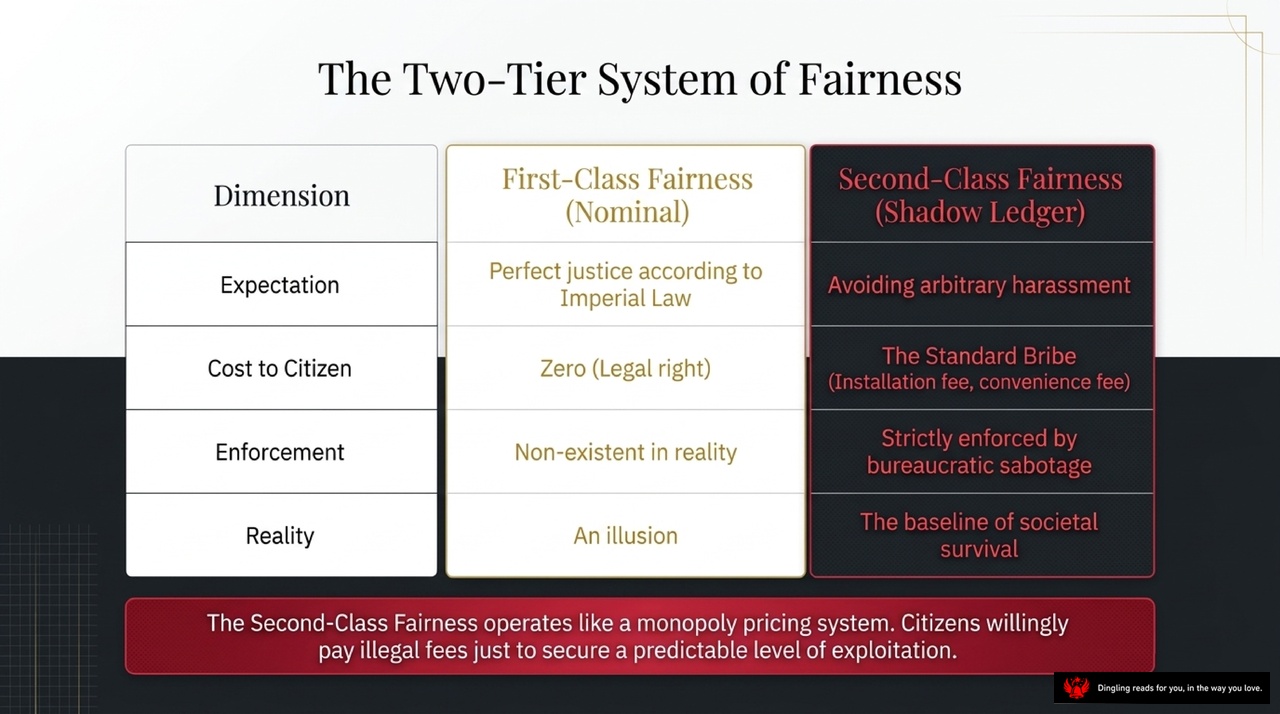
Today's slide reveals a stark reality: society isn't running on one set of rules, but on a "Two-Tier System of Fairness." On the left, we have "First-Class Fairness," or what we call Nominal Fairness. It promises perfect justice based on Imperial Law, zero cost for citizens, and a reality that is, quite frankly, an illusion. It's a beautiful lie that exists only on paper.
But look at the right side: "Second-Class Fairness," or the Shadow Ledger. This is where the real world operates. Here, the expectation isn't justice, but simply avoiding arbitrary harassment. The cost to the citizen isn't zero; it's "The Standard Bribe"—what we call installation fees or convenience fees. Enforcement isn't done by law, but by bureaucratic sabotage, strictly enforced to keep things predictable. And the reality? It's the baseline for societal survival.
The bottom line is crucial: Second-Class Fairness operates like a monopoly pricing system. Citizens willingly pay these illegal fees not because they want to be exploited, but to secure a predictable level of exploitation. It's better to pay a known price than to face the chaos of the unknown. This isn't about corruption in the traditional sense; it's about buying safety in a system where the law is too weak to protect you.
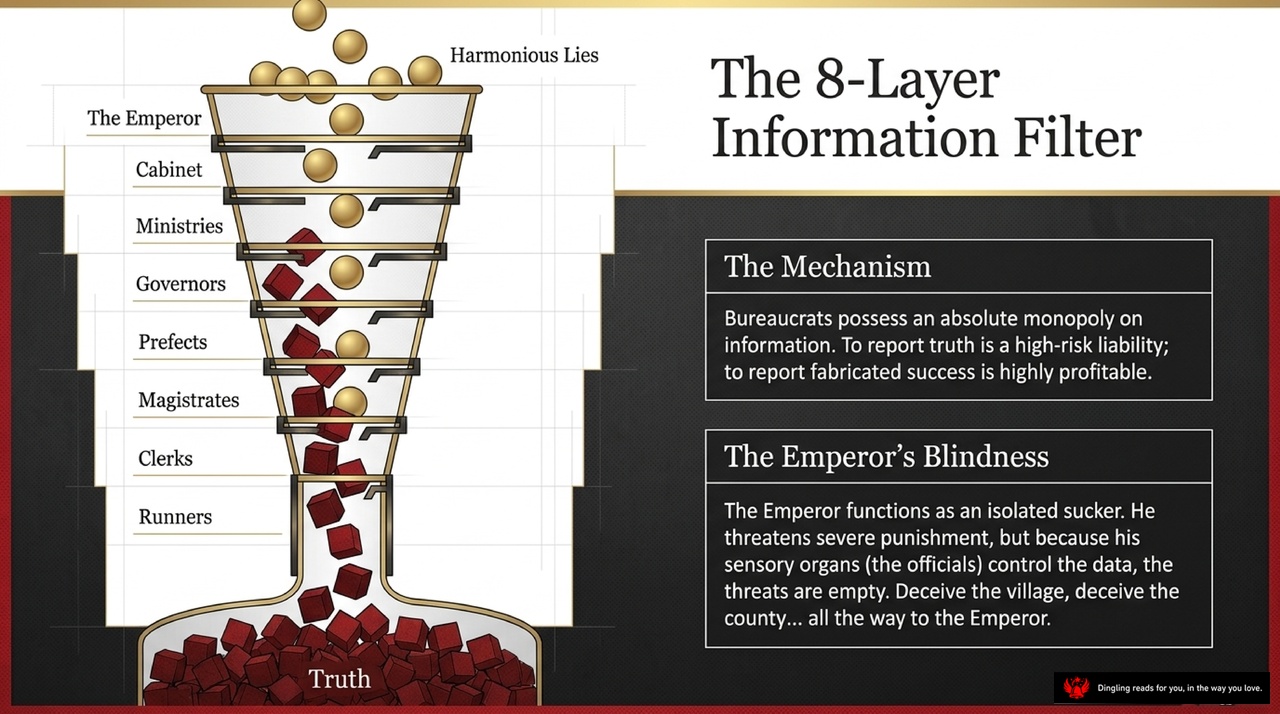
Imagine a funnel where truth starts at the top, but by the time it reaches the bottom, it's nothing but lies. This is the "8-Layer Information Filter," a powerful metaphor for how power works in traditional empires. At the very top, "Harmonious Lies" pour down from the Emperor's perspective. As these messages pass through the Cabinet, Ministries, and down to the Governors, Prefects, and Magistrates, the reality gets filtered out. Only the red cubes of "Truth" make it to the bottom, where the actual suffering of the people accumulates.
The mechanism behind this is simple yet brutal: bureaucrats hold a monopoly on information. Reporting the truth is a high-risk liability that could get them killed, while reporting fabricated success is highly profitable. It's a game where lying is the only way to survive. This creates what we call "The Emperor's Blindness." The ruler acts like an isolated sucker. He threatens severe punishment, but because his "sensory organs"—the officials controlling the data—are all part of the same corrupt system, those threats are empty.
The result is a cycle of deception. You deceive the village, the county, the province, all the way up to the throne. The Emperor remains completely unaware of the rot beneath his feet, surrounded by a wall of lies that no one dares to break. This isn't just about corruption; it's about a system designed to keep the truth from ever reaching the top.
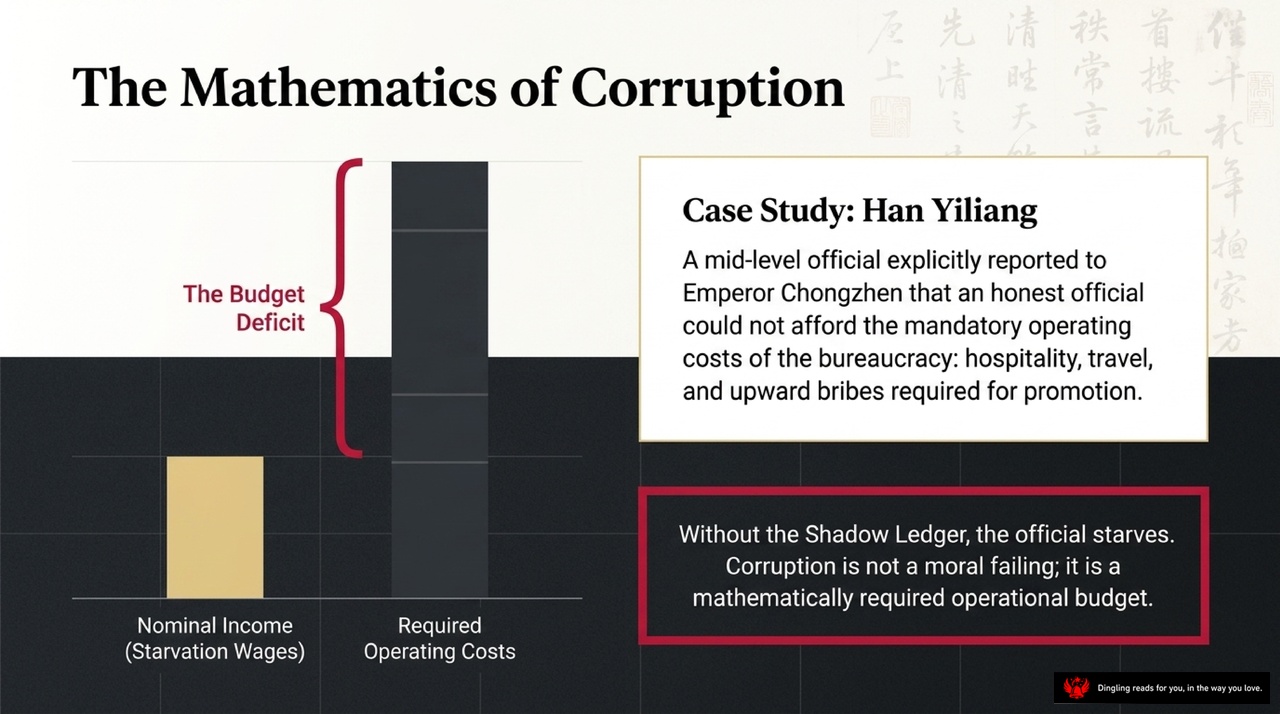
The Mathematics of Corruption isn't just about greed; it's a brutal equation where survival depends on breaking the rules. Look at the chart: on the left, you have the "Nominal Income," labeled here as "Starvation Wages." On the right, you have the "Required Operating Costs"—the mandatory expenses for bureaucracy like hospitality, travel, and the upward bribes needed just to get promoted. The red bracket highlights the gap between them: "The Budget Deficit."
This slide features a case study of Han Yiliang, a mid-level official who told Emperor Chongzhen a harsh truth: an honest official literally could not afford the costs of doing his job. Without corruption, the official starves. As the red box emphasizes, corruption is not a moral failing; it is a mathematically required operational budget. When the system pays you less than it costs to exist, the only way to stay in the game is to steal.
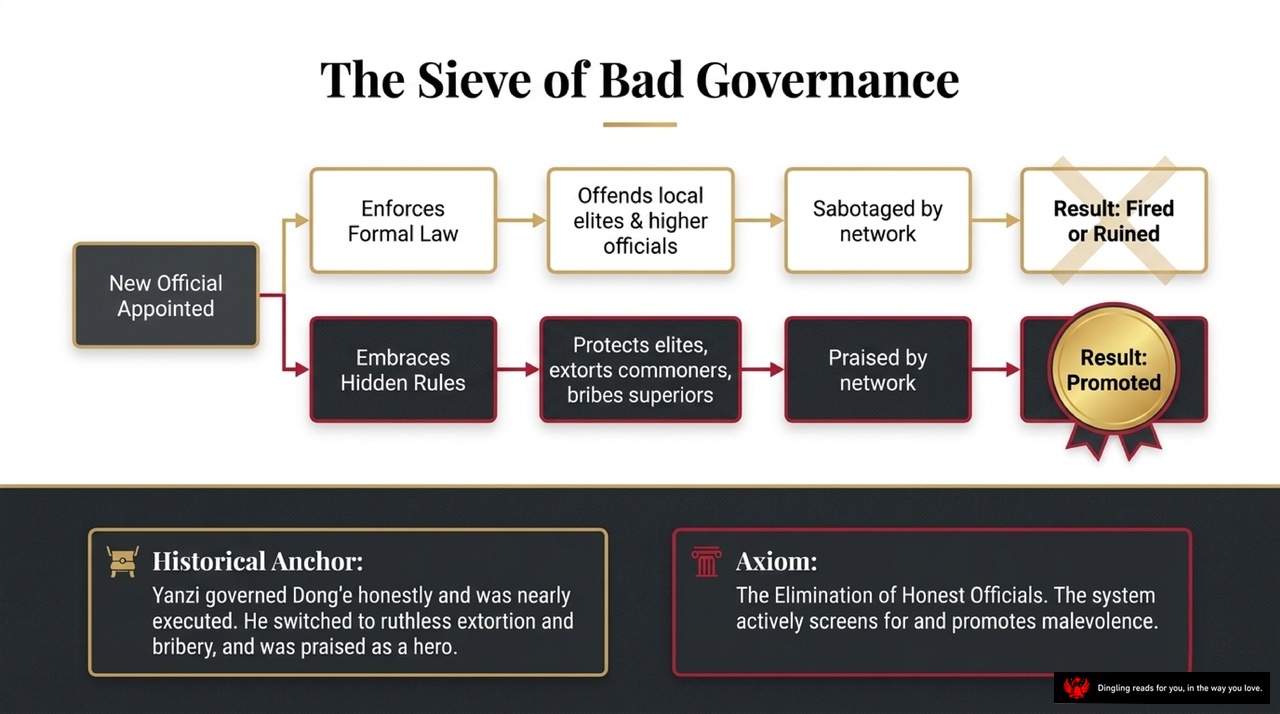
The slide illustrates a brutal reality: the "Sieve of Bad Governance." It shows that when a new official is appointed, they face a deadly choice. If they enforce formal laws and offend the powerful, the network sabotages them, leading to dismissal or ruin. But if they embrace hidden rules—protecting elites, extorting the common people, and bribing superiors—they get praised and promoted. This isn't just corruption; it's a system designed to screen out honesty and promote malevolence.
The historical anchor of Yanzi perfectly captures this trap. He governed Dong'e honestly but was nearly executed. To survive, he switched to ruthless extortion and bribery, and suddenly, he was praised as a hero. This aligns with our axiom: the elimination of honest officials. The system actively screens for and promotes those willing to do harm.
This dynamic creates a "legitimate right to harm," where officials use their power not to serve, but to create fear and extract resources. It's a self-reinforcing cycle where the most effective way to succeed is to become the very thing the system was supposed to prevent.
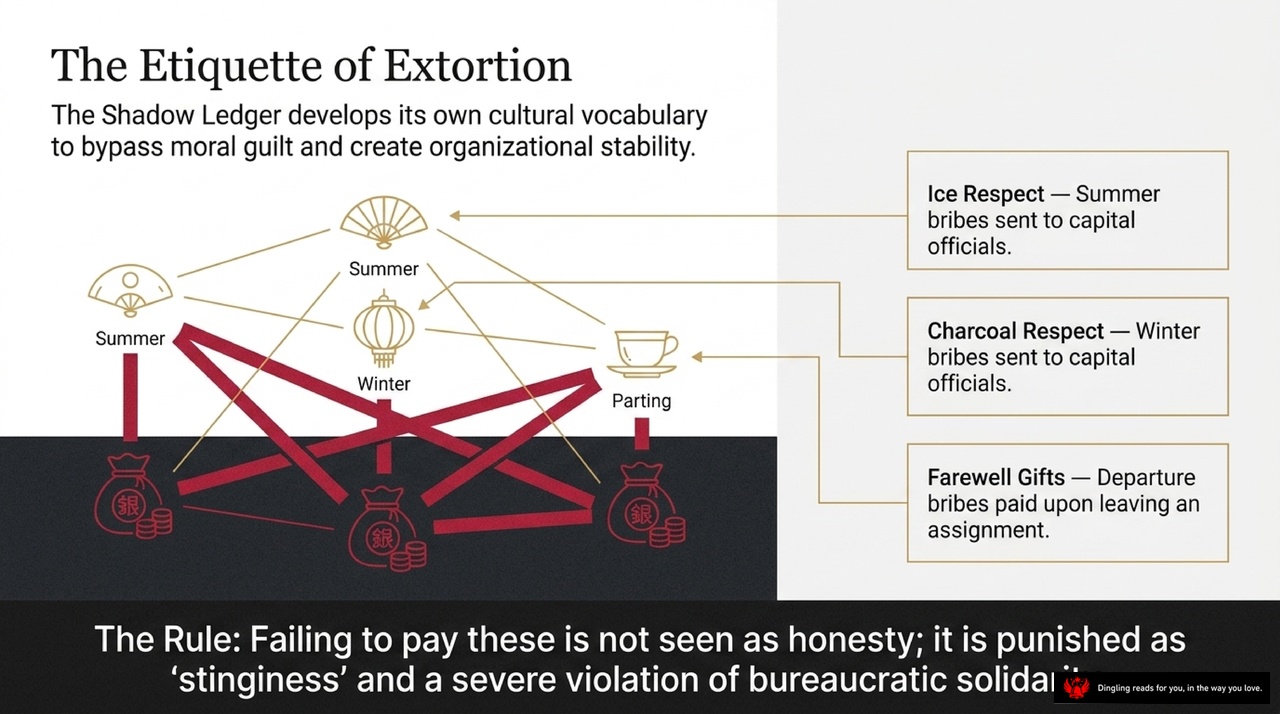
The Etiquette of Extortion isn't just about greed; it's about a specific, culturally coded language that allows officials to bypass guilt and maintain power. In the Ming and Qing dynasties, this "shadow ledger" created its own vocabulary to make corruption feel like a polite social obligation rather than a crime.
Look at the diagram on your screen. It breaks down these interactions into three distinct types of "respect." First, you have "Ice Respect" and "Charcoal Respect." These refer to summer and winter bribes sent to capital officials. Think of it as the mandatory seasonal gifts you'd give to a boss to ensure your job security. Then, there's "Parting," or "Farewell Gifts." This is the departure bribe paid when an official leaves an assignment. It's the final payment to secure your future references and avoid retaliation.
The visual shows these payments flowing from the official to the capital or upon departure, while the red lines at the bottom represent the money being extracted from the populace. The rule is simple but brutal: failing to pay these "respects" isn't seen as honesty. Instead, it's punished as "stinginess"—a severe violation of bureaucratic solidarity. In this system, paying the bribe is the only way to prove you are a reliable member of the ruling class. It's a perfect example of how a corrupt system rewrites morality, turning extortion into etiquette.
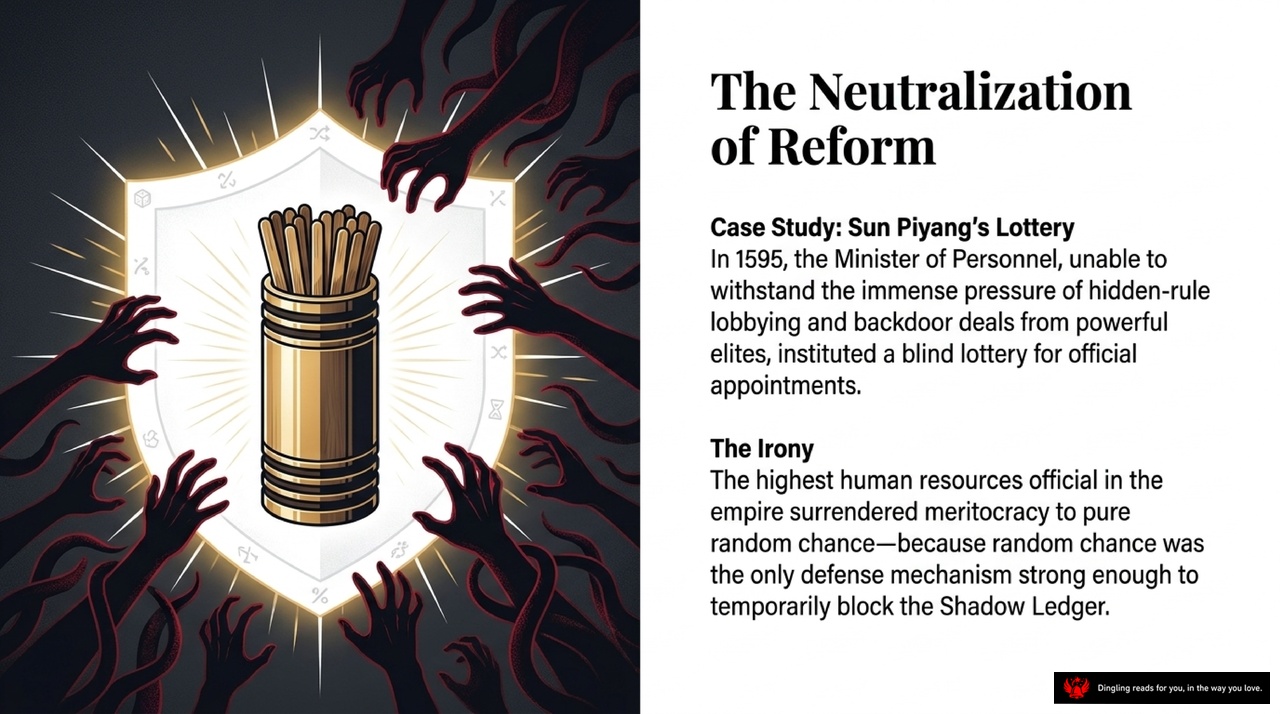
Look at this image: a golden container of matchsticks stands behind a glowing shield, while shadowy hands reach out from all sides, trying to tear it down. This visual perfectly captures the concept of "The Neutralization of Reform."
In 1595, the Minister of Personnel faced an impossible choice. Powerful elites were using hidden lobbying and backdoor deals to secure their positions, making it impossible to appoint officials based on merit. The system had broken down. So, what did he do? He introduced a blind lottery for official appointments.
At first glance, this seems absurd. Why would the highest human resources official surrender meritocracy to pure random chance? It feels like giving up. But here is the irony: random chance was the only defense mechanism strong enough to temporarily block the "Shadow Ledger."
Think about it this way. If appointments were based on talent or ability, the powerful elites would simply lobby for their favorites, and the system would collapse under their influence. But if it's a lottery, no one can buy their way into power. No backdoor deals work when the outcome is determined by luck.
So, by choosing chaos, the minister actually created order. He used randomness as a shield to protect the integrity of the system from the corrupting grip of the powerful. It was a desperate, ironic move, but it was the only way to stop the reform from being neutralized by the very people it was meant to serve.
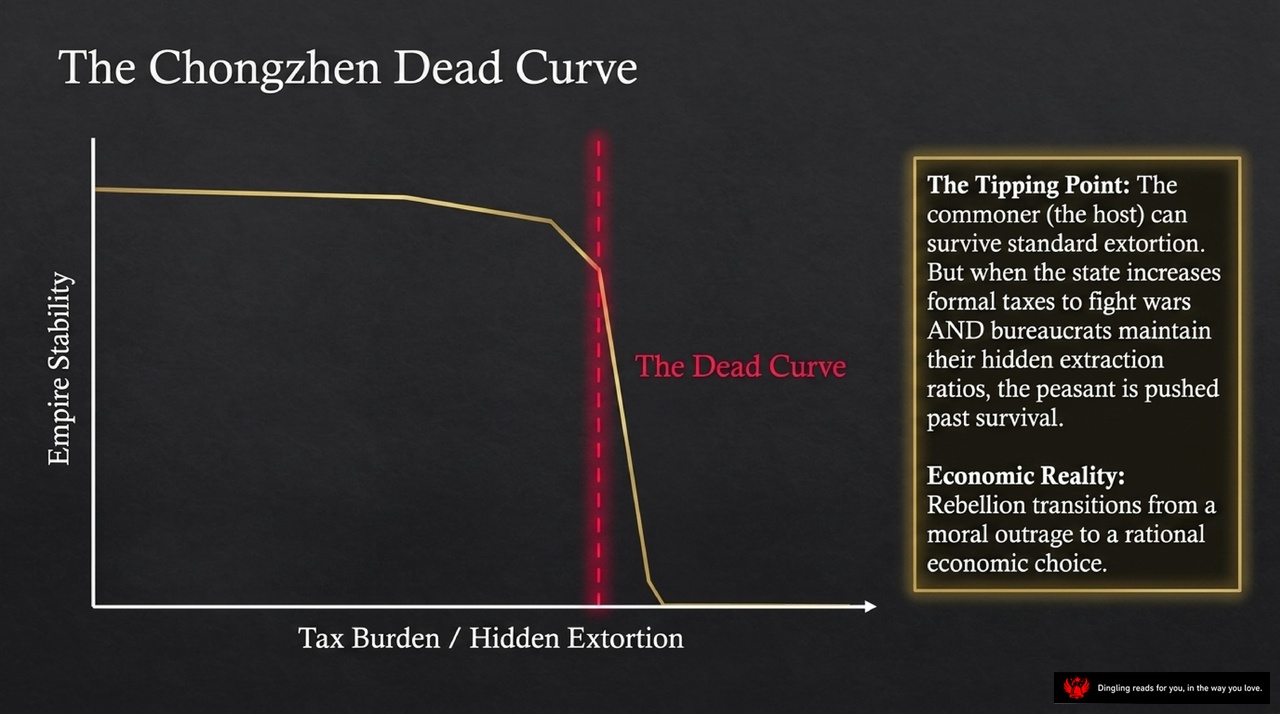
Look at this graph: "The Chongzheng Dead Curve." It maps a terrifying reality that applies not just to ancient China, but to any empire or large organization today. The vertical axis is "Empire Stability," and the horizontal axis is "Tax Burden plus Hidden Extortion."
Notice the red dashed line labeled "The Dead Curve." This is the tipping point. Up to this line, the commoner—the host—can survive standard extortion. They can pay the taxes and handle the hidden fees. But once you cross this threshold, the system collapses instantly. Why? Because the state increases formal taxes to fund wars or big projects, AND the bureaucrats maintain their hidden extraction ratios. When you add the official burden to the unofficial one, the peasant is pushed past the limit of survival.
This isn't just about morality; it's cold economic logic. Rebellion doesn't start because people are suddenly angry or evil. It transitions from a moral outrage to a rational economic choice. When the cost of living becomes higher than the cost of rebellion, the commoner simply chooses to fight. The empire doesn't fall because it's weak; it falls because it taxed the people into bankruptcy. This curve explains why empires that look stable on paper can shatter overnight when the pressure exceeds a specific, critical limit.
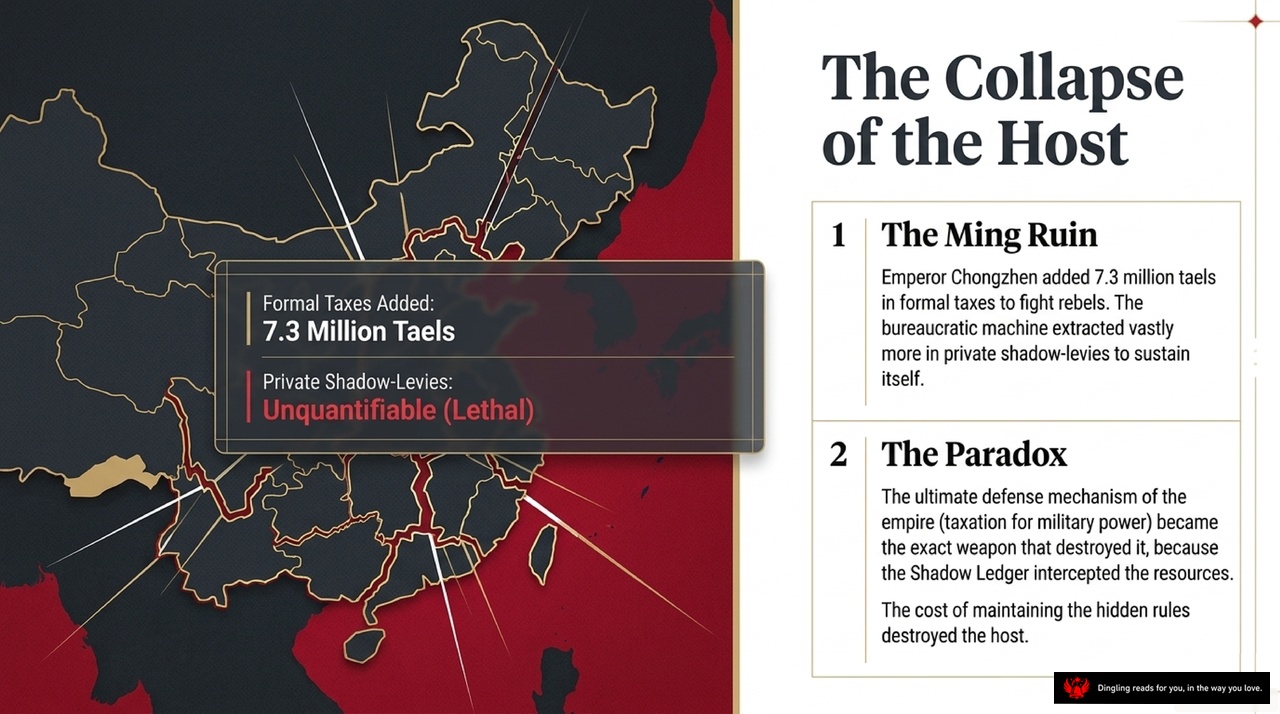
The Collapse of the Host: How the Empire Destroyed Itself
Look at this map. It shows a terrifying reality: the Ming Dynasty didn't fall because of an external enemy, but because its own tax system became a weapon of self-destruction. The slide highlights a critical detail: the Emperor added 7.3 million taels in formal taxes to fight rebels, but the bureaucratic machine extracted vastly more in private, unquantifiable shadow levies. This created a fatal paradox. The ultimate defense mechanism of the empire—taxation to fund military power—became the very weapon that destroyed it.
Here's the logic: The "Shadow Ledger" intercepted all the resources. The cost of maintaining these hidden rules and feeding the bureaucracy ate up the very wealth needed to fight the war. The state taxed the people so heavily that there was nothing left to sustain the host. It's a classic trap where the cure for the crisis becomes the cause of the collapse. When the cost of keeping the system running exceeds the value of what the system produces, the host inevitably collapses under its own weight. This wasn't just bad policy; it was a structural suicide note written in ink and gold.
Hidden rules aren't glitches; they are the operating system itself. When power becomes unbalanced, information gets blocked, and the legal ability to harm goes unchecked, people will inevitably build a shadow ledger that slowly consumes the host. As long as the basic architecture of power remains unchanged, we haven't truly eradicated the shadow ledger; we've simply renamed its categories for the modern age.