
High-growth Enterprises: Complete Chapter-by-Chapter Summary
Welcome to today's session on building a high-growth enterprise. We're going to explore how organization and cultural innovation drive sustained corporate success.
Look at the visual on your screen. It contrasts a rigid, mechanical hierarchy with a living, cybernetic network. This transition is the non-negotiable foundation for rapid, sustained growth. Traditional companies often rely on top-down command structures, but high-growth enterprises must evolve into flexible networks where information flows freely and teams adapt instantly to market changes.
In this book, we define high-growth enterprises not just by their speed, but by their ability to lead market shifts through key technologies and maintain excellence over a decade. Their success depends on moving from a static structure to a dynamic ecosystem. Just as a biological network learns and evolves, a modern organization must empower its people, break down silos, and foster a culture of continuous innovation.
We will dive deep into how strategic architecture and cultural DNA combine to create companies that don't just survive, but thrive in an unpredictable global economy. Let's begin by understanding the core principles that separate the giants from the rest.

Look at this slide. On the left, we see a rigid machine made of gears—representing the traditional "machine" paradigm of business. On the right, there's an organic, living network—symbolizing the biological imperative we need today.
The core message here is stark: we are facing a "Lifespan Crisis." The data on the screen tells a sobering story. Private SMEs now have an average lifespan of just 5.7 years. Even large corporate groups are only lasting about 7 to 8 years on average. This isn't just a statistic; it's a warning that the old way of doing business is no longer sustainable.
Why is this happening? As the text at the bottom explains, modern uncertainty is systematically destroying rigid organizations. The traditional machine model relies on stable environments, but today, the external world is changing faster than our internal structures can adapt. When the speed of external change outpaces our internal flexibility, the machine simply breaks.
This is why we must evolve. Survival no longer comes from building bigger, more complex machines. It demands an evolutionary leap toward an organic, high-growth model—one that is flexible, adaptive, and alive. If we want our businesses to last beyond these shrinking lifespans, we must stop thinking like machines and start thinking like living organisms.
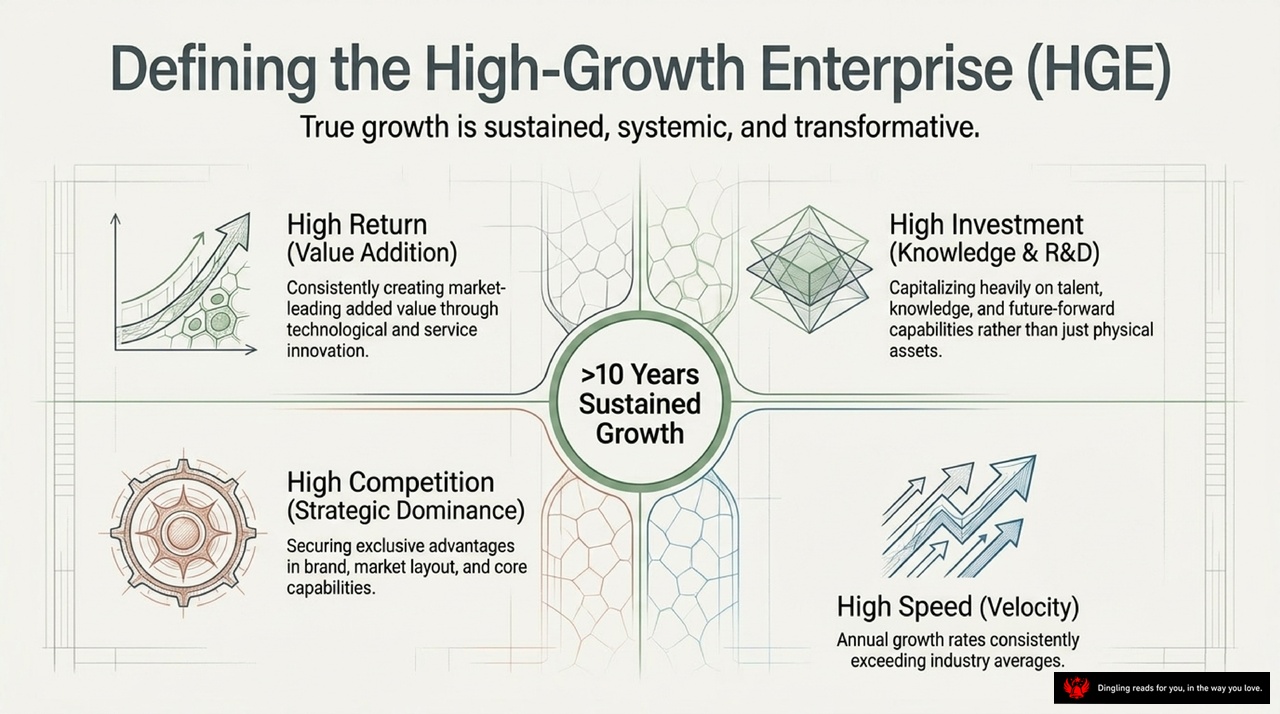
Today's slide breaks down exactly what makes a High-Growth Enterprise tick. At the very center, you see the golden rule: **Sustained Growth for over 10 years**. That's the non-negotiable baseline. But true growth isn't just about staying alive; it's about being transformative, systemic, and sustained.
To achieve that, a company must hit four specific targets. First, look at **High Return**. This isn't just about revenue; it's about **Value Addition**. These companies consistently create market-leading value through technological and service innovation. They don't just sell products; they redefine the market.
Second, consider **High Investment**. Unlike traditional firms that rely on physical assets, HGEs capitalize heavily on **Knowledge and R&D**. They invest in talent, future-forward capabilities, and intellectual property. This is their engine for the future.
Third, we have **High Competition**, which translates to **Strategic Dominance**. These enterprises secure exclusive advantages in their brand, market layout, and core capabilities. They don't just play the game; they set the rules.
Finally, there's **High Speed**. This is about **Velocity**. Their annual growth rates consistently exceed industry averages. They move faster than the curve.
When you combine these four elements—High Return, High Investment, High Competition, and High Speed—you get the **High-Growth Enterprise**. It's a formula where knowledge, speed, and strategic dominance converge to create a company that doesn't just grow, but transforms its entire industry.
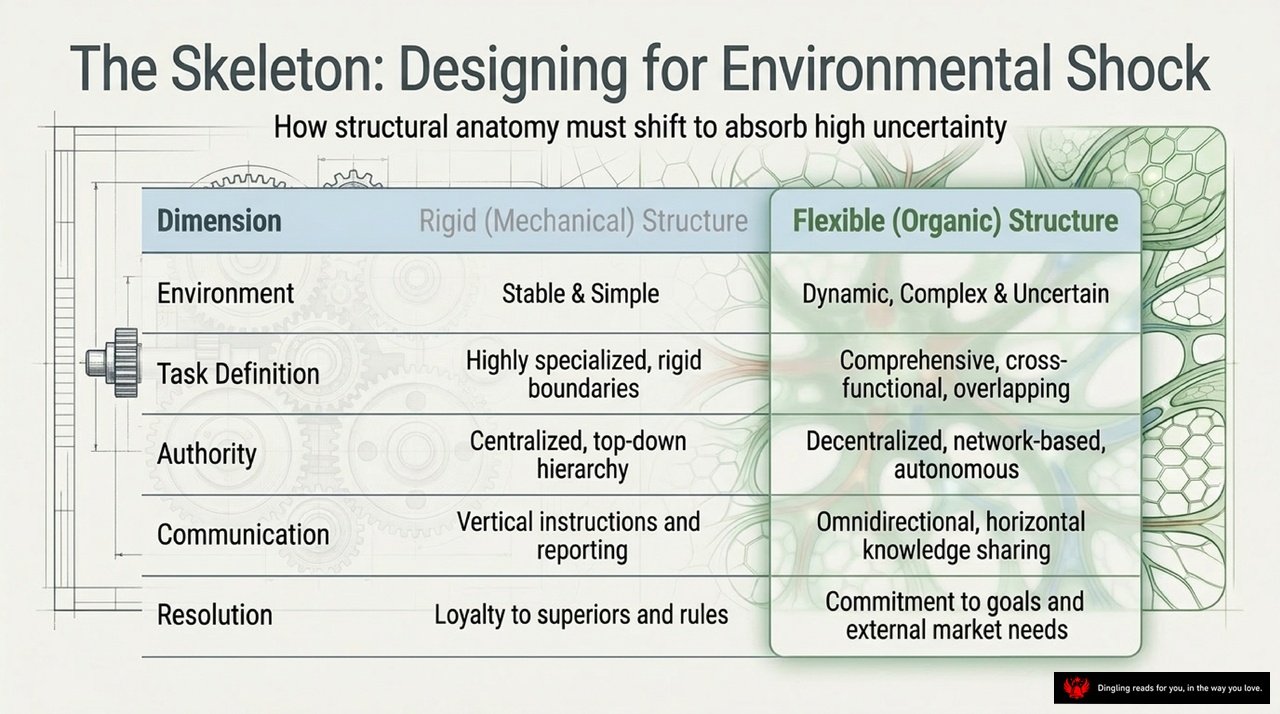
Imagine your organization not as a rigid machine, but as a living organism designed to survive environmental shocks. As we explore the architecture of high-growth enterprises, we see a fundamental shift from mechanical structures to organic ones. In a stable, simple environment, a rigid hierarchy works well—tasks are specialized, authority flows top-down, and loyalty is tied to rules. But in today's dynamic, complex, and uncertain world, this approach fails. High-growth companies must adopt a flexible, organic structure where tasks are cross-functional and overlapping, authority is decentralized and autonomous, and communication flows horizontally across the network.
The key difference lies in what drives resolution. While traditional models rely on loyalty to superiors, high-growth organizations demand a commitment to goals and external market needs. This shift isn't just about changing charts; it's about redefining the very skeleton of the company to absorb uncertainty. By moving from vertical instructions to omnidirectional knowledge sharing, these companies create a resilient framework capable of thriving where others stagnate.

Look at this timeline of TCL's evolution. We see it move from a simple, centralized startup structure to a functional model, and finally into a complex multi-regional matrix. This visual perfectly illustrates a core truth: structure isn't just a static chart; it must actively drag the enterprise into its next phase of growth.
In the early days, TCL operated like a classic startup with a simple structure. Everything was highly centralized under single-function management. But as they grew, that rigid hierarchy couldn't handle the complexity. So, they shifted to a functional structure, creating specialized product divisions and localized sales teams to manage the expanding scale.
However, the real game-changer came when TCL went global. To compete internationally, they had to evolve into a Multi-Regional Matrix. This meant decentralizing their business units and building global digital networks. By diversifying their product lines and empowering regional teams, TCL unlocked the agility needed to dominate markets worldwide.
This case proves that there is no one-size-fits-all structure. Whether you are a startup or a global giant, your organizational design must constantly adapt to your strategic needs. If your structure lags behind your ambition, you will stop growing. TCL's success lies in their willingness to constantly reshape themselves to match the demands of the future.
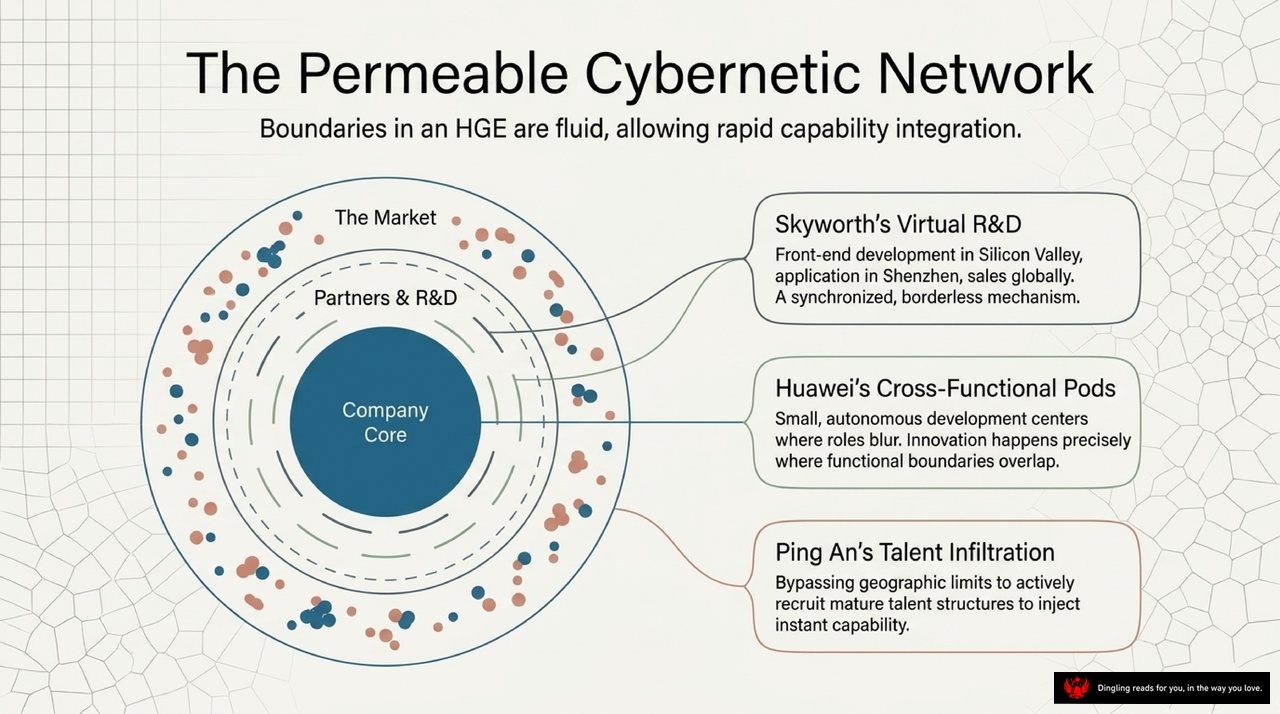
Look at this diagram: The Permeable Cybernetic Network. It illustrates how boundaries in a High-Growth Enterprise are fluid, allowing for rapid capability integration. Think of it as a dynamic ecosystem rather than a rigid hierarchy.
At the very center lies the Company Core. Surrounding it are Partners and R&D, and finally, the broader Market. The key insight here is that these layers aren't walls; they are permeable membranes. This is where the magic happens.
Take Skyworth, for instance. Their Virtual R&D model creates a synchronized, borderless mechanism. They do front-end development in Silicon Valley while applying and selling globally from Shenzhen. They aren't confined by geography; they integrate talent and innovation wherever it exists.
Then there's Huawei with their Cross-Functional Pods. These are small, autonomous development centers where roles blur. Innovation doesn't happen in silos; it sparks precisely where functional boundaries overlap. By breaking down departmental walls, they unlock creativity that a traditional structure would suppress.
And look at Ping An's Talent Infiltration. They bypass geographic limits entirely to actively recruit mature talent structures, injecting instant capability into their system. They don't wait for internal growth; they absorb external excellence.
This is the essence of the High-Growth Enterprise: a flexible, networked organism that constantly absorbs the best from the market, partners, and global talent to fuel its next leap forward.
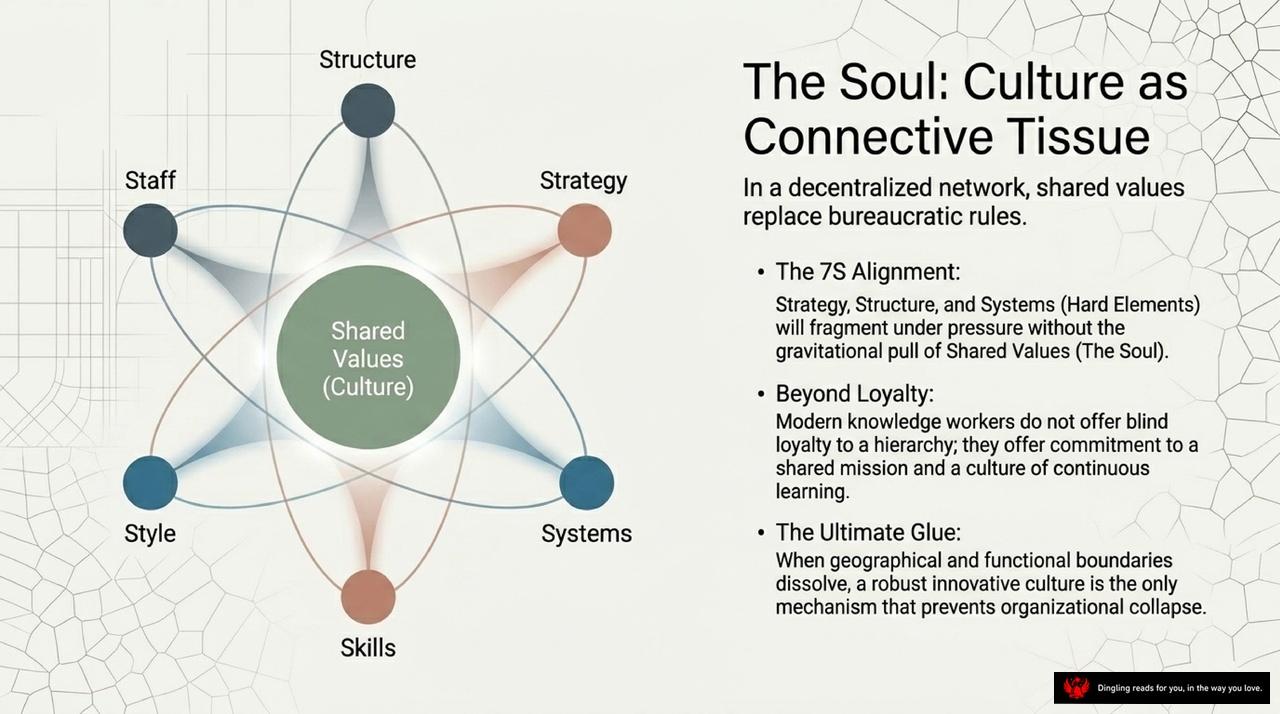
In today's hyper-competitive landscape, the difference between a fleeting success and a legacy-defining giant often comes down to one invisible force: culture. Look at the diagram on your screen. It visualizes what we call "The 7S Alignment," but more importantly, it reveals the true anatomy of a high-growth enterprise. At the very center sits "Shared Values," or what we like to call "The Soul."
Why is this central? Because in a decentralized network, shared values don't just replace bureaucratic rules; they become the connective tissue that holds everything together. Think of the outer ring: Strategy, Structure, Systems, Staff, Skills, Style, and even the people themselves. If you try to pull these hard elements apart under pressure—without that gravitational pull of shared values at the core—the entire organization fragments.
Consider the modern knowledge worker. They no longer offer blind loyalty to a hierarchy. Instead, they commit to a shared mission and a culture of continuous learning. This is what we mean by "Beyond Loyalty." When geographical and functional boundaries dissolve, as they inevitably will, a robust innovative culture becomes the only mechanism that prevents organizational collapse. It is the ultimate glue.
So, how do we build this? It starts with aligning the hard elements with the soft ones. As we saw with companies like Microsoft and TCL, when strategy, structure, and systems are anchored by a powerful, shared soul, the organization gains the flexibility to adapt, the speed to react, and the resilience to survive. Without this cultural core, even the best strategies and structures are just sandcastles waiting for the tide to come in.

Innovation isn't just about having a great idea; it's about how you scale that idea so the whole organization can run with it. Today, we're looking at the engine that drives high-growth companies: the Knowledge Spiral.
As the slide illustrates, this engine relies on converting invisible expertise into scalable systems. At the heart of this are two types of knowledge. On one side, you have **Tacit Knowledge**—the subjective, experience-based insights, cultural nuances, and personal genius that live inside individuals. It's the "invisible" stuff that's hard to write down. On the other side is **Explicit Knowledge**: objective, codified data, manuals, and software that become the organization's scalable assets.
The magic happens in the spiral. High-growth enterprises don't just store information; they deliberately engineer their environments to turn tacit knowledge into explicit systems through socialization. They take that individual genius, externalize it into shared knowledge, and then internalize it again across the network. This continuous cycle creates an upward spiral of innovation. It's the difference between a company where knowledge stays trapped in one person's head versus an organization where that knowledge becomes a powerful, shared engine for growth.

Today's slide breaks down the critical journey of organizational socialization, showing how we transform an outsider into a true cultural carrier. This process isn't just about onboarding; it's about deep integration.
We start with **Step 1: Anticipation**. This is the pre-entry phase where expectations must align. If we get this wrong—by setting unrealistic expectations—we invite a painful "reality shock" that often leads to early turnover. It's about setting the right tone before the employee even steps through the door.
Next comes **Step 2: Encounter**. This is the collision. The new hire confronts the actual work environment, and conflict naturally arises between their personal goals and external demands. This is where the real work begins: navigating the friction and finding resolution.
Finally, we reach **Step 3: Change & Acquisition**. This is the synthesis. The employee successfully internalizes shared values, masters the necessary skills, and evolves from an outsider into an active node in the innovation network. By mastering these three steps, we don't just hire employees; we build a resilient, self-renewing culture that drives high growth.
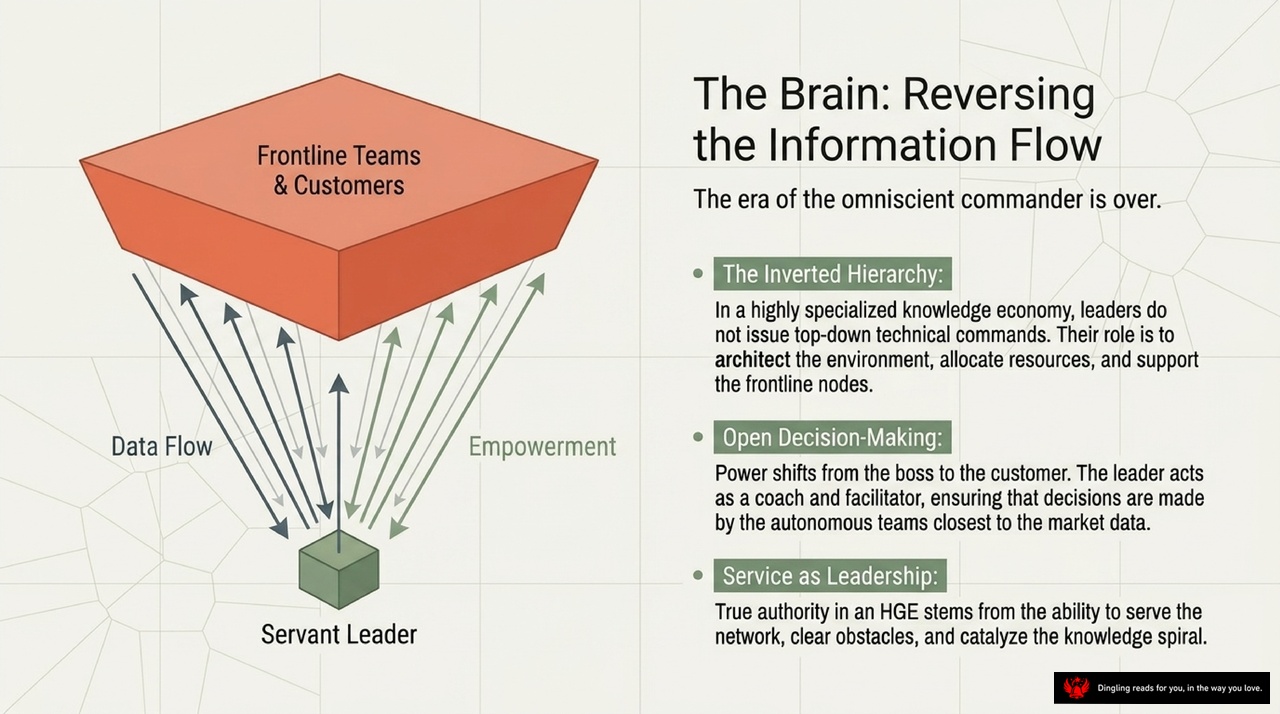
The era of the omniscient commander is officially over. Look at this diagram: we are moving from a traditional pyramid to an inverted hierarchy where the frontline teams and customers sit at the very top, acting as the "brain" of the organization. In this new model, data flows upward while empowerment flows downward.
This shift is built on three pillars. First, leaders stop issuing top-down technical commands. Instead, their role is to architect the environment, allocate resources, and serve as a support system for the frontline nodes. Second, decision-making power shifts from the boss directly to the customer. The leader acts as a coach and facilitator, ensuring that autonomous teams closest to the market data make the final call. Finally, we embrace service as leadership. True authority in a high-growth economy doesn't come from rank; it stems from the ability to serve the network, clear obstacles, and catalyze the knowledge spiral. By reversing the information flow, we turn every employee into an entrepreneur who can act instantly on customer needs.
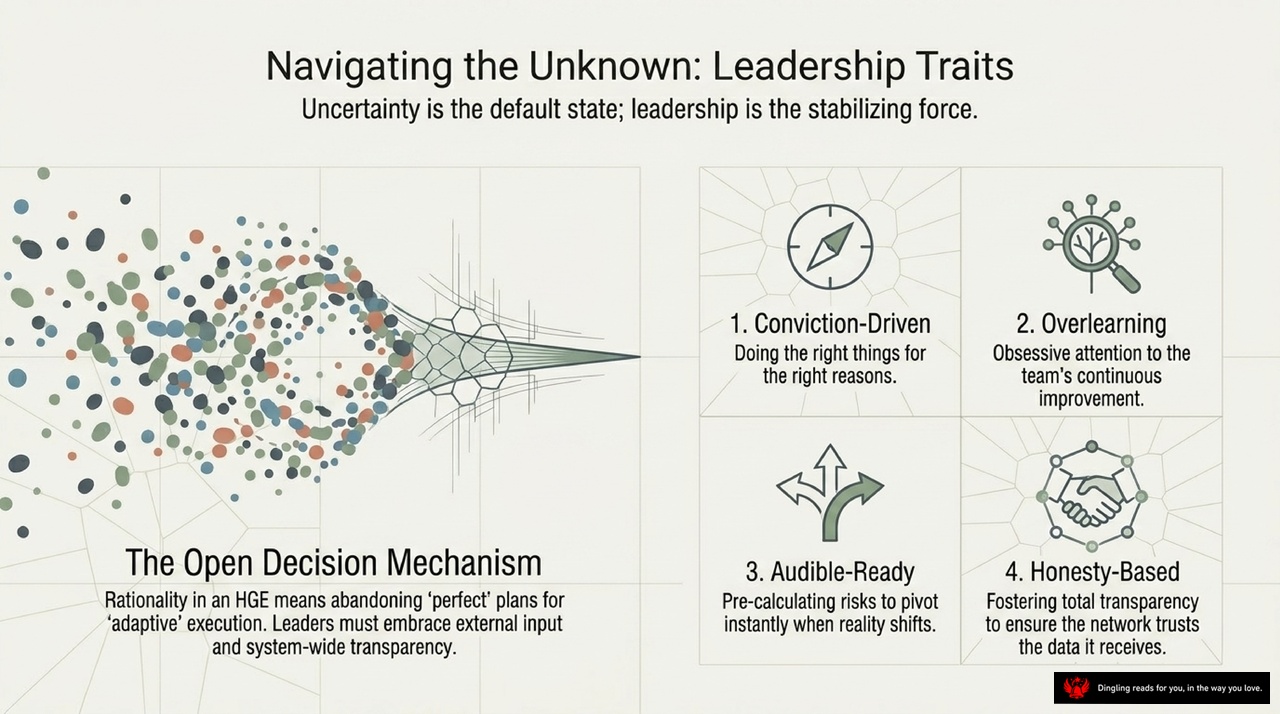
Navigating the Unknown: Leadership Traits. In today's volatile world, uncertainty isn't just a risk; it's the default state. And leadership? That's your stabilizing force.
Look at this slide. We're talking about the "Open Decision Mechanism." It's all about ditching those perfect, rigid plans for something truly adaptive. Leaders must embrace external input and system-wide transparency. You can't control everything, but you can control how fast you pivot when reality shifts.
Here are the four non-negotiable traits for this kind of leadership. First, be Conviction-Driven. This means doing the right things for the right reasons, not just because it's convenient. Second, Obsess about Overlearning. That's your team's continuous improvement. You need to be fixated on getting better every single day. Third, be Audible-Ready. Pre-calculate your risks so you can pivot instantly the moment the market changes. Finally, build an Honesty-Based culture. Foster total transparency so your network trusts the data you give them.
When you combine these traits with an open decision mechanism, you stop guessing and start navigating. You turn uncertainty from a threat into your biggest advantage.

Imagine a graph where the vertical axis represents growth and the horizontal axis tracks time. You see two curves here: one is the "Botanical Sage Green" line, representing the old way of doing things. It rises steadily, hits a peak, and then inevitably starts to flatten out and decline. That's the natural limit of any organization. If you stay on this first curve forever, your growth will stop, and eventually, you will die.
But look at the dark line rising alongside it. This is the "Second Curve." It represents the path of transformation. The critical moment is marked as "Point A: The Transformation Node." This is the exact spot where the green curve hits its ceiling. It's the critical juncture where the company is still growing, but its current resources and structures can no longer sustain that momentum.
The message is stark: "If you do not transform, you die." At Point A, leaders must make a radical choice. They have to initiate a complete structural and cultural shift while the company is still successful, before the inevitable decline begins. To launch this second curve, you must be willing to abandon the very habits that drove the first curve's success. It's about launching a new lifecycle, breaking free from legacy constraints, and embracing a future where growth isn't just a plateau, but a new, higher trajectory.

Imagine your high-growth company not as a rigid machine, but as a living, breathing biological organism. Just like a human body, it thrives only when its skeleton, soul, and brain work in perfect harmony.
Let's look at the anatomy of this ecosystem. First, we have **The Skeleton**, which represents your structure. It's not about heavy bureaucracy; it's about building decentralized, fluid networks. Think of it as a flexible framework that can absorb external shocks and scale up instantly without getting bogged down by red tape.
Next is **The Soul**, your culture. This is the connective tissue that holds everything together. It's made of shared values that do the hard work of turning the tacit genius of your people into explicit corporate capabilities. Without this soul, you're just a collection of individuals, not a unified force.
Finally, there is **The Brain**, your leadership. These are servant-leaders who flip the traditional hierarchy on its head. Instead of commanding from the top, they empower the nodes, trigger transformation before it's too late, and guide the system toward sustained high growth.
When these three elements—the resilient skeleton, the inspiring soul, and the adaptive brain—align, they create a self-sustaining engine. Growth stops being a forced strategy and becomes the natural output of a perfectly aligned biological system.

Imagine your company not as a rigid machine built for efficiency, but as a living, cybernetic organism designed for continuous evolution. This is the core truth of high-growth enterprises. To survive the chaos of modern markets and sustain limitless growth, an organization must marry three vital elements: a flexible structural skeleton, an innovative cultural soul, and a decentralized leadership brain.
Think about it: if your organization is truly a living organism, is its current DNA engineered to survive tomorrow's environment, or is it already preparing to die? The answer lies in your ability to adapt. Just like the image shows, these two forces—the rigid structure and the flexible soul—must merge to create something powerful and resilient.
In today's world, where market cycles are shrinking and competition is fierce, sticking to old, bureaucratic ways is a death sentence. You need a culture that embraces change, where innovation isn't just a buzzword but the very heartbeat of your business. As we've explored, from the theoretical frameworks to the real-world examples of companies like TCL and Microsoft, the secret to high growth isn't just about having great technology or a large team. It's about building an agile, responsive structure that can pivot instantly when the winds of change shift.
So, the ultimate question for you and your leadership team is this: Are you actively engineering your organization's DNA for the future, or are you waiting for the inevitable decline? The choice, and the speed at which you make it, defines whether your enterprise thrives or simply survives.