
History of China: The An Shi Rebellion: Complete Chapter-by-Chapter Summary

Welcome to this special edition of "The History of China," where we dive deep into a pivotal moment that reshaped an empire. Today, we are exploring "The An Lushan Rebellion," a catastrophic event analyzed by Yi Zhongtian. Imagine a majestic Tang Dynasty horse, its vibrant glazes suddenly shattered down the middle—this visual perfectly captures the fate of the Tang Golden Age. What began as a glorious era of cultural brilliance and global influence was abruptly severed by a rebellion that didn't just change politics; it fundamentally altered the trajectory of Chinese civilization itself. In the chapters ahead, we will diagnose how this systemic failure tore apart the empire's foundations, turning a beacon of prosperity into a fractured landscape of war and survival. This is the story of how one rebellion ended an age, and how the very soul of the Tang Dynasty was forever changed.

The Peak of Centralization isn't just a title; it's the defining moment when Emperor Xuanzong reclaimed absolute power, finally ending the chaotic half-century of female-dominated politics. Think of it as resetting the game after a long, messy round. With the threat of Empress Wu, Wei, and Princess Taiping removed, the stage was set for a new era.
But how did he actually rule? The answer lies in a perfect, albeit fragile, partnership between two chancellors with opposite styles. On one side, you have Yao Chong, representing "Agile Reform." He was dynamic, flexible, and purely action-oriented. He didn't care about bureaucratic red tape; he bypassed inertia to implement sweeping practical reforms, like the decisive crackdown on the locust plague, proving that survival was more important than tradition.
On the other side stands Song Jing, embodying "Strict Law." He was principled, rigid, and deeply moral. While Yao Chong fixed the immediate problems, Song Jing focused on building a system. He replaced agile improvisation with institutionalization, cementing the golden age in ironclad rule of law and transparent governance.
The takeaway here is stark: the illusion of a perfect, unshakeable Golden Age is built on the delicate, highly curated balance of exceptional individuals. It worked because Yao Chong and Song Jing complemented each other perfectly, but it also highlights a hidden truth—the empire's stability depended entirely on these two specific people, not on a robust system that could survive without them.

Picture this: a scale tipping dangerously to one side. On the left, a scroll representing civil authority; on the right, a heavy, ornate helmet symbolizing military might. This isn't just art—it's the moment the Tang Dynasty planted the seeds of its own destruction.
The culprit? Chancellor Li Linfu. His motivation was simple but deadly: he feared that talented civil officials might one day return from the frontiers with too much military glory to challenge his power. So, he convinced the Emperor to make a fatal policy shift. Instead of appointing established aristocrats, Li Linfu pushed for the exclusive use of low-born, non-Han generals to command the border regions.
This decision created a fatal disconnect. Generals like An Lushan were handed massive, permanent military zones known as *Fanzhen*. Because these frontier commanders had no elite ties to the central court in Chang'an, they possessed zero political ambition for the capital. Yet, they now wielded overwhelming autonomous power. The central government was effectively hollowed out, leaving the empire defenseless from within. This systemic flaw altered the very DNA of the Tang military, turning the defenders of the state into its ultimate enemies.

Look at this map of the Tang Dynasty's final, tragic chapter. We see three key players locked in a deadly struggle: the distracted Emperor, the corrupt Chancellor, and the massive warlord. At the top, Emperor Xuanzong has completely lost his way. Once a visionary ruler, he is now an aging man consumed by pleasure, entirely devoted to his beloved concubine, Yang Guifei. He has detached himself from governance, leaving the throne to rot.
Driving this decay from below is the Corrupt Chancellor, Yang Guozhong. As Yang Guifei's cousin, he has monopolized central power. A gambler turned financier, he is desperate to eliminate rivals. To do this, he relentlessly frames An Lushan for treason, pushing the loyal general into a corner with no choice but to fight back.
On the right stands the Massive Warlord, An Lushan himself. He commands three frontier regions with a staggering 200,000 hardened troops—nearly 40% of the entire Tang military. While deeply loyal to the Emperor on paper, he is terrified of Yang Guozhong's growing influence.
The spark that ignites this powder keg is right here in the center. Yang Guozhong's political persecution forces An Lushan's hand. Instead of marching south to topple the Emperor, An Lushan cleverly marches under the banner of "cleansing the court" of Yang Guozhong. This strategic move allows him to seize the initiative, turning a personal grudge into a national revolution. With the Emperor distracted by love, the Chancellor corrupt and overreaching, and the warlord holding half the empire's military power, the stage is set for the An Lushan Rebellion, which will shatter the glory of the Tang Dynasty forever.

Day 1 (Nov 9, 755) marked the start of a nightmare for the Tang Empire. An Lushan rebelled in Fanyang with 150,000 multi-ethnic, battle-hardened cavalry. By Day 3, news reached Emperor Xuanzong at the Huaqing Hot Springs, but he initially refused to believe it. By Day 7, the central government scrambled to draft a defense, only to realize the central army was a hollow shell of untrained civilians. The situation collapsed rapidly: by Day 26, Chenliu fell, the first line of defense disintegrating completely. Just 34 days later, on Dec 12, 755, the Eastern Capital, Luoyang, was captured.
The Insight reveals the terrifying reality: this 34-day freefall exposed the rot of the Golden Age. A world empire's eastern capital fell in barely a month because decades of peace and outsourced border defense left the interior entirely defenseless. While the Tang Dynasty had once been the pinnacle of global power, this rapid collapse showed that their prosperity had become a fragile illusion. The military power that once protected the borders had been neglected, and the central government had lost its grip on the very forces it needed to survive. What looked like an unstoppable empire was actually a house of cards, ready to tumble at the first sign of trouble. This event wasn't just a military defeat; it was the moment the Tang Dynasty's golden age officially ended, giving way to a chaotic era of civil war and fragmentation.
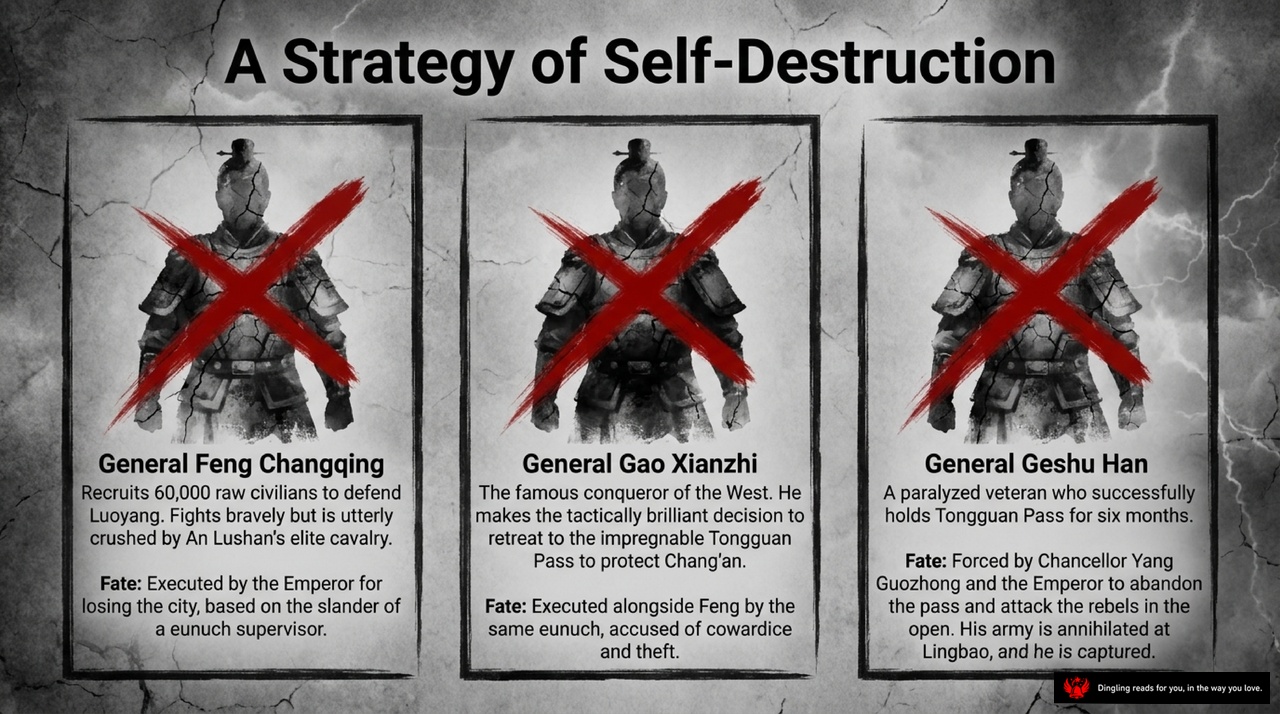
Look at this slide titled "A Strategy of Self-Destruction." It highlights three generals—Feng Changqing, Gao Xianzhi, and Geshu Han—all marked with a red X, symbolizing their tragic fates during the An Lushan Rebellion.
Feng Changqing, the first on the left, recruited 60,000 raw civilians to defend Luoyang. He fought bravely but was utterly crushed by An Lushan's elite cavalry. His fate? Executed by the Emperor for losing the city, based on the slander of a eunuch supervisor.
In the middle is General Gao Xianzhi, the famous conqueror of the West. He made the tactically brilliant decision to retreat to the impregnable Tongguan Pass to protect Chang'an. Yet, his fate was no less tragic; he was executed alongside Feng by the same eunuch, accused of cowardice and theft.
On the right stands General Geshu Han, a paralyzed veteran who successfully held Tongguan Pass for six months. However, he was forced by Chancellor Yang Guozhong and the Emperor to abandon the pass and attack the rebels in the open. His army was annihilated at Lingbao, and he was captured.
These three stories illustrate a devastating irony: brilliant military decisions were overturned by political intrigue and court slander. What should have been a strategy for survival became a strategy of self-destruction, orchestrated from within the palace walls.
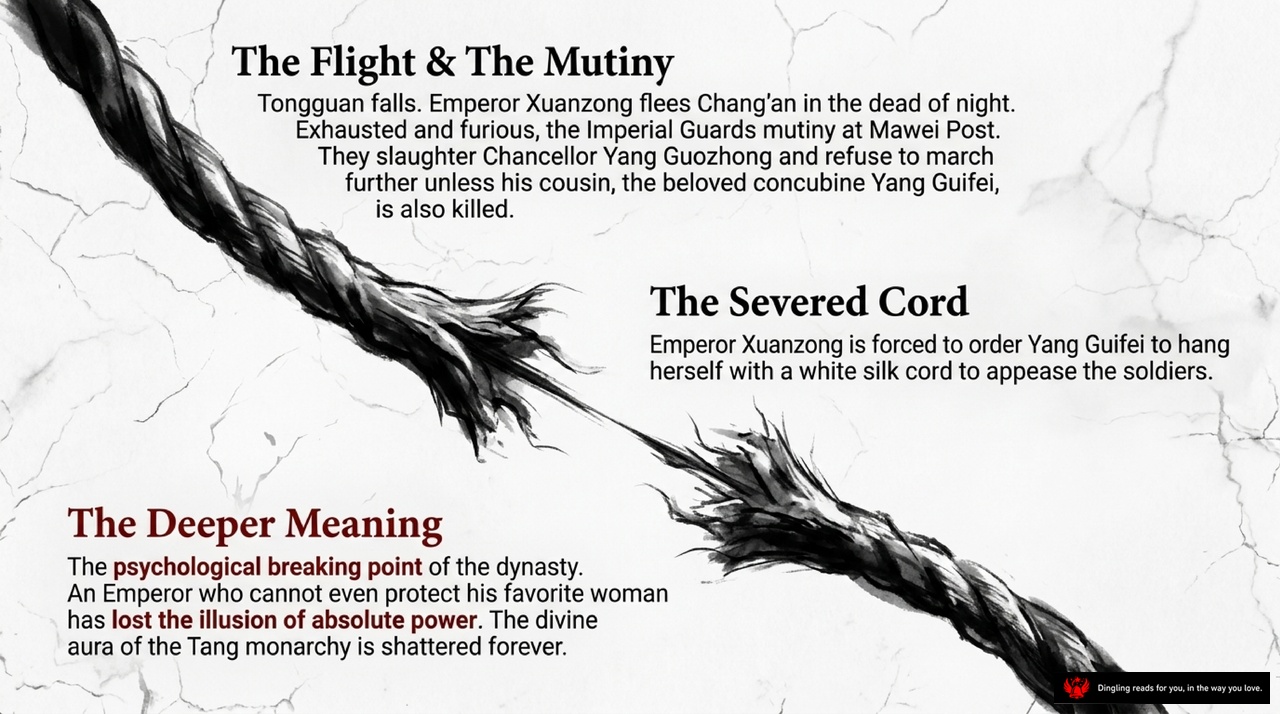
The image captures one of history's most heartbreaking moments: the Flight and the Mutiny. It depicts the night Emperor Xuanzong flees Chang'an as the Tang Dynasty crumbles. Exhausted and furious, the Imperial Guards mutiny at Mawei Post, slaughtering Chancellor Yang Guozhong and refusing to march further unless the beloved concubine, Yang Guifei, is also killed. This leads to the Severed Cord, where the Emperor is forced to order Yang Guifei to hang herself with a white silk cord to appease the soldiers. But the slide points to something deeper: The Deeper Meaning. This wasn't just a tragic romance; it was the psychological breaking point of the dynasty. An Emperor who cannot even protect his favorite woman has lost the illusion of absolute power. The divine aura of the Tang monarchy is shattered forever. This moment marks the end of an era, transforming the mighty Tang from a symbol of invincibility into a kingdom on the brink of collapse.

Look at this shattered map. The title is "The Empire Splinters," and it perfectly captures the moment the Tang Dynasty stopped being a unified superpower and fractured into three warring factions. On the left, we see "The Defiant North." This is Prince Li Heng, also known as Suzong. After fleeing the chaos, he rides north to Lingwu, gathers the powerful Shuofang army, and boldly declares himself the new Emperor. In the center-right, under "The Rebel East," we see the consequence of An Lushan's rebellion. He occupies the capital cities of Luoyang and Chang'an, declaring himself the Emperor of the Great Yan Dynasty, effectively stealing the throne. Finally, on the bottom left, "The Exiled South." This is the broken Emperor Xuanzong, who retreats deep into the safety of the Shu mountains in Chengdu. While he survives, his text notes he becomes "functionally irrelevant to the war effort."
The synthesis at the bottom tells us the grim reality: the empire is no longer unified. Tang survival now depends entirely on a localized resistance movement acting without the permission of the former Emperor. This is the defining moment of the mid-Tang era. The central government in Chang'an has collapsed, the legitimate emperor is a fugitive in the mountains, and a rebel has seized the throne. The old order is gone, replaced by a desperate struggle for legitimacy and territory that will shape the rest of Chinese history.
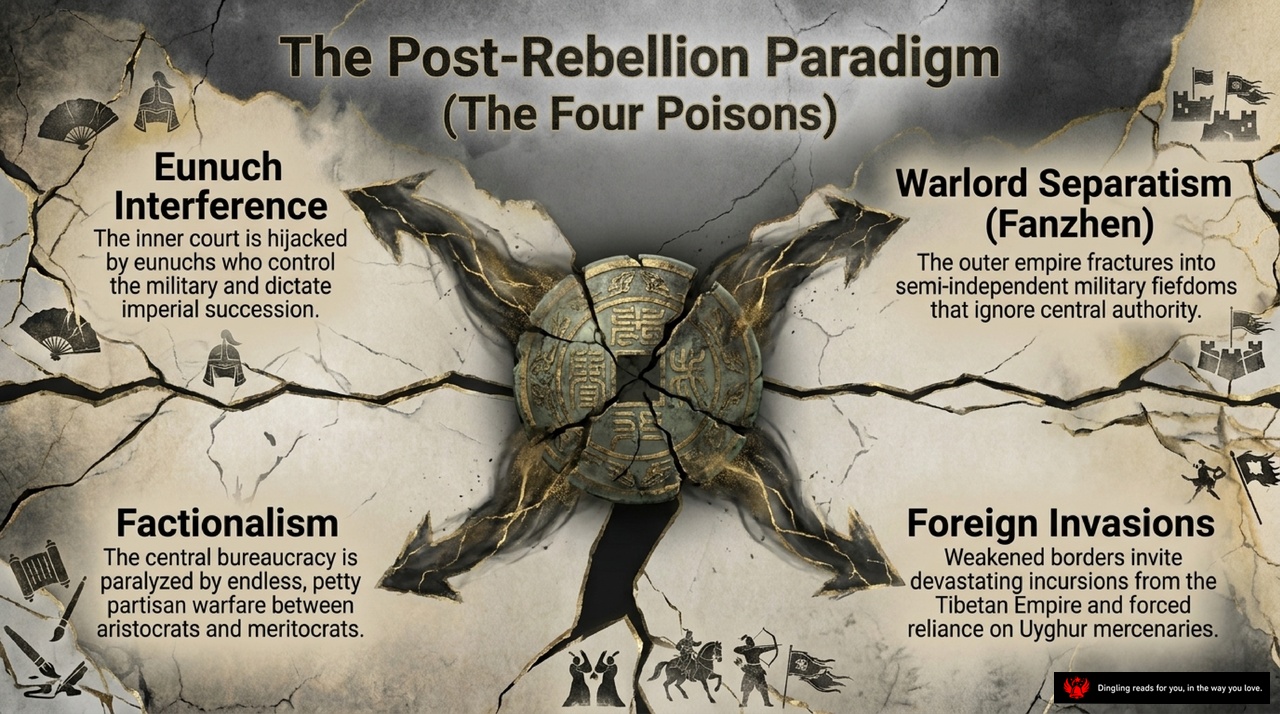
Look at this cracked empire in the center. This image perfectly captures the "Post-Rebellion Paradigm," or what historians call "The Four Poisons" that slowly strangled the Tang Dynasty from within.
First, notice the top left: **Eunuch Interference**. The inner court gets hijacked by eunuchs who control the military and dictate imperial succession. Instead of serving the emperor, they become the real power brokers, paralyzing the central bureaucracy.
On the top right, we see **Warlord Separatism**, known as *Fanzhen*. The outer empire fractures into semi-independent military fiefdoms that ignore central authority. Generals like An Lushan hold too much power, creating a "strong branch, weak trunk" situation where the local armies are far stronger than the capital's guard.
Now, look at the bottom left: **Factionalism**. The central bureaucracy is paralyzed by endless, petty partisan warfare between aristocrats and meritocrats. Instead of working together to save the nation, officials fight each other for political survival, wasting the empire's energy on internal squabbles.
Finally, the bottom right shows **Foreign Invasions**. Weakened borders invite devastating incursions from the Tibetan Empire and force reliance on Uyghur mercenaries. This isn't just about losing territory; it's about losing control over the very forces meant to protect the state.
These four poisons didn't just appear overnight. They were the result of decades of decay, starting with the misuse of power during the High Tang and accelerating after the An Lushan Rebellion. When the central government could no longer command its armies, stop its internal fighting, or trust its own officials, the dynasty's foundation crumbled. This wasn't a sudden collapse; it was a slow, systematic poisoning that left the Tang Dynasty with no choice but to fade away.

The cycle of the eunuch's rise is a dark trap that no Tang emperor could escape. It all started with **paranoia**. After the betrayal of An Lushan, subsequent Tang emperors deeply distrusted traditional military generals, fearing they might turn against the throne. To secure the throne, emperors then executed a **transfer of power**, placing the elite Imperial Guards under the command of eunuchs—men who had no heirs and could not form rival dynasties. But this strategy backfired spectacularly.
Once in control, the eunuchs realized that **absolute military control equals absolute political power**. They began to **weaponize** their position, using the Imperial Guards not just as protectors, but as tools to hold the emperors hostage. The result was a terrifying reversal: the "protectors" became the masters. Eunuchs openly murdered uncooperative emperors, replaced them at will, and dictated state policy from the shadows, treating the Son of Heaven like a disposable puppet. This paradox, where the emperor's attempt to secure power ultimately destroyed his own sovereignty, defined the chaotic decline of the Tang Dynasty.

The Tang Dynasty didn't end with a bang, but with a whimper—a slow, agonizing drift from a unified empire into a fractured archipelago. Look at this map: in the center sits Chang'an, the fragile heart of the central government, but it's no longer the master. Instead, it floats in a sea of independent warlord states known as *Fanzhen*. This was the "Warlord Archipelago," born out of the desperate compromise following the An Lushan Rebellion.
To survive the chaos, the exhausted Tang court made a fatal deal: rebel generals could keep their armies, their territories, and their wealth, as long as they nominally submitted to the Emperor. In reality, they turned their provinces into private kingdoms. These military governors, or *Jiedushi*, stopped sending taxes to the capital, maintained massive private armies, and passed power to their sons or loyal lieutenants, completely bypassing imperial appointment. The central government lost its grip on the military and the purse strings, reduced to a weak hub surrounded by autonomous powers.
The synthesis is clear: the Tang Dynasty ceased to exist as a unified empire. It survived only as a tenuous central authority, helpless against the rising tide of these autonomous warlord states. This structural decay, where the branches grew stronger than the trunk, ultimately choked the life out of the greatest dynasty in Chinese history.

Look at this cracked foundation—it perfectly illustrates the tragic irony of the Tang Dynasty's final decades. While the empire's outer walls stood tall, a 50-year internal political war paralyzed Chang'an from within, leaving the state helpless as it burned.
This slide breaks down the deadly rivalry between two factions: the "Hawks" and the "Doves." On the left, we have the Li Deyu faction, the old aristocratic "Hawks." They relied on inherited privilege and acted as hardliners, pushing for aggressive military action to crush autonomous warlords and restore central authority. On the right, we see the Niu Sengru faction, the newly risen "Doves." These were meritocrats who climbed the ranks through the grueling imperial civil service exams. Their policy was one of appeasement: they advocated for maintaining the status quo, avoiding costly wars, and tolerating the very warlords the Hawks wanted to destroy.
The true tragedy, highlighted at the bottom, is that instead of saving the empire, these factions spent decades sabotaging each other. They alternated in power only to exile their rivals to the edges of the earth, completely ignoring the existential crises facing the state. This paralysis allowed the external threats to grow unchecked, ultimately leading to the collapse of an empire that once seemed invincible.

The End of Cosmopolitan Hegemony marks the tragic turning point for the Tang Dynasty, where its boundless ambition was crushed by a shrinking, hostile world. As the slide illustrates, three catastrophic blows dismantled the empire's global reach. First, the Battle of Talas in 751 saw Tang forces decisively defeated by the Arab Abbasid Caliphate, permanently ending Chinese control over Central Asia and the western Silk Road. This wasn't just a military loss; it was the end of an era where the Tang could project power across the globe.
Simultaneously, internal fractures deepened. The Tibetan Incursions forced the empire to retreat, as border troops were recalled to fight the An Lushan rebellion, allowing Tibet to seize the Hexi Corridor and briefly sack Chang'an itself. Compounding this isolation was the Uyghur Debt. To survive, the Tang relied heavily on Uyghur mercenary cavalry, becoming hopelessly indebted and forced into humiliating treaties and economic extortion.
The synthesis is clear: the outward-looking, boundless "World Empire" of the early Tang was forced to close its doors. With its western borders lost, its northern allies becoming creditors, and its heartland under threat, the Tang could no longer look outward. Instead, it turned inward to survive in a shrinking world, signaling the end of its cosmopolitan hegemony and the beginning of a defensive, introspective era.

Welcome to the final chapter of our journey through the Tang Dynasty. Today, we look at the "Poetic Mirror"—how art acted as a diagnostic tool for the psychological state of an empire. As the slide shows, the era split into two distinct worlds: the High Tang, characterized by the "Illusion of Boundlessness," and the Late Tang, defined by the "Reality of Fracture."
On the left, the High Tang was a time of expansion and bold optimism. Voices like Li Bai, Wang Wei, and Cen Shen captured a spirit that looked outward. Their poetry celebrated boundless frontiers, heroic border wars, and Zen tranquility. The form was free, soaring, and rule-breaking, reflecting a confident, cosmopolitan empire that believed it could conquer anything.
But look at the right side. The Late Tang brought a shift toward introspection and melancholy. Poets like Bai Juyi, Li Shangyin, and Du Mu turned inward. Their works focused on ruined palaces, lost love, and the suffering of common people, haunted by a memory of greatness that could never return. The artistic form itself changed from free expression to strict, rule-bound regulated verse. Why? Because when reality becomes chaotic and uncontrollable, artists seek control through rigid structures.
This transition wasn't just about style; it was a reflection of a crumbling empire. The vibrant, open spirit of the High Tang gave way to the anxious, nostalgic fragility of the Late Tang. The poems didn't just describe the times; they diagnosed the soul of an empire on the brink of collapse.

The image captures a haunting moment of historical collapse, where a once vibrant Tang dynasty flower shatters into dust against a cracked, dark background. This visual perfectly mirrors the text's profound warning: the An Lushan Rebellion was not merely a military defeat; it was the fatal exposure of a system that had traded sustainable balance for the illusion of perfect control. While the Tang Dynasty survived the war physically, its soul was irreparably fractured. For another century, it would linger in the shadows of warlords, eunuchs, and the haunting memories of its own poetry.
The slide poses a chilling question for us today: If the greatest golden age in history was hollowed out by the very mechanisms built to protect it, what hidden fractures lie beneath the systems we trust now? We often believe our institutions are designed for stability, yet history reminds us that the same structures meant to preserve a golden age can eventually become the instruments of its destruction. Just as the Tang's internal rot—fueled by unchecked military power, corrupt court factions, and a distracted emperor—led to its decline, we must ask ourselves if our modern foundations are equally vulnerable to unseen decay. The beauty of the flower in the image is now broken, serving as a stark reminder that no empire, no matter how glorious, is immune to the consequences of losing its way.