
How An Economy Grows and Why It Crashes: Complete Chapter-by-Chapter Summary

Welcome to today's session on *How an Economy Grows and Why It Crashes* by Peter D. Schiff and Andrew J. Schiff. In this talk, we'll explore a simple island allegory that reveals the true engines of economic growth and the hidden dangers of fiat currency.
Imagine a tropical island where three men—Abel, Baker, and Charlie—struggle to survive by hand-fishing. To improve their lives, Abel sacrifices his daily meal to weave a net, creating capital that doubles their productivity. This act of saving and investing is the foundation of all economic progress. When Baker and Charlie borrow Abel's fish to build their own nets, the island's wealth grows through genuine production, not magic.
However, the story takes a dark turn when a corrupt leader introduces unbacked paper money, promising free goods while secretly diluting the value of everyone's savings. This mirrors the real-world danger of fiat currency: when governments print money without real assets to back it, they essentially steal from the hard-working and the poor. Without savings to fuel investment, the economy becomes a house of cards, destined to collapse under its own weight.
True growth never comes from borrowing more or spending beyond your means. It comes from innovation, hard work, and the disciplined accumulation of capital. As we've seen, when an economy loses its connection to real production and relies solely on debt and printed money, the result is inevitable decline. Let's dive deeper into how these principles shape our world.
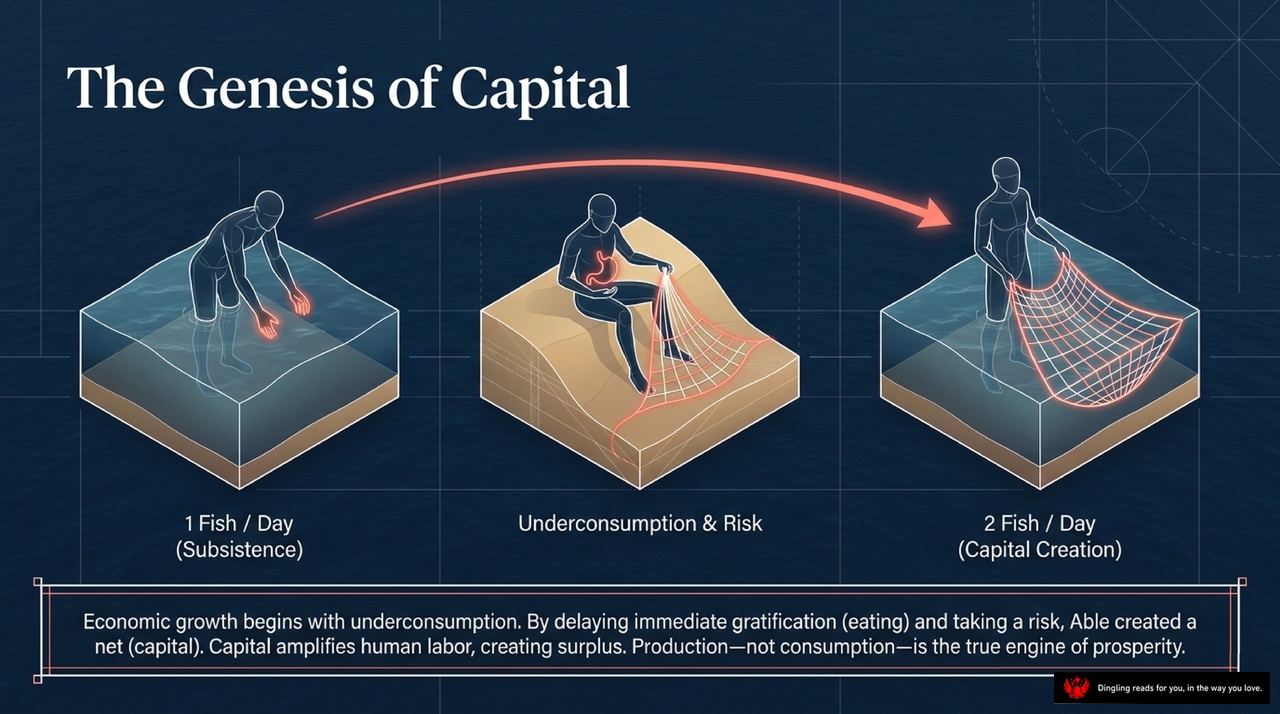
Imagine a small island where life was once a struggle: three men, three fish a day, just enough to survive. One man, Able, dared to do something different. He chose to go hungry today so he could weave a net tomorrow. That single act of underconsumption and risk created the first piece of capital—a net that doubled his catch. Suddenly, one fish a day became two.
This simple shift reveals the true engine of prosperity: production, not consumption. Economic growth doesn't start by giving people more money to spend; it begins by delaying gratification to build tools that amplify human labor. When Able's net allowed him to save a fish, he could lend it to his friends, Baker and Charlie, who used it to build their own nets. The island's productivity didn't just double; it quadrupled.
This story exposes the fatal flaw in Keynesian economics. It teaches us that real wealth isn't created by stimulating demand or printing money, but by the hard work of saving, investing in capital, and producing more value than we consume. Without this foundation, any attempt to boost the economy through debt or government spending is just building a castle on sand. True prosperity comes from creating the means to produce, ensuring that our future is richer because we built it, not because we borrowed it.

Look at this slide: "The 5 Fates of Surplus." It maps out where our extra savings can actually go. On the left, we have our "Surplus Savings," and on the right, five distinct paths. Hoarding it in a safe guarantees safety but kills growth. Consuming it immediately gives you utility now but zero capacity for the future. Renting it out offers passive income with low risk. Then, there's lending for emergencies or consumer needs, which carries high risk but yields no productivity gains. But the path we need to focus on—the one highlighted here—is lending for commercial purposes. This is the only route that truly expands societal capacity.
Why does this matter? Because true economic expansion happens only when savings are directed toward productive commercial loans that increase society's ability to produce. Think of it like a fishing net. If you hoard your catch or just eat it, you stay stuck in the same place. But if you lend that surplus to someone building a better net, you multiply your future harvest. Government intervention often distorts this tree, pushing savings toward unproductive consumption instead of investment. Without this vital link between saving and productive lending, the entire economy eventually stalls.

Let's talk about why falling prices are actually a good thing. Look at this graph: as time moves forward, we see productivity climbing steadily—more canoes built every week—while the price per canoe drops. This isn't a crisis; it's the "virtue of deflation."
As division of labor and capital equipment improve, the time required to build a canoe drops. The natural result is falling prices. This is the reward of innovation. Falling prices expand purchasing power, turning former luxuries into everyday goods for the working class.
Think of it this way: when it takes less effort to produce something, you don't need to charge as much to make a profit. That means you can sell more, and more people can afford these goods. What was once a luxury item becomes something everyone can use daily. Instead of fearing lower prices, we should celebrate them, because they mean our economy is becoming more efficient and our standard of living is rising.
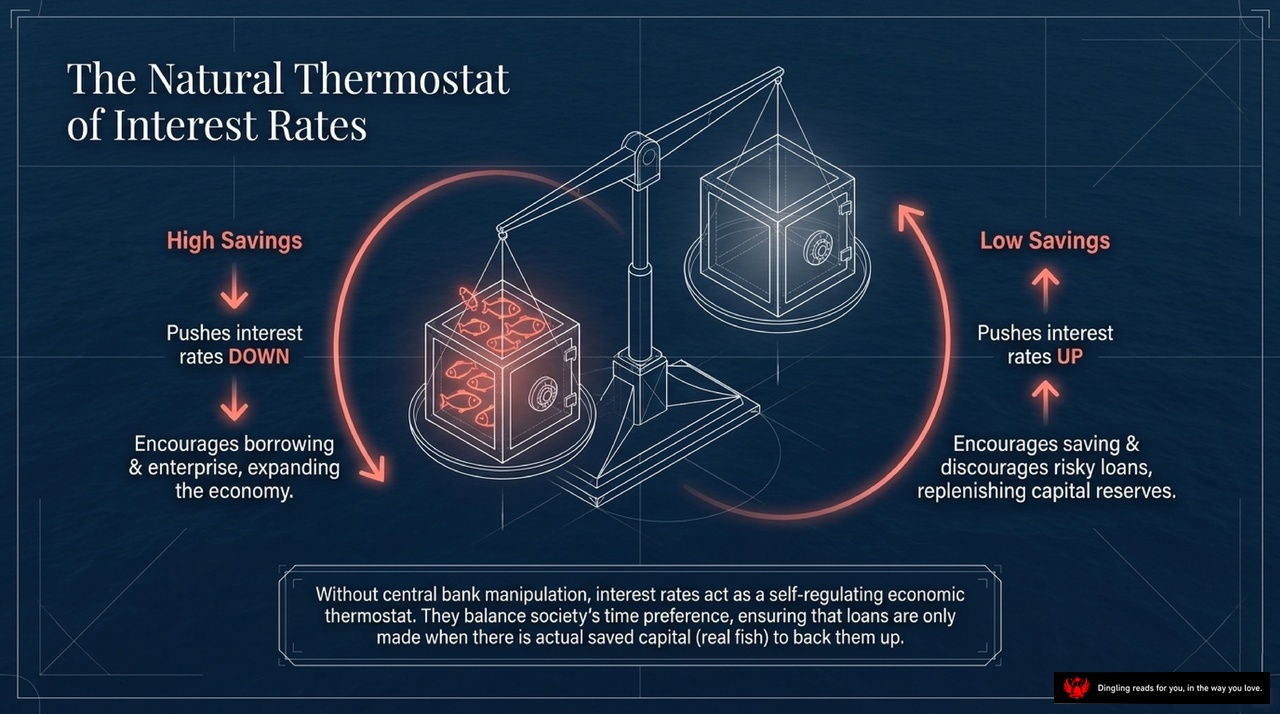
Imagine a small island nation, let's call it Mesonesia, where a charismatic leader named Frankie Dee takes charge. He spots a golden opportunity: the islanders love free things but hate paying taxes. So, he launches a bold new currency called "Fish Reserve Certificates," promising that every piece of paper can be exchanged for real fish. It sounds perfect, right? But here's the catch—there aren't enough fish to back all these new notes.
To make this work, Frankie and his team pull off a clever, albeit fraudulent, trick. They introduce "official fish"—fake fish made from real fish skin, bones, and meat, stitched together to look convincing. With a little legal maneuvering and a lie that real fish carry a deadly virus requiring official "disinfection," they convince the public to accept these fake fish as real money. The result? A slow, silent theft of wealth. As more fake fish are printed, their value plummets. Soon, you need twice as many to buy the same amount of food, then ten times as many. This is inflation in action, disguised as economic growth.
But the trouble doesn't stop there. The government, desperate to keep the illusion alive, creates a safety net: the "Fish Reserve Deposit Insurance." They tell everyone, "Don't worry, we'll protect your savings!" To make this believable, they even execute their most trusted banker, who had dared to warn them that this scheme would destroy the economy. Now, the citizens are even more eager to deposit their fish, unaware that the bank is already full of worthless paper.
This story mirrors what happened in the real world. For decades, governments have used the same playbook: print money, create fake assets, and hide the truth behind promises of security. The result? A gradual erosion of purchasing power that hits the hardest on those who saved their money for the future. When the house of cards finally collapses, the only thing left is a pile of worthless paper and a nation that has forgotten how to truly produce value.
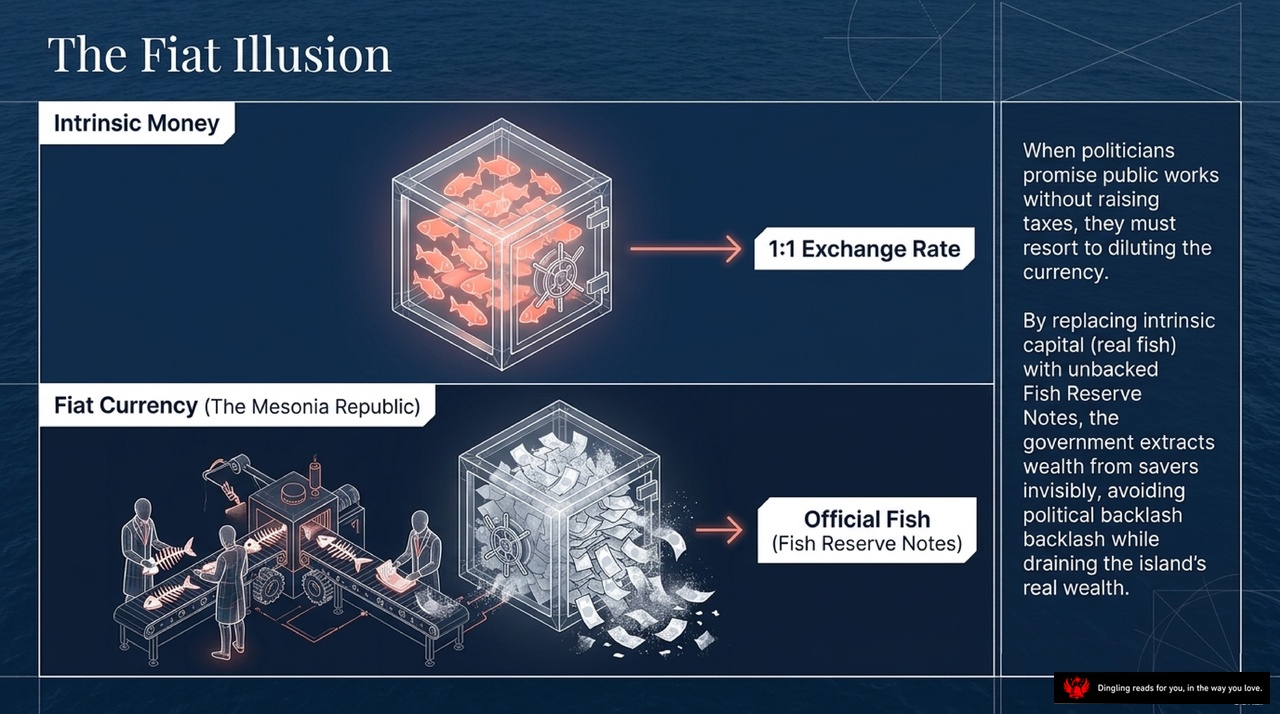
The Fiat Illusion exposes a terrifying truth: when politicians promise public works without raising taxes, they don't magically create wealth. Instead, they resort to diluting the currency. Imagine an island where the government replaces real fish—your actual savings—with unbacked "Fish Reserve Notes." This allows them to extract wealth from savers invisibly, avoiding political backlash while quietly draining the nation's real capital.
This is the core of the fiat illusion. By printing money that isn't tied to real production, the government creates a false sense of abundance. In our story, the islanders accept these "official fish" because they trust the government will honor them. But this trust is fragile. When the supply of these notes outpaces the catch of real fish, the value of every single note drops. What was once a reliable store of value becomes worthless paper.
This mirrors our own history perfectly. For decades, we were told that inflation was just a rising price tag. But the reality is far more insidious: inflation is the silent theft of your purchasing power. When the central bank expands the money supply without a corresponding increase in goods and services, your savings are effectively taxed away. The government gets to spend more, but you are left with less.
The illusion works because it's painless in the short term. You see prices rise, but you also see your nominal income rise, masking the fact that your real wealth has shrunk. It's like being tricked into trading real fish for a piece of paper that looks like fish but tastes like nothing. Eventually, the system collapses under its own weight. The currency loses its anchor to reality, and the economy reverts to a primitive state where trust is gone, and only the raw struggle for survival remains. The lesson is clear: a currency without intrinsic value is just an illusion, and no amount of political promise can sustain it forever.

Look at this iceberg. Above the water, we see rising prices, the "symptom" that everyone complains about. But the real danger lies deep below the surface: currency expansion, the actual disease. The text on your slide makes a crucial distinction—rising prices are just the consequence, not the definition of inflation. True inflation is the expansion of the money supply itself.
Imagine a government printing paper notes faster than the economy can produce real goods. Just like an island printing fake fish that can't be eaten, every new dollar printed dilutes the value of the ones you already have. When the supply of money grows without a corresponding increase in real wealth, the purchasing power of every note collapses. This is why modern economists are often wrong; they treat the symptom while ignoring the root cause. The only way to restore value is to stop the printing press and let the real economy catch its own fish.

Look at this diagram: "The Global Trade Imbalance." It paints a stark picture of a symbiotic but fatal relationship between a producer nation, represented here as Middle Island, and a consumer nation, Mesonia.
On the left, we have the economic engine. Middle Island is the producer. It's depicted as a complex machine, a symbol of manufacturing and saving. The trade flow shows a massive arrow of goods flowing from them to Mesonia, while money flows back. But look at the long-term result: Middle Island is building productive capacity. They are trading real goods for paper—currency that represents their future savings and industrial strength.
Now, turn to the right. This is Mesonia, the consumer. Their engine is a shopping cart, fueled by consumption. They receive the goods, but the return flow is just paper money. The tragic long-term result? They are accumulating unpayable debt. They are printing fiat to sustain an artificial standard of living, mistaking consumption for economic strength.
This isn't just a theoretical model; it's the story of our modern global economy. The producer saves and manufactures, creating real value. The consumer borrows and spends, creating a bubble. This imbalance is the root of our current financial instability. When the producer stops saving or the consumer stops borrowing, the entire system collapses. We are living on borrowed time, and the diagram shows exactly where that debt is piling up.
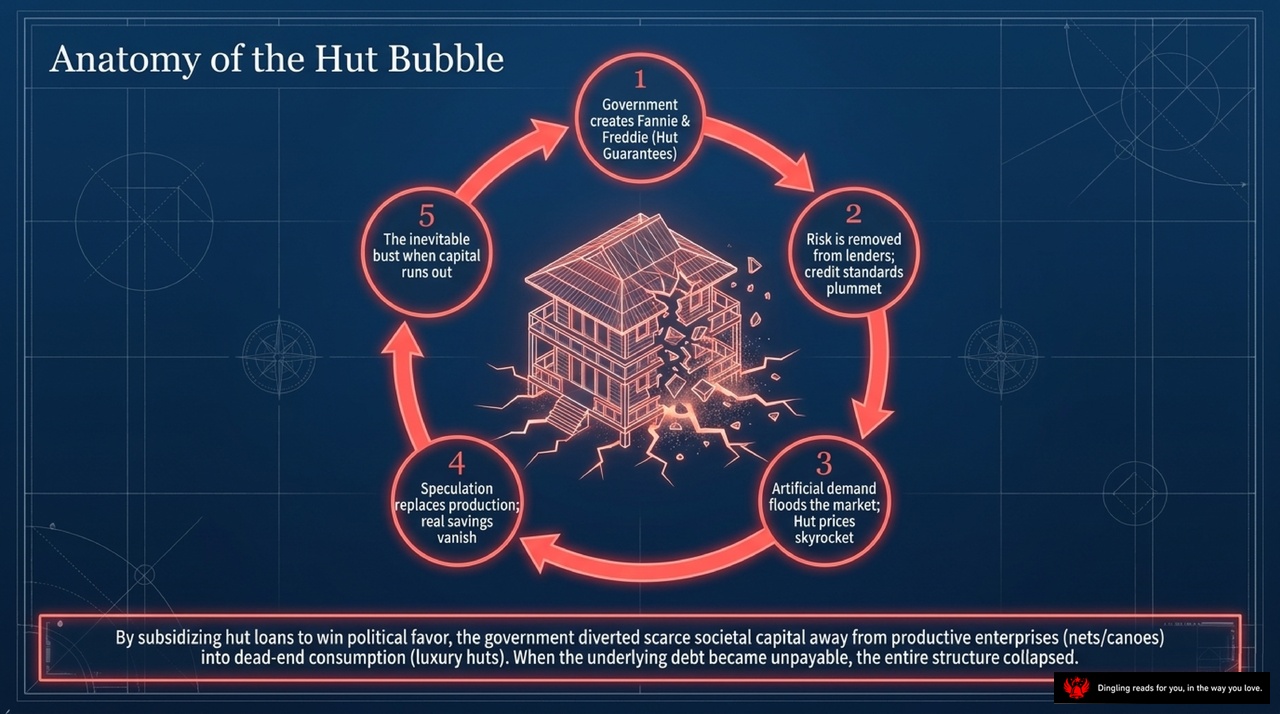
Look at this diagram: "The Anatomy of the Hut Bubble." It's a perfect blueprint for how a society can engineer its own collapse. We see five steps in a deadly cycle. First, the government creates a guarantee system—like Fannie and Freddie—to back risky loans. This removes the risk from lenders, causing them to slash credit standards. Suddenly, artificial demand floods the market, and hut prices skyrocket. But here's the trap: speculation replaces real production. People stop building nets or canoes and start buying luxury huts they can't afford. Real savings vanish. Finally, when the capital runs out, the inevitable bust hits, and the entire structure cracks, just like that house in the center.
The text at the bottom explains the root cause: the government subsidized hut loans to win political favor. They diverted scarce societal capital away from productive enterprises—like making nets and canoes—into dead-end consumption, like luxury huts. When the underlying debt became unpayable, the entire structure collapsed. This isn't just about houses; it's about prioritizing political applause over economic reality. By ignoring the need for real savings and production, we create a bubble that guarantees its own explosion.
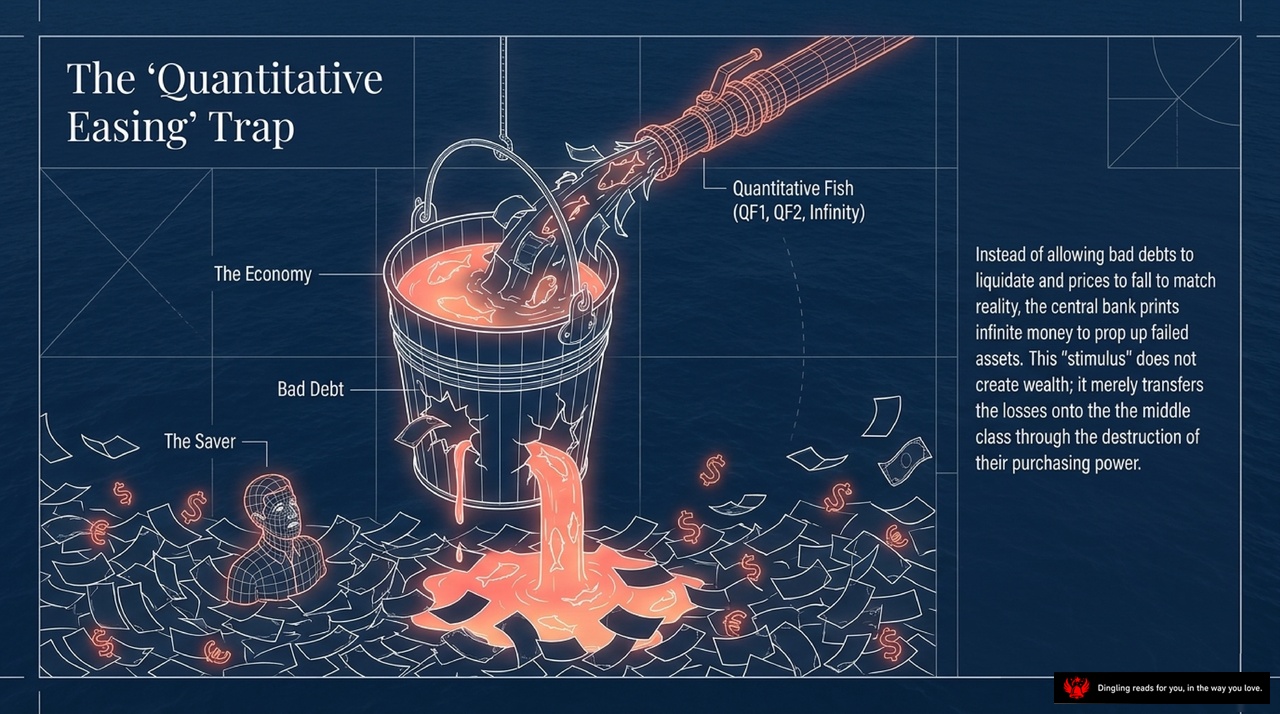
Imagine a central bank acting like a desperate firefighter, but instead of water, it's spraying infinite money onto a burning house of bad debts. This is the trap of "Quantitative Easing." As the slide illustrates, the central bank—labeled as the source of "Quantitative Fish"—is using massive tools like QF1, QF2, and even "Infinity" to pour endless cash into a bucket representing the economy.
But here's the problem: that bucket is already full of "Bad Debt." Instead of letting these failed assets liquidate and prices finally drop to match reality, the central bank just keeps printing more money to prop them up. The slide makes it clear: this isn't creating real wealth. It's merely transferring the losses from the failed projects onto the middle class.
Look at the bottom of the image. As the fake money floods out, it drowns "The Saver." The middle class is buried under a rising tide of devalued currency, their purchasing power destroyed. The economy isn't getting healthier; it's just becoming more expensive for everyone except the debtors. This "stimulus" doesn't fix the broken system; it just delays the inevitable crash while stealing value from ordinary people.
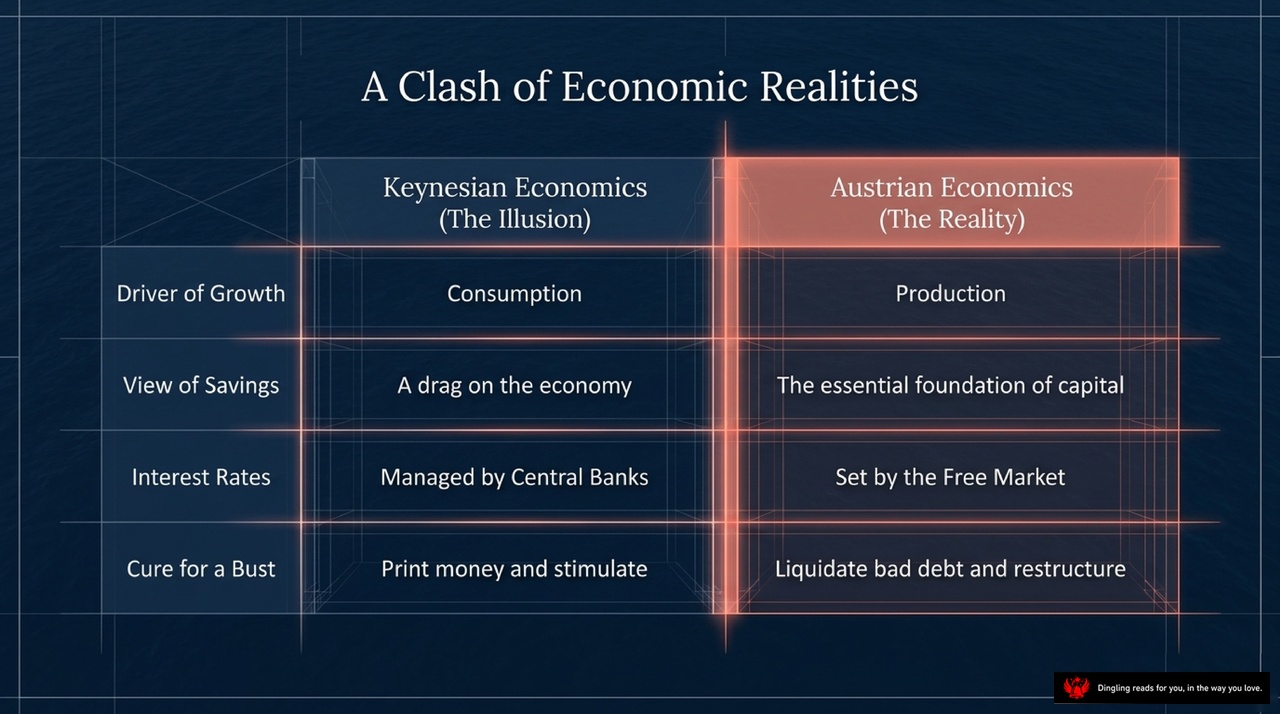
Look at this slide, "A Clash of Economic Realities." It lays out the fundamental divide between how Keynesian economics views the world versus how Austrian economics sees it. Keynesian theory, which we often call "the illusion," treats consumption as the engine of growth and views savings as a drag on the economy. It suggests that central banks should manage interest rates to stimulate spending, and when the economy crashes, the cure is simply to print money.
But on the other side, Austrian economics argues that production, not consumption, is the true driver of prosperity. It sees savings as the essential foundation of capital, without which no investment can happen. In this view, interest rates aren't managed by politicians; they are set by the free market to reflect real savings and investment opportunities. When a bust occurs, the proper remedy isn't to print money and create more debt, but to liquidate bad debt and restructure the economy to restore health.
The chart highlights that while Keynesianism promises a painless fix through government intervention, Austrian economics insists on the hard truth: we must prioritize real production and sound savings to build a resilient economy. It's a clash between a world built on financial engineering and one built on tangible value.
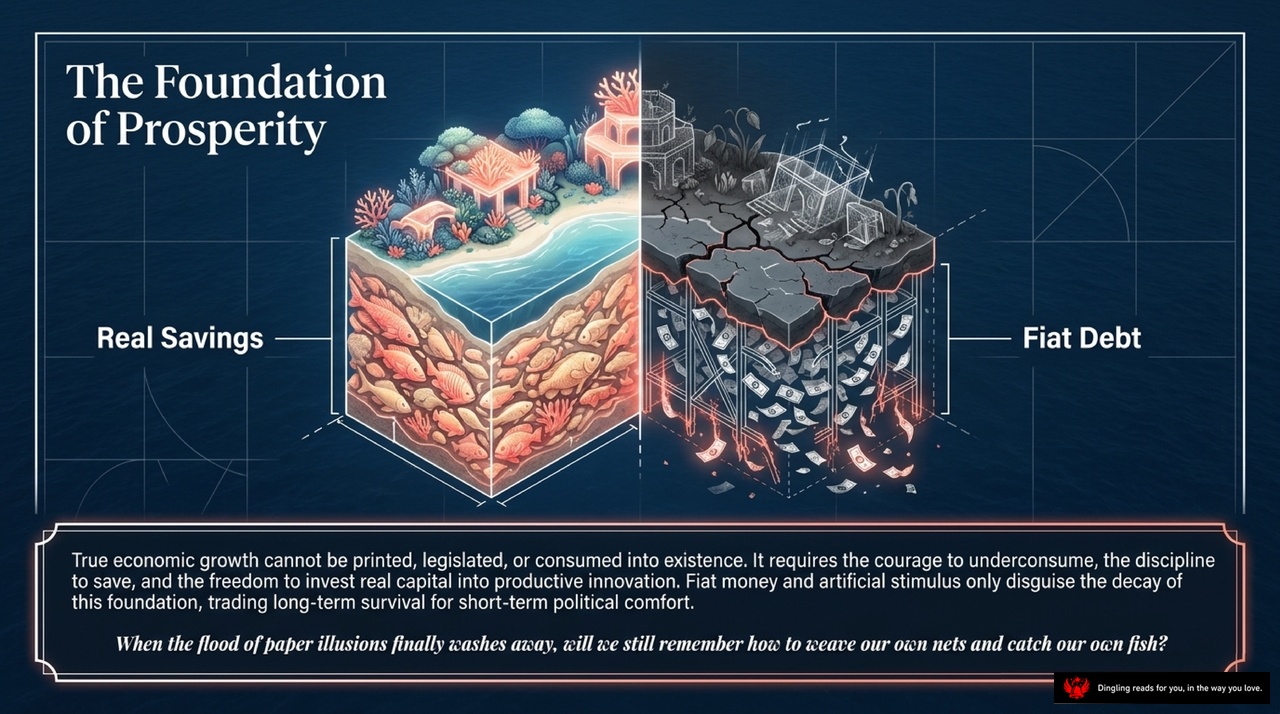
True economic growth cannot be printed, legislated, or consumed into existence. It requires the courage to underconsume, the discipline to save, and the freedom to invest real capital into productive innovation. As we see in this stark contrast, when we trade long-term survival for short-term political comfort through fiat money and artificial stimulus, we only disguise the decay of our foundation. We are essentially trading real assets for paper illusions. When the flood of these paper illusions finally washes away, will we still remember how to weave our own nets and catch our own fish? The lesson is clear: prosperity is built on real savings, not debt.