
How the Mighty Fall: Complete Chapter-by-Chapter Summary

Welcome to today's session on "How the Mighty Fall," a book by Jim Collins that serves as a diagnostic guide for spotting corporate decline before it becomes irreversible. Think of corporate decay not as a sudden explosion, but like cancer hiding beneath the skin of a seemingly healthy body. Just as Jim Collins discovered through a personal story about his wife's undetected breast cancer, the signs of a company's downfall are often subtle and invisible until it is too late.
We will explore how giants like Bank of America, Motorola, and Circuit City fell from grace. The lesson is clear: no company is immune to decline, but the difference lies in recognizing the early warning signs. By understanding these five stages—from arrogance and blind expansion to ignoring crises and desperately seeking a "savior"—we can learn to protect our organizations. This book isn't just about history; it's a vital toolkit for leaders who want to detect the first heartbeat of failure and take action while there is still time to save the day.
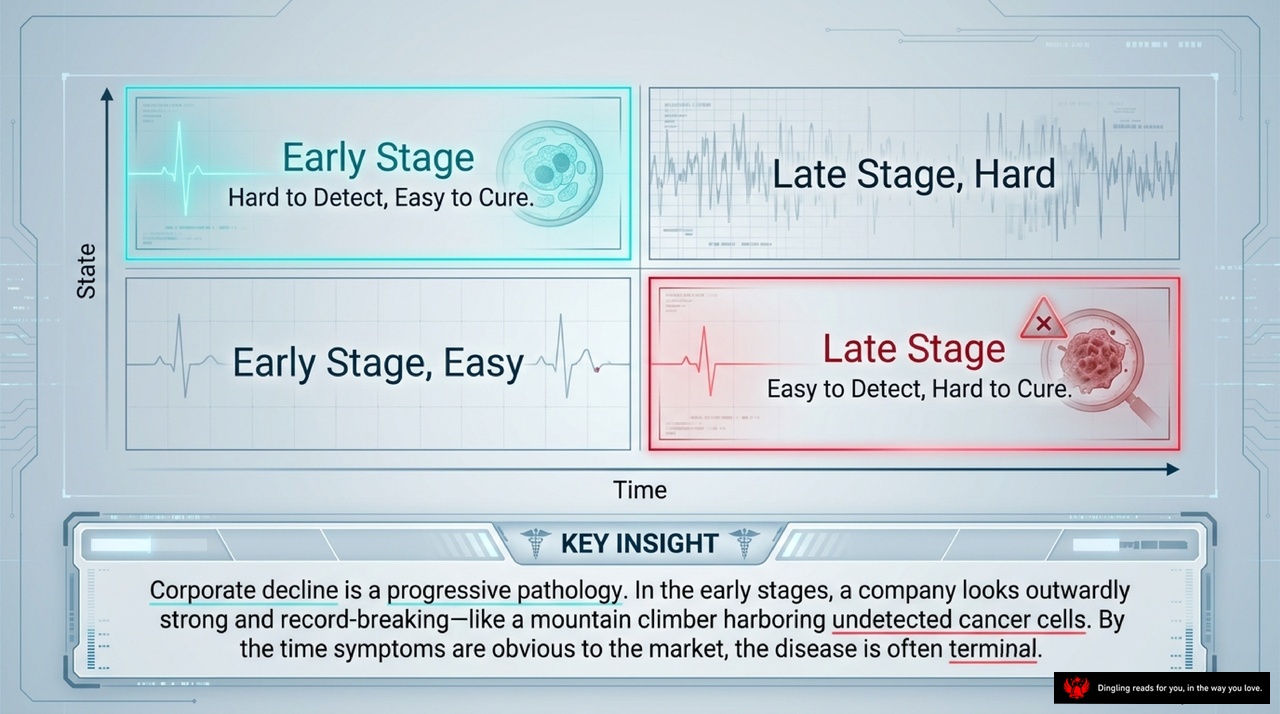
Imagine a company's decline not as a sudden crash, but as a slow, insidious disease—much like cancer hiding in what appears to be a healthy body. In the early stages, the company looks outwardly strong, even record-breaking, just as a climber might harbor undetected cancer cells while scaling a mountain. The symptoms are subtle, often invisible to the market, making them the perfect time for intervention. But by the time the warning signs become obvious to everyone, the disease has often become terminal.
This slide breaks that progression into four distinct states. In the top-left quadrant, we see the "Early Stage, Hard" scenario: difficult to detect but easy to cure. This is the critical window where a company can still pivot back to health if leaders are willing to look past the glossy exterior and address the hidden issues. Conversely, the bottom-left shows an "Early Stage, Easy" state, where problems are spotted early and resolved quickly before they spread.
However, the most dangerous path is the red box in the bottom-right: "Late Stage, Easy to Detect, Hard to Cure." By the time the market finally sees the bleeding, the internal damage is so extensive that recovery is nearly impossible. The EKG lines in the background tell a stark story—initially steady, then erratic, and finally flatlining. This visual perfectly captures the tragedy of corporate decline: waiting too long for the crisis to become visible ensures that the cure is far harder than the disease itself.

Look at this graph. It's not just a line chart; it's a map of corporate death. It shows the five stages a great company travels before it disappears.
It starts at the top with **Stage 1: Hubris Born of Success**. This is where momentum carries a company forward even as its underlying foundation cracks. Leaders start to believe their success is guaranteed, ignoring the risks that are quietly building beneath the surface.
As time passes, the line drops into **Stage 2: Undisciplined Pursuit of More**. The company stops focusing on what makes it great and starts chasing scale, speed, and new markets without a solid plan. They expand into areas where they have no advantage, burning resources on things that don't matter.
Then comes **Stage 3: Denial of Risk and Peril**. This is the most dangerous phase. Warning signs are flashing red inside, but leaders refuse to see them. They blame the market, the competitors, or the economy for their failures, while the internal culture rots from the inside out.
Next is **Stage 4: Grasping for Salvation**. Panic sets in. The company tries everything to fix it overnight: hiring a famous outsider CEO, making massive acquisitions, or launching untested products. These desperate moves often drain the last bit of cash and destroy what little trust was left.
Finally, the line hits the bottom at **Stage 5: Capitulation to Irrelevance or Death**. The company is either bought out for parts, slowly fades into obscurity, or goes bankrupt.
The key takeaway here is simple but powerful: Decline is a choice, not an inevitability. If you can spot the cracks in Stage 1 and fix them, you can turn the line back up. But once you reach Stage 5, there is no going back.

Look at this slide: "Hubris Born of Success." It's a stark reminder that the biggest threat to your company isn't a new competitor, but the arrogance born from past victories.
In Stage 1, success becomes an entitlement rather than a daily grind. Leaders stop asking "why" we succeeded and start assuming it's guaranteed. This mindset shift is dangerous. Look at Circuit City. They had a perfect flywheel, but when they got comfortable, they diverted all their energy into chasing CarMax and Divx, unproven ventures that distracted them from their core retail business. Meanwhile, Best Buy stayed focused, relentlessly iterating on their core experience. The result? Circuit City went bankrupt, while Best Buy dominated the market.
This arrogance often leads to two fatal mistakes: ignoring the primary flywheel that made you successful, and neglecting early warning signs. When you assume your dominance is unassailable, you stop listening to the market. You ignore the shift in customer behavior and the rise of agile competitors. As the book shows, companies that fail in this stage aren't destroyed by bad luck; they are blinded by their own success. They stop learning, stop innovating, and slowly drift away from the very things that made them great. The lesson is clear: humility isn't just a nice trait; it's the only thing standing between your company and the grave.

Let's dive into the mechanics of why companies crash, specifically looking at the "Undisciplined Pursuit of More."
Imagine a company growing its revenue at a breakneck pace, but failing to hire the right talent fast enough to execute that growth. When this happens, the system doesn't just slow down; it breaks. This is what we call a "Mechanical Failure." The gap between ambition and capability creates a vacuum that bureaucracy rushes to fill. Instead of empowering disciplined, self-managing individuals, the company builds layers of red tape and committees to control everything.
Look at Rubbermaid in the 1990s. They set an impossible mandate: launch 1,000 new products in just three years. They chased growth so aggressively that they vastly outpaced their talent and discipline. The result? Massive cost-control failures, compromised product quality, and ultimately, their demise.
This slide highlights a critical warning sign: when bureaucracy replaces discipline, you've lost the engine of your success. You might be selling more, but you're no longer running a lean, efficient organization. You're running a bloated machine that is destined to fail.

Welcome to Stage 3: The Denial of Risk and Peril. This is where the real danger hides, often disguised as stability.
Here is the core distinction between leaders who rise and those who fall. Successful leaders ask "Why?" constantly, maintaining an inquiring mindset. They magnify negative data and treat positive data objectively. Crucially, they look in the mirror and take personal responsibility for failures.
In contrast, failing leaders declare they already know the answer, shifting to a "knowing" mindset that shuts down inquiry. They discount or explain away negative data while amplifying positive results to create a false sense of security. Instead of looking in the mirror, they look out the window, blaming external factors like the economy, competitors, or bad luck.
This creates the Stage 3 Illusion. Internal warning signs flash red—employees are quiet, metrics are slipping—but external indicators still look fine. Failing leaders systematically explain away this danger, convincing themselves and others that everything is under control. It is the perfect storm of arrogance and denial, setting the stage for the next phase of collapse.

Imagine your company as a ship sailing through stormy markets. We've all seen leaders make risky bets that look like small ripples at the surface, but what if that one mistake is actually a hole right below the waterline?
This slide illustrates the "Waterline Principle," a critical concept for spotting catastrophic risks before they sink your entire organization. Above the waterline, you have "safe risks"—things that might cause some damage or minor setbacks, but the ship stays afloat. You can patch them up and move on. But below the waterline? That's where "catastrophic risks" hide. A single hole there, and the entire company goes under.
Let's look at a real-world example: the NASA Challenger disaster. In the 1980s, engineers were worried about O-ring performance in freezing temperatures. They had ambiguous data, but instead of asking, "Can we prove this is safe to launch?" NASA leadership shifted the question to, "Can we prove it is unsafe?" This dangerous reversal meant they were looking for reasons to fly, ignoring the hidden risks below the waterline.
When you face unclear data about a critical decision, don't gamble with a below-the-waterline risk. If the data is ambiguous, the only safe choice is to stop. As the principle states, taking a hidden risk with unclear information directly triggers the fourth stage of corporate decline. Don't let a small crack below the surface become the reason your ship sinks forever.

Look at this slide. We are deep in Stage 4: Grasping for Salvation. This is the moment when a company's decline becomes undeniable, and panic sets in. Instead of fixing the root cause, leaders start frantically searching for a "silver bullet"—a magic solution that will instantly reverse their fortunes.
The graphic contrasts two opposing forces. On the left, you see "The Flywheel." This represents the steady, disciplined path to success. It starts with disciplined thought and action, building gradual momentum that leads to enduring success. It's a slow, organic growth. But on the right, we see "The Doom Loop." This is what happens in Stage 4. Instead of building momentum, companies enter a cycle of disappointment and panic. They try to escape through radical restructuring or hiring a new savior, only to end up in more disappointment, which triggers more panic. It's a destructive spiral.
The symptoms listed at the bottom confirm this chaos. First, they are searching for game-changing acquisitions, hoping to buy their way out of trouble. Second, they are hyping unproven strategies and massive visions to the market, essentially selling smoke and mirrors to shareholders. And third, they are engaging in chronic, repetitive restructuring. This doesn't fix problems; it just drains cash and destroys morale.
Think about the real-world examples we discussed. When HP hired Carly Fiorina, she wasn't fixing the business; she was trying to buy its way back to glory with a massive acquisition of Compaq. Similarly, when Scott Paper brought in Al Dunlap, the goal wasn't long-term health, but a quick cash grab through layoffs and asset sales. These leaders aren't building a future; they are gambling on a miracle. And as the slide shows, that gamble almost always leads to the doom loop, accelerating the company's slide toward oblivion.

Today's slide contrasts two distinct leadership archetypes that define the fate of a company: The Savior and The Architect. On the left, we see The Savior, exemplified by Carly Fiorina at HP. Her style was that of a high-profile, charismatic visionary rockstar. She pursued radical, fast changes and a massive, culture-altering acquisition of Compaq, hoping for a quick turnaround. Unfortunately, this approach accelerated the company's decline, led to value destruction, and ultimately resulted in her dismissal.
On the right stands The Architect, represented by Lou Gerstner at IBM. His approach was methodical, disciplined, and low-profile. Famously, he declared that the last thing IBM needed was a new vision. Instead, he focused purely on fixing the core, improving execution, and getting the right people on the bus. This steady, pragmatic strategy led to a historic turnaround, saving the company from the brink of extinction.
The core lesson here is clear: while the Savior seeks a dramatic rescue, the Architect builds a foundation for survival. In times of crisis, the most effective path isn't a flashy savior, but the steady hand of an architect who restores order and competence.

Look at this stark warning from Professor Bill Lazier: "You don't die from a lack of profit. You die from a lack of cash." This quote perfectly captures the brutal reality of Stage 5: Capitulation to Irrelevance or Death. It's the final moment where the illusion of profitability shatters against the hard truth of liquidity.
In this final stage, a company has exhausted every financial and emotional resource just trying to fight the Doom Loop. The leaders are left with two choices: either sell out the company's legacy for a quick exit, or slowly bleed to death through a series of desperate leadership changes before total bankruptcy. It's a race against time where the fuel runs out before the engine can restart.
We've seen this play out with giants like Zenith and Scott Paper. Even if a brilliant leader like Jerry Pierce at Zenith found a new growth engine in personal computers, the company was too deep in debt and cash-starved to survive. They couldn't afford to keep their bleeding television division. The result? A rapid collapse, mass layoffs, and a complete loss of market relevance. The brand vanishes, and the company becomes a footnote in history.
The lesson here is clear: Profit is an accounting concept; cash is survival. Once you hit this stage, the window for recovery is closed. The only question left is whether you'll exit with dignity or fade into oblivion.

The Synthesis Arc proves a powerful truth: decline is not a one-way street; it is reversible. Look at the timeline on the screen. On the left, we see the red line representing the inevitable trap of decay—companies like Xerox, Nucor, and Nordstrom. But notice the arrow pointing right. That's the path to recovery.
Take Xerox first. In 2000, the company was drowning in $19 billion in debt. Anne Mulcahy, the CEO, made a radical but disciplined choice. She refused to panic. Instead of slashing R&D—the very engine of their future—she protected it fiercely. She cut costs elsewhere but kept the core innovation alive. That decision saved Xerox from bankruptcy and set the stage for its resurgence.
Then look at Nucor and Nordstrom. These companies faced the urge to reinvent themselves entirely, often chasing trends that didn't fit their DNA. Their turnaround came from the opposite direction: they halted those radical reinventions. They stepped back and returned completely to their foundational cultural principles. By focusing on what they did best and executing with discipline, they climbed out of the red zone.
Finally, there's IBM. This is the most dramatic turnaround of all. IBM survived the "Stage 4 Doom Loop"—a phase where companies desperately look for a magic bullet to save them. Instead of chasing quick fixes, IBM's leadership relied on disciplined execution backed by a charismatic vision. They stopped the bleeding, stabilized the culture, and slowly rebuilt the company into a global powerhouse.
The lesson here is clear. Whether you are a tech giant or a retail chain, if you can identify the early warning signs of decline and stop the frantic search for shortcuts, you can reverse the trend. The graph shows that time is on your side, but only if you choose the right path.

Look at this screen. We aren't just looking at three buzzwords; we are looking at a precise medical prescription for a failing company. Think of it as a triage protocol for when the business is bleeding out.
First, we need **Level 5 Leadership**. This means stripping away the ego. You cannot build a recovery plan on arrogance. You need a leadership team rooted in deep personal humility, paired with intense professional will. If the leaders are hiding behind their titles, the recovery won't start.
Second, we must follow the rule: **First Who, then What**. Before you change the strategy or the product, you have to fix the people. Halt all new initiatives until you get the right people on the bus and the wrong people off. You cannot fix a broken engine with a new paint job; you need the right mechanics in the seats.
Finally, we apply **The Hedgehog Concept**. This is where most companies fail because they try to do too much. Stop the undisciplined pursuit of more. Focus exclusively on the intersection of three circles: what you are deeply passionate about, what you can be the best in the world at, and what drives your economic engine. Only when these three overlap do you have a sustainable path to recovery.
This is the blueprint. Humble leaders, the right team, and a singular focus on your unique advantage. That is how you stop the decline and start the comeback.
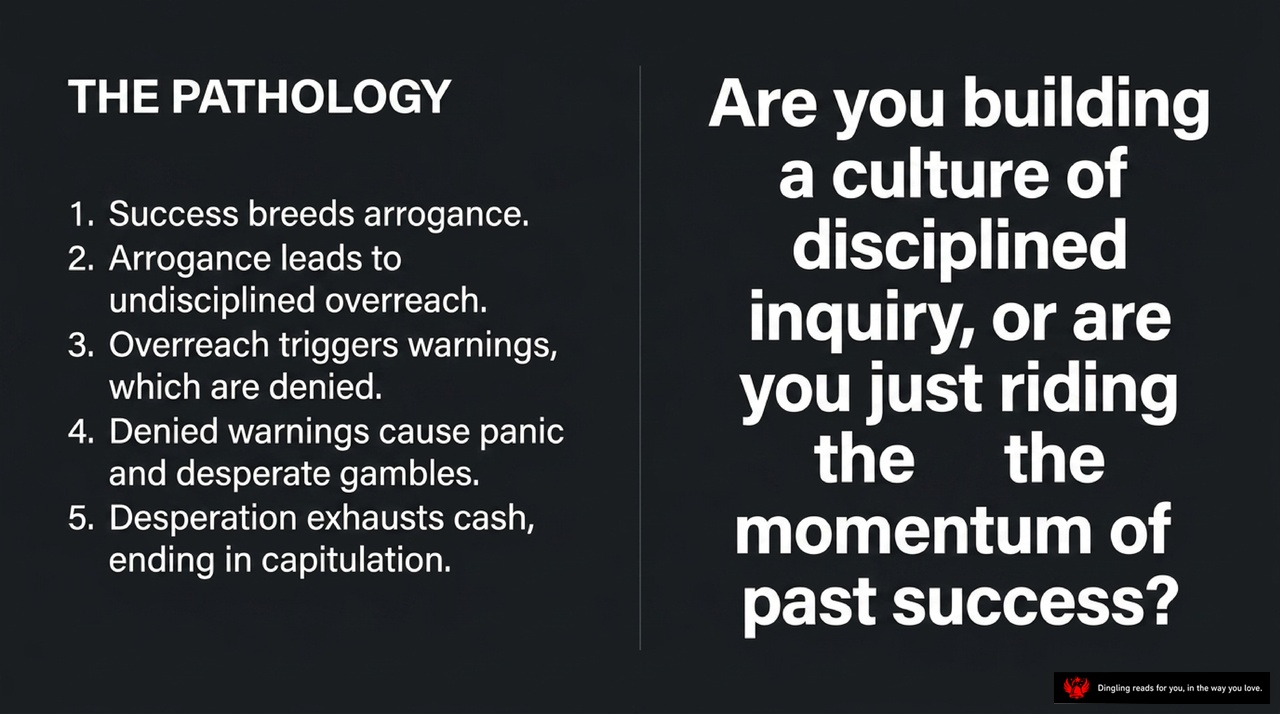
Look at this slide. It asks a critical question: Are you building a culture of disciplined inquiry, or are you just riding the momentum of past success? This is the heart of the pathology we are discussing today.
When success breeds arrogance, companies stop asking "why" we succeed and start assuming they know everything. This arrogance leads to undisciplined overreach. We see this in companies like Motorola, which ignored the shift to digital technology because they were too confident in their analog past. Or Circuit City, which abandoned its core appliance business for unproven ventures like used cars and video delivery.
As you move through this cycle, overreach triggers warnings. But in a culture of arrogance, these warnings are denied. Leaders blame the market, the economy, or competitors instead of looking in the mirror. This denial causes panic, which triggers desperate gambles. Think of the dot-com boom or the subprime mortgage crisis—companies betting everything on a turnaround strategy that had no foundation. Finally, desperation exhausts cash, ending in capitulation. The company is either sold off or forgotten, like the once-great Zenith or A&P.
The danger isn't just in the final collapse; it's in the early stages where the company feels invincible. The only way to break this cycle is to cultivate a culture of disciplined inquiry. You must constantly challenge your own assumptions, ask tough questions about your core business, and remain humble enough to admit when you are wrong. Don't let past success blind you to the present reality. Because if you keep riding that momentum without steering, you will eventually run off the road.