


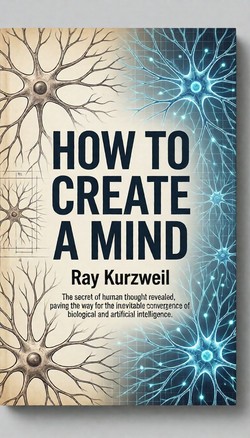
This book brilliantly explains how pattern recognition creates human intelligence.
Your Review
This book brilliantly explains how pattern recognition creates human intelligence.

This book brilliantly connects everyday brain quirks to the future of artificial intelligence.
Kurzweil uses simple thought experiments like reversing lyrics to explain complex brain mechanics without heavy jargon, making the neocortex's hierarchical pattern recognition system feel accessible and clear. By contrasting our struggle with computer efficiency, he shows how everyday quirks unlock deep insights into memory, creativity, and the path to artificial intelligence that mirrors human cognition perfectly.

This book explains how our brain works using simple patterns and thought experiments that anyone can understand.
Kurzweil explains the brain clearly using simple ideas. He connects everyday struggles like reciting the alphabet backwards to deep neuroscience principles about how our neocortex builds patterns hierarchically. This approach makes complex topics like memory storage and feature constancy feel accessible to anyone without a PhD, proving that thought experiments can truly demystify the mind without needing fancy equipment or overwhelming jargon.

I found the explanation of how the brain builds patterns from small details to complex thoughts.

Kurzweil uses the reverse alphabet trick to explain why our brains struggle with backward tasks, contrasting our clumsy human recall with computers' instant accuracy. He argues this gap isn't just a party trick but a window into how our neocortex actually processes information through hierarchical patterns rather than simple storage. By comparing our inability to recite the alphabet backwards to how machines handle it effortlessly, he shows that human intelligence relies on building complex structures from small, stacked patterns. This approach makes deep neuroscience accessible without jargon, letting anyone understand how memory and cognition work by observing everyday quirks like forgetting the middle of a phone number or struggling to reverse song lyrics. The book connects these simple observations to the structure of the neocortex, explaining how layers of pattern recognition create our unique abilities. It transforms abstract concepts about neural networks into something graspable through relatable examples we all experience, proving that the magic of human thought lies in how we stack and link these tiny patterns to form everything from language to love.
Kurzweil explains why I can't reverse the alphabet, making complex brain patterns feel surprisingly easy to understand.

The idea that creativity is just linking disparate pattern libraries changed how I see my own problem solving.
Kurzweil explains complex brain patterns through simple thought experiments like the reverse alphabet, making the science feel accessible and clear without needing a PhD.

Kurzweil explains how small patterns stack to create complex human intelligence.

The book explains how the brain builds knowledge through layers of patterns, using examples like chess and creativity to show how small steps create big skills over time, making complex ideas easy to understand for everyone without needing a science degree.

Interesting theory about the neocortex, but feels a bit too optimistic.

I love how the book uses simple everyday examples to make complex brain science easy to understand.
The detailed breakdown of cortical columns and pattern recognizers really helps visualize how our brains process information efficiently.

The explanation of the neocortex's hierarchical pattern system makes complex brain mechanics feel surprisingly accessible and clear.

The criticism from Penrose about quantum effects in the brain adds a layer of doubt to Kurzweil's classical computing model.

Kurzweil explains how the neocortex uses layered patterns to learn, making AI limitations clear.

Kurzweil uses the reverse alphabet test to show why our brains fail at backward tasks while computers succeed instantly, explaining that human memory relies on forward-hierarchical patterns rather than random data storage, which clarifies why we struggle with sequences we can recite forward but not backward, making the complex neocortex theory feel grounded in simple daily experiences like struggling to recall phone numbers or song lyrics in reverse order without practice, showing how this pattern recognition system underlies everything from expert skills to creativity and even long-term emotional bonds through shared pattern libraries that evolve over time.

Great overview of Kurzweil's vision for merging human and machine intelligence through neural interfaces.