
How to Know a Person: Complete Chapter-by-Chapter Summary

Welcome to our reading session on David Brooks' masterpiece, *How to Know a Person*.
Imagine standing in a room full of people, yet feeling completely invisible. We live in a world where we are technically connected but deeply isolated. This book is a masterclass in the art of seeing others deeply and being deeply seen. It challenges us to move past the surface level of who we think people are, and instead, uncover the unique, complex human beings they truly are.
Brooks argues that the quality of our lives often depends on the small, daily interactions where we choose to treat others with kindness and genuine understanding. He reminds us that the root of all social skill is the ability to understand another person's experience—to truly see them and make them feel seen. In a world filled with judgment and quick labels, this book invites us to become "illuminators," people who look at others with curiosity, respect, and a warm, accepting gaze, helping to bridge the gaps that divide us all.
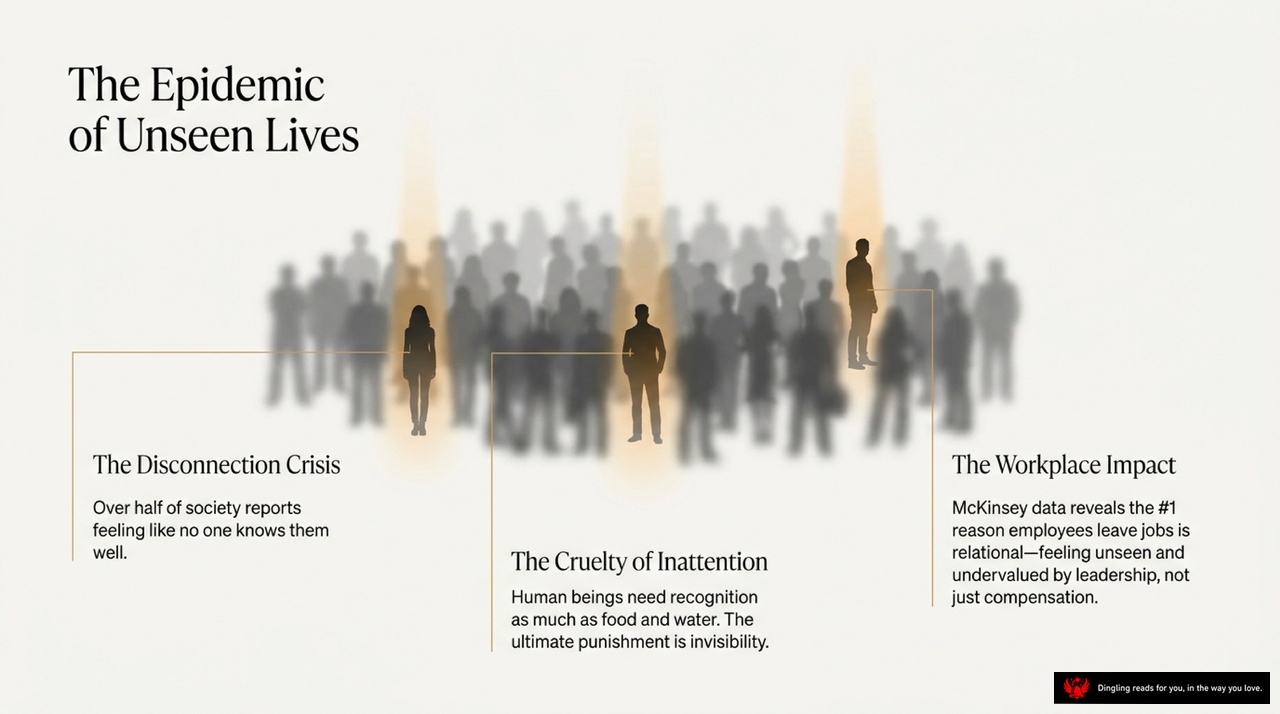
Look at this slide: "The Epidemic of Unseen Lives." It paints a stark picture of our modern reality. In the center, we see a crowd where most people are fading into the background, while only a few stand out under the spotlight. This visual perfectly captures what we're facing today: a crisis of disconnection.
The data on the left confirms it. Over half of society now reports feeling like no one truly knows them. We are living in an age where being invisible has become the ultimate punishment. As the slide notes, the cruelty of inattention is real—human beings need recognition just as desperately as they need food and water.
But why does this matter so much? Look at the impact on the right. McKinsey data reveals that the number one reason employees leave their jobs isn't just about money or compensation. It's relational. People quit because they feel unseen and undervalued by leadership. They crave connection, not just a paycheck.
We are surrounded by people, yet we are profoundly alone. The antidote to this epidemic isn't more noise or more social media posts; it's the simple, radical act of truly seeing one another. It's about moving from being a "diminisher" who judges and labels, to becoming an "illuminator" who listens, understands, and makes others feel valued. When we choose to see each other, we don't just save our relationships; we save our sanity in a fractured world.
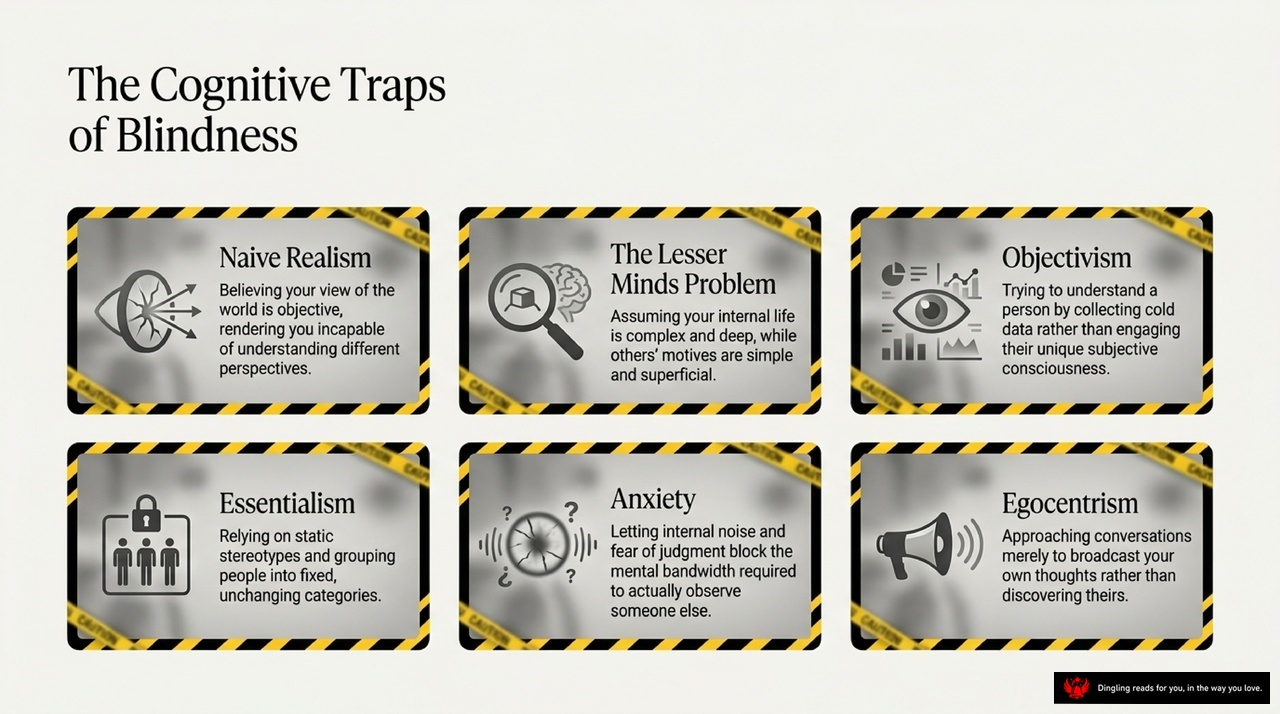
Have you ever felt like everyone is looking right through you? You're sitting in a room, eyes wide open, yet surrounded by a thick, invisible wall. We see each other, but do we actually *see* one another?
Today, we're diving into the art of being a "Lighter"—someone who truly illuminates the lives of others. It starts with a simple but profound shift in perspective: seeing people not as data points or stereotypes, but as complex, unique souls. Think about Jimmy Dorrell, a warm pastor who didn't just shake hands with Lalu Dorsey, a stern teacher; he grabbed her shoulders, looked deep into her eyes, and simply said, "I love you." In that moment, Jimmy didn't just acknowledge her; he saw the softness beneath her armor, and she instantly transformed from a rigid authority into a joyful child. That is the power of genuine connection.
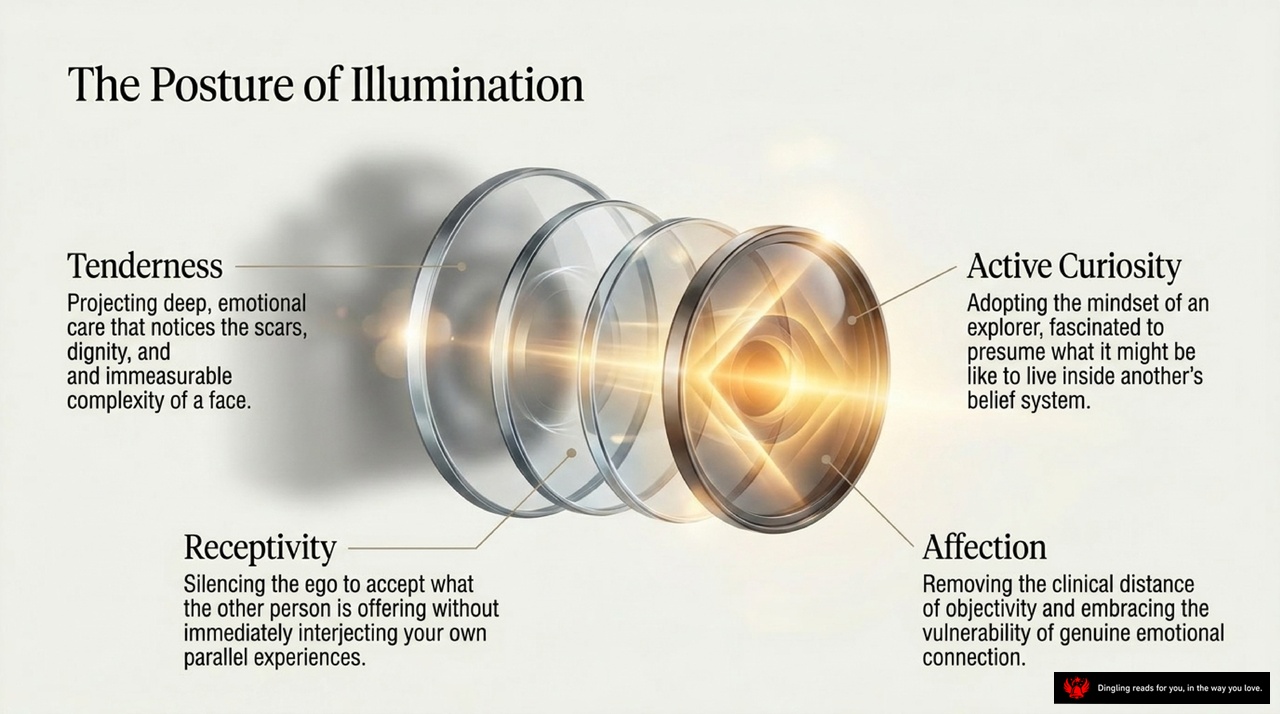
To become this kind of person, we need to cultivate specific traits. First, we need tenderness. It's about noticing the dignity in ordinary faces, like a painter finding the extraordinary in a stranger. Second, we need the courage to be open. This means resisting the urge to fill every silence with our own opinions and instead, listening with a soft, curious gaze. We must ask ourselves, "If I were them, what would I feel?"
But being a Lighter also means seeing the whole person, not just parts of them. It's about accepting that people are a mix of contradictions—flaws and virtues intertwined. And finally, it's about companionship. True companionship isn't about fixing someone or giving advice; it's about stepping into their world, even if it's dark. It's about being present, patient, and willing to sit with someone in their struggle without trying to rush them to a solution. When we offer this kind of undivided attention, we do more than just talk; we help others feel seen, valued, and less alone.
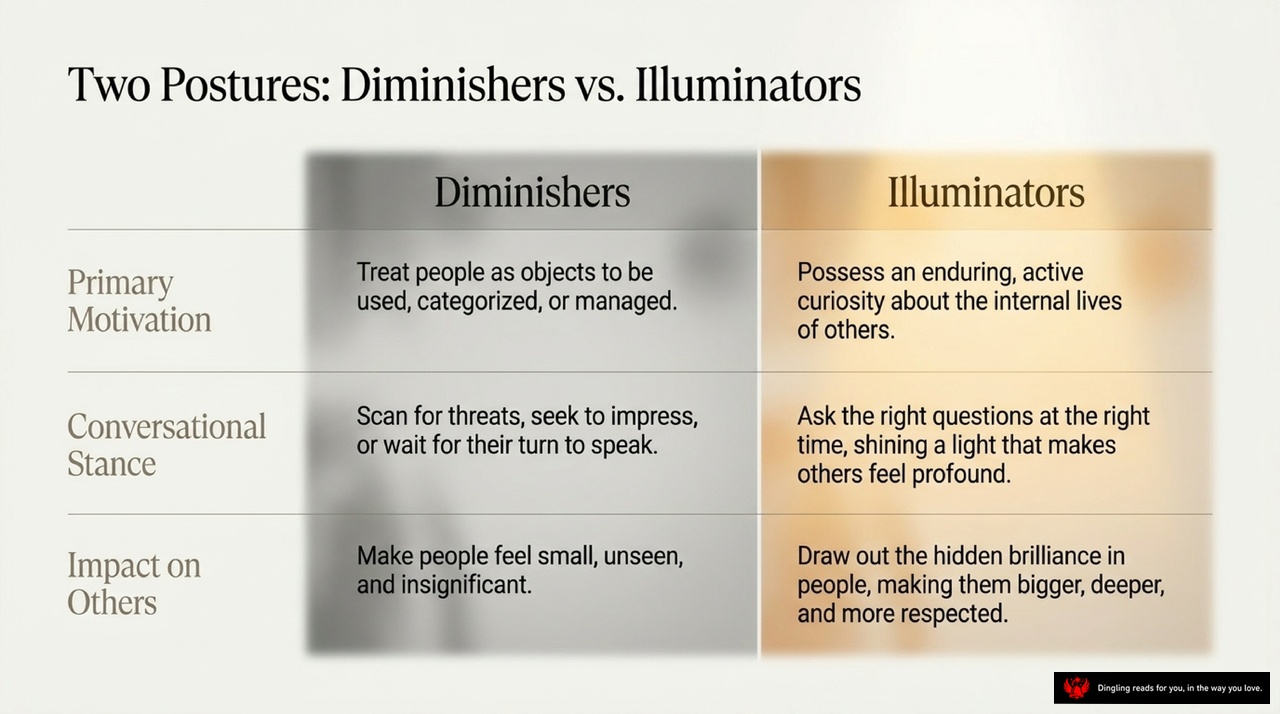
Have you ever walked into a room and felt an invisible wall between you and everyone else? We've all been there. We might be staring right at someone, yet we're completely blind to who they truly are. Today, we're diving into a crucial concept from the book: the two postures that define every human interaction—Diminishers and Illuminators.
Look at the slide. On the left, we have the Diminishers. Their primary motivation is to treat people like objects—things to be used, categorized, or managed. In a conversation, they are constantly scanning for threats or waiting for their turn to speak, often trying to impress rather than connect. The result? They make others feel small, unseen, and insignificant. It's a posture of control that ultimately shrinks the world around them.
Now, look at the right side. This is the stance of the Illuminator. Instead of seeing people as objects, they possess an enduring, active curiosity about the internal lives of others. Their conversational stance is different; they ask the right questions at the right time, shining a light that makes others feel profound. They aren't looking to dominate; they are looking to understand. The impact is transformative: they draw out the hidden brilliance in people, making them feel bigger, deeper, and more respected.
The difference between these two postures isn't just about being nice; it's about seeing the person in front of you as a complex, unique soul rather than a label or a tool. As the book reminds us, the most cruel punishment isn't anger or rejection—it's being ignored. When we choose to be Illuminators, we don't just change the conversation; we change the very reality of the other person's experience. We stop being Diminishers and start becoming the light that helps others see their own worth.

Imagine you're looking at a world through a grainy, black-and-white camera lens. That's the "flawed assumption" most of us hold: we think our brains are just passive recording devices, simply capturing external reality exactly as it is. But the neurological reality is far more fascinating. Our brains aren't cameras; they are high-definition projectors. We receive low-resolution, blurry sensory data, and then our minds instantly fill in the gaps, projecting a vivid, high-definition world based on our past traumas, joys, and experiences.
This means what you see isn't just "out there"—it's a creative act constructed inside you. To truly know another person, you can't just look at what they are doing or saying. You have to ask yourself: How is this person constructing their reality right now? We are all walking around with our own unique lenses, shaped by our unique histories. Understanding this is the first step to seeing the person in front of us clearly, rather than just seeing the version of them that our own biases project onto them.
True empathy isn't a magical, innate talent; it is a trainable social skill built on three distinct layers. First, we need mirroring—the ability to accurately catch someone's emotional state by reading the subtle signals in their face, eyes, and posture, often syncing our own breathing to theirs. Second, we must practice mentalization, which means looking beyond the emotion itself to ask *why* it exists, tracing it back to childhood wounds or unmet needs without getting swept away by it. Finally, and most importantly, we must offer genuine care. This is the difference between a manipulator who can mimic feelings or a child who just feels pain, and someone who truly understands another's unique needs and responds with the right support. Think of it this way: if a friend is panicking, they might not need advice or a drink; they need your quiet presence and a firm hand. If a colleague just pulled off a hard task, empty praise won't cut it; they need you to acknowledge the specific effort they poured into it. Only when we combine mirroring, understanding, and care do we complete the circle of true empathy. This ability starts in infancy, where a baby's cry is answered by a caregiver's face, planting the seed for lifelong security. If that connection is missing, adults often build defensive walls. Some retreat into cold rationality to avoid pain, while others become hyper-vigilant, interpreting every neutral face as a threat. The path to healing these patterns lies not in willpower, but in being seen by others, helping us realize that behind every adult's behavior is a child's struggle waiting to be understood.

Today's slide introduces the "SLANT Activation Cycle," a powerful framework for transforming how we connect with others. At its core is a simple, circular flow of five actions: Sit up, Lean forward, Track, Ask, and Nod.
Let's walk through this cycle together. It starts with **S**, for **Sit up**. This isn't just about posture; it's a psychological signal. When you sit upright, you're telling the speaker, "I am ready to engage." It's the first step in showing you care.
Next is **L**, for **Lean forward**. By physically closing the gap between you and the speaker, you project intense interest. It's a non-verbal way of saying, "What you are saying matters to me."
Then comes **T**, for **Track**. This means using your eyes to follow the speaker's movements. It grants them the moral act of your full attention, making them feel truly seen and valued in the moment.
The fourth step is **A**, for **Ask**. Here, you become a conversational midwife. Instead of dominating the talk, you ask questions that help the speaker birth their own thoughts, guiding them to deeper insights without taking over.
Finally, we have **N**, for **Nod**. This provides continuous, non-verbal micro-affirmations. A simple nod tells the speaker, "I understand," keeping the conversation flowing smoothly and building trust.
When we combine these five elements into a cycle, we stop being passive listeners and become active participants. We create a space where people feel safe to share, understood to be heard, and inspired to connect. That is the essence of the SLANT cycle.

Today's slide breaks down the architecture of a great question into three distinct layers, visualized as concentric rings. Think of this not as a rigid formula, but as a map for how we move from safe small talk to life-altering conversations.
At the outermost ring is Layer 1: The Shallow. This is where we find common ground. Questions like "Where did you grow up?" or "How did you get your name?" serve a vital function: they establish basic safety and shared humanity. It's the necessary foundation that lowers defenses and makes us feel like we belong to the same tribe.
Moving inward, we reach Layer 2: The Mid-Depth. Here, we stop discussing just facts and start evaluating experiences. This is where questions like "What is something you used to believe that you no longer do?" or "What are you exceptional at?" take over. This layer shifts the conversation from the surface of data to the deeper currents of judgment and personal history.
Finally, at the very center lies Layer 3: The Deep. This is the realm of life's crossroads. Questions here force the speaker to step back and view their life from a distance. Asking things like "What crossroad are you at right now?" or "If you were unafraid, what would you do?" invites someone to confront the pivotal moments shaping their existence.
The beauty of this framework is that it guides us away from superficial interactions and toward the kind of deep, meaningful connection that actually changes lives. By intentionally moving through these layers, we transform ordinary chats into opportunities for true understanding.
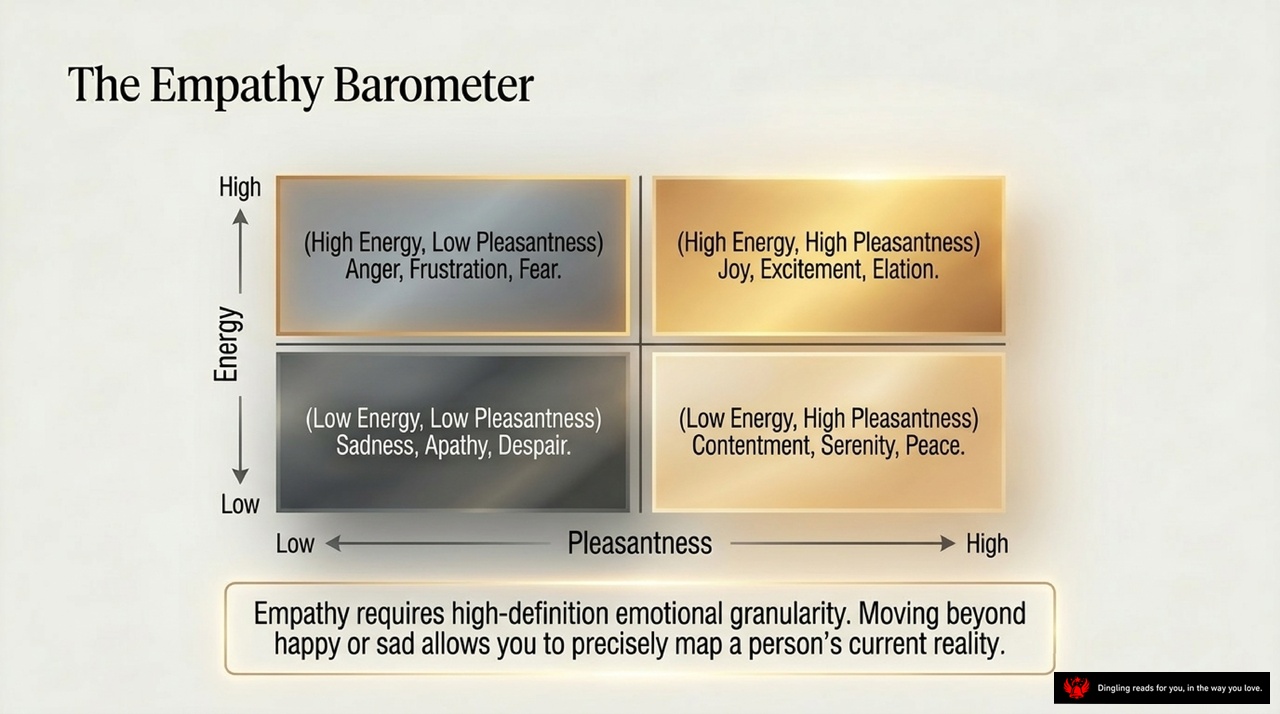
The Empathy Barometer isn't just a chart; it's a map for how we truly connect with one another. As you see here, emotions aren't just "happy" or "sad"—they exist on a spectrum defined by two forces: Energy and Pleasantness. When energy is high but pleasantness is low, we feel anger, frustration, or fear. When both are high, we experience joy, excitement, and elation. Conversely, low energy paired with low pleasantness leads to sadness, apathy, or despair, while low energy with high pleasantness brings us contentment, serenity, and peace.
This framework teaches us that true empathy requires high-definition emotional granularity. Moving beyond simple labels like "good" or "bad" allows us to precisely map a person's current reality. Instead of assuming someone is just "angry," we can recognize the specific mix of high energy and low pleasantness driving that reaction. This shift is crucial because it transforms our interactions from guessing games into meaningful conversations. When we can accurately identify where someone stands on this barometer, we stop reacting to vague emotions and start responding to the real human experience in front of us. It's the difference between saying "calm down" and understanding exactly what kind of storm they are weathering.

Imagine a conversation as an iceberg. What you see above the water is just the literal words—the topic, the debate, or the argument. But the real conversation happens deep below the surface, hidden from view. That's where the true dynamics live: the emotional undercurrents, the unspoken questions about respect, safety, and whether you're being seen as a unique person or just a stereotype.
The key action here is simple but powerful: never drag the argument back to your own comfortable framework. Instead, step into their vantage point. Address the actual conversation beneath the waterline. If you stay stuck in your own perspective, you'll only be talking past each other. True connection requires diving deep, understanding their hidden fears and needs, and meeting them there with genuine empathy. That's how you bridge the gap and turn a clash into a meaningful exchange.
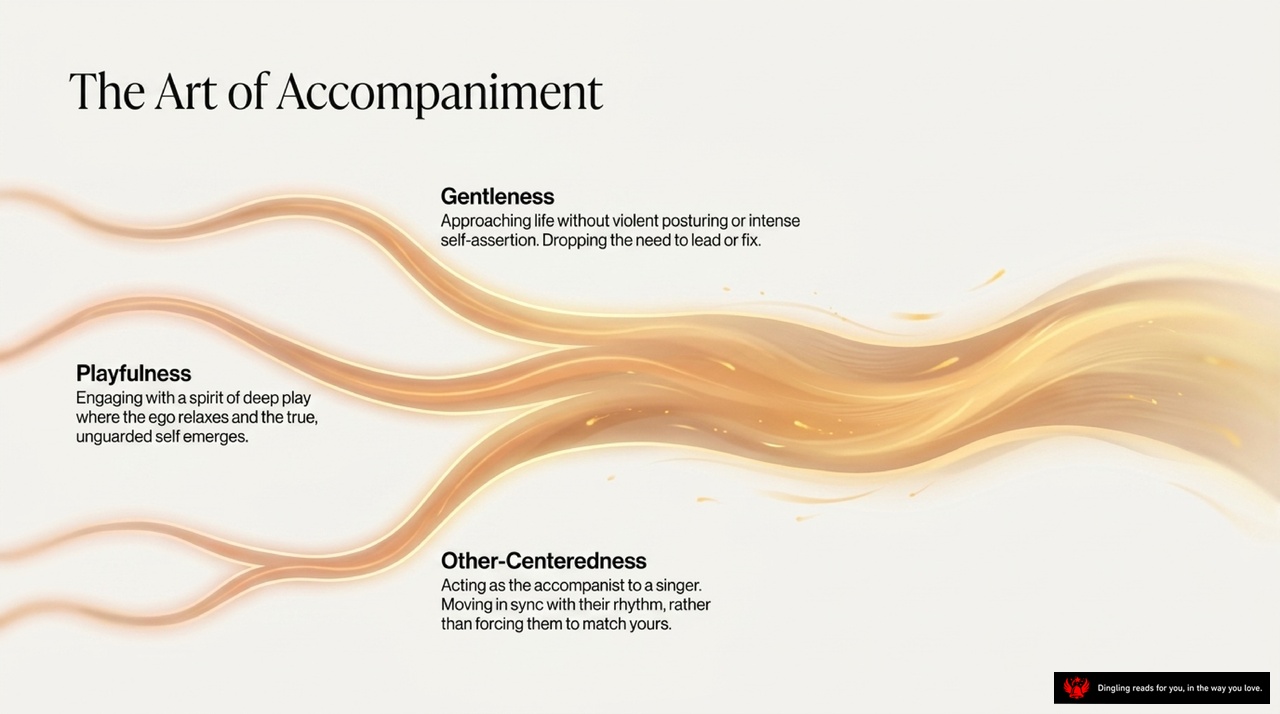
The Art of Accompaniment isn't just about being present; it's about how we move through someone else's world without trying to steer it. Think of yourself not as the lead singer, but as the accompanist to a vocalist. Your job isn't to force the melody to match your own; it's to listen deeply, feel their rhythm, and play in perfect sync with theirs. This starts with gentleness—dropping the need to lead or fix, and approaching life without aggressive posturing. It requires a playful spirit where your ego relaxes, allowing the true, unguarded self to emerge. And above all, it demands other-centeredness. Just like a pianist supporting a singer, you must honor their journey, offering support that feels like a natural extension of their own experience rather than an external instruction. When we truly accompany others, we create a space where they feel seen and safe to be themselves.

Mapping the 5 Tasks of a Human Life isn't just a theoretical chart; it's the actual rhythm of our lives, from the moment we first assert our presence to the final act of making peace with who we've become. Let's walk through this journey together.
It all begins with the **Imperial Task**. In those early years, our primary goal is establishing agency—proving to ourselves and the world that we are capable and can master our environment. It's about building that initial sense of self-worth.
As we grow, we move into the **Interpersonal Task**, where we learn to forge a social identity. We shift from focusing solely on the "I" to embracing the "We," driven by a deep, fundamental need to belong and be accepted by others.
Next comes the **Career Consolidation Task**. Here, we build our vessel. It often requires a strategic sacrifice of emotional openness in favor of intense focus, allowing us to achieve mastery and secure our professional status.
Then, life calls for the **Generative Task**. This is where we shift from acquiring to giving. We start to mentor, serve, and leave a legacy, realizing that our growth is deeply tied to how we lift others up.
Finally, we arrive at the **Integrity vs. Despair Task**. This is the ultimate challenge of looking back on a life lived. It's about finding peace and constructing a coherent, meaningful narrative that makes sense of our entire journey.
These five tasks aren't separate boxes; they are a continuous flow, guiding us from proving our worth to leaving a lasting, compassionate mark on the world.

So, let's talk about how we edit the stories of our lives. Imagine your life as a narrative that needs a good edit. On the left, you have what we call "Rumination Spirals"—that tangled mess of self-blame and looping thoughts that happens when trauma shatters our understanding of cause and effect. We get stuck in this broken narrative, trapped in victimhood because we're using "idiot compassion" to hide our pain instead of facing it.
But look at the arrow pointing right. That's the transformation. By acting as a "story editor"—which is what we call the Illuminator—we challenge those destructive loops. We help people reinterpret their past, turning the stones of a ruined life into the foundation of a new one. This leads us to "Coherent Redemption." It's about the Redemption Arc: finding agency and seeing how your struggles actually build the character you need for the future. The goal isn't to erase the past, but to weave it into a coherent, meaningful story where you are the hero, not just the victim. That's how we move from confusion to clarity.

Wisdom is a Social Skill. For too long, we've been sold a myth: that wisdom belongs to a solitary sage, some lone figure handing down maxims from a mountaintop while the rest of us watch from below. But the reality is far more relational. True wisdom isn't about having all the answers; it's about the ability to hold space for contradiction, to absorb another person's reality without judgment, and to co-create meaning with them.
Look at that network of light on the right. That represents what I call the "Community of Truth." True wisdom only emerges when individuals gather with honesty and respect, allowing a collective intelligence to transcend any single voice. It's about realizing that our individual perspectives are limited, but when we connect, we can see a much wider, deeper picture of the world.
This shift is everything. In a world that often rewards being right over being kind, wisdom invites us to be curious instead of defensive. It means understanding that the most profound insights rarely come from a lecture, but from a conversation where everyone feels safe enough to be vulnerable. So, let's stop looking for a guru on a mountain and start building the community right here, right now, where we can all learn from each other.
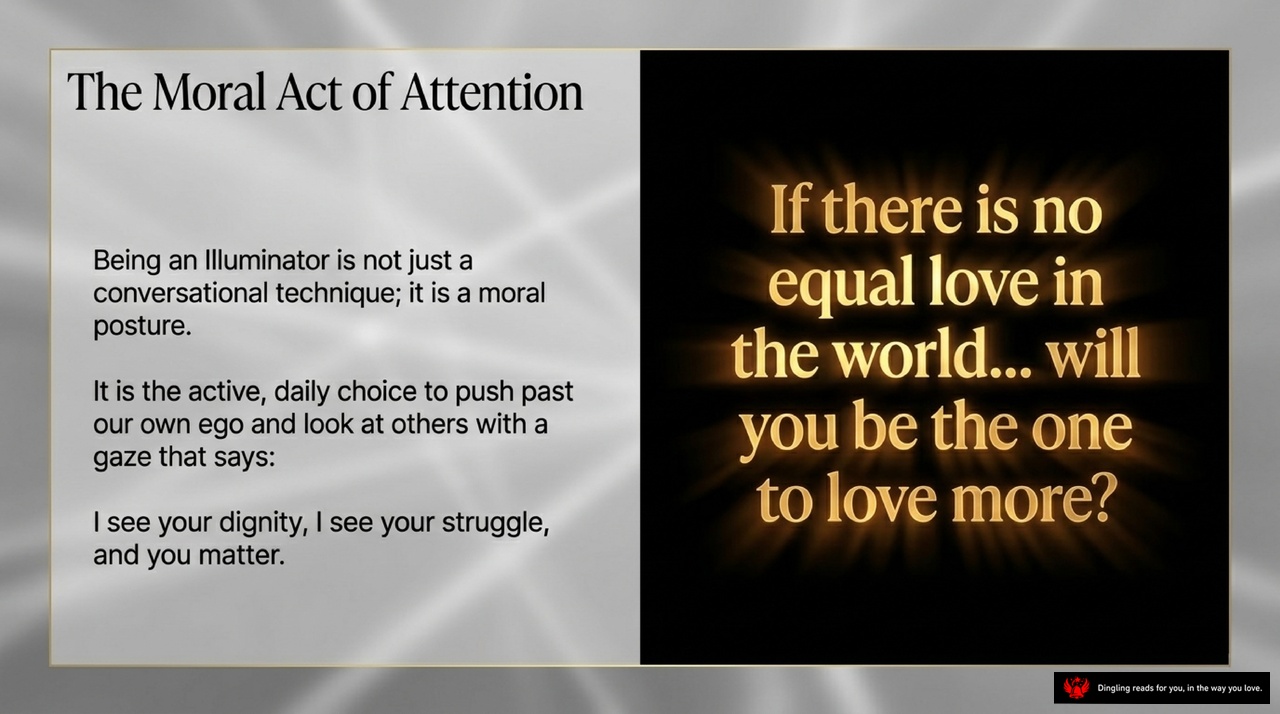
Being an Illuminator is far more than just a clever conversation tactic; it is a profound moral stance. It is the active, daily choice to push past our own ego and look at others with a gaze that says: "I see your dignity, I see your struggle, and you matter."
Imagine a world where love isn't automatically equal. If there is no equal love in the world... will you be the one to love more? That is the core challenge.
Too often, we fall into the trap of being "diminishers." We treat people like objects, using stereotypes to quickly categorize them. We see their job title, their race, or their age, and we stop there. We miss the complex, unique human sitting right in front of us. But an Illuminator does something different. An Illuminator approaches others with genuine curiosity. They don't just listen to what is said; they listen for the hidden pain, the unspoken hope, and the authentic self behind the mask.
Think about the difference in how we interact. When we are dismissive, we build walls. But when we choose to truly see someone—to acknowledge their dignity even when they are struggling—we build bridges. This isn't about being perfect or having all the answers. It's about the simple, radical act of saying, "You are here, and you count."
In a world that often feels cold and transactional, this moral act of attention is our most powerful tool for connection. It transforms a stranger into a person, and a person into a friend. So, the question remains: today, will you choose to be the one who sees? Will you choose to love more?